Dzhokhar Tsarnaev: The Big Issue Is Not Miranda, It’s Presentment

Particularly given Lindsey Graham’s persistent tweeting yesterday that “the last thing we may want to do is read Boston suspect Miranda Rights,” there was a lot of discussion in the moments after Boston Marathon bombing suspect Dzhokhar Tsarnaev was captured last night about whether he would be read his rights.

At first, there were reports he would be. But then DOJ announced he would not be read Miranda immediately; they would invoke the public safety exception to question him.

“The suspect is en route to the hospital for immediate treatment,” the official tells TPM’s Sahil Kapur. “But we plan to invoke the public safety exception to Miranda in order to question the suspect extensively about other potential explosive devices or accomplices and to gain critical intelligence.”

As of about 40 minutes ago, he had still not been read his rights.

Now, thus far, I’m actually not that worked up about Miranda rights (though I may get there soon). As Orin Kerr explains, the public safety exception is a legally recognized law, and Miranda itself only limits what can be admitted as testimony against Dzhokhar in his trial (I’m betting he’ll plead guilty in any case). The government appears to have so much evidence against him in any case, any confession he makes will likely not be necessary to convict him.

Mind you, as Charlie Savage reported two years ago, the government has been institutionalizing longer delays before they give Miranda warnings, most notably with people they (or foreign proxies) interrogate overseas first, followed by a clean team Mirandized interrogation. And as the reference to “gain[ing] critical intelligence” above suggests, the Obama Administration is stretching the intent of pre-Miranda interrogations to include more substantive interrogation (update: Emily Bazelon also made this point).

But here in the US, the delays on Miranda warnings aren’t that long. The best–quite similar–example is the 2009 UndieBomber, who was interviewed for about 50 minutes under a public safety exception when he was captured. That entire interrogation was deemed admissible and in fact formed a significant part of the opening arguments in his trial (which didn’t get much further than opening arguments before he plead guilty). So the UndieBomber’s case is one reason the Administration is confident they could question Dzhokhar without Mirandizing him at first (though the length of time has gotten far longer than used with the UndieBomber).

There’s a precedent from the UndieBomber I find more troubling though. The judge in that case also allowed the use of UndieBomber’s statements from the hospital after he had been given a fair amount of sedation. While there was a dispute about how much he got and what kind of effect that might have had, conversations he had with a nurse were also used in the opening arguments of the trial. The two issues together — a suspect interviewed without a lawyer after he’s been given serious drugs, both of which will be apply to Dzhokhar, as well — is troubling on legal, humanitarian, and practical grounds. The High-Value Interrogation Group had already been brought in last night, which suggests he may well be asked questions while in precarious medical state.

But the big issue, in my opinion, is presentment, whether he is brought before a judge within 48 hours. In addition to stretching Miranda, the government has also been holding and interrogating suspects for periods — up to two weeks for American citizens and far longer for non-citizens — before they see a judge. Not only does this postpone the time when they will be given a lawyer whether they ask or not (because judges are going to assign one), but it gives the government an uninterrupted period of time to use soft coercion to get testimony and other kinds of cooperation.

In my opinion, two of the most troubling cases like this, both involving naturalized citizens accused of terrorism, are Faisal Shahzad and Manssor Arbabsiar.

Continue reading


Anwar al-Awlaki Is the New Aluminum Tube

Mark Mazzetti, Charlie Savage, and Scott Shane team up to provide the government’s best case — and at times, an irresponsibly credulous one — for the killing of Anwar al-Awlaki and the collateral deaths of Samir Khan and Abdulrahman al-Awlaki.

Yet even in a 3,600 word story, they don’t present any evidence against the senior Awlaki that was fresher than a year old — the October 2010 toner cartridge plot — at the time the Yemeni-American was killed. (I’m not saying the government didn’t have more recent intelligence; it just doesn’t appear in this very Administration-friendly case.) Not surprisingly, then, the story completely ignores questions about the definition of “imminent threat” used in the OLC memo and whether Awlaki was an “imminent” threat when he was killed.

The “linked in various ways” standard for killing Americans

Moreover, the case they do present has various weaknesses.

The story provides a fair amount of space to Awlaki’s celebration of the Nidal Hasan attack (though it does make it clear Awlaki did not respond enthusiastically to Hasan’s queries before the attack).

Investigators quickly discovered that the major had exchanged e-mails with Mr. Awlaki, though the cleric’s replies had been cautious and noncommittal. But four days after the shootings, the cleric removed any doubt about where he stood.

“Nidal Hassan is a hero,” he wrote on his widely read blog. “He is a man of conscience who could not bear living the contradiction of being a Muslim and serving in an army that is fighting against his own people.”

It uses far vaguer language to describe Awlaki’s role in the Faisal Shahzad and toner cartridge plots.

Meanwhile, attacks linked in various ways to Mr. Awlaki continued to mount, including the attempted car bombing of Times Square in May 2010 by Faisal Shahzad, a naturalized American citizen who had reached out to the preacher on the Internet, and the attempted bombing by Al Qaeda in the Arabian Peninsula of cargo planes bound for the United States that October.

“Linked in various ways” seems to be the new standard for killing an American. That, in spite of the fact that Shahzad’s tie to Awlaki seems to be the same Hasan had: an inspiration, but not any involvement in the plot. And while Awlaki is reported to have had some role in the toner cartridge plot, reports from Saudi infiltrator Jabir al-Fayfi apparently fingered others in AQAP as the chief plotters.

I guess that would be too much nuance to include in a 3,600 word article.

NYT doesn’t care about problems with the Abu Tarak explanation

Which leaves the UndieBomb attack as the sole attack in which the NYT presents evidence about Awlaki’s direct role. But there’s a problem with their claims there, too.

The would-be underwear bomber told F.B.I. agents that after he went to Yemen and tracked down Mr. Awlaki, his online hero, the cleric had discussed “martyrdom and jihad” with him, approved him for a suicide mission, helped him prepare a martyrdom video and directed him to detonate his bomb over United States territory, according to court documents.

In his initial 50-minute interrogation on Dec. 25, 2009, before he stopped speaking for a month, Mr. Abdulmutallab said he had been sent by a terrorist named Abu Tarek, although intelligence agencies quickly found indications that Mr. Awlaki was probably involved. When Mr. Abdulmutallab resumed cooperating with interrogators in late January, an official said, he admitted that “Abu Tarek” was Mr. Awlaki. With the Nigerian’s statements, American officials had witness confirmation that Mr. Awlaki was clearly a direct plotter, no longer just a dangerous propagandist.

I don’t doubt that Awlaki was directly involved in this attack in some way. And I got the same explanation about Abu Tarak from “an official” back when I first noted the discrepancy between DOJ’s public claims (thanks for not crediting me on that one, NYT boys). But either Abdulmutallab said something beyond “Abu Tarak was Awlaki,” or the entire explanation is not credible.

That’s because Abdulmutallab’s initial interrogation — according to the version presented by Jonathan Tukel in the opening arguments of Abdulmutallab’s trial — said Abu Tarak did the following:

  1. Spoke daily with Abdulmutallab about jihad and martyrdom
  2. Suggested to Abdulmutallab that he become involved in a plane attack against the United States aircraft
  3. Gave him training in detonating the bomb
  4. Told him to make sure he attacked a U.S. aircraft and make sure the attack takes place over the United States

Yet according to the version of Abdulmutallab’s interrogation presented in his sentencing memo, here’s who did those things:

  1. Awlaki and Abdulmutallab discussed martyrdom and jihad
  2. Defendant and Ibrahim Al Asiri discussed defendant’s desire to commit an act of jihad; Asiri discussed a plan for a martyrdom mission with Awlaki, who gave it final approval
  3. Asiri trained defendant in the use of the bomb
  4. Awlaki instructed defendant that the only requirements were that the attack be on a U.S. airliner, and that the attack take place over U.S. soil

Continue reading


Food Trucks: The Next Terrorist Threat

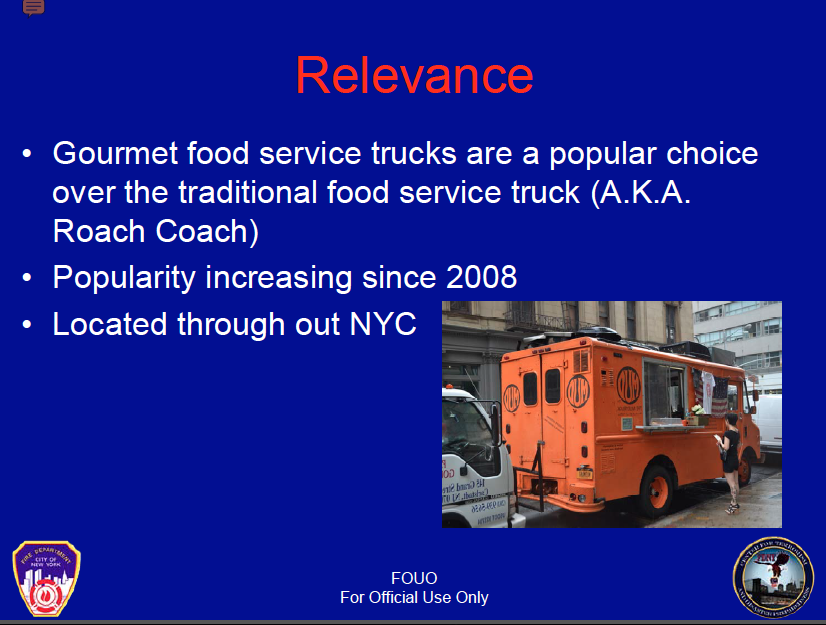
In a fit of fearmongering reminiscent of the Mobile Bioweapons Labs used to get us into the Iraq War, FDNY did a report last month warning about the use of food trucks by terrorists. (Via Government Security News, h/t G.W.Schulz) The chief worry seems to be that food trucks carry 20 pound propane cylinders, get close to important landmarks, and would serve as an easy surveillance platform.

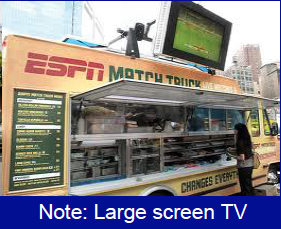
But some of the other things the report warns about are the fact that “roach coaches” are increasingly being replaced by gourmet carts and ESPN’s food cart has a large screen TV.

Apparently, in addition to Ford being a suspected terrorist, ESPN is now a suspected front for a terrorist surveillance operation, complete with large screen TV showing sports?

The thing is, in addition to threatening burgeoning small business growth, this fearmongering presents another problem: the last two real terrorist plots in NYC.

As Schulz pointed out, the guy who thwarted Faisal Shahzad’s attempt to blow up Times Square was street vendor Duane Jackson, not the NYPD, which was instead busy profiling Muslim-owned businesses rather than the 7-11 that might have led to Shahzad’s hawala. And while Jackson’s handbag cart probably doesn’t have propane tanks, if we start treating street vendors generally as subjects of suspicion, we’re less likely to see the cooperation that Jackson gave.

Food trucks may make great surveillance platforms, but that’s true of citizen observers like Jackson as much as terrorists.

Continue reading


NYPD’s Search for Cafes in Which Terrorists Would Be Comfortable

It’s bad enough that the NYPD continues its Muslim spying program in spite of their Intelligence Division Chief’s admission that they have not derived a single lead from it. But look more closely at the astoundingly stupid rationalizations that Thomas Galati gave in his deposition for the program.

Galati imagines that if NYPD were ever faced with an imminent terrorist threat, the demographic mapping they had already done would allow them to figure out right away where the terrorist might go.

When we are faced with a threat or we have information about a threat that is present and we need to go out and we need to try and mitigate that threat, we have to be able to, at our fingertips, find what is the most likely location that that terrorist is going to go to and hide out amongst other people from the same country.

Let’s consider how this worked in practice the single time it might have applied.

When the FBI alerted the NYPD that Najibullah Zazi was heading back to NYC with the intent to blow up some subways, the NYPD knew exactly who to go to. They called Zazi’s Imam, Ahmad Wais Afzali, who not only knew him but had taught him and some of his accomplices. So that part worked.

What didn’t work is that Afzali promptly tipped off Zazi and his father, making it more difficult to develop a case against Zazi’s accomplices.

Media reports quoting anonymous FBI officials have suggested the NYPD botched the case when it showed a picture of Najibullah Zazi, the Denver shuttle-bus driver at the heart of the investigation, to Ahmed Afzali, a Queens Imam and sometime police informant. Afzali, the reports say, first called Zazi’s father Mohammed, then Najibullah himself, alerting them to the probe. The FBI, which had been monitoring the calls, was then forced to move immediately to arrest the Zazis — much sooner than it had planned.

[snip]

When Zazi traveled to New York ahead of the anniversary of 9/11, the FBI as a precaution alerted the NYPD. That’s when officers from the NYPD’s intelligence unit consulted Afzali. “It looks like they did this on their own initiative — they really trusted this Imam,” says the law-enforcement official. “But if they’d consulted with the bureau first, they’d have been told not to talk to anybody.”

So far Galati’s logic works if you want to make sure terrorists are tipped off by their close associates.

But it gets worse.

Central to the Galati’s explanation for the NYPD’s retention of the content of conversations about events–such as a Quran-burning, in the passage below (or, presumably, opposition to a drone strike)–is that it provides insight into whether a terrorist would be “comfortable in” a particularly environment.

Q I think you’ve told me that the fact that at this particular location where there are Pakistanis speaking Urdu, the Zone Assessment Unit heard two men complaining about the [redacted-Quran burning] That fact alone, their complaint expressed to each other doesn’t make it more likely that this is a place where a terrorist would go?

A It doesn’t make it more likely or less likely. It’s a tool for us to look for that person that we’re looking for that has that same characteristic that’s going to hide or recruit within a place that he or she is comfortable in.

Continue reading


NYPD’s Counterterrorism Strengths: Bigfooting, Entrapping, and Overselling

Justin Elliott takes the debunking I did here one step further: a claim by claim debunking of the NYPD’s claims to have thwarted 14 attacks against the city. He helpfully groups his debunkery into three groups:

Real attacks the NYPD had no role in or even undermined but for which they claim credit.

  • Faisal Shahzad
  • Najibullah Zazi
  • Liquids Plot

Those marginally credible plots involving government informants.

  • Newburgh Four
  • Herald Square
  • JFK Airport

Those plots deemed not credible by (usually anonymous) experts or never developed.

  • Jose Pimental
  • Ahmed Ferhani and Mohamed Mamdouh
  • Iyman Faris
  • PATH Train
  • Subway Cyanide
  • NYSE/Citi
  • Uzair Paracha
  • Bryant Neal Vinas/LIRR

That’s it. The “threats” the NYPD is using to justify profiling the city’s (and suburbs’) Muslims were either missed by the NYPD, created in large by them, or never really developed.

I’d add just two things. First, as I have noted, for two of three actual attacks here, the NYPD actually got close but missed (or even hindered) the developing plots. These near misses suggest the NYPD may well have picked a few worthwhile investigation targets, but its actions are failing to reveal any real, rather than manufactured, threat.

There’s one more thing Elliot’s piece made me realize. Several of these–including Uzair Paracha, Iyman Faris, and the NYSE/Citi plot–can be traced back to KSM. As Elliott notes–and I’ve noted before–some of his evidence against Paracha, at least, was collected during his worst period of torture. Not only does that suggest I should add “exploiting torture-induced testimony” to my title.

But it makes me wonder whether one of the problems with trying KSM in NY, for Ray Kelly, was the possibility that KSM would expose the fraud at the heart of Kelly’s counterterrorism scam.


The Baitullah Mehsud Propaganda

I have twice before noted some curious details about Joby Warrick’s telling of the events leading up to Baitullah Mehsud’s death. I noted that it is another example–like the Iraq War–of an attack justified by nukes in which the nukes were ultimately never found. And I noted there are some significant differences between the NYT’s version of the story and Joby Warrick’s. Daniel Klaidman apparently tells his own version in his book, which I hope to read next week.

Mind you, I’m not saying that any of these journalists is telling the complete story or even that any one journalist presents a story that is entirely true, I’m just noting that different Administration sources are feeding different stories.

Last week Ben Wittes transcribed the complete passage from Klaidman’s book that describes how Rahm Emanuel decided to publicize Baitullah’s killing for political benefit.

When they finally took Mehsud out in August 2009, [White House Chief of Staff Rahm] Emanuel celebrated. He had a hawkish side to him, having volunteered with the Israeli Defense Forces as a civilian during the 1991 Gulf War. But above all, Emanuel recognized that the muscular attacks could have a huge political upside for Obama, insulating him against charges that he was weak on terror. “Rahm was transactional about these operational issues,” recalled a senior Pentagon official. “He always wanted to know ‘how’s this going to help my guy,’ the president.”

Though the program was covert, Emanuel pushed the CIA to publicize its covert successes.  When Mehsud was killed, agency public affairs officers anonymously trumpeted their triumph, leaking colorful tidbits to trusted reporters on the intelligence beat. Newspapers described the hit in cinematic detail, including the fact that Mehsud was blown up on the roof of his father-in-law’s compound while his wife was massaging his legs. [italics Wittes', bold mine]

Here’s how Warrick describes the killing in his book.

It was now 1:00 A.M. in the Paksitani village. Baitullah Mehsud, leader of the Pakistani Taliban and chief protector of the Jordanian physician Humam al-Balawi, now lay on his back, resting as the IV machine dripped fluid into his veins. At his feet, a pair of young hands, belonging not to a doctor, as the CIA supposed, but to his new wife, were massaging his swollen legs. Barely aware of the buzzing distance drone, oblivious of the faint hissing of the missile as it cleaved the night air, he took a deep breath and looked up at the stars.

The rocket struck Mehsud where he lay, penetrating just below the chest and cutting him in two. A small charge of high explosives detonated, hurling his wife backward and gouging a small crater in the bricks and plaster at the spot where she had knelt. The small blast reverberated against the nearby hills, and then silence.

Overhead, the drones continued to hover for several minutes, camera still whirring. A report was hastily prepared and relayed to Panetta at the White House.

Two confirmed dead, no other deaths or serious injuries. Building still stands. [italics original, bold mine]

That is, while Klaidman is too polite to say it, this account is the one that derives from Rahm’s decision to publicize Mehsud’s killing. (Warrick sources these details to “three U.S. intelligence officials involved in the planning or oversight of the operation.”)

Now, the NYT reveals that some sources say there were other civilian casualties.

Mr. Obama, through Mr. Brennan, told the C.I.A. to take the shot, and Mr. Mehsud was killed, along with his wife and, by some reports, other family members as well, said a senior intelligence official.

This doesn’t mean Warrick’s version of the drones originally reporting there were no other casualties is incorrect on that front–after all, drones don’t provide perfect intelligence, contrary to what their boosters say, and it’s possible that reports of other casualties came later from HUMINT. But if there were other casualties, it probably means many of these cinematic details about the pinpoint nature of the strike–Meshud being cut in two and his wife being blown back but the strike leaving only a small crater–are not entirely true.

Again, I’m not saying any of these journalists are fully capturing the truth; what they’re telling is what Administration sources have told them, and I doubt NYT and Klaidman’s sources have any less of an agenda than Warrick’s did. And note all the details about Mehsud’s death distract from the way we tried to get to him by first killing one of his clan-members, then targeting that man’s funeral, which Warrick does include; Warrick was reporting on our funeral targeting tactic before TBIJ did, to great controversy.

But I am noting that this cinematic picture of very controlled killing (even the killing of a young woman who was probably pushed into this marriage as a teenager) comes from a decision from Rahm to push such picture for political advantage.

One more thing. The killing of Mehsud’s commander and then Mehsud and his young wife and maybe her family, reportedly justified by intelligence on nukes that never materialized? Mehsud claimed direct credit for Faisal Shahzad’s attempted attack on Times Square, and al-Balawi killed 7 CIA officers at Khost in direct revenge for the killing of Mehsud. These are some of the most serious attacks on us or attempts in recent years, both stemming from this attack on someone whose aspirations to attack us may never have been real beforehand.


NYPD’s Fearmongers Are Arguing It’s More Useful to Spy on 2nd Graders than Disrupt Real Plots

Chuck Schumer, the NYDN, and the NYPost keep up their attacks on the AP’s exposure of the NYPD’s spying program. Increasingly, NYPD’s fearmongers are getting cornered on the question of efficacy.

Schumer, rarely a courageous man, made full use of the passive when he tried to claim everyone knew the spying program makes NY safer.

There is nothing wrong with the NYPD collecting and assessing publicly available information from New York, New Jersey, the other 48 states or around the world in the effort to prevent another terror attack like 9/11. In fact, it is widely understood that the NYPD’s actions have kept us safer. Looking at public information and following leads is perfectly acceptable as long as any one group, in its entirety, is not targeted based only on its religious or ethnic affiliation. [my emphasis]

Nevermind that the NYPD uses techniques–like informants and permanent cameras–that aren’t exactly available to the public. Nevermind that Schumer’s backing himself into a corner with his new caveat that profiling is okay so long as not the entire ethnic group is profiled (though arguably, they are).

Schumer proves unable to say, in the affirmative, that he knows this makes NY safer. And he ought to consider that question seriously.

More offensive is the NYPost’s insinuation that the AP is just in this for a Pulitzer.

Columbia is also where they keep the Pulitzers in the off-season; American journalism’s most treasured self-affirmation program is more or less run from the university’s J-school. Since the awards are soon to be presented, and since the AP’s lust for one is almost comically transparent, its show-the-flag campus visit is wholly unsurprising.

[snip]

Strip away the emotive rhetoric and what’s left is a series of stories over several weeks that show pretty clearly that the NYPD works very hard to keep the city safe — operating an aggressive and imaginative program, but staying well within both the law and the bounds of post-9/11 propriety from beginning to end.

Perspective matters.

At least twice in the decade before the NYPD program began, Islamist sleeper agents attacked New York City. The first time, six people died; the second, thousands.

Since then, the department has disrupted a number of Islamist-initiated plots; there is no way of telling how many more were never undertaken because the city is so aggressively anti-terrorist. And there have been no terror-related fatalities since 9/11.

That could change tomorrow — presumably the AP’s Pulitzer prospects would tail off sharply if it did — but that would prove only that there are no guarantees in counterterrorism.

Here, the NYPost is just flat out wrong–or should be.

If there were a terrorist attack tomorrow, the inevitable commission would finally give the NYPD spying program the scrutiny it needs, scrutiny which the AP has tried to offer. And that commission will discover that the NYPD has spent its time spying on girls’ and grade schools, hunting out Muslims at Jewish businesses, scamming whitewater rafting trips off of taxpayers.

Sure, such efforts have led to hyped busts of folks it took 31 months for the NYPD to coach how to drill holes into a pipe. Such busts only discredit Mayor Bloomberg, Ray Kelly, and ultimately everyone defending this program.

What those efforts didn’t find were the real terrorist attacks. They didn’t find Najibullah Zazi and they didn’t find Faisal Shahzad–even though both were right under their nose. Continue reading


After Ray Kelly Proved Incapable of Hosting a Terrorist Trial, His Supporters Shouldn’t Call OTHER Cities Overmatched

The NYDN and NYPost continue their uncritical defense of the NYPD’s spying on residents of other cities. In response to continued outrage that NYPD’s officers profiled Newark’s and Paterson’s Muslim community, the New York fearmonger papers’ response is basically a taunt that New Jersey should be grateful the NYPD has invaded their state because New Jersey can’t prevent terrorism on its own.

What is the matter with New Jersey politicians that they are raising a stink because the NYPD keeps an eye out for terrorists on their turf?

Have Gov. Chris Christie and Newark Mayor Corey Booker forgotten that 746 residents of the Garden State were killed in the terrorist attacks of 9/11?

Have they forgotten that ringleader Mohammed Atta met with co-conspirators in Newark?

Have they forgotten that the van used in the 1993 World Trade Center bombing was rented in Jersey City?

(The NYDN, which claims to have read the profile reports on things like girls’ schools, seems to have missed that none of the profiling reports we’ve seen from the NYPD have targeted any of the kinds of NJ establishments the terrorists have used in the past.)

But as a MI resident, what I’m really amused by is the NYPD boosters’ claim that Newark is “overmatched” and “incapable.”

So why wouldn’tthe NYPD bring its unmatched skills to bear in Newark, whose overmatched police department is simply incapable of monitoring threats as they develop far out of sight?

I can remember only one police department in recent years which has been “overmatched.” And that’s the NYPD, when faced with the prospect of hosting a terrorist trial in Manhattan.

When DOJ first announced plans to try Khalid Sheikh Mohammed and the other 9/11 plotters in New York, Ray Kelly started making the same kind of complaints about not being consulted as New Jersey’s politicians are making now.

NYPD Commissioner Ray Kelly said the Justice Department did not consult the city officials before deciding to send Khalid Sheikh Mohammed and four others to New York City for trial.

“There was no consultation, no consultation with the police department. That decision was made. We were informed,” Kelly said Tuesday.

When asked if the NYPD should have been asked about security and other considerations in advance of sending the accused terrorist to the scene of the attack, Kelly said,” The fact is we weren’t asked. And we will make the best of a situation. We weren’t.”

At first Kelly said the NYPD would be up to the task. But then he started rolling out a plan to effectively militarize lower Manhattan and demanded first $90 million then $200 million to pay for his war zone. Ultimately, the DOJ gave up the plan for a civilian trial.

Because Ray Kelly wasn’t up to the task of hosting a terrorist trial, Khalid Sheikh Mohammed has had at least two years added to his life.

Continue reading


Close, But No Cigar: NYPD within 3 Miles of Faisal Shahzad’s Hawala, Missed It

On April 10, 2010, Mohammad Younis, of Centereach, NY, met with Faisal Shahzad at the Ronkonkoma train station and gave him $7,000 in cash. That money went to buy fertilizer, propane, and gasoline that Shahzad used to build a bomb he tried to set off in Times Square three weeks later–the last real Islamic terrorist attack launched on New York City.

I was particularly interested to see the NYPD’s intelligence profile of Suffolk County released by the AP this morning. As I noted last year, the NYPD’s extensive intelligence programs failed to identify the two most significant attacks on NY in recent history: those attempted by Najibullah Zazi and Shahzad.

With Zazi, that failure was epic; the NYPD used his imam as an informant, and actually tipped Zazi off to the investigation.

But Shahzad’s attack would have been harder to find. He plotted the attack from Connecticut–outside the city, though well within the range of the NYPD’s intelligence efforts. The one lead squarely within the NYPD’s profiling activities, though, would have been the hawala Shahzad used–Younis’ hawala–to get money from Pakistan.

It turns out the NYPD’s profiling efforts got within 3 miles of Younis’ house. They profiled his house of worship, the Islamic Association of Long Island. They profiled about 10 businesses in his community–though they focused on the halal restaurants, not the 7-11 where Younis used to work or the Lowes where he worked at the time he met with Shahzad. They also profiled a mosque and an auto repair shop in Ronkonkoma, the town where Shahzad met with Younis.

They never found Younis or his hawala activities, which he did not operate for profit.

Mind you, even if they had profiled the 7-11 or the Lowes, they still wouldn’t have found anything. Younis himself had no knowledge of Shahzad’s plot (Younis plead guilty to one count of unlicensed money remitting and was sentenced to three years of probation in December).

Which all goes to show that even profiling the precise neighborhoods through which terrorist money flows will not–did not–serve to discover or prevent attacks.