Massive Earthquake Strikes Troubled Balochistan Region

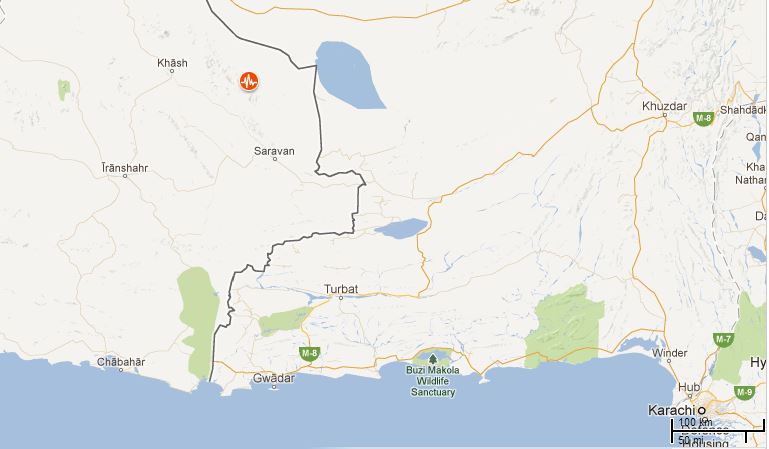
Google Map screen grab of USGS-reported epicenter of earthquake in Iran.

Google Map screen grab of USGS-reported epicenter of earthquake in Iran.

A massive earthquake has struck near the Iran-Pakistan border in the region known in both countries as Balochistan. With Iran subject to massive US sanctions that are already crippling its economy and affecting health care, responding to this disaster will be a huge challenge. Just over the border in Pakistan, the region has been torn by what some see as government-sanctioned disappearances and killings. The border in the region is quite porous and there have been a number of incidents involving both Iranian and Pakistani border control agents. The best prospects for the economy of the area to improve hinge on the Iran-Pakistan pipeline which crosses the border within about 150 miles of the epicenter and development of the port of Gwadar, which Pakistan recently signed over to China, also just over 150 miles from where the earthquake struck.

PressTV informs us that deaths from the quake have already been reported:

At least 40 people have been killed after a powerful earthquake measuring 7.5 on the Richter scale struck Iran’s southeastern Sistan and Baluchestan Province, the Iranian Seismological Center (IRSC) says.

The IRSC reported that the epicenter of the quake was situated 81 kilometers north of the city of Saravan.

Dawn reports that Iranian authorities say it is the worst earthquake to hit Iran in 40 years:

An Iranian government official said he expected hundreds of deaths from the massive 7.8 magnitude earth quake, felt as far away as New Delhi and Gulf cities of Dubai and Bahrain.

“It was the biggest earthquake in Iran in 40 years and we are expecting hundreds of dead,” said the official, who spoke on condition of anonymity.

(While this post was being written, Dawn updated the article to note that five deaths have already been reported on the Pakistan side of the border.)

The shaking was felt across large distances:

Tremors from the earthquake were felt as far away as New Delhi and the Gulf cities of Dubai and Bahrain.

Note that last year, two earthquakes in northwest Iran killed over 300 people. Those quakes had magnitudes of 6.4 and 6.2 on the Richter scale. The scale is logarithmic, so even the lower 7.5 estimate from Iran (compared to the initial 7.8 from USGS) makes this earthquake at least ten times more powerful than the quakes last summer. The region where today’s quake struck is much less populated, but with a quake of this magnitude, expect the devastation to cut a very wide swath.


Hagel Hearing: Twilight of the Neocons Makes Senate Armed Services Committee Dysfunctional

The disgusting bullying of former Senator Chuck Hagel (R-NE) during his hearing yesterday on his nomination to be Secretary of Defense is demonstrated clearly in the short clip above where Senator Lindsey Graham (R-Closet) asks Hagel to “Name one person, in your opinion, who’s been intimidated by the Israeli lobby.” Hagel said he couldn’t name one. A quick look at this word cloud from the hearing, though, or at this tweet from the Washington Post’s Rajiv Chandrasekaran: “At Hagel hearing, 136 mentions of Israel and 135 of Iran. Only 27 refs to Afghanistan. 2 for Al Qaida. 1 for Mali.” shows that Hagel should be at the top of the list of those intimidated by the Israeli lobby, which yesterday was embodied by the SASC.

Hagel did himself no favors when he stumbled badly on one of the few substantive and relevant topics brought up. On Iran’s nuclear program, even after being handed a note, he bungled the Obama administration’s position of prevention, stating first that the US favors containment. [His bungled statement of the Obama administration's position should be considered separately from the logic of that position, where containment of an Iran with nuclear weapon capability is seen by some as a stabilizing factor against Israel's nuclear capabilities, while prevention could well require a highly destabilizing war.]

Overall, however, the combative nature of Republican questioning of Hagel was just as hostile as the questioning last week of former Secretary of State Hillary Clinton over the Benghazi incident. Why would Republicans turn on one of their own with a vengeance equal to that shown to their long-term nemesis? Writing at Huffington Post, Jon Soltz provides an explanation with which I agree when he frames yesterday’s hearing as a referendum on neocon policy (emphasis in original):

“Tell me I was right on Iraq!”

Essentially, that’s what Sen. McCain said during most of his time in today’s confirmation hearing for Chuck Hagel. And that sums up why the die had been cast on the Hagel nomination, before we even got to these hearings today, which I am currently at. This vote, I believed (and now believe more than ever) is a referendum on neocon policy, not on Chuck Hagel.

Much of McCain’s bullying of Hagel was centered on McCain trying to get Hagel to admit that he had been wrong to oppose the Iraq surge. This clinging to the absurd notion that the Iraq surge was a success sums up the bitter attitude of the neocons as the world slowly tries to emerge from the global damage they have caused. And that this view that the surge was a success still gets an open and unopposed position at the Senate Armed Services Committee highlights the dangerous dysfunction of one of the most influential groups in Washington.

A functional SASC would have spent much time in discussion with Lt. Col. Daniel Davis, who provided a meticulous debunking of the myth that the Iraq surge was a success. His report, however, has been quietly ignored and allowed to fade from public view. Instead, this committee has essentially abandoned its oversight responsibilities in favor of pro-war jingoism. That Hagel refuses to engage in their jingoism is at the heart of neocon hatred of him.

Hagel would have done himself and the world a favor by turning the tables on the Committee during the hearing. A report (pdf) released Wednesday by the Special Inspector General for Afghanistan Reconstruction highlights a massive oversight failure by the Senate Armed Services Committee that lies at the juxtaposition of US defense policy in both Iran and Afghanistan. Despite long-standing sanctions against US purchases of Iranian goods, the Committee has allowed the Department of Defense to purchase fuel for use in Afghanistan that could well have come from Iran. Here is the conclusion of the report (emphasis added):

DOD’s lack of visibility—until recently—over the source of fuel purchased for the ANSF raises some concerns. DOD lacked certification procedures prior to November 2012 and had limited visibility over the import and delivery sub-contracts used by fuel vendors. As a result, DOD is unable to determine if any of the $1.1 billion in fuel purchased for the ANA between fiscal year 2007 and 2012 came from Iran, in violation of U.S. economic sanctions. Controls—recently added by CJTSCC to the BPAs for ANSF fuel—requiring vendor certification of fuel sources should improve visibility over fuel sources. To enhance that visibility, it is important that adequate measures are in place to test the validity of the certifications and ensure that subcontractors are abiding by the prohibitions regarding Iranian fuel. Recently reported steps to correct weaknesses in the fuel acquisition process may not help U.S. officials’ in verifying the sources of fuel purchased with U.S. funds for the ANSF. Given the Afghan government’s continued challenges in overseeing and expending direct assistance funds, it will become more difficult for DOD to account for the use of U.S. funds as it begins to transfer funds—in March 2013—directly to the Afghan government for the procurement and delivery of ANSF fuel. In light of capacity and import limitations of the Afghan government, the U.S. government may need to take steps to place safeguards on its direct assistance funding—over $1 billion alone for ANSF fuel from 2013-2018—to ensure that the Afghan government does not use the funds in violation of U.S. economic sanctions.

Imagine the sputtering that would have ensued if Hagel had managed to ask Graham or McCain why the committee had failed to enforce the sanctions against purchasing Iranian fuel by the Defense Department. While he was busy singing “Bomb, bomb, bomb, bomb, bomb Iran” on the campaign trail in 2008, McCain was failing in his responsibility to see that Iranian fuel wasn’t purchased by the Defense Department.


Medical Impact of US Sanctions Drives Iran’s Need for 20% Enriched Uranium

While Western media routinely proclaim the danger of Iran enriching uranium to 20% since it is “just a few short steps” from the 90%+ enrichment needed for producing nuclear weapons, what is often overlooked is the role that Western sanctions on Iran play in forcing Iran to carry out this 20% enrichment. Iran treats 850,000 patients a year with medical radioisotopes and has only a 40 year old research reactor in Tehran for producing isotopes. Despite attempts by neocons to claim that the sanctions have exceptions for humanitarian goods, the reality is that the sanctions forced Iran to produce new fuel for the Tehran reactor and we see today a mention in the Iranian press suggesting that four new research reactors are planned so that Iran can produce more radiomedicines domestically.

Here is how the medical isotope situation was described by Thomas Erdbrink three years ago:

The impending shortage of technetium-99 is caused by the controversy surrounding the Iranian nuclear program. The sanctions imposed by the UN Security Council, aimed at moving Iran to halt its uranium enrichment program, are supposed to leave medical practice unaffected. In reality, however, Iran has become unable to procure a wide range of medical products. Body scanners cannot be imported from the US or the EU, since parts in these machines could also be useful to Iran’s nuclear program. An embargo on medical isotopes was introduced in 2007, in defiance of the medical exception clause touted as part of the trade sanctions, Iranian leaders said.

Isotopes are a rare commodity produced at only five sites worldwide. One of these, the High Flux Reactor in the Dutch town of Petten, currently accounts for 30 to 40 percent of worldwide production, but it is scheduled for retirement soon. Apart from the UN sanctions, so many restrictions — particularly American — on trade with Iran exist, that in practice nobody is willing to supply Iran with medical isotopes any longer.

Out of dire necessity, Iran now uses its 41-year-old research reactor in Tehran — originally constructed by the US — exclusively for isotope production, a job which used to take only a day a week. However, the reactor’s fuel, provided by Argentina in 1993, is quickly running out, the scientists said.

The situation had not improved by late 2010:

Iran imports some ready-made isotopes, but it has faced greater restrictions under UN sanctions and has to pay higher prices to get them. Sanctions do not directly ban the sale to Iran of medical equipment, but they make foreign producers more reluctant to provide it, and those who will sell it do so at inflated prices.

“We are paying twice the value of this product to import it from Turkey,” said Mohammad Reza Ramezani, an official at Shariati Hospital, pointing to a cargo of technetium-99, the most common radioisotope used in diagnosis, that arrived from Turkey at day earlier.

Iran did indeed embark on its plan to enrich to 20% and has converted a significant portion of that 20% enriched uranium to fuel plates for the Tehran reactor, a move that leaves the uranium more difficult to subject to further enrichment to weapons grade. However, many have noted that Iran now has produced much more fuel than would be needed in the near future by the Tehran reactor and yet enrichment to 20% continues. At the end of a story carried today by Fars News Agency praising Iran’s accomplishments in nuclear technology, though, we see that Iran now plans additional research reactors. It appears that these reactors will supply material for more domestically produced radiomedicines: Continue reading


Warrick Promotes Neocon Framing of Newest Iran Sanctions

Despite crippling smog in Tehran that may well derive from sanctions aimed at refined gasoline and the UN noting several months ago that US sanctions against Iran “appear to be affecting humanitarian operations in the country”, Joby Warrick chose to frame the newest round of US sanctions against Iran in language provided directly by the neocon “think tank” Foundation for the Defense of Democracies.

Warrick does briefly note in his opening paragraphs that the sanctions against Iran have its “economy already reeling”,  but he doesn’t dwell on the impact to Iranian citizens of that reeling economy. Instead, he moves directly into neocon “think” with this passage (and Warrick doesn’t even get the group’s name correct):

While some previous U.S. sanctions targeted individuals and firms linked to Iran’s nuclear industry, the new policies are closer to a true trade embargo, designed to systematically attack and undercut Iran’s major financial pillars and threaten the country with economic collapse, the officials say.

“This is effectively blacklisting whole sectors of the Iranian economy,” said Mark Dubowitz, executive director of the Foundation for the Defense of Democracy[sic], a think tank. “The goal is to create a chilling effect on all nonhumanitarian commercial trade with Iran.”

By broadening the focus to entire industries, the new effort is intended to make it harder for Iran to evade sanctions through front operations, a time-honored practice in the Islamic republic, said Dubowitz, author of several studies on sanctions policy. “It was a game of whack-a-mole that the United States could never win,” he said.

Dubowitz’s framing casts those crafty Iranians as creating a game of “whack-a-mole” as they try to evade the sanctions, which he whitewashes as being aimed at “chilling all nonhumanitarian aid”. No less an authority than the UN, in a report titled “Situation of human rights in the Islamic Republic of Iran” and dated August 22, 2012, demonstrates that Dubowitz’s characterization of the sanctions is a lie, since even before this newest round, there are humanitarian effects from the sanctions:

The sanctions also appear to be affecting humanitarian operations in the country. Even companies that have obtained the requisite licence to import food and medicine are facing difficulties in finding third-country banks to process the transactions. Owing to payment problems, several medical companies have stopped exporting medicines to the Islamic Republic of Iran, leading to a reported shortage of drugs used in the treatment of various illnesses, including cancer, heart and respiratory conditions, thalassemia and multiple sclerosis.

Despite Dubowitz’s attempt to paint the sanctions as merely economic, we learned last fall that the severe impact on Iran’s economy has been devastating to its citizens.  More from the UN report: Continue reading


The Iran Sanctions Regime: Tracking Criminals Who Transship $5,241 of Dental Equipment

As the sanctions regime makes life worse and worse for ordinary Iranians, we will hear more about the humanitarian impact of it.

Which is why I find OFAC’s latest enforcement action of note: Treasury fined the medical supply company, Brasseler, $18,900 for transshipping a total of $5,241 of medical supplies through third countries to Iran once in 2006 and twice in 2009.

To be fair, some of the dental equipment that Brasseler makes might be imagined to be a dual use item, in that aluminum tube kind of way. So I guess you gotta bring the hammer for shipping medical supplies that might help the Iranian people.

Cause part of accomplishing regime change in Iran is to ensure Iranians’ teeth fall out, I guess.


P5 +1 Talks Resume in Moscow With Iran Sanctions Set to Ratchet Up

The latest round of talks between the P5 + 1 countries and Iran on Iran’s nuclear technology are underway today in Moscow amid mixed signals on whether any progress is expected. There is significant pressure on Iran in these negotiations as the sanctions currently in place are already causing great difficulty and they are set to move to an even more restrictive level in two weeks if no diplomatic progress is made.

Iran’s Mehr News agency is running a story with the headline “Iranian nuclear negotiators not optimistic about Moscow talks” which paints a stark picture of prospects for the talks:

The quality of the interaction of the Western countries’ representatives in the nuclear talks with Iran coupled with the atmosphere prevalent in the Baghdad talks, a reluctance for preparatory and expert talks before the Moscow meeting, and no authorization to present effective proposals have almost eroded chances for a breakthrough in the talks which starts on Monday, our correspondent says.

The Iranian negotiators say the Western countries on the 5+1 group have reneged on the agreements made in the previous meetings. They also say if the Western countries repeat their previous statements the negotiations will “definitely fail”.

Iran has clearly favored Moscow’s “step by step” proposal since the beginning of the process, and that preference also appears in this article:

There is also no sign that the Western countries are committed to the “step-by-step” approach or any new proposals will be presented in the talks on Monday and Tuesday.

According to the “step-by-step” proposal, which was first revealed by Russian Foreign Minister Sergei Lavrov at the Moscow Embassy in Washington on July 12, 2011, Iran would take steps to increase cooperation with the International Atomic Energy Agency and those steps would be rewarded with a gradual easing of sanctions.

Almost out of nowhere, Joby Warrick’s article in the Washington Post, which mostly centers on the status of sanctions now in place against Iran and the new sanctions set to kick in soon provides a “step by step” reference at the end. In this case, it seems significant that the reference is attributed to a Western diplomat:

But the Moscow talks could bog down quickly if Iran persists in demanding immediate relief from Western economic sanctions in exchange for any downsizing of its nuclear ambitions, U.S. diplomats and Iran experts say. Obama administration officials have said they would oppose a significant easing of sanctions until Iran makes verifiable cuts that sharply restrict its ability to develop nuclear weapons.

“We need to see a step-by-step process, with the core issue being an agreement by Iran on 20 percent enriched uranium,” said a Western diplomat involved in preparations for the Moscow talks. Continue reading