AP President Focuses on White House Claims about OBL Anniversary Threats

A lot of people are pointing to this Bob Schieffer interview of AP President Gary Pruitt because, later in the interview, Pruitt claims seizing the AP’s records without narrowing the scope or notifying the AP is “unconstitutional.” While that might make an interesting — though probably unsuccessful — argument if the AP takes this to court (note, Schieffer also asked whether the White House was trying to intimidate the AP, which seems the only basis for making a claim about constitutionality), I actually wanted to point to how Pruitt described the leak.

He emphasizes something that I pointed to here: the AP believed (or now says it believed) this was newsworthy because the White House had repeatedly said the government knew of no credible threat tied to the anniversary.

Pruitt: It was a very big story. And while the Justice Department hasn’t told us this is the case, we know there’s an announced public investigation to leaks in this case the focus was on this story. It was a story that only AP had. AP obtained knowledge that the US had thwarted an al Qaeda plot to place a bomb on an airliner bound for the United States. And it was round about the one, the year anniversary of the killing of Osama bin Laden.

Schieffer: So this was good news?

Pruitt: This was very good news. But strangely, at the same time, the Administration, through the Press Secretary and the Department of Homeland Security were telling the American public that there was no credible evidence of a terrorist plot related to the anniversary of the killing of Osama bin Laden. So that was misleading to the American public. We felt the American public needed to know this story.

Schieffer: You got this story, at first the people that gave it to you asked you to hold it for a certain time.

Pruitt: Yeah, so what happened was we got this story, we went to the government — the White House, intelligence agencies. They said, “there’s a national security risk if you run this, if you go with this story at this time.” We respected that. We acted responsibly. Withheld the story. We held it for five days. On the fifth day, we heard from high officials in two parts of the government that the national security issues had passed. And at that point we released the story.

Schieffer: Am I correct in saying that when you decided finally to release it then you got word that the White House did not want it released because they wanted to announce it themselves?

Pruitt: The White House wanted to, wanted us to hold it another day because they wanted to announce this successful foiling of the plot.

Schieffer: So they didn’t want to get scooped?

Pruitt: I guess! They didn’t tell us their motive, but that certainly seemed that way to us. We didn’t think that was a legitimate reason for holding the story. The national security issues had passed, we released this story.

Schieffer: And if memory serves the top counterterrorism official at the White House went on television the next morning and told the story.

Pruitt: Yes. The Administration was very aggressive in telling the story. [my emphasis]

What Pruitt is referring to, in part, is that Jay Carney introduced his April 26, 2012 press briefing by offering up the information that there were not threats tied to the OBL anniversary.

On a second matter, I just wanted to let you know that as part of his regular briefings on homeland security and counterterrorism, the President met today with members of his national security team to review the threat picture as we head into the anniversary of the bin Laden takedown.

At this time, we have no credible information that terrorist organizations, including al Qaeda, are plotting attacks in the U.S. to coincide with the anniversary of bin Laden’s death. However, we asses that AQ’s affiliates and allies remain intent on conducting attacks in the homeland, possibly to avenge the death of bin Laden, but not necessarily tied to the anniversary.

The President thanked his team and directed them to continue taking all necessary measures to protect the American people. [my emphasis]

Note the timing: this announcement came 2 days after Robert Mueller had an unscheduled 45-minute meeting in Yemen, where I suspect he picked up the UndieBomb that had been turned over several days earlier. So when Carney said this, UndieBomb 2.0 (to the extent it was a real plot in the first place) had already been rolled up.

And conflicting claims about threats must be what the AP told the White House was newsworthy, because — even though it played a fairly minor part of the original AP story — it is what John Brennan emphasized when explaining why he had to have a conference call that would lead to Richard Clarke figuring out the plot was actually a sting.

I said there was never a threat to the American public as we had said so publicly, because we had inside control of the plot and the device was never a threat to the American public.

[snip]

I — I — what I’m saying is that we were explaining to the American public why that IED was not in fact a threat at the time that it was in the control of individuals. When — when we say positive control, inside control, that means that we (inaudible) that operation either environmentally or any number of ways. It did not in any way reveal any type of classified information. And I told those individuals and there are, you know, transcripts that are available of that conversation, “I cannot talk to you about the operational details of this whatsoever.”

I’m still not entirely why this was so sensitive to the White House. As I’ve noted, there were several possible ways for Brennan to explain the discrepancy away that wouldn’t have outed their insider.

I think there are several possibilities, which I’ll lay out in a follow-up post. But one detail seems clear: the question of whether and why the Administration was sending mixed signals about the anniversary threat is the bone of contention here.


Department of Pre-Crime, Part 4: The NDAA Congress Is Not About to Legislate Targeted Killing

In three earlier posts, I have discussed the problem with turning the FISA Court into the Drone and/or Targeted Killing Court: As I noted, the existing FISA Court no longer fulfills the already problematic role it was set up to have, ensuring that the government have particularized probable cause before it wiretap someone. On the contrary, the FISA Court now serves as a veil of secrecy behind which the government can invent new legal theories with little check.

In addition, before the FISA Court started rubberstamping Drone Strikes and/or Targeted Killings of Americans, presumably it would need an actual law to guide it. (Though Carrie Cordero, who is opposed to the Drone and/or Targeted Killing FISA Court idea because it might actually restrain the Executive, seems to envision the Court just using the standards the Executive has itself invented.) And there’s a problem with that.

The same Congress that hasn’t been successful passing legislation on detention in the 2012 NDAA is certainly not up to the task of drafting a law describing when targeted killing is okay.

As a reminder, here’s what happened with the NDAA sections on military detention. The effort started with an attempt to restate whom we are at war with, so as to mandate that those we’re at war with be subject to law of war detention. The language attempting to restate whom we’re at war with ended up saying:

(a) IN GENERAL.—Congress affirms that the authority of the President to use all necessary and appropriate force pursuant to the Authorization for Use of Military Force (Public Law 107–40; 50 U.S.C. 1541 note) includes the authority for the Armed Forces of the United States to detain covered persons (as defined in subsection (b)) pending disposition under the law of war.

(b) COVERED PERSONS.—A covered person under this section is any person as follows:

(1) A person who planned, authorized, committed, or aided the terrorist attacks that occurred on September 11, 2001, or harbored those responsible for those attacks.

(2) A person who was a part of or substantially supported al-Qaeda, the Taliban, or associated forces that are engaged in hostilities against the United States or its coalition partners, including any person who has committed a belligerent act or has directly supported such hostilities in aid of such enemy forces.

Compare that language with what the actual AUMF says:

That the President is authorized to use all necessary and appropriate force against those nations, organizations, or persons he determines planned, authorized, committed, or aided the terrorist attacks that occurred on September 11, 2001, or harbored such organizations or persons, in order to prevent any future acts of international terrorism against the United States by such nations, organizations or persons.

Part of the difference arises from the shift to focusing exclusively on persons (you can’t detain a nation, after all, though Palestine might disagree).

Part of the difference comes from the effort — clause 2 above — to extend the AUMF to those associated forces. This was meant to cover groups like AQAP and al-Shabaab, but as we’ll see, it’s one source of the problem with the law.

But part of the problem is that the NDAA language smartly took out the “he determines” and “in order to prevent any future acts of international terrorism” language. The former has long been a giant loophole, allowing the President to define in secret whom we’re at war against. And I increasingly suspect the Administration has been using the latter language to expand the concept of imminent threat.

In other words, in an effort to parrot back its understanding of whom we’re at war against, Congress both introduced some new fuzzy language — associated forces — and took out existing loopholes — the “he determines” and “prevent any future acts.”

Continue reading


Dianne Feinstein’s Limited Hang-Out

Shorter Dianne Feinstein: “Well, the magical release of that white paper sure eliminates any need to release the Office of Legal Council memos that depict far worse legal theories, even to the grunt members of my committee who have are legally entitled to read it.”

I have been calling for the public release of the administration’s legal analysis on the use of lethal force—particularly against U.S. citizens—for more than a year. That analysis is now public and the American people can review and judge the legality of these operations. The administration has also described its legal analysis in speeches by the Attorney General and several senior officials during the past two years.

The white paper itself was provided to the Senate Intelligence and Judiciary Committees in June 2012 as a confidential document. The white paper (along with other documents and briefings) has allowed the Intelligence Committee to conduct appropriate and probing oversight into the use of lethal force. That oversight is ongoing, and the committee continues to seek the actual legal opinions by the Department of Justice that provide details not outlined in this particular white paper.

While the analysis in the white paper is not specific to any one individual, there has been significant question over the death of a U.S. citizen and operational leader of al-Qa’ida in the Arabian Peninsula named Anwar al-Aulaqi. As President Obama said at the time of his death, Aulaqi was the external operations leader for AQAP. He directed the failed attempt to blow up an airplane on Christmas Day in 2009 and was responsible for additional attempts to blow up U.S. cargo planes in 2010. He was actively plotting and recruiting others to kill Americans until the time of his death in Yemen.

The analysis is completely disingenuous for a number of reasons. As I have shown, DiFi utterly rolled John Cornyn when he tried to get the legal analysis released last year. She has done — and appears to be doing — far more to obstruct the release of the actual legal analysis than to facilitate it. And as at least 12 Senators strongly suggest, the white paper probably doesn’t reflect the memos (note that DiFi, like Wyden, uses the plural) — or at least one memo — that claims the authority to kill Americans solely on the President’s Article II power. At best, the intelligence (not evidence) to support the claims she advances about Anwar al-Awlaki is not a slamdunk; perhaps the  CIA is lying to her again, perhaps DiFi is lying herself to prevent Americans from assessing how badly she is fulfilling her role as a member of the Gang of Four who has presumably read the Administration’s legal justification and not objected to the President killing another American without due process.

Perhaps unsurprisingly, DiFi’s statement accords nicely with what Jay Carney said at the White House.

Continue reading


Latest “Isolated Incident” Raises Death Toll to 15 NATO Troops Killed by Afghan Troops This Year

Reacting to the killing of two senior NATO officers inside the previously secure Interior Ministry building in Kabul, Presidential Press Secretary Jay Carney on February 27 continued to insist that the ongoing killing of NATO troops by Afghan troops is just a series of “isolated incidents”. This stance is necessary in order for Obama administration and Pentagon officials to continue their attempts to hide the retroactively classified report “A Crisis of Trust and Cultural Incompatibility” (pdf) which clearly describes the cultural barriers which contribute to the disturbing trend of green on blue killings. Sadly, today marks another “isolated incident”, with the killing of two more NATO soldiers by a man “in an Afghan army uniform”:

A man wearing an Afghan army uniform killed two NATO troops in southern Afghanistan on Monday, military officials said, the latest in a string of shootings that have undermined trust between allies.

The gunman was killed by NATO troops shortly after he opened fire on a group of foreign troops, the military said in a statement. A military spokesman said officials were investigating whether the man was an Afghan soldier or an infiltrator wearing the uniform. No other details were released.

So-called “green on blue” shootings have become a rising threat this year, following a series of incidents that have created distrust between Afghan forces and their international coalition partners. The most significant was last month’s burning of Korans by U.S. troops. The episode sparked violent riots and prompted the Taliban to call on Afghan security forces to open fire on foreign troops.

From Reuters, we get an update on the fratricide statistics, along with an observation on the importance of this trend:

Before Monday’s attack, 13 members of the NATO-led force had been killed this year in what appeared to be attacks by members of Afghan forces, the commander of U.S. and NATO forces, General John Allen, told a U.S. senate committee last week.

About 70 members of the NATO force have been killed in 42 insider attacks from May 2007 to January this year.

The shootings raise new concern about the reliability of Afghan forces and their ability to take over security responsibilities by the end of 2014, when most Western combat forces leave.

So far, there has been no indication from the Obama administration that the clearly increasing trend of fratricide or other catastrophic events like the Panjwai Massacre will prompt a review of strategy in Afghanistan until after the November election. However, there is a hint that the Pentagon realizes they now stand on the precipice, as the blood money paid to the survivors in Panjwai is significantly higher than what was paid in previous incidents in Iraq and Afghanistan: Continue reading


US Vows No Change of Course in Afghanistan Despite 17% of NATO Deaths in 2012 From Fratricide

"There is absolutely no reason to change course when we're making the kind of progress we're making" -- Pentagon spokesman George Little, February 27, 2012

Displaying a remarkable inability to process the meaning of ongoing events, both White House spokesman Jay Carney and Pentagon spokesman George Little ventured dangerously close to “Baghdad Bob” territory on Monday, declaring that there is no reason to change the strategy or timetable for withdrawal in Afghanistan despite violence levels that have been on a steady rise since the US diverted its attention from Afghanistan to Iraq in 2003 and a rising toll of NATO forces being killed by Afghan forces.

The first question in Monday’s White House press briefing went right to the heart of the crisis that is ongoing in Afghanistan:

But I’m wondering how you explain to the average American who has seen this war go on for 10 years and is ready for troops to come home — how do explain it when the people that we’re training turn their guns on us, or U.S. officers in a secure Afghan Interior building are shot dead?  How do you explain why it’s working?

After Jay Carney responded with a very long “stay the course” explanation of how we must remove any possibility of al Qaeda re-emerging and that we must make conditions appropriate for handing off security to the Afghans, there was this follow-up:

Q    So you just sort of recounted the case there of how the President redefined the mission and how it’s important to stick with it, to stay the course.  But I’m wondering what you do about the attitudes of the American people who, in the case — more than one case in this last week — they say the people that we are going to war with, in some cases, are killing us.  Why should we still support this war?  How do you make that case?  And do you worry that it’s going to erode — the American public support will continue to erode in an election year?

MR. CARNEY:  Well, the incidents that you refer to are tragic and horrific and indefensible, there’s no question.  But it is important to remember that 95 to 97 percent of the missions the U.S. forces embark on in Afghanistan, they do so with their Afghan partners.  We’re talking about thousands and thousands of operations that proceed successfully with Afghan partners without anything like this happening.

These are isolated incidents — which does not, of course, mean they are not terrible — and are being investigated by both the Afghan government and ISAF.  But the overall importance of defeating al Qaeda remains and that is why we need to see — to continue the focus on that; to continue the process of, in the implementation of the President’s objectives, transferring security lead over to the Afghans so that American troops can come home.

It’s important to remember the President has already, through his strategy, laid out a process by which American troops will come home as we turn over security responsibility, security lead to Afghan forces.  And as we do that, we will be unrelenting in our pursuit of al Qaeda and unrelenting in our efforts to remove leaders of al Qaeda from the battlefield.

That’s just stunning. Carney insists that “These are isolated incidents” and yet, if we look at the numbers from this year, they are horrific. From AP:

Of 52 U.S. and NATO troops killed this year in Afghanistan, nine were apparently killed by Afghan forces or impersonators. Continue reading


If the Drug Czar Does Not Supervise the Money It Doles Out, Who Does?

At the Daily Press Briefing today, Jay Carney was asked whether the White House approves of the NYPD spying on New York and New Jersey’s Muslim communities.

He responded by claiming that the Office of National Drug Control Policy–the Drug Czar!–has no authority over the money.

The Office of National Drug Control Policy is a policy office that has no authority–no authority to and does not conduct, direct, manage, or supervise any law enforcement operations. The funding is provided to the H-I-D-T-A, HIDTA program, of New York and New Jersey, which then provides it to law enforcement agencies to assist in the procurement of resources like computers and other items.

[snip]

This is not an Administration program or a White House program. This is a program of the NY Police Department.

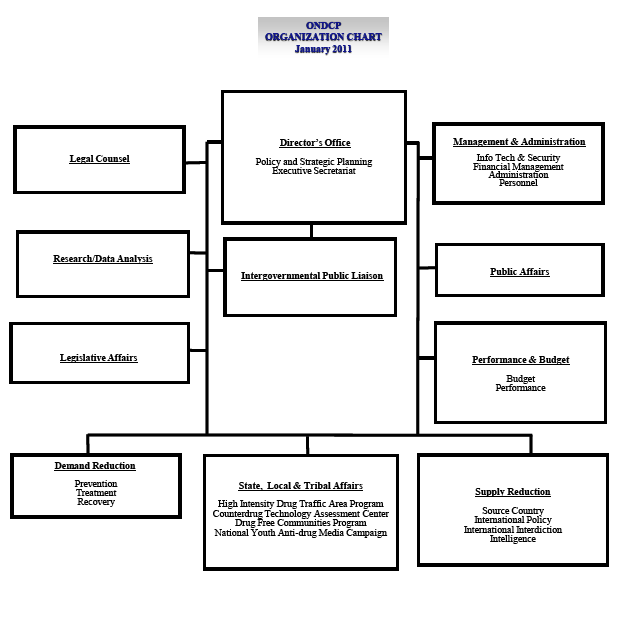
Now, there’s reason to believe the response was bullshit. As the Drug Czar org chart above shows–and Deputy Drug Czar Benjamin Tucker’s biography makes clear–HIDTA is solidly in the chain of command in the Drug Czar’s office.

In his position, Mr. Tucker oversees ONDCP’s High Intensity Drug Trafficking Areas (HIDTA) program , Drug-Free Communities (DFC), National Youth-Anti-Drug Media Campaign, and Counter-Drug Technology Assessment Center (CTAC).

With 40 years of experience in the fields of law enforcement and criminal justice, Mr. Tucker is a recognized expert in community policing.

Furthermore, the Director of HIDTA, Dr. Ellen Scrivner, has her office in the Executive Office of the President.

Drug Czar Gil Kerlikowske “coordinates all aspects of Federal drug control programs” and one of those programs is HIDTA, which apparently funds spying on Muslims. And the Drug Czar’s Policy Coordination Circular–which was updated on August 3, 2011–requires that the Drug Czar review any chances to “drug policy.”

Pursuant to 21 U.S.C. §1704(b), agencies are required, except under exigent circumstances, to notify ONCDP of any proposed change in policies relating to their activities under the National Drug Control Program prior to implementation of such change.

[snip]

The Director of ONCDP reviews such proposed changes and certifies in writing whetehr such change is consistent with the National Drug Control Strategy.

In other words, Obama’s Deputy Drug Czar oversees this program, its Director works in EOP, and any changes on anything pertaining to drug policy must be approved by the Drug Czar.

That kind of micro-management inside the White House is the whole point of having a Czar rather than a congressionally-supervised agency head.

Continue reading


Jake Tapper Flummoxes Jay Carney On White House Press Policy Hypocrisy

We take broadside shots at the press fairly regularly, both directly and as a vehicle for explaining ills and issues surrounding the government and, at least in my case, law. And there have been plenty of said shots aimed at the White House press over the years (stenographers!) and, pretty much, well earned. But fair is fair, and when there is good work done, it should be pointed out every now and then too. Today is a day for that.

At today’s White House press briefing, Jake Tapper of ABC News bored straight into WH Press Secretary Jay Carney, and it was a thing of beauty. The briefing opened with Carney evincing praise for the two journalists who died last night covering the Syrian popular uprising and resultant government crackdown and oppression, Marie Colvin and Rémi Ochlik as well as the New York Times’ recently deceased, Anthony Shadid. There is little doubt but that Carney, and the White House, have genuine sadness over the deaths. But Carney, on behalf of the White House, was taking it further and using them as shaded vehicle for political posturing and Tapper flat out called him on it. The exchange transcript, from Jake and ABC News:

TAPPER: The White House keeps praising these journalists who are — who’ve been killed –

CARNEY: I don’t know about “keep” — I think -

TAPPER: You’ve done it, Vice President Biden did it in a statement. How does that square with the fact that this administration has been so aggressively trying to stop aggressive journalism in the United States by using the Espionage Act to take whistleblowers to court?
You’re — currently I think that you’ve invoked it the sixth time, and before the Obama administration, it had only been used three times in history. You’re — this is the sixth time you’re suing a CIA officer for allegedly providing information in 2009 about CIA torture. Certainly that’s something that’s in the public interest of the United States. The administration is taking this person to court. There just seems to be disconnect here. You want aggressive journalism abroad; you just don’t want it in the United States.

CARNEY: Well, I would hesitate to speak to any particular case, for obvious reasons, and I would refer you to the Department of Justice for more on that.
I think we absolutely honor and praise the bravery of reporters who are placing themselves in extremely dangerous situations in order to bring a story of oppression and brutality to the world. I think that is commendable, and it’s certainly worth noting by us. And as somebody who knew both Anthony and Marie, I particularly appreciate what they did to bring that story to the American people.
I — as for other cases, again, without addressing any specific case, I think that there are issues here that involve highly sensitive classified information, and I think that, you know, those are — divulging or to — divulging that kind Continue reading


This Gitmo Anniversary Needs to Be about Bagram, Too

On a near daily basis in the last week or so, Jason Leopold has tweeted some quote from the daily White House press briefing in which a journalist asks Jay Carney a question about detention, to which Carney responds by insisting the Administration still intends to close Gitmo.

Q    One other topic.  Wednesday is apparently the 10th anniversary of the prison in Guantanamo Bay, and I’m wondering what the White House says now to critics who point to this as a pretty clear broken promise.  The President had wanted to close that within a year.  That hasn’t happened for a lot of the history that you know of.  And now it’s like there’s really no end in sight.  How do you respond to the criticism that this is just a big, broken promise?

MR. CARNEY:  Well, the commitment that the President has to closing Guantanamo Bay is as firm today as it was during the campaign.  We all are aware of the obstacles to getting that done as quickly as the President wanted to get it done, what they were and the fact that they continued to persist.  But the President’s commitment hasn’t changed at all.  And it’s the right thing to do for our national security interests.

That has been an opinion shared not just by this President or members of this administration, but senior members of the military as well as this President’s predecessor and the man he ran against for this office in the general election.  So we will continue to abide by that commitment and work towards its fulfillment.

And that response usually succeeds in shutting the journalist up.

No one has, as far as I know, asked the more general question: “does the Administration plan to get out of the due process-free indefinite detention business?” That question would be a lot harder for Carney to answer–though the answer, of course, is “no, the Administration has no intention of stopping the practice of holding significant numbers of detainees without adequate review.” Rather than reversing the practice started by the Bush Administration, Obama has continued it, even re-accelerated it, expanding our prison at Bagram several times.

That question seems to be absent from discussions about Gitmo’s anniversary, too. Take this debate from the NYT.

Deborah Pearlstein takes solace in her assessment that Gitmo has gotten better over the last decade.

In 2002, detention conditions at the base were often abusive, and for some, torturous. Today, prisoners are generally housed in conditions that meet international standards, and the prison operates under an executive order that appears to have succeeded in prohibiting torture and cruelty. In 2002, the U.S. president asserted exclusive control over the prison, denying the applicability of fundamental laws that would afford its residents even the most basic humanitarian and procedural protections, and rejecting the notion that the courts had any power to constrain executive discretion. Today, all three branches of government are engaged in applying the laws that recognize legal rights in the detainees. Guantánamo once housed close to 800 prisoners, and most outside observers were barred from the base. Today, it holds 171, and independent lawyers, among others, have met with most detainees many times.

But she doesn’t mention that the Administration still operates a prison alleged to be abusive, even torturous, still rejects the notion that courts have any power to constrain executive discretion over that prison. And that prison holds over 3,000 men in it!

Sure, Gitmo has gotten better, but that only serves to distract from the fact that our detention practices–except for the notable fact that we claim to have ended the most physical forms of torture–have not.

David Cole scolds those in Congress who “don’t seem troubled at all about keeping men locked up who the military has said could be released, or about keeping open an institution that jeopardizes our security,” yet doesn’t mention that Bagram does the same. Nor does he note the part of the Administration’s NDAA signing statement that suggested Congress’ salutary effort to expand detainee review would not necessarily apply to Bagram. How can it all be Congress’ fault when Obama isn’t fulfilling the letter of the law providing more meaningful review to those we’re holding at Bagram?

Even the brilliant Vince Warren focuses on the “legal black hole” that is Gitmo, without mentioning the bigger legal black hole that is Bagram.

Among the four participants in the debate, only Eric Posner even mentions Bagram, suggesting that that’s one less optimal alternative to keeping prisoners at Gitmo.

To be sure, there are other options. Detainees could be placed in prison camps on foreign territory controlled by the U.S. military, where they lack access to U.S. courts and security is less certain.

But then Posner misconstrues the issue.

Some critics believe that the whole idea of a war on terror is misconceived, that Congress could not have lawfully declared war on Al Qaeda, and that therefore suspected members of Al Qaeda cannot be detained indefinitely like enemy soldiers but must either be charged in a court or released. This position has been rejected repeatedly by the courts, but even if it were correct, Guantánamo would remain a legitimate place to detain enemy soldiers picked up on “hot” battlefields wherever they may be now or in the future — places like Afghanistan, Iraq, Libya and maybe soon Iran, to name a few.

There’s a difference between what is legal under international law developed for very different wars and what is just or what is the best way to conduct that war. And the problem with Gitmo (mitigated somewhat over the decade)–and the problem with Bagram, still–is that we’re spending unbelievable amounts of money to detain and abuse people that we haven’t even adequately reviewed to make sure we need to detain them. That’s not a smart way to conduct a war, particularly not one its backers insist will never end, particularly one that depends on our ability to win support among Afghans and other Muslims.

The only thing that was and is problematic about Gitmo that is not also problematic about Bagram is the publicity surrounding it (presumably, though, just here and in Europe–I imagine Afghans, Pakistanis, and al Qaeda members know as much about Bagram as they do about Gitmo). That is, by treating–and allowing the Administration to treat–Gitmo as the problem, rather than due process-free and possibly abusive indefinite detention generally, we’re all acting as if the problem is that people know we’re conducting due process-free indefinite detention, not that we’re doing it at all. We’re letting the Administration off easy with its claims that mean old Congress has prevented it from closing Gitmo, when Bagram offers proof that it wants to do so not for the right reasons–because it is wrong, because it damages our ability to claim to offer something better than corrupt regimes–but because what America has become and intends to stay is embarrassing, politically inconvenient.

I understand that this anniversary will attract general attention to Gitmo. I’m thrilled that, for once, people are listening to the reporters and activists and lawyers and guards and especially the detainees who have fought to close it. But by allowing the myth that Gitmo is the problem to go unchallenged, and not our due process-free indefinite detention generally, we’re simply pretending that unjust and stupid actions that occur outside of the glare of the press don’t matter as much as those that make the news.


Jay Carney: NDAA Still Doesn’t Give the Courts Any Oversight Over Detention and Killing

Jason Leopold pointed out this language in Jay Carney’s press briefing yesterday:

Q    You had objections to the defense bill; you’ve dropped them.  There’s still a lot of civil liberties experts who are convinced that that bill contains the seed of the future detention of U.S. citizens indeterminately if they’re suspected of terrorism.  Are you really that convinced that there was a big enough change that you’d drop an important issue like this?

MR. CARNEY:  Well, let me make clear that this was not the preferred approach of this administration, and we made clear that any bill that challenges or constrains the President’s critical authorities to collect intelligence, incapacitate dangerous terrorists, and protect the nation would prompt the President’s senior advisors to recommend a veto.
After intensive engagement by senior administration officials, the administration has succeeded in prompting the authors of the detainee provisions to make several important changes, including the removal of problematic provisions.
While we remain concerned about the uncertainty that this law will create for our counterterrorism professionals, the most recent changes give the President additional discretion in determining how the law will be implemented, consistent with our values and the rule of law, which are at the heart of our country’s strength.
This legislation authorizes critical funding for military personnel overseas, and its passage sends an important signal that Congress supports our efforts as we end the war in Iraq and transition to Afghan lead, while ensuring that our military can meet the challenges of the 21st century.
On the provision in particular that you reference, it does not increase or otherwise change any of our authorities in regard to detention of American citizens.  It is simply a restatement of the authorities that were granted to the President in 2001.
Q    Is this just a recognition that ultimately the courts would settle disputes like that?
MR. CARNEY:  No, the changes give discretion to the President in the implementation of this law.  If, as this law is being implemented, the President feels that our counterterrorism professionals are being constrained and that their flexibility is being constrained in a way that does not reflect our values, then he will ask for changes.  He will go to the authors of these provisions and ask for legislative changes that are separate from the defense authorization bill.

But again, the changes that were made were sufficient to allow senior advisors to withdraw the recommendation of a veto, but we are still concerned about the uncertainty that this law creates. [my emphasis]

The whole thing is a reaffirmation of unchecked Presidential power. But I agree with Leopold that the specific exchange in which, in response to a question whether the Courts will decide any disagreement about what the law means, Carney answers that no, the President will, is particularly troubling.

He seems basically to be saying that, if there is a dispute, the President will claim the law gave him discretion and do what he wants. He seems also to be saying (repeating a claim the Administration has made of late) that courts have no place in reviewing not just detention policy (and the targeted killing rooted in detention policy), but even this bill itself. That shouldn’t be a surprise, really, since the Administration’s veto threat complained that codifying the authorities Congress thought the President had threatened to disrupt “settled jurisprudence.”

After a decade of settled jurisprudence on detention authority, Congress must be careful not to open a whole new series of legal questions that will distract from our efforts to protect the country.

But it does raise alarms about the Administration’s disdain for separation of powers.

I had made two predictions about where these detainee provisions would go. I thought that codifying them might make it less likely the Administration would continue to avoid all court review by invoking state secrets (as they did with Anwar al-Awlaki). And I also predicted that Obama will issue a doozy of a signing statement, reiterating his understanding that this bill does nothing to limit his “flexibility.”

I see I was overly optimistic about the former, but suspect I’ll be proven correct about the latter.