
DOJ has submitted its detention memo for accused January 6 pipe bomber Brian Cole.
It largely tracks his arrest affidavit, only includes nifty maps and tables to show how his cell phone movement and his purchases showed his actions in preparation for and laying the pipe bombs.
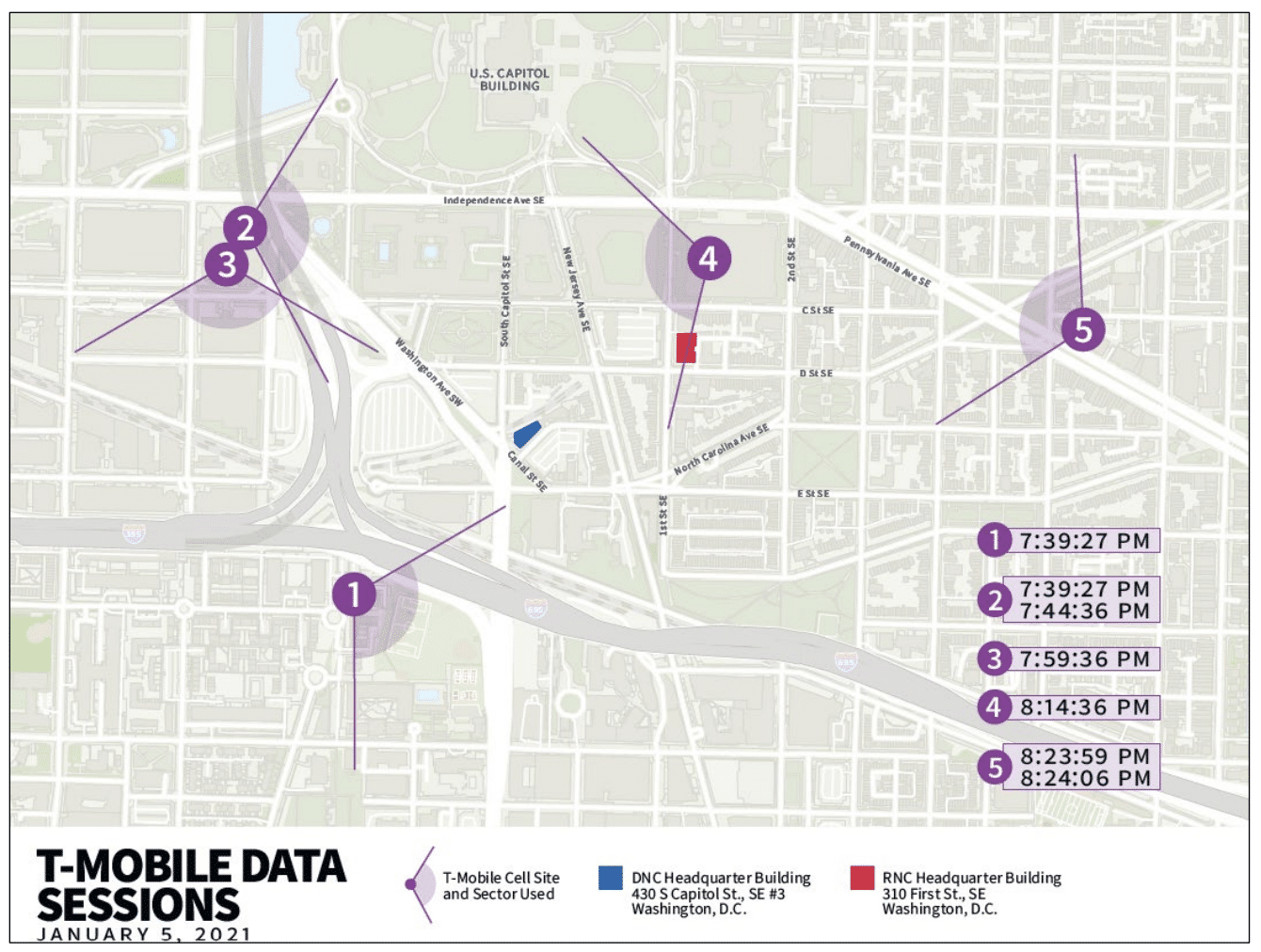
It also includes details of his Mirandized, videotaped confession.
The description of his motive confirms he was a Trump supporter, but then explains he just planted the pipe bombs at both the DNC and RNC because he hated both parties — it had nothing to do with January 6, the filing claims (without quoting him).
The defendant stated that he does not align politically with his family members and did not tell them that he “was going to a protest in support of [then President] Trump.”
[snip]
When the interviewing agents returned to the defendant’s motive, he explained that “something just snapped” after “watching everything, just everything getting worse.” The defendant wanted to do something “to the parties” because “they were in charge.” When asked why he placed the devices at the RNC and DNC, the defendant responded, “I really don’t like either party at this point.” The defendant also explained that the idea to use pipe bombs came from his interest in history, specifically the Troubles in Ireland. The defendant denied that his actions were directed toward Congress or related to the proceedings scheduled to take place on January 6.
But there are two holes in the detention affidavit.
First, it describes Cole taught himself how to make explosives from YouTube, and used Google Maps to decide where to plant the bombs.
According to the defendant, he learned to make the black powder from a video game that listed the ingredients, and he also viewed various science-related videos on YouTube to assist him in creating the devices.
[snip]
The defendant explained that he had used Google Maps to look up these locations in advance.
Both of those details should show up in a Google warrant.
The detention memo makes no mention of them (or of any Google warrant).
More stunning, the detention affidavit drops a key detail from the arrest affidavit: That he was on Capitol Hill on December 14, 2020.
The FBI has analyzed COLE’s purchase history associated with the Accounts. Between January 2018 and January 2021, COLE made a total of five purchases within Washington, D.C. on or about the following dates: January 13, 2018; January 16, 2018; October 31, 2019; December 5, 2020; and December 14, 2020.
Approximately three weeks before the pipe bombs were placed, on or about December 14, 2020, COLE made a purchase at a restaurant located near First and D Streets, Southeast. The restaurant is located across the street from the entrance to Rumsey Court on D Street, Southeast.
What the detention affidavit does reveal is that — starting on December 15, 2020 — the day after being on Capitol Hill and a full three weeks before planting the pipe bombs, Cole started factory resetting his phone.
A Samsung cellular device was seized from the defendant’s person at the time of his arrest. A forensic review of the device’s contents showed that between December 2020 and December 2025, the device recorded 943 events identified as a “factory reset” or “wipe,” including a “wipe” event approximately three hours before the defendant’s arrest on December 4, 2025.2
2 The first “factory reset” or “wipe” event took place on December 15, 2020. The next such event did not occur until July 15, 2022. From that date, the “factory reset” or “wipe” events occurred at least once a week. On some days, the device appears to have been wiped multiple times in the same day.
The alleged pipe bomber started exercising operational security the day after that trip to Capitol Hill, the scene of his alleged crime.
And now, Jeanine Pirro doesn’t want to talk about the trip he made there at all.
Update: Cole’s attorneys complain that DOJ is attempting to push his first appearance out to January 7 or 8, which would be past any 5-year statute of limitation (though his charged crimes have a longer 10-plus year statute of limtiation).
2. On December 28, 2025, when pressed on the question of proceeding with the preliminary hearing on December 30, the government asked to push the preliminary hearing to either January 7 or 8. That request comes too late and does not meet Rule 5.1(d)’s rigorous standard. The Court should confirm that December 30 is the preliminary hearing and detention hearing and direct the government to be prepared to present its evidence in support of probable cause.
[snip]
4. In its email to defense counsel, the government has identified no extraordinary circumstances; rather, the reasons referenced are ordinary scheduling matters and the possibility of a forthcoming indictment. Rule 5 “does not allow the [preliminary] hearing date” to be extended merely “to accommodate the pace of the grand jury investigation.” United States v. Gurary, 793 F.2d 468, 472 (2d Cir. 1986). And where the defendant does not consent—as he does not here—Rule 5.1(d) imposes “far more rigorous criteria” than the Speedy Trial Act’s ends-of-justice standard. Id. at 473; see also United States v. Fortenberry, 2014 WL 6969615, at *2 (D. Nev. Dec. 9, 2014) (“Rule 5.1 does not permit continuance solely to enable the government to avoid a preliminary hearing by securing an indictment.”) (citation omitted).