
When DOJ released its detention memo for accused January 6 pipe bomber Brian Cole, the MAGAts showed almost no interest; they’re too busy claiming to have discovered benefits fraud in Minnesota first charged under Merrick Garland’s DOJ.
But Jeanine Pirro did. She want on social media and repeated the apparent miscitation of Cole’s own words I laid out here, treating a comment made in the present tense this month — “I really don’t like either party at this point” — as if it were a comment about his mindset on January 5, 2021.
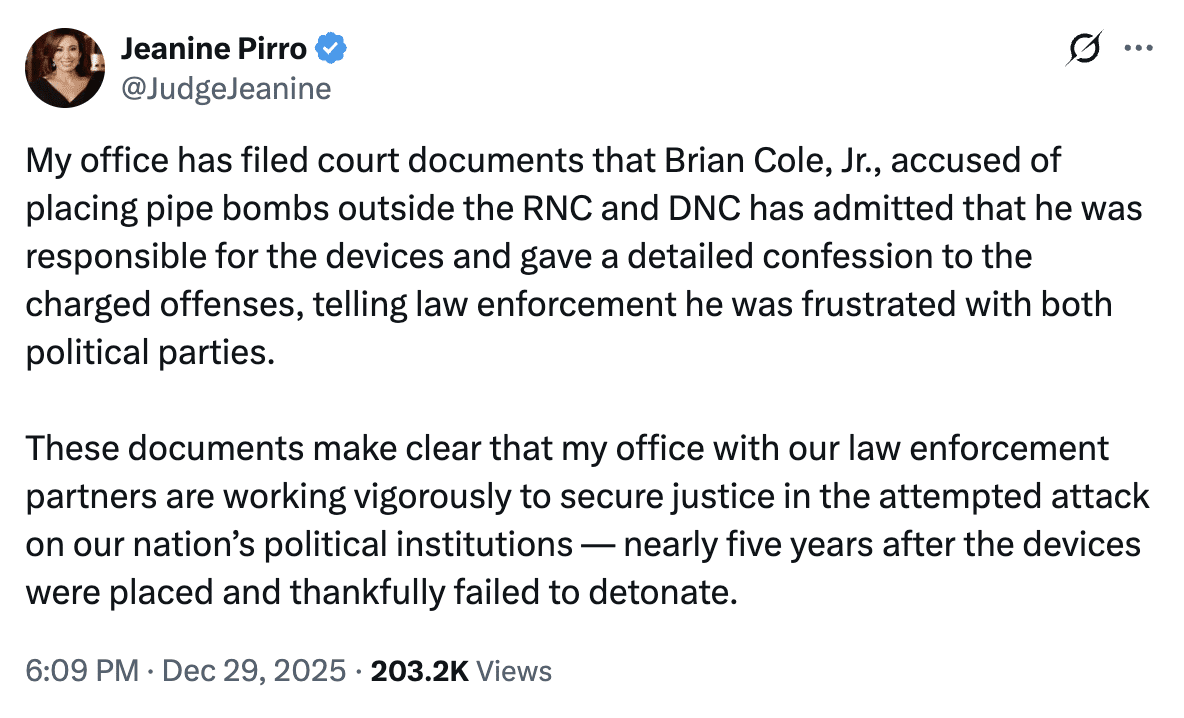
Unsurprisingly, Cole’s attorneys took note, arguing in their bid for bail that the “government-induced excitement” around Cole’s arrest should not factor into bail consideration and in fact is a violation of local rules about prejudicing a case.
The government-induced excitement around the arrest of Mr. Cole should not take this Court’s focus away from two essential principles of law that govern bail hearings.1
1 Indeed the U.S. Attorney has made numerous comments in contravention of Local Criminal Rule 57.7(b), specifically concerning the “existence or contents of any confession, admission, or statement given by the accused” ((b)(3)(ii)) and “opinion[s] as to the accused’s guilt or innocence or as to the merits of the case or the evidence in the case” ((b)(3)(vi)). See https://abcnews.go.com/US/pipe-bomb-suspect-disappointed -2020-election-results-us/story?id=128157568 (U.S. Attorney Pirro telling the media that based on the evidence, it is “unmistakable” that Mr. Cole is guilty and that “[t]his guy was an equal opportunity bomber.”); see also https://www.facebook.com/judgeje aninepirro/posts/my-office-has-filed-court-documents-that-brian-cole-jr-accusedofplacing-pipe-b/1424070829083142/ (U.S. Attorney Pirro posting on Facebook that Mr. Cole “has admitted that he was responsible for the devices and gave a detailed confession to the charged offenses”).
The rest of their opposition memo provides mere hints of how or whether they might defend this case.
It describes the evidence against Cole as circumstantial evidence of past guilt, not proof of ongoing risk at issue in the present.
The government’s showing is entirely retrospective and circumstantial. Even if credited, the government’s evidence describes an isolated window on a single evening nearly four years ago. It does not point to a “pattern of troubling activity” that would typically warrant detention in other cases. Klein, 539 F. Supp. 3d at 155. No device detonated, and the government has not alleged any comparable conduct or dangerous affiliations in the years since. This circumstantial proof—absent a direct forensic tie or evidence of ongoing threats—cannot overcome the Bail Reform Act’s default in favor of release subject to appropriate conditions. See Munchel, 991 F.3d at 1283 (The “threat [to the community] must also be considered in context.”).
It describes the pipe bombs as having “weapon characteristics,” perhaps questioning whether they really were functioning bombs at all.
According to the affidavit, both devices were rendered safe by the U.S. Capitol Police and later assessed by the FBI Laboratory to have “weapon characteristics,” with components consistent with improvised explosive devices.
It cites relevant DC Circuit opinions on pretrial release that just happen to be January 6 cases, here, Federico Klein — the former Trump State Department official with ties to Argentina’s fascist governments who was released on pretrial bail but ultimately sentenced to 70 months in prison — and Eric Munchel (AKA the Zip Tie Guy), whose pretrial release set the standard for many other January 6 defendants, but who was ultimately sentenced to 57 months in prison. Elsewhere the filing cites Bruno Cua, who was sentenced to just a year in prison after his pretrial release, largely because he was so young and impressionable during the events at hand.
All three, of course, have since been pardoned.
But Cole’s attorneys don’t mention those back stories to the detention precedents which must be applied to Cole too. Nor do they explain what they mean when they say the specific conditions that led young Bruno Cua to stalk the halls of the Capitol created a “specific risk profile for Mr. Cole,” just like it did Cua.
Finally, the unique conditions surrounding January 5–6, 2021, are unlikely to recur in a way that would present the same risk profile for Mr. Cole.
But that comment suggests they’re skeptical — perhaps have already seen reason to be skeptical — that Cole was telling the truth when he asserted there was no tie between his alleged planting of the pipe bombs and January 6, as the government’s detention memo asserts but does not quote directly.
They have reason to do that, of course. If planting the pipe bombs was part of January 6, then Cole may already have been pardoned, just like Klein and Munchel and Cua.
They do, however, confirm that Cole has been diagnosed with being on the spectrum.
Mr. Cole is an African American adult who has been diagnosed with Autism Spectrum Disorder, Level 1 and with obsessive compulsive disorder;
And like most bail memos, they include letters from character witnesses.
The only sign that today’s combined detention hearing and preliminary hearing, scheduled for 1PM before a Magistrate Judge who presided over only a (relative) handful of January 6 cases, might harbor some surprises is a repeat of their more explicit demand in a different filing that DOJ prove probable cause.
The defense understands that the detention hearing will begin with preliminary discussions that concern whether a rebuttable presumption that Mr. Cole should be detained arises in this case. The defense’s position is that the government cannot continue to keep Mr. Cole in custody absent a valid finding of probable cause.
One reason to do that is it raises the bar on pretrial detention.
True, the Bail Reform Act creates a rebuttable presumption “that no condition or combination of conditions will reasonably assure . . . the safety of the community if . . . there is probable cause to believe that the person committed” one of an enumerated list of crimes. 18 U.S.C. § 3142(e)(2). But for purposes of making that determination, “[a] grand jury indictment, by itself” is what establishes the probable cause “to believe that a defendant committed the crime with which he is charged.” Taylor, 289 F. Supp. 3d at 62 (quoting Stone, 608 F.3d at 945); see also United States v. Smith, 79 F.3d 1208, 1210 (D.C. Cir. 1996) (“[T]he indictment alone would have been enough to raise the rebuttable presumption that no condition would reasonably assure the safety of the community.”)
But who knows. There might be more.