
The word “subpoena” appears 84 times in the Jack Smith deposition (see my more general post describing how Jim Jordan tried to bury his own cowardice disclosed in Smith’s deposition here):
- Subpoenas to Jack Smith (by any party): 7
- Subpoenas for GOP toll records (questions by GOPers): 55
- Subpoenas for GOP toll records (questions by Dems): 2
- Other subpoenas for GOP witnesses (questions by GOPers): 1
- Subpoenas from the stolen documents investigation (asked by Dems): 19
As that tally makes clear, the vast majority of those references came during the GOP time, focused on the subpoenas for 10 members of Congress, one of two fake scandals that Chuck Grassley created in advance of Smith’s testimony.
There were no questions — zero — about the other scandal Chuck Grassley created, that Jack Smith had subpoenaed (Grassley falsely claimed) records, mostly financial, for 430 “targets”. Even Chuck Grassley, in a December 8 post laying out the “oversight” he plans to do in 2026, barely mentioned those subpoenas.
The closest the House GOP came in last month’s Smith deposition was this question about claims that right wingers were debanked (as if being an insurrectionist were not reason enough for a bank to cut ties with someone):
Q Where they’re basically told by their bank that they need to go find a different bank. And there is a long list of, you know, Trump allied, you know, officials that were subpoenaed for the grand jury, that were, you know, brought into your investigation that claim they had been debanked and that Capital One told them to go find a different bank and numerous other banks.
Do you know anything about that?
A No, I do not.
Q Okay. So your office didn’t have any communications with banks urging a bank to separate from any of their customers?
A I have no knowledge of that.
Q Are you aware of that allegations, or is this the first you’re hearing of it?
A I’m trying to think. I didn’t know what the term meant when you first said it, so, I mean, in the scheme of the world, have I heard of the word debanking? Maybe. But if you’d asked me to define it when you first said it, I don’t think I could have.
Q Okay. But have you — so you haven’t heard that allegation that some of the folks in President Trump’s inner circle have complained that they, you know, were kicked out of their bank?
As a result, the GOP did not invite (and Democrats did not think to invite) Jack Smith to explain a slew of subpoenas he sent out, subpoenas that constituted new prongs of the investigation and expanded prongs of work done in 2021 about finances.
As I laid out here, those subpoenas clearly addressed known prongs of the investigation into how Trump raised tons of money based on false claims and later funneled the money to people who had remained loyal through the attack on democracy.
Five pages — which appear to match the title of the document, Arctic Frost Bank Record Subpoenas — show subpoena returns with dates long after the date of the summary, going through a subpoena pertaining to Jeffrey Clark and John Eastman to Fidelity completed on July 6, 2023. [Note: The release of this document exposes the banks of dozens of Trump associates, a fairly alarming privacy violation.]
The five pages of subpoenas focus on several topics, largely the following:
- J6 $
- Wire fraud
- Misappropriation
- Payments to lawyers
- Bogus investigations
- Obstruction
- Credit reports
Most of this traces several prongs of investigation that were publicly reported at the time — largely picking up efforts of the January 6 Committee — showing that Trump raised money in the guise of election integrity, but then paid it to people like Brad Parscale or Dan Scavino.
Based on dates, this appears to be a key focus of Jack Smith once he was appointed
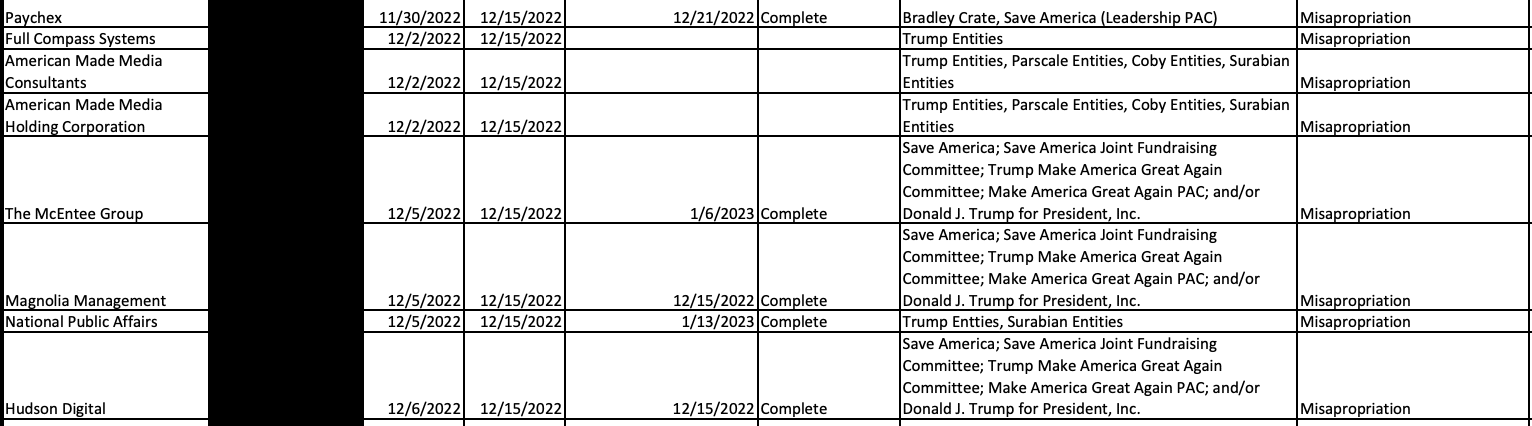
After squawking loudly (and to a significant extent, inaccurately) about the subpoenas, after doxing great swaths of the Republican Party, congressional Republicans decided they didn’t want to talk about the lucrative grift Trump took them for, in which Republican faithful paid Trump to lie.
As a result, the closest the full day deposition came to explaining how Trump abused the faith of his supporters was this exchange.
Q So did you develop evidence that President Trump, you know, was responsible for the violence at the Capitol on January 6th?
A So our view of the evidence was that he caused it and that he exploited it and 8 that it was foreseeable to him.
Q But you don’t have any evidence that he instructed people to crash the Capitol, do you?
A As I said, our evidence is that he in the weeks leading up to January 6th created a level of distrust. He used that level of distrust to get people to believe fraud claims that weren’t true. He made false statements to State legislatures, to his supporters in all sorts of contexts and was aware in the days leading up to January 6th that his supporters were angry when he invited them and then he directed them to the Capitol. Now, once they were at the Capitol and once the attack on the Capitol happened, he refused to stop it. He instead issued a tweet that without question in my mind endangered the life of his own Vice President. And when the violence was going on, he had to be pushed repeatedly by his staff members to do anything to quell it.
And then even afterwards he directed co-conspirators to make calls to Members of Congress, people who had were his political allies, to further delay the proceedings.
Trump deliberately stoked distrust to get his supporters to attack democracy.
January 6 was a violent insurrection. Never forget that.
But it was also an enormous fraud on the Republican Party.