
Remember the term “sanewashing,” which Parker Malloy used to describe how the press minimizes Trump’s ramblings to describe them as something reasonable to people who don’t see them personally?
Four years ago, in an article for Media Matters for America, I warned that journalists were sanitizing Donald Trump’s incoherent ramblings to make them more palatable for the average voter. The general practice went like this: The press would take something Trump said or did—for instance, using a visit to the Centers for Disease Control to ask about Fox News’s ratings, insult then–Washington Governor Jay Inslee, rant about his attempt to extort Ukraine into digging up dirt on Joe Biden, and downplay the rising number of Covid-19 cases in the U.S.—and write them up as The New York Times did: “Trump Says ‘People Have to Remain Calm’ Amid Coronavirus Outbreak.” This had the effect of making it seem like Trump’s words and actions seemed cogent and sensible for the vast majority of Americans who didn’t happen to watch his rant live.
[snip]
This “sanewashing” of Trump’s statements isn’t just poor journalism; it’s a form of misinformation that poses a threat to democracy. By continually reframing Trump’s incoherent and often dangerous rhetoric as conventional political discourse, major news outlets are failing in their duty to inform the public and are instead providing cover for increasingly erratic behavior from a former—and potentially future—president.
The consequences of this journalistic malpractice extend far beyond misleading headlines. By laundering Trump’s words in this fashion, the media is actively participating in the erosion of our shared reality.
These three paragraphs about why Donald Trump wants to take over Greenland when the US already has a base there, the rights to establish more bases, the ability to mine its minerals really exist in NYT’s third milking of their interview with Donald Trump:
“Ownership is very important,” Mr. Trump said as he discussed, with a real estate mogul’s eye, the landmass of Greenland — three times the size of Texas but with a population of less than 60,000. He seemed to dismiss the value of having Greenland under the control of a close NATO ally.
When asked why he needed to possess the territory, he said: “Because that’s what I feel is psychologically needed for success. I think that ownership gives you a thing that you can’t do, whether you’re talking about a lease or a treaty. Ownership gives you things and elements that you can’t get from just signing a document.”
The conversation made clear that in Mr. Trump’s view, sovereignty and national borders are less important than the singular role the United States plays as the protector of the West.
First of all, NYT interjected that “real estate mogul’s” comment; I assure you, Trump is not going to start building hotels in Greenland.
But more … uh … insane still, after Trump describes contemplating blowing up the alliance that has been the centerpiece of American national security since World War II out of a psychological need to own other people and other countries, nothing more, the NYT describes it to be a comment about Trump’s imagination that he is “the protector of the West.”
You’re both fucking insane! Donald Trump, for contemplating making the US and Europe less safe because of his own psychological inadequacies that drive him to covet big empty spaces on a map, and the NYT for describing it as the exact opposite of what it is, not Donald Trump needing to tend to Donald Trump’s increasing fragile psyche, but instead as something that protects the West rather than destroys the very concept of it.
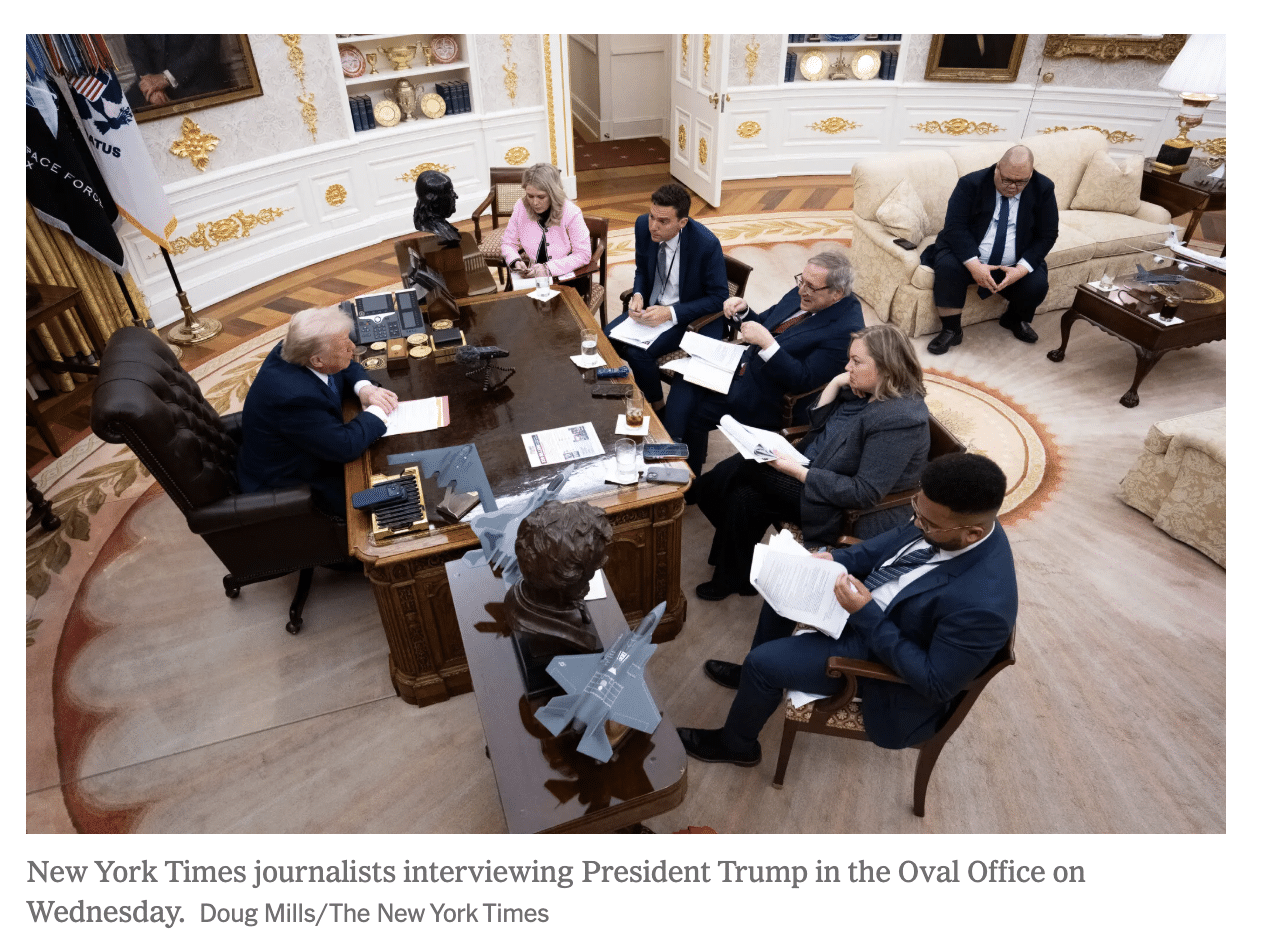
This is how access journalism works. You give an outlet that spent the entirety of the Biden Administration bitching that they didn’t get any sitdown interviews with the President two hours to watch the President ramble incoherently, and in return for that access — the latest of a series of stories screaming, look at us!! Donald Trump takes our calls and tells us nothing!! — you describe the most dangerous kind of malignant Narcissism as the opposite of what it is.