A footnote describing that, “On October 15, 2025, the government confirmed to the defense that Person 1 refers to Hillary Clinton and Person 3 refers to Daniel Richman.”
There’s nothing (besides the appointment) hinting at what Comey received in discovery.
Curse you, Pat Fitzgerald!!!
That has the advantage of allowing Comey to submit everything in unredacted fashion (his response to the loaner prosecutors’ bid to breach his privilege did have key redactions). It likely also had the advantage of being mostly written by the time of the arraignment.
There are some interesting legal details, however, which also telegraph what Comey will file if these two, closely linked motions fail. One paragraph describes the way Lindsey the Insurance Lawyer misrepresented what he said to Ted Cruz five years ago, which the filing notes will become a motion to dismiss because what he said was literally true (the basis on which Judge Anthony Trenga dismissed one of five counts against Igor Danchenko).
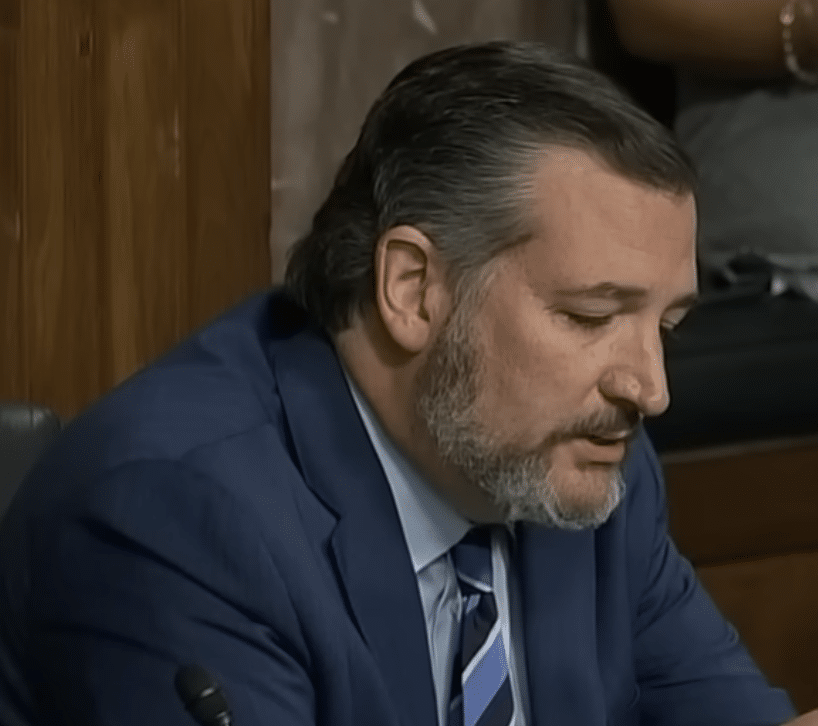
The indictment misstates the exchange between Senator Cruz and Mr. Comey. Senator Cruz asked Mr. Comey to affirm or deny prior testimony that he authorized “someone else at the FBI to be an anonymous source in news reports about . . . the Clinton Administration.” But Hillary Clinton was not elected, and Senator Grassley’s original questioning in 2017 related to the “Clinton investigation.” See FBI Oversight Transcript at 5, Exhibit B. The indictment nonetheless mischaracterizes Mr. Comey as stating that he “had not ‘authorized someone else at the FBI to be an anonymous source in news reports’ regarding an FBI investigation concerning PERSON 1,” ECF No. 1 at 1 (emphasis added). Thus, the indictment replaces Senator Cruz’s reference to the “Clinton Administration” with a reference to “PERSON 1” (Hillary Clinton) and misleadingly attributes statements to Mr. Comey that he did not in fact make during his September 30, 2020, testimony. 8
Further, the indictment omits Senator Cruz’s words that explicitly narrow the focus of his questions to Mr. McCabe and misleadingly implies that the questioning related to Mr. Richman. In fact, Mr. Comey’s September 2020 exchange with Senator Cruz made no reference whatsoever to Mr. Richman, who ultimately appears in the indictment as PERSON 3. Instead, the context of the exchange confirms that Senator Cruz was asking about leaks by Mr. McCabe—indeed, Senator Cruz asked Mr. Comey whether he or Mr. McCabe was “telling the truth.” In other words, the indictment presents an inaccurate description of the testimony at the heart of this case.
8 Mr. Comey expects to move to dismiss Count One based on a defense of literal truth. See Bronston v. United States, 409 U.S. 352 (1973).
Another describes that, because Lindsey the Insurance Lawyer was unlawfully appointed, she had no business being in the grand jury.
To start, the government has flagrantly violated due process, equal protection, and the First Amendment by prosecuting Mr. Comey based on his protected speech and based on personal animus. Those acts alone satisfy the first factor. And there is more: The government effectuated the prosecution through a separate and independent willful violation—an unlawful appointment of a White House aide as interim U.S. Attorney.11 The government’s conduct is antithetical to fundamental constitutional principles and serves no legitimate governmental end.
11 The government also violated the Federal Rules of Criminal Procedure, which allow only “attorneys for the government” to be “present while the grand jury is in session,” Fed. R. Crim. P. 6(d)(1), and define such attorneys to include only “attorney[s] authorized by law to conduct” grand jury proceedings, Fed. R. Crim. P. 1(b)(1)(D) (emphasis added). Those rules implement the longstanding principle that grand jury proceedings must remain secret and thus reinforce that the unlawful appointment of Ms. Halligan tainted the structure of the grand jury proceeding. See United States v. Sells Eng’g, Inc., 463 U.S. 418, 424 (1983).
This is how the two motions work in tandem. The aberrant procedures used to install Lindsey the Insurance Lawyer is itself proof of vindictiveness.
The other interesting arguments address why this should be dismissed with prejudice — most notably (given the loaner prosecutors’ games with privileged communications) because if Judge Nachmanoff does not, they’ll try again in the next six months.
Finally, dismissal with prejudice is warranted because any other remedy would put Mr. Comey “at a greater disadvantage than [he] would have faced had the government” not violated the Constitution. Id. at 1043. In fact, dismissing the indictment without prejudice would reward the government for its last-minute installation of Ms. Halligan as interim U.S. Attorney and consequent manipulation of the statute of limitations. As noted, the statute of limitations on Mr. Comey’s purported offenses was set to expire just ten days after Ms. Halligan’s unlawful appointment. Had the Attorney General not appointed Ms. Halligan at the eleventh hour, there is no reason to believe that the indictment would have been filed within the limitations period. That timing is significant not only because it allowed the government to bring this prosecution, but also because the government will likely argue that the filing of the indictment tolls the limitations period under 18 U.S.C. § 3288. And if this Court were to dismiss without prejudice, the government will likely argue that it has six months from the date of dismissal to file a new indictment. See id.12 The government would thus be in a better position than it would have been but for its constitutional violations. And Mr. Comey is in a worse position because he faces criminal prosecution, rather than experiencing the repose of an expired limitations period.
12 Mr. Comey disputes that reading of Section 3288. But for present purposes, the important point is that the government can at least argue that Section 3288 allows it to file a new indictment if this case is dismissed without prejudice—thus prolonging this deeply flawed case.
There’s very little fucking around here.
There’s no hint whether and if so how much of the earlier documents (like the declination decisions by Bill Barr and John Durham or even the 302s from those prosecutors) prosecutors even gave Comey in discovery.
We don’t even get to hear about Kash Patel’s well-documented malice!
We might have to wait to see that for Maurene Comey’s lawsuit.
Share this entry
https://www.emptywheel.net/wp-content/uploads/2017/05/Screen-Shot-2017-05-09-at-4.12.07-PM.png396535emptywheelhttps://www.emptywheel.net/wp-content/uploads/2016/07/Logo-Web.pngemptywheel2025-10-20 17:03:222025-10-21 01:39:4960 Pages of Animus: Jim Comey’s Motions to Dismiss His Prosecution
A filing in the Jim Comey case bearing the name of Lindsey Halligan claims that it is very important to disclose conflicts as early as possible.
1 “[Bo]th the Sixth Amendment and the Virginia Rules of Professional Conduct invite, indeed compel, prosecutors to alert a trial court to a defense attorney’s potential or actual conflict.” United States v. Cortez, 205 F. Supp. 3d 768, 775 (E.D. Va. 2016) (emphasis added) (Ellis, J.); see also United States v. Howard, 115 F.3d 1151, 1155 (4th Cir. 1997) (Wilkinson, C.J.) (noting that a district court “has an obligation to foresee problems over representation that might arise at trial and head them off beforehand”).
Only, the filing is not disclosing conflicts that Halligan, the Trump personal defense attorney turned unlawfully appointed US Attorney who didn’t identify her client at the arraignment, might have.
Rather, in a bid to accelerate consideration of the loaner prosecutors’ filter request (which I wrote about here), it insinuates that Pat Fitzgerald has a possible conflict on this case. As it describes, some of the communications that (it all but confirms) Dan Richman designated as privileged back in 2019 include Fitzgerald.
Relevant to this motion, the attorney has informed the government that the quarantined evidence contains communications between the defendant and several attorneys. The current lead defense counsel appears to be a party to some of these communications.
To turn that into a potential conflict, the loaner prosecutors (and probably also James Hayes, who again shows as the author of the document, but who has not filed a notice of appearance in the case) wildly misrepresent the DOJ IG Report on Jim Comey’s retention of the memos he wrote memorializing his conversations with Trump.
[T]he defendant used current lead defense counsel to improperly disclose classified information.2
2 See U.S. Department of Justice (DOJ) Office of the Inspector General (OIG), Report of Investigation of Former Federal Bureau of Investigation Director James Comey’s Disclosure of Sensitive Investigative Information and Handling of Certain Memoranda, Oversight and Review Division Report 19-02, (August 2019), (located at https://web.archive.org/web/20250818022240/https://oig.justice.gov/reports/2019/o1902.pdf, last accessed October 19, 2025).
(They provide a Wayback Machine link, because Trump killed the DOJ IG site in his bid to kill the main Inspector General organization.)
While the IG Report describes that Comey sent Fitzgerald four of the memos — which Comey believed to be unclassified — he sent the memo that Richman shared for this NYT story separately, meaning the report does not substantiate the claim that Fitzgerald was in the loop on that story.
May 14, 2017
Comey sends scanned copies of Memos 2, 4, 6, and 7 from his personal email account to the personal email account of one of his attorneys, Patrick Fitzgerald. Before sending, Comey redacts the second paragraph from Memo 7 involving foreign affairs because Comey deems it irrelevant. On May 17 Fitzgerald forwards these four Memos to Comey’s other attorneys, David Kelley and Richman.
May 16, 2017
Comey sends a digital photograph of Memo 4 (describing the meeting in which Comey wrote that President Trump made the statement about “letting Flynn go”) to Richman via text message from Comey’s personal phone. Comey asks Richman to share the contents, but not the Memo itself, with a specific reporter for The New York Times. Comey’s stated purpose is to cause the appointment of a Special Counsel to ensure that any tape recordings that may exist of his conversations with President Trump are not destroyed. Richman conveys the substance of Memo 4 to the reporter. The New York Times publishes an article entitled “Comey Memo Says Trump Asked Him to End Flynn Investigation.”
[snip]
As described in this section, on May 14, 2017, Comey transmitted copies of Memos 2, 4, and 6, and a partially redacted copy of Memo 7 to Fitzgerald, who was one of Comey’s personal attorneys. Comey told the OIG he thought of these Memos as his “recollection recorded,” like a diary or personal notes. Comey also said he believed “there’s nothing classified in here,” and so he thought he could share them with his personal attorneys.
And even using the FBI classification review of the memos he shared rather than Comey’s own review (he was an Original Classification Authority), he shared just six words, classified “Confidential” with his attorneys, and Richman didn’t share that information with Mike Schmidt.
FBI conducts a classification review of Comey’s Memos. The FBI determines that Comey correctly classified Memo 1 (which Comey did not share with anyone outside the FBI); that Memos 4, 5, and 6 are unclassified but “FOUO”; and that portions of Memos 2, 3, and 7 are classified, as follows:
Memo 2: Six words from a statement by President Trump comparing the relative importance of returning telephone calls from three countries, one of which the Memo notes the President mentioned twice, are classified as “CONFIDENTIAL//NOFORN.” Comey did not redact this information before sharing Memo 2 with his attorneys.
Memo 3: Information about sources, methods, investigative activity, and foreign relations is classified as “SECRET//NOFORN.” Comey did not share Memo 3 with anyone outside the FBI.
Memo 7: An assessment of a foreign leader by President Trump and discussion of foreign relations is classified as “CONFIDENTIAL//NOFORN.” Comey redacted this paragraph before he sent Memo 7 to his attorneys.
As Comey’s response notes, in a subsequent FOIA, a judge determined just one word was Confidential.
6 The portion of the memorandum the review team determined should be classified as “Confidential” concerned the President’s reference to then National Security Advisor Michael Flynn’s questionable judgment in not having notified the President sooner of a call from the leader of a particular country. (Report at 44). In that context, President Trump compared certain countries to a smaller country and the upclassification treated the name of a smaller country as classified for fear of offending that country. (Id. at 44-45). Mr. Comey’s reaction to the upclassification was: “Are you guys kidding me?” (Id. at 47). A federal court in unrelated litigation brought under the Freedom of Information Act (“FOIA”) ultimately rejected all but one of the subsequent classifications. (Id. at 3 n.4; 47 n.78; 58 n.100 (citing Cable News Network, Inc., v. FBI, 384 F. Supp. 3d 19, 25-26, 36, 38 (D.D.C. 2019))). The classification of the memorandum has been addressed in subsequent litigation and the single word that remains “CONFIDENTIAL” is the name of a single country.
That is, even Richman didn’t release classified information here. There’s even less to suggest Fitzgerald did.
[T]he government’s effort to defame lead defense counsel provides no basis to grant the motion.
[snip]
[T]here is no good faith basis for attributing criminal conduct to either Mr. Comey or his lead defense counsel. Similarly, there is no good faith basis to claim a “conflict” between Mr. Comey and his counsel, much less a basis to move to disqualify lead defense counsel.
Their goal in doing so is now clear: They want to get details of what Richman said while representing Comey after Richman had left and Comey was fired from the FBIm a time period that is irrelevant to charges pertaining to what Richman did as an FBI employee.
And to do that, they’re treating the Comey Memos as akin to some kind of grand insurance fraud (the common crime behind the precedent they’re invoking to conduct a highly invasive privilege review), when it was quite legitimately something you would do — sharing your own memorialization of sensitive events — with a lawyer. Which is probably why, per the original filing, Comey plans to challenge the warrant to get to that material.
Their filing is at least disingenuous about something else. They claim they need Judge Nachmanoff to make a decision about this quickly so that they can meet their trial deadlines.
Prompt implementation of the filter protocol is necessary in this case so the current trial milestones are maintained and met. This has been a point of emphasis from the Court. This desire is also shared by the government.
Here, the potentially protected material could contain exculpatory or inculpatory evidence relevant to the defense and the government. Currently, the government is not aware of the contents of the potentially protected material. As a party to some of the communications contained in the potentially protected material, the defense necessarily has awareness.
But this bid for a filter team already necessarily disrupts the trial deadlines.
As I pointed out here, the current schedule — especially the “the fastest CIPA process you have ever seen in your lives” that Judge Nachmanoff ordered at the arraignment — presumes that Fitzgerald will get clearance quickly.
The schedule proposed by the parties assumes that attorney Patrick Fitzgerald receives his security clearance, or interim clearance, within a reasonable time, and that all the classified materials to be reviewed are made available to the defense within a reasonable time.
You don’t agree to that CIPA schedule and then decide you want to kick Fitzgerald off the case. At that point, you’re effectively fucking with Comey’s Speedy Trial right. If you, as prosecutors, are compelled to identify conflicts, you’re compelled to do so before you build an entire trial schedule around there not being one.
And you especially don’t get to do that when this material has been in DOJ custody since 2019.
If there were reason to believe the discussions that Comey memorialized about Trump’s attempt to kill the Russian investigation included evidence of a crime, Bill Barr would have pursued it back in 2020. He didn’t.
And yet now the loaner prosecutors want to delay Comey’s trial so they can make a mad bid to get material that was clearly privileged.
Share this entry
https://www.emptywheel.net/wp-content/uploads/2025/10/Screenshot-2025-10-04-at-12.21.55.png750948emptywheelhttps://www.emptywheel.net/wp-content/uploads/2016/07/Logo-Web.pngemptywheel2025-10-20 11:44:542025-10-20 12:08:44Lindsey Halligan Lectures Someone ELSE about Conflicts
Donald Trump’s weaponization of government against his adversaries is a catastrophic assault on rule of law.
But in those efforts, he continues to do things that may backfire. I’ve noted repeatedly how poorly he chooses the political martyrs he creates. Just the other day, for example, Tish James got rock star treatment when she introduced and endorsed Zohran Mamdani.
In addition, Trump is conducting his vengeance tour in such a ham-handed fashion that that one after another after another after another after another after another after another prosecutor quit or resigned to much notice. Each will be available as witness to the politicization of DOJ.
Aside from LaMonica McIver (whose arrest the chattering class seem to have forgotten), Trump bolloxed the timing — the sequencing of his attacks — as well.
He indicted the well-lawyered Jim Comey, thus far the shoddiest case, first, and did so in EDVA’s rocket docket. That means that those who follow will benefit from the work — and possibly even precedents — Comey obtains. By the time Attorney General James is arraigned on October 24, for example, both Comey’s motion to disqualify Lindsey Halligan and his motion for selective and vindictive prosecution will be public.
And yesterday, with Trump’s commutation of George Santos’ prison sentence, he botched the timing again.
Trump’s clemency has already featured in motions for selective and vindictive prosecution. Both McIver and Sean Dunn (the sandwich guy) have invoked the Jan6ers that Trump pardoned as people who viciously assaulted cops but were freed. But in McIver’s case, as I laid out here, the government claimed — partly by placing an auto-pen in Trump’s hand — that prosecutors who dismissed the pending cases were left with no discretion after Trump issued his order.
McIver’s claim faces a threshold, insurmountable defect: the January 6 Defendants cannot be considered similarly situated because they all were pardoned. As a consequence, their ongoing prosecutions had to be dismissed without regard to the exercise of prosecutorial discretion, and they could not be prosecuted for January 6th related crimes thereafter. Because a similarly situated individual is someone that “could have been prosecuted for the offenses for which [the defendant was] charged, but were not prosecuted,” and the January 6 Defendants on their face do not meet those basic criteria, McIver’s motion must fail. See Hedaithy, 392 F.3d at 607 (quoting Armstrong, 517 U.S. at 470); see also Armstrong, 517 U.S. at 469.
But in Tish James’ case, the guy most responsible for her charges — the guy who has been literally stalking her in a dirty old man trench coat — also happens to be the guy who exercised discretion in the commutation of George Santos. Indeed, Eagle Ed Martin, who in addition to serving as Trump’s weaponization czar, also serves as Pardon Attorney, boasted of his role in the commutation.
To be sure, the kinds of fraud with which Eagle Ed charged Tish James are different than the kinds to which Santos pled guilty. Eagle Ed and Lindsey the Insurance Lawyer are effectively attempting to criminalize James’ generosity, her provision of a $137,000 home to her great niece. Even if she did what is alleged (and all the evidence suggests she did not), any benefit to James herself would be less than $19,000.
Meanwhile, Santos defrauded identified victims — some of them vulnerable seniors — of almost $375,000, along with $200,000 in ill-gotten gains himself. The victims include:
The Republican Party (which matched funds Santos hadn’t earned)
Donors whose credit cards he defrauded
Redstone Strategies investors
New York State’s Unemployment Insurance
Congress
Whereas Trump claims that the fraud for which James prosecuted him had no victims, because the banks ultimately got paid back (true of the loans James obtained as well), Santos’ crimes had a number of real victims, victims who have not yet been made whole.
And Donald Trump made no secret why he sprung Santos from prison: in crafting a false comparison with Richard Blumenthal, Trump declared that, “at least Santos had the Courage, Conviction, and Intelligence to ALWAYS VOTE REPUBLICAN!”
Alleged Democratic fraudsters get charges whereas far more dangerous Republican fraudsters win a Get Out of Jail Free card. It couldn’t be more clear.
It’s certainly possible that, if James used Santos as a comparator (along with other Republicans, like Ken Paxton, who haven’t been charged), DOJ would claim Trump may not have known about the various kinds of financial fraud Santos engaged in.
But if he doesn’t know that, it’s the fault of the Pardon Attorney.
The guy in the dirty old man trench coat, who has been stalking New York’s Attorney General all the while.
DOJ might claim that they can’t share any details of Santos’ commutation.
Too late!
In DOJ’s response to McIver, they already exhibited a willingness to share details of the treatment of specific pardons.
10 On September 2, 2025, the undersigned Assistant U.S. Attorneys spoke with the Deputy Pardon Attorney from the Office of the Pardon Attorney who confirmed that: (i) the January 6 Defendants with then-pending cases received pardons under the Pardon and were eligible to receive certificates of pardon, and (ii) that any January 6 Defendant was still considered pardoned even if a certificate of pardon was not requested. Additionally, the Deputy Pardon Attorney provided examples of certificates of pardon issued for January 6 Defendants with previously pending cases who requested a certificate.
I’m sure it seemed very clever, putting Eagle Ed in charge of both hunting Trump’s enemies and freeing his friends. But in this particular case it might get tricky.
At the very same time Eagle Ed was stalking Tish James up and down the Eastern Seaboard, desperately trying to find some crime to charge her with, he was also busy finding a way to free a much bigger, confessed fraudster from prison.
Share this entry
https://www.emptywheel.net/wp-content/uploads/2025/10/Stalker-Eagle-Ed.png14662022emptywheelhttps://www.emptywheel.net/wp-content/uploads/2016/07/Logo-Web.pngemptywheel2025-10-18 05:41:492025-10-18 12:51:05Eagle Ed Martin and George Santos Just Proved Tish James’ Vindictive Prosecution Claim
On Nicole’s podcast today, I said that many of the criminal issues that will arise from Trump’s politicization of DOJ won’t be all that controversial at SCOTUS (and SCOTUS is least awful on criminal justice issues). But I said one area would likely break new ground: selective and vindictive prosecution.
Jim Comey’s prosecution — and that of everyone else Trump is pursuing — fits poorly in the existing precedents for selective and vindictive prosecution, even while they clearly are vindictive.
Plus, I noted, that Trump’s penchant for yapping about legal cases even as DOJ attempts to protect him from liability in them conflicts with the language of Trump v. USA that — recklessly — puts the President in a prosecutorial function.
And the Executive Branch has “exclusive authority and absolute discretion” to decide which crimes to investigate and prosecute, including with respect to allegations of election crime. Nixon, 418 U. S., at 693; see United States v. Texas, 599 U. S. 670, 678–679 (2023) (“Under Article II, the Executive Branch possesses authority to decide ‘how to prioritize and how aggressively to pursue legal actions against defendants who violate the law.’” (quoting TransUnion LLC v. Ramirez, 594 U. S. 413, 429 (2021))). The President may discuss potential investigations and prosecutions with his Attorney General and other Justice Department officials to carry out his constitutional duty to “take Care that the Laws be faithfully executed.” Art. II, §3. And the Attorney General, as head of the Justice Department, acts as the President’s “chief law enforcement officer” who “provides vital assistance to [him] in the performance of [his] constitutional duty to ‘preserve, protect, and defend the Constitution.’” Mitchell v. Forsyth, 472 U. S. 511, 520 (1985) (quoting Art. II, §1, cl. 8).
Investigative and prosecutorial decisionmaking is “the special province of the Executive Branch,” Heckler v. Chaney, 470 U. S. 821, 832 (1985), and the Constitution vests the entirety of the executive power in the President, Art. II, §1. For that reason, Trump’s threatened removal of the Acting Attorney General likewise implicates “conclusive and preclusive” Presidential authority. As we have explained, the President’s power to remove “executive officers of the United States whom he has appointed” may not be regulated by Congress or reviewed by the courts. Myers, 272 U. S., at 106, 176; see supra, at 8. The President’s “management of the Executive Branch” requires him to have “unrestricted power to remove the most important of his subordinates”—such as the Attorney General—“in their most important duties.” Fitzgerald, 457 U. S., at 750 (internal quotation marks and alteration omitted).
Either Trump is properly in a prosecutorial role, in which case he needs to be at the center of these cases (and interventions like the Eric Adams bribery case), exposed to discovery. Or, his interventions are improper.
The current state of affairs, where DOJ claims the President is immune from discovery, permitted to speak endlessly about criminal cases, yet order up criminal prosecutions, is fundamentally inconsistent with rule of law.
Which is why I’m interested in four people Comey has added to his defense team (while also getting permission to submit a 45-page selective and vindictive prosecution brief, 15 pages extra).
Rebekah Donaleski, a Cooley Partner who, while at SDNY, was on the Lev Parnas/Rudy Giuliani team, including the Special Master process that exploited all of Rudy’s phones
Donaleski is interesting enough, not least given the loaner AUSA bid to play games with filter teams. Plus, she would have overlapped with Maurene Comey at SDNY (and with some of Jim Comey’s old pals when she first got there, probably).
But the others, especially Dreeben, signal that Comey is going into this with a plan and the expectation that he will have to argue this case before SCOTUS.
This team is a signal that Comey intends to reverse some of the damage done by Trump v. USA.
Share this entry
https://www.emptywheel.net/wp-content/uploads/2017/05/Screen-Shot-2017-05-09-at-4.12.07-PM.png396535emptywheelhttps://www.emptywheel.net/wp-content/uploads/2016/07/Logo-Web.pngemptywheel2025-10-17 17:57:172025-10-17 18:56:34Jim Comey Prepares to Prevail at SCOTUS
Approved a CIPA schedule that resolves by December (and therefore would not delay the January 5 trial date)
Meanwhile, Comey noticed his intent to challenge Lindsey Halligan’s appointment as US Attorney, so Judge Nachmanoff can refer the question to Fourth Circuit Chief Judge Albert Diaz, who will pick a District Judge from another District to preside over the challenge. Assuming Judge Diaz responds in timely fashion, Comey will submit that motion on Monday, along with his Selective and Vindictive prosecution claim, the latter of which is likely to be rather, um, illuminating.
There’s no sign, yet, that Halligan’s loaner AUSAs failed to meet Monday’s deadline, though they did file something under seal on Tuesday. If I had to guess, that might be the first bid to hide Trump’s role in the selective prosecution under claims of Executive Privilege, though I also imagine prosecutors may try to explicitly prevent the involvement of Maurene Comey (who is suing on closely related issues) or Troy Edwards (who presumably knows details of the turmoil at EDVA) on Comey’s defense team. Right wing propagandists are hinting that it might be a bid to claim Pat Fitzgerald has a conflict stemming from his past representation of Comey; but the CIPA filings, filed by prosecutors on October 13, are predicated on the assumption “that attorney Patrick Fitzgerald receives his security clearance, or interim clearance, within a reasonable time,” suggesting prosecutors have no complaint about Fitz’ involvement.
But there’s another filing that hints at far more turmoil ahead.
On Monday, after Judge Nachmanoff ordered prosecutors to turn over all discovery that day, prosecutors submitted a motion for a filter protocol. According to the filing, the government seized a whole bunch of computer devices — a hard drive, an iCloud account, an iPhone, and an iPad — from a lawyer in a past investigation, and they want to access it for this investigation.
Evidence in the government’s custody includes PPM because the evidence was obtained from an attorney. Currently, the quarantined evidence includes an image of a computer hard drive, an iCloud download, the backup of an iPhone, and the backup of an iPad (the “quarantined evidence”). The quarantined evidence was obtained through judicial warrants in a previous government investigation. After obtaining the quarantined evidence, and prior to any review, the attorney in question reviewed the quarantined evidence, withheld purported privileged material, and provided a privilege log to the government. However, the government is not aware of any involvement by the Defendant, or other putative privilege holders, in this prior review.
The devices are exceedingly likely to belong to Dan Richman, who is at least reported to be the person whom Comey is accused of authorizing to serve as an anonymous source in the indictment.
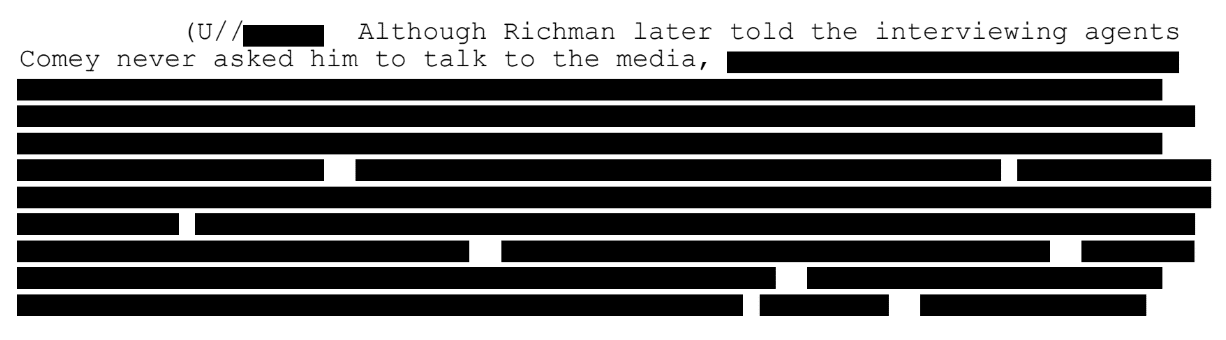
Indeed, the possibility that DOJ, under Bill Barr, seized a whole bunch of content from Richman explains something about the 2021 memo closing the investigation into Richman for leaking (which Comey likely received in unredacted form on Monday). One paragraph of the memo describes that Richman told the FBI that Comey had never asked him to talk to the media, followed by a two-paragraph redaction that must describe some reason why the FBI believed that to be false.
It was clear from the memo that the FBI obtained proof of what Richman said to Mike Schmidt, and while Barr tried to go after NYT directly for this investigation, they had limited success, so that evidence would have come from Richman. Plus, the closing memo is pretty clear that Richman was a confirming source for Schmidt (it says that the government has not previously charged people for being a confirming source, though I believe that’s inaccurate), which Richman admitted.
So if all those assumptions are correct, let’s consider what this motion for a filter protocol confesses.
First, prosecutors launched a bid to get access to this information to use at trial on the day that discovery was due, the day after Judge Nachmanoff ordered that all discovery be provided by October 13. They seem really unconcerned about how badly that will piss off Nachmanoff, which seems reckless.
The proposed filter itself is obnoxious in two ways. It proposes a team (which it says does not include EDVA or EDNC prosecutors, but does not address whether it includes prosecutors from WDVA or another of the far-flown parts of DOJ where Kash Patel has parked his witch hunt) will review the data for a set of narrow filter terms.
2 The Filter Team is comprised of Two Assistant United States Attorneys, and their support staff, from a separate federal district from the Eastern District of Virginia and the Eastern District of North Carolina. The Filter Team has a separate reporting and supervisory chain from the Prosecution Team and are not part of the Prosecution Team.
But aside from things explicitly marked privileged, they would get access to everything. Comey would only get a say over stuff triggered by those filter terms.
You can tell how unusual this protocol is for the citations — none of which is from EDVA, and only one of which is from the Fourth Circuit — the loaner AUSAs give to pretend it is not.
Of note, courts in the Fourth Circuit have entered similar protocols to the one proposed by the Filter Team in this case to handle the segregation and disclosure of PPM. See, e.g., United States v. Reifler, No. 1:20-cr-512-1, 2021 WL 2253134 (M.D.N.C. June 2, 2021).
Further, courts in other jurisdictions, including in the Third, Fifth, Sixth, and Eleventh Circuits, among others, have also entered similar protocols to the one proposed here. See, e.g., United States v. Farizani, No. 4:21-cr-62, ECF No. 153 (S.D. Tex. Feb. 16, 2024); United States v. Fletcher, No. 2:21-cr-64-DLB-CJS, 2022 WL 1118042 (E.D. Ky. Mar. 8, 2022); United States v. Siefert, No. 2:21-2-DLB-CJS, 2021 WL 3076940 (E.D. Ky. July 17, 2021); United States v. Salahaldeen, No. 3:20-cr-839, 2021 WL 2549197 (D.N.J. May 7, 2021); United States v. Lloyd and Strong, No. 9:25-cr-80015 (S.D. Fla.), United States v. Martinez and Vazquez, No. 24-cr20343, ECF No. 49 (S.D. Fla. Sep. 24, 2024); United States v. Blackman, No. 23-cr-20271, ECF No. 105 (S.D. Fla. Apr. 3, 2024); United States v. Waxman, No. 21-cr-60253, ECF No. 105 (Aug. 12, 2022).
They hide what prosecutors are probably attempting to do: to get to materials privileged to Richman in which he spoke about Comey.
This is something I predicted prosecutors would try to do in a post and video on the lessons from the Durham investigation. This is an attempt to use this proceeding to get to stuff privileged to Richman that they could use in their conspiracy fever dream.
The other reason this is wildly inappropriate goes to something Nachmanoff seems to be attentive to. As I noted, in his order approving Comey’s preferred protective order, Judge Nachmanoff noted that cases brought by Pat Fitzgerald, Robert Mueller, and under the supervision of Jack Smith did not adopt the punitive standard the Lindsey the Insurance Lawyer’s loaner AUSAs are attempting.
1 The Court observes that protective orders entered in numerous other high-profile false statements cases, within and outside of this judicial district, do not contain such limitations. See, e.g., Protective Order, United States v. McDonnell, et al., ECF 46, No. 3:14-cr-12-JRS (E.D. Va. Feb. 6, 2014); Protective Order, United States v. Kiriakou, ECF 32, No. 1:12-cr-127-LMB (E.D. Va. April 13, 2012); United States v. Libby, ECF 22, No. 1:05-cr-394-RBW (D.D.C. Nov. 23, 2005); Protective Order, United States v. Blagojevich, ECF 67, No. 1:08-cr-888-JBZ (N.D. Ill. April 14, 2009); Protective Order, United States v. Manafort, et al., ECF 46, No. 1:17-cr-201-ABJ (D.D.C. Nov. 15, 2017).
If one were to adopt the attorney-client review standards used in the Trump cases, the attorney in question — Rudy Giuliani, and John Eastman, among others, in the Trump cases, and Richman here — would be involved to speak to their own privilege, a process which created months and months of delay. The loaner AUSAs are pretty transparently trying to find a way around that process.
For now, Comey is adopting a different approach. As prosecutors describe it, Comey plans to challenge the warrant accessing this data in the first place.
First, the defendant has not explicitly objected to the protocol. As the government understands it, the defense prefers to challenge the underlying search warrant first before any review takes place. This two-tiered process is unacceptable in the government’s view because it risks delay.
It makes sense. The closing document in the investigation into Richman found that there was not sufficient evidence to charge either Comey or Richman, including for the false statements with which Comey has now been charged.
The investigation has not yielded sufficient evidence to criminally charge any person, including Comey or Richman, with making false statements or with the substantive offenses under investigation.
Unlike grand juries (where we can assume Lindsey the Insurance Lawyer neglected to tell grand jurors about all the conclusions there was not evidence to charge this), affiants for warrants are required to tell judges of all material information, such as that prosecutors already decided there’s no crime here. This is what the entire stink about the Carter Page FISA warrants was about. And the only thing that has changed since FBI presumably obtained warrants for Richman’s devices in 2019 is that Richman testified, twice, that Comey didn’t order him to leak to the press, and also that three sets of prosecutors (including those who reviewed the material in 2019) concluded there was no crime they could charge.
So if whoever got a new warrant to access this material for use in this investigation failed to disclose the prior prosecutorial decisions, that would make for an easy Fourth Amendment challenge. (I would be unsurprised if agents in WDVA already accessed this material, using precisely this protocol, which is one reason I find the language excluding EDVA and EDNC from the filter team but not identifying who would conduct it suspect.)
But understand what else is going on. The loaner prosecutors say they need to use an inapt filter process that treats both Comey and Richman like fraudsters because allowing them to participate in the process — or even pausing for a Fourth Amendment challenge — “risks delay.” But this is EDVA, home of the rocket docket, and in EDVA, you don’t wait until after you’ve indicted to obtain material you think might be helpful to your case.
Meanwhile, the clock is ticking.
As far as I understand the posture of this, unless Judge Nachmanoff orders differently, Comey will not have to respond to the October 13 request for two weeks — October 27, with a reply a week later, after all of Comey’s initial pretrial motions are submitted (he might file a Fourth Amendment challenge for the second deadline, October 30, or just file it on October 26).
Nachmanoff seems unimpressed by either this motion or the sealed filing.
Which is to say, unless something changes, this purported filter process wouldn’t even start for another month, resulting in the provision of any relevant materials to Comey months after the discovery deadline.
If this is a bid to access this material for this trial, it will likely fail. And, because this is EDVA, if that’s what prosecutors are trying, it may not work as well for investigators (including Jack Eckenrode, from John Durham’s team) as it did during the Michael Sussmann trial.
I already noted that, after Judge Michael Nachmanoff issued an order setting Monday as the deadline for prosecutors to provide Jim Comey all the discovery in his case, prosecutors submitted what they fashion as a Motion for a Discovery Order.
I was going to leave the filing well enough alone. Either Pat Fitzgerald or Judge Nachmanoff will respond later today, when things will get interesting. But there are a number of stupid things about the filing I can’t shake.
1) First, the prosecutors (it was submitted by Gabriel Diaz) do not fashion this as a motion for reconsideration. They just … pretend that Nachmanoff’s order doesn’t exist, and pretend they’re submitting this for the first time. That seems like a spectacular way to infuriate a judge.
2) They’re asking for two deadlines — October 14 for the things pertaining to the vindictive prosecution motion and October 20 for everything else, a transparent attempt to keep things from Comey that might be pertinent to his vindictive prosecution motion.
Part of their justification for filing this is that the parties had not reached an agreement and so they were following Nachmanoff’s order to submit competing versions on Monday.
On October 8, 2025, the Court ordered “the parties immediately confer regarding the entry of a joint discovery order” and further ordered “that if after good faith discussions the parties are unable to agree on and file a joint discovery order by Friday, October 10, 2025, . . . the parties shall each submit a proposed discovery order by Monday, October 13, 2025, at 5:00 p.m. D.E. 24.
But then, in a high school debate-worthy footnote, they suggest that Monday couldn’t be the deadline because it’s not five business days before the first pretrial motion deadline, since it’s a holiday.
Following the Court’s orders regarding discovery at docket entries 28 and 29, the Government conferred with Defense as to what the discovery deadline is. The Defense position was that, per the Court’s Order, discovery could have technically been due on Friday, October 10, 2025. But the notion that discovery was due prior to the Court entering a discovery order is not plausible. Alternatively, the Defense identified October 13, 2025, as the due date. This date is a Federal Holiday and is also inconsistent with the discovery order from this Court that lists discovery as due five business days before the pretrial motion deadline.
You’re already treating Monday as a business day!! Your entire premise here — that Fitzgerald should have held off on filing until Monday — is that you’re working on Monday.
3) Elsewhere — apparently in an attempt to suggest they were being really nice by letting Comey submit a second set of pretrial motions on October 30 — they describe that the default pretrial motion deadline going into last week’s hearing would have been October 22.
The defendant requested, the government agreed, and the Court ordered two motions Deadlines, October 20, 2025, and October 30, 2025. Notably, EDVA Local Criminal Rule 12 states that pretrial motions should be filed within 14 days of the arraignment. Here, the 14 day deadline would have been October 22.
This amounts to a confession that the default deadline for discovery going into last week’s hearing would have been five business days before October 22, or October 17. Prosecutors provide no explanation why they need an extra three days simply because Comey has two sequential pretrial motions.
4) They describe that Comey wouldn’t discuss the discovery order on October 7 when — for the first time in the 12 days since Comey had been indicted — prosecutors first reached out, because Comey’s team first demanded to know who the people described in the indictment were.
At that time, the government discussed with the defendant the proposed standard EDVA discovery agreement and a discovery protective agreement. At the initial discussion the defendant would not agree until the government provided information on the U.S. Attorney’s appointment and the identities of PERSON 1 and PERSON 3 on the Indictment.
Remember: Pat Fitzgerald said three different times in the arraignment the next day that he still hadn’t been told who these people were. So Diaz is effectively confessing that prosecutors wouldn’t — perhaps couldn’t — describe who these people were.
5) The only justifiable reason they give for delay is that the two sides have yet to agree on a protective order, which they claim is really important because of “the sensitivities and exposure associated with this prosecution.”
Additionally, the parties have yet to agree on a discovery protective agreement. Considering the sensitivities and exposure associated with this prosecution, a discovery protective agreement is a vital part of the overall discovery plan.
[snip]
On the afternoon of October 9, 2025, the defendant emailed back the government’s proposed protective agreement with significant proposed edits.
[snip]
Consistent with the Court’s direction at arraignment, the parties have also conferred regarding a discovery protection agreement. The government provided a past template used in the Eastern District of Virginia. The Defense made substantial edits, and the government agreed to those edits in large part. However, the parties still lack agreement as to whether the discovery can be provided and retained by the Defendant.
But they don’t provide the protective order (AKA “protection agreement”) with this filing. By their logic, they’re refusing to turn over discovery until they have one. By not turning it over, they’re ensuring that they cannot meet the currently set deadline of Monday.
6) Finally, they spelled North Carolina wrong.
Update: Corrected (from five to three) how many more days prosecutors are trying to get off what would have been the original October 17 due date.
Update: Here was Comey’s response (which noted that the government was just trying to change the terms of the discovery order after Comey signed it). And here’s Nachmanoff’s order rejecting the government bid.
Now the government is dicking around with the protective order, trying to mandate that the former Director of the FBI have a babysitter while reviewing discovery.
Update: Judge Nachmanoff adopted Comey’s preferred protective order. In his order, he included this footnote.
1 The Court observes that protective orders entered in numerous other high-profile false statements cases, within and outside of this judicial district, do not contain such limitations. See, e.g., Protective Order, United States v. McDonnell, et al., ECF 46, No. 3:14-cr-12-JRS (E.D. Va. Feb. 6, 2014); Protective Order, United States v. Kiriakou, ECF 32, No. 1:12-cr-127-LMB (E.D. Va. April 13, 2012); United States v. Libby, ECF 22, No. 1:05-cr-394-RBW (D.D.C. Nov. 23, 2005); Protective Order, United States v. Blagojevich, ECF 67, No. 1:08-cr-888-JBZ (N.D. Ill. April 14, 2009); Protective Order, United States v. Manafort, et al., ECF 46, No. 1:17-cr-201-ABJ (D.D.C. Nov. 15, 2017).
As you all likely know, Libby was a Fitz case. So were Blagojevich and Kiriakou — the latter of which was in EDVA.
Manafort, of course, was Mueller. And McDonnell, also in EDVA, was under the supervision of Jack Smith.
So a tidy way of saying, “Lindsey the Insurance Lawyer is trying to treat Comey worse than the investigations Trump is trying to avenge.”
Share this entry
https://www.emptywheel.net/wp-content/uploads/2025/10/Screenshot-2025-10-12-at-13.05.44.png292592emptywheelhttps://www.emptywheel.net/wp-content/uploads/2016/07/Logo-Web.pngemptywheel2025-10-12 09:06:102025-10-14 06:44:54“Sensitivities and Exposure:” Six Stupid Things about Lindsey Halligan’s First Filing
Donald Trump indicted Jim Comey (and Tish James, and probably John Bolton next) not just because he is wracked by a compulsion to humiliate the people who have the temerity to suggest the justice system should apply to him, too. His fascist project also requires him to completely replace rule of law with corruption, as part of a tool to enforce loyalty.
But as he betrayed in the Truth Social post to Pam Bondi that he accidentally posted publicly, he also did so because his rubes are growing impatient.
I have reviewed over 30 statements and posts saying that, essentially, “same old story as last time, all talk, no action. Nothing is being done.
Donald Trump has sold his rubes on a promise of “justice:” that those he has demonized will be be branded criminals not just in Trump’s propaganda, but by the legal system as well. The nativists were getting restless that he had yet to deliver and so Trump was under pressure and that’s part of why he pressured Bondi in turn.
It’s not just Trump’s pathologies that demanded these indictments; it’s also the impatience of a very dangerous mob.
With the impatience of Trump’s mob in mind, I want to look at what the Comey arraignment suggests the rhythm of this particular prosecution will go.
EDVA’s rocket docket
EDVA has what’s called a “rocket docket,” an expectation that cases go to trial as quickly as possible and that the trial be as short as possible. On its face, a rocket docket could disrupt Trump’s need to feed his rubes, because it would hasten the moment when the whole thing is exposed as a fraud.
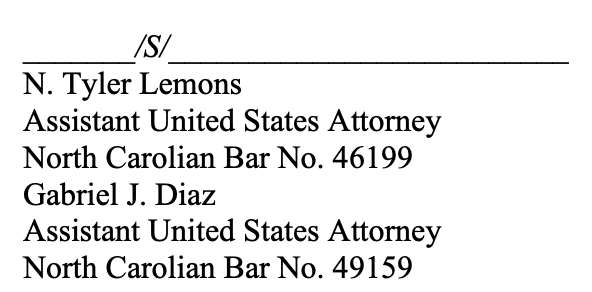
But it also poses a problem because the professionals who will take over this prosecution from Lindsey Halligan — Raleigh AUSAs Tyler Lemons (who took the lead at the arraignment) and Gabriel Diaz — only filed their notices of appearance on October 7, the day before arraignment, and when Patrick Fitzgerald reached out to them, they were completely unprepared to describe even the most basic aspects of the charges against Comey.
Unsurprisingly, the first thing Judge Michael Nachmanoff asked — after Fitzgerald entered a plea of not guilty for Comey — was to ask what date speedy trial would require a trial, which both Fitzgerald and Nachmanoff agreed would work out to be December 17.
When Nachmanoff asked if the case could go to trial by then, Fitzgerald skipped a step, immediately describing that he had sent a letter to prosecutors laying out his theory of defense and a two-phased set of motions he planned to file. He described the first — a Selective and Vindictive prosecution challenge and a challenge to Lindsey the Insurance Lawyer’s appointment — to be submitted on October 20. As Fitzgerald described, “our view is that this prosecution was brought at the direction of President Trump to silence a constant critic of him and, “we think [Halligan’s appointment] is an unlawful appointment.” He was less sure about what he would file ten days later, on October 30, but suggested a Bronston literal truth defense motion (the basis for which Anthony Trenga threw out one charge against Igor Danchenko in this same district), a grand jury abuse motion, and an outrageous government conduct motion.
Selling a Lemons CIPA dodge
Lemons used Fitzgerald’s explanation that he would like to exclude 31 days of time from Speedy Trial to insinuate Fitzgerald had suggested Comey needed time to prepare for trial, only to then confess he was not prepared to prosecute the case. “Part of it is obviously honoring the defense’s request for the later trial date and understanding and wanting them to be — have the time adequate to prepare for trial, but also in — it’s no discredit to Mr. Fitzgerald. He’s not — and we’re just getting our hands around the discovery as well.” But he also pointed to “a large amount of discovery which also includes classified information” for the request for more time.
Let me interrupt and note that the most recent ABC piece disclosing concerns the EDVA prosecutors had about the case included the amount of information the government would have to share with Comey.
Prosecutors further expressed concerns about the department’s ability to take the case to trial quickly due to problems identifying all the relevant materials that would need to be handed over to Comey’s lawyers, sources said.
As described, this is not about classified information (though I don’t doubt there’s a fair amount of materials on the SVR files believed to be at the heart of Dan Richman’s involvement). So it seems likely that Lemons is leaning on classified information as a way to stall.
Nevertheless, my sense is this is when things began to get a bit tense in the hearing, not least because it made it important for Fitzgerald to put on the record how unprepared the prosecution team was, but also because it raised the hackles of an EDVA judge about an interloper coming in and refusing to comply with rocket docket considerations.
Fitzgerald used it as an invitation to repeat that prosecutors had not yet told him who the people described in the indictment were (a complaint he made in different form at least three times). But — as a guy who has presided over some of the most difficult CIPA processes in history — he also scolded prosecutors for putting the cart before the horse, charging before making sure spooks would be willing to declassify intelligence to make a criminal case (not coincidentally, something John Durham did too).
We would have thought in the normal course when the government brings a case, they address the classified information issues ahead of time, coordinate within the national security section, and have a plan. And, frankly, we feel like in this case, the cart may have been put before the horse, and my client would not like to wait around unnecessarily while they go through things we think that should have been done before.
For his part, Nachmanoff used the CIPA excuse as an opportunity to order prosecutors to get Fitzgerald clearance as quickly as possible and to conduct the fastest CIPA process in history. “Either it’s not relevant to the case or it can be declassified or we will go through the fastest CIPA process you have ever seen in your lives.”
Donald Trump’s clearance tantrums
There are two surprises that may arise out of this focus on CIPA, even ignoring Nachmanoff’s impatience with it.
Nachmanoff only described getting Fitzgerald clearance (he noted that Jessica Carmichael, the only attorney of the five present who was currently practicing in EDVA, “has had a number of national security cases in this district in the last few months”). He did not mention Comey getting clearance.
That said, it is customary in CIPA cases to give a defendant clearance if he had clearance to access the materials at issue in a case during the period of the alleged crime — that’s the standard adopted, for example, by Aileen Cannon in the stolen documents case.
If Comey wanted access to this material — and there’s good reason to argue he should — then it might create a conflict between prosecutors (including Lindsey the Insurance Lawyer) and Trump, because one of the areas where a purportedly unreviewable Presidential authority has come under challenge is in legal cases, where the government has tried to moot a legal case by denying someone clearance.
That is, this trial might force Trump to agree to give Comey clearance, something he has stripped from all his adversaries.
But Comey might have reason not to pursue it: because of the even more abusive case Jack Eckenrode is attempting to build in WDVA.
Jack Eckenrode, WDVA, and John Durham’s discovery woes
Last week, one of the FBI agents purged by Kash Patel, Michael Feinberg, described that one of two FBI agents on this case was, “John Durham’s factotum and enforcer,” which via this link he confirmed to mean Jack Eckenrode.
The significance of Eckenrode’s role in this case has received far too little attention. As late as Scooter Libby’s indictment, Eckenrode was a key investigator on Fitzgerald’s CIA Leak case team. But then, as multiple people got leaked information about Karl Rove being imminently indicted, he wasn’t anymore. He and Fitzgerald (and Comey, as the link above notes) go way back, but there’s also a decent chance that Fitzgerald has reasons to know that Eckenrode leaked details of that earlier investigation to pressure him to expand the charges.
And, as Feinberg noted, Eckenrode was Durham’s right hand man, which makes Durham’s testimony (also reported by ABC) pretty awkward.
John Durham, the former special counsel who spent nearly four years examining the origins of the FBI investigation into President Donald Trump’s 2016 presidential campaign and its alleged ties to Russia, told federal prosecutors investigating James Comey that he was unable to uncover evidence that would support false statements or obstruction charges against the former FBI director, sources familiar with the matter told ABC News.
Federal prosecutors in Virginia met remotely with Durham in August to understand the findings of his investigation, according to sources familiar with the meeting, and his conclusions raise the prospect that Durham — who was once elevated by Trump and other Republicans believing he would prosecute high-level officials involved with the investigation of the president’s 2016 campaign — could now become a key figure aiding Comey’s defense.
But Eckenrode is also, per the NYT, the lead investigator in an investigation in WDVA premised on what seems to be a theory that FBI agents hid documents in a burn bag to protect people like Comey.
And that suggests a certain logic to the charges as originally packaged (which Lindsey the Insurance Lawyer fucked up and caused to be released). Lindsey the Insurance Lawyer, coached by Eckenrode, first tried to get the grand jury to approve three charges:
One false statement charge claiming Comey lied when he couldn’t remember what Durham and Eckenrode, with the collusion of Kash Patel and John Ratcliffe, falsely packaged up into a “Clinton Plan” to frame Donald Trump (this is the one the grand jury rejected)
Another false statement charge claiming Comey lied when he answered (he didn’t really) that he had not authorized anyone to speak to the press anonymously for him, which at some point meant Dan Richman sharing information about SVR documents suggesting that Loretta Lynch was helping Hillary dodge the email investigation
An obstruction charge arising out of those lies (and now, the single charged lie)
That is, the original theory of the case (and unless the new prosecutors pull a wild headfake to try to salvage the case, still the theory) was directly relevant to the WDVA case. The idea being, you “prove” in EDVA that Jim Comey was lying in 2020 about his knowledge of multiple SVR documents, which you then use to build a case in WDVA that the FBI was conspiring to protect an effort in 2016 to focus on Trump to the exclusion of Hillary.
This is a direct replay of the strategy that Durham (who debunked the current charges) adopted (working with Eckenrode) in 2021, when he attempted to hang conspiracies around two thin false statement cases against Michael Sussmann and Igor Danchenko. You use the false statement to prove a motive for the conspiracy.
You also use one case — as Durham did with privilege challenges in the Sussmann case to obtain records that might have been pertinent to the Igor Danchenko case if they had said what his fervant fever dreams imagined they might — to attempt to obtain evidence for the larger case.
What’s worth knowing, though, is how classification stymied Durham’s case but also — thus far — protected his collusion with Russian spies. First, in 2020 (literally leading up to the Jim Comey testimony for which he has been charged), Ratcliffe and Kash “declassified” a bunch of documents in a misleading way to substantiate their “Clinton Plan” fabrication, pretty much reversing the meaning of the documents. That then formed the backbone of the Durham investigation. But Durham only shared still-classified SVR documents with a few subjects of the investigation, like Julianne Smith. He showed targets, like Peter Strzok, the misleadingly redacted documents (indeed, that’s what the question to Comey they wanted to charge would have been based on). There was a CIPA process with Sussmann, but I’m convinced they didn’t give him adequate substitutions, because otherwise he would have argued that they were framing him with fabricated documents.
The important detail is that Durham tried to coerce testimony from targets, undoubtedly including Comey, that would have required granting them clearance for such testimony. Witnesses could and some did avoid testifying by refusing to accept clearance — the same thing that the US Attorney in Philadelphia is using with a credulous Marc Caputo to excuse his inability to charge John Brennan.
Of course, to the extent that prosecutors who know none of this background have been dragged into this at the last minute, they may be forced to provide Fitzgerald, at least, with the proof that Eckenrode is still chasing decade old Russian disinformation. They’re just getting their hands around the discovery as well, Lemons explained.
They may in fact hand Fitzgerald evidence that Eckenrode committed the crime he wants to frame Jim Comey of doing.
Lindsey Halligan won’t say who she represents
There were two other details of from the arraignment that didn’t get enough attention, in my opinion.
First, here’s how the introductions went down. Lemons, the AUSA taking the lead, spoke first, greeting Judge Nachmanoff and describing his client in the standard manner. “Good morning, Your Honor. Tyler Lemons for the United States government.”
Lindsey the Insurance Lawyer went next. Not only did she not greet the judge, but … she didn’t tell us who she represents. “Lindsey Halligan,” was all she said.
After Gabriel Diaz introduced himself in the normal fashion (greeting, then describing that he represents the US), Fitzgerald gave the answer that made all the press reports (probably by design): “Good morning, Your Honor. Pat Fitzgerald, and it’s the honor of my life to represent Mr. Comey in this matter.”
Carmichael, the only one currently practicing in EDVA, also gave the standard answer. “Good morning, Your Honor. Jessica Carmichael for Mr. Comey.”
Given that the only times Lindsey the Insurance lawyer has represented anyone in federal court before, she introduced herself as representing Donald Trump, perhaps it was just safer for Lindsey the Insurance Lawyer to say as little as possible.
More interesting, however, is that Nachmanoff was not playing dumb to the problems with Lindsey the Insurance Lawyer’s presence. After Fitzgerald described his plan to challenge Lindsey the Insurance Lawyer’s appointment, Nachmanoff described — having already checked — what the procedure would be. “[A]ny motion to disqualify Ms. Halligan will be heard by an out-of-district judge,” Nachmanoff explained. “That is the process that has been followed in New Jersey and Nevada, and the Court will follow that process here, which means that a request will be made to Chief Judge Diaz of the Fourth Circuit to appoint an out-of-circuit judge only to address that issue.”
He came prepared for this issue.
As Nachmanoff moved onto a discovery order, Fitzgerald pointed to a piece of discovery he wants right away. “[W]e would like to see the appointment papers forthwith. We don’t want to be shooting at the wrong target” on the disqualification motion. Fitzgerald, who has had all manner of DOJ appointments in his day (once, on Jim Comey’s orders) noted “that most appointment papers for United States attorneys are a page or two, we would ask if we could have that forthwith” so that they could start drafting their motion.
In multiple cases when the Trump Administration tries something funny (as with the Illinois invasion, in which DOD fucked up the authorizing paperwork at least three times), they often don’t have their paperwork in order.
Which is to say, even before the reports out today that Lindsey didn’t consult with ODAG on public integrity concerns about indicting Tish James, DOJ may not have their ducks in a row.
Even as it is, Trump’s indictments of Comey and James have only worked within the narrow bubble of his frothers. In the wider world, they have focused increasing attention on his corruption. But by putting two prosecutors with absolutely no understanding of this background, to say nothing of the real ethical hazards involved in this case, they made it much easier for Fitzgerald to flip the table, to appear as if he is the one doing the prosecution, not them.
Share this entry
https://www.emptywheel.net/wp-content/uploads/2025/10/Screenshot-2025-10-04-at-12.21.55.png750948emptywheelhttps://www.emptywheel.net/wp-content/uploads/2016/07/Logo-Web.pngemptywheel2025-10-10 11:53:212025-10-11 14:10:17The Nativists Are Getting Restless: How the Rhythm of the Comey Prosecution May Backfire
Remember how I argued that DOJ might actually be trying to get no-billed in the Jim Comey case? I argued that if the case were charged, it could put Todd Blanche, especially, in a really awkward position.
These leaks make it far more likely that Lindsey the Insurance Lawyer will get no-billed (meaning they’[d] vote against indicting Comey). And that may be the point. Indeed, her law license may be among a handful that get saved in the process.
Consider how this would look to Todd Blanche.
Blanche may not have noticed that DC added Ken Chesebro yesterday to the growing list of former Trump lawyers who’ve lost their license to practice law. But he’s no doubt aware of how common it is for Trump lawyers to lose their law licenses.
In her order, Garnett specifically directed Todd Blanche to clean all this up.
[snip]
Blanche’s personal exposure in the LaMonica McIver case goes far deeper. He is at once:
The official who ordered DHS personnel to arrest Ras Baraka even after he had left Delaney Hall property, creating the physical confrontation in which McIver was charged, and as such, part of the law enforcement team and implicated in a potentially unlawful arrest
The person whose office conducted the prosecutorial review previously done by career prosecutors in Public Integrity Division after that got shut down
Because Alina Habba continues to play US Attorney after being unlawfully retained, the person in charge of the prosecution
If McIver’s own selective and vindictive prosecution claim gains any traction, we may learn far more about Blanche’s effort to criminalize a co-equal branch of government for conducting lawful oversight.
According to a recent CNN story, there’s good reason to believe I was right! DOJ gave her no support to get the indictment, but the FBI prepared her just enough to get the job done.
DOJ headquarters declined to provide lawyers to assist Halligan, and FBI agents and lawyers working to prepare her were denied their request for a para-legal professional to assist in the presentation, according to two people familiar with the matter.
“Lindsey was set up to fail,” one of the sources familiar with the discussions said. “She was the lamb sent to slaughter.”
[snip]
Last Tuesday, Halligan began a crash course to prepare. Justice officials told her that the deputy attorney general’s office didn’t have lawyers to help her, and that it was against federal rules of criminal procedure for one of the attorneys from Justice headquarters to be in the grand jury room, one source familiar with the discussions said.
An administration official pushed back on the sources’ contention that Halligan did not have help from the Justice headquarters. Officials argued that Halligan was in touch personally with Deputy Attorney General Todd Blanche multiple times, including visiting the Department of Justice for meetings during the week leading up to her presentation, even if she lacked support from lower level attorneys with more experience in the grand jury room in Alexandria. The source added that Halligan and Blanche spoke after the indictment was issued.
Blanche and Attorney General Pam Bondi had earlier expressed qualms about the case, citing concerns raised in a memo produced by prosecutors who had spent months on the case, according to people familiar with the matter.
Instead, Halligan spent hours preparing with a group that included FBI attorneys and the agents who had led the investigation, the sources said.
Halligan participated in a number of “practice runs” and spent hours going through the exhibits in preparation, the sources said.
[snip]
But that Halligan succeeded in getting two counts handed up surprised Justice officials, who nonetheless immediately sought to celebrate.
Shortly after Halligan emerged from the courtroom Attorney General Pam Bondi issued a statement on X, declaring: “No one is above the law.”
In an administration where being quick to post on social media is prized, the move irritated Halligan and FBI officials who felt that top Justice officials were seeming to take credit for an indictment some believed they had sought to doom, according to sources briefed on the matter.
Well, Lindsey Halligan managed to convince barely enough grand jurors to approve the case to get an indictment. Which may be the worst of all worlds for DOJ, because however DOJ tried to insulate themselves, they failed the primary task but also made it easier to dig into the FBI (where Kash Patel lurks).
Meanwhile, Michael Feinberg provides some insight onto who the FBI personnel were who got her across the line. One, he describes as “John Durham’s factotum and enforcer,” a reference to Jack Eckenrode, whom Devlin Barrett told us — without understanding the egregious conflicts involved — was involved in the WDVA investigation. (Feinberg confirms this by pointing to the Eckenrode quote in this article.)
I learned the identities of the two primary investigators who developed the case against Comey.
One of the persons was unsurprising: A former special agent in charge, who has freelanced in a number of overly politicized matters since retiring—he served as John Durham’s factotum and enforcer, is now apparently back at the Hoover Building working in a similar capacity for Patel.
Things are about to get interesting, given that Eckenrode worked with Pat Fitzgerald on the Scooter Libby case. And that’s on top of the fact that Eckenrode kept chasing Russian disinformation for two years after he had reason to understand it was fabricated.
We can add Eckenrode to the list of people who could be criminally implicated by this investigation!
The other investigator is someone Feinberg believes is a really good investigator, leading him to wonder how the fuck someone could be involved in this.
It was the second name that completely undermined my composure. I used to supervise this agent, and, at times, I would like to believe I served somewhat as a mentor to him. We overlapped on the squad I led for only a year or so, but it was not uncommon for him to sporadically reach out when he faced a career decision and needed counsel. He was an outstanding investigator, a natural leader, and someone whom I wanted to see rise in the organization; it goes without saying that I would make time for him when he needed advice.
These two identities were not provided by any friends remaining in the FBI or the Justice Department—they would have known of the latter relationship and attempted to cushion the blow—but through a journalist’s tweet innocently forwarded by a Lawfare colleague. (I’m not providing a link to the post; the point of this article is not to name and shame someone but, rather, to use the situation as illustrative of how otherwise good people at the FBI, either voluntarily or by force, are being corrupted by its current leadership and overt weaponization.) Seeing my former agent’s name, though—once the shock subsided—made me think about the erosion of the rule of law once again not in terms of political theory or legal philosophy, but on a more human level: How does a special agent become involved in such a blatantly politically motivated revenge operation?
It hints at a really interesting possibility: that Lindsey the Insurance Lawyer relied on evidence in EDVA from the investigation at WDVA (basically a theory that Durham materials were put in burn bags to protect Comey rather than to hide Eckenrode’s own incompetence and reliance on Russian disinformation) that would present evidentiary problems, such as relevance problems, that an experienced prosecutor would know to avoid, but might convince jurors. That’s precisely what happened to John Durham’s prosecutions, and there, there were experienced prosecutors involved. They proceeded by wishcasting, just assuming they’d get evidence that was obviously inadmissible admitted at trial.
Here, there’s no experienced prosecutor to weigh those issues.
In any case, the statute of limitations on the charges have expired now, so we shall see whether and if so how Comey challenges Halligan’s appointment as a US Attorney. I mentioned the reason why this is probably true here, but Ed Whelan lays out the reasons she probably is only play-acting as US Attorney here.
4. As I explained in my initial post, the defect in a purported appointment of Halligan under section 546 arises from the fact that Erik Siebert had already served a full 120-day term as AG-appointed U.S. Attorney. Section 546 is best read to mean that the Attorney General cannot make a second interim appointment under section 546 after the first interim appointment has expired. Instead, the authority to make an interim appointment then lies with the district court. This has been DOJ’s own longstanding position, set forth in a 1986 Office of Legal Counsel opinion by then-deputy assistant attorney general Samuel Alito.
It turns out that (contrary to what I thought on Friday) Alito’s OLC opinion is publicly available. Here are some key excerpts (underlining added):
The statutory plan [for section 546] discloses a Congressional purpose that after the expiration of the 120-day period further appointments are to be made by the court rather than by the Attorney General….
Thus, it would appear that Congress intended to confer on the Attorney General only the power to make one interim appointment; a subsequent interim appointment would have to be made by the district court. At most, it could be said that the district court has the primary authority to make subsequent interim appointments, and that the Attorney General may make such appointments only if the district court refuses to make such appointments, or fails to do so within a reasonable period.
In a footnote, Alito explains that Congress has constitutional authority to “place restraints on a statutory authority to make interim appointments.”
But even if they have, knowing there’s an investigation at WDVA with presumably less inexperienced prosecutors involved, it might be better to blow this investigation out of the water via other means, by using the publicity and Halligan’s screw-ups to getting it deemed vindictive.
Share this entry
https://www.emptywheel.net/wp-content/uploads/2025/08/Screenshot-2025-08-27-at-09.09.23.png410424emptywheelhttps://www.emptywheel.net/wp-content/uploads/2016/07/Logo-Web.pngemptywheel2025-10-02 15:02:192025-10-02 15:02:19Lindsey Halligan Even Failed Failing
Let’s talk about all the lies that someone at EDVA would have to wade through to actually convict Jim Comey.
Lindsey Halligan’s disclaimer of signing the Comey indictment
First, there’s the weirdness with the indictment itself. As NBC and WaPo reported from the courtroom, Lindsey Halligan actually handed the magistrate judge, Lindsey Vaala, two charging documents. When Vaala asked what was going on, Halligan said she did not see the second one. Vaala noted that she had signed the document.
There was some confusion in the courtroom and from Judge Lindsey Vaala, who appeared puzzled by the multiple charging documents filed for one case. Vaala asked why there were two documents in the same case. Halligan told her, “I did not see,” to which Vaala replied, “It has your signature on it.”
Vaala then had Halligan make handwritten changes to one of the documents and said both documents would be uploaded to the docket for the record.
That may well lead to further scrutiny. One of the two charging documents is the indictment that includes the charge that grand jurors rejected.
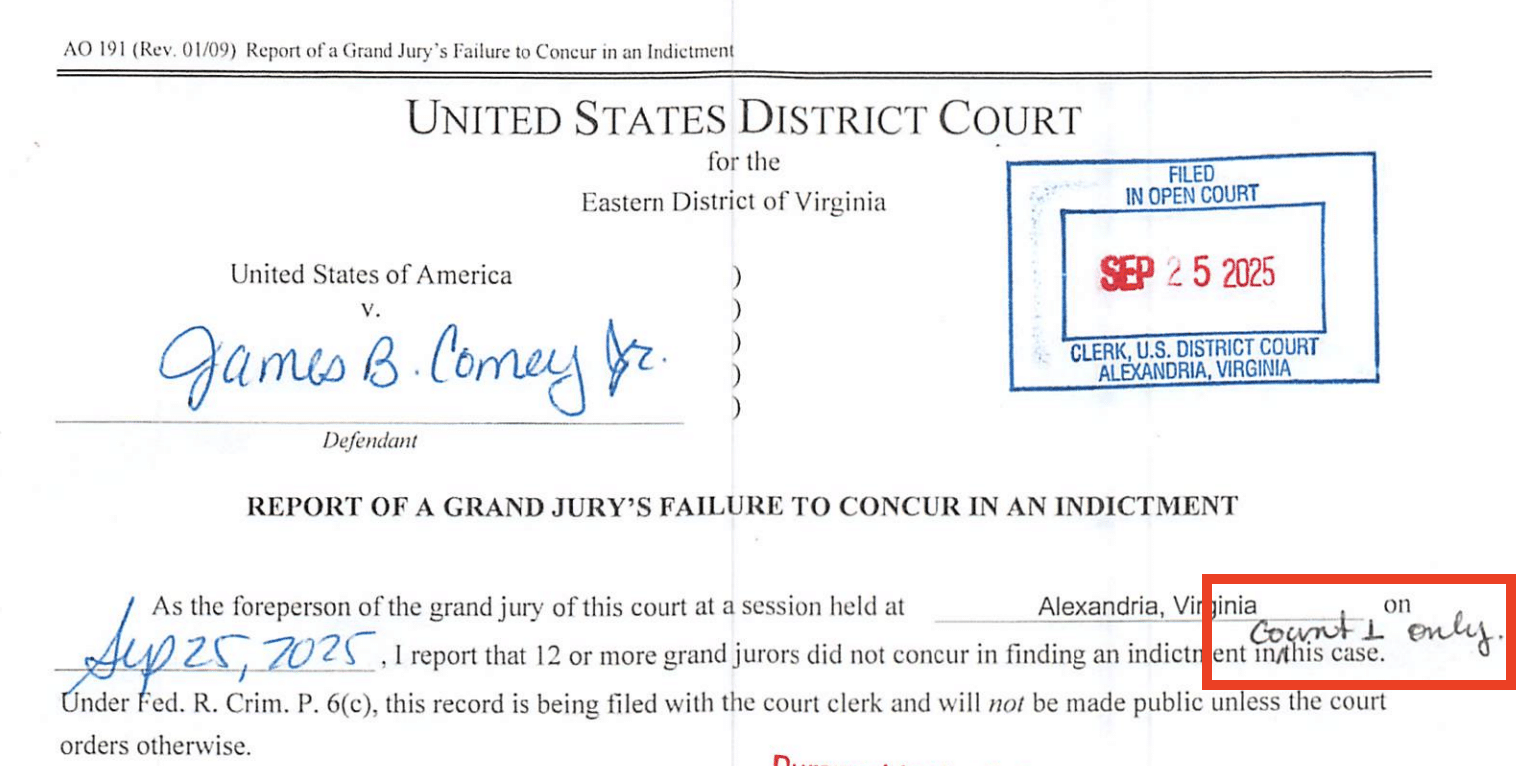
But the only writing on either document that appears to have been added is where (marked with the red box) someone noted, “count 1 only” (which is, indeed, the charge that was dropped). But there’s another irregularity with the document. The rest of it (and the indictment that was filed) looks like it was scanned — with a line down the center and a shadow, as I’ve marked in red.
But the second page lacks both of those things.
And both the charge on page two and the one on page three are called, “COUNT TWO.” Which may suggest someone just put the second page of the failed indictment in between the two pages of the one approved by the grand jury.
All that’s enough that Comey might ask questions about the conduct of the grand jury — something he normally would not be able to do. Given Halligan’s claim she never saw the indictment, it also might raise questions about whether Halligan signed the indictment before or after the grand jury approved it.
And then Halligan would have to explain why she never saw the indictment that she herself signed. Because she’s the only attorney on this filing, she would have to explain the irregularities herself.
That’s not the only question Halligan will face.
It’s not entirely clear under what legal authority she is play-acting as US Attorney. But when Alina Habba was challenged for play-acting as US Attorney after her temporary period expired in New Jersey, a judge ruled that the interim appointment is per position, not per person, meaning that Erik Siebert — the guy Trump fired on Friday — would already have used up the possibility of such an interim appointment in May.
In other words, Halligan may not be US Attorney at all, and unless she fixed that problem by Tuesday, the entire thing might just disappear.
In any case, while EDVA has a rocket docket (meaning this would otherwise go to trial quickly), Halligan’s temporary status could become be a problem before this goes to trial if Comey mounts a vindictive prosecution challenge (LaMonica McIver’s vindictive prosecution challenge is only now fully briefed, three months after her indictment). Then EDVA could be left with an indictment charging Jim Comey but no one willing to stand in a courtroom to prosecute it.
The vindictive prosecution challenge
Even if Halligan survived that long, it is exceedingly likely that Comey would not just get to present a vindictive prosecution claim, which Trump has confessed to over and over, but also to ask for discovery on how that all came about. If granted, I’m sure he’d ask to:
Depose Kash Patel, both about his children’s book naming Jim Comey a “government gangster” but also his conduct in this and related Comey investigations.
Depose Siebert, who decided there wasn’t even probable cause to charge this, much less the ability to prove it beyond a reasonable doubt.
Depose Todd Blanche, who reportedly agreed with Siebert and advised Trump not to fire Siebert.
Depose Pam Bondi because why the fuck not??
Depose Halligan.
Just deposing Kash alone would be a huge problem, because he only got confirmed by lying to the Senate about prosecuting the people in his Government Gangster book.
This indictment proves Kash lied, not that Comey did.
It proves something else, too.
Halligan tried to charge Comey with two lies. I’ll come back to the one that survived — basically, the indictment accuses Comey of lying in 2017 when he said he had never authorized anyone to leak information anonymously to the press.
The Russian disinformation that Chuck Grassley falsely claimed was a Clinton plan
The one the grand jury rejected charged Comey with lying when he said he didn’t recall being told (which the indictment transcribes as “taught”) this memo.
There are multiple problems with the question — posed shortly after Kash Patel and John Ratcliffe released it in 2020.
First, we now know that the “plan” was in fact Russian disinformation sown by fabricating several emails. Investigating based off this document commits precisely the crime that John Durham investigated for years: investigating someone based on something you know to be false.
Worse still, according to every witness that Durham interviewed, no one remembered receiving this memo at all. It’s possible Kash thinks he has found a copy (that seems to be part of what he’s investigating in WDVA), but Durham never did.
Finally, and most insane of all, as I noted here, the redactions in this document and the representation Kash and Ratcliffe made about what it is appear to be badly misleading. That is, this referral appears to be a referral about the Russian plot targeting Hillary, not about Hillary. It is only right wing fever dreams and deceitful redactions that made it into something else.
If Comey had seen this document, he would not remember it in the way that he was asked about it.
So not only is it ridiculous to charge someone for not remembering something that wasn’t that big a deal, but it’s crazier still to charge someone for not remembering a document that you’ve redacted in misleading fashion and then described as the opposite of what most people understood it to be.
All that wasn’t charged, but nevertheless, according to John Durham’s logic at least, Kash committed several crimes by investigating this at all.
Jim Comey will get to expose Ted Cruz as a liar, again
Which finally brings us to what did get charged, part of the exchange above.
1. On or about September 30, 2020, in the Eastern District of Virginia, the defendant, JAMES B. COMEY JR., did willfully and knowingly make a materially false, Fictitious, and fraudulent statement in a matter within the jurisdiction of the legislative branch of the Government of the United Stales, by falsely stating to a U.S. Senator during a Senate Judiciaiy Committee hearing that he, JAMES B. COMEY JR., had not “authorized someone else at the FBI to be an anonymous source in news reports” regarding an FBI investigation concerning PERSON 1.
2. That statement was false, because, as JAMES B. COMEY JR. then and there knew, he in fact had authorized PERSON 3 to serve as an anonymous source in news reports regarding an FBI investigation concerning PERSON 1.
Before Cruz asks the question that got charged, he asked one after another question based on false premises. Comey had to correct the following Cruz lies:
The FBI did not surveil the Trump campaign
The Carter Page IG Report did not show that FBI lied to the FISC 17 times
Cruz misrepresented the email that Kevin Clinesmith altered (it was not used in any submission and Cruz misstated the import of the change)
The FISC was alerted to the political source of the Steele dossier
Cruz falsely claimed that Comey stated that the FISC was informed that the DNC paid for the dossier
Cruz misstated what Comey said about his own knowledge about the funding
Cruz also misstated the facts about Igor Danchenko, but Comey didn’t know enough to correct those.
The actual charged lie starts after 6:30 in the video. Cruz reads Comey’s testimony from 2017, in which he responded to a question from Chuck Grassley whether he had “ever authorized someone else at the FBI to be an anonymous source in news reports about the Trump investigation or the Clinton investigation?”
Cruz then made another misstatement — three actually, that Andrew McCabe, “has publicly and repeatedly stated that he leaked information to the Wall Street Journal and you were directly aware of it and that you directly authorized it.”
Comey did not correct Cruz this time, but he said he stood by the testimony he gave in 2017.
Already, what Lindsey the Insurance Lawyer said in the indictment is a stretch. Comey did not say the words quoted in the indictment. He said only he stood by his earlier testimony. (Effectively, this is an attempt to charge Comey for something he said 8 years ago.)
If she’s thinking this is about McCabe, it also builds on Ted Cruz’s lie. First of all, the IG Report on McCabe (and his public comments) was about the Clinton Foundation — not Clinton, but the Foundation, not Person-1 but the foundation ran by her spouse.
Second, it was not a leak, anymore than Kash Patel’s non-stop frequently inaccurate blabbing on Xitter amount to leaks. It was an authorized conversation with the press.
Third of all, the specific authorization in this case was from McCabe to Lisa Page to serve as a source; it didn’t involve Comey.
McCabe thereafter authorized Special Counsel and AD/OPA to talk to Barrett about this follow-up story.
Where McCabe’s testimony differs from Comey’s is about what McCabe said to Comey after the fact. McCabe said that he told Comey and Comey thought it was a good idea.
McCabe said that he told Comey that he had “authorized AD/OPA and Special Counsel to disclose the account of the August 12th call” and did not say anything to suggest in any way that it was unauthorized. McCabe told us that Comey “did not react negatively, just kind of accepted it.” McCabe also told us Comey thought it was a “good” idea that they presented this information to rebut the inaccurate and one-sided narrative that the FBI was not doing its job and was subject to DOJ political pressure, but the Department and PADAG were likely to be angry that “this information made its way into the paper.” McCabe told us that he did not recall telling Comey prior to publication of the October 30 article that he intended to authorize or had authorized Special Counsel and AD/OPA to recount his August 12 call with PADAG to the WSJ, although he said it was possible he did.
Comey said when he spoke to McCabe about the story afterwards, McCabe denied knowing the source.
Comey told us that, prior to the article’s publication, he did not have any discussions with McCabe regarding disclosure of the August 12 PADAG call. According to Comey, he discussed the issue with McCabe after the article was published, and at that time McCabe “definitely did not tell me that he authorized” the disclosure of the PADAG call. Comey said that McCabe gave him the exact opposite impression:
I don’t remember exactly how, but I remember some form or fashion and it could have been like “can you believe this crap? How does this stuff get out” kind of thing? But I took from whatever communication we had that he wasn’t involved in it. . . . I have a strong impression he conveyed to me “it wasn’t me boss.”
Importantly, Comey disavowed any conversation with McCabe about this particular story before the fact.
Comey told us that, prior to the article’s publication, he did not have any discussions with McCabe regarding disclosure of the August 12 PADAG call.
That’s consistent with what McCabe said.
that he did not recall discussing the disclosure with Comey in advance of authorizing it, although it was possible that he did;
What McCabe has said elsewhere is that Comey had generally permitted just the two of them to speak with the press. But that was not specific to this story at all.
In other words, Ted Cruz got it wrong. Comey’s testimony to the Senate — which on follow-up was specifically about the WSJ story — was utterly consistent with McCabe’s.
Cruz lied. Comey didn’t.
Now it’s possible that Lindsey the Insurance Lawyer is attempting a gimmick, by claiming that Comey authorized Dan Richman to share information about the Hillary investigation (we know this is about Hillary because she is Person-1 in the charge the grand jury rejected). That is, Lindsey the Insurance Lawyer may be trying to apply this Comey answer to Richman.
Except — even assuming he had spoken to Richman about Hillary (the right wing belief, until Richman’s testimony in the last few weeks, is that Comey authorized Richman to talk about the Trump investigation) — Comey could easily say his answer here was about the McCabe reference. [Update: ABC is reporting that it is Richman.]
But if this thing were ever to go to trial — if Lindsey the Insurance Lawyer is really the US Attorney, if the indictment really is what the grand jury approved, if this doesn’t get booted on a vindictive prosecution claim, if Pat Fitzgerald fails to argue that Lindsey the Insurance Lawyer is confused about which FBI Director is a criminal — Comey can almost certainly call Teddy Cancun as a witness, at least to testify about materiality.
It would soon become clear that Comey’s answer, even if it were a lie, could never be material, because Ted Cruz was going to believe what he already believed. Cruz was committed to his false beliefs, no matter what Comey said in response.
But under questioning by a skilled attorney — and Fitz has questioned far bigger blowhards than Ted Cruz, if you can believe it — such testimony would force Cruz to either double down on his lies, or to confess he was the one lying all those years ago.
Right now, there’s not a shred of evidence that Comey lied in his statement.
There is, however, abundant evidence that Kash lied under oath and that Cruz lied in the same way he lies all the time. And if this were ever to go to trial, Cruz would, for once, have the opportunity to face consequences for any lies he told.
Update: CBS got the transcript of the exchange between Lindsey the Insurance Lawyer and Lindsey the Magistrate Judge. It seems clear that the Insurance Lawyer juggled her papers.
[T]wo versions of the indictment were published on the case docket: one with the dropped third count, and one without. The transcript reveals why this occurred.
“So this has never happened before. I’ve been handed two documents that are in the Mr. Comey case that are inconsistent with one another,” Vaala said to Halligan. “There seems to be a discrepancy. They’re both signed by the (grand jury) foreperson.”
And she noted that one document did not clearly indicate what the grand jury had decided.
“The one that says it’s a failure to concur in an indictment, it doesn’t say with respect to one count,” Vaala said. “It looks like they failed to concur across all three counts, so I’m a little confused as to why I was handed two things with the same case number that are inconsistent.”
Halligan initially responded that she hadn’t seen that version of the indictment.
“So I only reviewed the one with the two counts that our office redrafted when we found out about the two — two counts that were true billed, and I signed that one. I did not see the other one. I don’t know where that came from,” Halligan told the judge.
Vaala responded, “You didn’t see it?” And Halligan again told her, “I did not see that one.”
Vaala seemed surprised: “So your office didn’t prepare the indictment that they —”
Halligan then replied, “No, no, no — I — no, I prepared three counts. I only signed the one — the two-count (indictment). I don’t know which one with three counts you have in your hands.”
“Okay. It has your signature on it,” Vaala told Halligan, who responded, “Okay. Well.”
Probably, nothing will come of it. Probably, the only price Lindsey the Insurance Lawyer will pay for this is 1) disclosure of the no bill record 2) exposure of the charge grand jurors refused and 3) humiliation in her first big show.
But it creates surface area and, as I suggested, the possibility that Comey will use it to pierce the secrecy of everything else that went on in the grand jury, including why it took until 6:47 to indict this.
Share this entry
https://www.emptywheel.net/wp-content/uploads/2025/09/Screenshot-2025-09-26-at-19.46.33.png726818emptywheelhttps://www.emptywheel.net/wp-content/uploads/2016/07/Logo-Web.pngemptywheel2025-09-26 15:44:482025-11-02 07:29:57Will Ted Cruz Go to Prison for the Lies He Told as Part of the Jim Comey Indictment?