
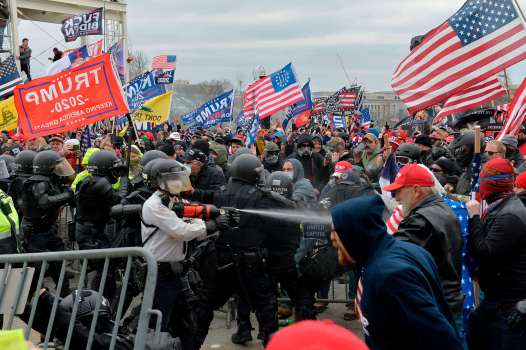
Three Descriptions Of Our Current Turmoil
If we are to believe Hegel – or Collingwood – no age, no civilization, is capable of conceptually identifying itself. This can only be done after its demise ….
Lescek Kolakowski, Modernity on Endless Trial p. 3.
If we can’t find help in dealing with the rise of fascism in older books perhaps we should look to newer material, remembering Kolakowski’s warning. In a recent article in the Boston Review titled What Are We Living Through, Jedidiah Purdy-Britton and David Pozen, law professors at Duke and Columbia respectively, take up this problem. They describe three “scripts” people use to answer the title question. This is an excellent article, worth reading and contemplating. In this post, I will briefly describe each script, the changes each suggests, and then offer some thoughts.
The Scripts
1. The Authoritarian Turn. The Trump regime represents a sudden shift into a dangerous authoritarian future. This view is mostly held by centrists, which I think means most Democratic politicians.
2. More of the same. The Trump regime is the culmination of decades of slow erosion of democratic society. Trump is accellerating it. This is a more leftish view.
3. Constitutional Crisis. The Trump regime is just another constitutional crisis, based on an electoral victory and a challenge to the existing regime. It’s like the FDR administration creating the New Deal. This is the view of Trump supporters and conservative intellectuals.
Trump’s decisive Electoral College victory in 2024, after a campaign with more sharply defined stakes than in 2016, put a popular (if not quite majoritarian) imprimatur on such change. Following a playbook developed during the New Deal and refined in the civil rights era, Trump’s team is employing all the tools at its disposal to reshape the balance of power across state and society in line with campaign pledges to curb illegal immigration, shrink the federal workforce, restore religion in the public sphere, and advance a “colorblind” conception of racial equality.
The difference between the Authoritarian Crisis view and the More of the Same view is continuity. The former suggests that the US was mostly fine and getting better, but then Trump came along. The latter suggests that this regime didn’t come out of nowhere, but is an acceleration of a long process of deterioration. The Constitutional Crisis theory is based on the idea that for some decades the US has lived under a ‘liberal hegemony”, and the second Trump regime is a counter-revolution against that hegemony.
The authors generate a list of horribles which justify each script. I assume we all know the horribles for the first two. The list for the third is culture war issues, and Republican revanchism.
The MAGA movement wishes to dismantle not just a policy here or a doctrine there but a whole edifice of laws, norms, and values that it sees liberals as having imposed through their dogma of “living constitutionalism” and their sway over regulatory bodies, universities, foundations, and legacy media organizations. Although a “radical” reform agenda of such scale may not sound very conservative, nothing less will suffice, on this view, to overthrow the prevailing forces of institutional and ideological control.
Actions suggested by scripts
The Authoritarian Crisis view suggests that we need to return to an earlier era of cooperation and bipartisanship. The main goal is decentralization of power after a turn to the concentration of power in the Presidency.
The More of the Same partisans will want a broad array of changes in the structure of government, and aggressive efforts to attack oligarchical control, reactionary courts, and right-wing extremists stuffed into government at all levels.
The Constitutional Regime Change script suggests that liberals and others who disagree should continue with normal political opposition. If enough people don’t like Trumpian government they can just vote the scoundrels out.
Each of these points is worked out in reasonable detail by the authors, making the article fairly balanced.
Discussion
General.
I agree with the authors that these three scripts accurately set out the basic features of current political discourse. I question whether anything a Trump advocate says is actually connected to anything the Trump regime says or does, but I’ve seen echoes of this argument elsewhere.
It seems to me the article generates two important questions. First, the authors don’t offer much explanation of how these changes started and increased to the current state. Second, it doesn’t talk about the role of the rest of government, especially the Supreme Court, which is surprising because the authors are law profs. Both are important for figuring out what is to be done. I’ll take these issues up in another post.
2, My view of the rise of authoritarianism.
I think people everywhere have deeply embedded ugly feelings that at our human best we try to eradicate, or at least repress into meaninglessness. But not all of us, and not always successfully. I think there was a period in recent US history where a large majority of us were shamed by those ugly streaks, and worked to eradicate them. But they are still there for a lot of people, smoldering, available to any demagogue who might benefit from stoking them.
As we see in Hannah Arendt’s The Origins Of Totalitarianism, anti-Semitism has been an undercurrent in Europe since at least the Middle Ages. By the mid-19th Century most middle and upper-class German and French Jews felt they were assimilating, becoming just regular citizens. But there remained a number of non-Jews in whom it never died out. There were occasional outbursts like the Dreyfus Affair in France, which flared up and then died uneasily, but mostly things seemed to be improving.
After social upheaval and economic disasters in Post-WWI Germany, anti-Semitism was a natural tool for the Nazis, creating an enemy within, and justifying the Holocaust. It was effective in Vichy France as well. In one poignant example, the granddaughter of Alfred Dreyfus, Madeleine Levy, was captured by the Vichy police and sent to Auschwitz, where she died of typhus at the age of 25. We still see it today in England, where the Labour Party was roiled by allegations of anti-Semitism. It’s present in the US, too.
In exactly the same way, racism has been part of US society almost since the first settlements here, as shown by Ibram X. Kendi in Stamped From the Beginning. Anti-immigrant sentiment was a natural tool for 19th and early 20th C capitalists to use to divide the working class. Misogyny and homophobia have even older roots in cultures as far back as we have records. In the US, we add a layer of anti-intellectualism, our own contribution to manipulation.
These ancient prejudices are natural wedges which have been used by elites through the centuries to divide and control people. Today those tools are explicitly welded by the right-wing and its billionaire backers. There are at least 1150 billionaires in the US today, and they control our economy. That control is obvious in mass media, including social media. Billionaires and their hirelings have tools to control discourse and direct the attention of huge numbers of voters who may not even realize how they are being manipulated.
Maybe most of the billionaires snd rank and file Trump supporters don’t think of themselves as prejudiced in any way. But they supported the overtly racist, xenophobic, misogynist, homophobic Trump. They probably like science and technology, but their Senators approved RFK, Jr., and stood by while he and Elon Musk wrecked governmental research.
There are other factors that reinforce this top-down justification and support for hate and fear, including inequality of income and wealth, inflation, and lack of critical thinking. But for many of us media-inspired fear and hatred make it impossible to see the actual causes of actual problems.
And that’s how we got here. Too many of us either wanted or ignored the hatred and justified their votes with the lies about the economy paid for by billionaires.


What’s a conservative intellectual?
Rich people with multiple degrees who are somehow gullible enough to believe conservatism still exists in US politics.
Somebody who conserves the things that, to them, matter; that seem important to society and its regular functioning. And actually stops to think about why they should do so rather than just making a knee-jerk response to the latest media story.
“What’s a conservative intellectual?”
Gosh, there’s got to be a hundred punch-lines for that joke.
Actually, that’s a line where the setup and the punchline are one and the same!
An effective right-wing propagandist.
Regarding your reference to antisemitism in “England” (should really be UK, England is only a part of the country, ) the antisemitism which was alleged in the Labour Party is subtly different from “traditional” antisemitism, which no doubt exists as well but largely on the right. It is based on opposition to the policies of the Government of Israel, its strategy and tactics. There are those its suits to blur the line between proper opposition to Israel, perhaps visceral under the current circumstances , and hatred of Jews as a whole. Here in the UK this dividing line is currently extremely difficult to navigate. Those who try to approach these problems using rigorous analysis find it especially difficult. That ought to be recognised when looking on from afar.
“Jews were expelled from England in 1290 by King Edward I’s Edict of Expulsion, a decree issued on July 18, 1290, that forced the entire Jewish population to leave the kingdom by November 1, 1290, ending centuries of their presence and lasting over 360 years until their readmission began in the 17th century.”
England was the first European country to expel Jewish people. Spain didn’t do it until 1492.
Then again, they elected Benjamin Disraeli, of Jewish heritage though he converted to Anglicism at the age of 12 because his father got into a controversy with his fellow Jews and wanted to advance the careers of his children, in the 19th century.
I’m not really far on the left but I saw these authoritarian trends during Bush II. A number of folks imagining a perfetualxright wing rule, coupled with government propadandistic manipulation of elections, though not to the degree we saw in 2024. The regime in the early 200s proved to be incompetent. I think folks are realizing this in spades with our current overlords. If we get control back we need a serious reform to prevent this catastrophe from recurring. The damage after even one year will leave permanent scars.
[Welcome back to emptywheel. Please use the SAME USERNAME and email address each time you comment so that community members get to know you. You attempted to publish this comment as “phil” triggering auto-moderation; it has been edited to reflect your established username. Please check your browser’s cache and autofill; future comments may not publish if username does not match. /~Rayne]
We’re watching the difference between conservative and reactionary play out in real time. Too few people understand the historical difference. Make America great again is a reactionary slogan calling for a return to a mythical golden ere and reactionaries will resort to violence to get their way.
I’ve been saying they’re reactionaries for at least a year.
The most important point in Purdy-Britton and Pozen’s article is, “Although they appear fundamentally at odds, there is a sense in which all three accounts of the second Trump administration can be true.” Most people in the authoritarian and more-of-the-same camps likely recognize that the constitutional-change camp is simply a sleight of hand. Reality has stripped that story of legitimacy. These are not competing ideas, they are frames designed to justify responses, mostly fostered by the MSM, journalists, academics, and especially politicians.
“Today those tools are explicitly welded by the right-wing…”
Did you mean ‘wielded’?
Jane Mayer’s Dirty Money lays out the concerted effort by right wing conservatives with a John Birch leaning to alter the political landscape through ‘charity’ funding…
And, in some ways, that book only scratches the surface. The fascist underpinnings of what is called “conservative” in the US has been around for a 100 years. HCR and Rachel Maddow have done yeoman work in bringing this history back into the light. The thing that I will contend is that every one of these nascent fascists is psychologically damaged, and this is why they are impossible to reach (or nearly, under the most generous assumptions).
Since Mayer’s book others like Katherine Stewart and Anne Nelson have expanded and deepened the research. For me, money is THE critical factor in explaining the authoritarian insurgency that started (from my perspective) with Reagan and led to Trump. More than anything, it was the purchasing. power of the right that explains Bush v. Gore, the indefensible decision that affirmed which path the US would take in the new millennium.
Leonard Leo funneled $$$ into creating the current corrupt SCOTUS, which has every intention of locking us into authoritarianism under the guise of the Unitary Executive.
What’s a conservative intellectual? File that with what’s a conservative think tank. Filed next to Project 2025.
Was Madison a conservative? Or just someone wanting guardrails?
Thanks for this recitation as the references allowed me to find David Pozen’s book The Constitution of the War on Drugs. I am just at the introduction and his look at how the Judicial system viewed this war has been detrimental to individual rights has been foundational for allowing the authoritarian bent to take hold. In my view the fear of rising crime that was occurring exactly at the point when an attempt to have a permissive view of recreational, or my preferred word responsible, drug use was being considered had the unfortunate result of “blaming” that crime rise on drugs.
While conservatives believed that they had every right to vote for individuals that would manage a woman’s womb, the left capitulated to that power by voting for the state to manage our use of naturally occurring plants. Giving into Federal or State control over individual choices got the US to this point and both parties helped make it happen and seemingly for the same reason, to protect the children.
Well my cohort certainly used a great deal of recreational drugs; we had far less overdoses occur than those of their offspring. What this cohort is finding is that mom’s Xanax is not the same as the one’s purchased off the street while my cohort is still buying and using the same drugs we learned how to responsibly use in the late 70s and 80s. My cohort is also still lying to their kids about drugs just as my parents did, much to my astonishment.
We now know why violence was rising in the 70s and 80s and that same issue contributed to an increase in drug use, but our response to let Drug War continue was the Left’s failure, which continues to this day. It is my contention that it is not Constitutional to ban plants/fungi from human use anymore than it is Constitutional to use the power of the state to manage a citizen’s womb. I think pounding these two messages would help break down the fear of individual choice in our society.
I dread the upcoming “War on Drugs”–when Trump declares that “narcoterrorists” live among us, include US citizens, and will now be subjected to “lethal force” just like those anonymous boaters in the Caribbean. Because “drugs.”
It worked in the Philippines!
[Welcome to emptywheel. Please choose and use a unique username with a minimum of 8 letters. We adopted this minimum standard to support community security. Because your username is too short and common, your username will be temporarily changed to match the date/time of your first known comment until you have a new compliant username. /~Rayne]
“worked”
https://en.wikipedia.org/wiki/Rodrigo_Duterte#Arrest_and_detention_at_the_International_Criminal_Court
I think you forgot the snark tag.