
“Border security is the primary element of national security.”
That sentence — “Border security is the primary element of national security” — comes from page 11 of the National Security Strategy.
Border security is the primary element of national security. Not one important element. The primary one.
That’s an insane assertion, of course. The military, the economy, real terrorism (including far right terrorism), cybersecurity, sovereign democracy all take a back seat to whatever Stephen Miller flunky had final control over the edit of the NSS, who wrote down something insane, prioritizing the border over all else.
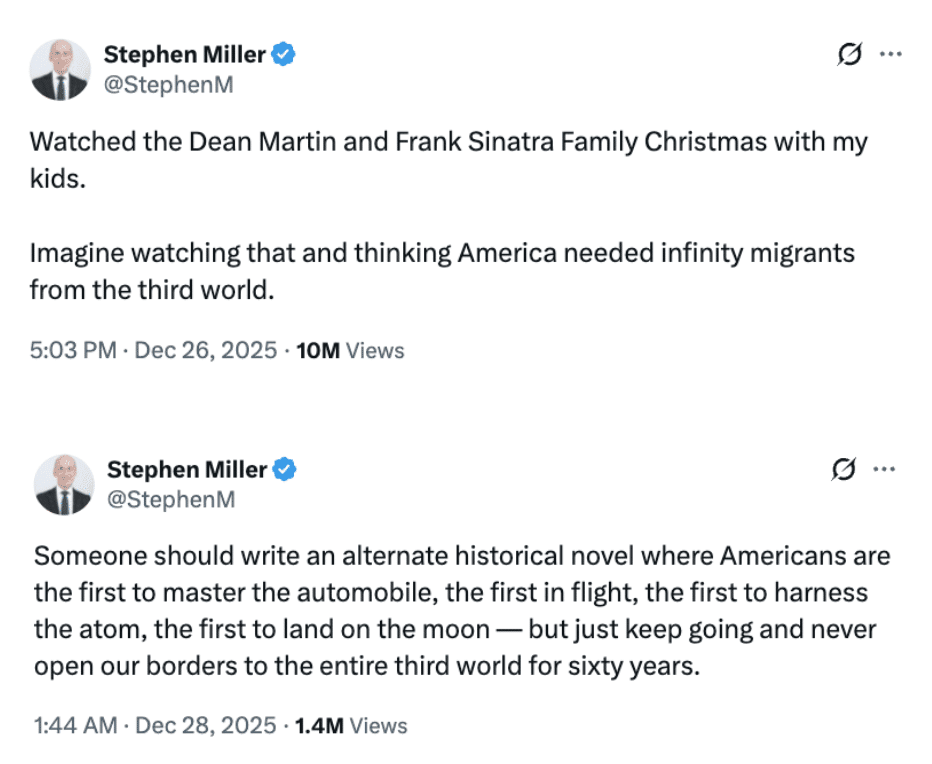
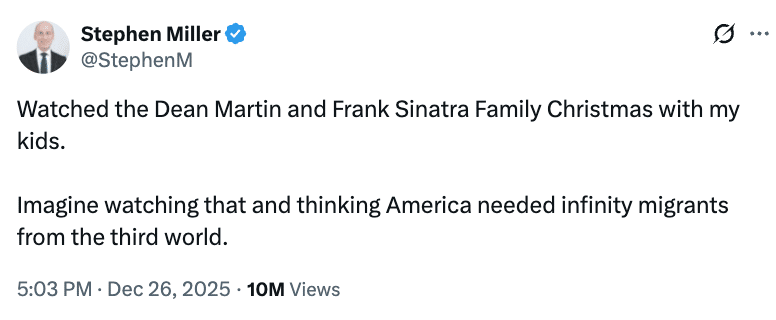
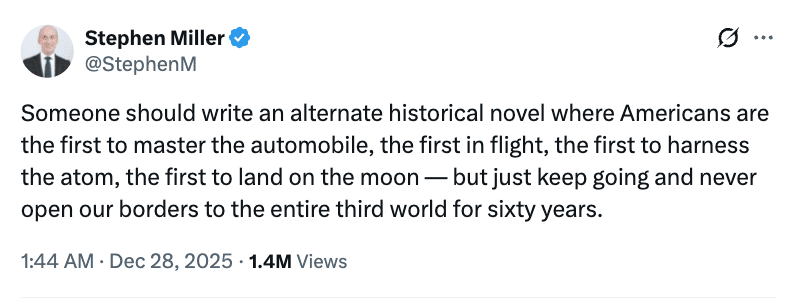
I’ve been obsessing about that comment ever since I read it, and kept thinking of it as I read this long NYT article that purports to explain Trump’s “policy” to target Venezuela. The article came out after I wrote this post attempting to understand Stephen Miller’s most prominent reversal over the last year, and in-between these two Tweets that make it very clear Miller’s entire conception about immigration to the US — even his own family’s immigration to the US — is based off his historically ignorant fantasies.
The story might be better staged as a Coen Brothers buddy movie featuring Stephen Miller, channeling Dr. Strangelove, looking for any opportunity to push harder against immigration, preferably in the form of bombing, even if it contributes to the root cause of drug trafficking and immigration, while Marco Rubio pursues the most stale kind of Cuban-American politics.
The story is so rambling, presumably because the subject and the insanity requires it, that I will attempt to map it.
NYT claims the current focus on Venezuela started when Marco Rubio signed a deal with Nayib Bukele to deport 300 people to his concentration camp.
The seeds of militarizing the approach to Mr. Maduro and Venezuelans were planted in February, when Mr. Rubio struck a deal with Nayib Bukele, the authoritarian leader of El Salvador, at his lakeside villa: The United States would pay nearly $5 million to send about 300 Venezuelans accused of being gang members to El Salvador’s Terrorism Confinement Center, or CECOT.
Soon after his visit with Mr. Bukele, Mr. Rubio designated eight Latin American criminal groups as foreign terrorist organizations. Tren de Aragua, a Venezuelan gang, topped the list.
Mr. Miller had already landed on a legal tool to bypass due process: the Alien Enemies Act, an 18th-century law that permits immediate detention and deportations of citizens of a country that has invaded the United States or is at war with it.
Mr. Trump signed an executive order in March invoking the act, with a title warning of “the invasion of the United States by Tren de Aragua.” In retrospect, the order was an important opening salvo against Mr. Maduro: It was the administration’s first formal framing of Mr. Maduro and the United States as being in a type of war. Contrary to a secret U.S. intelligence assessment, it said Tren de Aragua was an instrument of Mr. Maduro.
In this story, NYT is silent about Bukele’s goal with this deal — to obtain the return of MS-13 members who were testifying to his own ties to the gang (it is also silent about Trump’s pardon of Juan Orlando Hernández). It nods to the multiple lies Trump’s Administration told to claim the men it was sending to CECOT were gang members or even criminals (something covered at more length in this story, which it links). But it doesn’t describe how by misrepresenting the men, the Trump Administration failed to fulfill the terms of the deal made with Bukele.
Stephen Miller’s lies were a problem even for Nayib Bukele.
But NYT also doesn’t explain a temporal problem with this story: As the next major section of the story explains, at the beginning of the Administration, Ric Grenell had gotten Nicolás Maduro to accept deportation flights.
It began when Cuban American lawmakers pressed Mr. Trump early this year to end Chevron’s Biden-era confidential license. After Mr. Trump and Mr. Rubio announced in late February that they would do so, Mr. Maduro stopped accepting deportation flights of Venezuelans. Mr. Maduro had agreed to them on Jan. 31 with Richard Grenell, a special envoy for Mr. Trump.
One point of sending the men Stephen Miller falsely claimed were TdA members to CECOT was that Maduro was refusing to accept them. But Maduro had earlier agreed to accept them. So to understand the need to send planes full of men falsely claimed to be TdA members to Bukele’s concentration camp, you have to review Trump’s flip-flops on Chevron’s license to export Venezuelan oil.
That Chevron section goes like this:
- January 31: Maduro makes a deal with Grenell.
- February: Cuban-American Members of Congress (CAMC) pressure Trump to pull the Chevron license, which he does in late February (possibly between the time Rubio signs the deal with Bukele and the day 200 mostly-innocent men are loaded on planes?).
- Chevron CEO Mike Wirth notes that if Chevron can’t export Venezuela’s oil, China will do so.
- CAMC learn that Trump might reverse his decision, so threaten to vote against the Big Ugly Bill.
- Stephen Miller pitches Trump on murderboats.
- Trump lets Chevron license expire on May 27.
- CAMC vote to pass Big Ugly.
- Around the same time Trump considers a pardon for convicted drug kingpin Hernández, Marco Rubio sells Trump on a claim that Maduro is a drug kingpin.
- July: Based in part on Wirth’s China argument, Trump reverses course, again, on Chevron license, Maduro accepts the CECOT prisoners and releases 10 Americans, including a triple murderer.
So while Trump was helping Nayib Bukele bury his ties with a dangerous gang and weighing a pitch to free convicted drug kingpin Juan Orlando Hernández, he began entertaining the idea of using the claim that Maduro is a drug kingpin so he can satisfy Stephen Miller’s need to bomb something and Marco Rubio’s Cuban-American fantasies.
Meanwhile, for reasons NYT doesn’t fully explain (though it suggests this was about SCOTUS’ decisions against the Alien Enemies Act), Stephen Miller was searching for things to bomb.
At the same time, Mr. Miller was exploring policies unrelated to Venezuela that, like the deportations, had their roots in the so-called U.S. war on terror. He looked at the idea of bombing fentanyl labs in Mexico. But it became clear that Mexican leaders would not consent, and the administration feared losing their cooperation on drug and migrant issues. The Washington Post reported earlier on Mr. Miller’s discussions about striking cartels in Mexico.
By early May, Mr. Miller’s team began asking for further options for using force against drug cartels.
White House officials and others bandied around relatively more constrained ideas, including using the C.I.A. to carry out covert strikes on docked boats that did not have people in them. But Mr. Miller’s team wanted to publicize the strikes. Officials also discussed blowing up fake drug boats to instill fear in traffickers. But Mr. Miller’s aides wanted the real thing, officials said.
This passage adds to what The Atlantic reported — that Miller wanted to murderbomb people “to paint immigrants as a dangerous menace.” But Miller demanded that he get real dead people, not just fake drug boats (and to be fair, given the degree to which various nations are tracking the specific people being murderboated, Miller was right that he needed real dead people for whatever purpose he believes this serves, even if his claim it serves that purpose is probably baseless).
Then Trump or Miller or Marco came up with a list of drug gangs they wanted to target, some of which have little relation to the danger the gangs represent, some of which are (like many of the claims about Tren de Aragua beforehand) invented.
On July 25, [Trump] signed a secret order telling the Pentagon to take action against drug-trafficking groups, putting in motion the targeting of Venezuelans.
[snip]
The two-page order contained a previously unreported written proposal for boat strikes. It directed Mr. Hegseth to target vessels in international waters carrying drugs for any of 24 Latin American “narco-terrorist” groups. The attached list included ones from Venezuela.
[snip]
The secret list of 24 groups included major cartels and groups that the Trump administration had formally designated as terrorists, along with numerous relatively obscure Mexican gangs. The same day Mr. Trump signed the directive, the Treasury Department announced sanctions against “Cartel de los Soles,” a slang term for drug corruption in Venezuela’s military, declaring it a terrorist organization led by Mr. Maduro. The name was at the bottom of Mr. Trump’s secret list.
And that’s where Trump’s flunkies turned to cutting and pasting legal rulings from the war on terror to be used in Stephen Miller’s campaign to create dead bodies that he can spin as evidence of the danger of immigrants.
Only, in their rush to brainlessly cut-and-paste from a WOT policy that was unsuccessful in its original incarnation, these geniuses failed to consider that drone strikes on the sea are different, legally, from drone strikes on land.
Around the same time, a Trump appointee with little national security law experience was drafting a Justice Department memo saying boat strikes would be lawful based on Mr. Trump’s wartime powers. The legal blessing was already developed by late July, when the Senate confirmed the top two lawyers responsible for reviewing such an operation — T. Elliot Gaiser, head of the department’s Office of Legal Counsel, and Earl G. Matthews, Pentagon general counsel. They were essentially presented with a done deal.
[snip]
Mr. Hegseth signed an execute order that created the operational framework for the attacks. Dated Aug. 5 and written without input from many career Pentagon officials, it lifted language from previous orders developed for drone strikes against Al Qaeda targets in places like rural Yemen.
It lacked elements crucial to maritime operations — including any mention of what to do with shipwrecked survivors of an attack, officials said.
[snip]
The Pentagon also bypassed a process called the Maritime Operational Threat Response, used to get input from various agencies when proposing a maritime action with international implications, said William D. Baumgartner, a retired Coast Guard rear admiral and lawyer who oversaw Caribbean operations.
Which is how Miller, Rubio, and Whiskey Pete Hegseth got themselves in trouble for even worse murder, that of survivors of the initial drone strike.
But that wasn’t yet good enough for Strangelove Miller. One of his top aides then loosened the standards from what they were in the WOT.
During the planning, an aide to Mr. Miller, Anthony Salisbury, pushed the Pentagon for ways to expand the scope of the operations, including loosening standards — like the level of confidence military officials would need that a target meets the criteria. Gen. Dan Caine, the chairman of the Joint Chiefs of Staff, advised that the military establish targeting criteria using lessons learned from the post-Sept. 11 wars. Ms. Kelly, the White House spokeswoman, said the account of Mr. Salisbury’s role was “made up.”
The NYT story ends with the unresolved problem posed by murderboats — what to do with survivors.
On the same day, WaPo described what happened when one of the only survivors — a known drug trafficker — was returned to Ecuador.
The police arrived at the airport prepared to arrest a drug trafficker — a mariner whose crewmates the U.S. military had just killed.
Andrés Fernando Tufiño Chila was one of only two people known to have survived a U.S. strike on a vessel that the Trump administration alleged was smuggling drugs from South America. President Donald Trump had described the Ecuadorian and a fellow survivor of the Oct. 16 strike in the Atlantic Ocean as “terrorists” who would be returned to their countries of origin “for detention and prosecution.”
[snip]
Tufiño, then 41, stepped off the U.S. military plane at the Quito airport on the morning of Oct. 18 in shackles, cut and bruised from the attack but walking on his own, according to Col. Carlos Ortega, then the director of anti-narcotics for Ecuador’s national police. He was already a known trafficker: He had pleaded guilty in U.S. federal court to cocaine distribution conspiracy in 2021 and served more than three years in a U.S. prison before he was deported home to Ecuador last year. Now the U.S. military had picked him up amid the wreckage of a semisubmersible vessel — a “narco sub.”
In his gang-controlled hometown, Tufiño was known as Fresco Solo, neighbors said, a skilled navigator who they alleged was recruited by criminals to smuggle drugs north.
But in transferring him to Ecuadorian custody, three officials here said, U.S. forces didn’t provide any evidence that could be used to detain him — no seized drugs, no phone or GPS records, no videos, none of the intelligence that led them to target his vessel.
On landing in Quito, U.S. officials told the Ecuadorians that the transfer was a “humanitarian” repatriation, Ortega said.
Within hours, Tufiño was let go.
There’s very little discussion in the NYT about what happens if Marco and his Cuban-American cheerleaders get their wish, a collapse of the Maduro and Cuban Communist regimes. As noted, they ignore the degree to which this policy has led to three drug traffickers — Hernández, Bukele, and Tufiño — going free. There actually is an interesting question about what will happen to the drug trade if the US makes sea trafficking less lucrative after having shut down the US-Mexico border to illegal entries. Drug markets don’t disappear; they morph, and such shifts can bring really serious unintended consequences.
After all, one of Miller’s blind spots are the American citizens who play a key role in all this trafficking. And by treating drug trafficking as an immigrant problem, he surely makes it easier for citizens to go undetected — the kind of detail real drug criminals tend not to miss.
Meanwhile “China” is mentioned just twice in NYT’s 3,400-word article laying out how a rather senseless “policy” on Latin America has developed. But then these are the same geniuses who started a trade war with China that gave China a great deal of new leverage over the United States based, in part, on claims of fentanyl trafficking.
As noted, this NYT story really would be better as a humorous buddy flick, because it is so full of idiocy.
Update: Trump is murderboating off invented intelligence not just against Latin America; it appears he did the same in Nigeria.


I think CAMC should be changed to “Little Havana Members of Congress” since many haven’t had ties to Cuba in decades. They are as Cuban as many Boston Irish are.
What I find missing from your timeline is what Chevron did between telling the White House that it was giving China “free oil” from Venezuela and their license expiring. There’s no way that a corporation full of sociopaths with real-world experience in dealing with tinpot dictators didn’t have tools and knowledge to swing Trump around…and they did nothing.
True. I was struggling for words to describe how frozen in time this politics is.
And meanwhile neglected to mention a Democrat just got elected Mayor of Miami, in part bc of a reaction to Trump’s attacks on Latinos.
Since sycophant-of-all-trades (and master of none) Richard Grenell was mentioned: in addition to his past roles as ambassador to Germany (2018-20), special presidential envoy for Kosovo and Serbia (2019-21), acting DNI in 2020, and now currently special presidential envoy at-large…In his newest role as President of the Dear Leader and John F. Kennedy Center for the Performing Arts, his first notable act in that role has manifested in threatening to punish jazz drummer Chuck Redd for last-minute cancellation of his traditional Christmas gig at the Kennedy Center due to the name change, to the tune of $1 million.
One can only wonder whether he’ll accept payment from Chuck in crypto and then stuff it in his own pocket. If not, he’ll have to wait for the proceeds of Chuck’s next 100 gigs from generous donations to the musicians’ tip jar.
https://www.theguardian.com/us-news/2025/dec/27/kennedy-center-chuck-redd-canceled-concert
“Strangelove Miller”, nice! Dr Strangelove, a repurposed Nazi whose uncontrollable sadistic impulses could not be contained, reaping unintended consequences.
A few months ago, Dr Strangelove was shown in theatres. It was a real treat to watch, so well made, so much masterpiece.
Trying to imagine movie goers in 1964 watching this film in real time, that had to be extremely terrifying for audiences to recognize the stakes. The film had to have an influence on the voters to avoid that trajectory, and that kind of presentation is needed today.
Re. Your Strangelove comment: It might be an instructive triple feature to pair “Dr. Strangelove” with two other prescient creations from the brain of Stanley Kubrick, “Eyes Wide Shut” and “AI: Artificial Intelligence.” The latter film was directed by the estimable Steven Spielberg from a Kubrick concept and treatment.
My favorite part of this past Christmas was going through my niece’s new “Monsters of Hollywood” book with her. She’s 19 and a movie buff. When we got to a page with a very small* mention of Dr. Strangelove, I urged her to see it–she’s older than I was when I first saw it, so likely wise enough to get the jokes.
*John Landis put this book together. I suspect directorial jealousy.
Steve Coogan recently did a stage production of it in the UK where he played all the Peter Sellers roles plus Major Kong (the bomber captain played by Slim Pickens in the film). I saw a theater telecast of it, good stuff. Noted that the battle plan that allows General Ripper to start World War III is based on a variant of unitary executive theory.
Saw it in London. Whilst enjoyable, it didn’t hold a candle to the original (Sellers, Scott, Hayden). The sobering thing is that Trump, Hegseth, Miller, et al are likely more incompetent, more salubrious, and more adolescent than the original satire.
Reading this passage gave me a huge sense of Déjà vu.
Nicaraguan Contras, Kuomintang and the Golden Triangle, pre-Castro Cuba, Northern Alliance Afghanistan, Nugan Hand Bank, Manuel Noriega, BCCI, Charles Manson…
US shadow policy has been to selectively determine when drug trafficking is bad, and when it has utility. What is the difference in current events? Is the beat just going on?
The prospect has a great article about Rubio’s family connections to the Contras and elite drug traffickers, it was really eye-opening on the topic! I personally had no idea he was so entwined in that world… perhaps it also helps explain why some of these specific drug kingpins were allowed to go free?
https://prospect.org/2025/12/23/narco-terrorist-elite-rubio-south-america-iran-contra/
Excellent piece. Really detailing the cartels Trump and Rubio selectively support, and the backstory on Rubio.
A detail I learned, is the Tether is the preferred narco currency.
https://www.404media.co/tether-has-become-a-massive-money-laundering-tool-for-mexican-drug-traffickers-feds-say/
And this passage on Venezuela specifically:
For all the whining about deep state and starting wars, Trump sure seems to be doing the same thing, but out in the open and a an unprecedented scale.
As I recall, Frank Sinatra and Dino Paul Crocetti (Martin) came from Italian immigrant stock and in those days Italians weren’t considered fully white. Perfect poster boys for Miller’s project indeed!
Henry Ford was the son of immigrants. The Manhattan Project relied on the innovations of European physicists. The American space program was built largely on the efforts of German scientists that we took in after WWII. Miller’s belief in American technological superiority is ill-informed, or deliberately obtuse.
Miller seems to forget that his official boss is the son, grandson, and husband of immigrants.
‘German scientists that we took in after World War II when they had murdered 30,000 slave workers at Dora-Nordhausen’
I cannot find the exact quotation, but more than once trump has said something along the lines of, ‘Oh, yeah, well we did some horrible things, too.’
I suppose that helps him quieten whatever tiny smidgen of conscience he may have. The United States has been supporting fascism abroad since June 1950. Now we get a taste of our own medicine.
Miller’s ignorance is actually impressive. Cars and planes were being developed in Europe both before and concurrently with US efforts around the late 1800s. One of the major reasons for the Manhattan Project was a fear the Germans were going to build a fission weapon, something I think the Japanese were already working toward. Radio was a European technology, initially, and radar came from the Brits to help defeat German subs. The list certainly goes on.
There’s a reason Miller keeps hammering that “Third World” garbage. He (and Trump) want to validate all things European: what they call “western civilization” and identify almost exclusively with Christianity and *exclusively* with white people.
You know…like Hitler.
They (at least Pete Hegseth) are plenty vicious on the subject on Native Americans too. Not “European” enough, obviously.
It seems to me that ““Border security is the primary element of national security” should be looked at not just as securing borders from the invading hordes, but also preventing free outward-bound travel.
How different is it to be asked for “Ihre Papiere, bitte” on the way in or out? We’ve also seen some legislative attempts to have this happen at state borders (between pro/anti abortion states.)
This can happen when an authoritative regime wants to start to control movement of the population and also wants to let the AI cameras/etc. have a good look at its individuals.
One of the reasons there used to be a consensus against assassinating world leaders – apart from “uppity” newbies in post-colonial third-world countries – was the elite’s consensus that “What goes around, comes around.” The truism was made more real by JFK’s assassination. But that appears to be one of the many lessons Trump-Murderboat-Vought can only learn the hard way.
And not nearly soon enough
All of this analysis gets it exactly backwards. There’s no Venezuela policy, no drug policy, no border policy. There are only totalitarian power grabs. Miller wants to build a secret police force to oppress people he hates (first, third world immigrants, then lgbt folks and eventually his political enemies). Every action described here makes sense if you see that it’s all geared towards turning this country into a totalitarian state.
Well, that’s what I was trying to suggest.
The murderboating is key. He didn’t care WHO he murderboated, so long as he was allowed to murder, even if he had to make up terrorist groups to excuse it.
Creepy little Steven Miller just enjoys hurting people. People who knew him in high school say he would say outlandish things just to get attention. He is an attention-deprived sadist who thinks he can change peoples views of capitalism and Western exploitation by bombing those ideas into people’s heads. He is a sick man and needs to find out that there are societal consequences for targeting people for murder without due process.
This’ll be the last time I say it. I promise. But I’ve seen it too many times.
Miller is a perfect example of how the matzoh crumbles; into a half-baked cracker.
Miller aka Rasputin has far too much power for one unelected person. How to wrest it from him? He’s not even subject to impeachment, correct?
So many Rasputins, so little time. Bannon was/is rasputin-esque. Putin’s Rasputin, Alexsandr Dugin (still alive!), is also Peter Thiel’s Rasputin, Curtis Yarvin’s Rasputin, and possibly J. D. Vance by inheritance. Steven Miller is just somebody who can never get over being ordered to pick up his own trash at high school. It evolves.
I wonder if Miller knows the classic Jewish joke about the Rabbi in cheder, and his student, who is reading an astronomy book.