
In Indictment of Aurelio Perez-Lugones, DOJ Proves It Didn’t Need to Search Hannah Natanson’s Home
DOJ has indicted Aurelio Perez-Lugones, the government contractor accused of leaking classified information to the WaPo journalist whose house it searched after arrested Perez-Lugones, Hannah Natanson.
The indictment is written in a way that may harm the case, and that should make it easier for WaPo to demonstrate the overkill of the searches — which include 2 MacBook Pros, an iPhone, a portable hard drive, her Garmin running watch, and her voice recorder — targeting Natanson.
After all, DOJ has screen shots of Perez-Lugones allegedly sending Natanson photographs of classified documents. They don’t need anything from her.
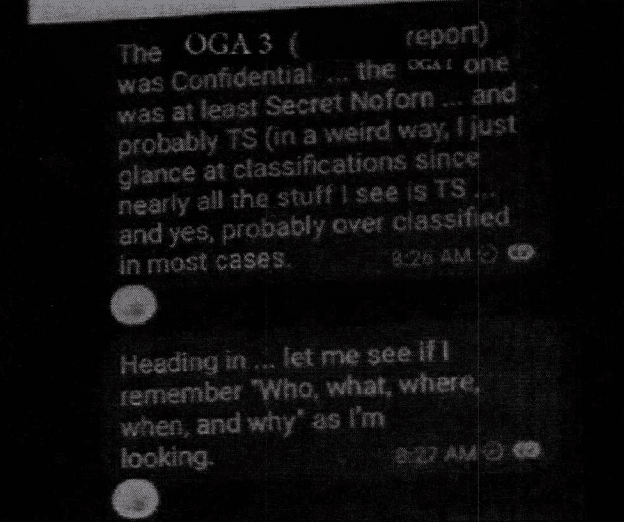
Plus, they do something I’ve never seen in a classified leak case: identify all the stories in which the purportedly still-classified information appears. The indictment reveals:
- This October 31, 2025 story about Venezuela asking Russia and China for security assistance included Top Secret/SCI/NOFORN information.
- This November 11, 2025 story about potential targets in a US attack included Secret/NOFORN information.
- This December 8, 2025 story about Maduro’s plans includes Confidential information.
- This January 6, 2026 story tallying 75 dead in Trump’s invasion includes Secret information.
- This January 9, 2026 story about an unsuccessful attempt to find an escape for Maduro includes Secret/NOFORN information.
Prosecutors won’t have a hard time proving that Perez-Lugones accessed and shared classified information.
They may well have a problem proving that it is defense information — something always left to the jury to decide. After all, none of this is about protecting the United States. Rather, it’s about invading a foreign country, one whose riches Trump has already starting awarding to his closest buddies and campaign donors.
They certainly will have a problem proving that they were keeping it secret, because they just told us what the classified information is, which informs everyone a great deal of how it was collected.
Just this week, DOJ refused a series of offers by WaPo to limit what DOJ accessed to stuff included in a subpoena DOJ also served on WaPo, though Magistrate Judge William Porter granted WaPo’s request to halt any searches of the material until after he weighs the newspaper’s bid to get everything back.
11. On January 16, 2026, the parties conferred twice regarding the seized data. I proposed a process that would involve the government’s preservation of the seized data, returning the seized property, and reviewing only the identified responsive material, if any, identified by counsel for The Post and Natanson.
12. After conferring with the unnamed, more senior officials, the government called back that same day and rejected this proposal, but agreed that it would not begin a substantive review of the seized data pending further discussion on Tuesday, January 20, 2026. The government asked us to provide a list of attorney names on January 20 to assist in a privilege review. I explained that a list of attorney names would be an inadequate basis to screen privileged information because editors at The Post, as opposed to reporters, generally request and receive legal advice from attorneys and then disseminate that advice to reporters.
13. I also explained that a list of attorney names would not address the significant First Amendment privilege issues and asked for further time to discuss these complex issues before the government commenced its review. The government expressed doubt that the unnamed, senior officials would agree to a proposal designed to protect the significant First Amendment interests at stake.
14. On January 20, 2026, I explained that we were still concerned about the First Amendment and attorney-client privilege issues and proposed that the government return the seized property and that we would treat the devices as covered by the grand jury subpoena served on The Post.
And all the while they had a clear proof of Perez-Lugones sharing information.


The article about the first Venezuela oil sales going to a mega donor is behind a paywall on Financial Times.
Here is a link that covers it.
https://truthout.org/articles/first-us-sale-of-seized-venezuelan-oil-goes-to-company-of-trump-megadonor/
I think we all know that searching her home was as much about intimidation of the press as it was about information. (And this administration is much more concerned about WANTS than NEEDS, anyway.)
Is it a legitimate investigative purpose to seek info for documenting disclosures other than the ones listed in the indictment? Would it amount to 404 evidence or material for plea bargaining/sentencing? Or is that a straight up ! Am violation to hunt through a journalist’s records for additional crimes?
“…the government…agreed that it would not begin a substantive review of the seized data pending further discussion…”
To me this sounds meaningless. We all know the dictionary meaning of “substantive,” but it’s not in my law lexicon. Does it have any legal–that is, parameter-bound–meaning in a negotiation like this?
Given this particular “government,” it’s all too easy to infer from their ask that 1.) Bondi & Blanche LLC have *already* plundered Natanson’s devices for everything they could get, and 2.) the “government” will plow ahead and use its ill(egally)-gotten gains however and wherever it wants to, and you can’t stop us Mr. Judge because we’ll just appeal to our old friends at SCOTUS.
Yes, GdB, that word caught my attention, too.
The words…they just mean what these people SAY they mean.
If a piece of information is classified and leaked, normally the Government won’t officially acknowledge it (GLOMAR response), but the fact technically remains classified.
Often the fact that certain information is classified is can itself be classified information (Fact that X is classified TS/SCI/NF might be itself be CONFIDENTIAL).
In this case a classified fact was leaked and published, and the Government has officially acknowledged it. Assuming that the indictment does not itself contain classification markings, does this mean:
1. That the indictment is actually a data spill in that it contains Fact Of information that is classified
2. The information in its original form was classified, but the information is no longer classified because it has now been published in a non-classified document
3. DOJ is incompetent and never actually reviewed the classification guide on this information and did not go back to the agency of record and have them sign off/approve the DOJ filing.