Posts

Yet More of a Lapsed Catholic’s Bible Study

[NB: check the byline, thanks. /~Rayne]

I mentioned in comments beneath my first Lapsed Catholic’s Bible Study post that I had other biblical material I was chewing on.

Funny enough, the chapter and verses I was referring to are absolutely appropriate to the Trump administration’s ethical and moral failures as well as that of the GOP’s congressional caucus.

It’s one of the most popular portions of the Bible. It may be familiar to you even if you’re not a church-going Christian as you may have heard as a reading at Christian weddings. It’s frequently used as an exhortation to the newlyweds and their future lives together.

1 Corinthians 13:1-13
13 If I speak in the tongues of men and of angels, but have not love, I am a noisy gong or a clanging cymbal.
2 And if I have prophetic powers, and understand all mysteries and all knowledge, and if I have all faith, so as to remove mountains, but have not love, I am nothing.
3 If I give away all I have, and if I deliver up my body to be burned, but have not love, I gain nothing.
4 Love is patient and kind; love does not envy or boast; it is not arrogant
5 or rude. It does not insist on its own way; it is not irritable or resentful;
6 it does not rejoice at wrongdoing, but rejoices with the truth.
7 Love bears all things, believes all things, hopes all things, endures all things.
8 Love never ends. As for prophecies, they will pass away; as for tongues, they will cease; as for knowledge, it will pass away.
9 For we know in part and we prophesy in part,
10 but when the perfect comes, the partial will pass away.
11 When I was a child, I spoke like a child, I thought like a child, I reasoned like a child. When I became a man, I gave up childish ways.
12 For now we see in a mirror dimly, but then face to face. Now I know in part; then I shall know fully, even as I have been fully known.
13 So now faith, hope, and love abide, these three; but the greatest of these is love.

Nice, huh? You can imagine the newlyweds before the altar, glowing with happiness, feeling all the wonderful attributes of love described in these verses.

Except that’s not what appears in every Bible published. In the King James version, this is 1 Corinthians 13:1-13

13 Though I speak with the tongues of men and of angels, and have not charity, I am become as sounding brass, or a tinkling cymbal.
2 And though I have the gift of prophecy, and understand all mysteries, and all knowledge; and though I have all faith, so that I could remove mountains, and have not charity, I am nothing.
3 And though I bestow all my goods to feed the poor, and though I give my body to be burned, and have not charity, it profiteth me nothing.
4 Charity suffereth long, and is kind; charity envieth not; charity vaunteth not itself, is not puffed up,
5 Doth not behave itself unseemly, seeketh not her own, is not easily provoked, thinketh no evil;
6 Rejoiceth not in iniquity, but rejoiceth in the truth;
7 Beareth all things, believeth all things, hopeth all things, endureth all things.
8 Charity never faileth: but whether there be prophecies, they shall fail; whether there be tongues, they shall cease; whether there be knowledge, it shall vanish away.
9 For we know in part, and we prophesy in part.
10 But when that which is perfect is come, then that which is in part shall be done away.
11 When I was a child, I spake as a child, I understood as a child, I thought as a child: but when I became a man, I put away childish things.
12 For now we see through a glass, darkly; but then face to face: now I know in part; but then shall I know even as also I am known.
13 And now abideth faith, hope, charity, these three; but the greatest of these is charity.

I don’t ever recall this selection being read at Christian weddings, do you?

But even this version in which the word charity is used to describe the greatest of three virtues still doesn’t fully convey the intended meaning.

The English words love and charity are rough approximations of a Greek word ἀγάπη, agape — the love of humanity. Agape is both love and charity; it is the emotion of love combined with action of charity, felt for and offered to fellow humans who are God’s creations.

Trump and his minions, particularly Russell Vought, wanted to reshape the U.S. by way of Project 2025:

An influential think tank close to Donald Trump is developing plans to infuse Christian nationalist ideas in his administration should the former president return to power, according to documents obtained by POLITICO.

Christian nationalists in America believe that the country was founded as a Christian nation and that Christian values should be prioritized throughout government and public life. As the country has become less religious and more diverse, Vought has embraced the idea that Christians are under assault and has spoken of policies he might pursue in response.

One document drafted by CRA staff and fellows includes a list of top priorities for CRA in a second Trump term. “Christian nationalism” is one of the bullet points. Others include invoking the Insurrection Act on Day One to quash protests and refusing to spend authorized congressional funds on unwanted projects, a practice banned by lawmakers in the Nixon era.

Emphasis mine. Source: Trump allies prepare to infuse ‘Christian nationalism’ in second administration, Politico, Feb 20, 2024.

By actively choosing to starve or bankrupt Americans by refusing to extend healthcare subsidies and fully fund SNAP, thereby endangering human lives, Trump and his administration are doing the furthest thing from establishing a Christian nation. They are not acting with charity, and in this sense the demonstration of agape. They are treating persons who are marginalized by circumstances with more than disrespect but malignant disregard.

It is yet another mortal sin, on top of other mortal sins committed by knowingly seeking individuals to murder in the Gulf of Mexico and the Pacific Ocean, by turning over individuals for abuse and torture abroad as part of deportations, by encouraging cruel and unusual punishments in painful forms of execution of inviduals on death row. I’m sure there are more examples in this profile of Chicago under occupation by Trump’s ICE.

Being the lapsed Catholic that I am, I don’t ordinarily ask this kind of question, however I feel I need to ask as Trump and his Christian nationalist purveyors clearly haven’t asked either. What would Jesus do if confronted with this level of hate for fellow humans? What would Christ say about consciously choosing to deny food and healthcare to those most in need, including persons who are needy because they serve now or have served in the military? This level of hate for fellow humans is creating a national security threat; we can’t expect strong defense of our nation from people who haven’t eaten, or who are worried about feeding their family.

Ed Walker examined Trumpist Moral Choice in his most recent post as part of his excellent series on Simone de Beauvoir’s The Ethics of Ambiguity. I’m beyond the eeny-meeny-miney-moe of moral choice; our fellow Americans’ urgent needs call for more than mental exercise by the Trumpists who appear unable to consider consequences in advance of decisions.

Nor are platitudes enough; they don’t pay healthcare premiums and medical bills, make the rent, or put food on the table.

We need deeds not words. Genuine, immediate demonstrations of agape, the greatest of Christian virtues.

Little children, let us not love in word or talk but in deed and in truth.
— 1 John 3:18

Share this entry
Graphic: Quino Al via Unsplash (mod by Rayne)

Making America Gross Again: Big Fugly Bill Hits the Senate Floor [UPDATE]

[NB: check the byline, thanks. Updates will be added at the bottom of this post. /~Rayne]

Trump’s big ugly bill will be up for a vote in the Senate this morning.

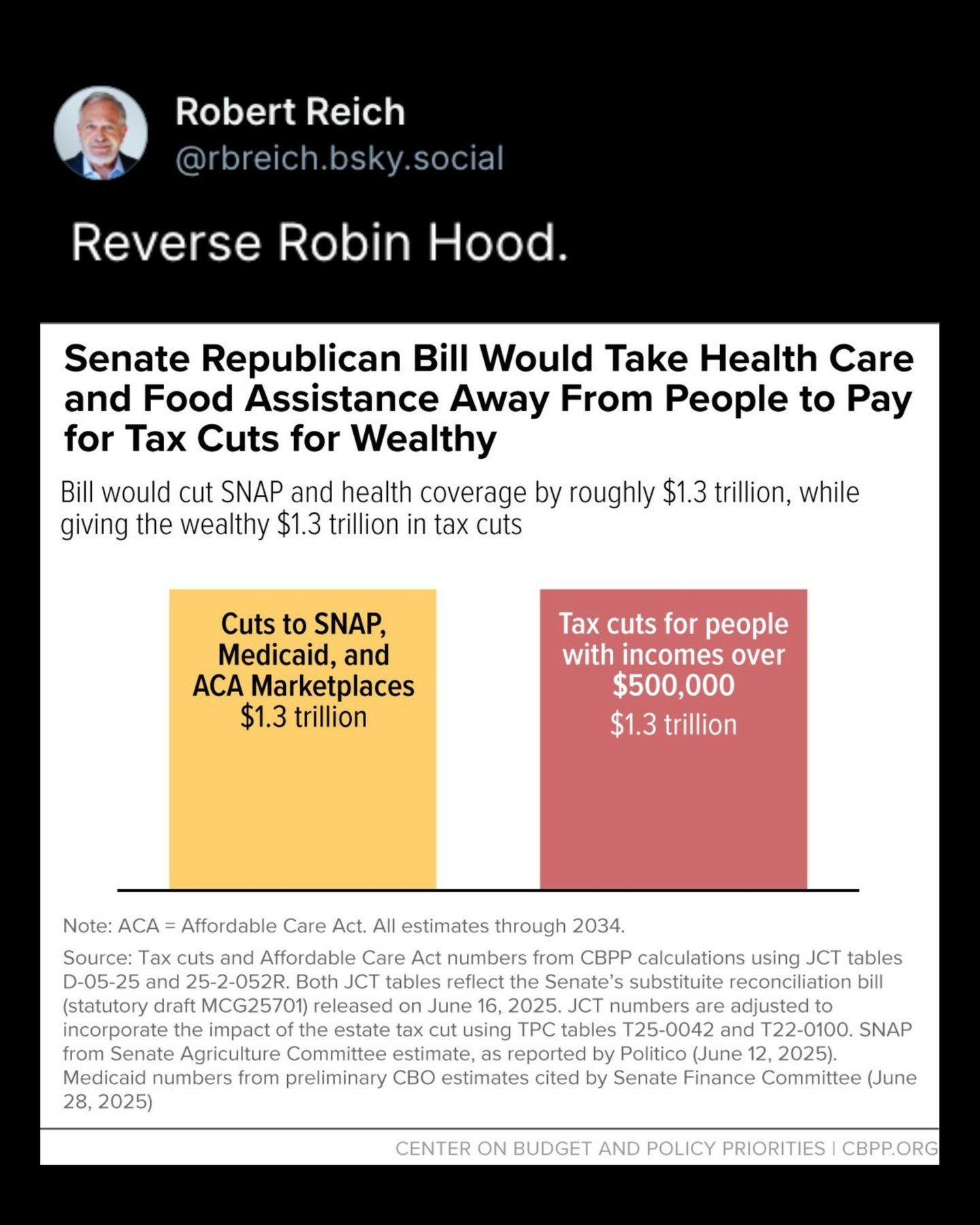
It takes money from hungry children and gives it to the already rich as Marcy has previously said, and the Center for Budget Policy and Priorities has quantified.

But this bill is a mortal menace to many Americans because of the bill’s cuts to Medicaid.

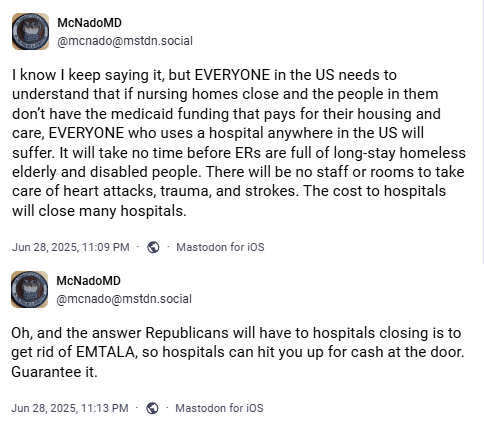
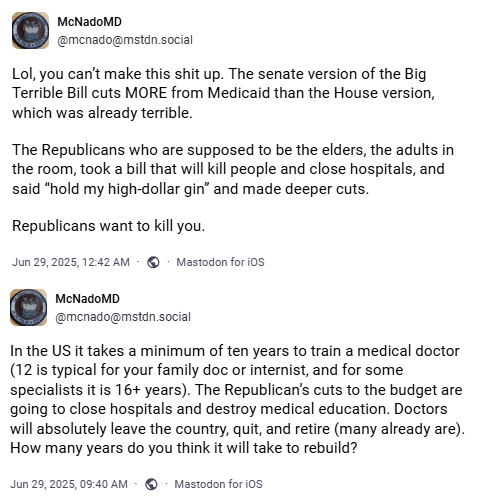
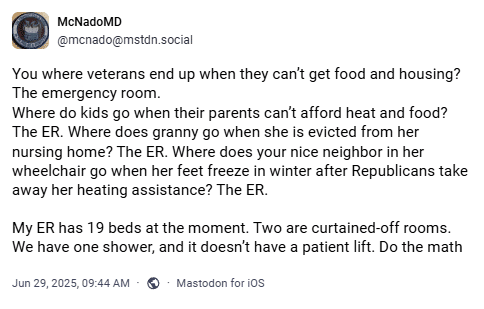
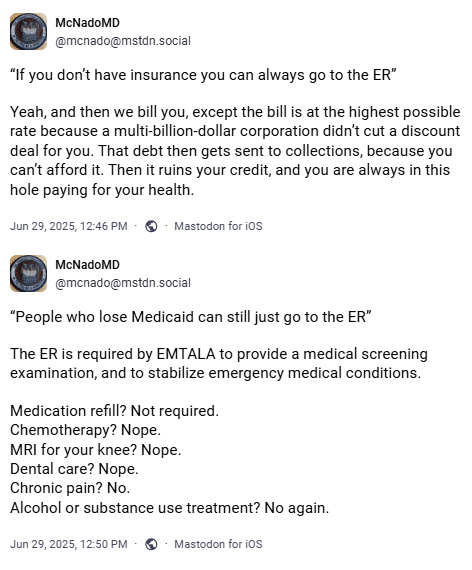
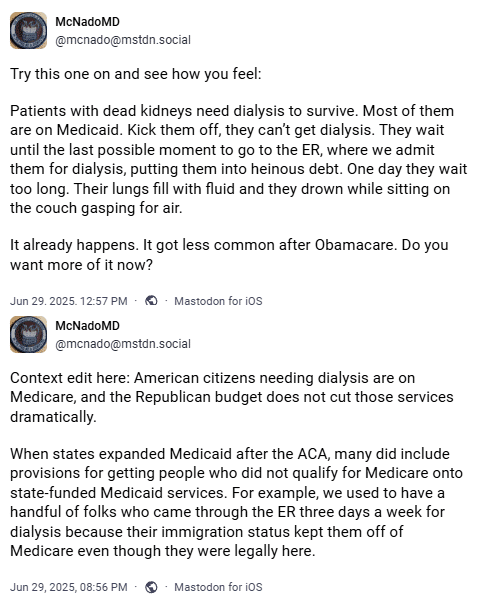
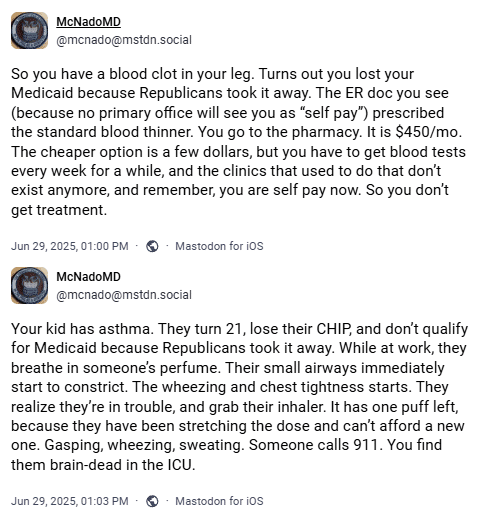
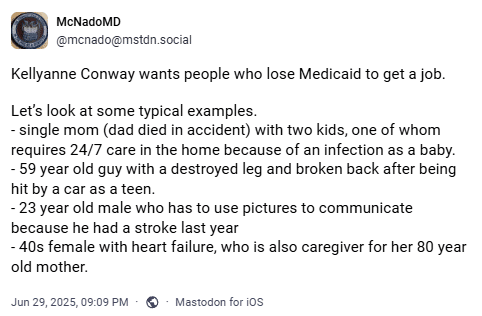
ER doctor McNadoMD spelled out the revolting death threats this bill poses:


EMTALA: Emergency Medical Treatment and Active Labor Act of 1986. They want to ditch 39-year-old legislation which assures Americans obtain

— a medical screening examination (MSE);
— are stabilized with an emergency medical condition;
— are transferred or accepted as a patient as appropriate and needed.

What are we left with if the GOP Senate knocks off EMTALA?

We already lost so many health care professionals because of COVID and have yet to replace them. COVID also cost this nation hospitals, thanks in no small part to right-wing refuseniks who rejected vaccines and masks. Rural hospitals were at risk of closure before COVID; 19 were closed in 2019. A net 50 rural hospitals were closed between 2017 and 2023.

We simply don’t have enough health care professionals or hospitals BEFORE the damage this bill’s cuts could wreak.

My 94-year-old father-in-law, a veteran, died last August. He ended up in the ER more than three times inside his last 18 months because his nursing home couldn’t handle his needs — basically a soft form of eviction until he was stabilized and returned to the home. This happened in a small town where the resources for his care were limited. If the local hospital closed, he’d have simply been evicted and died.

But I suspect the GOP doesn’t give a shit about lifelong GOP voters once they’re as elderly as my FIL was, without the kind of money to burn on political donations. They certainly don’t care about veterans. The GOP congressional caucus has become the death panels they warned us about.

And who pays for the unpaid ER visits — before the hospital goes bankrupt? We who have private insurance do, through increases to our premiums as hospitals increase overall charges to absorb the losses. This is an invisible tax on us, where Medicaid is fully visible.

In other words this is a definite death sentence for a group of Americans and legal residents who have kidney failure.


I don’t have words for this, but this is reality.

This is a real massacre being staged in the Senate, Kellyanne.

Across America especially in smaller cities and towns, Americans are going to face increasing poverty, illness, and death if this big fugly bill passes.

~ ~ ~

I need to get this post up so that you can see the problem and start working the phones and emails. I’ll continue to add to this post for a bit because you need to read what this ER doctor says about the bill’s likely impact if it passes.

Contact your senators and tell them this bill, H.R. 1 “One Big Beautiful Bill Act” is simply not acceptable. Contact your family and friends, explain quickly how bad this bill is and tell them to contact their senators, too.

Congressional switchboard: (202) 224-3121

or use Resist.bot or 5Calls.

Call even if your senator(s) are Democrats or Independents, because they need to know how you feel, they need to know backsliding isn’t acceptable. Don’t trust they will do the right thing without hearing from you (I’m looking at Pennsylvanians especially given Sen. Fetterman’s increasing unreliability).

~ ~ ~

UPDATE — 2:09 PM ET 01-JUL-2025 —

The POS BFB passed with JD Vance casting the tie breaking vote.

Via Associated Press:

Senate Republicans hauled President Donald Trump’s big tax breaks and spending cuts bill to passage Tuesday on the narrowest of votes, pushing past opposition from Democrats and their own GOP ranks after a turbulent overnight session.

Vice President JD Vance broke a 50-50 tie to push it over the top. The three Republicans opposing the bill were Sens. Thom Tillis of North Carolina, Susan Collins of Maine and Sen. Rand Paul of Kentucky.

The GOP owns this POS. It’s on them, they have committed to hurting this country.

Furthermore, they have completely abandoned any pretense of being the party of fiscal responsibility having voted to add $3.3 trillion to the national debt over the next 10 years.

** Do not let this lead you to despair. Let it anger you, and let that righteous anger motivate you to action.**

Continue to call your members of Congress — excoriate them if they voted for this POS BFB, thank them for rejecting it if they didn’t.

Find out when your members of Congress will be home over this break and whether they are having in-district sessions. Be there in person to communicate with them.

Our next major concerns should be how to care for others who will be directly damaged by this GOP bullshit, and how to protect the elections ahead.

Take the holiday break to rest up and ready yourself for the next phase.

Share this entry

Social Security And Other Entitlements

Posts in this series
The Deficit Myth By Stephanie Kelton: Introduction And Index
Debunking The Deficit Myth
MMT On Inflation
Reflections On The Deficit Myth
The National Debt Is Soooooo Big
The Wonkish Myth Of Crowding Out
MMT On International Trade

Chapter 6 of Stephanie Kelton’s The Deficit Myth discusses the perennial conservative effort to cut entitlements. [1] Kelton defines entitlements as statutory determinations that people who meet certain criteria are entitled to certain defined payments. She discusses several of the most widely used entitlements, Social Security, Social Security Disability, Medicare, Medicaid, SNAP and welfare.

Kelton describes the history of these programs, beginning with Franklin Delano Roosevelt. FDR saw Social Security as the first step towards a comprehensive array of programs that would insure that the citizens would be truly free. He specifically chose to fund Social Security with a tax, so that people would feel ownership, making it harder for politicians to vote to take away those benefits. it worked. People are firmly attached to the program. The money is put into a “trust fund”, which holds it in the form of special non-negotiable US Treasury notes.

Politicians, goaded by their rich donors, try to weasel around this powerful attachment. They start with basic debt hysteria: the Trust Funds are Going Bust! [2] They base this on the reports of the Trustees of the trust funds, who are directed to estimate the date on which the Social Security Trust Fund will run out of money. If that happens. under current law, Social Security payments will be cut. They then claim that all they want to do is put Social Security on a firm financial footing. But they have to act now. Now! And somehow the only possible actions are benefit cuts and tax hikes for working people.

This worked the last time the deficit hawks of both parties tried it. Under Ronald Reagan both parties agreed to cut benefits, raise the retirement age, and increase FICA taxes. This increase in tax revenues was then used as cover for tax cuts for the filthy rich. The effort was led by Alan Greenspan, an Ayn Rand devotee, and no friend of working people.

Medicare is also funded with specific taxes which are put into a special Treasury account, and has a board of trustees. But there’s a big difference. Under Medicare statutes, the Treasury is directed to make all payments, regardless of the state of the trusts. So, every report of the Trustees says that Medicare is just fine. We could do the same for Social Security, and all other entitlements. That simple change would solve the problem. That’s what Kelton recommends, and it makes perfect sense under Modern Monetary Theory.

Liberals offer other solutions. We could raise the cap on the wages subject to FICA taxes. We could have a millionaires tax that would fund Social Security and other entitlements. We could impose a tiny tax on securities transactions and direct the funds to the various trust funds. I don’t think Kelton is opposed to funding social programs with dedicated taxes, and I don’t think she would object to any of these ideas or to the idea that paying dedicated taxes adds to a sense of ownership. The issue is that people think it must be this way. It doesn’t. MMT teaches us that we have the money to do what we want to do.

Taking the pressure off of funding sources does two things. It relieves the anxiety of the older people, the group Enzi is trying to frighten. But it also frees us to focus on the actual needs of the future and to plan for them. As people get older, their needs change. They need more medical care, more help at home, more and different kinds of medicine, different furniture, different living arrangements, and so on. Their desires change, too. They want to do more travel, to spend more time with their spread-out families, and to enjoy more varied kinds of entertainment, restaurants, and other kinds of get-togethers.

Kelton, writing before the pandemic hit, calls for the expansion of Social Security. She points out that it was originally intended as one leg of a “three-legged stool” of retirement planning. The other two were personal savings and pensions from employment. The latter two are disappearing.

Before the pandemic, 40% of us didn’t have savings of $400 for emergencies. Once upon a time, employers provided defined-benefit plans, which promised to pay retirees a specific amount based on pay and length of service. [3] Most of those plans are gone. Kelton cites a particularly ugly case where McDonnell-Douglas closed a plant in Tulsa and terminated a defined-benefit plan in part because so many workers were approaching retirement age when they could collect a full pension with terrible results for older workers. [4] Congress established the Pension Benefit Guarantee Corporation to cover a portion of the lost benefits when companies terminate plans. The benefits guaranteed are absurdly low.

Employers now establish defined-contribution plans like 401(k)s. The track record of these plans shows that they are an inadequate substitute for most people. They are expensive, as members pay administration costs as well as management fees to Wall Street. The national average all-in fee is 2.2%. The Center for American Progress estimates that “… the typical American worker who earns a median salary starting at age 25 will pay about $138,336 in 401(k) fees over their lifetime.” Median account sizes vary substantially by age. For those over 50, the median is around $66K. The average is much higher, around 200K, showing that these plans primarily benefit the wealthy.

Taken together, these facts show a critical need for a stronger Social Security system, not the cuts sought by conservatives.

Other entitlement programs are under attack from the deficit hawks. There are constant efforts to make it more difficult to enroll in Medicaid, like work requirements or co-pays. Fifteen states haven’t implemented Medicaid expansion as permitted by Obamacare; Missouri just added a constitutional amendment requiring implementation. SNAP benefits are under constant assault by Republicans in the name of frugality, as if these $68 billion in a 4$ trillion budget was meaningful compared to the needs of the population served.

Kelton’s point is that we have the money. We need the will to establish priorities that match our moral values, and a Congress that will legislate those priorities.

=====
[Graphic via Grand Rapids Community Media Center under Creative Commons license-Attribution, No Derivatives]

[1] It’s one of the more bizarre conservative demands. Social Security is a crucial element of the financial lives of a very large number of older Americans; approximately 40% of retirees would have incomes near or below the poverty line without it. That’s about 21 million voters who are more likely to vote for conservatives. To protect themselves from voter anger, conservatives explicitly call for the “I’ve got mine, screw you Jack” approach: their proposals always exempt today’s older crowd, as if the younger citizens won’t notice that their parents are safe but they aren’t and neither will their parents.

[2] We are currently getting a heavy dose of this from Republicans as they try to avoid passing a pandemic rescue bill that will primarily benefit ordinary Americans. Here’s Senator Mike Enzi, from the metropolis of Wyoming, where he ran a shoe store, insisting that Social Security is the problem. Kelton has a story about Enzi. P. 41 et seq.

[3] The strange locution “defined benefit plan” comes from the Employee Retirement Income Security Act of 1974. Its counterpart is defined contribution plans, which don’t promise any specific payment on retirement. It just requires the employer to pay a specific amount into some kind of plan with whatever vesting rights and investment possibilities the employer chooses.

[4] McDonnell-Douglas eventually merged with Boeing. Here’s a story connecting its executives to the 737 Max disaster.

Share this entry