
Posts

Applying Existentialist Ethics

The third and last chapter of The Ethics Of Ambiguity by Simone de Beauvoir applies the ideas in the first two chapters to the question how one should respond to oppression and tyranny. She focuses on the responses to the Nazis and to the oppression of the proletariat by the capitalists.

The Aesthetic Attitude

Many Frenchmen also sought relief in this thought in 1940 and the years which followed. “Let’s try to take the point of view of history,” they said upon learning that the Germans had entered Paris. And during the whole occupation certain intellectuals sought to keep “aloof from the fray” and to consider impartially contingent facts which did not concern them. Pp. 75-6.

De Beauvoir calls this the aesthetic attitude, and says it is merely flight from reality. In the real world, we are all in this together. What happens to others is our concern. Our freedom exists only in the presence and freedom of others. The aesthetic attitude is an effort to hide from the reality of our own freedom. These people aren’t free: they are locked in a tiny bubble of like-minded cowards (my word, not de Beauvoir’s), people afraid of the existential truth of human existence in the moment of crisis.

She says that the responsibility of the intellectual, the artist, and the critic is to create awareness of existential freedom as a common goal for all humanity, and to encourage everyone to accept the demands of that freedom in the face of tyranny.

How can we do that today? It seems to me that the people carrying whistles and filming the thugs attacking my neighbors in Chicago demonstrate their freedom and challenge to the rest of us to exercise our freedom as best we can. [As a former lawyer I remind everyone that if the goons arrest you while you’re demonstrating your freedom, STFU.]

Freedom And Liberation

The next two sections take up the ethics of dealing with oppression and tyranny. She says we must resist both, with violence if necessary. De Beauvoir follows Kant’s assertion that we are not to treat other people as means to our ends, or as objects, as we would a lump of coal, but as ends in themselves, autonomous creatures acting from their own freedom.

De Beauvoir conflates the ideas of tyranny and oppression, but there’s a useful distinction. The capitalist system is oppressive, in the Marxian sense. The capitalists extract most of the wealth created by systems of production. They claim that this is the natural order of things, and that nothing can be done to correct it. I tell that story in this post.

The oligarchs tell their story everywhere, and vilify every competing story as socialist or communist while never taking it on seriously. This is a standard tactic of the dominant class, as we saw reading Culture and Power: The Sociology of Pierre Bourdieu, as here.

Outside the workplace, the proles are free to pursue their own projects. De Beauvoir is contemptuous of many of those projects, seeing them as tools of further oppression:

… the trick of “enlightened” capitalism is to make [the worker] forget about his concern with genuine justification, offering him, when he leaves the factory where a mechanical job absorbs his transcendence, diversions in which this transcendence ends by petering out: there you have the politics of the American employing class which catches the worker in the trap of sports, “gadgets,” autos, and frigidaires. Pp. 87-88.

Tyranny is better seen as the domination of a social order by one person who treats all others as ends, fit only to fulfill the desires of the tyrant. Tyrants can limit the freedom of every individual in all aspects of their lives at all times, whether or not they choose to do so.

The difference between these two is reflected in the means used to resist. Oppression operates largely by mystification. People are acculturated to the capitalist system from birth, and have no means to construct an alternate view or attract a significant number of people even to question it. Thus this post. But this kind of change only occurs when enough people are ready to move into a different form of economic organization, Violence won’t make anyone change their minds about capitalism.

Tyranny either dies when the tyrant’s line dies out, as with Soviet Russia, or it is resisted with violence, as with Hitler and Mussolini. Treating the tyrants and their minions as objects is necessary if we are to remove their ability to restrict the freedom of ourselves and others. And it is fully justified.

The desirable thing would be to re-educate [them]; it would be necessary to expose the mystification and to put the men who are its victims in the presence of their freedom. But the urgency of the struggle forbids this slow labor. We are obliged to destroy not only the oppressor but also those who serve him, whether they do so out of ignorance or out of constraint. P. 98.

The Future

De Beauvoir says that the struggle for freedom is never-ending. In part this is the necessary result of her notion of freedom as generating new ways to be human, opening new futures for all. But also it results from the fact that we are merely human, and thus operate under many different forces. Many people will not accept their freedom, some will not accept new freedoms, others will accept it partially, as with the Adventurer, and still others will use it for their own private ends. Some will use it to oppress or tyrannize others. Some will not be willing to see themselves as oppressors in the Capitalist System or otherwise. The future is open, but only if we make it so.

Conclusion

One problem with reading texts like this one is the nagging feeling of elitism they generate. Throughout this book, de Beauvoir is judgmental. The descriptions of her categories is a good example, as is her snide comment on Frigidaires above. In the end, she seems to say that most people will never achieve her notion of freedom, but that it is the goal of people like her to show everyone their freedom and let them choose. Should we characterize that as elitism? If so, is that bad, or just annoying to people unwilling to cope with her level of abstraction?

In the end, I don’t see answers to the question I raised at the outset: what should we do to defeat rising fascism. We see signposts for a bad future in Arendt and Polyani but we don’t see off-ramps. We get ideas about how people think in other readings. We see responses and justifications for those responses in de Beauvoir. It’s disappointing that the best minds of that era have no answers for their future readers. But there we are. People who want their freedom will find a way. Maybe it starts with whistles.


Share this entry

Coping With Existentialist Ambiguity

Posts in this series.  Please read this first, at least the section on ambiguity.

Preface

The point of this series is to examine The Ethics Of Ambiguity by the French intellectual Simone de Beauvoir as a reaction, in part, to the horrors of the Nazi and Stalinist regimes. My hope is that we can learn something that will help understand and possibly to derail the drive towards fascism by the Trump Administration.

Existentialism’s core principle is radical freedom accompanied by radical responsibility. In Chapter 2 de Beauvoir shows how people become conscious of their freedom, starting with childhood. She then gives some examples of how people respond to their awareness of that freedom.

I think it helps us to understand this material to think about how it applies to people we know or know about, whether from real life or from books or from the internet.

The origins of awareness of freedom

De Beauvoir starts with a discussion of childhood. She says the child experiences the adult world as a given, a fixed and immutable environment, just like a stage set. The child is expected to take a specific role in that world, a place that is stable and certain. The rules and goals are set by the adults in the child’s world.

At the same time, at play and with its peers the child experiences a completely free world. It is open to all possibilities, even those beyond the child’s physical limits. It’s as if the child is free in a room, with walls, ceilings and floors that protect it from actual danger. Adults provide shelter and safety to go with that apparently unlimited freedom.

As the child grows older, it begins to notice that adults aren’t statues, that they aren’t gifted with perfect foresight, that they make mistakes, and that they say things are one way when the child sees that they are another. At this point the child begins to see that the world is not a given, that it is made by other people and begins to realize it will have to take a role in that making. This can be traumatic.

… [I]t is not without great confusion that the adolescent finds himself cast into a world which is no longer ready-made, which has to be made; he is abandoned, unjustified, the prey of a freedom that is no longer chained up by anything. P. 39.

It is in this moment, says de Beauvoir, that we have to form our own justifications and take responsibility for our actions. At this moment we cross into the plane of morality.

In the next section, de Beauvoir discusses some of the possible responses the newly aware person might have to the moral questions presented by thee discoveries.

Responses to freedom

Infantile people. De Beauvoir says that some people are not allowed to make this transition. She gives two examples. First she talks about certain of the people enslaved in the US Antebellum South who have not “raised themselves to consciousness” of their enslavement (p. 37).

Second, she talks about women who do not separate themselves from the domination of men. Many, she says, were trained from birth to accept it, for religious or cultural reasons, and do not have the means of forming a different view.

In these examples, the person remains in an infantile state, unable to recognize either their own freedom or their responsibility.

Sub-men. Sub-men are people who blind and deafen themselves against consciousness of their freedom. De Beauvoir thinks the underlying problem is fear of existence and a desire to hide from it. Sub-men experience only a dull pointless world, which hands them no reason to exist, and they refuse to use their freedom to create their own justifications, their own reasons for living. They demonstrate the absurd facticity of a creature in the shape of a human but without the fundamental will to exist that drives the fully human person.

De Beauvoir thinks that other people respond to the sub-man with contempt, recognizing the indifference to freedom and responsibility as a failure of human existence. But sub-men are dangerous:

He realizes himself in the world as a blind uncontrolled force which anybody can get control of. In lynchings, in pogroms, in all the great bloody movements organized by the fanaticism of seriousness and passion, movements where there is no risk, those who do the actual dirty work are recruited from among the sub-men. P. 44.

Serious people

Sub-men have not connected with the world or with other people, and have no way to deal with the future. It seems dark and foreboding, full of unknown but real terrors. That forces some of them to realize that the source of their anguish is awareness of their freedom. To solve that terror they grab hold of the solutions that society gives them, abandoning their freedom for the comfort of a fixed existence. These are the serious people.

The givens that governed serious people as children, adjusted for adulthood, become real things, so that their freedom and responsibility, which should be the drivers of individual action, are replaced by aggressive rule-following. The goals of the given norms are absolute ends for these people.

This state of being is justified in people described above as infantile, people with no real choice. In the same way, those with little ability to act on the world are more likely to move toward this state. Such people still have access to their own freedom, even though it may be difficult to achieve it.

Those who havve the intellectual and material means to accept their freedom but choose to subject themselves to the givens of their societies become slaves of the ends those givens dictate

I read this as saying that these givens are of human construction built for an earlier time by earlier humans. It’s one thing to accept them provisionally, and to adjust them as circumstances reveal their imperfections, but another to adhere to them rigidly, surrendering your personal freedom to other people with different experiences and unstated purposes.

De Beauvoir thinks this is dangerous because serious people ignore their own subjectivity; but more importantly because they ignore the subjectivity of other people. They are self-righteous in pushing the thing to which they have subjected themselves onto other people, tyrannically hammering them into submission.

She gives examples: the Inquisition; vigilantes lynching Black people in the US; and “…the political fanaticism which empties politics of all human content and imposes the State, not for individuals, but against them.” P. 50.

Discussion

1. As usual, this is a skeleton of de Beauvoir’s thinking, emphasizing the parts that seem relevant to the goal of understanding our current situation. There are other responses to freedom, followed by a discussion of the importance of other people which I will take up in the next posts in this series.

2. De Beauvoir starts her analysis with a discussion of the growing child. Other philosophical theories seem to start with the fully developed adult, as if we came into the world fully formed. Perhaps it helps that de Beauvoir didn’t think of herself as a philosopher, but as a more general thinker.

———-

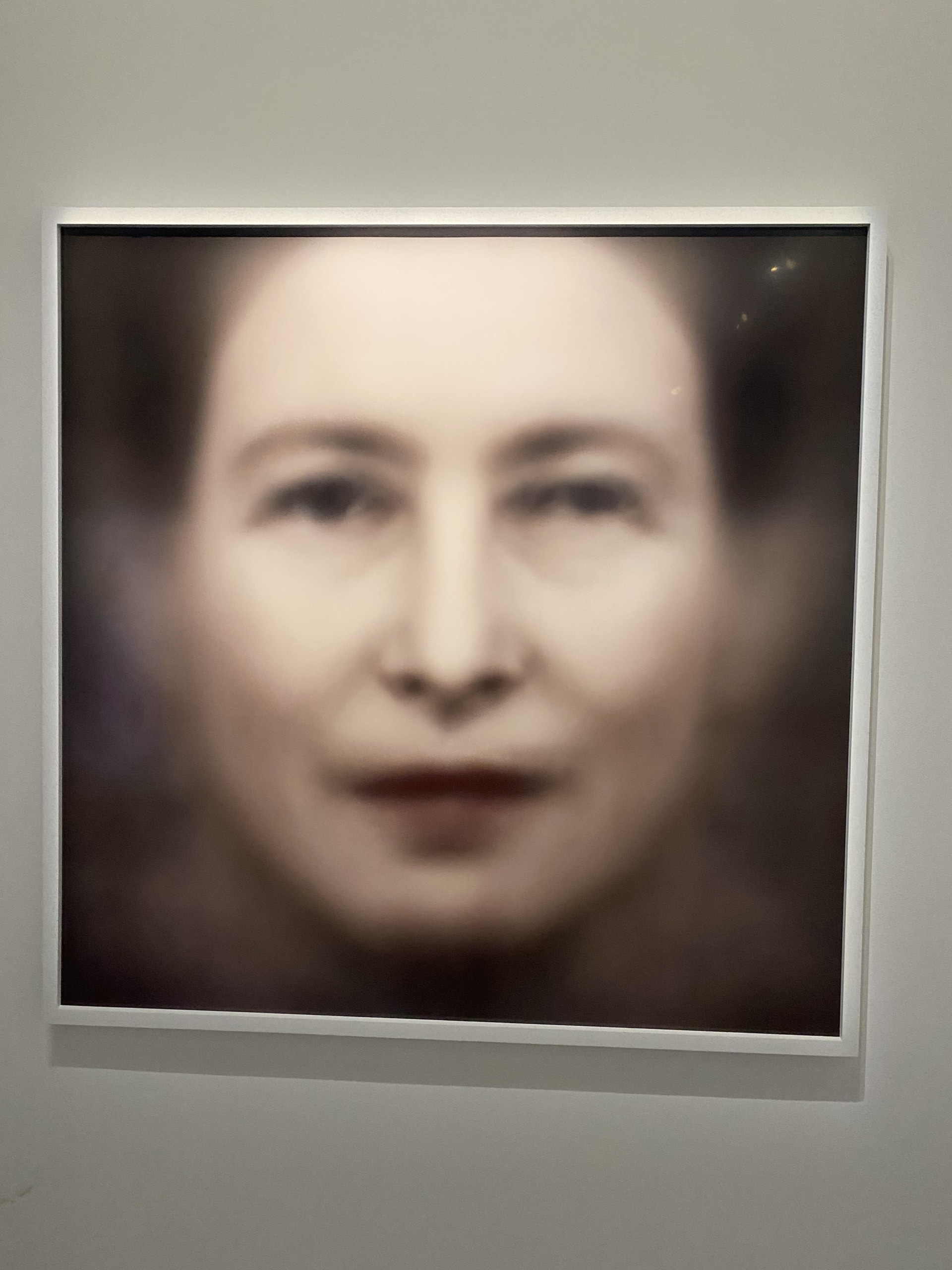
The featured image is my photo of a work by Trevor Paglen titled De Beauvoir (Even the dead are not safe) Eigenface (Colorized), part of an exhibition titled The World Through AI at the Jeu de Paume in Paris.

Share this entry