January 2, 2026 / by 


Paulie Goes to Prison*

Judge Amy Berman Jackson just sent Paul Manafort to jail to await trial because he violated his release conditions.

The judge said sending Manafort to a cell was “an extraordinarily difficult decision,” but added his conduct left her little choice, because he had allegedly contacted witnesses in the case in an effort to get them to lie to investigators.

“This is not middle school. I can’t take away his cell phone,” she said. “If I tell him not to call 56 witnesses, will he call the 57th?” She said she should not have to draft a court order spelling out the entire criminal code for him to avoid violations.

“This hearing is not about politics. It is not about the conduct of the office of special counsel. It is about the defendant’s conduct,” Jackson said. “I’m concerned you seem to treat these proceedings as another marketing exercise.”

I’m interested in where that leaves him (besides, probably, the jail in Alexandria).

Manafort has a bunch of pending motions in EDVA: one challenging Mueller’s authority that Judge TS Ellis should be set to rule on, as well as a bunch trying to suppress evidence and one asking for a hearing on leaks. But things keep getting delayed in EDVA, which is supposed be a rocket docket but isn’t working out that way for Manafort. For both family reasons and because he had to preside over a spy trial, Ellis moved the hearing for the latter issues to June 29 and moved the trial itself (for which Mueller just got 75 sets of subpoenas) to July 24.

In DC, ABJ laid out this schedule back in March (which I’ll return to). Basically, she envisions two rounds of motions leading towards a trial in September.

Meanwhile, earlier this week, Mueller filed this curious motion in EDVA, asking Ellis to impose this discovery order. The problem Mueller’s team is having is that Manafort won’t respond to any of the requests Mueller’s team has made about a discovery order, going back to February and still, as recently as last week. And while they’ve turned over a ton of stuff, they suggest there’s “additional materials to be produced in this case” that they don’t want to turn over until Manafort is obligated by a discovery order.

Prior to the arraignment, on February 27, 2018, the government proposed the attached discovery order to defense counsel. The proposed order tracks the schedule and deadlines in this district’s standard discovery order. As the Court is aware, in addition to a schedule for Rule 16 discovery, the standard discovery order also sets forth deadlines for 404(b), Brady, Giglio, and Jencks material as well as notices for experts, alibis, and stipulations.

The defendant has already received robust discovery in this case and in the parallel District of Columbia prosecution. Indeed, the government has cumulatively made 19 separate productions − each containing a detailed index − in both cases. However, since February 2018 and as recently as last week, the government has been unable to obtain Manafort’s position on the attached proposed discovery order. Accordingly, in order to adequately prepare for trial, reduce discovery litigation, and protect additional materials to be produced in this case, the government respectfully asks this Court to enter the attached proposed discovery order.

Now, most of the obligations in the discovery order are on the prosecution, and given the delay in scheduling they’re not immediately pending in any case. The defense is supposed to tell the government about experts (which might be pertinent in this case since it’s a tax case), but that still wouldn’t be due until mid-July. The most immediate deadline would be if Manafort wanted to offer an alibi, which the standard protection order for EDVA would require by the first week of July; but I can’t imagine any alibi Manafort could offer on the EDVA case.

Now back to the DC case. There’s actually something due there, today (which given past practice will come out late in the day as everyone’s trying to get on with their weekend). Today’s the day the government has to submit their 404(b) notice to Manafort — basically advance warning of any other crimes they want to introduce during trial.

The government’s notice of its intention to introduce evidence under Fed. R. Evid. 404(b) must be filed by June 15, 2018; the opposition will be due on June 29; and the reply will be due on July 9. A hearing on the motion, if necessary, will be held on July 24, 2018 at 9:30 a.m.

Back in January, Mueller had requested delaying this notice until 8 weeks before trial (which would have been early August had ABJ not set the earlier deadline of today). My guess, then, was that they wanted to hold off letting Manafort know about what evidence they had on the case in chief, but that they wanted to introduce at trial.

The government just submitted a request to modify the deadline Judge Amy Berman Jackson set to give Paul Manafort and Rick Gates notice of other crimes or bad acts it will introduce at trial, what is called a Rule 404(b) notice. Currently, they have to provide that notice on April 6, but the judge is now considering a September rather than a May trial date, so prosecutors want to bump the 404 notice back accordingly.

Mueller’s prosecutors don’t want to give Manafort and Gates more than a couple months notice of the other crimes they’re going to unload during the trial. They also note that if they give notice in April, they may have to provide multiple notices as they learn of other bad acts.

Premature disclosure raises issues as well. For example, in declining to require disclosure that is too early, courts have recognized that “the evidence the government wishes to offer may well change as the proof and possible defenses crystallize.”

[snip]

For similar reasons, early disclosure can result in multiple Rule 404(b) notices and multiply the rulings that a court needs to make, thus undermining the efficient use of judicial and party resources.

The government wants to wait until 8 weeks before the trial before giving notice.

At least two things appear to be going on here. First, Mueller doesn’t want to tip his hand to the many crimes it has found Manafort implicated in. Perhaps, he also wants to avoid making other obvious allegations about Manafort and Gates to preserve their credibility when they flip on the President and his family. But it also seems to suggest Mueller expects he’ll be finding other crimes Manafort and Gates committed for the next 8 months.

This conversation with Matt Tait makes me wonder whether they’re trying to keep 404(b) evidence that they might file in NY State under wraps for now, in case Trump pardons Manafort (as he suggests, Manafort’s remaining money laundering properties involve Trump Organization).

So maybe that’s what Mueller’s trying to get Manafort to agree to. The EDVA standard order he’s trying to get him to use would require 404(b) notice by July 17, but permits the government to request avoiding such pretrial notice.

It is further ORDERED that, no later than seven calendar days before trial, the government shall provide notice to the defendant, in accordance with FED. R. EVID. 404(b), of the general nature of any evidence of other crimes, wrongs, or acts of defendant which it intends to introduce at trial, except that, upon motion of the government and for good cause shown, the court may excuse such pretrial notice.

It’s unclear what is operative in the DC case, but clearly the government can continue to file, as noted in January.

Anyway, that’s all just a guess, and we should see what they file for the 404(b) notice in DC this evening. Meanwhile, Paulie will be making himself comfortable in his new cell.

Update: Here’s the 404(b) motion. Mueller wants to introduce three things:

  • Evidence that one reason that Manafort and others arranged for [Skadden Arps] to be retained for the de minimis sum of approximately $12,000—even though they knew at the time that Law Firm A proposed a budget of at least $4 million—was to avoid certain limitations imposed by Ukrainian public procurement law.
  • Evidence that Manafort was treating a NYC apartment as a business property with the IRS but as a personal dwelling with a lender.
  • Evidence that Manafort structured intra-Cypriot funds to hide income.

The first of those two, of course, involve crimes in NY state.

*Technically, Manafort is being sent to jail, not prison. But that doesn’t alliterate so forgive me the error this once, okay?

Shorter Yevgeniy Prigozhin: Don’t Send the PII We Already Stole — Just Send the Intelligence

In this post, I described the Mueller team’s motion for a protective order that would keep sensitive information from the case against Concord Management away from its owner, Vladimir Putin crony Yevgeniy Prigozhin.

Concord’s lawyers have now responded with the performative aspect that has characterized their filings in this case. From a legal standpoint, they argue both that protective orders are an unusual thing (which seems utterly absurd on its face) and that withholding information from a co-defendant who has not presented himself before the court is not supported by case law (a proposition I await Mueller’s answer to judge).

For now, though, note that their demands have actually gotten worse than what, according to Mueller at least, they had already agreed to.

Mueller, as I noted, contended that Concord had agreed to keep all discovery in the United States, but objected to Mueller’s request to withhold it from Prigozhin. The US-restrictions showed up on their protective order this way:

Neither defense counsel nor any person authorized by this Court is permitted at any time to inspect or review Sensitive materials outside of the U.S. offices of Reed Smith LLP, without prior permission from of this Court. Defense counsel or a designated and identified employee of Reed Smith LLP must accompany any person at all times while he or she is reviewing Sensitive materials at U.S. offices of Reed Smith LLP, unless otherwise authorized by this Court.

[snip]

Sensitive materials shall not be viewed or stored on any device that is connected to or accessible from the Internet.

Sensitive materials may under no circumstances be transported or transmitted outside the United States.

But Concord has now changed its mind about the US restrictions.

Further, the Special Counsel attests to the Court that the defense has agreed “on many procedures designed to enable the government to turn over discovery,” Mot. at 2, while failing to tell the Court the truth; that any such concessions were made as part of a concerted effort by undersigned counsel to reach a stipulated agreement of this issue, and absent that stipulation there is in fact no agreement at all. Despite this fact, and as a courtesy to the Court only, Defendant Concord represents that it is willing to accept the draft protective order attached hereto as Exhibit A, which will permit it to protect its constitutional rights in defending this criminal case.

It calls the requirement that discovery remain in the US (it doesn’t address the demand that it remain firewalled from the Internet) a hostage situation.

The Special Counsel seeks the unprecedented process of prohibiting defense counsel from sharing or discussing any discovery with any co-defendant—including the only person affiliated with Concord named in the Indictment—unless those individuals come to the United States to become hostages in this political game of tit-for-tat. See ECF 24-1, proposed Protective Order at ¶ 2.

Perhaps even more interesting, having been told that Mueller will hand over everything because it is too unwieldy to strip Personal Identifying Information of victims and others, Concord not only says they don’t want it (though they caveat about whether they’ll eventually release it at trial), but that they refuse to accept it.

Not yet ashamed, the Special Counsel plays the personal identifying information (“PII”) card. See Mot at p. 9. However, undersigned counsel has already advised the Special Counsel that Defendant does not seek any personal identifying information that is irrelevant to the defense. The Special Counsel stated to undersigned counsel that it would not be possible to remove any such information from the discovery. But that is the Special Counsel’s problem, not Concord’s. And undersigned counsel will not accept any such information unless the Special Counsel can demonstrate that, in fact: 1) it is relevant to the defense of the case; 2) the Special Counsel intends to use the item in its case-in-chief at trial; or 3) the information was obtained from or belongs to Defendant. See Fed. R. Crim. P. 16(a)(1)(E). The Special Counsel’s reliance on the out of circuit case United States v. Johnson, 191 F. Supp. 3d 363 (M.D. Pa. 2016) provides no cover. To the contrary, Johnson, a drugs and firearms case, returns to the concept of an umbrella protective order that is unheard of in published opinions in this district, and further addresses PII which we are not seeking unless it is relevant to the defense.7

7 The Special Counsel’s description of the PII to undersigned counsel makes it difficult to understand how it could be relevant to the defense. The Special Counsel generally noted that some of the discovery contains financial account numbers of innocent individuals. As noted above, undersigned counsel refuses to accept or be responsible for any such irrelevant data. As to names, addresses and other personal information of the same or other individuals, undersigned counsel has no intention of making any such information public prior to trial.

Of course, Russia has already stolen a lot of this PII.

So effectively, what Prigozhin is saying is that he doesn’t want any of the PII he already stole; he just wants the intelligence showing what the US government knows about how he stole it.

Don’t get me wrong: the underlying legal issues here will be an interesting question. But the message — don’t send the PII we already stole, just send the intelligence — is quite simple.

Update: In a hearing on Friday, Friedrich expressed impatience that discovery hadn’t begun yet, but generally showed great deference to the government’s concerns about security. She set a deadline for the parties to agree on a protective order, but if the interim one she drew up until they agree on something is any indication, the Mueller team will generally get what they want. In particular, she prohibited the sharing of discovery with anyone not in Concord’s law firm, meaning they can’t share it with Prigozhin.

Pursuant to this interim order, the government shall initially produce the materials to defense counsel. In the first instance, and unless and until further order from this Court, defense counsel shall not further disclose the materials or their contents directly or indirectly to anyone except defense counsel, as defined above.

And she required sensitive materials to be firewalled from the Internet, and prohibited sensitive materials being transmitted outside the US.

The government shall provide Sensitive materialsto defense counsel in a password protected, electronic format. Sensitive materials shall not be copied or reproduced without prior permission from this Court, except that defense counsel may make copies for use exclusively by defense counsel in connection with this criminal case. Sensitive materials shall be maintained in a locked room at Reed Smith’s offices within the United States, when they are not in the actual possession of defense counsel. Sensitive materials shall not be viewed or stored on any device that is connected to or accessible from the Internet.

Sensitive materials may under no circumstances be transported or transmitted outside the United States.

She also endorsed the idea of a firewall counsel who could raise objections on sharing, and even suggested a special master for discovery here.

Update: Fixed protection for protective. h/t mw.


The Decline and Recent Fall of Manafort’s Hapsburg Empire

It turns out the government was telling the truth (not that I doubted it) when they told Judge Amy Berman Jackson they’ve only just put together the evidence that Paul Manafort violated bail by trying to suborn perjury from Alan Friedman and Eckart Sager, the two flacks who set up the Hapsburg Group for Manafort back in 2012. That’s made clear by comparing the materials submitted back on May 25 asking for leave to object to Manafort’s then just finalized bail proposal and the materials — particularly the declaration from FBI Agent Brock Domin — released in conjunction with Mueller’s motion to revoke or revise bail.

For example, whereas the later Domin declaration notes that Friedman and Sager (identified as Person D1 and D2) “provided the content of the text messages described below in May 2018,” Domin’s earlier declaration provides the specific dates.

Person D1 provided the text messages described below on May 12, 2018, and Person D2 provided the content of the text messages described below on May 21, 2018.

And while the earlier declaration relies on statements from Friedman,

Documents produced by Persons D1 and D2, statements made by Person D1 to the government, and documents recovered pursuant to a court-authorized search of Manafort’s iCloud account evidence that Manafort,

The later declaration refers to statements from Sager, too.

Documents produced by Persons D1 and D2, statements made by Persons D1 and D2 to the government, telephone records obtained by the government, and documents recovered pursuant to a court-authorized search of Manafort’s iCloud account evidence that Manafort,

So Sager must have been interviewed between May 25 and June 4.

A filing submitted last night, providing even more detail describing why Manafort should have his bail revoked includes this great quote from Sager, though it’s unclear when he gave it.

Manafort’s references to the Hapsburg member’s “role” and the “EP” refer to that Hapsburg member’s position as a representative of the European Parliament and the parallel actions of the European Parliament and the United States Senate regarding Tymoshenko’s imprisonment in 2012. That characterization is consistent with Person D2’s description, during a meeting with the government, of that Hapsburg member’s role as Manafort’s “spy and mouthpiece.”

And, as reflected both in the passage cited above and by comparing the two communication logs, the government did not reference toll records from Manafort in the May 25 filing but did in the June 4 one, suggesting that along with a Sager interview, they obtained the toll records after May 25.

Which raises two interesting questions for me: first, had the government interviewed Friedman and Sager before Manafort tried to suborn their perjury? If Mueller’s team hadn’t, it makes his effort all the more interesting, as if he somehow knew that. And also, did the government obtain proof of these communications (likely, via monitoring Manafort’s iCloud account) before reaching out to Friedman and Sager, whether anew or for the first time?

Interestingly, the earlier Domin declaration makes it clear Friedman took screen caps of the WhatsApp comms he had with Manafort contemporaneously, so even if he weren’t backing up his super secret obstruction of justice to Apple’s cloud, he’d have been fucked.

Person D1 has provided the government screen shots that Person D1 took contemporaneously of these messages.

That suggests it’s possible that Friedman contacted (possibly recontacted) the government to let them know this. But that doesn’t explain the two and a half month delay between the time Manafort tried to suborn perjury and the time the government actually chased this detail down.


Mueller to Yevgeniy Prigozhin: Sure You Can Have Discovery … If You Come to the United States to Get It

This Concord Management filing, from Mueller’s team, is attracting a lot of attention because Mueller predictably asked for a protective order and said Russians are still engaging in information operations (so are we!!). Since we covered the certainty that there’d be a protective order in this case over a month ago, I’m going to focus on some other interesting tidbits about this filing.

As a reminder, Concord Management is a company owned by close Putin ally Yevgeniy Prigozhin. Concord is accused in the Internet Research Agency indictment of funding the troll operation.

Defendants CONCORD MANAGEMENT AND CONSULTING LLC (Конкорд Менеджмент и Консалтинг) and CONCORD CATERING are related Russian entities with various Russian government contracts. CONCORD was the ORGANIZATION’s primary source of funding for its interference operations. CONCORD controlled funding, recommended personnel, and oversaw ORGANIZATION activities through reporting and interaction with ORGANIZATION management.

[snip]

To conceal its involvement, CONCORD labeled the monies paid to the ORGANIZATION for Project Lakhta as payments related to software support and development. To further conceal the source of funds, CONCORD distributed monies to the ORGANIZATION through approximately fourteen bank accounts held in the names of CONCORD affiliates, including Glavnaya Liniya LLC, Merkuriy LLC, Obshchepit LLC, Potentsial LLC, RSP LLC, ASP LLC, MTTs LLC, Kompleksservis LLC, SPb Kulinariya LLC, Almira LLC, Pishchevik LLC, Galant LLC, Rayteks LLC, and Standart LLC.

The indictment accuses Prigozhin of supervising the operation closely enough to have been saluted by troll operations in the US.

PRIGOZHIN approved and supported the ORGANIZATION’s operations, and Defendants and their co-conspirators were aware of PRIGOZHIN’s role.

For example, on or about May 29, 2016, Defendants and their co-conspirators, through an ORGANIZATION-controlled social media account, arranged for a real U.S. person to stand in front of the White House in the District of Columbia under false pretenses to hold a sign that read “Happy 55th Birthday Dear Boss.” Defendants and their co-conspirators informed the real U.S. person that the sign was for someone who “is a leader here and our boss . . . our funder.” PRIGOZHIN’s Russian passport identifies his date of birth as June 1, 1961.

When Concord moved to defend itself, it presented the possibility that it and Prigozhin would obtain discovery, and via Prigozhin, everyone else in Russia who was part of this operation, up to and including Putin. Indeed, the Mueller filing makes it quite clear that is the intent of the defense attorneys. They explicitly asked to share information with co-defendants that serve as officers of Concord, which can only mean they want to share information with Prigozhin.

In its initial proposed protective order, the government proposed a complete prohibition on sharing discovery with any co-defendant charged in this criminal case, whether individual or organizational. Defense counsel proposed that they be permitted to share discovery with a codefendant if that co-defendant is an officer or employee of Concord Management. To the government’s knowledge, the only charged defendant in this category is Yevgeniy Viktorovich Prigozhin, who was charged individually for conspiring to defraud the United States, in violation of 18 U.S.C. § 371.

So this dispute over the protective order is an effort to continue with the prosecution, while ensuring that Russia doesn’t obtain important information on the investigation into the operation by doing so.

Before I get into how Mueller’s team proposes to resolve the dispute, it’s worth reviewing the data in question, because that’s actually one of the most interesting parts of this filings. Apparently, the government used no classified information in the investigation of social media trolling (or parallel constructed whatever they did use).

As described further in the government’s ex parte affidavit, the discovery in this case contains unclassified but sensitive information that remains relevant to ongoing national security investigations and efforts to protect the integrity of future U.S. elections. [my emphasis]

Later, the filing makes it clear that much of the evidence in the case came from US providers — surely Facebook and Twitter and others.

The evidence includes data related to hundreds of social media accounts, as well as evidence obtained from email providers, internet service providers, financial institutions, and other sources. Additionally, the need to produce much of the data in its original format (formats that include, for example, Excel and HTML files) makes it infeasible to make certain redactions without compromising expeditious review of the data.

These two details confirm a point I made in March: this indictment really doesn’t rely on information as secret as many reporters claimed. It relies on stuff you get from social media providers.

And contrary to what NBC says about the heavy reliance, in the Internet Research Agency indictment, “on secret intelligence gathered by the CIA, the FBI, the National Security Agency (NSA) and the Department of Homeland Security (DHS),” it really wasn’t all that sophisticated from a cybersecurity standpoint. Especially not once you consider the interesting forensics on it (aside from IDing the IRA’s VPNs) would have come from Facebook and Twitter.

That detail — that much of this indictment comes from the social media providers that Russia exploited in 2016 — is important background to this passage (this is the one that has gotten all the press), which asserts that Russia continues to do what Prigozhin’s trolls did in 2016.

Public or unauthorized disclosure of this case’s discovery would result in the release of information that would assist foreign intelligence services, particularly those of the Russian Federation, and other foreign actors in future operations against the United States. First, the substance of the government’s evidence identifies uncharged individuals and entities that the government believes are continuing to engage in interference operations like those charged in the present indictment. Second, information within this case’s discovery identifies sources, methods, and techniques used to identify the foreign actors behind these interference operations, and disclosure of such information will allow foreign actors to learn of these techniques and adjust their conduct, thus undermining ongoing and future national security investigations.

And that, in turn, explains much of the logic for the larger protective order request: the government is trying to prevent Prigozhin and through him Putin from learning what the US is doing to counter its information operations.

The government’s description of what it considers “sensitive” information that it wants to require a special review before sharing with foreign nationals reveals it is also trying to prevent Prigozhin and others from learning about the status of the investigation and its targets.

a. Witness statements provided pursuant to 18 U.S.C. § 3500;

b. Information that could lead to the identification of potential witnesses, including civilian, foreign and domestic law enforcement witnesses and cooperating witnesses;

c. Information related to ongoing investigations, including information that could identify the targets of such investigations; and

d. Information related to sensitive law enforcement or intelligence collection techniques.

Finally, the government is trying to hide what it knows about relationships between parties involved in this operation and “other uncharged foreign entities and governments.”

At a high level, the sensitive-but-unclassified discovery in this case includes information describing the government’s investigative steps taken to identify foreign parties responsible for interfering in U.S. elections; the techniques used by foreign parties to mask their true identities while conducting operations online; the relationships of charged and uncharged parties to other uncharged foreign entities and governments; the government’s evidence-collection capabilities related to online conduct; and the identities of cooperating individuals and, or companies. Discovery in this case contains sensitive information about investigative techniques and cooperating witnesses that goes well beyond the information that will be disclosed at trial. [my emphasis]

So one thing the government wants to protect is what it knows about the relationship between Prigozhin and Putin, and the Russian government’s involvement in this trolling operation more generally.

And to do that, the government is demanding the ability to prohibit Concord’s lawyers from sharing information with Prigozhin (or any other defendant) without prior court review.

Notwithstanding the previous categories of authorized persons, no co-defendant charged in this criminal case, whether individual or organizational, shall be deemed an authorized person for purposes of discovery until the co-defendant appears before this Court. Defense counsel shall not disclose or discuss the material or their contents to any co-defendant charged in this criminal case, whether individual or organizational, until the co-defendant appears before this Court unless otherwise directed by this Court. If defense counsel, after reviewing discovery in this matter, believes it necessary to seek to disclose or discuss any material with a co-defendant who has not appeared before this Court, counsel must first seek permission from this Court and a modification of this Order.

Perhaps more interesting, it is demanding that Concord’s lawyers keep anything deemed sensitive in the US, firewalled from the Internet.

Neither defense counsel nor any person authorized by this Court is permitted at any time to inspect or review Sensitive materials outside of the U.S. offices of Reed Smith LLP, without prior permission from of this Court. Defense counsel or a designated and identified employee of Reed Smith LLP must accompany any person at all times while he or she is reviewing Sensitive materials at U.S. offices of Reed Smith LLP, unless otherwise authorized by this Court.

[snip]

Sensitive materials shall not be viewed or stored on any device that is connected to or accessible from the Internet.

Sensitive materials may under no circumstances be transported or transmitted outside the United States.

The logic here is nifty: even if they lose on the ability to protect all materials from Prigozhin, they’ve already succeeded in requiring that he come to the US if he wants to read it. At which point, he’d be met by authorities at customs and promptly put in custody.

On one point I was mistaken. I thought there would be classified discovery of some sort, that would require the use of the Classified Intelligence Protection Act procedures. It will apparently never get to that. The government will either win on this protective order, which will largely moot much of the logic for Concord to contest the case, or it will lose, which will likely lead it to dismiss the indictment against Concord.

Update: Fixed protective for protection, h/t mw.


The Crimes with which NSD Envisions Charging Those Attacking Elections

The Senate Judiciary Committee had a hearing on how to protect our elections today. Among others, Deputy Assistant Attorney General Adam Hickey from DOJ’s National Security Division testified. He gave a list of some of the crimes he thought might be used to charge people who tampered with elections.

Foreign influence operations, though not always illegal, can implicate several U.S. Federal criminal statutes, including (but not limited to) 18 U.S.C. § 371 (conspiracy to defraud the United States); 18 U.S.C. § 951 (acting in the United States as an agent of a foreign government without prior notification to the Attorney General); 18 U.S.C. § 1001 (false statements); 18 U.S.C. § 1028A (aggravated identity theft); 18 U.S.C. § 1030 (computer fraud and abuse); 18 U.S.C. §§ 1343, 1344 (wire fraud and bank fraud); 18 U.S.C. § 1519 (destruction of evidence); 18 U.S.C. § 1546 (visa fraud); 22 U.S.C. § 618 (Foreign Agents Registration Act); and 52 U.S.C. §§ 30109, 30121 (soliciting or making foreign contributions to influence Federal elections, or donations to influence State or local elections).

In their testimony, Ken Wainstein (someone with extensive experience of national security prosecutions, but less apparent focus on the available evidence in this investigation) and Ryan Goodman (who doesn’t have the prosecutorial experience of Wainstein, but who is familiar with the public facts about the investigation) also list what crimes they think will get charged.

I find a comparison of what each raised, along with what has already been charged, to be instructive. I believe that comparison looks like this:

I’m interested, in part, because Hickey, who likely has at least a sense of the Mueller investigation (if not personal involvement), sees the case somewhat differently than two differently expert lawyers. Two charges — agent of a foreign power (basically, being a foreign spy in the US not working under official cover) and CFAA (hacking) seem obvious to both National Security Division prosecutors, but have not yet been publicly charged. Illegal foreign contributions seems obvious to those paying close attention, but also has not been charged. We might expect to see all three charges before we’re done.

Neither Wainstein nor Goodman mentioned false statements, but of course that’s what we’ve seen charged most often so far.

Then there are the two crimes Hickey mentions that the others don’t, but that have not yet been charged (both have been alleged as overt acts in the Internet Research Agency indictment): Visa fraud (alleged against the trolls who came to the US to reconnoiter in 2014) and destruction of evidence (again, alleged against IRA employees destroying evidence after Facebook’s role was discovered). Mueller also described George Papadopoulos destroying evidencec when he deleted his Facebook account, but like the Russian trolls, he didn’t get charged for it. Visa fraud, in particular, is something that multiple figures might be accused of — Alexander Torshin and others reaching out via NRA, Natalia Veselnitskaya, and even Brits who worked illegally during the election for Cambridge Analytica.

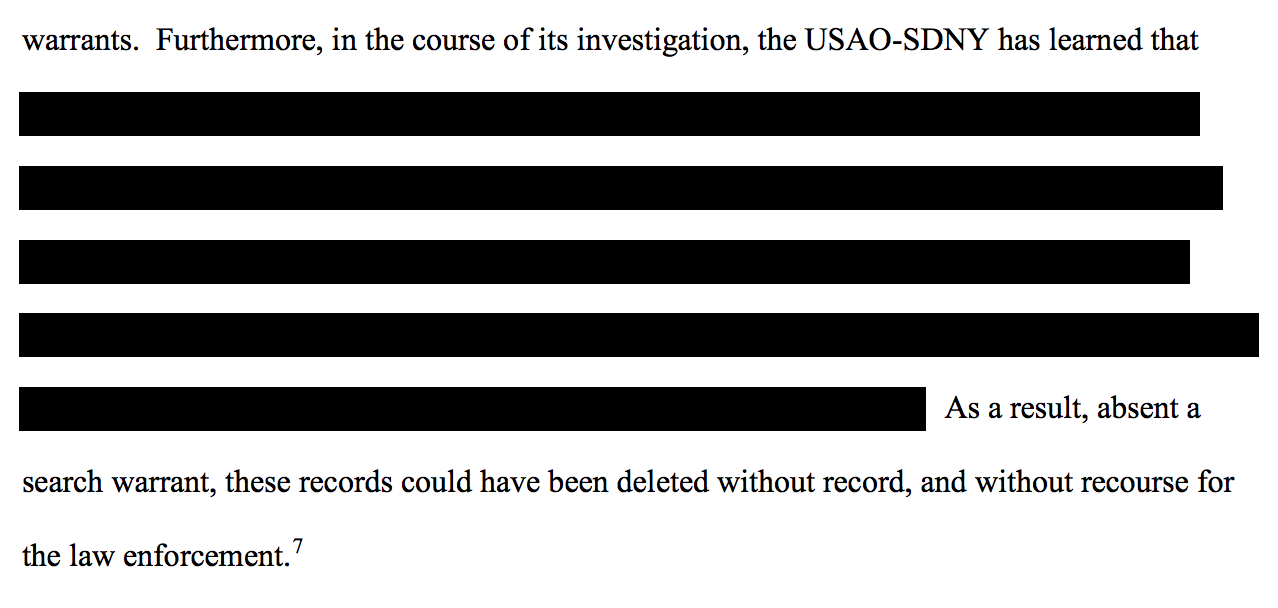
I confess I’m most interested in Hickey’s mention of destruction of evidence, though. That’s true, in part, because SDNY seems to think Michael Cohen might destroy evidence.

Hope Hicks, too, reportedly thought about hiding evidence from authorities. Then there’s the report that Mueller is checking encrypted messaging apps as people turn in phones when they arrive for interviews.

Huckey seems to think some of the people being investigated — beyond Papadopoulos and IRA troll Viktorovna Kaverzina — may have been destroying evidence.

I wonder if he has reason to suspect that.


Revisiting Trump’s Joint Defense Agreement

Betsy Woodruff has a story reminding us that Trump has a joint defense agreement with some of the other people caught up in Mueller’s probe.

The president’s personal lawyers have teamed up with attorneys for other individuals embroiled in special counsel Bob Mueller’s probe, multiple sources tell The Daily Beast. For a while, the president’s lawyers even had regular conference calls with other attorneys to discuss the Mueller investigation, according to one source familiar with the calls.

The arrangement is known as a joint defense agreement, and it allows the lawyers to share information—without violating attorney-client privilege. It’s a common strategy when multiple defendants are dealing with the same prosecutor on the same matter.

I say “reminding us,” because this is not news. When Mike Flynn flipped, the first notice came when he alerted this very same joint defense agreement he could no longer share information (as the story itself notes).

The story doesn’t even describe, generally, who is included in it, which might help observers understand the dynamics we’re watching. The closest hint of that is the observation that Paul Manafort might be going to jail on Friday.

This week is poised to be less-than-harmonious for at least one person in Mueller’s sights: Paul Manafort, who will appear in court on Friday for a hearing where a judge will decide whether or not to revoke his bail.

The article doesn’t even confirm that Manafort is part of the defense agreement. But Trump was bragging, back in January, that he had “decided that a key witness in the Russia probe, Paul Manafort, isn’t going to ‘flip’ and sell him out, friends and aides say.” That’s the kind of thing Trump might have assurance about if Manafort were part of a joint defense agreement, particularly if — as has subsequently been reported — John Dowd offered Manafort a pardon (through one of his lawyers, in the kind of discussion lawyers might assume were shielded by a joint defense agreement) last year.

The pardon discussion with Mr. Manafort’s attorney, Reginald J. Brown, came before his client was indicted in October on charges of money laundering and other financial crimes. Mr. Manafort, the former chairman of Mr. Trump’s presidential campaign, has pleaded not guilty and has told others he is not interested in a pardon because he believes he has done nothing wrong and the government overstepped its authority. Mr. Brown is no longer his lawyer.

Mind you, now we know that Mueller knows about such offers (because it’s one of the questions they posed to Trump in March). That makes Trump’s legal impunity for offering such pardons at least slightly more sketchy, particularly if he’s pardoning someone so obviously corrupt as Paul Manafort. Add in the fact that Jared Kushner sold out Flynn last fall (which is reportedly what led him to flip), and Manafort may be less certain about Trump’s reliability, even in spite of Trump’s Tweets suggesting FBI should have prevented him from hiring someone they were investigating back in 2016, posted — with remarkable prescience! — on the eve of the latest setback in Manafort’s case.

Still, the reminder that Trump and a number of subjects of this investigation have been comparing notes explains a lot we’ve seen since. It explains, for example, why Manafort has made such a diligent effort to get the court to disclose information to him– such as the substance of warrant affidavits to seize up to four other people’s AT&T phone information, or the other bullet points in Rod Rosenstein’s August 2, 2017 memo laying out the scope (at that point) of the investigation — that affects others likely covered by the defense agreement. It explains one advantage to Manafort of insisting on being charged in two jurisdictions: because it gives him two bites at an attempt to challenge Mueller’s jurisdiction.

The joint defense agreement also explains several other things we’ve seen, such as the coordinated messaging — particularly the planted narrative about Spygate — best explained by the coordination of Victoria Toensing armed with information only legally available to Trump.

Finally, it explains the delay in any charges related to the conspiracy between Trump and the Russians: once Mueller charges those issues, he will have to provide discovery about what he knows, which will then get shared back with others involved in the conspiracy. It appears he’s primarily sharing that information (aside from in the form of questions to witnesses who appear before the grand jury) with those who’ve flipped. Even the questions he has posed to Trump are probably sharply limited to hide the main thrust of the conspiracy investigation.

That’s why the stakes for Friday are so high (and the timing of this reminder that there’s a joint defense agreement). Mueller still won’t need to provide Manafort the evidence he has about his role in the conspiracy, though the indictment of Kilimnik gets far closer to that. But it raises the cost on Manafort for sustaining a joint defense, minimizes his value to the others, all while the crimes charged could still be refiled in a VA state court.


“I Mean His Trump Organization Employees”

I’m still plodding through the June 9 meeting materials, working on what they show about the story about the June 9 meeting that got crafted after the fact.

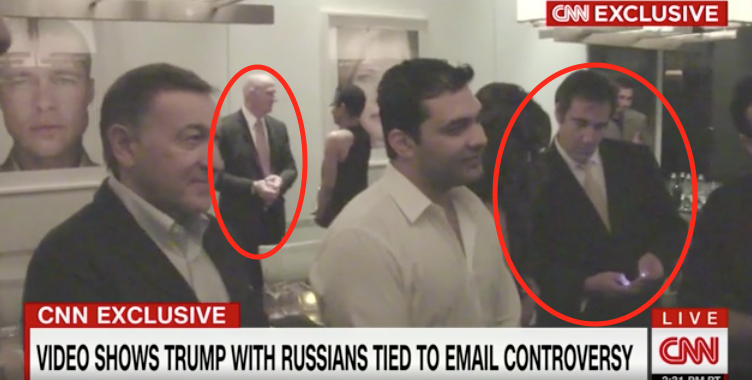
There’s one detail that I want to post separately. On July 13, 2017, Ike Kaveladze (who was really in charge of the meeting for his boss, Aras Agalarov) and Roman Beniaminov (Emin Agalrov’s assistant, who heard ahead of time the meeting was about dealing dirt on Hillary to the Trumps) had the following exchange by text (PDF 34).

[Kaveladze sends link]

Beniaminov: But I don’t recall taking any video. And I can’t understand why it looks so similar.

Kaveladze: I mean his trump organization employees.

By July 13, the Agalarovs and Trumps were increasingly at odds on how to respond to the story, not least after the Trumps leaked Rod Goldstone’s name to the press after saying they wouldn’t. After that, there seemed to be increasing amounts of dirt being leaked, perhaps by both sides.

It appears that Kaveladze may have phoned Beniaminov right before this to raise this CNN story, which had just been posted. Beniaminov seemed to think Kaveladze had suggested that he, Beniaminov, had taken the video, even while he seems to have been present at the Las Vegas event back in 2013.

Scott Balber, the Agalarov’s ever-present lawyer (who had actually represented Trump on a Miss Universe related issue in 2013), was quoted in the piece.

“It’s simply fiction that this was some effort to create a conduit for information from the Russian federal prosecutors to the Trump campaign,” Balber said on CNN’s “New Day.” “It’s just fantasy world because the reality is if there was something important that Mr. Agalarov wanted to communicate to the Trump campaign, I suspect he could have called Mr. Trump directly as opposed to having his son’s pop music publicist be the intermediary.”

I don’t rule out Balber having taken and leaked the video.

Or maybe not: What Kaveladze is interested in highlighting to Beniaminov is the presence of two other Trump employees in the video: Keith Schiller and Michael Cohen, shown above.

I don’t know what to make of the reference — though it’s equally possible they were involved in the 2017 response, or were viewed for some other reason as an additional concern regarding the June 9 meeting. Both, of course, have gotten some scrutiny for the liaison role they have served between Trump and other Russians.


On the Eve of the June 9 Trump Tower Meeting Anniversary, Putin Tells Trump to Keep His Campaign Promises

I’ve long argued that Vladimir Putin and Donald Trump engage in a kind of signaling, perhaps fueled by some kind of back channel.

With that in mind, I wanted to look at the last few days of public statements. First, in an interview recorded Thursday, Putin was asked whether he was beginning to prepare for a summit with Trump. Among other things, Putin said that Trump knows how to listen even in spite of what the reporter cued as “domestic pressure,” and fulfills his campaign promises. Putin said Trump promised to improve Russian-American relations but the ball was in the American court. (This WaPo story on the interview may have better translations of the Russian.)

Two short clarifications on the events of the last week, and I understand that there is very little time. Recently, on the air of “Vesti on Saturday”, information appeared with reference to The Wall Street Journal, which, in turn, referred to sources in the White House that the Americans had begun training – as they say, at an early stage – to Trump’s meeting with you . Have you started this training?

“This was discussed from the very beginning, after the election of Mr. Donald Trump as President of the United States.” And we from the very beginning responded to this, that we believe that such personal meetings are expedient, and not only possible. We met with the President of the United States at international venues. Of course, this does not give an opportunity to give due attention to Russian-American relations. In general, I think this meeting is useful. The only question is that the domestic political situation in the United States allows this.

– And how to deal with them, given that Trump is largely hostage to the domestic political process? Even if you meet and agree, they will let him carry out what you potentially negotiate?

“The experience I have with the President of the United States suggests that, despite the fact that his actions are often criticized, especially recently, including in the international arena and in the sphere of the economy, after all this experience tells me that he is a thoughtful man, he knows how to listen and responds to the arguments presented by the interlocutor. All this gives me reason to believe that dialogue can be constructive.

– Recently he received the closest allies: German Chancellor Angela Merkel, French President Macron. And the meetings, especially with Macron, were caress in the flesh, embraces, almost kisses and so on. And then it takes literally a week and a half, and it was worthwhile for the Europeans to raise their voice, including, I think, because of this, what you call sanctions, in particular, increased tariffs for aluminum and steel , is introduced . Are not you afraid of such “affectionate” embraces of Americans who now say: let’s prepare a meeting, and then you will meet with Trump, you will be exposed to such conditions. Or with you this will not work?

– The fact is that this does not pass with anyone. And the relationship between the leaders of states should be acceptable, civilized. But this does not preclude the adoption of decisions that this or that leader consider important and expedient for his country. It is possible to treat differently the decisions that are made in the United States, including the US president. You can criticize. Indeed, there is much that deserves criticism. But there is one circumstance about which I have already spoken: Trump fulfills his promises given to them during the election campaign.

– With one exception: to improve Russian-American relations.

– One of the promises is to improve Russian-American relations. I hope that this too will take place. In any case, we are ready for this. The ball, I believe, on the American side, on the American court.

On Friday, Trump said that Russia should be readmitted into the G-7, just before he premised leaving the G-7 early based on whether the other countries capitulate on tariffs.

Q (Inaudible) G6-plus-one?

THE PRESIDENT: It may be. You can call it anything you want. It doesn’t matter. It doesn’t matter what you call it. It used to be the G8 because Russia was in it. And now Russia’s not in it.

Now, I love our country. I have been Russia’s worst nightmare. If Hillary got in, I’d think Putin is probably going, “Man, I wish Hillary won.” Because you see what I do. But, with that being said, Russia should be in this meeting. Why are we having a meeting without Russia being in the meeting? And I would recommend, and it’s up to them, but Russia should be in the meeting. They should be a part of it.

You know, whether you like it or not — and it may not be politically correct — but we have a world to run. And in the G7, which used to be the G8, they threw Russia out. They should let Russia come back in. Because we should have Russia at the negotiating table.

Q Mr. President, why did you decide to cut (inaudible) short?

THE PRESIDENT: Say it? What?

Q You’re leaving a little early from the summit. Why did you decide (inaudible)?

THE PRESIDENT: I may leave a little bit early. It depends on the timing. But I may leave a little bit early. And it depends what happens here.

Look, all of these countries have been taking advantage of the United States on trade. You saw where Canada charges our dairy farmers 270 percent tariffs. We don’t charge them, or if we do, it’s like a tiny percentage. So we have to straighten it out.

We have massive trade deficits with almost every country. We will straighten that out. And I’ll tell you what, it’s what I do. It won’t even be hard. And in the end, we’ll all get along.

But they understand. And you know, they’re trying to act like, “Well, we fought with you in the war.” They don’t mention the fact that they have trade barriers against our farmers. They don’t mention the fact that they’re charging almost 300 percent tariffs. When it all straightens out, we’ll all be in love again.

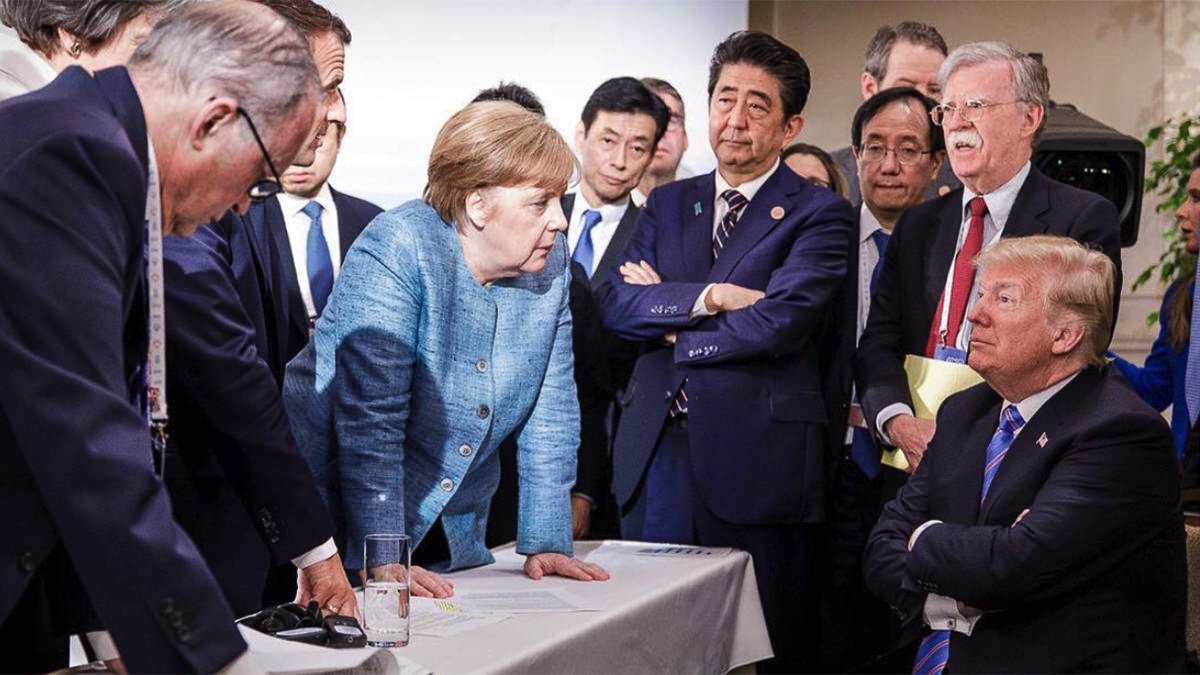
Trump acted like a sullen toddler throughout the G-7, agreed to the communique, then backed out, blaming Justin Trudeau, ostensibly for publicly saying Canada would adopt retaliatory tariffs in response to Trump’s steel tariffs. (Trudeau had spoken most forcefully against readmitting Russia). On leaving, he reiterated his support to readmit Russia, even in spite of their actions in Crimea.

Q Mr. President, David Herszenhorn with Politico Europe. Just to come back to Russia for a second. Something that happened that got them kicked out of the G8 was the invasion and annexation of Crimea. Do you think that Crimea should be recognized as Russian (inaudible)?

THE PRESIDENT: Well, you know, you have to ask President Obama, because he was the one that let Crimea get away. That was during his administration. And he was the one that let Russia go and spend a lot of money on Crimea, because they’ve spent a lot of money on rebuilding it. I guess they have their submarine port there and such. But Crimea was let go during the Obama administration. And, you know, Obama can say all he wants, but he allowed Russia to take Crimea. I may have had a much different attitude. So you’d really have to ask that question to President Obama — you know, why did he do that; why did he do that. But with that being said, it’s been done a long time.

Q But you would allow Russia back into the G8 with Crimea still (inaudible)?

THE PRESIDENT: I would rather see Russia in the G8 as opposed to the G7. I would say that the G8 is a more meaningful group than the G7, absolutely.

As Putin was leaving the Shanghai Cooperation Organization, after making comments about Trump’s trade wars hurting Europe, Putin again said he was ready to meet, though said it is important that the summit be “filled with specific content.”

Question: Mr President, there is real drama unfolding around the G7 summit in Quebec and inside the G7 itself: disagreements over Russia’s possible return, over tariffs, and more controversy. In this regard, how do you assess the proposal made by Trump and the Italian Prime Minister on Russia’s return to the format, given that the purchasing power parity in the SCO is actually higher than in the G7?

Vladimir Putin: As for Russia’s return to the G7, or G8 – we have never withdrawn from it. Our colleagues refused to come to Russia at some point for well-known reasons. We would be happy to see everyone in Moscow, they are welcome. That is first the first thing.

Second. As for the efficiency and volume of the economy, indeed, the purchasing power parity (this is IMF data) of the countries of the Shanghai Cooperation Organisation is already higher than in the G7 countries. Yes, it is, the PPP is higher.

True, the seven are still richer in per capita income, as they say, but the SCO economies are larger, and their population is much larger, too – half the world’s population.

As for the various difficulties in the negotiation process within the G7, I need to take a look at this, I do not know the details. Of course, this is also of interest, these are the largest economies in the world.

We can see that there are internal problems there. Well, it happens. You know, when I look at our debates in the EAEU, we also have disputes and do not unanimously sign everything at the same time. I think this is common practice. It is necessary to deal with this calmly and without any irony.

I would draw attention to one more circumstance, which, in my opinion, is more significant than any emotional outbursts. What do I mean? As far as I know, the President of the United States said the US is considering the possibility of regulating the additional supply of automotive equipment in the US market.

This is a serious matter. This can really hurt the economic interests of so many countries, above all European, of course. Well, let us see how things will really unfold. This is of significant importance for the entire world economy.

[snip]

Question: There have been reports that Austria is ready to host the US-Russia summit between you and Donald Trump. Can you confirm this? Perhaps you discussed this when you were in Austria? And when will you meet with Trump? Everyone is looking forward to it. Many problems have accumulated.

Vladimir Putin: The President of the United States has repeatedly said that he considers this meeting expedient, and I agree that this is indeed the case. I can reiterate, in our last telephone conversation he expressed his concern about the threat of a new round of the arms race. I agree with him.

But to discuss this specifically, our respective foreign ministries need to work, and experts need to work very closely together. Personal meetings are certainly necessary as well. As soon as possible. As soon as the American side is ready, this meeting will be held immediately, depending on my work schedule.

About the location. We did not talk about this in detail, but many countries are willing to render such assistance to us, including several European countries, Austria among them. I have not heard anything else. But I think this is a technicality. What is important is that the meeting, if it takes place, is filled with specific content.

Given the way Trump blew up the G-7, I really wonder whether Putin has a greater threat over Trump than we know — something far, far greater than the goddamned pee tape. Trump has always seemed anxious to reassure Putin that he, himself, is not under investigation (indeed, that seemed to be one reason Trump raised the Comey firing at the May 10, 2017 meeting with Sergei Lavrov). It’s almost as if, as Robert Mueller gets closer and closer to Trump, Putin raises the stakes as well.

And this weekend, after Putin demanded that Trump keep his campaign promises, Trump made havoc of a key alliance.

Whatever Putin has over Trump, Trump appears more afraid of Putin than he is of Mueller.


On the Tactics of the Latest Manafort Indictment

When I went out to run errands yesterday, Paul Manafort was likely facing having his bail revoked next Friday and going to jail, from where he would fight charges that could put him in prison for the rest of his life. When I returned after an hour and a half, Paul Manafort — faced with a new superseding indictment — was probably facing having his bail revoked next Friday and going to jail, from where he will fight charges that could put him in prison for the rest of his life. That is, nothing much has changed, especially if you’ve been following along closely enough to know that Konstantin Kilimnik, who finally got added to Manafort’s indictments, has always been a key part of the election year conspiracy and the damage control since.

The key development, in my mind, is tactical. As Popehat explained in one of two great lawsplainers yesterday, the standard on revoking bail in any case is just probable cause that you’ve committed new crimes while being out on bail. By getting the grand jury to indict the underlying behavior behind the witness tampering claim, you’ve established probable cause.

And by the way, those accusations that Manafort committed a crime on bail? Mueller got a grand jury indictment, establishing probable cause. That may be all the judge requires. Manafort’s in trouble. I mean, even in the context of someone facing multiple indictments trouble.

This makes easier for Amy Berman Jackson to send Manafort to jail next Friday, effectively outsourcing the decision to a bunch of anonymous grand jurors. That is, it takes a likely action and makes it even more likely.

I’m interested in what it does to preserve evidence, though.

Manafort submitted his opposition to having his bail revoked last night, effectively claiming that Mueller has shown almost no evidence of witness tampering.

The Special Counsel creates an argument based on the thinnest of evidence; to wit, Mr. Manafort violated the Release Order’s standard admonition that a defendant not commit an offense while on release by allegedly attempting to tamper with trial witnesses. However, the scant proof of this claim is an 84-second telephone call and a few text messages between Mr. Manafort (or an associate referred to as “Person A”) and two former business associates(Doc. 315-2, Ex. N). These brief text messages followed the filing of the Superseding Indictment on February 23, which was the first time the Special Counsel raised any allegations about the mission and work of the Hapsburg Group. (Doc. 202, ¶¶30, 31.) Closer scrutiny of this “evidence” reveals that the Special Counsel’s allegations are without merit because Mr. Manafort’s limited communications cannot be fairly read, either factually or legally, to reflect an intent to corruptly influence a trial witness.

The merits aside (remember, Jeffrey Sterling spent years in prison based in significant part on metadata showing 4:11 in phone calls, without content, between him and James Risen), I find this footnote most interesting.

2 This is no small matter. It is clear from the Special Agent’s declaration that the agent spoke with the person on the other end of the call (i.e., D1). (See Doc. 315-2, ¶¶ 19, 20). Instead of identifying what was said exactly for purposes of this motion, however, the Special Counsel instead states what D1 “understood” from Mr. Manafort’s brief text messages—not the telephone call that occurred. Id. at ¶19. The Special Agent also states what D1 opines, i.e., what D1 believes Mr. Manafort knew. Id. Person D2, with whom Mr. Manafort had no telephone conversations or text messages, states that D1 told him (D2) that he “abruptly ended the call.” Id. at ¶ 20.

Manafort is complaining that Mueller didn’t reveal precisely what FBC Group’s Alan Friedman (see this post to explain who he is) told the government about the call. Had Mueller not indicted, then he would have had a real incentive to call Friedman as a witness next week to explain precisely why Manafort’s comments reeked of obstruction. Mueller has likely presented the substance of the call to the grand jury, however, and may now have less need to put Friedman on the stand next week.

But there is probably far more interesting evidence that Mueller presented to the grand jury to substantiate these two charges:

Obstruction of Justice

From in or about and between February 23, 2018, and April 2018, both dates being approximate and inclusive, within the District of Columbia and elsewhere, the defendants PAUL J. MANAFORT, JR., and KONSTANTIN KILIMNIK knowingly and intentionally attempted to corruptly persuade another person, to wit: Persons D1 and D2, with intent to influence, delay, and prevent the testimony of any person in an official proceeding

Conspiracy to Obstruct Justice

From in or about and between February 23, 2018, and April 2018, both dates being approximate and inclusive, within the District of Columbia and elsewhere, the defendants PAUL J. MANAFORT, JR., and KONSTANTIN KILIMNIK knowingly and intentionally conspired to corruptly persuade another person, to wit: Persons D1 and D2, with intent to influence, delay, and prevent the testimony of any person in an official proceeding, in violation of 18 U.S.C. § 1512(b)(1).

Charging both the obstruction charge and the conspiracy charge is, in some ways, insurance. It implicates Manafort in what are mostly Kilimnik’s efforts to get Friedman on the phone to coordinate stories.

But to charge conspiracy to obstruct, as opposed to just obstruction, Mueller also needs to show an agreement between Manafort and Kilimnik. Such an agreement would likely get to the core of Manafort’s intent more quickly than the calls as received by D1. That is, such an agreement would be the evidence that Manafort claims is lacking.

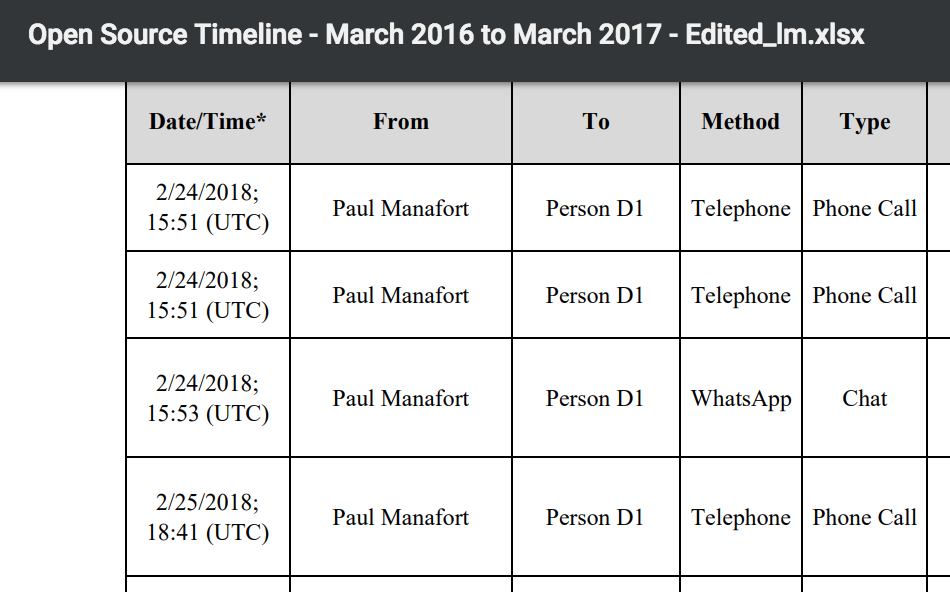
Which brings me to this exhibit, submitted Monday as part of the government’s motion to revoke bail, which is an XLS spreadsheet bearing the title “Open Source Timeline – March 2016 to March 2017 – Edited_lm.xlsx” uploaded to the docket.

It tracks the phone, WhatsApp, and Telegram communications between Manafort and Person D1 and D2, and the WhatsApp and Telegram chats between Kilimnik and D1 and D2 (Manafort uses WhatsApp once to place a phone call, but otherwise the WhatsApp and Telegram communications are all chats). It shows that the government has third-party sources for all of this — either D1 and D2 turning things over on their own, Manafort’s phone company (he was using AT&T quite recently) turning over his toll records, or Apple turning over the contents of Manafort’s iCloud account.

The table also shows time tracked in two scales: All of Manafort’s communications and the single chat between Kilimnik and D1 are in Coordinated Universal Time, while all of Kilimnik’s chats with D2 are in Central European Summer Time. You might get the latter via screen shots from a phone taken while in Central Europe.

Note, even though Kilimnik tells D2 that he had tried D1 “on all numbers,” the log doesn’t show any calls between Kilimnik and D1, it shows only the one WhatsApp chat between Kilimnik and D1. So the log doesn’t even show all the communications to D1 that exist. Just those that the government can provide a source that it’s willing to share publicly. I assure you, however, that the government knows when those calls were placed.

The log, as presented, also doesn’t show any communications between Manafort and Kilimnik.

Now go back to the fact that, yesterday, the government showed the grand jury not just evidence that Manafort and Kilimnik individually tried to suborn perjury from D1 and D2, but that they agreed to do so. At the very least, that would involve communications between the two of them. They’re only going to have the substance of that communication in one of two ways, though: if they did this via WhatsApp chats, those chats would be available on Manafort’s iCloud account, because he’s got really bad OpSec.

But if those communications were via a phone or WhatsApp call, then the government would have gotten that communication via some other means, means it hasn’t shown in that contact log. Keep in mind: as a foreigner with key connections, Kilimnik is a legitimate spying target under any definition of the term, even aside from the allegation he’s got active ties to Russian intelligence. And since January 2017, the NSA has been able to share raw EO 12333 intelligence with intelligence agencies, including the FBI. If that sharing works the same way Section 702 sharing works (and Kilimnik’s WhatsApp activity may or may not be collectable under 702, even before you get to EO 12333 collection), then so long as the FBI has a full investigation, it can obtain raw feeds of the targets covered by that full investigation.

No FISA notice has been filed in this case; it’s not clear whether the government would give notice of EO 12333 data (they should but they likely don’t). In either case they’d only have to if they intended to use that information in trial. The rest, they’d parallel construct by obtaining from the other parties to a communication or Manafort’s iCloud account.

Now, I suspect Mueller did not intend to file a document indicating that this communication log was originally started with a March 2016 to March 2017 scope, making it clear they’ve got a collection of parallel constructed sources for Kilimnik and Manafort communications that go back that far, right back to when Manafort joined the Trump campaign (which is slightly different than saying they got all of Manafort’s communications during the campaign).

That they’re still using the log to track the duo’s really idiotic ongoing communications is testament to the fact that since Manafort was indicted in October, the government has just been sitting back, watching everything Manafort and Kilimnik do and say to each other while getting Rick Gates to flip, collecting more information, and forcing Manafort to pledge all remaining liquidity to get bail. They’ve been watching Manafort and Kilimnik continue their efforts to try to get out of the deep shit Manafort is in, biding their time.

At the very least, revealing the communication log on Monday would have led Manafort to finally change the privacy settings on his phone, though it may well have led to a noticeable security change from Kilimnik as well, perhaps even a new phone without an FBI or NSA sensor collecting everything.

In the interim, too, other corners of the government revealed, in fairly spectacular fashion, that they can and will obtain the Signal and WhatsApp chats involving journalists of even congressional staffers like James Wolfe, meaning not just that they would do the same for alleged criminals out on bail and their co-conspirators, but that the means to do so has become readily available to the FBI for national security investigations. In short, this week the government tipped their hand about a whole slew of communications involving Manafort and Kilimnik that haven’t been disclosed in discovery yet as well as a capability that even lots of national security journalists (present company excepted) didn’t know they had.

Thus the grand jury and the new charges. It strikes me that, after disclosing the additional collection the FBI has on these two (though both have been fairly stupid in response to such disclosures in the past), the government has less incentive to let Manafort remain out on bail, because it will have a diminishing yield of information about the conspiracy. But the government also has a need to move things along without presenting everything they’ve got (including what they’ve asked Friedman about the developments post April 2 that led Kilimnik to try reaching out a second time). The new indictment provides a way to get to probable case without showing everything they’ve got, which in turns makes the chances that Manafort will finally be going to jail that much higher.

Update: On June 12, the government elaborated on the evidence showing that Manafort intended to suborn perjury, noting that the indictment should be enough by itself to revoke bail.

On June 8, 2018, a grand jury sitting in the District of Columbia returned a Superseding Indictment charging Manafort and his longtime associate, Konstantin Kilimnik, with attempted witness tampering and conspiracy to commit witness tampering, in violation of 18 U.S.C. §§ 1512(b)(1) and (k). See Doc. 318 ¶¶ 48-51. Counts Six and Seven of that Superseding Indictment “‘conclusively determine[] the existence of probable cause’ to believe the defendant” committed a federal crime while on pretrial release. Kaley v. United States, 134 S. Ct. 1090, 1097 (2014) (quoting Gerstein v. Pugh, 420 U.S. 103, 117 n.19 (1975)); see also United States v. Smith, 79 F.3d 1208, 1210 (D.C. Cir. 1996) (“[T]he indictment alone would have been enough to raise the rebuttable presumption that no condition would reasonably assure the safety of the community.”). Probable cause to believe that Manafort committed a crime, in turn, triggers a rebuttable presumption “that no condition or combination of conditions will assure that [Manafort] will not pose a danger to the safety of any other person or the community.” 18 U.S.C. § 3148(b). Manafort’s challenge to the strength of the government’s evidence of witness tampering is thus both misplaced and unavailing. See Kaley, 134 S. Ct. at 1098 & n.6 (explaining that “[t]he grand jury gets to say—without any review, oversight, or second-guessing—whether probable cause exists to think that a person committed a crime,” and recognizing that this “unreviewed finding . . . may play a significant role in determining a defendant’s eligibility for release before trial under the Bail Reform Act”). 1

The go on to suggest that given the indictment, they don’t even need to bring the FBI agent to testify, but will.

Although the government submits that the grand jury’s probable-cause determination obviates the need for testimony by the agent who signed the declaration in support of the government’s motion to revoke or revise, the agent will be available to testify if needed per the Court’s Order. The government submits, however, that any remaining factual matters can be addressed by proffer, as is common practice at bail hearings. See Smith, 79 F.3d at 1210; see also United States v. LaFontaine, 210 F.3d 125, 131 (2d Cir. 2000) (calling it “well established . . . that proffers are permissible both in the bail determination and bail revocation contexts”).

Again, all this seems designed to make it easy for Amy Berman Jackson to revoke his bail.


Some Possibilities on the Emails Hope Hicks Wanted to Withhold

Remember this story about how Hope Hicks told Mark Corallo in a conference call on July 9, 2017 that they didn’t have to be fully forthcoming about the purpose of the meeting because the emails would never come out?

In Mr. Corallo’s account — which he provided contemporaneously to three colleagues who later gave it to The Times — he told both Mr. Trump and Ms. Hicks that the statement drafted aboard Air Force One would backfire because documents would eventually surface showing that the meeting had been set up for the Trump campaign to get political dirt about Mrs. Clinton from the Russians.

According to his account, Ms. Hicks responded that the emails “will never get out” because only a few people had access to them. Mr. Corallo, who worked as a Justice Department spokesman during the George W. Bush administration, told colleagues he was alarmed not only by what Ms. Hicks had said — either she was being naïve or was suggesting that the emails could be withheld from investigators — but also that she had said it in front of the president without a lawyer on the phone and that the conversation could not be protected by attorney-client privilege.

At the time, I suggested something didn’t make sense about the story, given the facts we knew at the time, because the NYT already had (what we assume to be) the set of emails that got released.

[T]he NYT admits that even as (or shortly after) that meeting transpired it already had the emails Don Jr released that day and was going to publish them itself.

I suggested at the time that there might be other emails — perhaps between Don Jr and Rob Goldstone, perhaps between other players — that provided more damning information.

But there’s another possibility: that more emails exist, between Don Jr and Rob Goldstone (indeed, we know Goldstone sent follow-up emails involving Vkontakte). Or that there are communications between other players. In which case the release of the current emails might serve to distract from a fuller set that Hicks did succeed in burying.

Given the materials released to SJC — and when they were released — we can be sure there were other emails, and at least some of them have come out.

A return email to Paul Manafort

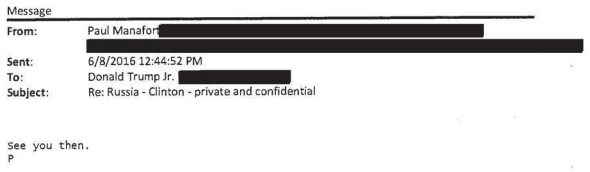
I’ve already noted one example, or at least part of one example. The Don Jr production turned over by the Trump Organization withheld the version of the original invite letter that includes a response from Paul Manafort.

Of particular interest, however, is a detail revealed about the email that Don Jr released last summer. Effectively, the email thread setting up the meeting appears in two places in the exhibits introduced with Don Jr’s testimony. The thread appearing at PDF 26 to 29 is for all intents and purposes the set he released over two tweets last July 11. That bears Bates stamp DJTJR 485 to 487, which designates that it was the version that Don Jr himself turned over. There’s another version of that thread, though, bearing Bates stamp DJTFP 11895 to 11897, which appears at PDF 1 to 3 in Don Jr’s exhibits (and is used for all the other witnesses). The Bates stamp abbreviation DJTFP, Donald J Trump for President, indicates that that’s the version turned over by the campaign. The exhibit shows the same thread, only with this addition.

That is, after Don Jr informed Jared and Paul Manafort that the meeting would be at 4 instead of 3, Manafort responded, “See you then.”

That — and the fact that Don Jr chose to suppress it when publicly releasing his email — is not by itself damning.

Jared wasn’t copied on the Manafort response, so he couldn’t have turned over the Manafort response (and it wouldn’t have been in the copy leaked to the NYT, if he did the leaking, as suggested by Michael Wolff’s book). Nevertheless by the time Don Jr testified on September 7, SJC had both copies.

Manafort’s awareness of the meeting might be damning by itself, because he spoke with Don Jr and met with Trump on June 7, the day Trump announced the campaign would soon be making a “a major speech on probably Monday of next week, and we’re going to be discussing all of the things that have taken place with the Clintons.”

But it’s possible Manafort’s response wasn’t the last in the thread. Perhaps Don Jr wrote back and said something like, “with the dirt Emin promised we’ll really take out this bitch” or something similarly dignified.

The emails showing Agalarov involvement

As I mentioned in this thread, Goldstone did not fully cooperate with SJC. In the first round he left out a lot of stuff that was responsive to SJC’s request and he never provided phone records; in his later production, two voice mails from Emin appear to be truncated. But in February of 2018 (probably after at least one interview with Mueller’s team), his lawyer provided more documents not produced in the first go-around. Among other things, those materials included more details on Emin’s involvement in crafting a statement, and Kaveladze’s role running everything. Of particular interest, many of these materials would show direct communications between the Agalarov camp and Trump Organization lawyers as they crafted their statement.

The draft statement from July 6

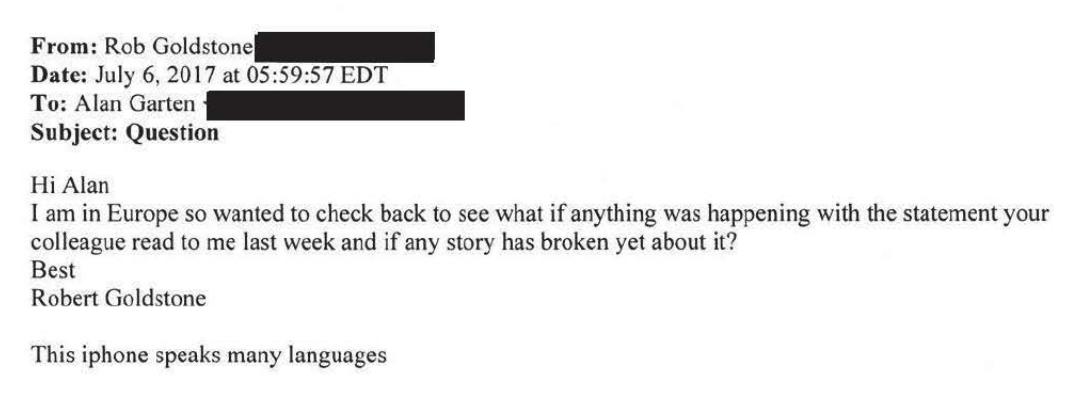
Finally, when considering the possibility that parties withheld damning records, consider this email between Goldstone and Don Jr’s lawyer.

It shows that by the time Goldstone (and Emin and Kaveladze) had some phone calls with Alan Garten and Alan Futerfas at the end of June, the Trump folks already had a statement. When Goldstone gets off his cruise in Greece on July 6, he immediately contacts the Trump camp and asks if that statement has been released.

There’s no record of a response to Goldstone from the Trump camp for several days (though they were on the phone with Kaveladze), until when, on July 9, someone (Goldstone believes it’s the Trump camp) leaked his name. That’s when communications resumed, starting with a Trump request that Goldstone attest that the misleading Don Jr statement they subsequently released is 100% true.

Still, the communication on July 6 is damning enough, because it makes it clear that before Trump is known to have been involved, before Trump spoke to Putin, the Trump camp had what it presented as a finalized statement.

Now imagine if either Goldstone or someone else has a hard copy of that statement and it qualitatively deviates from the existing story?

One notable detail. As noted, Goldstone provided these materials after the NYT story at question here, and after Mark Corallo said he’d testify about Hope Hicks’ obstruction; it possibly took place after the Corallo testimony itself. Goldstone testified to SJC a second time on March 29, not long after Mueller subpoenaed the Trump organization — a subpoena that almost certainly would obtain new copies of the documents at least pointed to if not turned over by others.

All of which is to say that there are numerous emails that have been identified since Don Jr testified that appear not to have been turned over in his production, not to mention any Manafort communications he suppressed.

As I’m still working on showing, there was a tremendous degree of coordination going on in that period. And yet, perhaps in spite of that, some of the key documents didn’t get turned over.

Update: Here’s a version of the document requests to the Trump’s. Any of the emails between the Trump lawyers and Kaveladze or Goldstone would have been responsive. Here is what Jared got (remember, the committee complained that he hadn’t provided everything). And here is what Kaveladze and what Goldstone got. I can see Goldstone arguing the follow-up — and the discussions about earlier Agalarov/Trump meetings — didn’t fit the criteria laid out.

Copyright © 2026 emptywheel. All rights reserved.
Originally Posted @ https://www.emptywheel.net/2016-presidential-election/page/147/