
This Is Not A Constitutional Moment
Introduction
In this post I described three scripts that different political groups use to describe our current situation. Trump apologists say that we are in a constitutional moment, roughly defined as a period in which the American people update the Constitution by insisting on changing prior interpretations. This script is based on a theory proposed by Bruce Ackerman, Sterling Professor of Law and Political Science at Yale Law School. Ackerman’s idea is laid out in his 1991 book We The People: Foundations, and is discussed in the second of his Oliver Wendell Holmes Lectures of 2006. It’s gained prominence since the 2024 election and the wholesale assault on our governmental system by Trump. For example, the New York Times did a podcast featuring long-time SCOTUS reporter Adam Liptak (link is to transcript).
I was dismissive of this idea, partly because I’d never heard of it, and partly because it seems weird that anything about Trump would fit into a responsible theory of the Constitution. And, of course it doesn’t fit: Trump apologists have to distort and prune the theory to make seem vaguely plausible.
The dualist Constitution and the Constitutional Moment
Ackerman calls his theory a dualist constitution. He describes the basic ideas. In our system of representative democracy, power flows from the people. Some decisions are made directly by the people, such as elections. Spme are made by the government directly, for example rules and executive orders; and some indirectly through representatives of the people, such as laws and appointments to certain bodies. Thus, a dualist constitution.
With respect to constitutional issues, the people can act in two ways. They can amend the Constitution following Article V. This hasn’t been done in a long time, and may no longer be possible. The second way is the relevant part of Ackerman’s theory.
Most of the time the people do not engage in constitutional debates, or even extended policy debates. We are consumed by the demands of our private lives, work, family, community, and that’s as it should be. These are the blessings of liberty. But occasionally some event occurs that requires the people to pay attention and make a decision. I’ll focus on the Civil Rights Era as in the Lectures.
In the Lectures Ackerman says:
In past work, I have shown how key constitutional transformations in American history have passed through a distinctive institutional dynamic, consisting of five phases: signaling, proposing, triggering, ratifying, and finally consolidating the new principles supported by the American people. Fn omitted.
Very briefly, signalling is the recognition by a significant institution or large group of people that change is needed and must be considered, and the issue is forced to the forefront. Proposing is the stage at which the issue is debated and specific proposals are made. Triggering is the adoption of new legislation or a change made by SCOTUS, or new rules adopted by the federal government. Ratification takes place as the moving group wins elections. Consolidation occurs as the new principle is embedded in confirming cases and bureaucratic practice.
In the case of the Civil Rights Era, Brown v. Board was the signal, the marches, demonstrations, citizen organizing, and agitation that followed are the proposing stage, The trigger was the Civil Rights Act of 1964. The ratification was that year’s landslide victory of Lyndon Johnson over Barry Goldwater along with huge majorities in Congress. The consolidation phase took place as the Voting Rights Act and other legislation passed with substantial bipartisan support. Richard Nixon continued and reinforced enforcement of those laws, and SCOTUS upheld the new laws and allowed powerful judicial enforcement.
Ackerman calls examples like the Civil Rights Era Constitutional Moments. The Trump crowd claims that this is one.
Applying the Ackerman theory
It’s difficult to diagnose the current state of a society, as Lescek Kolakowski tells us. At the time Ackerman was writing his book, the Civil Rights Era was 25 years in the past. His analysis in the Lectures was written 40 years later, which allows for at least some historical perspective, We are operating in real time, so I think it’s not safe to apply historical theories blindly; caution is essential.
Even so it seems obvious that the Trump crowd has nothing like the record of the Civil Rights Era to support a claim that we are in a Constitutional Moment. Trump never won a majority in an election, let alone a landslide victory like Johnson’s.
The Republicans, now firmly under Trump’s control, have never won a substantial majority in the House, and their fragile majority was won through computerized racial and political gerrymandering sanctioned by the Republican SCOTUS. The Republicans have a small majority in the Senate, but the Republican Senators represent fewer people than the Democratic Senators.
Trump has no popular support for his policies. His agenda is set out in Project 2025, and it was so toxic he disavowed it during the campaign. His favorability numbers are and have been negative. Polling consistently shows that a substantial majority of Americans loathe his policies. The brutality of his immigration enforcement, his attacks on the judiciary, his refusal to comply with the Epstein Transparency Act, his stupid tariffs, cutting research in violation of appropriation laws, and his foreign wars, none of them have even close to majority support.
I do not think the MAGA movement is a grass roots expression of the will of the American people. There are always racists and fascists, and authoritarians and anti-Semites, and religious crackpots, but the vast majority of Americans mostly ignore them. Trump’s not-crazy voters are largely influenced by demagogues, liars, and grifters, funded by filthy rich right-wingers with astonishing views about the rest of humanity. Without them, he’s a blow-hard flogging fraudulent universities.
The slightly bigger picture
Ackerman is a firm believer in the idea of a living Constitution. To put it very simply, the Constitution is a mix of organizational and operational rules; and a set of aspirations. The former include the establishment of the three branches, allocation of powers, and election rules. The latter are mostly contained in the Preamble and the Bill of Rights. Almost all of it is open to some degree of interpretation. The Supreme Court arrogated to itself the power to make final decisions on the meaning of both as[ects of the Constitution.
But in the end, the power of government lies in the people. If SCOTUS gets it wrong, the people force change. That’s one way to understand the Civil Rights Era: the absurdly limited interpretation of the Reconstruction Amendments in the Slaughterhouse Cases and the Civil Rights Cases established racial segregation as our baseline, and overturning it took decades and deaths.
Another of Ackerman’s examples is the New Deal. For decades SCOTUS struck down almost all progressive legislation regulating business and empowering unions, in such cases as Lochner v. New York. But the Depression was such a hideous problem that SCOTUS capitulated.
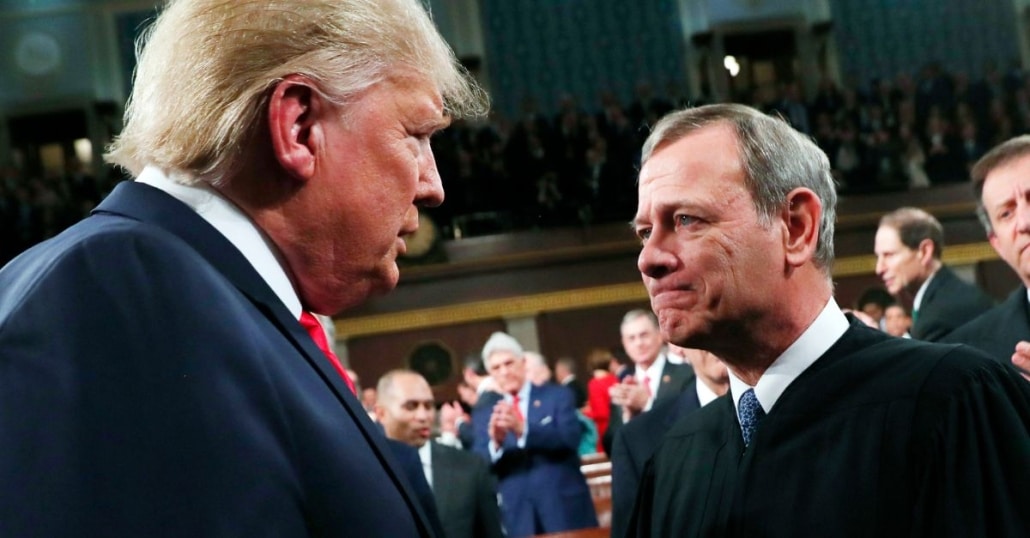
That’s not likely to happen given the relationship between Trump and SCOTUS Chief John Roberts. The front page pic of Trump and Roberts at the 2025 State of the Union address is the lead pic in this article at Law & Crime, titled “Chief Justice Roberts just handed Trump another win on foreign aid cuts after admin complained of judge’s ‘brinkmanship’”. The title and the pic are a not-so-subtle sneer at Roberts’ claims of independence from Trump.
Electoral victories won’t fix that.
==========
Photo credit: Leah Millis/Pool via AP


Very interesting. You end with “Electoral victories won’t fix that.” In my mind this points to the central issue of retaking power over MAGA and changing course which is what to do about SCOTUS. If we leave SCOTUS untouched as it is, anything of substance that a Democratic government will do will be opposed. In your view, what are the realistic options to reform SCOTUS then?
SCOTUS members only hold office during good behavior. I think it’s bad behavior to immunize Trump from all accountability except through impeachment, grab almost total control over allowable legislation, and systematically rip up the safe-guard Congress thought necessary to protect democratic elections, among other things.
The first step is to hold hearings on the impact of SCOTUS decisions increasing the power of the president and weakening the power of Congress, focusing attention on these issues.
The next is to hold hearings on the grounds for impeachment of members of SCOTUS. I think there is no precedent, so Congress gets to make its own decision about impeachment. The hearings should include corruption but not be limited to it. The impact of bad decisions on the structure of government and on the distribution of power is a crucial subject.
In the 1930s, the increased focus on the damage done by SCOTUS was enough to force changes. Maybe these two steps and the increase in public attention will be enough to force changes now.
If not, hold impeachment hearings on Brett Kavanaugh. Flesh out the lies from his confirmation about Christine Blasey Ford and his view of Roe v. Wade. Bring witnesses in to talk about Kavanaugh Stops. Then vote.
Ed, Your strategy gave me a secret thrill…until I remembered the billionaires who contracted with Leonard Leo to pick this court, for the purpose of protecting their wealth–and almost nothing else. Although some will squeal about “values,” especially Christian ones, the bottom line for the Roberts Court has always been these donors’ bottom line.
Should anyone start the process(es) you describe, these donors would surely flood the public zone with their Fox-yapping minions. Their voices would be amplified by Putin, who stands to gain only if American democracy continues its long slide toward oblivion. How do you propose overcoming such opposition?
Well, it won’t happen until the Dems gain control of the House, so we have time to lay the groundwork. I hope I’m helping with that.
Thanks Ed. Always thought provoking.
I recently heard a discussion with Jill Lepore, who spoke about changes to the constitution (last changed in 1992). Her words:
“One of the Constitution’s founding purposes was to prevent change. Another was to allow for change without violence.”
During that discussion she spoke about so-called originalism and the conflict with the Civil Rights Era. The transcript of that conversation can be found here: https://the1a.org/segments/jill-lepore-on-the-constitution-the-founders-and-change-without-violence/
There is another interview with Prof. Lepore, on the PBS Newshour, containing this exchange:
One problem with scholars like Lepore is that, in order to be taken seriously by the media and policy makers, they need to ascribe good faith to the other side, when in fact there isn’t any.
Originalists use Originalist arguments when they serve their purpose, use Textualist arguments when those serve their purpose, and will be perfectly happy to use the barrel of a gun and internment camps if need be.
The assault on the Constitution began long ago and has powerful forces behind it,
but it’s certainly been helped by professorial courtesy.
https://www.pbs.org/newshour/show/historian-jill-lepore-explores-the-constitution-and-its-interpretations-in-we-the-people
I think that’s probably true, but mostly because the slavers didn’t want anti-slavery amendments. The roots of the failures of our Constitution so often turn on slavery and racism.
@allen_in_upstate
I agree. The deference shown to judges is a real problem, not just for academics but for practicing lawyers.
I see a number of professionals turning against that, as on the podcasts Strict Scrutiny which i follow, Chris Geidner at Law Dork, and in the Doerfler/Moyn and Purdy-Britton/Pozen pieces I’ve discussed. Even Steve Vladek is starting to lose it.
Even my centrist Dem institutionalist friends are offended; people who defended SCOTUS three years ago are now aggressively attacking Trump judges, and especially the rogue SCOTUS six, personally.
“Change without violence” is not how the New Deal or Civil Rights eras went down. The New Deal changes happened because of the threat of violence against the Old Guard, not because SCOTUS had a legitimate change of heart about the Constitution. Plenty of workers from that era testified to Ken Burns about preparing for violence if FDR’s reforms were stopped, and there was the Lindbergh Fascist Conspiracy as well. You also have to take into account that FDR’s reforms were fairly moderate among proposed populist reforms.
Civil Rights movement also happened in the context of the Cold War and the Korean and Vietnam Wars. It’s a mistake to separate MLK’s pacifism from his threats of economic “passive-aggressive violence” and mass desertion.
I think that the moment is at least quasi-Constitutional because the questions being raised include whether you can find an argument to use a mangled version of the Constitution to lock in one party rule via judicial lifetime appointments, rigged House elections, and an increasingly disproportionate Senate map. There’s a reason that Earl Warren, author of Brown v. Board, said his proudest case was Baker v. Carr with very good reason: disproportionate representation that prevents electoral changes cannot be fixed with elections.
“Polling consistently shows that a substantial majority of Americans loathe his policies.”
Made me sit up! Predicts blue TIDAL wave, no?
Only if we can prevent folks from being shot when they try to vote. Or from being so terrified of being shot that they don’t vote.
Nothing about Trump and Miller’s terror regime is accidental. Especially the fear.
Actually, much like in current Iran, a lot of bodies (and even more injuries) may be necessary to turn the tide. Fifty years ago, subsequent to partaking LSD, I proposed that the world’s problems could disappear overnight if everyone awoke enlightened. Not likely, so we struggle in the tide to swim and survive, hoping for improvement, but history tends to need baths of blood before change progresses, it seems. Bless us for the times ahead.
If a woman can’t go to her doctor’s office without having her windows shattered and being pulled from her car. If a young man can’t hold a sign. then people are going to be cowed into not risking going to the polls. All it takes is one incident where ice assaults brown people lined up to vote and significant numbers of brown people won’t be voting.
That seems like the exact vision they want us to conjure…with the result that we don’t take the risk of voting.
There are many ways to suppress the (Democrats’) vote. Terror is the one I pray we don’t overlook until it’s too late.
. . . and in other news the befuddled and bewildered Supreme Court bailed on a Tariff ruling, I guess waiting to see how Trump’s latest tariffs on traders with Iran will further complicate their challenged minds.
The government has apologize for deporting a student flying home for the holidays as a surprise.
https://apnews.com/article/college-student-thanksgiving-deportation-government-apology-1ebeee3f3ddc4cf04448d31bcd71b09b
But it still hasn’t admitted that it shouldn’t be deporting people who are here legally. And it’s still lying to courts, and some of the courts are accepting those lies as truth.
The government has apologized in court but has yet to bring that student back from the country to which they deported her, Honduras.
That would require obeying a court order, which would mean the courts are not subject to the whims of The Felon Guy.
It was just an “Oops” by an individual and only affected an “illegal criminal alien”, not a human being with value and rights. No need for corrective action here, folks. If she had been white it wouldn’t even have happened, so the fault is on her. (I should give up sarcasm and snark, but I can’t).
If Trump had legitimate popularity and a supermajority of Congress, he wouldn’t need to strongarm his policies through. It’s his unpopularity and slim majority that make it necessary for him to be a dictator to impose his will.
But these people all see themselves as the main character who is unbiased and nonpartisan so they can decide for us how things should be and we’ll eventually all fall in line like Republicans did to the New York Democrat who bullied them into submission to take over their party.
It can’t be that we legitimately disagree with them because they can’t even see that a legitimate alternative to their views is possible. It must be that we’re pushing a partisan and dangerous agenda and they’re the grownups setting things right while obeying the whims of a toddler king.
Its also the only way he knows how to act.
Two points:
There are determined groups working to make an Article V Constitutional Convention happen soon. 28 states are on board with only 6 more to go. Common Cause is monitoring the situation and working against it: https://www.commoncause.org/work/stopping-a-dangerous-article-v-convention/
The refusal of the Judicial Council to do their duty under the 1978 Ethics in Government Act to investigate Clarence Thomas’ congential inability to fill out financial disclosure forms correctly makes the Supremes above and beyond the law in a similar way that the Supremes have made the [Republican] President above and beyond the law.
The Presidency and the Court are beyond the law now and Congress, both House and Senate , are more or less AWOL. The Constitutional moment may have passed or is basically moot, at least until we can restore the law and the Constitution to our own government. If we can.
I have trouble imagining a new constitution that does not create the US as Jesusland and bans abortion. I don’t see how we get rid of the outrageous misrepresentation ensconced in the Senate without a new Constitution.
said it before,
say it again.
term limits.
in this country, the top judges are off the bench at the age of 70.
the turnover guarantees contemporary assessment, and gives Australia a team of top level legal brainpower on international fora.
waiting for the passing of your out-of-touch legal minds is looking “not good”.
This is an interesting analysis, Mr. Walker, thank you. I don’t think you can so easily bucket all transformative social change in America into five distinct buckets but the overall framework is sound. I think social change is like Stephen Jay Gould’s “punctuated equilibrium” in describing anthropological evolution. Things stay the same for a period of time (“stasis” or equilibrium) and then they change rather suddenly, usually due to a triggering event. In terms of changing the Constitution, I agree with your thought that it may no longer even be possible, given the hopelessly fractured nature of American politics and how it is impossible to get Red and Blue states to agree on almost anything.
I think we can pull back a whole lot of Trump voters without giving up any of our principles. First, people mostly prefer the outcomes Dems claim to seek. Second, Trump isn’t delivering on his version of those promises, or on other promises he made about no foreign wars and releasing the Epstein Files. Third, it’s become obvious that ICE goons murdering people is his preferred modus operandi, and it nauseates people.
I know a lot of us worry that his MAGA base is lost to cruelty, but they’ve been lied to so often, and the lies have been exposed so often, that the less-committed are shrinking away from him and his evil; that will spread. That rotting bag of guts knows it and is flailing. I hope.
Thanks for this article, Ed and also for RePosting the GIFT link to this:
How the Supreme Court Broke Congress In the name of protecting the balance of powers, the Court is radically refashioning that balance. https://www.theatlantic.com/ideas/2026/01/supreme-court-congress-powers/685590 Duncan Hosie [Stanford Law] January 13, 2026
GIFT Link [via Ed] here:
https://bsky.app/profile/hoppy75.bsky.social/post/3mccp6wdops24
8:51 AM · Jan 13, 2026