The 2009 Challenge to the Dragnet

Ken Dilanian has a story about someone who looks a lot like Chris Inglis raising questions about the phone dragnet in 2009.

A now-retired NSA senior executive, who was a longtime code-breaker who rose to top management, had just learned in 2009 about the top secret program that was created shortly after the Sept. 11, 2001, attacks. He says he argued to then-NSA Director Keith Alexander that storing the calling records of nearly every American fundamentally changed the character of the agency, which is supposed to eavesdrop on foreigners, not Americans.

Alexander politely disagreed, the former official told The Associated Press.

The former official, who spoke only on condition of anonymity because he didn’t have permission to discuss a classified matter, said he knows of no evidence the program was used for anything other than hunting for terrorism plots in the U.S. But he said he and others made the case that the collection of American records in bulk crossed a line that had been sacrosanct.

He said he also warned of a scandal if it should be disclosed that the NSA was storing records of private calls by Americans – to psychiatrists, lovers and suicide hotlines, among other contacts.

While interesting, it’s the kind of story — and it is accompanied by enough obvious errors and general lack of awareness about the program — that it raises questions about the further backstory (as for the errors, the most obvious include badly misstating how many people access the data, misstating where Basaaly Moalin is from, and accepting the source’s claim it has only been used to hunt terrorist plots rather than informants).

How do you write an intelligent story about anything having to do with the dragnet in 2009 and not mention the other issues going on with the dragnet, the 9 month process during which the ultimate structure leftover from Stellar Wind was cleaned up?

Indeed, the buried lede of this story is that someone this senior in the NSA would just be discovering the program, 8 years after it started and 3 years after it got put under FISC review. That’s consistent with what we saw from dragnet data, mind you — one reason the program was so screwed up in 2009 was that NSA’s regular coders hadn’t been overseeing its integration, even while the program appears to have gotten integrated into ICREACH in 2008.

But especially given the evidence that tech people committed the worst known violation and had access to commit far more serious ones, this part of the story should be the news.

It also raises questions about two other things going on that year. It is true that DOJ delayed quite some time from when Dianne Feinstein and Kit Bond first asked for language to resume the reauthorization program. Then, once they did start the process, DiFi was up boasting about how this (and presumably the PRTT program) were the most important investigations going on. Whether the government was honest about what they told SSCI about the program, it’s fairly clear that’s where the legislative push to retain it came from.

Then there’s the question I already raised: the change in FBI’s interpretation of Basaaly Moalin’s donations to Al-Shabaab, which earlier in 2009 they viewed as an effort to fight back against (US-backed) Ethiopian invaders. That is, did Moalin get prosecuted solely so they could have a dragnet win to justify all the other things they’re doing with the data?

Share this entry

Only Remaining Senator Personally Targeted by Terrorist Attack Still Believes in Constitution

The Senate just voted down cloture on the USA Freedom Act, 58-42. Even while we disagreed on the bill, I extend sincere condolences to civil liberties allies who worked hard to pass this in good faith. I know you all have worked hard in good faith to pass something viable.

Several things about the vote were predictable (in fact, I predicted them in June). Just as one example, I noted to allies that if Jeff Flake — who had a great record on civil liberties while he was still in the House — did not support the effort, it would fail. Four Senators — cosponsors Mike Lee, Ted Cruz, and Dean Heller, plus Lisa Murkowski voted for cloture; Rand Paul did not. Bill Nelson voted against cloture as well (there are reports he is claiming it was a mistake, but given how closely this bill was whipped that would be … telling).

Equally predictable was the fear-mongering. GOP Senator after GOP Senator got up and insisted if the phone dragnet ended, ISIL would attack the country. None noted, of course, that the phone dragnet had never succeeded in preventing a terrorist attack. Pat Leahy made that point but it’s one opponents of the dragnet need to make in more concerted fashion.

Then there was a piece of news that neither side — supporter or opponent — seemed to want to mention. Dianne Feinstein revealed that at first 2 of 4 providers (presumably the fourth is T-Mobile though it could even be Microsoft, given that Skype is a more important phone carrier for international traffic) had refused to keep phone records, but that they had voluntarily agreed to do so for a full two years (this is at least a 6 month extension for Verizon, though may be significantly longer for cell calls).

The most dramatic part of the debate came after everyone left, when a frustrated Pat Leahy made the case for defending the Constitution. He recalled the anthrax letter addressed to him, on September 18, 2001, that killed a postal worker who processed it (another letter killed a Tom Daschle aide see Meryl Nass’ correction). “13 years ago this week, a letter was sent to me, addressed to me. It was so deadly, with the antrax in it that one person who touched the envelope–addressed to me, that I was supposed to open–They died!” Leahy reminded that the FBI had still not caught all the culprits for the attack. (That he believes that was first reported here in 2008; I believe FBI has, in fact, caught none of the culprits.) That attack targeting him personally, Leahy noted, did not convince him he had to abrogate the Constitution. “This nation should not let our liberties to be set aside by passing fears.” Leahy said. “If we do not protect our Constitution we do not deserve to be in this body.”

Senators like Marco Rubio got up and screamed about terrorists. But unless I’m mistaken, Pat Leahy is the only one remaining in the Senate who was personally targeted by a terrorist.

Maybe we ought to highlight that point?

Updated w/additions from Leahy’s comments.

Share this entry

The Bottom End of the Fourth Amendment

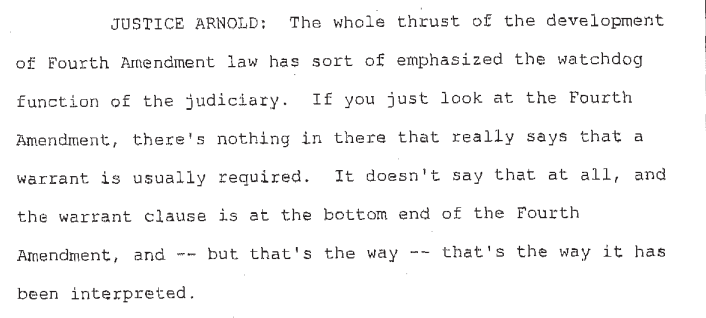
Here’s what self-confessed NEWB FISCR Judge Buzz Arnold said on what he claimed was his fourth day on the job (in reality it was several weeks in) during the hearing on the Yahoo challenge in 2008.

Warrant Clause at Bottom End of 4th Amendment


You know–that long tradition of “bottom end of the Fourth Amendment” jurisprudence?

Share this entry

“There Is No Database”

I Con the Record has released the transcript for the Yahoo hearing before the FISA Court of Review.

I’ll come back to the substance of it, but I did want to point to the lie that underscores this entire case.

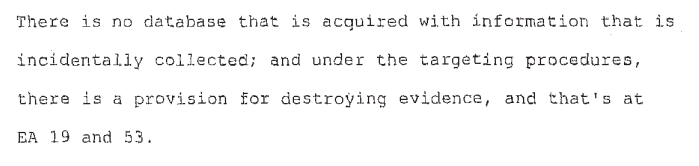
There Is No Database


On page 41, Acting Solicitor General Gregory Garre claims there is no database of incidentally collected information.

That’s of course false — the incidentally collected information is kept right along with the targeted information.

The FISCR used this in its ruling Protect America Act was constitutional.

Funny how that works…

Share this entry

Former Surveillance Lawyer Peter Keisler Pushes for Surveillance Limits

Screen Shot 2014-11-18 at 2.33.55 PMI’ve been laying low so supporters of USA Freedom can try to get a vote for cloture allowing debate for their bill in the Senate (and also trying to duck getting back into the arguments I made about Jonathan Gruber in 2009 and 2010). I’ve had my say on the former issue here and here.

But even as USA Freedom faces an uncertain future in the Senate, something interesting happened in the 11th Circuit.

I wrote in June about the 11th Circuit decision in US v. Quartavious Davis. In a decision written by David Sentelle (on loan from the DC Circuit) the Circuit overturned a conviction based almost entirely on stored cell site location information (CSLI).

The government filed for rehearing en banc which was granted.

AT&T just submitted an amicus brief generally supporting a higher standard for CSLI.

This is no hippie brief. Generally, it calls for more clarity for the providers, and ultimately concludes asking for one standard.

However the scope of the Fourth Amendment’s protection is resolved, a clear and categorical rule will benefit all parties involved in the application of Section 2703(d), including the technology companies subject to orders to produce information. Whatever standard the Court ultimately determines the government must satisfy, the third party records cases may provide an unsatisfactory basis for resolving this case. Smith and Miller rested on the implications of a customer’s knowing, affirmative provision of information to a third party and involved less extensive intrusions on personal privacy. Their rationales apply poorly to how individuals interact with one another and with information using modern digital devices. In particular, nothing in those decisions contemplated, much less required, a legal regime that forces individuals to choose between maintaining their privacy and participating in the emerging social, political, and economic world facilitated by the use of today’s mobile devices or other location based services.

But to support that stance, it argues that because of increasing accuracy, CSLI is probably more intrusive than the car-based GPS tracker found to require a warrant in US v. Jones.

CSLI at times may provide more sensitive and extensive personal information than the car tracking information at issue in Jones. Users typically keep their mobile devices with them during the entire day, potentially providing a much more extensive and continuous record of an individual’s movements and living patterns than that provided by tracking a vehicle; CSLI, therefore, is not limited to the largely public road system or to when the device user is in a vehicle.

More interesting still, it argues that the 3rd Party doctrine doesn’t work anymore.

The privacy and related social interests implicated by the use of modern mobile devices and by CSLI are fundamentally different and more significant than those evaluated in Miller and Smith. Miller, 425 U.S. at 443 (“We must examine the nature of the particular documents sought to be protected in order to determine whether there is a legitimate ‘expectation of privacy’ concerning their contents”); Smith, 442 U.S. at 741-42 (emphasizing the “limited capabilities” of pen registers). Use of mobile devices, as well as other devices or location based services, has become integral to most individuals’ participation in the new digital economy: those devices are a nearly ever-present feature of their most basic social, political, economic, and personal relationships. In recent years, this has become especially true of the data communications – from email and texting to video to social media connections – that occur on a nearly continuous basis whenever mobile devices are
turned on.

[snip]

Nor does Miller or Smith address how individuals interact with one another and with different data and media using mobile devices in this digital age. Location enabled services of all types provide a range of information to their users. At the same time, mobile applications, vehicle navigation systems, mobile devices, or wireless services for mobile devices often collect and use data in the background.

As part of that, AT&T talks about CSLI shows interactions.

But perhaps my favorite part of the brief is this:

Screen Shot 2014-11-18 at 4.19.09 PM

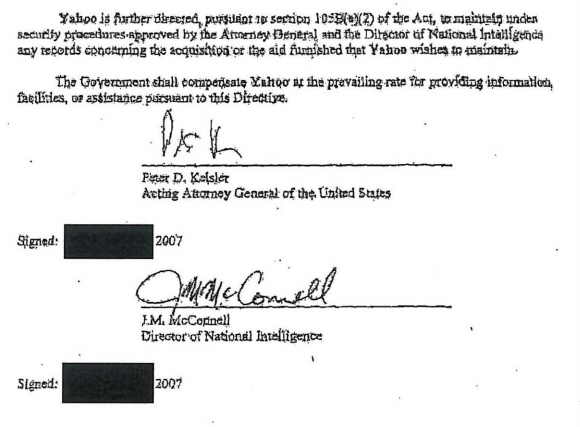
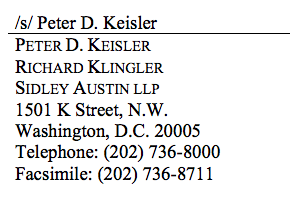
The brief was written by Peter Keisler, a longtime telecom attorney but also — during his brief stint as Acting Attorney General in 2007 — the guy who signed at least Directives (and possibly 2 Certificates) in Protect America Act. See page 34 for where Keisler signed Directives to Yahoo on his last day as Acting AG, November 8, 2007.

Share this entry

White House Supports USA Freedom Act, with Bates-Clapper Caveats about Amicus

The White House has come out with an enthusiastic statement supporting USA Freedom Act.

The Administration strongly supports Senate passage of S. 2685, the USA FREEDOM Act. In January, the President called on Congress to enact important changes to the Foreign Intelligence Surveillance Act (FISA) that would keep our Nation safe, while enhancing privacy and better safeguarding our civil liberties. This past spring, a broad bipartisan majority of the House passed a bill that answered the President’s call. S. 2685 carefully builds on the good work done in the House and has won the support of privacy and civil liberties advocates and the private sector, including significant members of the technology community. As the Attorney General and the Director of National Intelligence stated in a letter dated September 2, 2014, the bill is a reasonable compromise that enhances privacy and civil liberties and increases transparency.

The bill strengthens the FISA’s privacy and civil liberties protections, while preserving essential authorities that our intelligence and law enforcement professionals need.

It says the bill ends bulk collection which might be a useful record if the President used a definition besides “without any discriminator,” but that is what he is on the record as meaning by “bulk.”

The bill would prohibit bulk collection through the use of Section 215, FISA pen registers, and National Security Letters while maintaining critical authorities to conduct more targeted collection. The Attorney General and the Director of National Intelligence have indicated that the bill will retain the essential operational capabilities of the existing bulk telephone metadata program while eliminating bulk collection, based on communications providers’ existing practices.

Perhaps the most troubling part of Obama’s statement, however, is its endorsement of John Bates’ language about the amicus as echoed by James Clapper and Eric Holder, which among other things said that the amicus could not be required to represent the interests of civil liberties and privacy.

The bill also authorizes an independent voice in significant cases before the Foreign Intelligence Surveillance Court (FISC) — the Administration is aware of the concerns with regard to this issue, as outlined in the letter from the Attorney General and the Director of National Intelligence, and the Administration anticipates that Congress will address those concerns. Finally, the bill will enhance transparency by expanding the amount of information providers can disclose and increasing public reporting requirements.

In sum, this legislation will help strengthen Americans’ confidence in the Government’s use of these important national security authorities. Without passage of this bill, critical authorities that are appropriately reformed in this legislation could expire next summer. The Administration urges Congress to take action on this legislation now, since delay may subject these important national security authorities to brinksmanship and uncertainty. The Administration urges the Senate to pass the USA FREEDOM Act and for the House to act expeditiously so that the President can sign legislation into law this year. [my emphasis]

As I said here, the designed impotence of the amicus is not a reason to oppose the bill; it’s just a reason to expect to have to wait 9 years before it becomes functional, as happened with PCLOB. Still, it is very very troubling that given all the evidence that the Executive has been abusing the process of the FISC for a decade, the Executive is moving to ensure they’ll still be able to do so.

Share this entry

Even as Congress Prepares to Legislate, Intelligence Community Stalling on Section 215 IG Report

I’ve been covering the DOJ Inspector General’s billion-day old review of Section 215.

  • June 2010: Then DOJ IG Glenn Fine lays out investigation
  • June 2013: Transition to Michael Horowitz stalls PATRIOT investigation
  • August 2013: The investigation has been ongoing
  • September 2013: Pat Leahy calls for an IC IG investigation into 215 and 702; IC IG Charles McCullough declines
  • December 2013: Horowitz states current investigation limited by AG/DNI declassification of earlier reports
  • April 2014: The Section 215 review has a baby!

If my calculation is correct, that report has been pending for 1,616 days.

Today, in a report on the most significant challenges faced by the government, the IG explains what happened to the review: it is caught up in declassification review.

Ongoing OIG work, such as our reviews of the Department’s requests for and use of business records under Section 215 of the USA PATRIOT Reauthorization Act and the Department’s use of pen register and trap-and-trace devices under the Foreign Intelligence Surveillance Act (FISA), also address privacy concerns implicated by the use of national security authorities to collect data.  Although the OIG completed both of these reviews months ago, and we have provided classified briefings to Congress regarding them, we have been unable to release the classified reports to Congress or non-classified reports to the public because the classification review being conducted by the intelligence community, which includes the FBI, is still ongoing.

This is craziness! Congress is actively legislating on this topic … tomorrow! There’s also the matter of the secret FBI PRTT program, that I strongly suspect is a location dragnet, which this report likely covers.

But the IC is suppressing a report that has been in the works for over 4 years with a slow declassification review?

Update: From Glenn Fine’s original letter scoping out the review, here’s some of what it includes.

It will examine the number of Section 215 applications filed from 2007 through 2009, how the FBI is using the tool today, and describe any reported improper or illegal uses of the authority. Our review also will examine the progress the FBI has made in addressing recommendations contained in our prior reports that the FBI draft and implement minimization procedures specifically for information collected under Section 215 authority.

We also intend to conduct a programmatic review of the FBI’s use of its pen register and trap and trace authority under the FISA. That part of the review will examine issues such as how the FBI uses the authority to collect information, what the FBI does with the information it collects, and whether there have been any improper or illegal uses of the authority either reported by the FBI or identified by the OIG.

In addition to identifying any improper uses of these authorities (the report should provide some sense of how rigorous the First Amendment review is), it will certainly lay out how FBI has refused to implement minimization procedures are required by law and recommended in DOJ IG’s last Section 215 report (we know this to be the case because the FISC is imposing minimization procedures itself, and requiring compliance reviews).

All that would be rather important to know before extending Section 215 for another 3 years.

Share this entry

How to Fix the FISA Court … Or Not

The government assures us that it does not maintain a database of incidentally collected information from non-targeted United States persons, and there is no evidence to the contrary. On these facts, incidentally collected communications of non-targeted United States persons do not violate the Fourth Amendment.(26)

That line, from the FISCR opinion finding the Protect America Act constitutional, gets to the core problem with the FISA Court scheme. Even in 2009, when the line was first made public, it was pretty clear the government had made a false claim to the FISA Court of Review.

Now that we know that FBI had already been given authority to keep PAA-collected content in databases that they could search at what is now called the assessment stage of investigations — warrantless searches of the content of Americans against whom the FBI has no evidence of wrong-doing — the claim remains one of the signature moments where the government got approval for a program by being less than candid to the court (the government has been caught doing so in both Title III courts and at FISC, and continues to do so).

That’s also why I find Greg McNeal’s paper on Reforming the FISC, while very important, ultimately unconvincing.

McNeal’s paper is invaluable for the way he assesses the decision — in May 2006 — to authorize the collection of all phone records under Section 215. Not only does the paper largely agree with the Democratic appointees on PCLOB that the program is not authorized by the Section 215 statute, McNeal conducts his own assessment of the government’s application to use Section 215 for that purpose.

The application does not fare well.

Moreover, the government recognized that not all records would be relevant to an investigation, but justified relevance on what could best be described as usefulness or necessity to enable the government’s metadata analysis, stating:

The Application fully satisfies all requirements of title V of FISA. In particular, the Application seeks the production of tangible things “for” an international terrorism investigation. 50 U.S.C. § 1861(a)(1). In addition, the Application includes a statement of facts demonstrating that there are reasonable grounds to believe that the business records sought are “relevant” to an authorized investigation. Id.  § 1861(b)(2). Although the call detail records of the [redacted] contain large volumes of metadata, the vast majority of which will not be terrorist-related, the scope of the business records request presents no infirmity under title V. All of the business records to be collected here are relevant to FBI investigations into [redacted] because the NSA can effectively conduct metadata analysis only if it has the data in bulk.49

The government went even further, arguing that if the FISC found that the records were not relevant, that the FISC should read relevance out of the statute by tailoring its analysis in a way that would balance the government’s request to collect metadata in bulk against the degree of intrusion into privacy interests. Disregarding the fact that the balancing of these interests was likely already engaged in by Congress when writing section 215, the government wrote:

In addition, even if the metadata from non-terrorist communications were deemed not relevant, nothing in title V of FISA demands that a request for the production of “any tangible things” under that provision collect only information that is strictly relevant to the international terrorism investigation at hand. Were the Court to require some tailoring to fit the information that will actually be terrorist-related, the business records request detailed in the Application would meet any proper test for reasonable tailoring. Any tailoring standard must be informed by a balancing of the government interest at stake against the degree of intrusion into any protected privacy interests. Here, the Government’s interest is the most compelling imaginable: the defense of the Nation in wartime from attacks that may take thousands of lives. On the other side of the balance, the intrusion is minimal. As the Supreme Court has held, there is no constitutionally protected interest in metadata, such as numbers dialed on a telephone.50

Thus, what the government asked the court to disregard the judgment of the Congress as to the limitations and privacy interests at stake in the collection of business records. Specifically, the government asked the FISC to disregard Congress’s imposition of a statutory requirement that business records be relevant, and in disregarding that statutory requirement rely on the fact that there was no constitutionally protected privacy interest in business records. The government’s argument flipped the statute on its head, as the purpose of enhancing protections under section 215 was to supplement the constitutional baseline protections for privacy that were deemed inadequate by Congress.

McNeal is no hippie. That he largely agrees and goes beyond PCLOB’s conclusion that this decision was not authorized by the statute is significant.

But as I said, I disagree with his remedy — and also with his assessment of the single source of this dysfunction.

McNeal’s remedy is laudable. He suggests all FISC decisions should be presumptively declassified and any significant FISC decision should get automatic appellate review, done by FISCR. That’s not dissimilar to a measure in Pat Leahy’s USA Freedom Act, which I’ve written about here. With my cautions about that scheme noted, I think McNeal’s remedy may have value.

The reason it won’t be enough stems from two things.

First, the government has proven it cannot be trusted with ex parte proceedings in the FISC. That may seem harsh, but the Yahoo challenge — which is the most complete view we’ve ever had of how the court works, even with a weak adversary — really damns the government’s conduct. In addition to the seemingly false claim to FISCR about whether the government held databases of incidentally collected data, over the course of the Yahoo challenge, the government,

  • Entirely restructured the program — bringing the FBI into a central role of the process — without telling Reggie Walton about these major changes to the program the challenge he was presiding over evaluated; this would be the first of 4 known times in Walton’s 7-year tenure where he had to deal with the government withholding materially significant information from the court
  • Provided outdated versions of documents, effectively hiding metadata that would have shown EO 12333, which was a key issue being litigated, was more fluid than presented to the court
  •  Apparently did not notice either FISC or FISCR about an OLC opinion — language from which was declassified right in the middle of the challenge — authorizing the President to pixie dust EO 12333 at any time without noting that publicly
  • Apparently did not provide the underlying documents explaining another significant change they made during the course of the challenge, which would have revealed how easily Americans could be reverse targeted under a program prohibiting it; these procedures were critical to FISCR’s conclusion the program was legal

In short, the materials withheld or misrepresented over the course of the Yahoo challenge may have made the difference in FISCR’s judgment that the program was legal (even ignoring all the things withheld from Yahoo, especially regarding the revised role of FBI in the process). (Note, in his paper, McNeal rightly argues Congress and the public could have had a clear idea of what Section 702 does; I’d limit that by noting that almost no one besides me imagined they were doing back door searches before that was revealed by the Snowden leaks).

One problem with McNeal’s suggestion, then, is that the government simply can’t be trusted to engage in ex parte proceedings before the FISC or FISCR. Every major program we’ve seen authorized by the court has featured significant misrepresentations about what the program really entailed. Every one! Until we eliminate that problem, the value of these courts will be limited.

But then there is the other problem, my own assessment of the source of the problem with FISC. McNeal thinks it is that Congress wants to pawn its authority off onto the FISC.

The underlying disease is that Congress wants things to operate the way that they do; Congress wants the FISC and has incentives to maintain the status quo.

Why does Congress want the FISC? Because it allows them to push accountability off to someone else. If members ofCongress are responsible for conducting oversight of secretoperations, their reputations are on the line if the operations gotoo far toward violating civil liberties, or not far enoughtoward protecting national security. However, with the FISC conducting operations, Congress has the ability to dodge accountability by claiming they have empowered a court to conduct oversight.

I don’t, in general, disagree with this sentiment in the least. The last thing Congress wants to do is make a decision that might later be tied to an intelligence failure, a terrorist attack, a botched operation. Heck, I’d add that the last thing most members of Congress serving on the Intelligence Committees would want to do is piss off the contractors whose donations provide one of the perks of the seat.

But the dysfunction of the FISC stems, in significant part, from something else.

In his paper on the phone dragnet (which partly incorporates the Internet dragnet), David Kris suggests the original decision to bring the dragnets under the FISC (in the paper he was limited by DOJ review about what he could say of the Internet dragnet, so it is not entirely clear whether he means the Colleen Kollar-Kotelly opinion that paved the way for the flawed Malcolm Howard one McNeal critiques, or the Howard one) was erroneous. Read more

Share this entry

Fixes for USA Freedom Act

I’m now being accused by USA Freedom Act champions of not providing constructive suggestions on how to improve USAF (even though I have, both via channels they were involved in and channels they are not party to) [oops, try this tweet, which is still active].

Now that it appears people who previously claimed I was making all this up now concede some of my critiques as a valid, here goes: my suggestions for how to fix the problems I identified in this post.

Problem: No one will say how the key phone record provision of the bill will work

Fix: Permit the use of correlations — but provide notice to defendants because this is probably unconstitutional warrantless surveillance

There is one application of connection chaining that I find legitimate, and two that are probably unconstitutional. The legitimate application is the burner phone one: to ask providers to use their algorithms (including new profiles of online use) to find the new phones or online accounts that people adopt after dropping previous ones, which is what AT&T offers under Hemisphere. To permit that, you might alter the connection chaining language to say providers can chain on calls and texts made, as well as ask providers to access their own records to find replacement phones. Note, however, that accuracy on this mapping is only about 94% per Hemisphere documents, so it seems there needs to be some kind of check before using those records.

The two other applications — the ones I’m pretty sure are or should be unconstitutional without a warrant — are 1) the use of cloud data, like address books, calendars, and photos, to establish connections, and 2) the use of phone records like Verizon’s supercookie to establish one-to-one correlations between identities across different platforms. I think these are both squarely unconstitutional under the DC Circuit’s Maynard decision, because both are key functions in linking all these metadata profiles together, and language in Riley would support that too. But who knows? I’m not an appellate judge.

To prevent the government from doing this without really independent judicial review — and more generally to ensure Section 215 is not abused going forward — the best fix is to require notice to defendants if any evidence from Section 215 or anything derived from it, including the use of metadata as an index to identify content, is used in a proceeding against them. Given that Section 215’s secret application is now unclassified, they should even get a fairly robust description of how it was used. After all, if this is just third party doctrine stuff, it can’t be all that secret!

Problem: USAF negotiates from a weak position and likely moots potentially significant court gains

Fix (sort of): Provide notice to defendants under Section 215

I’m frankly of the opinion that ACLU’s Alex Abdo kicked DOJ’s ass so thoroughly in the 2nd Circuit, that unless that decision is mooted, it will provide a better halt to dragnets than any legislation could. But I get that that’s a risk, especially with Larry Klayman botching an even better setup in the DC Circuit.

But I do think the one way to make sure we don’t lose the opportunity for a judicial fix to this is to provide notice to defendants of any use or derivative use of Section 215. The government has insisted (most recently in the Reaz Qadir Khan case, but also did so in the Dzhokhar Tsarnaev and derivative cases, where we know they used the phone dragnet) that it doesn’t have to give such notice. If they get it — with the ability to demonstrate that their prosecution arises out of a warrantless mosaic analysis of their lives which provides the basis for the order providing access to their content — then at least there may be a limited judicial remedy in the future, even if it’s not Abdo fighting for his own organization. FISCR said PAA was legal because of precisely these linking procedures, but if they’re not (or if they require a warrant) then PRISM is not legal either. Defendants must have the ability to argue that in court.

Problem: USAF’s effects in limiting bulk collection are overstated

Fix: Put temporal limits on traditional 215 collection, add flexibility into the emergency provision, but adopt existing emergency provision

USAF prohibits using a communications provider corporate person as a selector, but permits the use of a non-communications corporate person as a selector, meaning it could still get all of Visa’s or Western Union’s records. I understand the government claims it needs to retain the use for corporate person selectors to get things like all the guests at Caesars Palace to see if there are suspected terrorists there. The way to permit this, without at the same time permitting a programmatic dragnet (of, say, all Las Vegas hotels all the time), might be to temporally limit the order — say, limit the use of any non-communications provider order to get a month of records.

But this creates a problem, which is that it currently takes (per the NSL IG Report) 30-40 days to get a Section 215 order. The way to make it possible to get records when you need them, rather than keeping a dragnet, is to permit the use of the emergency provision more broadly. You might permit it to be used with counterintelligence uses as well as the current counterterrorism use (that is, make it available in any case where Section 215 would be available), though you should still limit use of any data collected to the purpose for which it was collected. You might even extend the deadline to submit an application beyond 7 days.

That exacerbates the existing problems with the emergency provision, however, which is that the government gets to keep records if the court finds they misused the statute. To fix this, I’d advise tying the change to the adoption of the existing language from the emergency provision currently in place on the phone dragnet order, specifically permitting FISC to require records be discarded if the government shouldn’t have obtained them. I’d also add a reporting requirement on how many emergency provisions were used (that one would be included in the public reporting) and, in classified form to the intelligence and judiciary committees, fairly precisely what it had been used for. I’d additionally require FBI track this data, so it can easily report what has become of it.

Given that the government may have already abused the emergency provisions, this requires close monitoring. So no loosening of the emergency provision should be put into place without the simultaneous controls.

Problem: USAF would eliminate any pushback from providers

Fix: Put “good faith” language back in the law and provide appeal of demand for proprietary requests

I’d do two things to fix the current overly expansive immunity provisions. First, I’d put the language that exists in other immunity provisions requiring good faith compliance with orders, such that providers can’t be immunized for stuff that they recognize is illegal.

I’d also add language giving them an appeal if the government were obtaining proprietary information. While under current law the government should be able to obtain call records, they shouldn’t be able to require providers also share their algorithms about business records, which is (I suspect) where this going (indeed, the Yahoo documents suggest that’s where it has already gone under PRISM). So make it clear there’s a limit to what is included under third party doctrine, and provide providers with a way to protect their data derived from customer records.

Problem: USAF may have the effect of weakening existing minimization procedures

Fix: Include language permitting FISC approval and review of compliance with traditional 215 minimization procedures and PRTT, adopt emergency provision language currently in place

This should be simple. Just include language letting the court review minimization procedures and review compliance, which is currently what happens and should happen as we get deeper and deeper into mosaic collection (indeed, this might be pitched as a solution to what should be a very urgent constitutional problem for the status quo practice).

Additionally, the bill should integrate the emergency provision currently applicable to the phone dragnet for all Section 215 use, along with reporting on how often and how it is used.

Both of these, importantly, simply codify the current status quo. If the government won’t accept the current status quo, after years of evidence on why it needs this minimal level of oversight from FISC, then that by itself should raise questions about the intelligence community’s intent going forward.

Problem: USAF’s transparency provisions are bullshit

Fix: Require reporting from all providers, give FBI 2 years and a budget to eliminate exemptions, give NSA 2 years to be able to answer all questions

One minimal fix to the transparency provisions is to require reporting not just from all communications providers, but from all providers who have received orders, such that the government would have to report on financial and location dragnets, which are both currently excluded. This would ensure that financial and location dragnets that currently exist and are currently exempted from reporting are included.

As to the other transparency provisions, the biggest problem is that the bill permits both the NSA and FBI to say “omigosh we simply can’t count all this.” I think they’re doing so for different reasons. In my opinion, the NSA is doing so because it is conducting illegal domestic wiretapping, especially to pursue cybersecurity targets. It is doing so because it hasn’t gotten Congress to buy off on using domestic wiretapping to pursue cybertargets. I would impose a 2 year limit on how long ODNI can avoid reporting this number, which should provide plenty of time for Congress to legislate a legal way to pursue cybertargets (along with limits to what kind of cybertargets merit such domestic wiretapping, if any).

I think the FBI refusing to count its collection because it wants to passively collect huge databases of US persons so it can just look up whether people who come under its radar are suspicious. I believe this is unconstitutional — it’s certainly something the government lied to the FISCR in order to beat back Yahoo’s challenge, and arguably the government made a similar lie in Amnesty v. Clapper. If I had my way, I’d require FBI to count how many US persons it was collecting on and back door searching yesterday. But if accommodation must be made, FBI, too, should get just 2 years (and significant funding) to be able to 1) tag all its data (as NSA does, so most of it would come tagged) 2) count it and its back door searches 3) determine whether incoming data is of interest within a short period of time, rather than sitting on it for 30 years. Ideally, FBI would also get 2 years to do the same things with its NSL data.

Again, I think the better option is just to make NSA and FBI count their data, which will show both are violating the Constitution. Apparently, Congress doesn’t want to make them do that. So make them do that over the next 2 years, giving them time to replace unconstitutional programs.

Problem: Other laudable provisions — like the Advocate — will easily be undercut

Fix: Add exemption in the ex parte language on FISA review for the advocate

In this post, I noted that the provision requiring the advocate have all the material she needs to do to do her job conflicts with the provision permitting the government to withhold information on classification or privilege grounds. If there is any way to limit this — perhaps by requiring the advocate be given clearance into any compartments for the surveillance under question (though not necessarily the underlying sources and methods used in an affidavit), as well as mandating that originator controlled (ORCON) documents be required to be shared. This might work like a CIPA provision, that the government must be willing to share something if it wants FISC approval (and with it, the authority to obligate providers).

But since that post, we’ve seen how, in the Yahoo challenge, the government convinced Reggie Walton to apply the ex parte provisions applying to defendants to Yahoo. That precedent would now, in my opinion, apply language on review to any adversary. To fix that, the bill should include conforming language in all the places (such as at 50 USC 1861(c)) that call for ex parte review to make it clear that ex parte review does not apply to an advocate’s review of an order.

I fully expect the IC to find this unacceptable (Clapper has already made it clear he’ll only accept an advocate that is too weak to be effective). But bill reformers should point to the clear language in the President’s speech calling for “a panel of advocates from outside government to provide an independent voice in significant cases before the Foreign Intelligence Surveillance Court.” If the IC refuses to have an advocate that can do the job laid out by statute, they should have to answer to the President, who has called for real advocates (not amici). 

To recap — all this pertains only to the bill on its face, not to the important things the bill is missing, such as a prohibition on back door searches. But these are things that would make USA Freedom Act far better.

I suspect the intelligence community would object to many, if not all of them. But if they do, then it would certainly clarify what their intent really is.

Share this entry

Americans: On the Internet, People Do Too Know You’re a Dog

Screen Shot 2014-11-13 at 10.42.51 AMBack in 1993, cartoonist Peter Steiner famously captured a largely held belief about the Internet: “On the Internet, no one knows you’re a dog.”

According to a fascinating new study from Pew, that’s no longer true.

Just 24% of adults “agree” (20%) or “strongly agree” (3%) with the statement: “It is easy for me to be anonymous when I am online.” By contrast, 74% “disagree” (52%) or “strongly disagree” (22%) that it is easy for them to be anonymous.

The poll suggests this is partly because of coverage of government spying, and partly because of corporate spying.

I find two other things about this most interesting. First, the demographics on the specific answers are very fascinating. Just as one example, more affluent people are more likely to check how they come up on Internet searches.

Self-searching activity varies greatly across different groups, particularly by age, income, and household education. Adults under the age of 50 are far more likely to be “self-searchers” than those ages 50 and older, and adults with higher levels of household income and education stand out as especially likely to check up on their own digital footprints.

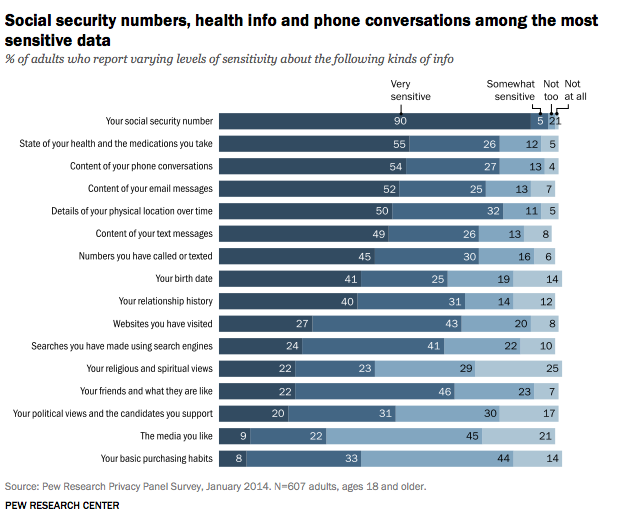
But I can imagine that’s because they live more of their life online (and they’re more apt to use things like Linked In to apply for jobs). There are also demographic differences in what people find sensitive (see differences in sensitivity about email content at 50, for example). Again, that may reflect the degree to which these tools are available, and therefore are likely to include sensitive communications.

The other thing, however, is that people appear far less worried about metadata than they should be. I get why people are almost universally worried about social security privacy — and this likely reflects the fact that the most immediate threat to everyone is identity theft, not government spying or abuse from Google. But in both government and commercial hands, metadata have become more revealing than content. Respondents don’t seem to worry about it though.

Share this entry