Anwar al-Awlaki Assassination: Double Secret Illegitimacy

Frances Fragos Townsend is distraught that the media are not using the government’s euphemism for the Anwar al-Awlaki assassination.

Awalaki op was NOT assassination; nor a targeted killing; nor a hit job as media keeps describing! Was a legal capture or kill of AQ enemy.

My favorite bit is how that “captureorkill” rolls right into her tweet, a false foundation stone for the shaky logic that there’s a legal distinction between an operation in which there was never any consideration of capture, and an assassination.

But her panic that the media is not using the preferred semantics to describe the Awlaki assassination reflects a seemingly growing concern among all those who have participated in or signed off on this assassination about its perceived legitimacy.

In addition to Townsend, you’ve got DiFi and Saxby Chambliss releasing a joint statement invoking the magic words, “imminent threat,” “recruiting radicals,” and even leaking the state secret that Yemen cooperated with us on it. You’ve got Mike Rogers asserting Awlaki, “actively planned and sought ways to kill Americans.” All of these people who have been briefed and presumably (as members of the Gang of Four) personally signed off on the assassination, citing details that might support the legality of the killing.

In his effort to claim the assassination was just, Jack Goldsmith gets at part of the problem. He makes the expected arguments about what a careful process the Obama Administration uses before approving an assassination:

  • Citing Judge John Bates’ punt to the political branches on the issue, all the while claiming what Bates referred to as an “assassination” is not one
  • Arguing that killing people outside of an area against which we’ve declared war is legal “because the other country consents to them or is unable or unwilling to check the terrorist threat, thereby bringing America’s right to self-defense into play”
  • Asserting that Administration strikes “distinguish civilians from attack and use only proportionate force”

But, as Goldsmith admits,

Such caution, however, does not guarantee legitimacy at home or abroad.

And while his argument self-destructs precisely where he invokes the Administration’s claims over any real proof, Goldsmith at least implicitly admits the reason why having Townsend and Chambliss and DiFi and Rogers and himself assuring us this attack was legal is not enough to make it legitimate: secrecy.

[T]he Obama administration has gone to unusual lengths, consistent with the need to protect intelligence, to explain the basis for and limits on its actions.

[snip]

It can perhaps release a bit more information about the basis for its targeted strikes. It is doubtful, however, that more transparency or more elaborate legal arguments will change many minds, since the goal of drone critics is to end their use altogether (outside of Afghanistan). [my emphasis]

As Goldsmith’s own rationalization for the legality of this attack makes clear, the attack is only legal if Yemen consents OR is unable OR unwilling (leaving aside the question of imminence, which at least DiFi and Chambliss were honest enough to mention). So too must the attack distinguish between a civilian–perhaps someone engaging in First Amendment protected speech, however loathsome–and someone who is truly operational.

And while the government may well have been able to prove all those things with Awlaki (though probably not the imminence bit Goldsmith ignores), it chose not to.

It had the opportunity to do so, and chose not to avail itself of that opportunity.

The Administration very specifically and deliberately told a court that precisely the things needed to prove the operation was legal–whether Yemen was cooperating and precisely what Awlaki had done to amount to operational activity, not to mention what the CIA’s role in this assassination was–were state secrets. Particularly given the growing number of times (with Reynolds, Arar, Horn, al-Haramain, and Jeppesen) when the government has demonstrably invoked state secrets to hide illegal activity, the fact that the government has claimed precisely these critical details to be secret in this case only make its claims the killing was legal that much more dubious.

Critical thinkers must assume, given the government’s use of state secrets in recent years, that it invoked state secrets precisely because its legal case was suspect, at best.

Aside from John Brennan spreading state secrets, the Administration has tried to sustain the fiction that these details are secret in on the record statements, resulting in this kind of buffoonery.

Jake Tapper:    You said that Awlaki was demonstrably and provably involved in operations.  Do you plan on demonstrating —

MR. CARNEY:  I should step back.  He is clearly — I mean “provably” may be a legal term.  Read more

Share this entry

What Is the Secret Item the Government Wants Withheld from Abdulmutallab?

As I tweeted earlier, I find the timing of the Anwar al-Awlaki assassination to be rather curious. The first time we might hear real evidence supporting the government’s claim that Awlaki was operational, and not just producing propaganda, will be in Umar Farouk Abdulmutallab’s trial, which starts next week.

Which is why I’m curious about the government’s motion for a protective order submitted last Friday, seeking to have one item withheld from Abdulmutallab (who, remember, is technically defending himself; Judge Edmunds granted the motion on Monday).

The United States of America respectfully moves pursuant to [Criminal Procedure and CIPA] for a second protective order precluding the discovery of a particular item which contains classified information. The classified information is not exculpatory, is privileged, and is otherwise not discoverable.

A page and a half of the seven page filing (which includes a half page redacted description of the item in question) is background which I don’t believe to be boilerplate; that is, I think it is background specific to this filing. And that background includes a close focus on Abdulmutallab’s ties to Awlaki.

The defendant told the [FBI] agents that he was inspired to commit jihad against the United States as a result of regular visits to the web sites of Anwar Awlaki, a member and leader of Al Qaeda in the Arabian Peninsula (“AQAP”), which has been designated by the United States government as a foreign terrorist organization. The defendant stated that while in Yemen, he was able to make contact with members of Al Qaeda, who subsequently provided the defendant with the bomb and gave him training on its components. The defendant and other members of Al Qaeda discussed plans to attack the United States.

Now, I have no real suspicions about what this item is and I’m not suggesting the government is withholding it improperly.

But I find it curious that the government is, at this late date (and at a time when they were already watching Awlaki for their opportunity to kill him) finding items that must be withheld from Abdulmutallab. And I find the particular focus in this filing on his time with Awlaki–precisely the stuff that supports the claim Awlaki had given Abdulmutallab operational instructions–to be interesting.

Is there any reason why the government might be obliged to protect the assassination approval, which we know to be based in part on Abdulmutallab’s own testimony, from him?

Update: I’ve got just a few more major filings left, and thus far, I haven’t found one that mentions Awlaki. This is how the superseding indictment referred to Abdulmutallab’s time in Yemen, which is some of the most detail given on this front.

Defendant Umar Farouk Abdulmutallab is a Nigerian national. In August 2009, defendant Abdulmutallab traveled to Yemen for the purpose of becoming involved in violent “jihad” on behalf of Al Qaeda.

[snip]

In preparation for a suicide attack, defendant Abdulmutallab practiced detonating explosive devices similar to one which he later received for an attack on a U.S. airliner.

The government moved for an earlier protective order in August. That motion doesn’t mention Yemen at all.

Update: This request for expert testimony again mentions Yemen.

The First Superseding Indictment, on which defendant will be tried, alleges that he traveled to Yemen to become involved in violent jihad on behalf of Al Qaeda, a designated terrorist organization, as part of a conspiracy to commit an act of terrorism transcending national boundaries.

And it describes the importance of English-language propaganda.

Finally, the government seeks to admit three minutes and forty two seconds of the Al Qaeda produced video, America and the Final Trap1 and portions of the Al Qaeda in the Arabian Peninsula publication Inspire. Through testimony by the Al Qaeda expert, see Argument A, supra, the government will establish that America and the Final Trap and Inspire are produced by Al Malahem media, an Al Qaeda production company, that products of Al Malahem media serve as official statements by Al Qaeda, and thus are unquestionably authentic. The Al Qaeda expert will explain the reasons Al Qaeda produces Arabic language videos with accurate English language subtitles, as is the case with America and the Final Trap. The expert also will establish that such productions are created by terrorist organizations as part of and in furtherance of their criminal conspiracies, for a number of reasons. Those reasons include the goals of terrorizing their targets into fearing that additional attacks will be forthcoming, and to convince their own supporters and possible recruits that the terrorists are successful and are gaining the upper hand.

And it mentions the toner cartridge plot.

The conspiracy to commit aircraft attacks against the United States had not ended, as demonstrated, at a minimum, by the contents of America And the Final Trap and the 2010 toner cartridge conspiracy by Al Qaeda in the Arabian Peninsula.

Yet in none of these discussions–all of which involve actions in which Awlaki was central–does the filing mention the cleric.

Share this entry

Lots of Senior Officials Spilling State Secrets Today

Last year, Director of National Intelligence James Clapper said the following:

I am asserting privilege over classified intelligence information, assessments, and analysis prepared, obtained, or under the control of any entity within the U.S. Intelligence Community concerning al-Qaeda, AQAP or Anwar al-Aulaqi that may be implicated by [Awlaki’s father’s attempt to sue for information about why Awlaki was on the CIA’s assassination list]. This includes information that relates to the terrorist threat posed by Anwar al-Aulaqi, including information related to whether this threat may be “concrete,” “specific,” or “imminent.”

Then Secretary of Defense Robert Gates said the following:

DOD cannot reveal to a foreign terrorist organization or its leaders what it knows about their activities and how it obtained that information.

[snip]

The disclosure of any operational information concerning actions U.S. armed forces have or may plan to take against a terrorist organization overseas would risk serious harm to national security and foreign relations. Official confirmation or denial of any operations could tend to reveal information concerning operational capabilities that could be used by adversaries to evade or counter any future strikes.

[snip]

Finally, as discussed below, public confirmation or denial of either prior or planned operations could seriously harm U.S. foreign relations.

[snip]

The disclosure of information concerning cooperation between the United States and a foreign state, and specifically regarding any possible military operations in that foreign country, could lead to serious harm to national security, including by disrupting any confidential relations with a foreign government. [my emphasis]

Then CIA Director and current Secretary of Defense Leon Panetta said the following:

I am invoking the [state secrets] privilege over any information, if it exists, that would tend to confirm or deny any allegations in the Complaint [about CIA targeting Awlaki for assassination] pertaining to the CIA.

Yet in spite of the fact that these top government officials swore to a judge that revealing operational details about the CIA’s assassination operations, US counterterrorist cooperation with Yemen, and confirmation of prior or planned military operations would harm foreign relations and national security, we’re seeing details like this in reporting on Anwar al-Awlaki’s death:

An American-born cleric killed in Yemen played a “significant operational role” in plotting and inspiring attacks on the United States, U.S. officials said Friday, as they disclosed detailed intelligence to justify the killing of a U.S. citizen.

Anwar al-Awlaki, an American-born radical Islamic preacher who rose to the highest level of al Qaeda’s franchise in Yemen, was killed in a CIA-directed strike upon his convoy, carried out with the U.S. Joint Special Operations Command’s firepower, according to a counterterrorist official, speaking on condition of anonymity to discuss intelligence.

[snip]

Four individuals were killed in Friday’s attack, according to U.S. officials.

[snip]

Al-Awlaki had been under observation for three weeks while they waited for the right opportunity to strike, one U.S. official said.

[snip]

U.S. counterterrorism officials said that counterterrorism cooperation between the U.S. and Yemen has improved in recent weeks, allowing the U.S. to gather better intelligence on al-Awlaki’s movements. The ability to better track him was a key factor the successful strike, U.S. officials said.

Or details like this, including John Brennan’s comments on the record:

Fox News has learned that two Predator drones hovering above al-Awlaki’s convoy fired the Hellfire missiles which killed the terror leader. According to a senior U.S. official, the operation was carried out by Joint Special Operations Command, under the direction of the CIA.

[snip]

But American sources confirmed the CIA and U.S. military were behind the strike on al-Awlaki, whom one official described as a “big fish.”

The strike hit a vehicle with three or four suspected Al Qaeda members inside, in addition to al-Awlaki. According to a U.S. senior official, the other American militant killed in the strike was Samir Khan, the co-editor of an English-language Al Qaeda web magazine called “Inspire.”

[snip]

Top U.S. counter terrorism adviser John Brennan says such cooperation with Yemen has improved since the political unrest there. Brennan said the Yemenis have been more willing to share information about the location of Al Qaeda targets, as a way to fight the Yemeni branch challenging them for power. Other U.S. officials say the Yemenis have also allowed the U.S. to fly more armed drone and aircraft missions over its territory than ever previously, trying to use U.S. military power to stay in power. [my emphasis]

Judge Bates, if I were you, I’d haul Clapper, Gates, and Panetta into your courtroom to find out whether they lied their ass off to you last year so as to deprive a US citizen of due process, and if they didn’t, then how long it will be until John Brennan and some other counterterrorism officials get charged with Espionage.

Share this entry

DOJ Deems Plan to Attack Military Targets with a Drone, Terrorism

Last year, I tracked how TSA head (and former FBI Deputy Director) John Pistole used an FBI entrapment plot targeted at the Metro to justify increased TSA surveillance of the Metro.

Which is why I’m intrigued that the FBI’s latest entrapment product, Rezwan Ferdaus, is alleged to have wanted to strike the Pentagon with, effectively, a drone (with what Julian Sanchez, in a great post, calls a comic book plot). I wondered whether Ferdaus came up with his comic book plot himself, whether this was projection, or whether the FBI wanted us to fear being struck via the same means we’re striking others.

In the affidavit supporting Ferdaus’ arrest, the FBI emphasizes that Ferdaus came up with the idea of a drone himself (if you can call replicating our own tactics an original idea). They describe, for example, a March 29, 2011 meeting with two FBI undercover officers at which Ferdaus,

explained that he had this idea of attacking the Pentagon long before he met the [cooperating witness] (and by implication before he met the [FBI undercover officers–UCEs]). FERDAUS advised the UCEs that he had initially discussed his remote controlled aircraft plans with a friend from Dorchester. FERDAUS told the UCEs that his Dorchester friend had a “less complicated idea” — his friend’s idea was to “just get weapons and go after … a recruitment center.” The UCEs asked FERDAUS what was wrong with that idea, to which FERDAUS responded: “nothing.” FERDAUS indicated, however, that he wanted “to go bigger.”

But they don’t say how the FBI–rather, their cooperating witness–came to find Ferdaus.

Particularly given the FBI’s past misrepresentations about when one of their entrapments began, this seems relevant. All the more so in this case, given that the affidavit appears to support its claim that “FERDAUS told the UCEs that he realized more than a year ago from viewing jihadi websites and videos ‘how evil’ America is” based on an August 1, 2011 conversation with the UCEs (but again, not the cooperating witness) that his jihad,

started last year. I realized I should try to do something to attack them here. I should try to go down to Washington or something like that. I should try to get them here. That is the best thing.

There’s nothing in this quote that says it happened more than a year ago–only that it happened before January 2011. Given that the cooperating witness shows up in the narrative “last year” (in December), the seemingly unsupported claim about how long Ferdaus has been pursuing his comic book plot seems relevant–or perhaps an indication the FBI has reason to know his surfing on jihadi sites happened more than a year ago.

So what about that cooperating witness, who, the affidavit admits, “has a criminal record and has served time in prison”? The affidavit describes his involvement this way:

Initially, FERDAUS met and engaged in conversations with an FBI CW regarding his planned attacks against the United States. These conversations occurred between December 2010 and April 2011; the majority of them were consensually recorded. [my emphasis]

Yet the affidavit doesn’t say anything about what transpired between Ferdaus and the CW in December, neither how they met nor how many times they conversed or met before January 7, 2011, the first meeting described in the affidavit.

Nor do they tell us the circumstances surrounding that minority of conversations that weren’t recorded. There always seems to be a conversation that doesn’t get recorded, doesn’t there?

Nor does the affidavit explain how long they were monitoring Ferdaus’ participation in jihad chat rooms. They describe him saying that’s what radicalized him. But they don’t admit the obvious, that that’s probably what led them to send an informant out to cultivate him to the point where trained FBI agents would take over (assuming, of course, that Ferdaus’ friend from Dorchester wasn’t another informant, but who knows?).

One more point. The only times the affidavit describes Ferdaus accessing the Internet, he does so via public computers, at a library and internet cafe, though the affidavit also describes him using his own computer to show the UCEs his plan.

It looks very tidy, wrapped up in this affidavit, if you ignore the fact that when the FBI told Ferdaus not to play with chemicals he complied. But this is yet another entrapment that seems to obscure where the plot came from.

Share this entry

Two of Obama’s Independent Intelligence Advisors Have Supported Oversight in Past; Why Not Now?

I’ve written recently about Obama’s refusal to appoint anyone to the Privacy and Civil Liberties Oversight Board, which is supposed to ensure the government protects privacy while laying out a dragnet to catch terrorists, most recently when Thomas Kean and Lee Hamilton issued their 10-year report card on the 9/11 Commission’s recommendations. And I wrote about Bush’s efforts to bypass the intelligence oversight that is supposed to be exercised by the Intelligence Oversight Board by simply eliminating the part of the Presidential Foreign Intelligence Advisory Board that did that oversight, the IOB.

But it seems Obama has ensured–as he has with PCLOB–that IOB can’t do its job. Or at least that’s the appearance from the government’s stone-walling on information about the board.

The Electronic Frontier Foundation has been trying to see whether Obama has fulfilled his promise to restore the IOB to functionality by FOIAing who is on it and what they’ve been doing (and whether they’ve been ignoring the National Security Letters the Army has been sending out).Thus far, the government has denied their FOIA.

The IOB is supposed to alert the president and attorney general when it spots behavior that is unlawful or contrary to executive order. However, in his nearly three years in office, President Obama has not yet announced any appointments to the IOB. EFF’s suit comes after the ODNI refused to respond to a Freedom of Information Act (FOIA) request for membership, vacancies, and other information about the IOB made earlier this year.

“The IOB has a critically important mission – civilian oversight of America’s intelligence activities. The board exists to make sure government agencies are not overstepping their authority and abusing citizens’ rights,” said EFF Open Government Legal Fellow Mark Rumold. “History has shown that intelligence agencies overseeing their own behavior is like the fox guarding the henhouse. If the IOB is ineffective, impaired, or short-staffed, that’s information Americans need to know.”

So now they’re suing to get that information.

But there’s something else weird about Obama’s stone-walling here. Here’s the list of people Obama has appointed to the President’s Intelligence Advisory Board, the board that oversees the IOB.

  • Chuck Hagel (10/28/2009)
  • David Boren (10/28/2009)
  • Roel Campos (12/23/2009)
  • Lee Hamilton (12/23/2009)
  • Rita Hauser (12/23/2009)
  • Paul Kaminski (12/23/2009)
  • Ellen Laipson (12/23/2009)
  • Les Lyles (12/23/2009)
  • Jami Miscik (12/23/2009)
  • Richard Danzig (12/1/2010)
  • Daniel Meltzer (12/1/2010)
  • Thomas Wheeler (4/17/2011)
  • Mona Sutphen (9/6/2011)
  • Phillip Zelikow (9/6/2011)

You know, Lee Hamilton, the 9/11 Commission Chair who just weeks ago was nagging the Administration that, “there should be a board within the executive branch to oversee adherence to the [privacy] guidelines we recommend and the commitment the government makes to defend our civil liberties.” And Phillip Zelikow, who wasn’t involved in the anniversary nagging, but who was involved in the original recommendation? (FWIW, Chuck Hagel voted for PCLOB as part of the larger counterterrorism reform package of which it was a part.)

These men obviously think (or at least used to think) our intelligence community needs some oversight. I realize PCLOB isn’t the same thing as IOB (as originally conceived and even as statutorily defined PCLOB was supposed to be stronger in some ways than IOB, though it was targeted at privacy, not intelligence violations). So why not push for oversight designated to be a part of the board on which they serve?

Seven years ago, Hamilton and Zelikow signed off on the this language:

[W]hile protecting our homeland, Americans should be mindful of threats to vital personal and civil liberties. This balancing is no easy task, but we must constantly strive to keep it right.

This shift of power and authority to the government calls for an enhanced system of checks and balances to protect the precious liberties that are vital to our way of life.

Right now, even as Hamilton and Zelikow serve as Obama’s handpicked independent intelligence advisors, the checks and balances on our intelligence system are actually worse than when they signed off on those words. They may not be able to do anything about EFF’s FOIA to learn what has become of the IOB. But it’d be nice if they used their advisory position to implement checks and balances more generally on the intelligence community.

Share this entry

The Terrorist Watchlist: One Watchlist Among a Collection of Databases and Watchlists

Timothy Healy, the Director of the FBI’s Terrorist Screening Center, has a telling comment at the end of Charlie Savage’s story on documents revealing new details about the terrorist watch list.

But Mr. Healy said the government could not reveal who was on the list, or why, because that would risk revealing intelligence sources. He also defended the idea of the watch list, saying the government would be blamed if, after a terrorist attack, it turned out the perpetrator had attracted the suspicions of one agency but it had not warned other agencies to scrutinize the person.

Mr. Healy also suggested that fears of the watch list were exaggerated, in part because there are many other reasons that people are subjected to extra screening at airports. He said more than 200,000 people have complained to the Department of Homeland Security about their belief that they were wrongly on the list, but fewer than 1 percent of them were actually on it.

It’s a neat boast–that just 1 percent of the people who have reason to believe the government has them in a big database turn out to be in the database (the terrorist watch list, formally the Terrorist Screening Database or TSDB) at issue.

But given that the documents reveal an interlocking set of multiple databases, that ought to be little comfort. The Known and Suspected Terrorist list was, somewhat disturbingly, actually the Violent Gang and Terrorist Organization File until August 2009 (see PDF 17), suggesting that the Bush Administration kept all scary brown people together in one database, but also making clear that there is now a Gang File that is very similar to the KST file. The TSDB is separate from the No Fly and Selectee lists; hypothetically the latter two lists are a subset of the former (people from the TSDB have to be submitted and approved to be put on the TSA lists), but it is not absolutely clear that is the case for the less stringent Selectee list (PDF 100 makes it clear the No Fly list is). There are the Consular Lookout and Support System and the Interagency Border Inspection System; while inclusion in the TSDB should automatically include someone in these databases, it is not clear that these databases only include those in the TSDB (PDF 55 and 59 suggest they were in 2004, though it’s not clear that that is still the case). The Terrorist Screening Center also provides access to other databases–the Automated Case Support System, the Foreign Terrorist Tracking Task Force database, and TSA’s Office of Transportation Threat Assessment database (PDF 26), all of which are distinct from the KST, and PDF 59 seems to make clear that the latter TSA list is not included in the TSDB. PDF 89 makes it clear there are other Department of Homeland Security and DOJ terrorist watch lists that are not the same as the TSDB. There is a Customs and Border Patrol database that includes additional information (see PDF 95) that will not be included in the TSDB.

In short, when Healy says there are many other reasons why people are subject to screening at airports, he is not saying that people aren’t in a database somewhere, only that they are not in his database.

Then there’s the possibility of a false positive–of someone being stopped because he had the same name as someone in the TSDB. The documents describe how to put someone in the database with just a name and approximate age, and there at least used to be a Handling Code dedicated to people with limited biographical data (see PDF 45). And Healy himself admitted (PDF 101) that 60-70% of the people reported to the Terrorist Screening Center, some via stops and some via other bureaucratic means, are not positive matches to the list, which says some people are being stopped for no reason. Further, PDF 103 makes it clear that almost half the people who complain about being on the watchlists (that less than 1 percent Healy referred to) were either a false positive or were not appropriately on the watchlist.

So sure. The TSDB isn’t necessarily the reason everyone is being stopped. But that doesn’t mean the country’s vast array of databases and watchlists are working properly.

Share this entry

Our Counterterrorism Policies Will Make Impact of Climate Change Worse

What place does this sound like?

Ruling elites … do not see climate change as an immediate threat to their authority. They therefore feel free to take an opportunistic attitude toward climate change, supporting climate change mitigation policies that have collateral economic or political benefits to their particular interests.

Though it could be, it is not an indictment of our own country’s refusal to do anything about climate change. Rather, it’s one of a series of climate change studies and conferences the National Intelligence Council contracted to have done. This one describes the self-serving actions of the pre-Arab Spring authoritarian elite of North Africa.

As Steven Aftergood reported, the CIA is hiding the climate change analysis they’re doing. They just rejected a FOIA for their climate change reports based on a claim that everything they have done is classified. So these reports, prominently labeled, “This paper does not represent US Government views,” are one of the only public reads about what the intelligence community is doing with climate change.

Those contractor studies are interesting for several reasons. First, check out how they define their regions:

  • China
  • India
  • Russia
  • Southeast Asia and Pacific Islands
  • North Africa
  • Mexico, the Caribbean, and Central America

The impact of climate change on the US, Europe, much of the Middle East, and most of Africa are all missing (or, at least, not public).

Shouldn’t someone (not the CIA, which can’t, but perhaps DOE) start thinking about how climate change will affect security in the US? How do you rationalize not including the Middle East (where water is already is source of conflict between Israel and its neighbors) or the Horn of Africa (where climate-related issues discussed in the North Africa studies have presented predictably catastrophic problems in countries that already pose other national security challenges to the US)? Why study India rather than South Asia as a whole, particularly given that Bangladesh will be one of the most impacted countries and (as reflected in the India report) will present India with a serious refugee problem. In short, there are real, critical gaps in the way the intelligence community at least publicly thinks of the potential impact of climate change.

I checked out the North Africa reports (commissioned report, conference report) to see how the intelligence community viewed the region two years before the Arab Spring. True, these reports analyze the impact of things like drought on agriculture and the impact of that on stability, but such analysis largely parallels the impact of neoliberal economic policies on agriculture and therefore on stability. Here’s what the NIC was hearing about climate change and Ag and stability two years before the Arab Spring (these quotes come from the conference report):

An acute state failure to address climate change that results in intolerable conditions for significant segments of the population may constitute a sociopolitical tipping point, in essence a breaking of the social compact between North African states and civil society. At that point, civil actors may determine that fundamental systemic change is necessary. The results of such a situation will depend on the specific reactions by state elites and by the public; reform, repression, or revolution are all possibilities. A combination of climatic stress and inadequate state responses over the next two decades could prove the catalyst for a major sociopolitical shift in North Africa. On the other hand, North Africans tend to hold a religiously based view that “what will be, will be.” Owing to this fatalistic mindset, North Africans are unlikely to blame the state for climate related stresses, making it more difficult to attain the aforementioned tipping point.

Much later, the report predicts that the ancillary effects of climate change will be the cause of social stress.

The implications of climate change in North Africa—notably migration, stress on both rural and urban areas, unemployment, and increased resource competition—are likely to generate volatile sociopolitical conditions that will pose significant threats to the existing political structure. The responses of North African states to these threats may be more decisive for the fate of the region than their direct responses to climate change impacts. North African states have robust capacity to maintain social control in the face of domestic challenges and destabilization. Regimes depend on a combination of entrenched patronage systems, robust mukhabarat (security) apparatuses, and the support of external allies—a combination that has proven highly effective at maintaining political control. They have a track record of effectively suppressing dissent and unrest or remaining resilient where unrest has persisted, such as the civil conflict in Algeria.

States in the region may seek to suppress or distort information on climate change-related challenges. They seek to control access to any information that could provide a basis for opposition to the state, even information as seemingly innocuous as census data. The proliferation of new media and alternative information sources, however, will make it difficult to maintain such censorship. [my emphasis]

Particularly given our own IC’s failure to take the warnings of unrest expressed via social media social media seriously, I find the warning that North African regimes would find it hard to censor this social unrest prescient.

And I find it richly ironic that the IC notes other countries would “seek to suppress or distort information on climate change-related challenges” when the CIA is doing just that in the US.

But I also find the description of these regimes’ reliance on their allies chilling. This report always describes these regimes, several of them key allies of ours, as badly repressive regimes.

Although the level of repression varies between states, with Tunisia and Libya the most extreme, and has varied cyclically over time, authoritarian regimes are well entrenched in every state in the region.

The conference report acknowledges that the US focus on terrorism has narrowed its diplomatic focus with these countries, which in turn has strengthened the security apparatuses in the region–precisely the source of the repressive strength of the countries.

Security issues are the primary focus of US relations with North African states. The predominance of security and military concerns has led to disproportionate US engagement with security apparatuses in the region, strengthening regimes in ways that may damage long-term prospects to meet the challenges of climate change. US policy in the region has become even more security-centric as a result of the continuing struggle against radical Islamic terrorism. While terrorism has deepened US security ties with states in the region, it has also narrowed the scope of US engagement, which may not be in the long-term interests of either party.

And then the report incorrectly suggests that the only likely challenge to these regimes if they fail to respond adequately to climate change would be Islamists.

Islamist groups have emerged as the only viable opposition force because they have resisted state cooptation and because the state has blocked other avenues for social mobilization. In addition, they have established a track record of effective humanitarian responses to mudslides, earthquakes, and other natural disasters, often providing immediate medical, shelter, and food aid that are normally the responsibilities of the state. In many cases Islamist groups may fill the void left by inadequate state responses or the weakness of other types of potential civil responders. Moderate Islamist groups could play a constructive role, providing highly visible humanitarian assistance that empowers autonomous civil actors and contrasts with ineffectual state responses, thus pressuring state actors to respond more effectively. Moderate Islamists could use the climate change mitigation issue to bolster their argument that existing North African governments are illegitimate and exploitative, creating momentum for political reform.

On the other hand, Islamic extremists across the region may exploit climate change’s destabilizing impacts and ineffective state responses to promote the spread of militancy and anti-regime violence. Indeed, Islamist militants could point to climate-induced catastrophes as evidence of God’s wrath against “apostate regimes” whose un-Islamic behavior has plunged the region into desperate circumstances.

In other words, while the report doesn’t lay out the the logical case it makes explicitly, it nevertheless argues that:

  • The repressive nature of these regimes may make them less likely to respond adequately to climate change
  • Our single-minded focus on terrorism tends to make these countries even more repressive
  • If these countries don’t respond to climate change, it may provide an opportunity for precisely the Islamists our single-minded counter-terrorism focus is designed to combat

In other words, this conference report suggests (though does not say so explicitly, perhaps because it was written by contractors intent on getting paid) that in the presence of a stress like climate change, our counter-terrorism approach may be self-defeating.

Now, again, this report wasn’t written by our spooks and it “does not represent US Government views.” Our policy makers may not agree with this report’s analysis, or they may be ignoring it (seeing no “collateral political or economic benefits to their particular interests”). And if you buy my premise that the stress of climate change is similar to the stress caused by an embrace of neoliberalism, then the report badly underestimated both the success of those challenging these regimes and the centrality of Islamists in these countries.

There’s a lot else that could be said about these reports (such as their too-narrow focus on the Ag in each particular country, when recent food price shocks make it clear such stress will play out at broader levels).

But more generally, the report suggests that our counterterrorism policies are making countries around the world less resilient to climate change (and so presumably to a range of other stresses as well).

Share this entry

The Name of NYPD Brutality: Anthony Bologna

[youtube]moD2JnGTToA[/youtube]

The Lieutenant Deputy Inspector who pepper-sprayed a kettled, defenseless woman has been identified as Anthony Bologna. He was IDed, in part, by a lawyer representing one of the people Bologna improperly arrested during the 2004 RNC.

The Guardian has learned that the officer, named by activists as deputy inspector Anthony Bologna, stands accused of false arrest and civil rights violations in a claim brought by a protester involved in the 2004 demonstrations at the Republican national convention.

[snip]

Alan Levine, a civil rights lawyer representing Post A Posr, a protester at the 2004 event, told the Guardian that he filed an action against Bologna and another officer, Tulio Camejo, in 2007. The case, filed at the New York Southern District Court, is expected to be heard next year.

[snip]

The lawyer said Posr was arrested on 31 August 2004, after he approached the driver of a Volkswagen festooned with anti-abortion slogans.

[snip]

Levine said: “Police contend that Posr hit the man with a rolled-up newspaper. He said he was just talking to the guy. Bologna ordered another officer, Camejo, to arrest Posr.”

Posr was charged with two counts of disorderly conduct and one count of second degree harassment, and held until September 2. On November 8, all charges against him were dropped.

Levine said that, in a departure from normal police procedure, his client was held in a special detention facility, at Pier 57, where he and others arrested were held until the protests were over.

It sounds like this guy is using his badge to legally and physically abuse people whose politics he disagrees with–someone politically debating choice in 2004 and a woman opposing MOTU power this weekend.

I don’t expect Ray Kelly to do anything about such an abusive officer on his staff (in any case, the union would presumably defend Bologna if Kelly tried to fire him). But so long as he remains on the force, we have a name and a face to personify the NYPD’s brutality: Anthony Bologna.

Update: Bologna’s rank fixed. One of the women who got partly sprayed by him apparently incorrectly used that rank. h/t Cynthia Kouril.

Share this entry

If the NYPD Maces the First Amendment, What Will They Do with Anti-Aircraft Weapons?

[youtube]moD2JnGTToA[/youtube]
The NYPD made the news yesterday twice.

First, for their over-reaction to the Occupy Wall Street protests. In the video above, street cops corral some women with orange mesh, so another cop–in the white shirt–could mace them.

As the NYPD was bullying people for exercising their First Amendment rights, Commissioner Ray Kelly was on 60 Minutes. He started by confirming he was the boss of all 50,000 people the NYPD had working for it (more than the FBI, 60 Minutes helpfully notes).

Pelley: You call it a hierarchical kind of organization. In other words, you’re the boss.

Kelly: That’s correct. That’s the way it works here.

Pelley: And you’ve got 50,000 people working for you.

Kelly: 35,000 uniformed police officers, 15,000 civilian employees. That’s correct.

Kelly went on to boast that the NYPD had the ability to take down a plane.

Pelley: Are you satisfied that you’ve dealt with threats from aircraft, even light planes, model planes, that kind of thing?

Kelly: Well, it’s something that’s on our radar screen. I mean in an extreme situation, you would have some means to take down a plane.

Pelley: Do you mean to say that the NYPD has the means to take down an aircraft?

Kelly: Yes, I prefer not to get into the details but obviously this would be in a very extreme situation.

Pelley: You have the equipment and the training.

Kelly: Yes.

Since Ray Kelly is “the boss” here, I assume he owns the over-reaction to Occupy Wall Street as much as he owns missing Najibullah Zazi and his Imam, who was an NYPD informant. Presumably, too, that means the guys trained to use anti-aircraft weapons have the same itchy trigger finger as the cop shooting mace in the video above.

The visible face of the NYPD–cops macing women in pens–offers reason enough to question the discipline and judgment of at least the supervisors running the department. Yet there’s a secret face of the NYPD, one that spies on Americans and, apparently, trains to shoot down planes, too. Given what we see in the visible face of the NYPD, how can we trust the invisible face to have anti-aircraft weapons?

Share this entry

How Does the CIA-on-the-Hudson Program Interact with Secure Communities?

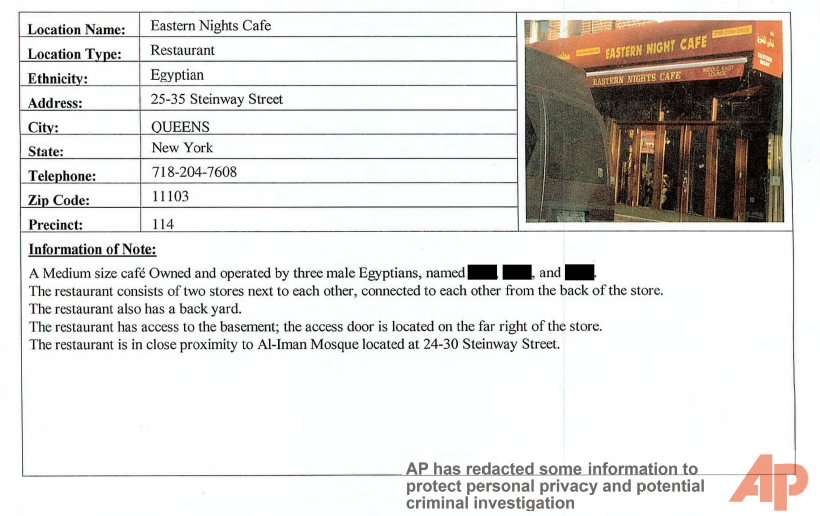
The AP has another installment of their series on the NYPD intelligence department’s mapping of ethnic neighborhoods in New York. As always, you should read the whole thing, as well as the documents showing the spooks’ data collection on innocent Moroccans and Moroccan-Americans.

One question I came away with, though, was how this program interacted with Department of Homeland Security’s Secure Communities program.

Secure Communities, recall, involves information sharing from local law enforcement to the FBI to DHS.

When state and local law enforcement arrest and book someone into a jail for a violation of a state criminal offense, they generally fingerprint the person. After fingerprints are taken at the jail, the state and local authorities electronically submit the fingerprints to the Federal Bureau of Investigation (FBI). This data is then stored in the FBI’s criminal databases. After running the fingerprints against those databases, the FBI sends the state and local authorities a record of the person’s criminal history.

With the Secure Communities program, once the FBI checks the fingerprints, the FBI automatically sends them to DHS, so that U.S. Immigration and Customs Enforcement (ICE) can determine if that person is also subject to removal (deportation). This change, whereby the fingerprints are sent to DHS in addition to the FBI, fulfills a 2002 Congressional mandate for the FBI to share information with ICE, and is consistent with a 2008 federal law that instructs ICE to identify criminal aliens for removal. Secure Communities does not require any changes in the procedures of local law enforcement agencies or jails.

By that process, DHS identifies people it can deport so as to meet the quota set for them by Congress.

As DDay has written repeatedly, this process has led to the deportation of low-level undocumented people, not the hardened felons the program was designed for. And this, in turn, makes local law enforcement less effective, because it makes immigrant communities less willing to cooperate with the cops because doing so might get them deported.

As the documents made available by AP make clear, when the NYPD’s spooks case out businesses, they note whether they are owned by citizens of ethnic (even Italian!) descent, or (as with the Eastern Nights Cafe profile, above) non-citizens. This effectively means NYPD’s spooks are, among other things, creating a database of the statuses of key members of ethnic communities throughout the city. Also, since the NYPD had a set of questions to ask anyone arrested or on parole from the Moroccan community, it also means the normal law enforcement process was being used to collect a database of information on immigration statuses and habits.

The AP story seems to suggest that NYPD keeps this information in a database separate from their other database system.

The information was recorded in NYPD computers, officials said, so that if police ever received a specific tip about a Moroccan terrorist, officers looking for him would have details about the entire community at their fingertips.

[snip]

Current and former officials said the information collected by the Demographics Unit was kept on a computer inside the squad’s offices at the Brooklyn Army Terminal. It was not connected to the department’s central intelligence database, they said.

The first installment of this series reported that the NYPD had shredded some of its documents to keep aspects of the program–including the fact that they were “building dossiers on innocent people, as these latest documents show they were–secret.

Some in the department, including lawyers, have privately expressed concerns about the raking program and how police use the information, current and former officials said. Part of the concern was that it might appear that police were building dossiers on innocent people, officials said. Another concern was that, if a case went to court, the department could be forced to reveal details about the program, putting the entire operation in jeopardy.

That’s why, former officials said, police regularly shredded documents discussing rakers.

But they did pass some of the information to the CIA via back channels.

Intelligence gathered by the NYPD, with CIA officer Sanchez overseeing collection, was often passed to the CIA in informal conversations and through unofficial channels, a former official involved in that process said.

Mind you, that doesn’t mean this information was shared with DHS’ Immigration and Customs Enforcement, leading to deportations.

But given information sharing laws included within the PATRIOT Act, this intelligence might well be legally available to the Federal government (but possibly illegal for them to keep, given that it is potentially illegal domestic intelligence).

All of which leads me to wonder: has the CIA-on-the-Hudson make NYC less safe, because it has turned the local cops into officers combining law enforcement, intelligence, and immigration mapping?

Share this entry