January 19, 2026 / by 


After Trump Issued Threats, Abigail Jo Shry “Came after” Judge Tanya Chutkan

As noted, Judge Tanya Chutkan lifted the stay on the gag she imposed on Donald Trump. In her opinion lifting the stay, Chutkan laid out how Trump’s garden variety attacks on Joe Biden were fair game under the gag, but his specific attack on Mark Meadows in conjunction with the Jack Smith prosecution was not.

Two of Defendant’s social media posts since the Order’s entry illustrate the comprehensible difference between the statements it permits and those it proscribes. First, on October 20, 2023—after the Order was entered, but before it was administratively stayed— Defendant stated:

Does anyone notice that the Election Rigging Biden Administration never goes after the Riggers, but only after those that want to catch and expose the Rigging dogs. Massive information and 100% evidence will be made available during the Corrupt Trials started by our Political Opponent. We will never let 2020 happen again. Look at the result, OUR COUNTRY IS BEING DESTROYED. MAGA!!!3

This statement asserts that Defendant is innocent, that his prosecution is politically motivated, and that the Biden administration is corrupt. It does not violate the Order’s prohibition of “targeting” certain individuals; in fact, the Order expressly permits such assertions. Order at 3.

By contrast, on October 24, 2023—after the Order was administratively stayed— Defendant stated:

I don’t think Mark Meadows would lie about the Rigged and Stollen 2020 Presidential Election merely for getting IMMUNITY against Prosecution (PERSECUTION!) by Deranged Prosecutor, Jack Smith. BUT, when you really think about it, after being hounded like a dog for three years, told you’ll be going to jail for the rest of your life, your money and your family will be forever gone, and we’re not at all interested in exposing those that did the RIGGING — If you say BAD THINGS about that terrible “MONSTER,” DONALD J. TRUMP, we won’t put you in prison, you can keep your family and your wealth, and, perhaps, if you can make up some really horrible “STUFF” a out him, we may very well erect a statue of you in the middle of our decaying and now very violent Capital, Washington, D.C. Some people would make that deal, but they are weaklings and cowards, and so bad for the future our Failing Nation. I don’t think that Mark Meadows is one of them, but who really knows? MAKE AMERICA GREAT AGAIN!!!4

This statement would almost certainly violate the Order under any reasonable definition of “targeting.”5 Indeed, Defendant appears to concede as much, Reply in Support of Motion to Stay, ECF No. 123, at 10 n.3 (“If the Gag order had been in effect, President Trump would have been unable to [make the statement].”)—and for good reason. The statement singles out a foreseeable witness for purposes of characterizing his potentially unfavorable testimony as a “lie” “mad[e] up” to secure immunity, and it attacks him as a “weakling[] and coward[]” if he provides that unfavorable testimony—an attack that could readily be interpreted as an attempt to influence or prevent the witness’s participation in this case. The plain distinctions between this statement and the prior one—apparent to the court and both parties—demonstrate that far from being arbitrary or standardless, the Order’s prohibition on “targeting” statements can be straightforwardly understood and applied.

3 https://truthsocial.com/@realDonaldTrump/posts/111267550982205234.

4 https://truthsocial.com/@realDonaldTrump/posts/111293117150329703.

5 Because of the administrative stay on the Order, this statement is not before the court. Before concluding that any statement violated the Order, the court would afford the parties an opportunity to provide their positions on the statement’s meaning and permissibility.

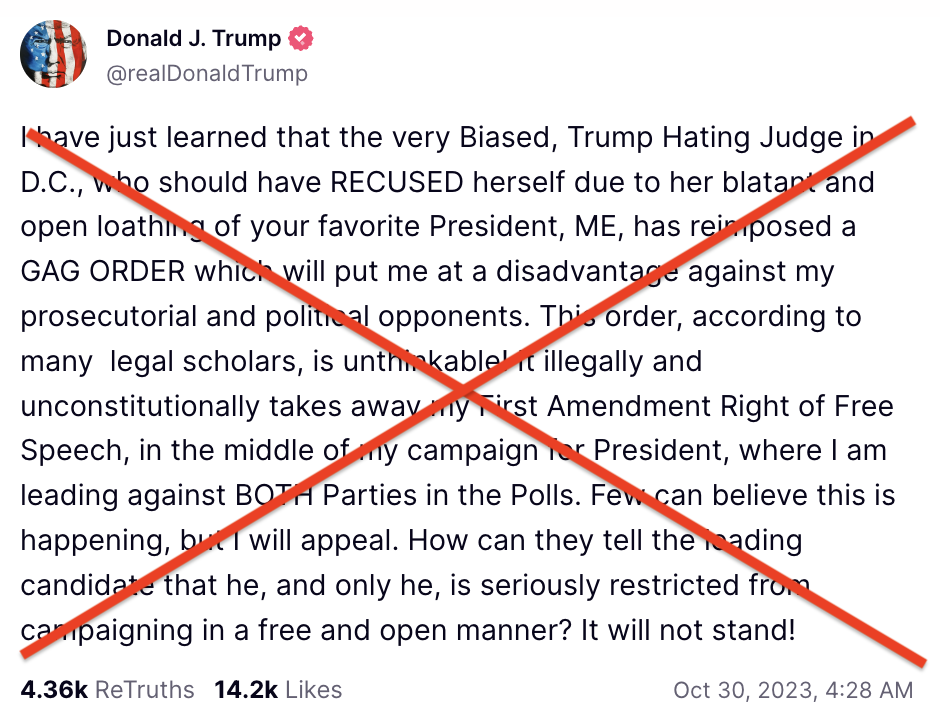
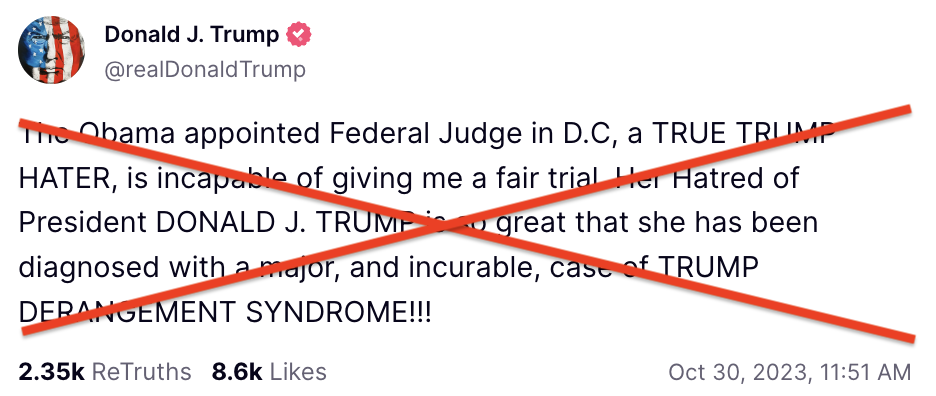
Since Chutkan lifted the stay, Trump has made six attacks on his failing social media platform, four complaining that the prosecution against him wasn’t initiated three years ago (under Bill Barr?!?! at a time when Bill Barr was still corruptly shutting down prosecutions of Trump and his people?!?!?!), before the conspiracies charged against him started, and two attacking Judge Chutkan.

All of these attacks are perfectly permissible under the gag.

While Chutkan’s staffers are covered by the gag, she specifically excluded Joe Biden and herself from the gag.

Because Chutkan is excluded from the gag, I thought it worth reviewing the specific circumstances of the threat Abigail Jo Shry made against Judge Chutkan, which as I noted first got raised in the government’s opposition to staying the gag.

Such risks are far from speculative here, the Court found, given uncontradicted facts submitted by the Government showing that when the defendant “has singled out certain people in public statements in the past,” it has “led to them being threatened and harassed.” ECF No. 103 at 66-67.1

1 Shortly after being assigned to the case, the Court itself received a racist death threat explicitly tied to the Court’s role in presiding over the defendant’s case. See United States v. Shry, No. 4:23-cr-413, ECF No. 1 at 3 (Criminal Complaint) (S.D. Tex. Aug. 11, 2023) (caller stating, among other things, “‘If Trump doesn’t get elected in 2024, we are coming to kill you, so tread lightly, b***h. . . . You will be targeted personally, publicly, your family, all of it.’”). This incident, like many of the others the Government cited, was widely publicized and surely well known to the defendant.

That is, it first got raised explicitly in the opposition to lift the stay.

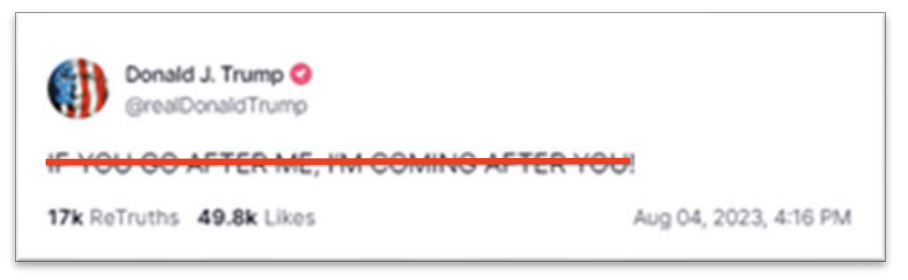
Not stated anywhere in this filing is that when DOJ said Shry made her threat against Judge Chutkan and Sheila Jackson Lee “shortly after” Judge Chutkan was assigned to the case, they mean Shry made the threat on August 5, one day after Trump issued his, “if you come after me” threat, which was included in the initial motion for a gag (the consideration of which, remember, John Lauro succeeded in stalling for ten days).

Trump followed that attack with more, including several almost identical to the ones he used overnight, except that they swapped out Jack Smith (who is covered under the gag) for Joe Biden.

When DOJ first moved for a gag on September 5, Shry remained detained pretrial, based on the findings that she had repeatedly made increasingly serious threats in the previous year.

Defendant has been criminally charged four times in the past year for engaging in similar conduct. On September 20, 2022, she was convicted in two separate cases (misdemeanor resisting arrest and misdemeanor criminal mischief) and sentenced to 30 days imprisonment. Recently, on July 11, 2023, she was charged with misdemeanor threat causing fear of imminent serious bodily injury. It is alleged that she committed the instant offense while on bond for the July 11 incident, less than one month after it occurred.

Defendant suffers from major depression and has a long history of substance abuse. She denies using any illegal substances for the past year. However, according to Defendant’s father, she excessively drinks beer daily. Defendant lives with her boyfriend, but he is presently charged with a family assault against her. Defendant has two children, ages 17 and 19, who currently live with her parents.

Defendant’s father, Mark Shry testified at the detention hearing. Mr. Shry believes that Defendant is a non-violent alcoholic. He testified that she sits on her couch daily watching the news while drinking too many beers. She then becomes agitated by the news and starts calling people and threatening them. Mr. Shry stated that his daughter never leaves her residence and therefore would not act upon her threats. He has agreed that Defendant can reside with him and Defendant’s mother, and he would serve as a third-party custodian.

Defendant’s aggressive and threatening behavior has continually escalated during the past year as evidenced by her criminal conduct in four separate cases.

But by the time DOJ resubmitted the motion on September 15, Shry had been released to home detention with an order to get mental health and substance abuse treatment.

In less than 24 hours since the stay, Donald Trump has shown a fine-tuned ability to continue to issue threats even as he adheres to the letter of the gag, just like I used to legalistically adhere to my seventh grade Geometry teacher’s rule against chewing gum in class by simply not chewing the gum in my mouth.

But there are thousands — maybe millions — of Trump supporters with mental health problems out there, sitting on couches, getting worked up about what they see on Fox News.

And as this gag gets appealed all the way to SCOTUS, Judge Chutkan has chosen to entrust her own safety from threats like Shry’s to the US Marshals, not to any gag.

Update: Fixed some points where I said the opposite of what I meant wrt lifting or staying the gag.


Mike Pence Simplifies the Gag Order Dispute

If my Irish Daylight Savings calculation and PACER operations are correct, Donald Trump submitted his reply to DOJ’s opposition to a stay on the gag Judge Tanya Chutkan imposed at around 8:50PM ET last night.

President Trump’s political opponents (some of whom are witnesses), the Biden Administration, and the citizenry writ large in connection with the 2024 campaign. This is precisely where the Gag Order runs headlong into unconstitutional shoals. President Trump is absolutely entitled to defend himself publicly and explain with specificity why the charges against him are false and meritless.

The filing includes the kind of sophistry John Lauro excels at. It continues to artificially dismiss the abundant evidence that Trump’s statements routinely lead to violence (in one place, by dismissing anything that happened more than three months ago: Taylor Taranto’s stalking of Barack Obama in response to Trump’s Truth Social post was on June 28, exactly four months before this filing).

But it is not frivolous. Trump wildly misrepresents the scope of the gag, particularly as it pertains to Joe Biden, about whom the gag imposes no restrictions.

This Order shall not be construed to prohibit Defendant from making statements criticizing the government generally, including the current administration or the Department of Justice; statements asserting that Defendant is innocent of the charges against him, or that his prosecution is politically motivated; or statements criticizing the campaign platforms or policies of Defendant’s current political rivals, such as former Vice President Pence.

These are not easy First Amendment questions.

And, Trump used the prosecution’s request to put restrictions on witness tampering into Trump’s release conditions (which is where Amy Berman Jackson put a similar gag for similar reasons on Roger Stone) to note its tactical position of strength.

The prosecution’s request is also jurisdictionally improper. The Court entered the Gag Order, and President Trump promptly filed a notice of appeal. The prosecution does not dispute that the Gag Order is an appealable order. See Doc. 110, at 8. Thus, when President Trump filed his notice of appeal, it divested the Court of jurisdiction to amend or modify the Gag Order: “The filing of a notice of appeal is an event of jurisdictional significance—it confers jurisdiction on the court of appeals and divests the district court of its control over those aspects of the case involved in the appeal.” Griggs v. Provident Consumer Disc. Co., 459 U.S. 56, 58 (1982). The prosecution’s latest proposal seeks to end-run around the Court of Appeals’ jurisdiction by modifying and reasserting the Gag Order as a condition of release while it is being challenged on appeal, which the Court lacks jurisdiction to do. See id.

Trump intends to take this gag order to a partisan Supreme Court where several Justices are already raring to forcibly protect the kind of violent threats that Trump specializes in. Heck, if Trump succeeds as well as he might, his appeal of this gag could solve the problem with the “mob” part of the indictment which I’ve noted.

And all that’s why the stakes of Pence’s decision to drop out of the presidential race yesterday matters.

I came here to say it’s become clear to me: this was not my time. So after much prayer and deliberation, I have decided to suspend my campaign for president, effective today.

He’s absolutely right. It is not the time for someone running on having upheld the Constitution to run in the Republican Party. The GOP is little more than a criminal protection racket to shelter one man, Donald Trump.

Pence dropped out before 5PM ET. By the time Trump submitted his motion claiming some of the witnesses the gag would prevent him from attacking were his political opponents, Pence dropped out of the race.

So long as Pence was in the race running on the policy of upholding the Constitution, as he did on January 6, there was a clear conflict between the gag’s restrictions on Trump’s attacks on witnesses and its explicit permission to attack the policies of his rivals in the 2024 Presidential race.

That conflict has been resolved.

These First Amendment questions are still difficult. This appeal may still give Trump a vehicle to get SCOTUS to protect the kind of mob incitement that is at the core of the indictment.

But yesterday, Pence resolved the most difficult of the questions.

Update: On Sunday night, Judge Chutkan denied the stay. Her order notes:

  • Even if a request to alter Trump’s release conditions were procedurally proper, it’s not necessary to enforce the terms of the gag
  • Trump ignored the causal link between his attacks and certain kinds of threats
  • Trump failed to fully raise the First Amendment interests of his followers in his opposition to a gag
  • Trump ignored the way Judge Chutkan had tailored her order (for example, by not gagging attacks on DC)
  • Trump adopted a dictionary rather than the well-accepted legal definition of “interested parties”
  • The difference between Trump’s general attack on the “Election Rigging Biden Administration,” which is not gagged, and a post claiming “if [Meadows would] say BAD THINGS about that ‘MONSTER’” Donald Trump he might avoid prison, which is gagged, is clear


Lurid Realities: Trump Implies That Selling Nuclear Secrets Is Treason

In this post, I noted that two passages from DOJ’s response to Trump’s Motion to Dismiss for Absolute Immunity — one pertaining to exchanging pardons as part of a quid pro quo, another describing otherwise official acts that would clearly be illegal — actually described things that may have or likely happened under Trump.

Here’s the latter discussion:

The same is true of an even splashier passage. A paragraph describing the implications of Trump’s claim to absolute immunity lays out what some commentators have taken as hyperbolic scenarios of presidential corruption.

The implications of the defendant’s unbounded immunity theory are startling. It would grant absolute immunity from criminal prosecution to a president who accepts a bribe in exchange for a lucrative government contract for a family member; a president who instructs his FBI Director to plant incriminating evidence on a political enemy; a president who orders the National Guard to murder his most prominent critics; or a president who sells nuclear secrets to a foreign adversary. After all, in each of these scenarios, the president could assert that he was simply executing the laws; or communicating with the Department of Justice; or discharging his powers as commander-in-chief; or engaging in foreign diplomacy—and his felonious purposes and motives, as the defendant repeatedly insists, would be completely irrelevant and could never even be aired at trial. In addition to the profoundly troubling implications for the rule of law and the inconsistency with the fundamental principle that no man is above the law, that novel approach to immunity in the criminal context, as explained above, has no basis in law or history.

These seemingly extreme cases of crimes a President might commit, crimes that everyone should agree would face prosecution, include (these are out of order):

  • A President ordering the National Guard to murder his critics
  • A President ordering an FBI agent to plant evidence on his political enemy
  • A bribe paid in exchange for a family member getting a lucrative contract
  • A President selling nuclear secrets to America’s adversaries

Like the pardon discussion above, these hypotheticals — as Commander-in-Chief, with the conduct of foreign policy, with the treatment of classified materials — invoke actions where DOJ typically argues that the President is at the zenith of his power.

We have no reason to believe that Trump ordered the National Guard, specifically, to murder his critics. But we do know that on January 3, 2021, Trump proposed calling out 10,000 members of the National Guard to “protect” his people and facilitate his own march on the Capitol.

And he just cut me off, and he goes, well, we should call in the National Guard.

And then I think it was Max who said something to the effect of, Well, we should only call in the Guard if we expect a problem. And then the President says, no, we should call in the Guard so that there aren’t – so that there isn’t a problem. You know, we need to make sure people are protected.

And he said – he looked over at Max, and I don’t know if somebody was standing behind him or not. He just looked the other way from me and says, you know,  want to call in 10,000 National Guard. And then  opened my folder and wrote down 10,000 National Guard, closed my folder again.

We know that days later Mark Meadows believed the Guard would be present and Proud Boy Charles Donohoe seemed to expect such protection.

Similarly, we don’t know of a specific instance where Trump ordered an FBI agent to plant information on his political enemy. But we do know that as part of a Bill Barr-directed effort to reverse the Mike Flynn prosecution in 2020, misleading dates got added to the notes of Trump’s political enemies, Peter Strzok and Andrew McCabe.

Days after those misleading dates were made public via Sidney Powell, Trump used the misleading dates in a packaged debate attack on Joe Biden.

President Donald J. Trump: (01:02:22)
We’ve caught them all. We’ve got it all on tape. We’ve caught them all. And by the way, you gave the idea for the Logan Act against General Flynn. You better take a look at that, because we caught you in a sense, and President Obama was sitting in the office.

We know of no instance where Trump accepted a bribe in response to which a family member got a US government contract. We do, however, know of an instance where the Trump Administration gave the Saudis something of value — at the least, cover for the execution of Jamal Khashoggi — which everyone seems to believe has a tie to Jared’s lucrative $2 billion contract with the Saudi government.

As to selling nuclear secrets to a foreign adversary? Well, we know Trump had some number of nuclear secrets in his gaudy bathroom and then in his leatherbound box. We have no fucking clue what happened to the secrets that Walt Nauta allegedly withheld from Evan Corcoran’s review that got flown to Bedminster just before a Saudi golf tournament, never to be seen again.

All of which is to say that these edge cases — examples of Presidential misconduct that some commentators have treated as strictly hypothetical — all have near analogues in Trump’s record. [my emphasis]

Trump’s reply to that response addresses this second passage — at least, two items from it — in what it deems to be “lurid hypotheticals.”

10 Ignoring actual lessons from history, the Government provides a list of lurid hypotheticals that have never happened—including treason and murder. Response, at 20 (speculating that a President might “murder his most prominent critics” or “sell[] nuclear secrets to a foreign adversary”). Some or all of these hypotheticals, depending on the facts, would likely involve purely private conduct, rendering them irrelevant here. See id. Yet even if such examples somehow were within the outer perimeter of a President’s duties, it is overwhelmingly likely the House impeach and the Senate would convict, and the offending President would then be subject to “Indictment, Trial, Judgment and Punishment” by criminal prosecution. U.S. CONST. art. I, § 3, cl. 7. That is the process the Constitution provides, and the prosecution may not ignore it here. [my emphasis]

Since Trump doesn’t include the entire list, here are the four items in it:

  • A President ordering the National Guard to murder his critics
  • A President ordering an FBI agent to plant evidence on his political enemy
  • A bribe paid in exchange for a family member getting a lucrative contract
  • A President selling nuclear secrets to America’s adversaries

This footnote seems to suggest more than one and possibly all of these things — in a list including an order to the National Guard and an order to an FBI Agent — would be private acts.

That’s a consistent stance with the claim, in a footnote that concludes on this very same page, that Nixon’s suspected involvement in the DNC burglary as part of an attempt to win an election would also be a private act.

9 The Government relies on President Ford’s pardon of President Nixon, arguing that it presupposes that Nixon could have been prosecuted for acts he committed as President. Doc. 109, at 18. Not so. The fact that Nixon was never prosecuted—despite widespread public outrage and compelling evidence of wrongdoing—provides compelling evidence of the strength of the historical tradition against prosecuting former Presidents for their official acts, not its weakness. Moreover, this argument overlooks that much of the conduct at issue in the Watergate scandal—such as ordering the burglary of the Democratic National Committee headquarters—may well have been purely private acts, not shielded by immunity at all, thus necessitating a pardon. (Both of these points apply equally to President Clinton’s admitted perjury in the Paula Jones litigation, for which he was never prosecuted. Response, at 19.)

FWIW, I agree with this reply’s argument that DOJ doesn’t aggressively lay out the extent to which Trump’s alleged acts in the January 6 indictment are private acts. But if Trump concedes that Nixon’s suspected role in the DNC break-in to win an election was a private act, then it seems to concede that Trump’s own actions to reverse the outcome of an election he lost would also be a private act.

And Trump’s extension of private acts to this list of four “lurid hypotheticals” would seem to swallow up the entire argument about Presidential immunity.

But it seems to do something else.

There is nothing on that list resembling treason.

Accepting a bribe from Saudi Arabia to win a $2 billion contract for your son-in-law? Not treason.

Ordering the FBI to alter records to gin up an investigation against Joe Biden? Not treason.

Ordering 10,000 National Guard members to protect your mob as it attacks Congress? Not treason — at least not until it kicks off Civil War.

The closest thing on that list to treason is selling nuclear secrets to America’s adversaries. Not treason.

But Trump’s lawyers, including two of the lawyers representing him in the stolen documents case, lawyers who had their first good look at the documents Trump is accused of stealing last week, seem to suggest it could be.

To be clear: Trump has never been accused of selling nuclear secrets to America’s adversaries.

He undoubtedly gave Israel’s counterterrorism secrets to Russia — why, and whether there was a quid pro quo involved, we still don’t know.

He is known to have Tweeted out highly sensitive satellite information to dick-wag Iran, with the result that Iran learned about the satellites targeting their country.

To spite Mark Milley, he showed a plan to attack Iran to Mark Meadows’ ghost writers.

Ongoing reporting, first from ABC and then from NYT, reveals that after Australian billionaire Anthony Pratt paid millions for access to Trump, Trump shared details of a conversation he had about a call he had with Iraq’s president after bombing Iraq, described his perfect phone call with Volodymyr Zelenskyy, and provided sensitive details of America’s nuclear subs.

And he is accused of leaving nuclear documents — documents that Trump’s lawyers may have reviewed for the first time last week — in unsecure ways at his beach resort, possibly even in his gaudy bathroom.

So, no. Trump has not (yet) been accused of selling nuclear secrets, to adversaries or anyone else. Though he did give away what he claimed to be nuclear secrets to a businessman from an allied nation after the guy paid a lot of money for access to Trump.

But as I noted, we don’t yet know what happened to some of the secret documents that Trump snuck away from Mar-a-Lago after hiding them from Evan Corcoran in June 2022, documents he took with him to host a golf tournament the Saudis paid an undisclosed sum to host at Bedminster.

Those documents have never been located.

Just so long as Trump didn’t sell any of these nuclear documents, but instead gave them away, I’m sure we’re all good.


Trump Is Going Through the Motions to Dismiss until He Resumes the Presidency

One of the reasons I suspect that Trump-leaning Republicans replaced Kevin McCarthy with a key player in Trump’s last attempted coup is because Trump shows no signs of any plan to try to win his Federal criminal trials.

For some time, it has appeared (to me at least) that he has approached these cases with the belief that if he can use them as a campaign prop with which to get reelected, then he can simply pardon himself or remain President indefinitely to beat the Federal rap. That’s one of the reasons, I think, why he is treating many of his DC court filings as stunts, especially his extensive fundraising and messaging campaign around the gag order.

Delay, disinform, then dismiss.

I get that. I expected that. Yet, I still expected him to present the best legal case he could as insurance in case winning or stealing the election and self-pardoning doesn’t work.

He has lawyers capable of making very competent legal arguments.

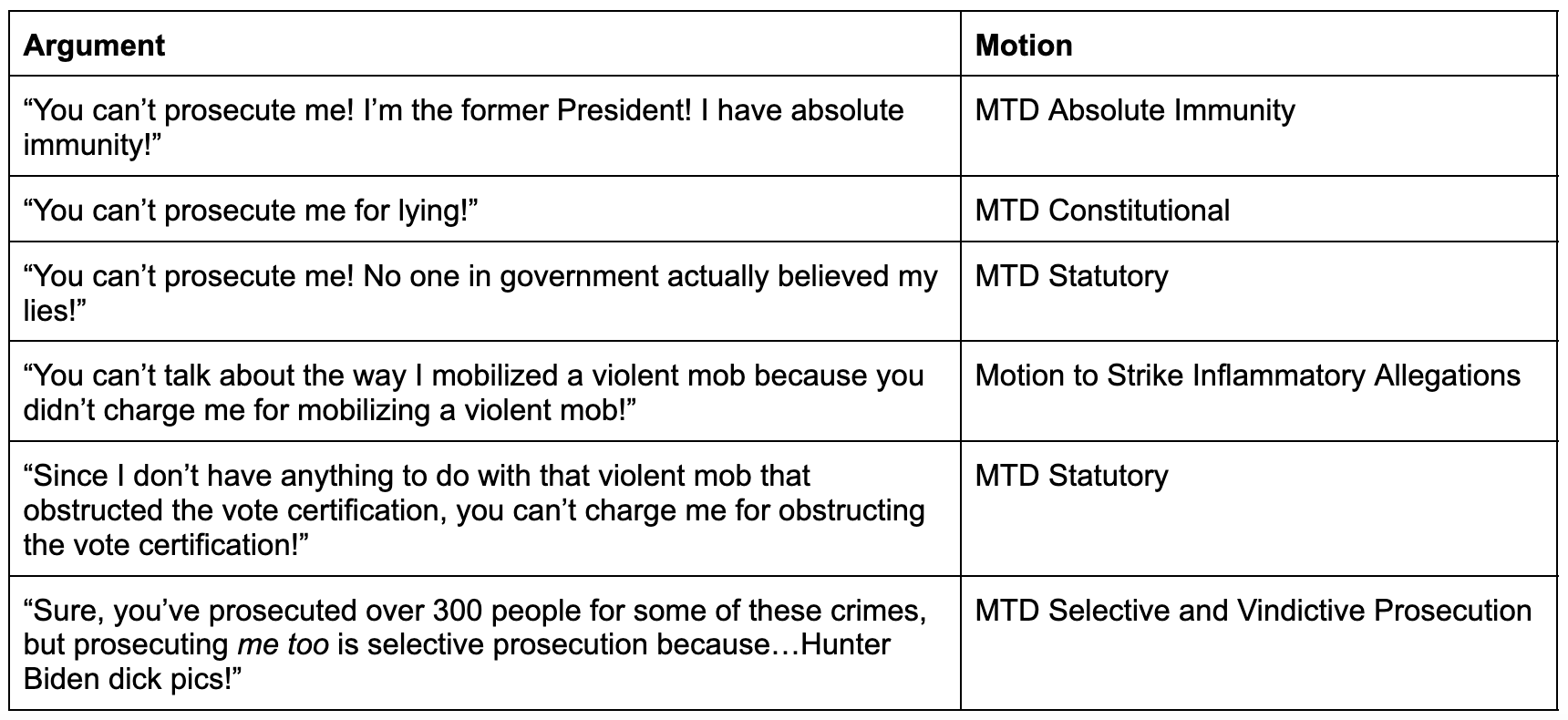
So I’m frankly shocked by how inadequate his Motions to Dismiss have been. I wrote them up here and made this nifty table summarizing the arguments.
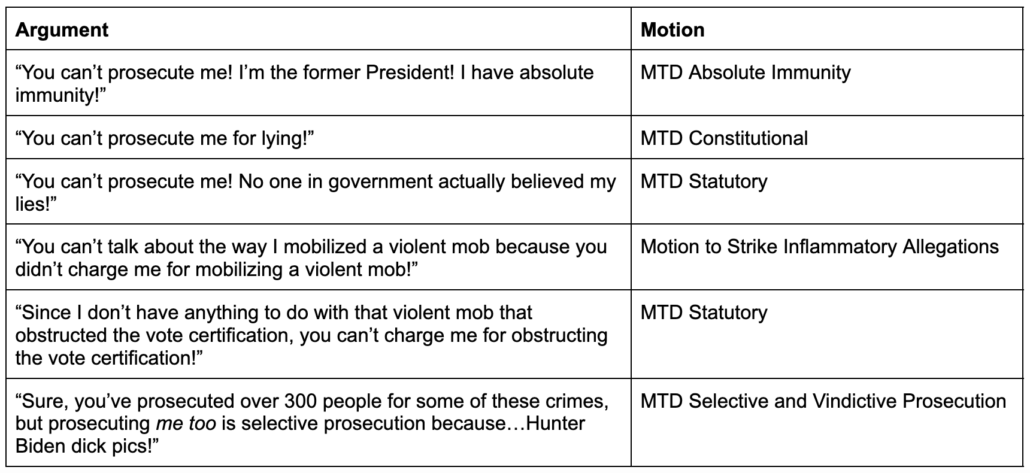
This is not just a legal observation — though some of his purportedly legal arguments, most notably his selective prosecution motionare legally shitty. Don’t take my word for it: take Carissa Byrne Hessick’s expert opinion, who says, “his motion is embarrassingly awful & should clearly be denied under current law.”

This is not just a legal observation. Partly, it’s box-ticking one. As I show below, Trump isn’t even addressing all the allegations against him.

As DOJ noted in the response to Trump’s MTD for Absolute Immunity, Trump totally misrepresented the indictment. As DOJ laid out, the indictment consists of four charges — three of them, conspiracy charges (18 USC 371, 1512(k), and 241). For each of those charges, DOJ alleged that Trump used five means of pursuing that conspiracy, laid out as five bullet points in the indictment. Those five bullets read:

a. The Defendant and co-conspirators used knowingly false claims of election fraud to get state legislators and election officials to subvert the legitimate election results and change electoral votes for the Defendant’s opponent, Joseph R. Biden, Jr., to electoral votes for the Defendant. That is, on the pretext of baseless fraud claims, the Defendant pushed officials in certain states to ignore the popular vote; disenfranchise millions of voters; dismiss legitimate electors; and ultimately, cause the ascertainment of and voting by illegitimate electors in favor of the Defendant. [state]

b. The Defendant and co-conspirators organized fraudulent slates of electors in seven targeted states (Arizona, Georgia, Michigan, Nevada, New Mexico, Pennsylvania, and Wisconsin), attempting to mimic the procedures that the legitimate electors were supposed to follow under the Constitution and other federal and state laws. This included causing the fraudulent electors to meet on the day appointed by federal law on which legitimate electors were to gather and cast their votes; cast fraudulent votes for the Defendant; and sign certificates falsely representing that they were legitimate electors. Some fraudulent electors were tricked into participating based on the understanding that their votes would be used only if the Defendant succeeded in outcome-determinative lawsuits within their state, which the Defendant never did. The Defendant and co-conspirators then caused these fraudulent electors to transmit their false certificates to the Vice President and other government officials to be counted at the certification proceeding on January 6. [fake electors]

c. The Defendant and co-conspirators attempted to use the power and authority of the Justice Department to conduct sham election crime investigations and to send a letter to the targeted states that falsely claimed that the Justice Department had identified significant concerns that may have impacted the election outcome; that sought to advance the Defendant’s fraudulent elector plan by using the Justice Department’s authority to falsely present the fraudulent electors as a valid alternative to the legitimate electors; and that urged, on behalf of the Justice Department, the targeted states’ legislatures to convene to create the opportunity to choose the fraudulent electors over the legitimate electors. [Jeffrey Clark]

d. The Defendant and co-conspirators attempted to enlist the Vice President to use his ceremonial role at the January 6 certification proceeding to fraudulently alter the election results. First, using knowingly false claims of election fraud, the Defendant and co-conspirators attempted to convince the Vice President to use the Defendant’s fraudulent electors, reject legitimate electoral votes, or send legitimate electoral votes to state legislatures for review rather than counting them. When that failed, on the morning of January 6, the Defendant and co-conspirators repeated knowingly false claims of election fraud to gathered supporters, falsely told them that the Vice President had the authority to and might alter the election results, and directed them to the Capitol to obstruct the certification proceeding and exert pressure on the Vice President to take the fraudulent actions he had previously refused. [PenceCard]

e. After it became public on the afternoon of January 6 that the Vice President would not fraudulently alter the election results, a large and angry crowd–including many individuals whom the Defendant had deceived into believing the Vice President could and might change the election results–violently attacked the Capitol and halted the proceeding. As violence ensued, the Defendant and co-conspirators exploited the disruption by redoubling efforts to levy false claims of election fraud and convince Members of Congress to further delay the certification based on those claims. [mob] [red brackets my own]

Here’s how DOJ described the indictment in their response to Trump’s Absolutely Immunity filing.

A grand jury charged the defendant in a four-count indictment. ECF No. 1. The defendant moved to dismiss the indictment on the ground that he “is absolutely immune from prosecution.” Mot. 1. When considering a motion to dismiss, the Court must view the indictment “as a whole[,] and the allegations must be accepted as true.” United States v. Weeks, 636 F. Supp. 3d 117, 120 (D.D.C. 2022) (internal quotation marks omitted).

Count One, which charges a conspiracy to defraud the United States, in violation of 18 U.S.C. § 371, alleges that the defendant, then a candidate seeking re-election to the presidency, conspired with, among others, several individuals outside the Executive Branch to “overturn the legitimate results of the 2020 presidential election by using knowingly false claims of election fraud to obstruct the federal government function by which those results are collected, counted, and certified.” ECF No. 1 at ¶¶ 1, 7, 8. The indictment further alleges that the defendant aimed at accomplishing the conspiracy’s objectives in five ways: [state] using deceit toward state officials to subvert the legitimate election results in those states, id. at ¶¶ 13-52; [fake electors] using deceit to organize fraudulent slates of electors in seven targeted states, and cause them to send false certificates to Congress, id. at ¶¶ 53-69; [Jeffrey Clark] leveraging the Department of Justice to use deceit to get state officials to replace the legitimate electoral slate with electors who would cast their votes for the defendant, id. at ¶¶ 70-85; [PenceCard] attempting to enlist the Vice President to fraudulently alter the election results during the certification proceeding on January 6, 2021, and directing supporters to the Capitol to obstruct the proceeding, id. at ¶¶ 86-105; and [mob] exploiting the violence and chaos that transpired at the United States Capitol on January 6, 2021, id. at ¶¶ 106-124. Counts Two and Three, which incorporate allegations from Count One, charge conspiracy and substantive violations of 18 U.S.C. § 1512(c)(2) for corruptly obstructing the certification of the presidential election results on January 6, 2021. Id. at ¶¶ 125-28. Count Four, which likewise incorporates the allegations from Count One, alleges that the defendant conspired to violate one or more person’s constitutional right to vote and have one’s vote counted. Id. at ¶¶ 129-30. [red brackets my own]

Get used to this paragraph: you’re going to see some version of it in the response to many if not all of the MTDs submitted last week.

To address the charges, you need to explain why each of those five means don’t substantiate, either alone or in combination, the elements of the offense of the charges. Effectively, Trump has to show how these five means don’t prove the three different ways they have been charged criminally.

One reason you have to address the alleged means of conspiracy is that First Amendment protected activities, if they are part of a conspiracy, may be included as overt acts in that conspiracy. Scores of January 6 defendants have already made the same First Amendment argument Trump is, including some members of the Proud Boys and Oath Keepers who, like Trump, didn’t breach the Capitol. But if DOJ can prove speech was part of a conspiracy, that speech can come in as evidence of that conspiracy. Trump’s MTD on Constitutional Grounds, for example, which is substantially the same argument about the First Amendment that has already failed for other Jan6ers, names each of the crimes alleged.

These points are not in dispute. Nonetheless, in an astonishing display of doublethink, the prosecution simultaneously claims that President Trump—simply by speaking his mind and petitioning for a redress of grievances—also somehow conspired to “defraud the United States,” “oppress rights,” and “obstruct an official proceeding.” Id. at ¶ 5–6, 125–130.

Then, purportedly citing to the five bullets that describe the means, he spins the five means as giving voice to concerns about election integrity, not his unlawful goal of trying to invalidate the votes of 81 million Biden voters.

As the indictment itself alleges, President Trump gave voice to these concerns and demanded that politicians in a position to restore integrity to our elections not just talk about the problem, but investigate and resolve it. See id. at ¶ 10(a) (state legislators and election officials) act) [sic]; ¶ 10(b) (Vice President and other government officials); ¶ 10(c) (state officials); ¶ 10(d) (vice president); ¶ 10(e) (members of Congress).

This passage replaces the instrumentality alleged with the targets of what Trump calls persuasion. Trump correctly describes one target of the state means (but not the coercion involved). But then he spins the creation of fraudulent documents as, instead, an attempt to persuade Mike Pence. He redefines the hijacking of DOJ in order to make a seemingly authoritative false statement as an attempt to persuade state officials (long after the involvement of state officials was concluded). He describes efforts to get Pence to violate the law as instead an attempt to persuade him. And he calls a violent mob threatening to assassinate members of Congress as, instead, an attempt to persuade those members.

Trump is a con man. And his First Amendment argument is a breathtaking claim that the means he uses to sustain his con — including fraud and coercion backed by violence — are merely free speech.

To some degree, this quick sleight of hand doesn’t matter: In the discussion of the First Amendment that follows, he never returns to address the charges against him. As a result, Trump’s First Amendment argument is sloppy fluff compared to the First Amendment January 6 challenges that have gone before and will be before the DC Circuit by the time Trump goes to trial.

Having at least acknowledged the existence of all five “means” bullet points in his MTD on Constitutional Grounds (even if he redefined them as targets of persuasion), the section of Trump’s MTD on Statutory Grounds addressing 371 pretends the indictment names just three means, not five.

As relevant here, the indictment alleges three types of conduct that supposedly involved making a false statement: (1) claims that the 2020 Presidential election was rigged or tainted by fraud or other irregularities, made both in public and in communications with public officials; [state] (2) organizing and submitting contingent slates of electors to the President of the U.S. Senate and the Archivist of the United States; [fake electors] and (3) making public claims about the scope of the Vice President’s legal authority with respect to the election certification. [PenceCard] [red brackets my own]

Trump doesn’t even pretend to address two of the five means alleged involve a conspiracy to defraud the government: the Jeffrey Clark and mob means. In the sections addressing 1512 and 241, Trump never revisits those other two means (or, in any specificity, the three he does include).

And that’s how, in the section on 1512 (an area where he could, but does not, piggyback on two years of determined work from other January 6 defense attorneys, including several who are members of his larger defense team), he claims he did nothing that could have obstructed the official proceeding — the January 6 vote certification — that he never even identifies.

As discussed above, lobbying members of Congress and state officials to act in a certain way when they conduct an official proceeding does not “obstruct” or “impede” that official proceeding. Nothing about lobbying Congress to act a certain way “places an obstacle” or “impediments,” “hinders … from action,” “gets in the way of the progress of,” “holds up,” or “blocks” Congress from acting. See id. at 1132, 1159. On the contrary, lobbying Congress to act in a certain way presupposes that Congress will conduct an official proceeding, and it seeks to persuade Congress to act in a certain way during that official proceeding. That is the antithesis of “obstructing” or “impeding” the proceeding.

Think about that! If Trump bothered to mention the vote certification, he would literally be claiming that he had absolutely nothing to do with its interruption on January 6, 2021. Nothing.

Even the illegal order to Pence, clearly identified as item 3 in Trump’s 371 section and a primary focus of both Judge David Carter’s opinion finding it likely this did amount to obstruction and the January 6 Report, is gone here. Jeffrey Clark never gets put back in. Most importantly, the obvious means of sending thousands of angry Trump supporters, many armed, to Congress to chase lawmakers out of their chambers remains absent from Trump’s discussion.

This is why (as I noted earlier) I think Trump is simply trying to make his incitement of actual mobsters go away with the Motion to Strike. His legal arguments ignore the incitement of the mob entirely, even after his recusal stunt introduced evidence of someone convicted under 1512, Robert Palmer, who said he committed crimes “at the behest” of Trump, even after his gag fight introduced evidence of a Jan6er stalking Obama immediately after Trump sent him.

To the extent that Trump’s MTDs don’t result in the wholesale dismissal of his indictment (and DOJ argued that by allegedly conspiring with five people outside of government, most of the allegations against Trump couldn’t be treated as official acts even if he did win the Absolute Immunity argument) Trump’s failure to address some of the means he allegedly used will lead to the failure of these efforts.

With the exception of the MTDs for Absolute Immunity (arguing that as a former President Trump, can’t be charged for things he did as President) and Selective Prosecution, these MTDs don’t attempt to argue that the entire indictment should be dismissed. And where in some cases he could make compelling arguments — I think the Jeffrey Clark means, for example, is particularly prone to legal challenge, though Trump barely addresses it — so long as you leave one of the means intact, you won’t succeed in dismissing the indictment.

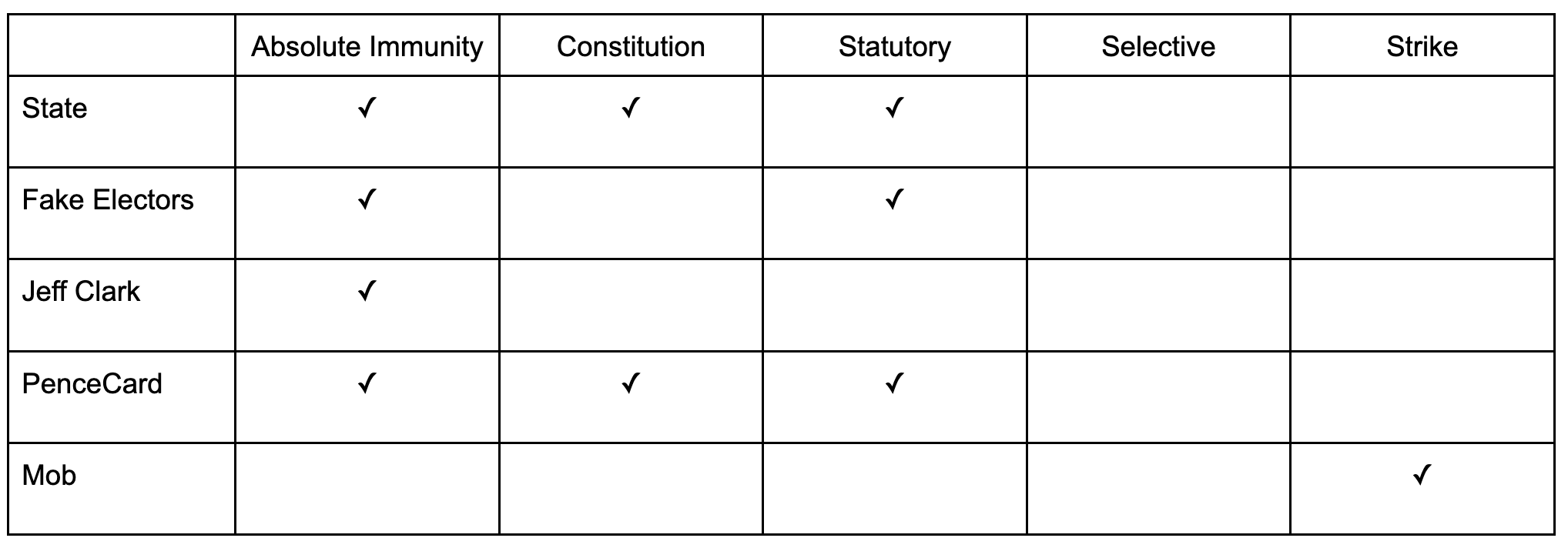
In practice, the scope of what Trump actually addresses in his MTDs looks something like this:
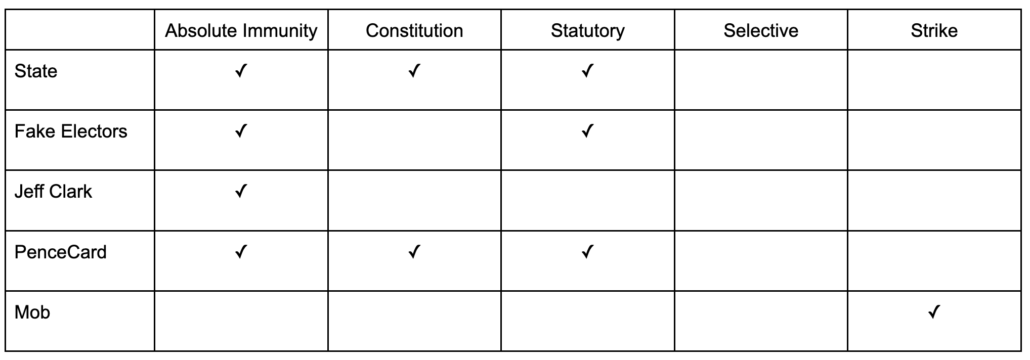
Not only doesn’t Trump ever address the indictment as alleged (DOJ notes that a Motion to Dismiss must accept the facts alleged as true), but in none of these MTDs does he address all the means alleged. The only place he fully deals with the Jeffrey Clark allegation (which, again, I think is the most susceptible to legal challenge) is in the Absolute Immunity filing that is weak for other reasons. The only place he deals with the mob means is in the Motion to Strike, his legal effort to sweep his role in the violence all under the rug.

If his effort to do that — to remove the descriptions of his own role in the violence from the indictment with his Motion to Strike — fails, then that means alleged in the indictment will survive no matter what else happens.

To be sure, these MTDs have no bearing on whether he’ll ultimately be successful. Trump doesn’t need any of these MTDs to succeed to be acquitted. There will be a contentious fight about admissible evidence and arguments, where this First Amendment argument will be even more contentiously argued than it is here. The fight over advice of counsel arguments has already started, And ultimately he only needs to find one MAGAt willing to ignore all evidence to keep on a jury.

But the big gaps in Trump’s MTD arguments, to say nothing of the way he spins having his campaign submit fraudulent documents to NARA and Congress, seem to reflect points where even his lawyers recognize his case is so weak they just won’t bother — they’ll just try to sweep it all under the rug some other way, like that Motion to Strike.

Again, even if this goes to trial in March as currently scheduled, Trump needs only persuade one voter. If he can use these court filings as a means to delay that trial and as campaign props to win the election, these weak points won’t matter.

Update: Corrected trial date, which is scheduled to start on March 4, per Sean Sullivan.


Like Taylor Taranto, Trump Tries to Excuse Threats by Invoking the First Amendment

The government responded to Trump’s motion to stay Judge Tanya Chutkan’s gag order.

As many people note, it cites the new threats Trump has made — against Judge Arthur Engoron’s clerk (for which the judge fined Trump $10,000 yesterday), against Mark Meadows — since Chutkan temporarily stayed her own order. DOJ used those examples to show that as soon as Chutkan stayed her own gag, Trump resumed his normal incitement.

I find two footnotes raising things that happened months ago more telling. First, a footnote describing the Trump supporter charged with making death threats against Judge Chutkan herself, along with Sheila Jackson Lee, presented as yet another example of how Trump’s attacks lead to credible threats.

Such risks are far from speculative here, the Court found, given uncontradicted facts submitted by the Government showing that when the defendant “has singled out certain people in public statements in the past,” it has “led to them being threatened and harassed.” ECF No. 103 at 66-67.1

1 Shortly after being assigned to the case, the Court itself received a racist death threat explicitly tied to the Court’s role in presiding over the defendant’s case. See United States v. Shry, No. 4:23-cr-413, ECF No. 1 at 3 (Criminal Complaint) (S.D. Tex. Aug. 11, 2023) (caller stating, among other things, “‘If Trump doesn’t get elected in 2024, we are coming to kill you, so tread lightly, b***h. . . . You will be targeted personally, publicly, your family, all of it.’”). This incident, like many of the others the Government cited, was widely publicized and surely well known to the defendant.

And then, a footnote describing how Jan6er Taylor Taranto, a Navy veteran with long-standing mental health issues, invoked the First Amendment after he responded to Trump’s publication of Barack Obama’s DC address by stalking the former President’s Kalorama neighborhood in a van with (locked) weapons.

7 The Government’s submissions, while extensive, did not purport to be a comprehensive account of every occasion when the defendant’s public targeting of perceived adversaries has resulted in threats, harassment, or intimidation. The public record is replete with other examples. See, e.g., United States v. Taranto, No. 1:23-cr-229, ECF No. 27 at 4-6 (D.D.C. Sep. 12, 2023) (affirming detention order for Taranto and explaining that, after “‘former President Trump posted what he claimed was the address of Former President Barack Obama’ on Truth Social,” Taranto— who had previously entered the Capitol on January 6, 2021—reposted the address, along with a separate post stating, “‘See you in hell, Podesta’s and Obama’s’” [sic], and then proceeded, heavily armed, to the area the defendant had identified as President Obama’s address, while livestreaming himself talking about “getting a ‘shot’ and an ‘angle,’” adding, “‘See, First Amendment, just say First Amendment, free speech’”) (quoting Taranto, ECF No. 20).

Here’s more of the Taranto detention memo from which DOJ cited.

Taranto parked his van on the street and began walking around the neighborhood, continuing to film. Taranto made several references to “the Podestas” and stated several times that he was trying to get an interview. Taranto’s continued narration made it clear that he intended to access or enter the private residences of his subjects. For example, Taranto panned the camera to show several sewer grates on the street – calling them “entrance points,” and stating that the grates were an “entrance” to reach “them.” Throughout the video he also stated,

“So if you go down there, there’s obviously tunnels down there. I don’t know how close they’ll get you in terms of access;”

“We’re gonna find a way to the tunnels, underneath their houses;” and,

“We’re looking for tunnel access so we can get the interview, in case they try to weasel their way out. No in or out now! See, First Amendment, just say First Amendment, free speech. Free, it’s free.”

Throughout the video, Taranto repeatedly attempted to couch his actions in terms of “First Amendment” or free speech, as if he believed that simply saying the words, “First Amendment” absolved him from any trespass. When initially approached by Secret Service, Taranto stated, “Hello, just trying to get an angle, for First Amendment, free speech. Thanks. That’s Secret Service, she’s alright.” He also said, “See how it works? Just say, ‘First Amendment.’” Taranto made additional concerning statements during the video including the following statements about getting a “shot”:

“Gotta get the shot, stop at nothing to get the shot. This is where other people come to get the shot;”

“We’re gonna see what we can get, as a shot. If I were them, I’d be watching this, watching my every move;” and,

“This is where everyone goes to get the shot. It’s just me today though. This is an easy way around. Yeah, they can’t stop me from walking through here. Just don’t step foot on the street.”

Regarding getting an “angle,” Taranto states several times, “Let’s see what angles we can get,” and, “Just trying to get an angle, for First Amendment, free speech.” Additional concerning statements included:

“I don’t have any ID, so in case I get detained or something, they’re just going to have to use their cellphone to figure out who I am.”

“So yeah, more than likely, these guys also all hang for treason. See how I said that? You gotta be very safe and careful. Someone warned me.”

“I control the block, we’ve got ‘em surrounded.”

“Oh, is this intimidating? I don’t think so.”

The reference to the threat against Chutkan puts that example into the record before the DC Circuit hears this appeal. DOJ provided the reference to Taranto (Judge Carl Nichols’ affirmation of his detention order post-dates when DOJ initially submitted this motion on September 5) to support this passage, in which DOJ notes that the catalog of past incitement it has presented thus far is in no way comprehensive:

The defendant does not meaningfully dispute the accuracy of any of these findings. Instead, he first argues (ECF No. 110 at 8-10) that they lacked adequate evidentiary support. But the Government’s uncontradicted filings (ECF No. 57 at 2-13; ECF No. 64 at 9-12) documented a long history of targeted tweets as well as a litany of individuals who have described (sometimes in sworn testimony) the repeated and foreseeable effects of his targeting. E.g., ECF No. 57 at 3 (quoting congressional testimony stating, “After the President tweeted at me by name, calling me out the way he did, the threats became much more specific, much more graphic, and included not just me by name but included members of my family by name, their ages, our address, pictures of our home. Just every bit of detail you could imagine. That was what changed with that tweet.”); id. at 5 (quoting congressional testimony stating, “[W]hen someone as powerful as the President of the United States eggs on a mob, that mob will come.”).7 As the Court explained, these citations to public statements and testimony were “[u]ndisputed,” ECF No. 105 at 2, and there was no need to submit the same material as part of an affidavit, ECF No. 103 at 57. Cf. United States v. Smith, 79 F.3d 1208, 1210 (D.C. Cir. 1996) (per curiam) (holding that the parties may proceed by proffer at a detention hearing). The factual findings here were adequately supported and readily distinguish this case from Ford. Cf. Ford, 830 F.2d at 597 (noting that the order was issued sua sponte); id. at 603 (Krupansky, J., concurring) (noting the absence of factual findings). And the defendant will not be able to demonstrate that they are clearly erroneous on appeal.

The Chutkan and Taranto examples reinforce the overall point DOJ makes with this filing: Trump has not contested the proof in their original submission that after he targets people, the mob soon follows.

He has simply ignored that evidence.

Indeed, I called John Lauro out for ignoring that evidence in real time.

Lauro ignores the multiple cases, cited in prosecutors’ filing, where people told Trump directly that his incitement had ratcheted up threats against people like Jeff Duncan, Chris Krebs, and Ruby Freeman.

Trump’s lawyers have now established a pattern.

In the recusal fight, prosecutors pointed out that the two sentencing hearings which Trump cited to justify recusal included one, that of Robert Palmer, where a January 6 defendant stated that he went to the Capitol, where he serially assaulted some cops, “at the behest” of Trump because Trump and others had convinced him he had to take action to stop the vote certification. Trump ignored that discussion in his reply.

When Trump complained that Jack Smith improperly claimed that Trump, “fueled . . . an unprecedented assault on the seat of American democracy,” DOJ laid out that, in fact, the indictment did show how Trump riled up the mob, of which this paragraph is just one example:

Finally, on the afternoon of January 6, after “a large and angry crowd—including many individuals whom the [d]efendant had deceived into believing the Vice President could and might change the election results—violently attacked the Capitol and halted the proceeding,” the defendant exploited the disruption in furtherance of his efforts to obstruct the certification, id. at ¶10e.

Trump ignored this reply in his bid for a stay.

Both Trump’s motion to dismiss for absolute immunity and for Constitutional grounds ignore the actual charges and overt acts of which he is accused and instead tell a tale of protected speech. His motion to dismiss on statutory grounds, meanwhile, completely ignores how he mobilized the mob and thereby successfully obstructed the vote certification (which, as noted, DOJ had laid out in this underlying dispute), choosing instead to ask that those allegations be stricken from the indictment and then, assuming that will work, claiming that nothing he did actually did obstruct the vote certification.

That is, in over 130 pages of filings attempting to make his prosecution go away, Trump tried to simply remove all overt acts showing how he sent the mob on January 6 from his indictment, rather than contesting the veracity of those allegations.

As DOJ notes, by appealing this, Trump will have another opportunity to dispute Chutkan’s findings of fact that his attacks do, in fact, result in targeted threats.

The Court’s Order was premised on three well-supported factual findings.6 First, the defendant has a long history of using his social media account and public statements to target perceived adversaries by singling them out and using inflammatory and disparaging language that “vilif[ies] and implicitly encourage[s] violence against” them. ECF No. 103 at 84. Second, when the defendant does so, harassment, threats, and intimidation reliably follow. ECF No. 105 at 2. Third, such harassment, threats, and intimidation “pose a significant and immediate risk that (1) witnesses will be intimidated or otherwise unduly influenced by the prospect of being themselves targeted for harassment or threats; and (2) attorneys, public servants, and other court staff will themselves become targets for threats and harassment.” Id.

6 Although the Court of Appeals will review the propriety and scope of the Order de novo, it will review questions of “historical fact” such as these for clear error. See Thompson v. Hebdon, 7 F.4th 811, 819 (9th Cir. 2021); Keister v. Bell, 879 F.3d 1282, 1287 (11th Cir. 2018); Green v. Haskell Cnty. Bd. of Comm’rs, 568 F.3d 784, 796 (10th Cir. 2009); Gustafson v. Jones, 290 F.3d 895, 906 (7th Cir. 2002).

That’ll provide DOJ yet another opportunity to lay out evidence supporting this formula, and yet another opportunity for Trump to try to ignore it to make it just go away.

“See, First Amendment, just say First Amendment, free speech,” prosecutors cite Taylor Taranto in the footnote, prowling Obama’s neighborhood after having been sent there by a Trump Truth Social post.

There’s no better embodiment of Trump’s formula for violence than a mentally disturbed man invoking the First Amendment — just as Trump does here — even as he stalks someone Trump has invited him to target.

And I’m sure, if asked to on appeal, prosecutors would be all too happy to provide more examples showing how Trump mobilized people like Robert Palmer and Taylor Taranto.


“Leave the Rest to” Mike Johnson: Republicans Prepare to Elect Key Jan6 Figure as Speaker

Update: Sure enough, Johnson was elected unanimously, 220-209. All the Republicans who had raised issues about election denialism (like Ken Buck) capitulated, as did all the so-called moderates. 

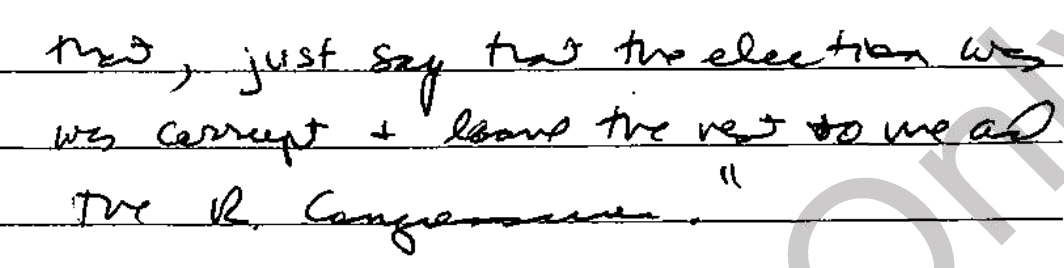
On December 27, 2020, Donald Trump told Richard Donoghue to announce that the election was corrupt.

“Leave the rest to me and the R Congressmen,” Trump said.

One of those Congressmen — one who had for weeks been inventing reasons for other Republican Congressmen to defy their oaths — was Mike Johnson.

NYT described Johnson’s role this way:

[I]n early December 2020, the Texas attorney general filed a long-shot appeal citing an array of unproven claims of fraud and other irregularities and asking the U.S. Supreme Court to invalidate the Pennsylvania results on similar constitutional grounds.

Mr. Johnson drafted a supporting brief that focused on the constitutional argument. As chairman of the Republican Study Committee, he pushed its members to sign the brief, and he also wrote an email to all Republican lawmakers warning in bold red letters that Mr. Trump would be tracking their response. “He said he will be anxiously awaiting the final list to review,” he wrote.

[snip]

The lawyer for the House Republican leadership told Mr. Johnson that his arguments were unconstitutional, according to three people involved in the conversations, and Ms. Cheney, also a lawyer, called the brief “embarrassing.” Mr. McCarthy, the Republican leader, told members that he refused to sign, the three people said.

Nonetheless, Mr. Johnson pushed ahead and filed the brief on Dec. 10 with 105 lawmakers as co-signers, and within a day he had added 20 more — including Mr. McCarthy. Later, at the caucus meeting on Jan. 5, 2021, Mr. Johnson suggested the signers, in effect, had signaled their support for declaring “constitutional infirmity” as grounds for objecting. Most of the signers did exactly that.

In the days leading up to January 6, he invented a reason beyond voter fraud not to do what the Constitution requires.

In formal statements justifying their votes, about three-quarters relied on the arguments of a low-profile Louisiana congressman, Representative Mike Johnson, the most important architect of the Electoral College objections.

On the eve of the Jan. 6 votes, he presented colleagues with what he called a “third option.” He faulted the way some states had changed voting procedures during the pandemic, saying it was unconstitutional, without supporting the outlandish claims of Mr. Trump’s most vocal supporters. His Republican critics called it a Trojan horse that allowed lawmakers to vote with the president while hiding behind a more defensible case.

On Monday night, Trump said something similar as what he said to Richard Donoghue, but he said it publicly. He told supporters in New Hampshire that they don’t have to vote, they only have to watch what sounds like vote counters.

You got to get out there and you got to watch those voters. You don’t have to vote. Don’t worry about voting. The voting, we got plenty of votes. You got to watch election night.

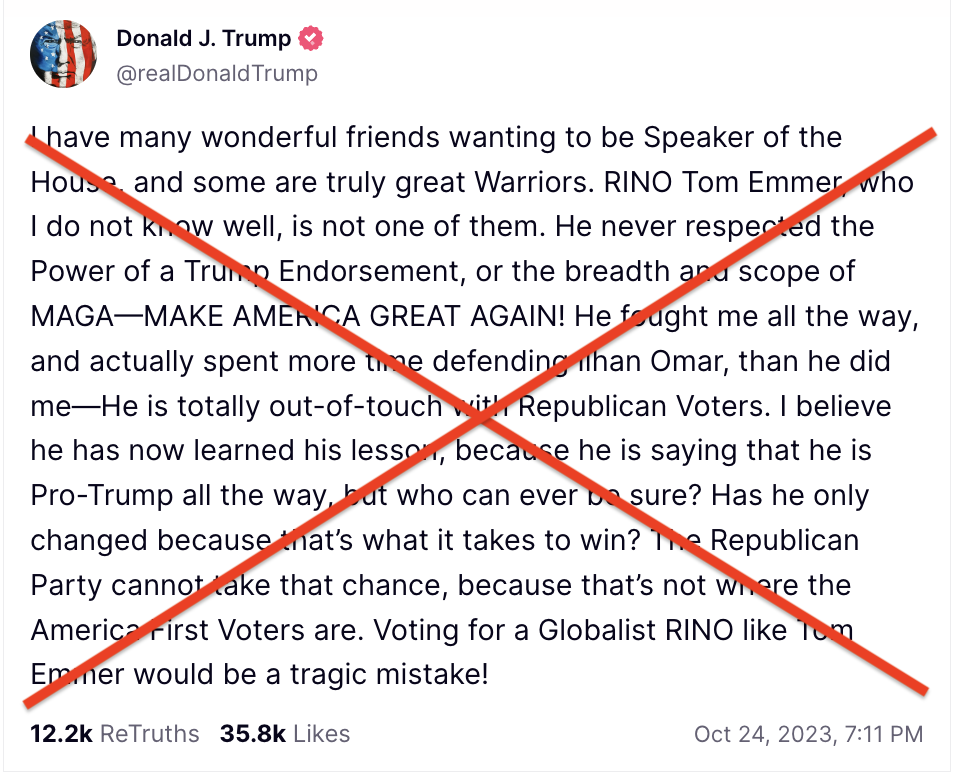
The next day, Matt Gaetz first shepherded Tom Emmer’s nomination to be Speaker, then let Trump destroy his candidacy by Tweet (Trump’s return to his fraud trial was delayed slightly, and this post came out while he was in the courtroom).

By the end of the evening, Johnson had been picked as the next man to try to get 217 votes.

When a reporter asked Johnson, at the gleeful presser afterwards, about his role in leading efforts to overturn the results of the 2020 election, everyone booed, he simply shook his head, and called for the next question.

It remains the case that no vote in these caucus meetings have generated the total votes necessary to win. Politico reported that 44 of those present didn’t vote for either candidates, and the total votes case were only 201: still less than Hakeem Jeffries will get.

Republicans went back to the drawing board, and made Johnson the latest aspirant to a position the fractured and exhausted conference can’t seem to fill. He beat out a field of four other candidates, including Byron Donalds, in the final ballot by a 128 to 29 vote. Some 44 other Republicans didn’t vote for either of the two men.

But it increasingly looks like this process of picking a Speaker is a process designed to oust those who did support their oaths on January 6 and replace them with people who could find excuses to pick Donald Trump in 2025.

Update: The first round, via secret ballot, is where Johnson only got 128 votes. He would have gotten around 198 in a later public vote.

He won only 128 votes, defeating Rep. Byron Donalds (R-Fla.), who won 29 votes. But 44 Republicans voted for other candidates — including 43 who voted for McCarthy, according to notes taken by Rep. Randy Weber (R-Tex.).

But Johnson did far better in a roll-call vote late Tuesday night in which House Republicans voted by name instead of by secret ballot. Just three lawmakers voted “present” and about 20 were absent, according to two lawmakers. The rest backed Johnson.


Cautions on ABC’s Huge Mark Meadows Scoop

For more than six months, access journalists in DC have been trying to confirm how much Mark Meadows cooperated with Jack Smith.

Today, ABC has a huge scoop reporting that Meadows testified at least three times, one time — before a grand jury — with immunity.

Former President Donald Trump’s final chief of staff in the White House, Mark Meadows, has spoken with special counsel Jack Smith’s team at least three times this year, including once before a federal grand jury, which came only after Smith granted Meadows immunity to testify under oath, according to sources familiar with the matter.

Click through to read the details — ABC has earned the clicks.

But I caution against concluding too much about what the testimony means. Most importantly, there’s no hint that Meadows has flipped. Meadows has testified (which a past ABC scoop made clear). But giving immunized testimony is not flipping, and the two ABC stories raise far more questions about the story Meadows has told.

I say that for several reasons. First, ABC doesn’t describe the dates for any of his interviews. I’ll return to that, but it’s important that ABC doesn’t reveal whether Meadows’ testimony to Jack Smith precedes or postdates the Georgia indictment and subsequent failure to get the Georgia indictment removed to Federal courts. An earlier big ABC scoop describes April grand jury testimony, and it’s not clear that this would be a different time frame or grand jury appearance.

I offer cautions, as well, because virtually all of ABC’s reporting says that Meadows was asked not about what Trump did on a given day, but whether Meadows believed what Meadows had said publicly. Here’s an example.

Sources told ABC News that Smith’s investigators were keenly interested in questioning Meadows about election-related conversations he had with Trump during his final months in office, and whether Meadows actually believed some of the claims he included in a book he published after Trump left office — a book that promised to “correct the record” on Trump.

Again, click through to see how much of the rest is of the same sort.

As I noted in my post on that prior big ABC scoop, there are still loads of details — especially about January 6 — missing from the public timeline that Meadows surely knows.

There’s a lot that’s missing here — most notably Meadows’ coordination with Congress and any efforts to coordinate with Mike Flynn and Roger Stone’s efforts more closely tied to the insurrection and abandoned efforts to deploy the National Guard to protect Trump’s mob as it walked to congress. Unless those actions get added to charges quickly, Meadows will be able to argue, in Georgia, that his actions complied with federal law without having to address them. If and when they do get charged in DC, I’m sure Meadows’ attorneys hope, his criminal exposure in Georgia will be resolved.

Importantly, that earlier ABC scoop served to signal co-conspirators how Meadows changed his testimony after prosecutors obtained proof his claims about his ghost-writers — the same ghost-writers whose book remains at the center of ABC’s scoop! — were proven wrong by further evidence.

That story suggested Meadows was only going to be as truthful as evidence presented to him required him to be.

And this story is of the same type. It describes how, as he did in the stolen documents case, Meadows said he didn’t believe what he wrote when it was legally necessary.

Finally, that post also lays out that the narrative told in the DC indictment, while useful for Jack Smith, is different than the narrative told by Fani Willis, where Mark Meadows has not given cooperative testimony. The right column (his story to Jack Smith) in this table is helpful for Jack Smith, but probably not true; the left column (where he didn’t cooperate) is more damning.

Meadows team recites the alleged Georgia acts as Judge Jones has characterized them on page 19 and then directly quotes the references to Meadows in the federal indictment on page 26. It helps to read them a table together:

There’s an arc here. The early acts in both indictments might be deemed legal information gathering. After that, in early December, Meadows takes two actions, one alleged in Georgia and the other federally, both of which put him clearly in the role of a conspirator, neither of which explicitly involves Trump as charged in the Georgia indictment. Meadows:

  • Asks Johnny McEntee for a memo on how to obstruct the vote certification
  • Orders the campaign to ensure someone is coordinating the fake electors

The events on December 22 and 23, across the two indictments, are telling. Meadows flies to Georgia and, per the Georgia indictment, attempts to but fails to access restricted areas. Then he flies back to DC and, per the federal indictment, tells Trump everything is being done diligently. Then Meadows arranges and participates in another call. Both in a tweet on December 22 and a call on December 23, Trump pressures Georgia officials again. For DOJ’s purposes, the Tweet is going to be more important, whereas for Georgia’s purposes, the call is more important. But with regards his argument for removal and dismissal, Meadows would argue that he used his close access to advise Trump that Georgia was proceeding diligently.

On December 27, Meadows calls and offers to use campaign funds to ensure the signature validation is done by January 6. This was not Meadows arranging a call so Trump could make the offer himself, it was Meadows doing it himself, likely on behalf of Trump, doing something for the campaign, not the country.

On January 2, Meadows participates in the Raffensperger call, first setting it up then intervening to try to find agreement, but then ultimately pressuring state officials not so much to just give Trump the votes he needs, which was Trump’s ask, but to turn over state data.

Meadows: Mr. President. This is Mark. It sounds like we’ve got two different sides agreeing that we can look at these areas ands I assume that we can do that within the next 24 to 48 hours to go ahead and get that reconciled so that we can look at the two claims and making sure that we get the access to the secretary of state’s data to either validate or invalidate the claims that have been made. Is that correct?

Germany: No, that’s not what I said. I’m happy to have our lawyers sit down with Kurt and the lawyers on that side and explain to my him, here’s, based on what we’ve looked at so far, here’s how we know this is wrong, this is wrong, this is wrong, this is wrong, this is wrong.

Meadows: So what you’re saying, Ryan, let me let me make sure … so what you’re saying is you really don’t want to give access to the data. You just want to make another case on why the lawsuit is wrong?

Meadows was pressuring a Georgia official, sure, but to do something other than what Trump was pressuring Raffensperger to do. His single lie (he was charged for lying on the call separately from the RICO charge), one Willis might prove by pointing to the overt act from the federal indictment on December 3, when Jason Miller told Meadows that the number of dead voters was not 10,000, but twelve, is his promise that Georgia’s investigation has not found all the dead voters.

I can tell you say they were only two dead people who would vote. I can promise you there were more than that. And that may be what your investigation shows, but I can promise you there were more than that.

But even there, two is not twelve. Meadows will be able to challenge the claim that he lied, as opposed to facilitated, as Chief of Staff, Trump’s lies.

Finally, in an overt act not included in the Georgia indictment, Meadows is among the people on January 6 who (the federal indictment alleges) attempted to convince Trump to call off the mob.

There’s a lot that’s missing here — most notably Meadows’ coordination with Congress and any efforts to coordinate with Mike Flynn and Roger Stone’s efforts more closely tied to the insurrection and abandoned efforts to deploy the National Guard to protect Trump’s mob as it walked to congress. Unless those actions get added to charges quickly, Meadows will be able to argue, in Georgia, that his actions complied with federal law without having to address them. If and when they do get charged in DC, I’m sure Meadows’ attorneys hope, his criminal exposure in Georgia will be resolved.

Of what’s included here, those early December actions — the instruction to Johnny McEntee to find some way to obstruct the January 6 vote certification and the order that someone coordinate fake electors — are most damning. That, plus the offer to use campaign funds to accelerate the signature match, all involve doing campaign work in his role as Chief of Staff. For the federal actions, Jack Smith might just slap Meadows with a Hatch Act charge and end the removal question — but that might not help him, Jack Smith, make his case, because several parts of his indictment rely on exchanges Meadows had privately with Trump, and Meadows is a better witness if he hasn’t been charged with a crime.

Aside from those, Meadows might argue — indeed, his lawyers may well have argued to Jack Smith to avoid being named as a co-conspirator — that his efforts consistently entailed collecting data which he used to try to persuade the then-President, using his access as a close advisor, to adopt other methods to pursue his electoral challenges. Meadows’ lawyers may well have argued that several things marked his affirmative effort to leave the federally-charged conspiracies. In this removal proceeding, I expect Meadows will argue that his actions on the Raffensperger call were an attempt, like several others, to collect more data to use his close access as an advisor to better persuade the then-President to drop the means by which he was challenging the vote outcome.

The point being, that before Fani Willis indicted Mark Meadows, Meadows had found a story that was going to work. And now, that story doesn’t work anymore.

Which is why the timing of Meadows’ immunized testimony to a grand jury and the timing of this scoop matters. His January 6 testimony seems to conflict with what Willis knows. This paragraph, from today’s big ABC scoop, is even less credible than stuff in the indictments.

However, according to what Meadows told investigators, Trump seemed to grow increasingly concerned as he learned more about what was transpiring at the Capitol, and Trump was visibly shaken when he heard that someone had been shot there, sources said.

If the two versions of Meadows story have started to obviously conflict, he’s may be doing some soul searching about whether he wants to go the way of Sidney Powell and Ken Chesebro and Jenna Ellis, who sent 350 texts with Meadows.

And before he does that soul searching, he’s going to want to signal to others what he has said, to test how valuable it is for him to continue to say it.


25-3=22: Diminishing Representations

Less than a day after Sidney Powell pleaded guilty in Georgia, but before he made his curious comments that she would be conflicted from representing him, Trump responded to DOJ’s bid to require him to reveal any advice of counsel defense by mid-December, when trial exhibits are due.

In the DOJ motion, they claimed that Trump knew what had been withheld from DOJ under privilege claims.

[T]he defendant knows what information the Government has—and does not have—that might support or undermine the defense. The Government produced in discovery the privilege logs for each witness who withheld material on the basis of a claim of privilege on behalf of the defendant or his campaign, and in some cases the defendant’s campaign was directly involved in discussions regarding privilege during the course of the investigation. In other instances, the Government produced court orders requiring the production of material claimed to be privileged. Compelling the defendant to provide notice, and thereby discovery, would be reciprocal of what the Government already has produced. For example, defense counsel publicly identified one attorney on whose advice the defense intends to rely at trial, and the Government has produced in discovery substantial evidence regarding that attorney and his advice, including relevant search warrant returns.8 Any material relevant to that attorney’s advice that remains shielded by the attorney-client privilege should be produced to the Government at the earliest date to avoid disruption of the trial schedule.

8 That same attorney asserted an attorney-client privilege with the defendant and his campaign to shield material from disclosure to Congress. See Eastman v. Thompson, Case No. 8:22-cv-00099 (C.D. Cal.), ECF No. 260 at 15 (“The evidence clearly supports an attorney-client relationship between President Trump, his campaign, and [plaintiff] during January 4-7, 2021.”).

Trump appears to disagree with DOJ’s claim that he knows the universe of materials withheld on privilege grounds. He wants DOJ to share with him everything that DOJ knows about over which a privilege claim has been made.

He even suggests that some of these 25 people, potentially including Powell, were not claiming his was the privilege they were protecting.

The prosecution claims that 25 witnesses have invoked privilege. Presumably, the prosecution also received privilege logs or other privilege invocations in response to document requests. The prosecution should be required to disclose these 25 witnesses, along with all of the logs in which the prosecution is interested. At this time, defense counsel has not been able to fully review the voluminous discovery in this matter, which is indeed impossible within the schedule set by the Court.

At a minimum, the prosecution should (1) identify all materials within their discovery production that they assert are attorney-client privileged information, work product, or are otherwise protected; (2) describe the basis for the assertion that the materials are protected and who holds the privilege with respect to those materials; (3) identify the 25 witnesses referenced in the motion, or any other witnesses, that have asserted the attorney-client privilege or who the prosecution believes possess attorney-client privileged information; and (4) identify all materials not within their discovery production that they believe the defense would be required to produce regarding an advice of counsel defense, including the source of the materials.

His filing even made an obscure comment, taunting that DOJ would need to turn over “what it recovers” from previously privileged witnesses and records.

6 The prosecution does not seem to recognize that if the defense produces privileged discovery, the prosecution then has an obligation to produce what it recovers from its investigation of the previously privileged witnesses and records.

That was Friday. Also on Friday, Kenneth Chesebro pled guilty in Georgia. And Jenna Ellis has (unsurprisingly, given that Trump refused to pay for her defense) also pled guilty.

Just for reference, here are the privilege logs that Rudy and Bernie Kerik submitted in the Ruby Freeman case; between the two of them, Jenna appears over 150 times, including on a bunch of Dominion-related communications.

There were clearly 25 lawyers in the know. But Trump seems to have some doubts whether he knows who those lawyers were representing.

As more of them plead guilty, he may have more urgency in wanting to learn the full details of their privilege claims.

Update: Folks are disputing how useful Jenna will be as a cooperating witness. I agree with NYT: she’s more valuable than Ken Chesebro, and possibly even than Sidney Powell.

Here are the people that she at first tried to claim privilege over with the January 6 Committee, only to invoke the Fifth Amendment:


Trump’s Motions to Dismiss Things That Aren’t the Charges Against Him

Last night, Trump just met the deadline for filing motions to dismiss his January 6 indictment.

I’m going to lay out what he filed. I’ll review them at length in follow-ups. Here’s a handy table to understand them.

Motion to Dismiss on Constitutional Grounds: This 31-page motion cites Mollie “Federalist Faceplant” Hemingway. But it doesn’t actually mention the charges in the indictment. Having not described how his (and his fake electors’) false claims were charged as conspiracy to defraud the government, having not explained how orders to Mike Pence and the incitement of his mob obstructed the vote certification, having not acknowledged efforts to reverse vote counts in the states, Trump then claims he’s being prosecuted for First Amendment protected speech.

In a section that significantly overlaps with his Motion to Dismiss on Absolute Immunity grounds, Trump claims the failed January 6 impeachment prevents him from being tried on substantially different crimes.

Motion to Dismiss on Statutory Grounds: This filing moves to dismiss the indictment for failure to state a claim, a motion similar to dozens if not hundreds that have failed for January 6 defendants.

Trump moves to dimiss the 18 USC 371 charge against him because, he claims, all the lying alleged in the indictment (which he all but concedes was false in the MTD on Constitutional Grounds) didn’t involve deceit. He even argues that because there was “a clear difference in form” in the fake electors submitted to NARA, no deceit (or forgery) was involved!

Interestingly, Trump says that his false statements to Congress under 18 USC 1001 (which, he notes, was not charged) would be exempted as advocacy. This ignores the abundant litigation finding the vote certification to be an official proceeding.

Trump’s challenge to 18 USC 1512(c)(2) largely involves completely misrepresenting the finding of Robertson, which I wrote about here. I don’t think Trump even engages with the “otherwise illegal” standard applied to Thomas Robertson. He definitely doesn’t engage with the standard that right wing judges want to adopt: unlawful personal benefit.

Trump’s attack on 18 USC 241 is particularly curious. In spite of the fact that his own DOJ was taking actions against false election claims online in 2020, he argues there was no court decision, in 2020, saying that it would be illegal (the Douglass Mackey prosecution, charged by a guy who had been one of the Bill Barr’s top deputies, has since done so). More curiously, Trump doesn’t even seem to understand that all his other attempts to prevent Joe Biden votes from being counted are also overt acts that support this prosecution.

Motion to Dismiss for Selective and Vindictive Prosecution: This is mostly a political document. It points to the scant evidence that Joe Biden was behind this prosecution. It claims that this indictment was retaliation for Trump’s complaints about his stolen document indictment. He cites his own attacks on Hunter Biden (citing Congressional press announcements, not any of his own posts, though he does include two of his own other posts on more general attacks), including one that post-dates this indictment (which was charged on August 1).

4 See Hunter Biden, Burisma, and Corruption: The Impact on U.S. Government Policy and Related Concerns, U.S. Senate Comm. on Homeland Security and Government Affairs and U.S. Senate Comm. on Finance (Sept. 22, 2020), https://www.hsgac.senate.gov/wpcontent/uploads/imo/media/doc/HSGAC_Finance_Report_FINAL.pdf, at 3.

5 See Second Bank Records Memorandum from the Oversight Committee’s Investigation into the Biden Family’s Influence Peddling and Business Schemes, House of Rep. Comm. on Oversight and Accountability (May 10, 2023), https://oversight.house.gov/wpcontent/uploads/2023/05/Bank-Memorandum-5.10.23.pdf, at 5, 9.

6 See Third Bank Records Memorandum from the Oversight Committee’s Investigation into the Biden Family’s Influence Peddling and Business Schemes, House of Rep. Comm. on Oversight and Accountability (Aug. 9, 2023), https://oversight.house.gov/wpcontent/uploads/2023/08/Third-Bank-Records-Memorandum_Redacted.pdf, at 2. [my emphasis]

This ploy is interesting, given the likelihood that Hunter Biden will file a parallel selective prosecution motion.

He also cites two articles showing that Garland didn’t open an investigation into Trump right away as proof that he was unfairly targeted. I suspect Trump may try to call Steve D’Antuono, whose actions are described in one of them (the famous and problematic Carol Leonnig story), to talk about his own resistance to opening the investigation. This motion doesn’t do the least amount of things it’d need to do to actually get a hearing (in part because the evidence all shows the opposite of what Trump claims). But he would have fun if he somehow did get a hearing (and if he does not but Hunter does, he’ll use Hunter’s efforts to renew the demand).

Motion to Strike Inflammatory Allegations: This is an attempt to eliminate the language in the indictment showing how Trump mobilized his mob because he isn’t charged with mobilizing the mob (as DOJ already laid out, that is one of the means by which he obstructed the vote certification). This is likely tactical, an attempt to remove one of the primary means by which he obstructed the vote certification to make his 18 USC 1512(c)(2) argument less flimsy.


Trump’s First Amendment Defense of Mobilizing His Violent Mob

There’s a move in Trump’s motion for a stay pending appeal of the gag order Judge Tanya Chutkan imposed that deserves more attention.

Trump appealed the gag last Tuesday and requested the stay on Thursday, about which Judge Chutkan ordered additional briefing that same day; we’ll see more briefing about this all week.

MINUTE ORDER as to DONALD J. TRUMP: Upon consideration of Defendant’s opposed 110 Motion for Stay Pending Appeal, Request for Temporary Administrative Stay, and Memorandum in Support, it is hereby ORDERED that the court’s 105 Opinion and Order is administratively STAYED to permit the parties’ briefing and the court’s consideration of Defendant’s Motion. It is FURTHER ORDERED that the government shall file any opposition to Defendant’s Motion by October 25, 2023, and that Defendant shall file any Reply by October 28, 2023.

A substantial portion of the 33-page motion speaks for the First Amendment rights of his mob to hear, respond to, and amplify Trump’s speech. To defend this principle, Trump cites, among other things, the Missouri v. Biden that SCOTUS just agreed to review over the objections of Sam Alito, Clarence Thomas, and Neil Gorsuch.

Under the First Amendment, violating the rights of a speaker inflicts an equal and reciprocal constitutional injury on the listener. “Freedom of speech presupposes a willing speaker. But where a speaker exists, . . . the protection afforded is to the communication, to its source and to its recipients both.” Virginia State Bd. of Pharmacy v. Virginia Citizens Consumer Council, Inc., 425 U.S. 748, 756 (1976) (emphasis added) (collecting many cases); see also, e.g., Red Lion Broadcasting Co. v. F.C.C., 395 U.S. 367, 390 (1969) (“It is the right of the viewers and listeners, not the right of the broadcasters, which is paramount.”); Packingham v. North Carolina, 582 U.S. 98, 104 (2017) (recognizing the right to “speak and listen, and then … speak and listen once more,” as a “fundamental principle of the First Amendment”); Missouri v. Biden, — F.4th –, No. 23- 30445, 2023 WL 6425697, at *11 (5th Cir. Oct. 3, 2023) (holding that the “right to listen is ‘reciprocal’ to the … right to speak” and “constitutes an independent basis” for relief). Thus, injuring President Trump’s ability to speak injures the First Amendment rights of over 100 million Americans who listen to him, respond to him, and amplify his message.

The claim to have 100 million listeners is a bit like calling his NY penthouse 33,000 square feet, insofar as it relies on overlapping numbers, including the 87 million followers he has but does not tweet to on Xitter.

Trump necessarily dedicates a very long footnote to explaining how he has standing to appeal this gag on behalf of his mob.

3 President Trump unquestionably has third-party standing to defend the rights of his audiences in this context. The Supreme Court is “quite forgiving” of third-party standing requirements “[w]ithin the context of the First Amendment.” Kowalski v. Tesmer, 543 U.S. 125, 130 (2004). The First Amendment’s overbreadth doctrine, for example, relieves the third-party plaintiff of the burden to show the usual “close relationship” and “hindrance” required by the third-party standing doctrine, id.; instead, Article III injury is all that is required. See id.; United States v. Sineneng-Smith, 140 S. Ct. 1575, 1586 (2020) (Thomas, J., concurring) (“Litigants raising overbreadth challenges rarely satisfy either requirement [‘close relationship’ and ‘hindrance’], but the Court nevertheless allows third-party standing.”) (citing Dombroski v. Pfister, 380 U.S. 479, 487 (1965)); N.J. Bankers Ass’n v. Att’y Gen., 49 F.4th 849, 860 (3d Cir. 2022) (noting that “the requirement that an impediment exist to the third party asserting his . . . own rights” does not apply when the challenged government action “substantially abridges the First Amendment rights of other parties not before the court”). Further, as the Supreme Court held in Bantam Books Inc. v. Sullivan, it is particularly important to allow third-party standing to vindicate First Amendment interests because “freedoms of expression … are vulnerable to gravely damaging yet barely visible encroachments” and must be protected by “the most rigorous procedural safeguards.” 372 U.S. 58, 66 (1963); see also id. at 64 n.6 (upholding the third-party standing of book publishers to assert the rights of distributors because “[t]he distributor … is not likely to sustain sufficient economic injury to induce him to seek judicial vindication of his rights,” whereas the seller has a “greater . . . stake” in vindicating those rights). In addition, the doctrine of third-party standing applies “when enforcement of the challenged restriction against the litigant would result indirectly in the violation of third parties’ rights.” Kowalski, 543 U.S. at 130. Here, the interference and restriction of President Trump’s First Amendment rights “would result indirectly in the violation of third parties’ rights,” id.—i.e., the rights of his audiences to receive, respond to, and amplify his speech.

I think this footnote is suspect, legally and practically. I mean, the notion that Stephen Miller’s NGO for fascism couldn’t vindicate these rights is nonsense. But it is nevertheless telling.

Trump makes that argument even while complaining that Judge Chutkan had to rely on the potential actions of others — that very same mob riled up by the amplified false victimization of Trump — to justify the gag itself.

Unable to justify the Gag Order based on President Trump’s actions, the prosecution pivots to third parties, alleging that unnamed others, outside of President Trump’s control, acted improperly before this case began. Such concerns cannot justify the Gag Order. The Supreme Court has repeatedly explained that citizens of this country cannot be censored based on a fear of what others might do. Brandenburg v. Ohio, 395 U.S. 444, 447 (1969) (“[T]he constitutional guarantees of free speech and free press do not permit a State to forbid or proscribe advocacy . . . except where such advocacy is directed to inciting or producing imminent lawless action and is likely to incite or produce such action.”).

[snip]

In entering the Gag Order, the Court relied heavily on the anticipated reactions of unidentified, independent third parties to President Trump’s speech. The Court found that “when Defendant has publicly attacked individuals, including on matters related to this case, those individuals are consequently threatened and harassed.” Id. at 2. But the Court cited no evidence that President Trump’s statements—as distinct from the statements of millions of others—caused such alleged threats or harassment, let alone that the statements were directed to inciting imminent lawless action.

Remember, Trump has repeatedly denied that the indictment accuses him of mobilizing the mob against Congress. Even after DOJ disabused Trump of that fantasy, he is playing coy about the fact that the crime he is alleged to have committed significantly involves riling up a mob to use as a weapon.

Indeed, Trump admits this is the plan to get elected: to rile up the mob again, this time by using this prosecution as a trigger.

The prosecution filed the indictment in this matter on August 1, 2023. Doc. 1. As this case is pending, President Trump continues to campaign for President, and one of his core messages is that the prosecutions against him are part of an unconstitutional strategy to attack and silence the Biden Administration’s chief political rival. To advance this message, President Trump has made many public statements criticizing individuals he believes are wrongly prosecuting him, including President Biden, Attorney General Garland, and Special Prosecutor Jack Smith and his team. This viewpoint—that the prosecution is politically motivated—is one shared by countless Americans.

[snip]

President Trump’s speech in support of his re-election campaign—which is inextricably intertwined with this prosecution and his defense—lies “at the core of our electoral process of the First Amendment freedoms—an area . . . where protection of robust discussion is at its zenith.” Meyer v. Grant, 486 U.S. 414, 425 (1988) (citations and quotations omitted); see also Buckley v. Am. Const. Law Found., Inc., 525 U.S. 182, 186–87 (1999); McIntyre v. Ohio Elec. Comm’n, 514 U.S. 334, 347 (1995) (“[C]ore political speech” encompasses any “advocacy of a politically controversial viewpoint.” “No form of speech is entitled to greater constitutional protection than” core political speech.).

Some of this is just cynicism: by claiming all this is political speech, Trump does base his appeal on the most expansive First Amendment precedent. The legal arguments here, some of them, anyway, are not frivolous.

But he’s not wrong about his campaign strategy. The key to Trump’s political success since he was sworn in was to polarize the electorate based off false claims that any investigation of Trump’s crimes is an attack on him and his mob.

And at one point, Trump’s argument admits that this is all an argument about democracy.

The Gag Order’s carve-outs exacerbate the vagueness problems by imposing new layers of confusion upon the Order. Doc. 105, at 3. The carve-outs seem to authorize “criticizing the government generally, including the current administration or the Department of Justice,” but that does not seem to include criticizing the most relevant figure of the Department of Justice, i.e., Jack Smith. Id. The carve-outs supposedly allow President Trump to state “that his prosecution is politically motivated,” but the Gag Order prevents him from “targeting” the specific actors involved in his prosecution, so it prevents him from giving any specific or detailed justification for this claim. Id. Where claiming that the prosecution is politically motivated ends, and “targeting” the prosecutors against President Trump begins, is anyone’s guess. The carve-outs apparently authorize “statements criticizing the platforms or policies of . . . former Vice President Pence,” id., but the “platforms or policies” of candidates like Pence (and Biden) are deeply intertwined with their views on election integrity, with specific reference to the 2020 election. When does criticism of Mike Pence’s “platforms or policies” become a statement “that target[s] . . . the substance of [his] testimony,” id., when questions about the integrity of the 2020 election are “central” to the 2024 Presidential campaign?

Joe Biden (comments about whom this gag does not restrict) is running on democracy. Mike Pence is running on defending the Constitution.

Trump is running on a promise that none of that matters: no election outcome — not that of 2020, not that of 2024 — should be respected, unless he wins.

And the way to ensure that happens, Trump knows, is to guard the right of his mob to amplify and respond to his false claims of victimization.

Copyright © 2026 emptywheel. All rights reserved.
Originally Posted @ https://www.emptywheel.net/january-6-insurrection/page/17/