
Jeanine Pirro Has a Black Powder Problem
At the hearing in accused pipe bomber Brian Cole’s case the other day, Magistrate Judge Matthew Sharbaugh ordered both sides to file their views about whether the indictment DOJ obtained against Cole from a Superior Court grand jury was valid; he ordered those filings to be posted to the public docket by end of business yesterday.
MINUTE ORDER as to BRIAN J. COLE, JR.: As discussed during today’s proceedings, the Court was presented yesterday afternoon with a two-count indictment in this case that was returned by a D.C. Superior Court grand jury, rather than a federal court grand jury. The indictment included the same two counts charged in the criminal complaint, namely 18 U.S.C. 844(d) and 844(i). In asking the Court to accept the indictment, the government invoked D.C. Code § 11-1916(a), which provides that “[a] grand jury serving in the District of Columbia may take cognizance of all matters brought before it regardless of whether an indictment is returnable in the Federal or District of Columbia courts.” The Court recognizes that Chief Judge Boasberg recently upheld the propriety of this approach based on that statute, concluding that Section 11-1916(a) authorizes local D.C. grand juries to return indictments in U.S. District Court (and vice versa). United States v. Stewart, 2025 WL 3237833 (Nov. 20, 2025). But Judge Boasberg then stayed that ruling pending appeal, stating in part that “the public interest lies in letting the Court of Appeals decide this issue before the Government moves forward both on this case and in similar fashion on other cases.” See Stewart, No. 25-mj-225, Order (Dec. 9, 2025). The Court yesterday deferred a decision on whether to accept the indictment pending further briefing from the parties on the question of whether Judge Boasberg’s stay order extends to the circumstances here. The parties were directed to submit briefing on that question, and the Court intends to issue a decision in short order on whether to accept the indictment as proposed. Meanwhile, the Court ORDERS that both sides shall file their respective briefs on the public docket by close of business on December 31, 2025. Either side may request redactions to their briefs the extent they believe it necessary, provided that the filing is accompanied by an appropriate motion to seal. SO ORDERED. Signed by Magistrate Judge Matthew J. Sharbaugh on 12/30/2025. [my emphasis]
According to Cole’s response, the government may have filed something under seal (I’m confused about the date here, because Cole’s response bears yesterday’s date, which would make the government filing, filed “yesterday,” on December 30).
Defendant Brian Cole Jr. respectfully submits this response in opposition to the government’s memorandum, filed late yesterday, December 29, 2025, asking this “Court [to] accept the indictment return,” referencing a document returned earlier that day not by a grand jury of this Court but rather by a grand jury organized by, and sitting at the behest of, the D.C. Superior Court. (Gov. Mem. at 7.)
But Jeanine Pirro went out partying last night before actually filing whatever they filed publicly.
And given the panic that Cole’s response describes, it suggests there may be real problems with the case.
The response provides the back story to their December 28 filing seeking to clarify that Tuesday’s hearing would include a probable cause inquiry.
On Christmas Eve, Cole’s attorneys asked prosecutors whether the December 30 hearing or whether they would indict before then.
We also need to know whether the government plans on holding a probabl[e] cause hearing on Tuesday [December 30, 2025]. We have received no information regarding an indictment and thus would like to know the government’s position on this. Please let us know by December 27, 2025.
Cole’s exasperated filing translated that inquiry this way: “Are you going to indict this case before next Tuesday?” [italics original].
The government used the holiday to stall almost two days, after which they asserted that the hearing would deal only with detention.
Tuesday’s hearing is a detention hearing under 18 U.S.C. § 3142(f). The government will be proceeding by proffer.
As Cole’s filing describes, nothing about that response made sense.
In this context, two options seemed likely: (1) the government had tried and failed to secure an indictment; or (2) it was still planning to obtain an indictment from the federal grand jury on Monday. To that end, Mr. Williams quickly wrote back:
Also, please tell us whether the government has sought an indictment before a grand jury on the charges against Brian Cole Jr. If an indictment was sought before a grand jury, we are requesting all documents demonstrating the outcome of the grand jury. For example, if a “No Bill” was rendered by the grand jury on Brian Cole Jr’s charges, please provide us with that. Please provide us with this documentation prior to this Monday.
On December 28 (that is, the day Cole’s attorneys filed that motion to clarify), AUSA Charles Jones responded that no grand jury was sitting after December 19, which surely he knew in real time.
As John [Shoreman] indicated below, the parties have not yet scheduled a Rule 5.1 preliminary hearing given the defense’s request to continue the December 15 detention hearing (at which we would typically have scheduled the preliminary hearing). Please let me know if you have a view on when to schedule that hearing.
Had there been a “no bill” in this matter, we would have promptly reported it to the Court pursuant to FRCP 6(f).[2] The government has not yet sought a grand jury indictment in this case given the defense’s request to continue the detention hearing and your agreement to exclude time under the Speedy Trial Act’s 30-day indictment deadline. Additionally, there are no sitting grand juries in D.C. District Court between 12/19 and 1/5.
Which Cole’s attorneys used to note that the FBI was surveilling Cole for a good deal of time before they arrested him.
2 The government must only make the report of a “No True Bill” under Fed. R. Crim. P. 6(f) “[i]f a complaint or information is pending against the defendant,” so the government’s response does not say whether it sought (and failed to receive) such an indictment prior to Mr. Cole’s arrest. From discovery, the defense team is aware that federal agents had placed the defendant under surveillance for a long period of time before his arrest, suggesting again that they had plenty of time to seek an indictment.
Cole’s team wonders whether they tried and failed to indict Cole; I repeat my observation that they did this last minute, in such a way that they would be unable to prosecute others.
This is when the filing gets a bit comical.
They translate what this means, again.
In turn, defense counsel finally had the answer to the question they had asked four days earlier: No, the government is not going to indict this case before next Tuesday. This meant, based on a plain reading of the relevant federal Rules and statutes, that there would have to be a preliminary or Mr. Cole would be released without conditions. [italics original, again]
In real time, Cole’s lawyers offered to forgo the probable cause inquiry if prosecutors would release him on bail.
(1) “We can exchange dates for the preliminary hearing;” and (2) “[W]ould the government be interested in waiving the preliminary hearing in exchange for bail under a strict set of agreeable conditions placed on Mr. Cole?”
That’s when Jones got obstinate: No release, no probable cause hearing until January 7.
23. About 20 minutes later, the government responded on these two points by writing: (1) “Would the afternoon on January 7 or January 8 work for a preliminary hearing?”; and (2) “We’re not willing to agree to release under conditions in exchange
Cole’s lawyers were not that stupid, as they describe.
Given that a federal grand jury would reconvene on January 6, 2025, it would have been malpractice for defense counsel to agree to delay the preliminary hearing again until a date as late as January 7, 2026.
Jones went silent, so Cole’s lawyers flew out a witness who — they reportedly said during the hearing the other day — would have testified that the pipe bombs would not have exploded. They also noted what I did: neither the arrest affidavit nor the detention memo presented any evidence that Cole bought black powder or the potassium nitrate that he allegedly told them he used to make it.
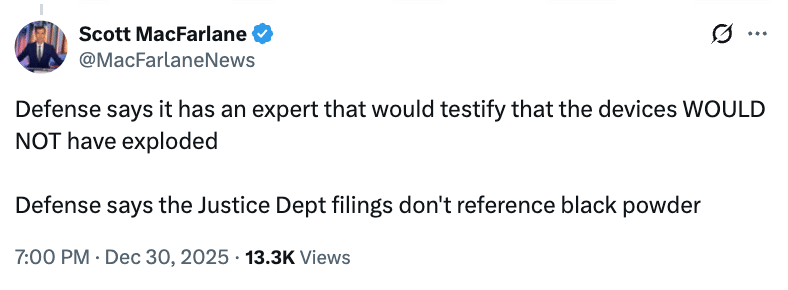
If these weren’t bombs, they might not be able to charge Cole under the existing statute, and if they can’t, then the statute of limitations might run before a grand jury is seated to indict Cole with something else.
And in the government’s (apparently still sealed) filing, they try to blame Cole for adhering to Federal Rules of Criminal Procedure.
34. This is not hyperbole. The government admits as much, stating that it “would have sought [] an early indictment from a federal grand jury panel had there been any indication that the defense, contrary to all indications, intended to pursue a preliminary hearing on December 30, 2025.” In other words, the government expected defense counsel to drop the ball.3 That is not “changed circumstances.”
3 The government does not proffer any reason why competent defense counsel would agree to forego a preliminary hearing in the absence of receiving some benefit, such as an agreement to release the defendant from custody. That is because there is none—making the government’s purported reliance on this “indication[]” entirely unreasonable.
For what it’s worth, I think the government’s location data is also likely to be aggressively challenged.
But it sounds like the government also understands they’ve got a hole in their case where the actual explosives are supposed to be.