Posts

Jeanine Pirro Has a Black Powder Problem

At the hearing in accused pipe bomber Brian Cole’s case the other day, Magistrate Judge Matthew Sharbaugh ordered both sides to file their views about whether the indictment DOJ obtained against Cole from a Superior Court grand jury was valid; he ordered those filings to be posted to the public docket by end of business yesterday.

MINUTE ORDER as to BRIAN J. COLE, JR.: As discussed during today’s proceedings, the Court was presented yesterday afternoon with a two-count indictment in this case that was returned by a D.C. Superior Court grand jury, rather than a federal court grand jury. The indictment included the same two counts charged in the criminal complaint, namely 18 U.S.C. 844(d) and 844(i). In asking the Court to accept the indictment, the government invoked D.C. Code § 11-1916(a), which provides that “[a] grand jury serving in the District of Columbia may take cognizance of all matters brought before it regardless of whether an indictment is returnable in the Federal or District of Columbia courts.” The Court recognizes that Chief Judge Boasberg recently upheld the propriety of this approach based on that statute, concluding that Section 11-1916(a) authorizes local D.C. grand juries to return indictments in U.S. District Court (and vice versa). United States v. Stewart, 2025 WL 3237833 (Nov. 20, 2025). But Judge Boasberg then stayed that ruling pending appeal, stating in part that “the public interest lies in letting the Court of Appeals decide this issue before the Government moves forward both on this case and in similar fashion on other cases.” See Stewart, No. 25-mj-225, Order (Dec. 9, 2025). The Court yesterday deferred a decision on whether to accept the indictment pending further briefing from the parties on the question of whether Judge Boasberg’s stay order extends to the circumstances here. The parties were directed to submit briefing on that question, and the Court intends to issue a decision in short order on whether to accept the indictment as proposed. Meanwhile, the Court ORDERS that both sides shall file their respective briefs on the public docket by close of business on December 31, 2025. Either side may request redactions to their briefs the extent they believe it necessary, provided that the filing is accompanied by an appropriate motion to seal. SO ORDERED. Signed by Magistrate Judge Matthew J. Sharbaugh on 12/30/2025. [my emphasis]

According to Cole’s response, the government may have filed something under seal (I’m confused about the date here, because Cole’s response bears yesterday’s date, which would make the government filing, filed “yesterday,” on December 30).

Defendant Brian Cole Jr. respectfully submits this response in opposition to the government’s memorandum, filed late yesterday, December 29, 2025, asking this “Court [to] accept the indictment return,” referencing a document returned earlier that day not by a grand jury of this Court but rather by a grand jury organized by, and sitting at the behest of, the D.C. Superior Court. (Gov. Mem. at 7.)

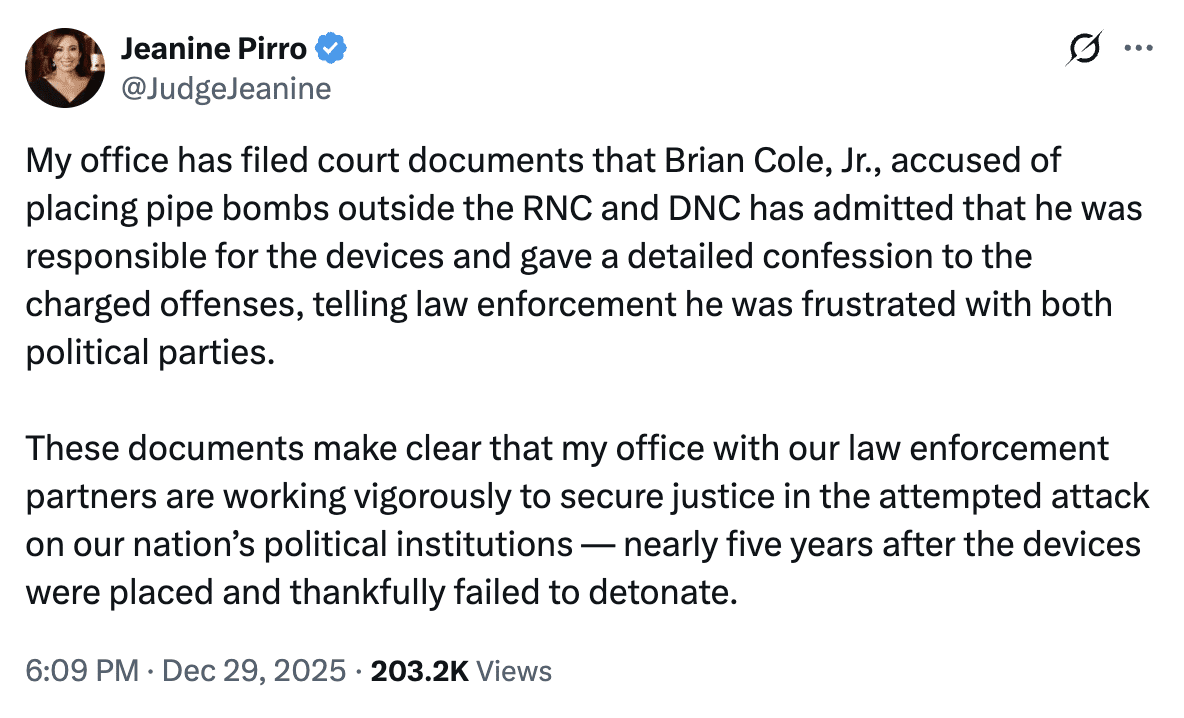
But Jeanine Pirro went out partying last night before actually filing whatever they filed publicly.

And given the panic that Cole’s response describes, it suggests there may be real problems with the case.

The response provides the back story to their December 28 filing seeking to clarify that Tuesday’s hearing would include a probable cause inquiry.

On Christmas Eve, Cole’s attorneys asked prosecutors whether the December 30 hearing or whether they would indict before then.

We also need to know whether the government plans on holding a probabl[e] cause hearing on Tuesday [December 30, 2025]. We have received no information regarding an indictment and thus would like to know the government’s position on this. Please let us know by December 27, 2025.

Cole’s exasperated filing translated that inquiry this way: “Are you going to indict this case before next Tuesday?” [italics original].

The government used the holiday to stall almost two days, after which they asserted that the hearing would deal only with detention.

Tuesday’s hearing is a detention hearing under 18 U.S.C. § 3142(f). The government will be proceeding by proffer.

As Cole’s filing describes, nothing about that response made sense.

In this context, two options seemed likely: (1) the government had tried and failed to secure an indictment; or (2) it was still planning to obtain an indictment from the federal grand jury on Monday. To that end, Mr. Williams quickly wrote back:

Also, please tell us whether the government has sought an indictment before a grand jury on the charges against Brian Cole Jr. If an indictment was sought before a grand jury, we are requesting all documents demonstrating the outcome of the grand jury. For example, if a “No Bill” was rendered by the grand jury on Brian Cole Jr’s charges, please provide us with that. Please provide us with this documentation prior to this Monday.

On December 28 (that is, the day Cole’s attorneys filed that motion to clarify), AUSA Charles Jones responded that no grand jury was sitting after December 19, which surely he knew in real time.

As John [Shoreman] indicated below, the parties have not yet scheduled a Rule 5.1 preliminary hearing given the defense’s request to continue the December 15 detention hearing (at which we would typically have scheduled the preliminary hearing). Please let me know if you have a view on when to schedule that hearing.

Had there been a “no bill” in this matter, we would have promptly reported it to the Court pursuant to FRCP 6(f).[2] The government has not yet sought a grand jury indictment in this case given the defense’s request to continue the detention hearing and your agreement to exclude time under the Speedy Trial Act’s 30-day indictment deadline. Additionally, there are no sitting grand juries in D.C. District Court between 12/19 and 1/5.

Which Cole’s attorneys used to note that the FBI was surveilling Cole for a good deal of time before they arrested him.

2 The government must only make the report of a “No True Bill” under Fed. R. Crim. P. 6(f) “[i]f a complaint or information is pending against the defendant,” so the government’s response does not say whether it sought (and failed to receive) such an indictment prior to Mr. Cole’s arrest. From discovery, the defense team is aware that federal agents had placed the defendant under surveillance for a long period of time before his arrest, suggesting again that they had plenty of time to seek an indictment.

Cole’s team wonders whether they tried and failed to indict Cole; I repeat my observation that they did this last minute, in such a way that they would be unable to prosecute others.

This is when the filing gets a bit comical.

They translate what this means, again.

In turn, defense counsel finally had the answer to the question they had asked four days earlier: No, the government is not going to indict this case before next Tuesday. This meant, based on a plain reading of the relevant federal Rules and statutes, that there would have to be a preliminary or Mr. Cole would be released without conditions. [italics original, again]

In real time, Cole’s lawyers offered to forgo the probable cause inquiry if prosecutors would release him on bail.

(1) “We can exchange dates for the preliminary hearing;” and (2) “[W]ould the government be interested in waiving the preliminary hearing in exchange for bail under a strict set of agreeable conditions placed on Mr. Cole?”

That’s when Jones got obstinate: No release, no probable cause hearing until January 7.

23. About 20 minutes later, the government responded on these two points by writing: (1) “Would the afternoon on January 7 or January 8 work for a preliminary hearing?”; and (2) “We’re not willing to agree to release under conditions in exchange

Cole’s lawyers were not that stupid, as they describe.

Given that a federal grand jury would reconvene on January 6, 2025, it would have been malpractice for defense counsel to agree to delay the preliminary hearing again until a date as late as January 7, 2026.

Jones went silent, so Cole’s lawyers flew out a witness who — they reportedly said during the hearing the other day — would have testified that the pipe bombs would not have exploded. They also noted what I did: neither the arrest affidavit nor the detention memo presented any evidence that Cole bought black powder or the potassium nitrate that he allegedly told them he used to make it.
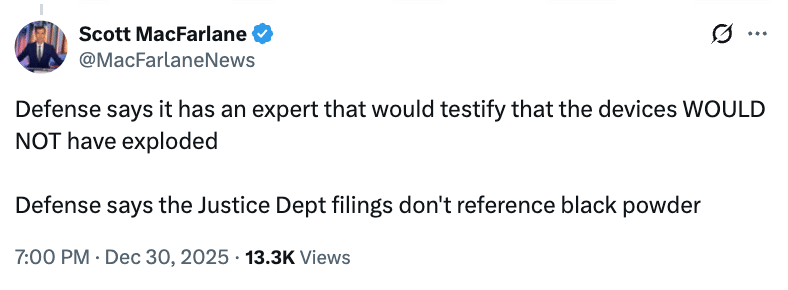
If these weren’t bombs, they might not be able to charge Cole under the existing statute, and if they can’t, then the statute of limitations might run before a grand jury is seated to indict Cole with something else.

And in the government’s (apparently still sealed) filing, they try to blame Cole for adhering to Federal Rules of Criminal Procedure.

34. This is not hyperbole. The government admits as much, stating that it “would have sought [] an early indictment from a federal grand jury panel had there been any indication that the defense, contrary to all indications, intended to pursue a preliminary hearing on December 30, 2025.” In other words, the government expected defense counsel to drop the ball.3 That is not “changed circumstances.”

3 The government does not proffer any reason why competent defense counsel would agree to forego a preliminary hearing in the absence of receiving some benefit, such as an agreement to release the defendant from custody. That is because there is none—making the government’s purported reliance on this “indication[]” entirely unreasonable.

For what it’s worth, I think the government’s location data is also likely to be aggressively challenged.

But it sounds like the government also understands they’ve got a hole in their case where the actual explosives are supposed to be.
Share this entry

Brian Cole’s Lawyers Admonish Jeanine Pirro for Yapping Her Mouth

When DOJ released its detention memo for accused January 6 pipe bomber Brian Cole, the MAGAts showed almost no interest; they’re too busy claiming to have discovered benefits fraud in Minnesota first charged under Merrick Garland’s DOJ.

But Jeanine Pirro did. She want on social media and repeated the apparent miscitation of Cole’s own words I laid out here, treating a comment made in the present tense this month — “I really don’t like either party at this point” — as if it were a comment about his mindset on January 5, 2021.

Unsurprisingly, Cole’s attorneys took note, arguing in their bid for bail that the “government-induced excitement” around Cole’s arrest should not factor into bail consideration and in fact is a violation of local rules about prejudicing a case.

The government-induced excitement around the arrest of Mr. Cole should not take this Court’s focus away from two essential principles of law that govern bail hearings.1

1 Indeed the U.S. Attorney has made numerous comments in contravention of Local Criminal Rule 57.7(b), specifically concerning the “existence or contents of any confession, admission, or statement given by the accused” ((b)(3)(ii)) and “opinion[s] as to the accused’s guilt or innocence or as to the merits of the case or the evidence in the case” ((b)(3)(vi)). See https://abcnews.go.com/US/pipe-bomb-suspect-disappointed -2020-election-results-us/story?id=128157568 (U.S. Attorney Pirro telling the media that based on the evidence, it is “unmistakable” that Mr. Cole is guilty and that “[t]his guy was an equal opportunity bomber.”); see also https://www.facebook.com/judgeje aninepirro/posts/my-office-has-filed-court-documents-that-brian-cole-jr-accusedofplacing-pipe-b/1424070829083142/ (U.S. Attorney Pirro posting on Facebook that Mr. Cole “has admitted that he was responsible for the devices and gave a detailed confession to the charged offenses”).

The rest of their opposition memo provides mere hints of how or whether they might defend this case.

It describes the evidence against Cole as circumstantial evidence of past guilt, not proof of ongoing risk at issue in the present.

The government’s showing is entirely retrospective and circumstantial. Even if credited, the government’s evidence describes an isolated window on a single evening nearly four years ago. It does not point to a “pattern of troubling activity” that would typically warrant detention in other cases. Klein, 539 F. Supp. 3d at 155. No device detonated, and the government has not alleged any comparable conduct or dangerous affiliations in the years since. This circumstantial proof—absent a direct forensic tie or evidence of ongoing threats—cannot overcome the Bail Reform Act’s default in favor of release subject to appropriate conditions. See Munchel, 991 F.3d at 1283 (The “threat [to the community] must also be considered in context.”).

It describes the pipe bombs as having “weapon characteristics,” perhaps questioning whether they really were functioning bombs at all.

According to the affidavit, both devices were rendered safe by the U.S. Capitol Police and later assessed by the FBI Laboratory to have “weapon characteristics,” with components consistent with improvised explosive devices.

It cites relevant DC Circuit opinions on pretrial release that just happen to be January 6 cases, here, Federico Klein — the former Trump State Department official with ties to Argentina’s fascist governments who was released on pretrial bail but ultimately sentenced to 70 months in prison — and Eric Munchel (AKA the Zip Tie Guy), whose pretrial release set the standard for many other January 6 defendants, but who was ultimately sentenced to 57 months in prison. Elsewhere the filing cites Bruno Cua, who was sentenced to just a year in prison after his pretrial release, largely because he was so young and impressionable during the events at hand.

All three, of course, have since been pardoned.

But Cole’s attorneys don’t mention those back stories to the detention precedents which must be applied to Cole too. Nor do they explain what they mean when they say the specific conditions that led young Bruno Cua to stalk the halls of the Capitol created a “specific risk profile for Mr. Cole,” just like it did Cua.

Finally, the unique conditions surrounding January 5–6, 2021, are unlikely to recur in a way that would present the same risk profile for Mr. Cole.

But that comment suggests they’re skeptical — perhaps have already seen reason to be skeptical — that Cole was telling the truth when he asserted there was no tie between his alleged planting of the pipe bombs and January 6, as the government’s detention memo asserts but does not quote directly.

They have reason to do that, of course. If planting the pipe bombs was part of January 6, then Cole may already have been pardoned, just like Klein and Munchel and Cua.

They do, however, confirm that Cole has been diagnosed with being on the spectrum.

Mr. Cole is an African American adult who has been diagnosed with Autism Spectrum Disorder, Level 1 and with obsessive compulsive disorder;

And like most bail memos, they include letters from character witnesses.

The only sign that today’s combined detention hearing and preliminary hearing, scheduled for 1PM before a Magistrate Judge who presided over only a (relative) handful of January 6 cases, might harbor some surprises is a repeat of their more explicit demand in a different filing that DOJ prove probable cause.

The defense understands that the detention hearing will begin with preliminary discussions that concern whether a rebuttable presumption that Mr. Cole should be detained arises in this case. The defense’s position is that the government cannot continue to keep Mr. Cole in custody absent a valid finding of probable cause.

One reason to do that is it raises the bar on pretrial detention.

True, the Bail Reform Act creates a rebuttable presumption “that no condition or combination of conditions will reasonably assure . . . the safety of the community if . . . there is probable cause to believe that the person committed” one of an enumerated list of crimes. 18 U.S.C. § 3142(e)(2). But for purposes of making that determination, “[a] grand jury indictment, by itself” is what establishes the probable cause “to believe that a defendant committed the crime with which he is charged.” Taylor, 289 F. Supp. 3d at 62 (quoting Stone, 608 F.3d at 945); see also United States v. Smith, 79 F.3d 1208, 1210 (D.C. Cir. 1996) (“[T]he indictment alone would have been enough to raise the rebuttable presumption that no condition would reasonably assure the safety of the community.”)

But who knows. There might be more.

Share this entry

Jeanine Pirro Got Curiously Silent about What Brian Cole Did on December 14, 2020

DOJ has submitted its detention memo for accused January 6 pipe bomber Brian Cole.

It largely tracks his arrest affidavit, only includes nifty maps and tables to show how his cell phone movement and his purchases showed his actions in preparation for and laying the pipe bombs.

It also includes details of his Mirandized, videotaped confession.

The description of his motive confirms he was a Trump supporter, but then explains he just planted the pipe bombs at both the DNC and RNC because he hated both parties — it had nothing to do with January 6, the filing claims (without quoting him).

The defendant stated that he does not align politically with his family members and did not tell them that he “was going to a protest in support of [then President] Trump.”

[snip]

When the interviewing agents returned to the defendant’s motive, he explained that “something just snapped” after “watching everything, just everything getting worse.” The defendant wanted to do something “to the parties” because “they were in charge.” When asked why he placed the devices at the RNC and DNC, the defendant responded, “I really don’t like either party at this point.” The defendant also explained that the idea to use pipe bombs came from his interest in history, specifically the Troubles in Ireland. The defendant denied that his actions were directed toward Congress or related to the proceedings scheduled to take place on January 6.

But there are two holes in the detention affidavit.

First, it describes Cole taught himself how to make explosives from YouTube, and used Google Maps to decide where to plant the bombs.

According to the defendant, he learned to make the black powder from a video game that listed the ingredients, and he also viewed various science-related videos on YouTube to assist him in creating the devices.

[snip]

The defendant explained that he had used Google Maps to look up these locations in advance.

Both of those details should show up in a Google warrant.

The detention memo makes no mention of them (or of any Google warrant).

More stunning, the detention affidavit drops a key detail from the arrest affidavit: That he was on Capitol Hill on December 14, 2020.

The FBI has analyzed COLE’s purchase history associated with the Accounts. Between January 2018 and January 2021, COLE made a total of five purchases within Washington, D.C. on or about the following dates: January 13, 2018; January 16, 2018; October 31, 2019; December 5, 2020; and December 14, 2020.

Approximately three weeks before the pipe bombs were placed, on or about December 14, 2020, COLE made a purchase at a restaurant located near First and D Streets, Southeast. The restaurant is located across the street from the entrance to Rumsey Court on D Street, Southeast.

What the detention affidavit does reveal is that — starting on December 15, 2020 — the day after being on Capitol Hill and a full three weeks before planting the pipe bombs, Cole started factory resetting his phone.

A Samsung cellular device was seized from the defendant’s person at the time of his arrest. A forensic review of the device’s contents showed that between December 2020 and December 2025, the device recorded 943 events identified as a “factory reset” or “wipe,” including a “wipe” event approximately three hours before the defendant’s arrest on December 4, 2025.2

2 The first “factory reset” or “wipe” event took place on December 15, 2020. The next such event did not occur until July 15, 2022. From that date, the “factory reset” or “wipe” events occurred at least once a week. On some days, the device appears to have been wiped multiple times in the same day.

The alleged pipe bomber started exercising operational security the day after that trip to Capitol Hill, the scene of his alleged crime.

And now, Jeanine Pirro doesn’t want to talk about the trip he made there at all.

Update: Cole’s attorneys complain that DOJ is attempting to push his first appearance out to January 7 or 8, which would be past any 5-year statute of limitation (though his charged crimes have a longer 10-plus year statute of limtiation).

2. On December 28, 2025, when pressed on the question of proceeding with the preliminary hearing on December 30, the government asked to push the preliminary hearing to either January 7 or 8. That request comes too late and does not meet Rule 5.1(d)’s rigorous standard. The Court should confirm that December 30 is the preliminary hearing and detention hearing and direct the government to be prepared to present its evidence in support of probable cause.

[snip]

4. In its email to defense counsel, the government has identified no extraordinary circumstances; rather, the reasons referenced are ordinary scheduling matters and the possibility of a forthcoming indictment. Rule 5 “does not allow the [preliminary] hearing date” to be extended merely “to accommodate the pace of the grand jury investigation.” United States v. Gurary, 793 F.2d 468, 472 (2d Cir. 1986). And where the defendant does not consent—as he does not here—Rule 5.1(d) imposes “far more rigorous criteria” than the Speedy Trial Act’s ends-of-justice standard. Id. at 473; see also United States v. Fortenberry, 2014 WL 6969615, at *2 (D. Nev. Dec. 9, 2014) (“Rule 5.1 does not permit continuance solely to enable the government to avoid a preliminary hearing by securing an indictment.”) (citation omitted).

Update: This is a super minor point. But in the detention memo, DOJ quotes Cole as saying (this month), “I really don’t like either party at this point,” which is at least consistent with him having been a Trump supporter and souring on him.

A few paragraphs later, they change the tense of that, claiming he placed that opinion in 2020.

In his own words, the defendant did so because he did not “like either party,” but “they were in charge” and thus were, in the defendant’s mind, an appropriate target for extreme acts of violence.

And they turn it into a both-sides thing.

By his own admission, the defendant committed these chilling acts because he was unhappy with the response of political leaders on both sides of the political aisle to questions raised about the results of the 2020 election, and “something just snapped.” [my emphasis throughout]

It may well be that something about what Cole said makes it fair to put his animosity to both parties back in time to 2020, but that’s not the tense he used.

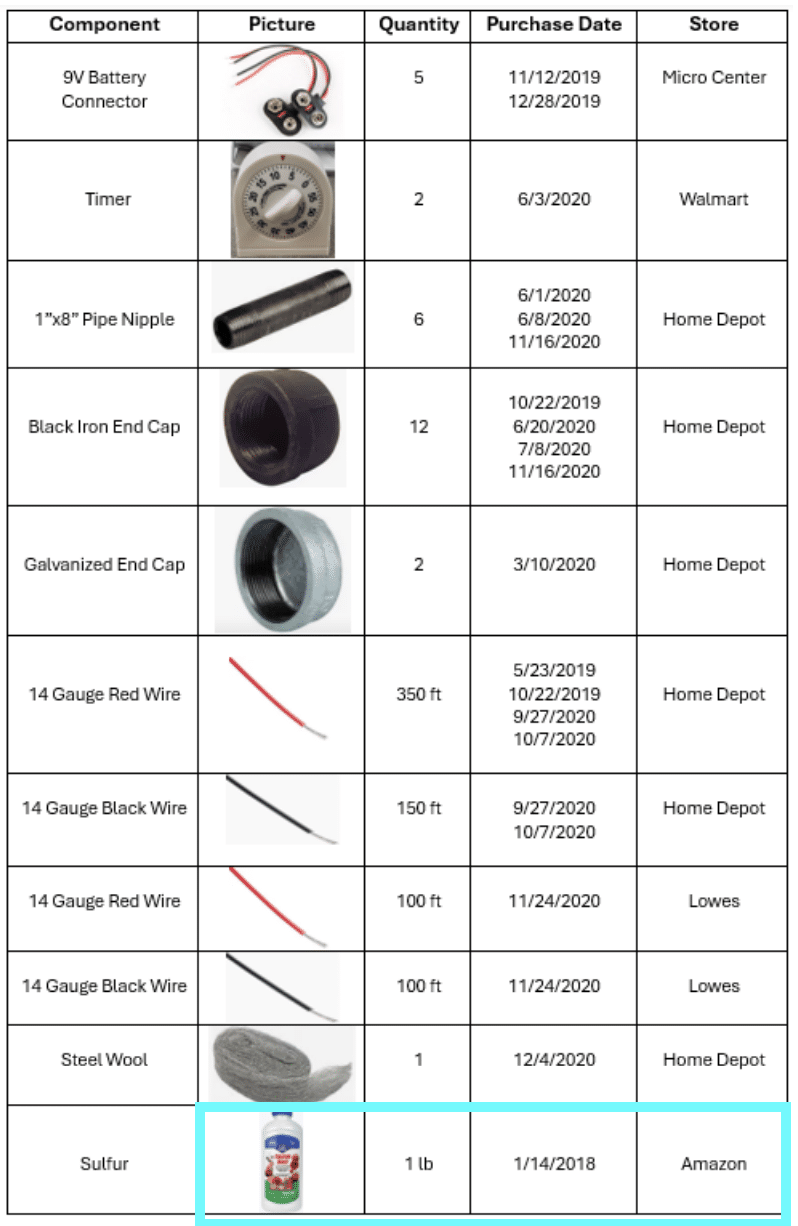
Additionally, this is the table DOJ uses to claim they found purchase records for all the components he used to make the bombs.

But this is misleading. While the table includes Lilly Miller sulfur dust, one of the things he said he used to make black powder (and charcoal, another, would be readily on hand), that’s actually a purchase 14 months earlier than any other component, and from a different store. But they didn’t find a purchase record for the potassium nitrate, which they say he said he got at Lowes (from which they have a bunch of other purchase records).

Share this entry

Four Years and 345 Days

As originally scheduled, Magistrate Judge Michael Harvey would have held a detention hearing today for Brian Cole, the guy accused of planting pipe bombs on January 5, 2021.

We might have learned more about evidence and motive at such a hearing, but now we’ll have to wait until December 30, if at all.

Last Wednesday, the AUSA in the case, submitted a filing basically saying, “Regarding your question about whether we still need a detention hearing on December 15, I respond that the defense wants another two weeks to review discovery before such a hearing, and we’d like an exclusion of time under Speedy Trial Act.”

The United States respectfully moves the Court to exclude time under the Speedy Trial Act from the date of defendant Brian J. Cole, Jr.’s arrest on December 4, 2025, through the date of the detention hearing, which the defense has requested to continue. 1

In response to the Court’s inquiry, the government conferred with defense counsel. Defense counsel has requested that the government represent the following to the Court in this motion: The defense requests that the Court continue the detention hearing in this case currently set for December 15, 2025, to allow the defense additional time to review the significant amount of discovery provided by the government to date. The defense consents to the exclusion of time under the Speedy Trial Act from December 4, 2025, through the date of the rescheduled detention hearing.

The government does not oppose a defense continuance of the detention hearing. The parties jointly request that the detention hearing be reset for December 30, 2025.

1 For administrative efficiency, the government is submitting a single motion reflecting the relief sought by both parties.

Before I unpack what this means — and what we can or cannot assume from this — let me point to this WSJ story that explains why it took so long to find Cole: Basically, an FBI Agent wrote code to be able to read cell tower dumps T-Mobile provided, which the government had claimed — for years! — was corrupted.

For four years, a tranche of cellphone data provided to the FBI by T-Mobile US sat on a digital shelf because investigators couldn’t figure out how to read it, people familiar with the matter said. The data turned out to be essential to cracking the case, the people said, a breakthrough that happened only recently when a tech-savvy law-enforcement officer wrote a new computer program that finally deciphered the information. That move led to the arrest of 30-year-old Brian Cole Jr. at his home in Northern Virginia, where he had been quietly living with his mother and other relatives.

[snip]

Increasingly desperate and under pressure to make progress, supervisors urged agents and analysts to take a new look at what they had, including the data from T-Mobile—reflecting phone locations based on internet usage—that investigators had set aside years earlier.

Once investigators were finally able to read the data, they said it led them to Cole’s phone number because his cellphone’s movements tracked what investigators had seen in surveillance footage.

I have no doubt that the government believed they couldn’t access some or most of the T-Mobile data; it is a problem that has shown up in court filings for years. How well-founded that belief was is something we may learn in the months ahead.

WSJ also describes why we’re getting — and why we should expect to continue getting  — so much leaking from this investigation: Because Kash Patel is claiming credit and accusing the FBI of sandbagging before now.

In a four-hour interview with investigators, Cole acknowledged placing the bombs, people familiar with the probe said. He expressed support for Trump and said he had embraced conspiracy theories regarding Trump’s 2020 election loss, the people said. He had thrown out the Air Max sneakers, he said. Cole hasn’t entered a plea, and his lawyer didn’t respond to requests for comment.

Inside the Justice Department, agents and prosecutors have privately expressed widespread relief that an arrest has finally been made, but also resentment over FBI Director Kash Patel, who has suggested that they didn’t work doggedly on the probe until Trump administration leadership arrived.

The assertion that Cole is a Trump supporter, which was always the most likely explanation for his actions, adds to the likelihood of leaks. All the people crowing about the Cole arrest — Pam Bondi, Kash, and Dan Bongino — could well get fired if they find proof of another Trump supporting terrorist. So they’re no doubt trying to minimize the chances that becomes public via official channels.

The fact that the FBI had to write code simply to read the T-Mobile data may explain something that I allude to here: The language the complaint uses to refer to location data is not described in the normal way, usually expressed as a percentage likelihood that a device was within a certain range at the time in question.

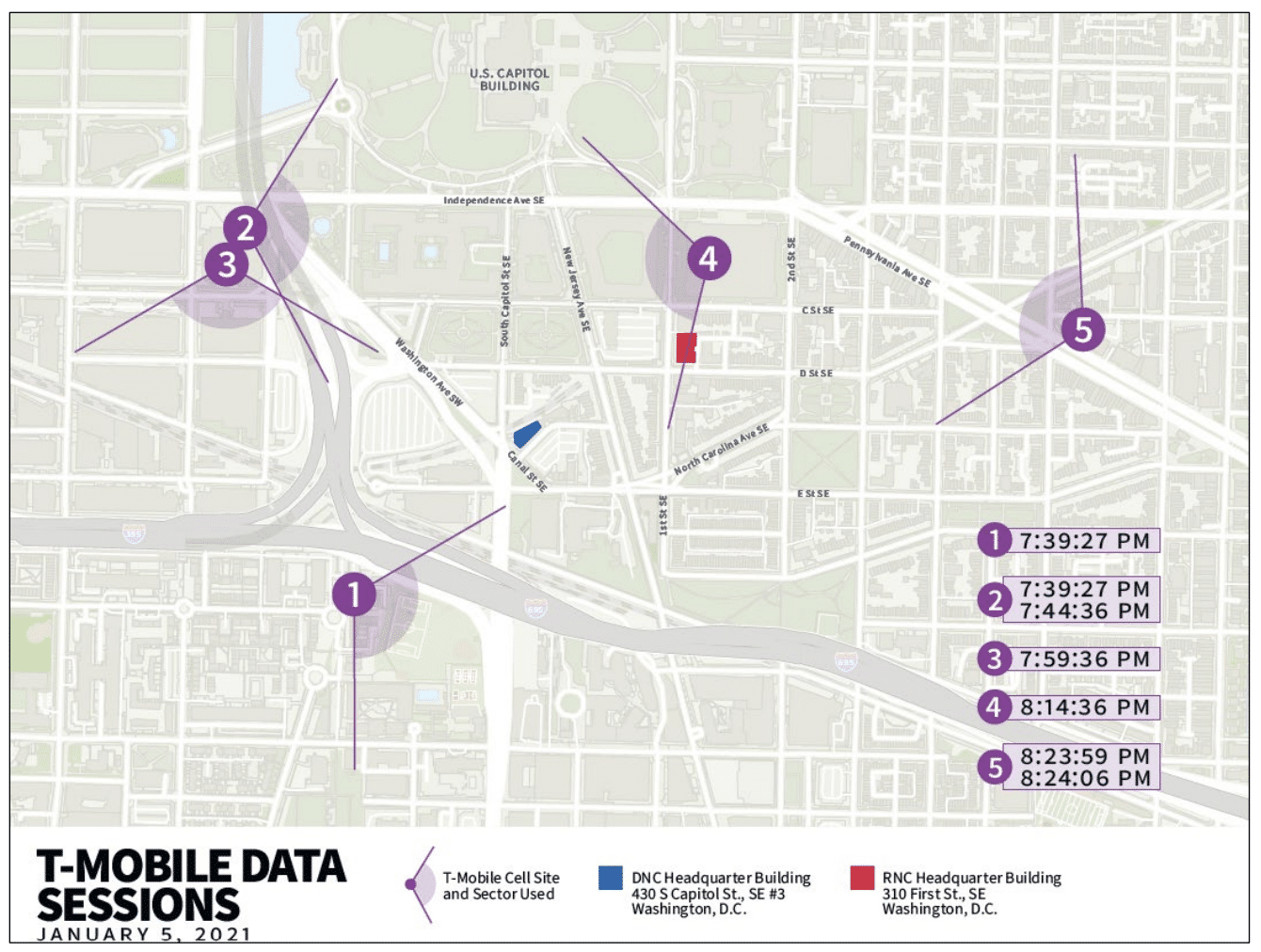
The seven transactions between the COLE CELLPHONE and Provider’s towers occurred at approximately 7:39 p.m., 7:44 p.m., 7:59 p.m., 8:14 p.m., 8:23 p.m., and 8:24 p.m. Two transactions took place at 7:39 p.m. During this time period, the COLE CELLPHONE had transactions with five different sectors on Provider’s cell towers.

a. At approximately 7:39:27 p.m., the COLE CELLPHONE interacted with a particular sector of Provider tower 59323, which faces southeast (approximately 120˚) from its location at 103 G Street, Southwest in Washington, D.C. (“Sector A”). Also at 7:39:27 p.m., the COLE CELLPHONE interacted with a particular sector of Provider tower 126187, which faces east1 (approximately 90˚) from its location at 200 Independence Avenue, Southwest in Washington, D.C. (“Sector B”). Video surveillance footage shows that at approximately 7:39:32 p.m., the individual who placed the pipe bombs walked westbound on D Street, Southeast and then turned southbound on South Capitol Street, Southeast. These locations are consistent with the coverage areas of Sector A and B.

b. At approximately 7:44:36 p.m., the COLE CELLPHONE interacted with Sector B of Provider tower 126187. Video surveillance footage shows that at approximately 7:44:36 p.m., the individual who placed the pipe bombs walked east on Ivy Street, Southeast. This location is consistent with the coverage area of Sector B.

Here, the complaint claims only that the cell tower data is consistent with Cole’s presence in a certain cardinal directions from the cell towers; it doesn’t even explain how far that cell site is.

Even without the hack of the data needed to read the T-Mobile data, this case might have been vulnerable on Fourth Amendment grounds. While the geofences for the Capitol itself have been sustained in a series of court orders, these tower dumps did not (as the Capitol-focused geofences did) collect data of people who were by definition culprits or victims. But if the T-Mobile data showing Cole’s location comes from some untested code, it would be far more vulnerable to challenge, with the likelihood of dueling experts about whether the software hack faithfully rendered the location data.

Sure, there’s the confession, but any good defense attorney will attempt to challenge any Miranda waiver, particularly in the case (as here) where a suspect is reportedly on the spectrum or is otherwise vulnerable to pressure.

Meanwhile, consider the implications of DOJ finding a way to read T-Mobile data that had been unavailable for years. What else might that data reveal? Might that data reveal a meeting between Cole and someone else on Capitol Hill on December 14?

Approximately three weeks before the pipe bombs were placed, on or about December 14, 2020, COLE made a purchase at a restaurant located near First and D Streets, Southeast. The restaurant is located across the street from the entrance to Rumsey Court on D Street, Southeast.

I think it inconceivable that Cole placed those bombs at the perfect location set to explode at the perfect time for an attack the following day without consultation with others. Which means any investigation into Cole could break open (or reopen) an investigation into the far more coordinated attack that was evident in movement that day but — for whatever reason — not charged.

Imagine the possibility that the FBI could find proof — and a witness — to explain how January 6 was an exceedingly well-coordinated terrorist attack? That would be sure to get Bondi, Kash, and Bongino fired!

As noted, DOJ asked for and got an exclusion of the 15-day delay in detention hearing time from the Speedy Trial Act (STA). That’s actually a very big deal, because when DOJ arrested Cole on December 5, the month they had to indict Cole under the STA coincided with the month that existed before the normal 5-year statute of limitations on most crimes expired.

The charges against Cole, 18 USC 844(d) & (i), actually have an extended (at least ten year) statute of limitations, as would some other charges, but some other possible charges (or conspiracy charges) might not.

So several things are likely going on:

First, while I think it likely FBI got their guy, if Cole’s confession is at all vulnerable to challenge, the case might be exceedingly weak, not least because the data has been manipulated.

Meanwhile, DOJ really is in crunch time regarding both the charges and any further investigation. That likely suits Trump’s appointees, who could be fired if the arrest of Cole provides cause to investigate further.

And that’s all on top of any colorable claim that Cole is entitled to the pardons Trump has already given his mob (not least if he had contact with someone else who has already been pardoned).

That’s the kind of mix that gives DOJ strong incentive to push for a plea, using as leverage the possibility of further charges, on top of an already draconian possible 40-year sentence.

Everyone else may be focused on holidays. But the people involved in this prosecution are likely involved in a very delicate game of chicken, as the ticking clock of dual deadlines threatens to explode.

Share this entry

Trump’s Terrorists

Things could get a bit awkward with two of Trump’s terrorists in the days ahead. Trump has done such a great job of memory-holing his insurrection, and yet it won’t entirely go away.

Start with Taylor Taranto. I’ve written about the mentally ill Navy veteran who trespassed on January 6 — just one of thousands of Trumpsters who invaded the Capitol — but then took up with the DC Jail crowd in the aftermath, growing increasingly unstable until when, after Trump posted Barack Obama’s address on Truth Social, Taranto started stalking Obama, as prosecutors described in a footnote of a motion to gag Trump this way:

[T]he defendant’s public targeting of perceived adversaries has resulted in threats, harassment, or intimidation. The public record is replete with other examples. See, e.g., United States v. Taranto, No. 1:23-cr-229, ECF No. 27 at 4-6 (D.D.C. Sep. 12, 2023) (affirming detention order for Taranto and explaining that, after “‘former President Trump posted what he claimed was the address of Former President Barack Obama’ on Truth Social,” Taranto— who had previously entered the Capitol on January 6, 2021—reposted the address, along with a separate post stating, “‘See you in hell, Podesta’s and Obama’s’” [sic], and then proceeded, heavily armed, to the area the defendant had identified as President Obama’s address, while livestreaming himself talking about “getting a ‘shot’ and an ‘angle,’” adding, “‘See, First Amendment, just say First Amendment, free speech’”) (quoting Taranto, ECF No. 20).

Like everyone else, Taranto was pardoned for his Jan6 trespass and his gun-related crimes were downgraded along with the rest of America’s defense against gun crimes. Trump appointee Carl Nichols sentenced him to time served on October 30, but not before Jeanine Pirro’s office tried to hide the sentencing memo (and prosecutors) who described Taranto’s role in Trump’s insurrection and Trump’s role in inciting Taranto’s stalking.

So he was free to go home to Seattle and attempt to rebuild his life from the chaos that Trump made of it.

Only he didn’t.

In recent days he has been back stalking DC, and specifically Jamie Raskin. The very same prosecutors who attempted to bury Trump’s role in inspiring Taranto’s crimes were stuck asking he be jailed again.

Assistant U.S. Attorney Travis Wolf said Taranto’s return to D.C., his erratic behavior and renewed livestreaming raised serious alarms that he was “on the path” to the same conduct that led to criminal charges against him two years earlier and urged that he be returned to jail.

Wolf described acute mental health concerns, a series of alleged violations of Taranto’s supervised release conditions, and alarming social media posts, including one from the parking lot of the Pentagon. The prosecutor discussed other details of Taranto’s case during a closed court session.

Trump appointee Carl Nichols tried to give Taranto one more chance to go back to Washington and get some help. But he continues to lurk around DC, figuring he still has time before he has to report to Probation in Washington on Wednesday.

The man needs help, and jail is not going to get him what he needs, but until he leaves DC, he remains a real concern.

He’s a reminder of what Trump does to people, driving around DC broadcasting as he goes.

According to the standards DOJ has used with ICE protestors, Trump should have been charged right along with Taranto.

Then there’s the possibility that efforts to prosecute alleged pipe bomber Brian Cole will backfire, at least on those — Pam Bondi, Kash Patel, and Dan Bongino — who crowed about the arrest on Thursday.

Since he was arrested there have been a series of leaks, starting with Ryan Reilly (who literally wrote the book on the January 6 investigation, with all that suggests about his possible sources) followed by Evan Perez (one of the best-sourced journalists at FBI), told the FBI he believed Donald Trump’s bullshit.

The man charged with planting two pipe bombs near the Democratic and Republican party headquarters on the eve of the Jan. 6 attack on the U.S. Capitol told the FBI he believed conspiracy theories about the 2020 election, according to two people familiar with the matter.

Brian Cole Jr., 30, is cooperating with the FBI, NBC News has reported, citing a separate person familiar with the matter. Cole appeared in court Friday, one day after he was charged with leaving pipe bombs outside the Republican National Committee and Democratic National Committee in the hours before Donald Trump supporters stormed the U.S. Capitol. Trump has falsely claimed the 2020 election was “rigged.”

Cole confessed to planting the devices outside the parties’ headquarters in the hours before the Capitol attack, three people familiar with the matter told NBC News. A federal prosecutor said in court on Friday that the suspect spoke with the government for more than four hours, but did not reveal the contents of those discussions.

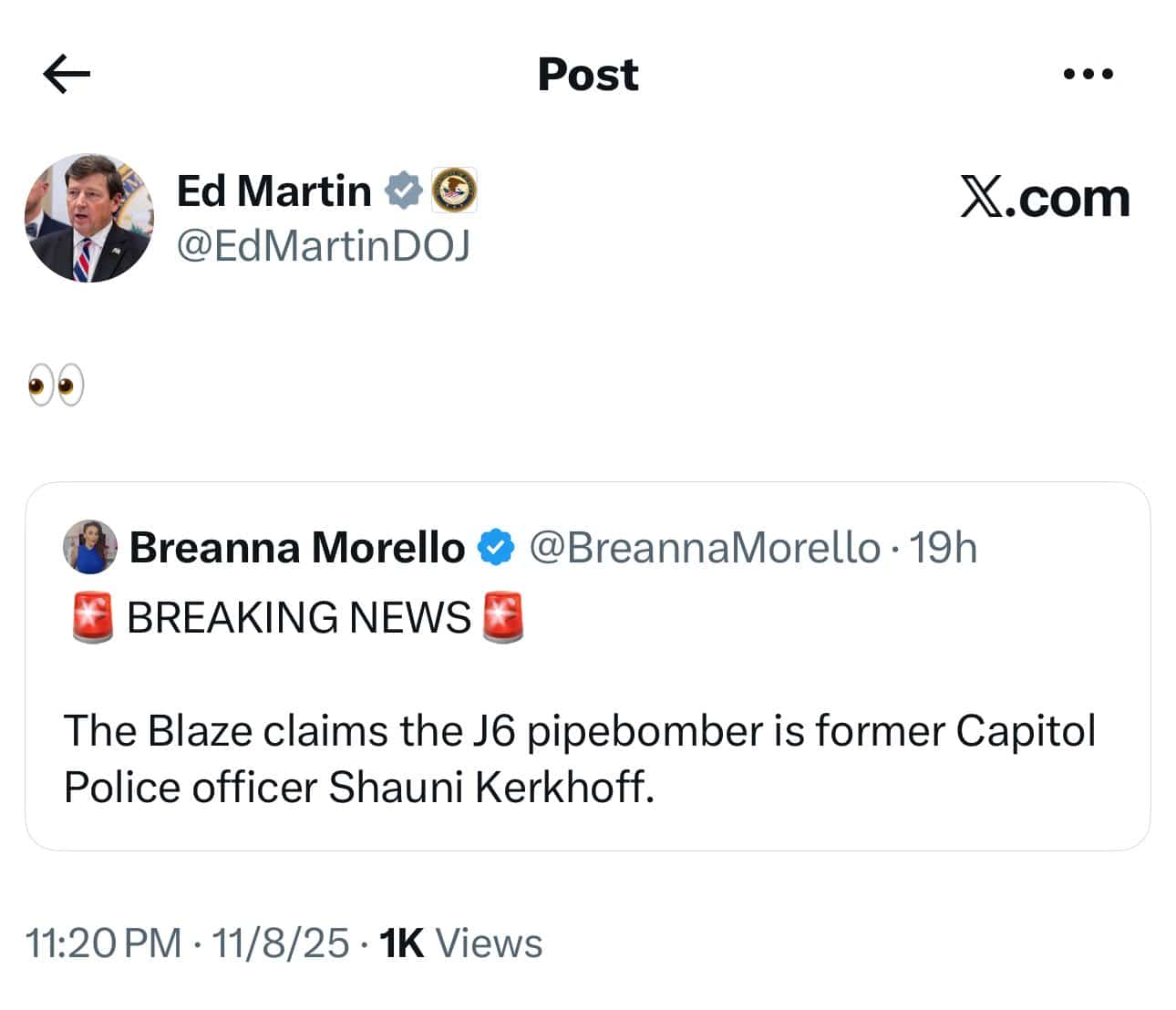
Pirro has been out trying to disclaim the obvious: that Cole is one of Trump’s terrorists, not the insider threat that people like Dan Bongino and Ed Martin have been claiming since the attack.

Anna Bower tracked Martin’s effort to stoke conspiracy theories about the pipe bomber, including this screen cap.

Kash Patel who has fired people for claiming that Jan6ers were a terrible threat to the country, said that when you do what Cole did, “you attack the very being of our way of life”  — and he did so after Pam Bondi hailed his hard work to make the case.

And then Bongino went on Sean Hannity and confessed he was making shit up before.

Hannity, during his interview with his former colleague, gave Bongino an opportunity to criticize prior iterations of the Justice Department and FBI for failing to arrest anyone in the case, and praise his own colleagues for getting the job done. But then he asked Bongino about the FBI deputy director’s own role in promoting conspiracy theories about the bomber during Bongino’s past career as a right-wing commentator.

“You know, I don’t know if you remember this — this is before you became the deputy FBI director,” Hannity said. “You put a post on X right after this happened and you said there’s a massive cover-up because the person that planted those pipe bombs, they don’t want you to know who it is because it’s either a connected anti-Trump insider or an inside job. You said that, you know, long before you were even thought of as deputy FBI director.”

Bongino’s response was astounding. He looked down, as if embarrassed, and replied: “Yeah, that’s why I said to you this investigation’s just begun.” But after hemming and hawing about the confidence he and FBI Director Kash Patel have that they arrested the right person, he got real.

“Listen, I was paid in the past, Sean, for my opinions,” he explained. “That’s clear. And one day, I’ll be back in that space. But that’s not what I’m paid for now. I’m paid to be your deputy director, and we base investigations on facts.”

And when you peruse the possible explanations about why FBI didn’t find Cole before this week (I suspect it’s because FBI had far less evidence against Cole when they arrested him on Thursday than against virtually every other Jan6er; they just got fucking lucky that they got the right guy), they all feed left wing concerns.

Did Steve D’Antuono take steps to distract from Cole back in 2021, as some right wingers are now suggesting? If so, he did that between the time he took insufficient steps to prevent the attack and those times in 2022 when he attempted to kill any investigation of Trump.

Did Chris Wray intentionally stall this investigation? Then what does that say about the rest of the January 6 investigation?

And what if Cole says he qualifies for one or both of the pardons Trump already gave to people, like him, who responded to Trump’s false claims by attacking the Capitol. After all Enrique Tarrio, who was convicted of sedition and adjudged a terrorist at sentencing, was gone from the Capitol a whole day before Cole allegedly placed those bombs, and Tarrio got a full pardon. What is Pardon Attorney Ed Martin going to say to conclude that Cole is somehow different from the hundreds of others, including a good many who brought incendiary devices, who have been running free since January?

It’s still possible Jocelyn Ballantine will manage to bury Cole’s pro-Trump leanings — or at least avoid implicating anyone who worked with Cole to plant the bombs in the precisely perfect place to create a distraction on January 6. Ballantine has played such a role before, and emails that Dan Richman submitted in his bid to get his data back before the FBI can violate his Fourth Amendment rights again suggest she was part of the process that led to that violation in the first place.

But until then, the lesson Dan Bongino just learned could be devastating. When you follow the facts, even the most rabid Trump supporter may discover that Trump’s terrorists are the ones threatening America.

Share this entry

Fridays with Nicole Sandler

Listen on Spotify (transcripts available)

Listen on Apple (transcripts available)

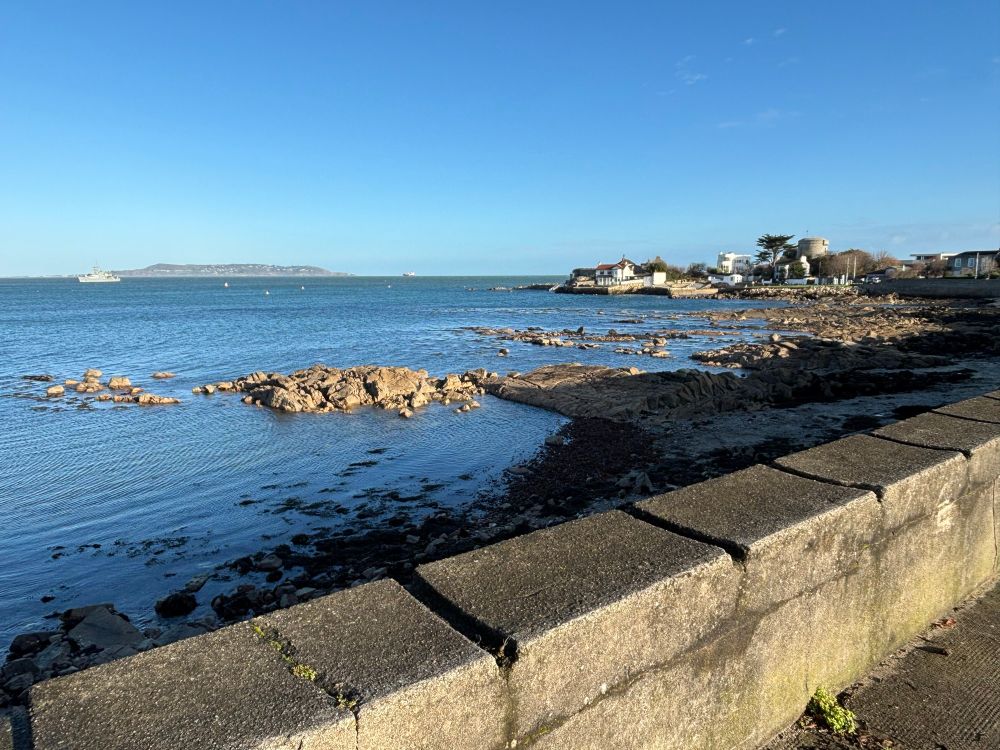
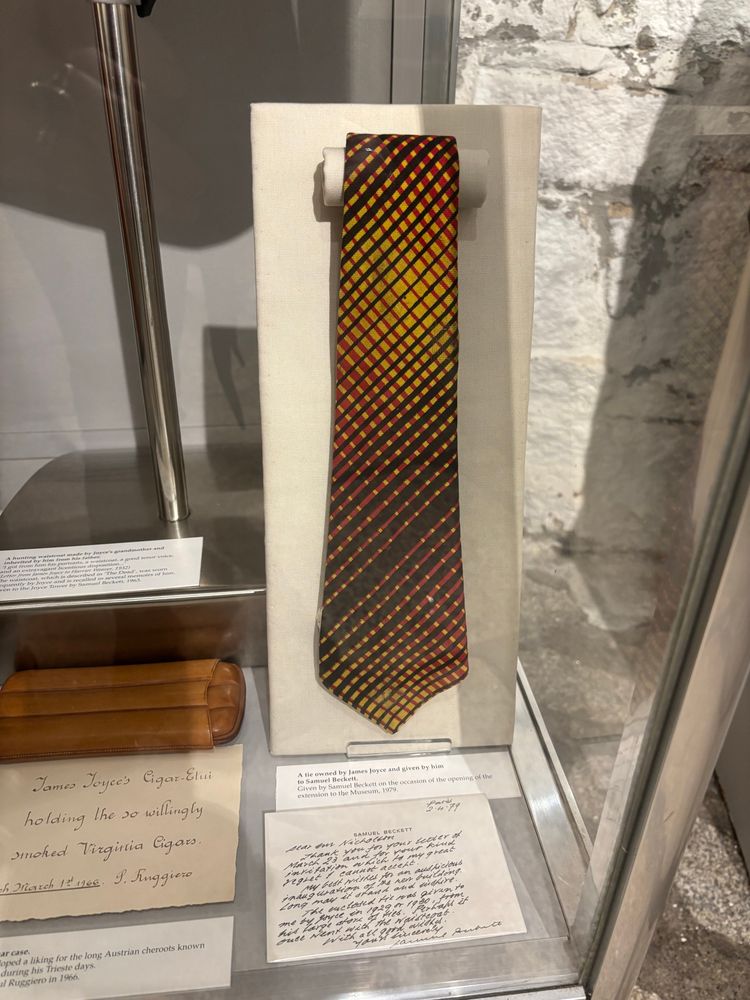
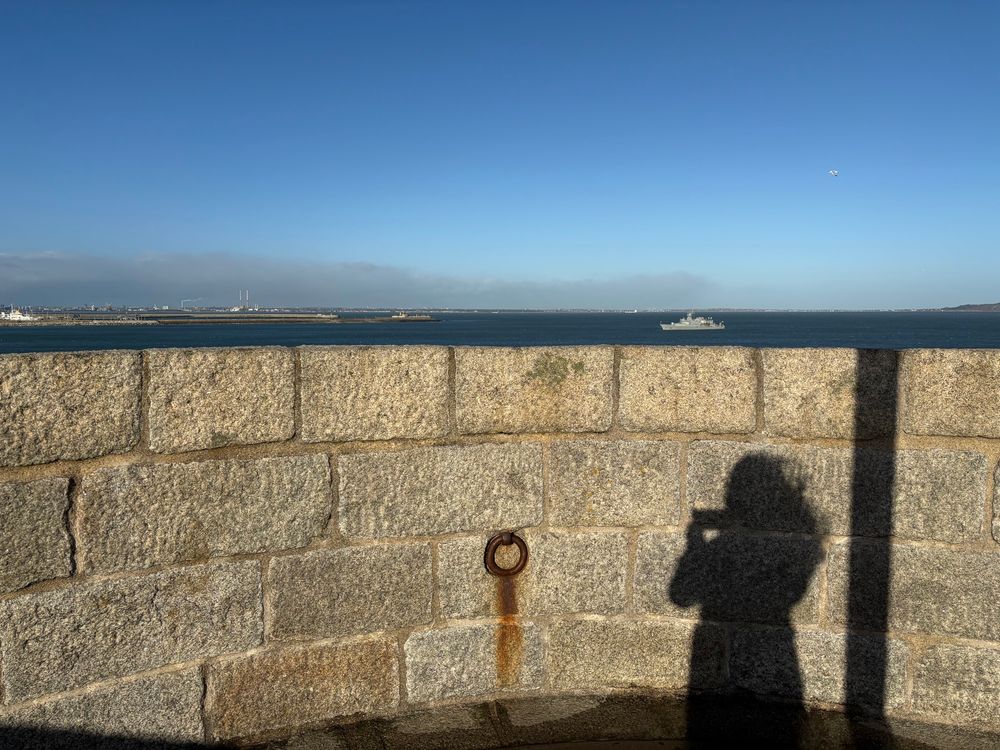
Update: Here are the photos of James Joyce’s Martello Tower I mentioned.

Looking towards the sea from the strand.

A tie Joyce gave Samuel Beckett, which is exhibited in the Martello Tower.

Me, pretending to be Buck Mulligan, spying the ship named the Samuel Beckett.


Share this entry

What’s Not Being Said about the Alleged Pipe Bomber

The arrest affidavit for Brian Cole, the 30 year old guy charged as the pipe bomber today, is here.

The evidence consists of:

Phone records placing him on Capitol Hill at the time the FBI believes the bombs to have been placed.

The seven transactions between the COLE CELLPHONE and Provider’s towers occurred at approximately 7:39 p.m., 7:44 p.m., 7:59 p.m., 8:14 p.m., 8:23 p.m., and 8:24 p.m. Two transactions took place at 7:39 p.m. During this time period, the COLE CELLPHONE had transactions with five different sectors on Provider’s cell towers.

a. At approximately 7:39:27 p.m., the COLE CELLPHONE interacted with a particular sector of Provider tower 59323, which faces southeast (approximately 120˚) from its location at 103 G Street, Southwest in Washington, D.C. (“Sector A”). Also at 7:39:27 p.m., the COLE CELLPHONE interacted with a particular sector of Provider tower 126187, which faces east1 (approximately 90˚) from its location at 200 Independence Avenue, Southwest in Washington, D.C. (“Sector B”). Video surveillance footage shows that at approximately 7:39:32 p.m., the individual who placed the pipe bombs walked westbound on D Street, Southeast and then turned southbound on South Capitol Street, Southeast. These locations are consistent with the coverage areas of Sector A and B.

b. At approximately 7:44:36 p.m., the COLE CELLPHONE interacted with Sector B of Provider tower 126187. Video surveillance footage shows that at approximately 7:44:36 p.m., the individual who placed the pipe bombs walked east on Ivy Street, Southeast. This location is consistent with the coverage area of Sector B.

c. At approximately 7:59:36 p.m., the COLE CELLPHONE interacted with a particular sector of Provider tower 147990 which faces south (approximately 180˚) from its location at 200 Independence Avenue, Southwest in Washington, D.C. (“Sector C”). Video surveillance footage shows that at approximately 7:59:38 p.m., the individual who placed the pipe bombs walked southbound on New Jersey Avenue, Southeast then turned eastbound on E Street, Southeast. These locations are consistent with the coverage area of Sector C.

d. At approximately 8:14:36 p.m., the COLE CELLPHONE interacted with Provider tower 45111 which faces west (approximately 255˚) from its location at 101 Independence Avenue, Southeast in Washington, D.C. (“Sector D”). Video surveillance footage shows that at approximately 8:14:15 p.m., the individual who placed the pipe bombs exited Rumsey Court and walked westbound through an alley between the Capitol Hill Club and the RNC then walked northbound onto First Street, Southeast. This location is consistent with the coverage area of Sector D.

e. At approximately 8:23:59 p.m. and 8:24:06 p.m., the COLE CELLPHONE interacted with Provider tower 144340, which faces west (approximately 295˚) from its location at 600 Pennsylvania Avenue, Southeast in Washington, D.C. (“Sector E”). Video surveillance footage last captures the individual who placed the pipe bombs at 8:18 p.m. walking eastbound on Rumsey Court in the direction of tower 144340, which is approximately 1/2 mile east of the individual’s last recorded location. The last recorded location is consistent with the coverage area of Sector E.

A license plate reader showing his car arriving at Capitol Hill that evening.

On January 5, 2021, at approximately 7:10 p.m., COLE’s Nissan Sentra was observed driving past a License Plate Reader at the South Capitol Street exit from Interstate 395 South, which is less than one-half mile from the location where the individual who placed the devices was first observed on foot near North Carolina and New Jersey Avenues, Southeast at 7:34 p.m. Approximately 5 minutes later, at 7:39:27 p.m., the COLE CELLPHONE began to interact with Provider towers in the area.

Purchases of components consistent with the construction of the pipebombs, including paying cash for a battery connector consistent with the pipe bombs in 2019.

Both pipe bombs were manufactured using a nine-volt (9V) battery connector with attached red and black wires. The nine-volt battery connectors used in the pipe bombs had identifying information on the black and red insulated wires that were consistent with those distributed in North America by a known company and its predecessors (the “Nine Volt Distributor”). COLE purchased five of the Nine Volt Distributor’s nine-volt battery connectors from Micro Center in northern Virginia on or about November 12 and December 28, 2019, including cash purchases made during the December transaction. Fewer than 8,000 of Nine Volt Distributor’s nine-volt battery connectors were distributed in the United States between December 2017 and January 5, 2021. [my emphasis]

A purchase made across the street from the alley way on December 14.

Approximately three weeks before the pipe bombs were placed, on or about December 14, 2020, COLE made a purchase at a restaurant located near First and D Streets, Southeast. The restaurant is located across the street from the entrance to Rumsey Court on D Street, Southeast.

There’s nothing that ties those weird sneakers to Cole at all. [Corrected]

Certainly, he’s a candidate, and should have been IDed as such in 2021. But the affidavit lacks the kind of thing we saw all the time in real January 6 affidavits: Personal communications. Signs of planning in the period after Trump announced the rally. While there are a bunch of components purchased in November 2020, after the election, there’s not a single data point in the affidavit between when Trump announced the rally on December 19 and when Cole was on Capitol Hill on January 5, 2021.

Surely, FBI has already obtained warrants for all that and it is at least consistent with someone who had been playing with bomb-making for two years before placing these bombs.

But they’re not telling what’s in them.

You get the feeling they might not tell the story Kash Patel and Pam Bondi want to tell. What if finding the pipe bomber gets them fired, just like responding competently to COVID got Anthony Fauci fired and targeted?

DOJ has assigned Jocelyn Ballantine to this case. You may recall that she made false claims in support of efforts to throw out the Mike Flynn case in 2020.

Update: Per Ryan Reilly, Cole (who wouldn’t have been assigned an attorney yet) told the FBI that he believed in 2020 election fraud claims.

Share this entry