
Posts

Voiding International Agreements Can Have Awkward Consequences
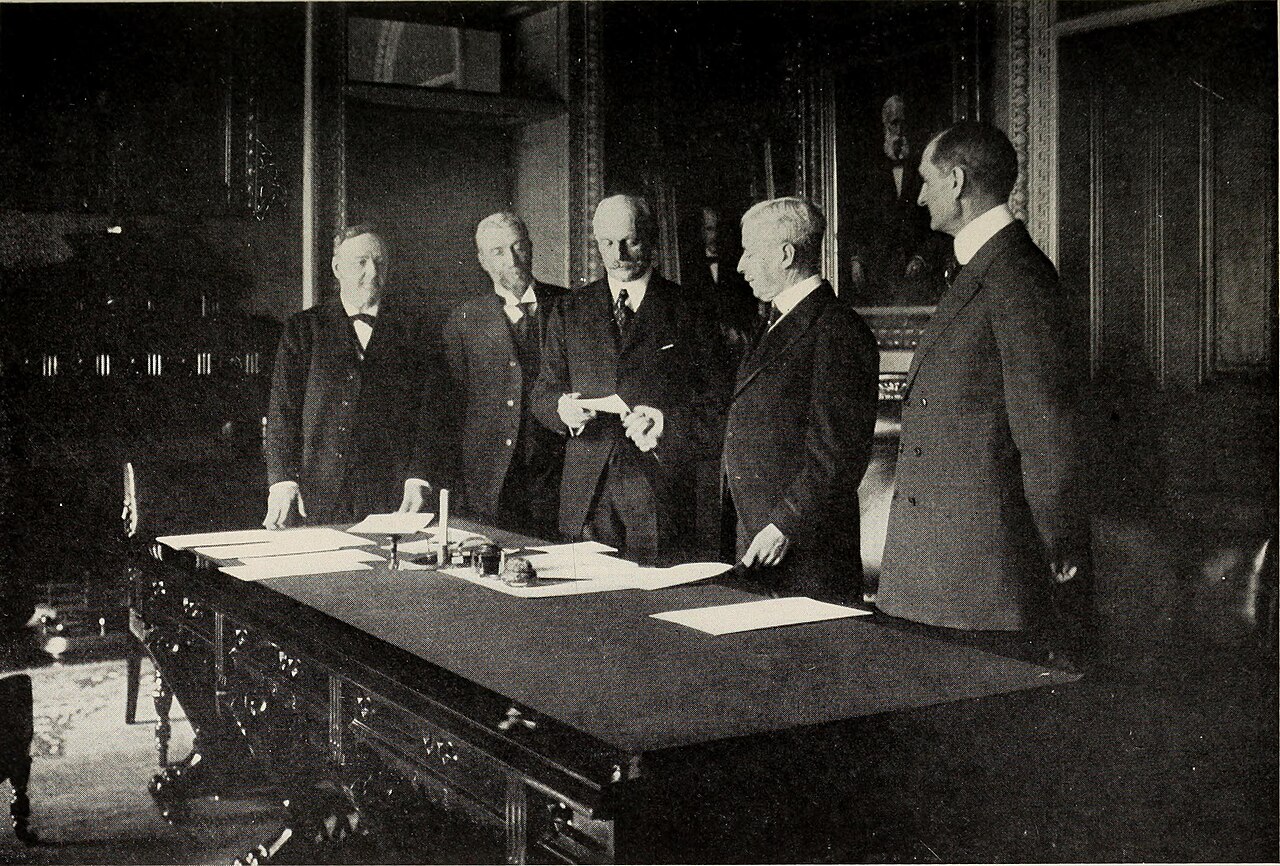
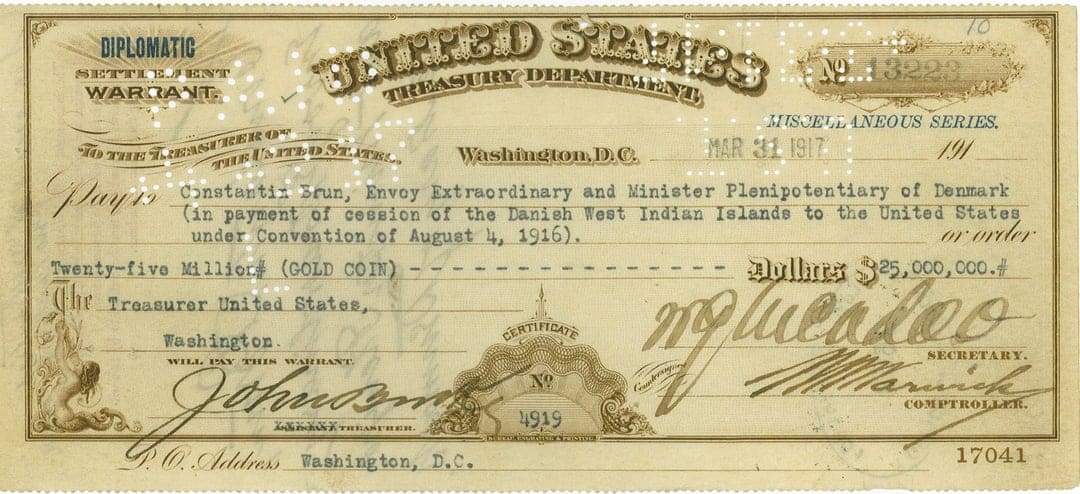
US hands Denmark a $25M check at Closing on the purchase of the Virgin Islands

History is so cool.

In 1917, Denmark and the US approved a treaty (or more specifically, a convention), the guts of which are summed up in two simple paragraphs:

His Majesty the King of Denmark by this convention cedes to the United States all territory, dominion and sovereignty, possessed, asserted or claimed by Denmark in the West Indies including the Islands of Saint Thomas, Saint John and Saint Croix together with the adjacent islands and rocks.

[snip]

In full consideration of the cession made by this convention, the United States agrees to pay, within ninety days from the date of the exchange of the ratifications of this convention, in the City of Washington to the diplomatic representative or other agent of His Majesty the King of Denmark duly authorized to receive the money, the sum of twenty-five million dollars in gold coin of the United States.

The bulk of the document spells out the details, like how long Denmark has to vacate the premises, what items go with them and what transfers to the new owners, etc.

So OK, the US bought the Virgin Islands from Denmark? What’s the big deal, you ask.

The big deal is a little clearer when you see the “Declaration” at the end, made by US Secretary of State Robert Lansing:

In proceeding this day to the signature of the Convention respecting the cession of the Danish West-Indian Islands to the United States of America, the undersigned Secretary of State of the United States of America, duly authorized by his Government, has the honor to declare that the Government of the United States of America will not object to the Danish Government extending their political and economic interests to the whole of Greenland.

Ah. So the deal was the US gets the Virgin Islands, and Denmark gets Greenland and $25M in gold coin.

And now, Trump wants to void the deal. He ought to be careful, though, because there are other deals like this that the US made that other leaders might want to void.

In 1803, there was a little real estate deal that took three Conventions to lay out all the details (part cash, part debt-swap; involving 3 different nations), but the basic deal was this:

Whereas by the Article the third of the Treaty concluded at St Ildefonso the 9th Vendé miaire an 9/1st October 1800 between the First Consul of the French Republic and his Catholic Majesty [of Spain] it was agreed as follows.
“His Catholic Majesty promises and engages on his part to cede to the French Republic six months after the full and entire execution of the conditions and Stipulations herein relative to his Royal Highness the Duke of Parma, the Colony or Province of Louisiana with the Same extent that it now has in the hand of Spain, & that it had when France possessed it; and Such as it Should be after the Treaties subsequently entered into between Spain and other States.”
And whereas in pursuance of the Treaty and particularly of the third article the French Republic has an incontestible title to the domain and to the possession of the said Territory–The First Consul of the French Republic desiring to give to the Unit ed States a strong proof of his friendship doth hereby cede to the United States in the name of the French Republic for ever and in full Sovereignty the said territory with all its rights and appurtenances as fully and in the Same manner as they have bee n acquired by the French Republic in virtue of the above mentioned Treaty concluded with his Catholic Majesty.

[snip]

The Government of the United States engages to pay to the French government in the manner Specified in the following article the sum of Sixty millions of francs independant of the Sum which Shall be fixed by another Convention for the payment of the debts due by France to citizens of the United States.

For the payment of the Sum of Sixty millions of francs mentioned in the preceeding article the United States shall create a Stock of eleven millions, two hundred and fifty thousand Dollars bearing an interest of Six per cent: per annum payable half y early in London Amsterdam or Paris amounting by the half year to three hundred and thirty Seven thousand five hundred Dollars, according to the proportions which Shall be determined by the french Govenment to be paid at either place: The principal of t he Said Stock to be reimbursed at the treasury of the United States in annual payments of not less than three millions of Dollars each; of which the first payment Shall commence fifteen years after the date of the exchange of ratifications:–this Stock Shall be transferred to the government of France or to Such person or persons as Shall be authorized to receive it in three months at most after the exchange of ratifications of this treaty and after Louisiana Shall be taken possession of the name of the Government of the United States.
It is further agreed that if the french Government Should be desirous of disposing of the Said Stock to receive the capital in Europe at Shorter terms that its measures for that purpose Shall be taken So as to favour in the greatest degree possible the credit of the United States, and to raise to the highest price the Said Stock.

Again, lots of details passed over in these three conventions, but the essence of deal is simple: the US gets the land, and France gets cash and a settlement on the debts they owe to US citizens.

Perhaps if Trump wants to revoke by fiat the Convention with Denmark over the Virgin Islands and Greenland, President Macron might start thinking he should do the same with Trump over Louisiana.

Or there’s this, from 1867:

His Majesty the Emperor of all the Russias, agrees to cede to the United States, by this convention, immediately upon the exchange of the ratifications thereof, all the territory and dominion now possessed by his said Majesty on the continent of America and in adjacent islands, the same being contained within the geographical limits herein set forth, to wit: [geographic details omitted]

[snip]

In consideration of the cession aforesaid, the United States agree to pay at the Treasury in Washington, within ten months after the exchange of the ratifications of this convention, to the diplomatic representative or other agent of His Majesty the Emperor of all the Russias, duly authorized to receive the same, seven million two hundred thousand dollars in gold.

Again, lots of details omitted, but these two paragraphs lay out the broad parameters of the deal. Now imagine Putin wanting it back.

See, that’s the thing about international agreements. If you decide they aren’t worth the paper they are written on, other folks might agree with you and act accordingly.

Sarah Palin might want to brush up on her Russian, and I may need to be working on my French.

ADDENDUM

Don’t know how I could have forgotten this one from 1819, but I hit publish before it occurred to me.

His Catholic Majesty [of Spain] cedes to the United States, in full property and sovereignty, all the territories which belong to him, situated to the eastward of the Mississippi, known by the name of East and West Florida. The adjacent islands dependent on said provinces, all public lots and squares, vacant lands, public edifices, fortifications, barracks, and other buildings, which are not private property, archives and documents, which relate directly to the property and sovereignty of said provinces, are included in this article. The said archives and documents shall be left in possession of the commissaries or officers of the United States, duly authorized to receive them.

[snip]

The United States, exonerating Spain from all demands in future, on account of the claims of their citizens to which the renunciations herein contained extend, and considering them entirely cancelled, undertake to make satisfaction for the same, to an amount not exceeding five millions of dollars.

Lots of other details omitted, but you get the idea.

Perhaps Trump can ask one of his minions how to say “Welcome to Mar-a-Lago” in Spanish?

When Even the German Far-Right Thinks You’ve Gone Too Far . . .

Der Führer, upon learning that things are not going as he would like.

From Politico.eu:

Germany’s far-right Alternative for Germany (AfD) party has long sought close ties to the Trump administration in its quest for powerful international allies and an end to its political isolation at home.

But as public sentiment in Germany increasingly turns against U.S. President Donald Trump and his foreign interventionism — in particular his talk of taking control of Greenland and his seizure of Venezuelan President Nicolás Maduro — AfD leaders are recalibrating, putting distance between their party and a U.S. president they previously embraced.

“He has violated a fundamental election promise, namely not to interfere in other countries, and he has to explain that to his own voters,” Alice Weidel, one of the AfD’s national leaders, said earlier this week.

Hmm . . . I don’t recall Weidel complaining when Trump, Vance, and Musk were stumping for the Afd in the last national elections in Germany.

With that as background, it’s that much more impressive that Weidel now is throwing Trump under the bus. Think about that for a minute: a would-be Führer who is underbussed by the neo-Nazi AfD is no Führer at all. And for it to be the German far-right . . . that’s really gotta leave a mark. Stephen Miller must be so sad.

Or emboldened. “These AfD folks are so soft, so lacking in strength . . . Looks like it is up to us to remind Germans of their own heritage and strength.”

The AfD is the second-largest party in the Bundestag, much to the horror of Germany’s conservatives and liberals alike, and the AfD seems to support everything Miller and Trump embrace: Islamophobia, anti-immigration, and historical revisionism, just to name a few. Even so, the AfD looks at Trump’s comments about Greenland (following his actions in Venezuela) and says “no thanks – that’s too extreme, even for us.”

Enter Mike Godwin, of Godwin’s Law fame, speaking with Politico two years ago:

So to be clear — do you think comparing Trump’s rhetoric to Hitler or Nazi ideology is fair?

I would go further than that. I think that it would be fair to say that Trump knows what he’s doing. I think he chose that rhetoric on purpose. But yeah, there are some real similarities. If you’ve read Hitler’s own writing — which I don’t recommend to anyone, by the way — you see a dehumanizing dimension throughout, but the speeches are an even more interesting case.

What we have of Hitler’s speeches are mostly recorded, and they’re not always particularly coherent. What you see in efforts to compile his speeches are scholars trying to piece together what they sounded like. So, it’s a little bit like going to watch a standup comedian who’s hitting all of his great lines. You see again and again Hitler repeating himself. He’ll repeat the same lines or the same sentiment on different occasions.

With Trump, whatever else you might say about him, he knows what kinds of lines generate the kinds of reactions that he wants. The purpose of the rallies is to have applause lines, because that creates good media, that creates video. And if he repeats his lines again and again, it increases the likelihood that a particular line will be repeated in media reporting. So that’s right out of the playbook.

And now the lines aren’t hitting in quite the same way, as the AfD (of all people!) has noticed. Nothing hurts worse that being the open-mic comedian who throws out what they think is a great punchline, only to hear the sounds of silence.

Godwin ends his interview like this:

When I was growing up and being taught the American system of government, we would always be taught that the U.S. government has checks and balances in its design, so you can’t take it over with a sentiment of the moment. But I think what we’ve learned is that the institutions that protect us are fragile. History suggests that all democracies are fragile. So we have to be on the alert for political movements that want to undermine democratic institutions, because the purpose of democratic institutions is not to put the best people in power, it’s to maintain democracy even when the worst people are in power. That’s a big lift.

“Even when the worst people are in power.”

Godwin said that two years ago, but damned it if doesn’t sound like he said it yesterday. And we are finding out now just how big a lift it is to maintain democracy with folks like that in power.

Other Nations are Updating their Threat Assessments, Too

Logo of the Danish Defense Intelligence Service

It’s not just the US updating its national threat assessments, in public and in private.

From the NYT:

Denmark’s military intelligence service raised concerns for the first time about the United States in its annual threat assessment, saying in a report released Wednesday that shifts in American policy are generating new uncertainties for Denmark’s security.

The report points to the United States’ use of tariffs against allies and its intensified activity in the Arctic, and raises many of the same concerns that European leaders have voiced about the direction of President Trump’s America-first foreign policy.

“The United States uses economic power, including threats of high tariffs, to enforce its will, and no longer rules out the use of military force, even against allies,” the report said.

More from the Danish news site Politiken (Firefox translation):

Particularly one specific sentence stands out in the annual threat assessment, where the Danish Defence Intelligence Service (FE) lists external threats and security policy challenges for Denmark.

And notably, it is not about Russia or China. For the first time, the intelligence service in the report titled ’Udsyn 2025’ also focuses on the United States under Donald Trump’s leadership.

»The US is now using its economic and technological strength as a means of power, even against allies and partners«, the main conclusion states.

In an interview with Politiken, the head of FE cites examples such as the threats and imposition of tariffs, the belligerence over Greenland (including US-Greenland talks that exclude Denmark), and attempting to make Denmark (and others) dependent on US technologies.

But with Donald Trump’s statements about wanting to take over Greenland, are you as a service then forced to be interested in the U.S.’s actions in the same way as you do with Russia and China?

»The U.S. has for many years been and remains our most important ally when it comes to our security. So we work closely with the U.S. and with the American services in several areas. That is no secret. It is also clear that we are concerned with how the U.S. acts and also have dialogue with the U.S. regarding American interests«.

But doesn’t it almost go without saying that if someone wants to take over part of Denmark’s territory, it is your job to keep track of it?

»There is no doubt that it interests us and falls within our task. What instruments we use, we do not comment on«.

Is the U.S. our friend or enemy?

»I think that is a political question. We do not focus on friends and enemies; our task is to look at what security policy challenges and threats Denmark faces«.

Not a friend.
Not an enemy.
Someone who presents security challenges and threats.

Politiken goes on:

According to Professor of International Politics Ole Wæver from the University of Copenhagen, it is remarkable that FE »finally« suggests that the U.S. and Europe are no longer two sides of the same coin. For Denmark, he describes it as a »painful divorce« because, compared to many other European countries, we have been »hyper-Atlantic«.

»One thing is that we cannot take for granted that the U.S. is our eternal, reliable ally when we need to counter a threat from Russia and China. The next is how to relate to the fact that the U.S. itself can be a threat. Not least in Greenland. If the service really delved into that question, they would need to write an entire chapter about it in Udsyn«, he says.

Those are not exactly the words any US ambassador or US Secretary of State wants to hear said about the US. The US poses challenges and threats like an ex-spouse, rather than being an eternal, reliable ally? Ouch.

[Let us pause to remember that Trump is the ex-spouse of not one, but two women. Post-Stormy Daniels, we can only speculate on the status of his relationship with wife #3. One can only imagine how much money it has cost Trump to minimize the challenges and threats posed by ex-spouses. But I digress.]

How close was this relationship before? It wasn’t that long ago that the NSA and the FE cooperated in tapping the phones of European leaders like Angela Merkel, and now it’s come to this.

Trump has taken the US relationship with the rest of the world from being the “Leader of the Free World” to “America First” to “America Against the World.” Lovely.

Perhaps Trump might understand this if I put it another way: We’re talking about the Ryder Cup, with Nukes. (And Trump will recall how the Ryder Cup without nukes turned out.)