Posts

Fridays with Nicole Sandler

Note, as we discuss at the very end of this, we’re wondering when/if you think we should record next week. We could do it on Wednesday, Friday, or not at all. Let us know!


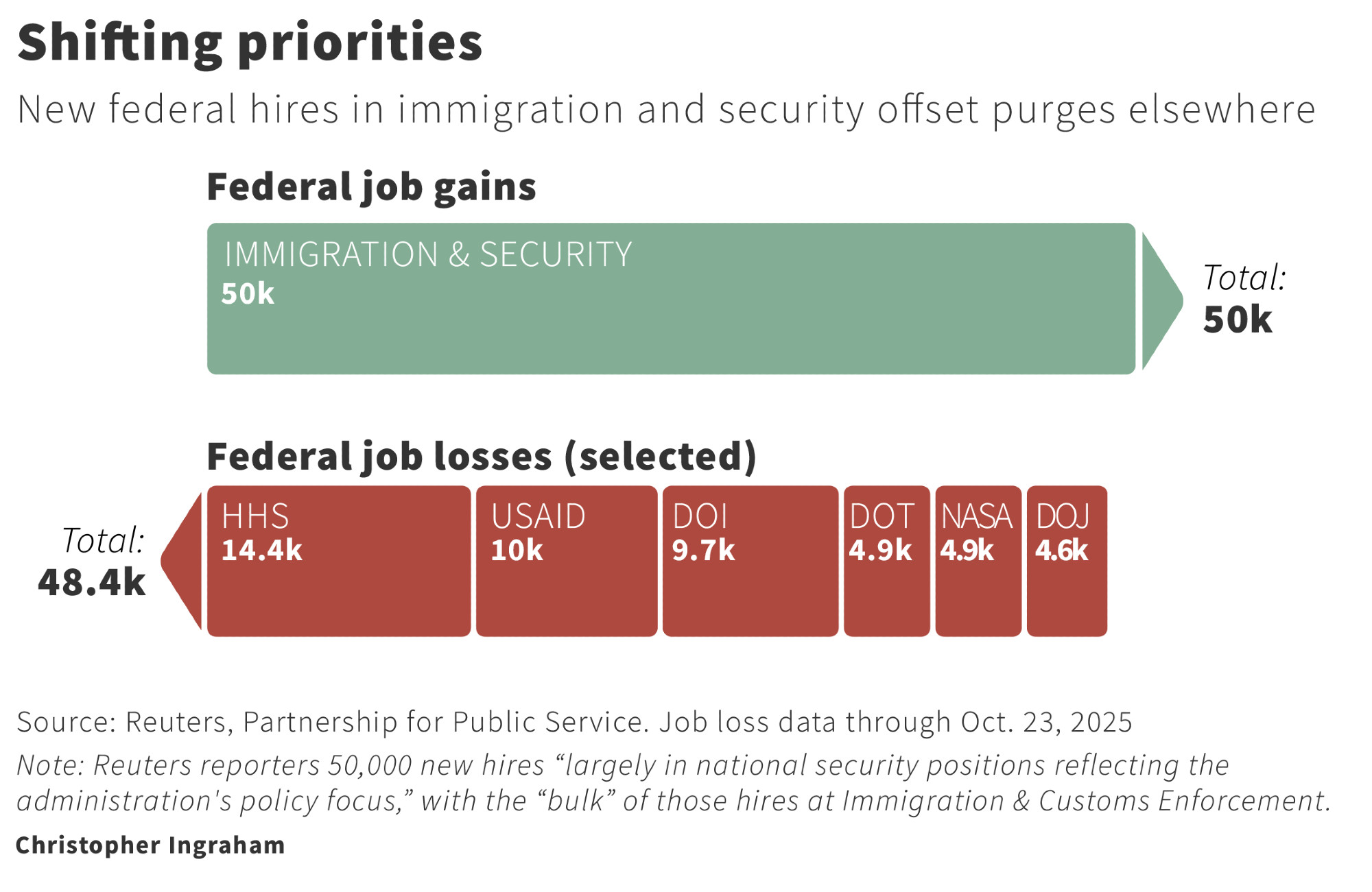
Also, here’s that graphic Nicole mentioned, which shows that we’re firing cancer researchers and VA nurses and replacing them with ICE goons.


Listen on Spotify (transcripts available)

Listen on Apple (transcripts available)

Share this entry

“Shitshow:” Greg Bovino’s Zero Success Rate

Back on October 8, I noted that of the eleven people DHS claimed had been arrested at a September 27 protest at the Broadview ICE facility in Chicago, a protest at which Greg Bovino had promised a “shitshow,” the cases of all but one had been dismissed.

Bovino, I noted, was batting just 9% on his claims that protestors had engaged in violence.

Well, yesterday, the case of Dana Briggs, a 70-year old Air Force veteran charged with assault when he fell as officers were pushing him back, was dismissed too. He had planned to call Bovino as a witness at his December trial. Bovino’s success rate at substantiating his claim there were any rioters from that day is now zero.

Briggs is not actually the most stunning dismissal from yesterday. The case against Marimar Martinez (and her co-defendant Anthony Ruiz) was also dismissed, just before a follow-up hearing on the things the CBP agent, Charles Exum, did and said before and after he shot her.

At a press hearing afterward, Martinez’ attorney Christopher Parente suggested they would still be seeking vindication for her, so hopefully we’ll still get to learn what DOJ dropped the case in hopes of suppressing.

The Magistrate Judge who dismissed Briggs case (who had also signed the arrest warrants for the five actual arrests on September 27), Gabriel Fuentes, wrote a long opinion about the collapse of the September 27 cases.

Examining more closely the five September 27 Broadview criminal arrest cases, all of which came before the undersigned magistrate judge, the Court notes the following facts:

1) The initial complaints charged four (Collins, Robledo, Ivery, and Briggs) of the foregoing five persons with felony violations of Section 111(a). Only the complaint against Mazur was filed as a misdemeanor.

2) With today’s dismissal of the Briggs criminal information, none of these cases remains pending today – all have been dismissed.

3) As the docket entries reflect in all five of the cases, the undersigned magistrate judge obtained a sworn statement from the affiants in each affidavit, at the time of complaint issuance, that not only were the affidavit allegations true, but that video evidence of the encounters existed, that the affiants had reviewed the video evidence, and that the video evidence corroborated the version of events set forth in the affidavits. Mazur (D.E. 11); Collins/Robledo (D.E. 26); Ivery (D.E. 13); and Briggs (D.E. 14).

[snip]

4) Each of the five persons arrested on September 27 from Broadview on Section 111 charges endured official detention (or other government restrictions on their liberty) after their arrests.

[snip]

Importantly, nothing in this order should be construed as scolding the government for dismissing in these cases. Dismissing appears to be the responsible thing for the government to have done, in light of the government’s judgment and discretion. But the Court cannot help but note just how unusual and possibly unprecedented it is for the U.S. Attorney’s Office in this district to charge so hastily that it either could not obtain the indictment in the grand jury or was forced to dismiss upon a conclusion that the case is not provable, in repeated cases of a similar nature. Federal arrest brings federal detention, even for a short time. It brings the need to obtain counsel, to appear at court hearings, to answer the charges (as Briggs did in this case, pleading not guilty), and to prepare for trial (as Briggs also has had to do in this case). Being charged with a federal felony, even if it is later reduced to a misdemeanor, is no walk in the park.

He also noted, repeatedly, that Briggs’ case was dismissed when he noticed his intent to call Bovino to testify.

Also yesterday, Judge Sara Ellis released her 233-page opinion in the Civil Rights case against the ICE/CBP invasion (my weekend reading, I guess), which catalogs the depredations done during that invasion, including her judgement that Bovino is a liar.

Turning to Bovino, the Court specifically finds his testimony not credible. Bovino appeared evasive over the three days of his deposition, either providing “cute” responses to Plaintiffs’ counsel’s questions or outright lying. When shown a video of agents hitting Rev. Black with pepper balls, Bovino denied seeing a projectile hit Rev. Black in the head. Doc. 191- 3 at 162:21–165:17; Doc. 22-44 (Ex. 44 at 0:10–12, available at https://spaces.hightail.com/space/ZzXNsei63k). In another video shown to Bovino, he obviously tackles Scott Blackburn, one of Plaintiffs’ declarants. Doc. 191-3 at 172:13–173:7; Doc. 22-45 (Ex. 45 at 0:19–30, available at https://spaces.hightail.com/space/ZzXNsei63k). But instead of admitting to using force against Blackburn, Bovino denied it and instead stated that force was used against him. Doc. 191-3 at 173:9–176:11, 179:11–181:5. Bovino also testified that, in Little Village on October 23, 2025, several individuals associated with the Latin Kings were found taking weapons out of the back of their car, and that they, as well as at least one individual on a rooftop and one person in the crowd of protesters, all wore maroon hoodies. Id. at 227:2– 228:21. He further testified that he believed the “maroon hoodies . . . would signify a potential assailant or street gang member that was making their way to the location that I was present” and that “there did begin to appear, in that crowd, maroon hoodies, both on top of buildings and in the crowd.” Doc. 237 at 18:22–19:10. But Bovino also admitted that he could not identify a street gang associated with the color maroon, id. at 19:11–13, although Hewson acknowledged that while Latin Kings members usually wear black, “they also can throw on maroon hoodies,” Doc. 255 at 264:17–20.10 Even were maroon hoodies to signify gang membership, the only evidence on footage from the relevant date of individuals dressed in maroon protesting in Little Village consists of a male wearing a maroonish jacket with an orange safety vest over it, Alderman Byron Sigcho-Lopez wearing a maroon sweater with a suit jacket over it, a female in a maroon shirt, a female in a maroon sweatshirt, and a man with a maroon hoodie under a green shirt and vest. Axon_Body_4_Video_2025-10-23_1053_D01A38302 at 10:03–10:33; Axon_Body_4_Video_2025-10-23_1106_D01A32103 at 16:12–17:17. Bovino’s and Hewson’s explanations about individuals in maroon hoodies being associated with the Latin Kings and threats strains credulity.

Most tellingly, Bovino admitted in his deposition that he lied multiple times about the events that occurred in Little Village that prompted him to throw tear gas at protesters. As discussed further below, Bovino and DHS have represented that a rock hit Bovino in the helmet before he threw tear gas. See Doc. 190-1 at 1; Homeland Security (@DHSgov), X (Oct. 28, 2025 9:56 a.m.), https://x.com/dhsgov/status/1983186057798545573?s=46&t=4rUXTBt_W24muWR74DQ5A. Bovino was asked about this during his deposition, which took place over three days. On the first day, Bovino admitted that he was not hit with a rock until after he had deployed tear gas. Doc. 191-3 at 222:24–223:18. Bovino then offered a new justification for his use of chemical munitions, testifying that he only threw tear gas after he “had received a projectile, a rock,” which “almost hit” him. Doc. 191-3 at 222:24–223:18. Despite being presented with video evidence that did not show a rock thrown at him before he launched the first tear gas canister, Bovino nonetheless maintained his testimony throughout the first and second days of his deposition, id. at 225–27; Doc. 237 at 11–17. But on November 4, 2025, the final session of his deposition, Bovino admitted that he was again “mistaken” and that no rock was thrown at him before he deployed the first tear gas canister. Doc. 238 at 9:12–21 (“That white rock was . . . thrown at me, but that was after . . . I deployed less lethal means in chemical munitions.”); id. at 10:20–23 (Q. [Y]ou deployed the canisters, plural, before that black rock came along and you say hit you in the head, correct? A. Yes. Before the rock hit me in the head, yes.”).

This is what the complete collapse of credibility looks like.

It should have happened after Bovino got caught prevaricating on the stand in Brayan Ramos-Brito’s Los Angeles trial in September, another protestor charged with assault but ultimately exonerated.

But unless and until an Appeals Court disrupts Ellis’ finding (the Seventh Circuit has stayed her order with respect to remedy, not fact-finding), the word of Greg Bovino will be utterly useless in any court in the United States.

Greg Bovino and his violent goons have moved on, at least to Charlotte (where — as Chris Geidner laid out — Bovino doesn’t understand he’s the guy trying to kill Wilbur, not the clever spider who thwarts that effort), possibly already onto New Orleans.

But his reputation as a liar will now follow him wherever he goes.

Share this entry

How City of Chicago Beat Back Stephen Miller’s Shoddy Propaganda … So Far

No one has confessed they were wrong that JB Pritzker’s late August messaging was enough to stave off an invasion.

Shortly after Pritzker had that press conference on August 27, Trump announced he was going to invade New Orleans instead of Chicago, implying that he wanted to be invited to invade.

President Donald Trump said on Wednesday that he may deploy federal troops to New Orleans next, not Chicago, and is waiting for governors to ask for help — a shift in his rhetoric about moving into major U.S. cities uninvited.

“We are making a determination now: Do we go to Chicago? Or do we go to a place like New Orleans where we have a great governor, Jeff Landry, who wants us to come in and straighten out a very nice section of this country that has become quite – quite tough, quite bad?” Trump said during an Oval Office meeting alongside Poland’s new president.

“You have New Orleans, which has a crime problem. We’ll straighten that out in two weeks, easier than D.C.,” Trump said.

That was a walk-back of his declaration just 24 hours earlier that “we’re going in” to Chicago, a city he has long maligned for violent crime but has a Democratic governor who opposes Trump’s deployment of federal troops in his state.

That led to a wave of wishcasting that Pritzker’s strong words (particularly as compared to what Gavin Newsom had done) were enough to stave off invasion.

They weren’t.

The details in Illinois’ lawsuit that has, thus far, at least, halted the invasion by the National Guard, reveal that even as lefties were celebrating the effect of Pritzker’s firey rhetoric, ICE was laying the groundwork to create the excuse to send in troops.

On September 2, 2025—as President Trump was repeatedly threatening a troop deployment in Chicago—ICE’s Chicago Field Director Russell Hott and Assistant Field Director Jimmy Bahena met with Broadview’s Chief of Police, Thomas Mills.76 In that meeting, Director Hott informed Chief Mills and his staff that, beginning the next day, a large number of federal agents, including approximately 250 to 300 CBP agents, would begin arriving in Illinois to assist with a ramped-up immigration enforcement campaign in the Chicagoland area.77 Director Hott stated their goal was to make large numbers of immigration-related arrests and stated that the ICE facility in Broadview would be the primary processing location for the operation.78 Director Hott stated that the facility would operate continuously, seven days per week for approximately 45 continuous days.79

Director Hott also informed Chief Mills that ICE officials expected numerous protests, including potential property damage and assaults against law enforcement personnel, similar to what had occurred in Los Angeles earlier in the year. 80 ICE officials also expected there to be impacts on traffic and businesses in the immediate vicinity of ICE’s detention center, located at 1930 Beach Street in Broadview. 81 [my emphasis]

Broadview Police Chief Thomas Mills described in a declaration how the arrival of agents in tactical gear changed the tone of the crowd.

21. At around 10:00 a.m. that morning, 20-30 federal agents parked their vehicles in the parking lot on the opposite side of Beach Street and began to walk across the street toward the ICE facility. The agents were dressed in camouflage tactical gear and had masks covering their faces. September 12 was the first day that I recall seeing federal agents on scene dressed in that manner. It was a very noticeable shift in my mind.

22. As agents approached the ICE facility that day, September 12, the tone of the crowd of protestors changed. The crowd grew louder and began to press closer to the building. Broadview Police officers positioned ourselves on the public way, between the 1930 Beach Street building and the crowd, attempting to keep the crowd on the public way and off of ICE’s property. When the federal agents went into the building, the crowd calmed down, and Broadview Police officers relocated to the outer perimeter of the crowd.

For 44 days and counting, Stephen Miller’s goons have been trying to create a pretext to federalize law enforcement in Chicago.

Along the way, they’ve engaged in a whole bunch of propaganda: making false claims of assault to explain away ICE assaults, setting up dramatized attacks on an entire apartment building, deliberately creating “shitshows” that result in arrests that almost all get dismissed.

And at least thus far, it has not worked.

When Judge Amy Perry ruled against the National Guard deployment last week, she found that all three government affiants claiming there was unrest in Chicago that justified an invasion lacked credibility.

The Court therefore must make a credibility assessment as to which version of the facts should be believed. While the Court does not doubt that there have been acts of vandalism, civil disobedience, and even assaults on federal agents, the Court cannot conclude that Defendants’ declarations are reliable. Two of Defendants’ declarations refer to arrests made on September 27, 2025 of individuals who were carrying weapons and assaulting federal agents. See Doc. 62-2 at 19; Doc. 62-4 at 5. But neither declaration discloses that federal grand juries have refused to return an indictment against at least three of those individuals, which equates to a finding of a lack of probable cause that any crime occurred. See United States v. Ray Collins and Jocelyne Robledo, 25-cr-608, Doc. 26 (N.D. Ill. Oct. 7, 2025); United States v. Paul Ivery, 25-cr-609 (N.D. Ill.). In addition to demonstrating a potential lack of candor by these affiants, it also calls into question their ability to accurately assess the facts. Similar declarations were provided by these same individuals in Chicago Headline Club et. al. v. Noem, 25-cv-12173, Doc. 35-1, Doc. 35-9 (N.D. Ill.), a case which challenged the Constitutionality of ICE’s response to protestors at the Broadview ICE Processing Center. In issuing its TRO against DHS Secretary Kristi Noem, the court in that case found that the plaintiffs would likely be able to show that ICE’s actions have violated protestors’ First Amendment right to be free from retaliation while engaged in newsgathering, religious exercise, and protest, and Fourth Amendment rights to be free from excessive force. Id. at Doc. 43. Although this Court was not asked to make any such finding, it does note a troubling trend of Defendants’ declarants equating protests with riots and a lack of appreciation for the wide spectrum that exists between citizens who are observing, questioning, and criticizing their government, and those who are obstructing, assaulting, or doing violence.5 This indicates to the Court both bias and lack of objectivity. The lens through which we view the world changes our perception of the events around us. Law enforcement officers who go into an event expecting “a shitshow” are much more likely to experience one than those who go into the event prepared to de-escalate it. Ultimately, this Court must conclude that Defendants’ declarants’ perceptions are not reliable.6

Finally, the Court notes its concern about a third declaration submitted by Defendants, in which the declarant asserted that the FPS “requested federalized National Guard personnel to support protection of the Federal District Court on Friday, October 10, 2025.” Doc. 62-3. This purported fact was incendiary and seized upon by both parties at oral argument. It was also inaccurate, as the Court noted on the record. To their credit, Defendants have since submitted a corrected declaration, and the affiant has declared that they did not make the error willfully. Doc. 65-1. All of the parties have been moving quickly to compile factual records and legal arguments, and mistakes in such a context are inevitable. That said, Defendants only presented declarations from three affiants with first-hand knowledge of events in Illinois. And, as described above, all three contain unreliable information. [Links added]

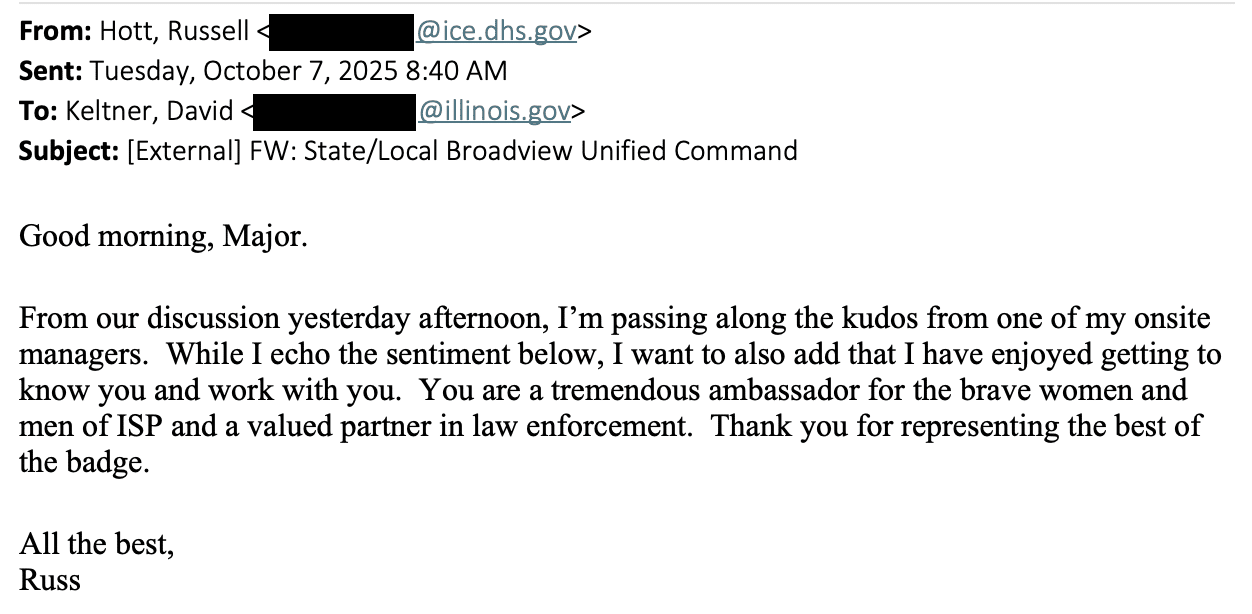
One of the most persuasive things Illinois was able to do was to show that at the same time that ERO Field Director Russ Hott was submitting a sworn declaration claiming all manner of horribles, he was sending email saying something totally different to the local cops saying something totally different.

It’s not clear, in this day and age, whether definitively proving that Stephen Miller and Kristi Noem and Greg Bovino and Tricia McLaughlin are just making shit up will be enough. Certainly, the right wingers on SCOTUS have proven just as susceptible to the Fox News propaganda bubble as Trump himself.

But thus far, at least, truth has won out over fabrications.

Update: The 7th Circuit just declined to disrupt Judge Perry’s retraining order. The panel — which included Trump appointee Amy St. Eve — cited Perry’s credibility ruling this way:

After holding a hearing and assessing the preliminary record, the court granted in part plaintiffs’ request for a temporary restraining order and enjoined the federalization and deployment of the National Guard for 14 days. The court withheld judgment on a preliminary injunction and did not extend its order to non–National Guard military forces or the President himself. The district court recognized the substantial deference due a President’s assessment of whether § 12406(2) or (3)’s factual predicates are satisfied, but it concluded nonetheless that, under its factual findings, the statutory requirements were not met. Where the declarations of the administration conflicted with the declarations of state and local law enforcement concerning conditions on the ground, the court made a credibility determination in plaintiffs’ favor. In particular, the court found that all three of the federal government’s declarations from those with firsthand knowledge were unreliable to the extent they omitted material information or were undermined by independent, objective evidence.

[snip]

Even giving great deference to the administration’s determinations, the district court’s contrary factual findings— which, at this expedited phase of the case, are necessarily preliminary and tentative—are not clearly erroneous. The submitted evidence consists almost entirely of two sets of competing declarations describing the events in Broadview. The district court provided substantial and specific reasons for crediting the plaintiffs’ declarations over the administration’s, and the record includes ample support for that decision. Given the record support, the findings are not clearly erroneous. See United States v. Nichols, 847 F.3d 851, 857 (7th Cir. 2017) (explaining that “where the district court’s factual findings are supported by the record, we will not disturb them” under clear-error review).

The opinion was more important for the way it defined rebellion (in part, because the same ruling will be the starting point for discussions of insurrection).

Although we substantially agree with the definition of rebellion set forth by the district court in Newsom, we emphasize that the critical analysis of a “rebellion” centers on the nature of the resistance to governmental authority. Political opposition is not rebellion. A protest does not become a rebellion merely because the protestors advocate for myriad legal or policy changes, are well organized, call for significant changes to the structure of the U.S. government, use civil disobedience as a form of protest, or exercise their Second Amendment right to carry firearms as the law currently allows. Nor does a protest become a rebellion merely because of sporadic and isolated incidents of unlawful activity or even violence committed by rogue participants in the protest. Such conduct exceeds the scope of the First Amendment, of course, and law enforcement has apprehended the perpetrators accordingly. But because rebellions at least use deliberate, organized violence to resist governmental authority, the problematic incidents in this record clearly fall within the considerable daylight between protected speech and rebellion.

Applying our tentative understanding of “rebellion” to the district court’s factual findings, and even after affording great deference to the President’s evaluation of the circumstances, we see insufficient evidence of a rebellion or danger of rebellion in Illinois. The spirited, sustained, and occasionally violent actions of demonstrators in protest of the federal government’s immigration policies and actions, without more, does not give rise to a danger of rebellion against the government’s authority. The administration thus has not demonstrated that it is likely to succeed on this issue.

The panel allowed Trump to keep Guard deployed, sitting in Illinois doing nothing. But they cannot patrol the streets.

Update: Trump has appealed to SCOTUS. Amy Coney Barrett has ordered Illinois to respond by Monday evening, but did not immediately overturn the stay.

Share this entry

Greg Bovino’s September 27 “Shitshow:” Batting 9% [Updated]

In Illinois’ Motion for a Temporary Restraining Order against Trump’s invasion, they describe how, on September 27, Greg Bovino drive three Chevy Tahoe’s into the Broadview police facility, promising a “shitshow,” later that day. That led to increased targeting of protestors and even journalists.

Around 7:00 a.m. on Saturday, September 27, three Chevrolet Tahoe SUVs appeared in the Broadview Police Department’s parking lot without invitation. 91 Federal agents, including Agent Bovino of the CBP, emerged from the vehicles with a message for the Broadview police: prepare for “a shitshow.”92 Specifically, federal agents, including Agent Bovino, told the Broadview police to expect increased use of chemical munitions and increased ICE activity in Broadview.93

That afternoon and evening, September 27, Agent Bovino and his colleagues followed through on their warning. Groups of federal agents repeatedly chased people on foot through the streets of Broadview in ongoing vehicle traffic.94 Around dusk, Agent Bovino and a large team of fatigue-clad, tactically equipped, and masked federal agents escorted multiple federal vehicles out of the ICE detention facility. 95 And, again, federal agents fired pepper balls, rubber bullets, and teargas cannisters at protestors.96 Over the course of the protests on September 26 and 27 in Broadview, DHS reported making a total of eleven arrests of protestors, though only five of the individuals arrested have been criminally charged. 97

[snip]

The actions of federal officials since the September 26 DHS-to-DOD memorandum belie the notion that the protests in Broadview exceed law enforcement’s capacity to address them. See 10 U.S.C. § 12406 (referring to inability to execute federal law with the “regular forces”). When confronted with a protest of approximately 100 people on the evening of September 27 outside the Broadview ICE facility, federal agents dispersed the protestors and arrested eleven people, including a journalist, in the process.140 Far from being overwhelmed by this protest, a DHS spokesperson bragged on social media about the number of arrests its agents made in response.

If the September 27 protest in Broadview had truly threatened to render the federal government incapable of executing federal law, then presumably the federal officials in charge of the ICE facility in Broadview would have focused their energy, attention, and resources on securing it the following day, September 28. Instead, CBP sent dozens of armed, fatigue-clad Border Patrol agents led by Agent Bovino through downtown Chicago—twelve miles removed from the ICE facility in Broadview.143 These actions are impossible to square with any good-faith argument from the federal government that it is unable to execute federal law in Broadview or anywhere else in Illinois.141 And although DHS declared all 200 people at the protest to be “rioters,” only eleven people had been arrested by federal agents, and, as of September 29, only five had been criminally charged by federal prosecutors.142

91 Id. [declaration of Broadview Police Chief Thomas Mills] ¶ 38.

92 Id.

93 Id.

94 “Agents chase after protesters, smoke and pepper bullets deployed outside Broadview ICE facility” ABC 7 Chicago (Sept. 26, 2025), available at https://www.youtube.com/watch?v=Byews1aX7XI.

95 “Protest continues outside ICE facility in Broadview,” CBS News (Sept. 27, 2025), available at https://www.cbsnews.com/chicago/video/protest-continues-outside-ice-facility-in-broadview/; see also Ex. 13, Declaration of Gil Kerlikowske (“Kerlikowske Decl.”), ¶¶ 46-51; Ex 15, Declaration of Commander Jacqueline Cepeda (Cepeda Decl.) at ¶ 8.

96 Ex. 4 (Mills Decl.) ¶¶ 35-36, 40.

97 Sabrina Franza, “Arrested Broadview ICE protestors appear in court; 2 held, 3 released,” CBS News Chicago (Sept. 29, 2025), available at: https://www.cbsnews.com/chicago/news/broadview-ice-facility-protesters-arrestcourt/.

[snip]

140 Ashlyn Wright, et al., “U.S. Border Patrol takes over security of Broadview ICE facility, protests continue over the weekend,” WGN (Sept. 27, 2025), available at: https://wgntv.com/news/operation-midway-blitz/protesters-rallyoutside-broadview-ice-facility-against-operation-midway-blitz/ (noting that “[a]bout 100 demonstrators” gathered outside the Broadview ICE facility” on Saturday, September 27); Cindy Hernandez, et al., “Broadview officials say ICE agents warned that mayor’s comments would bring consequences,” Chicago Sun-Times (Sept. 27, 2025), available at: https://chicago.suntimes.com/news/2025/09/27/ice-broadview-action-mayor-katrina-thompsonimmigration; @DHSgov, 8:50 a.m., Sept. 28, 2025 post on X.com, available at: https://x.com/DHSgov/status/1972297960319832252.

141 @DHSgov, 8:50 a.m., Sept. 28, 2025 post on X.com, available at: https://x.com/DHSgov/status/1972297960319832252.

142 ABC7 Chicago Digital Team, “Neurodivergent man among 5 protesters charged after clash at Broadview ICE facility, supporters say,” ABC7 (Sept. 29, 2025), available at: https://abc7chicago.com/post/ice-chicago-todayprotesters-expected-return-broadview-facility-weekend-clashes/17902425/. [my emphasis]

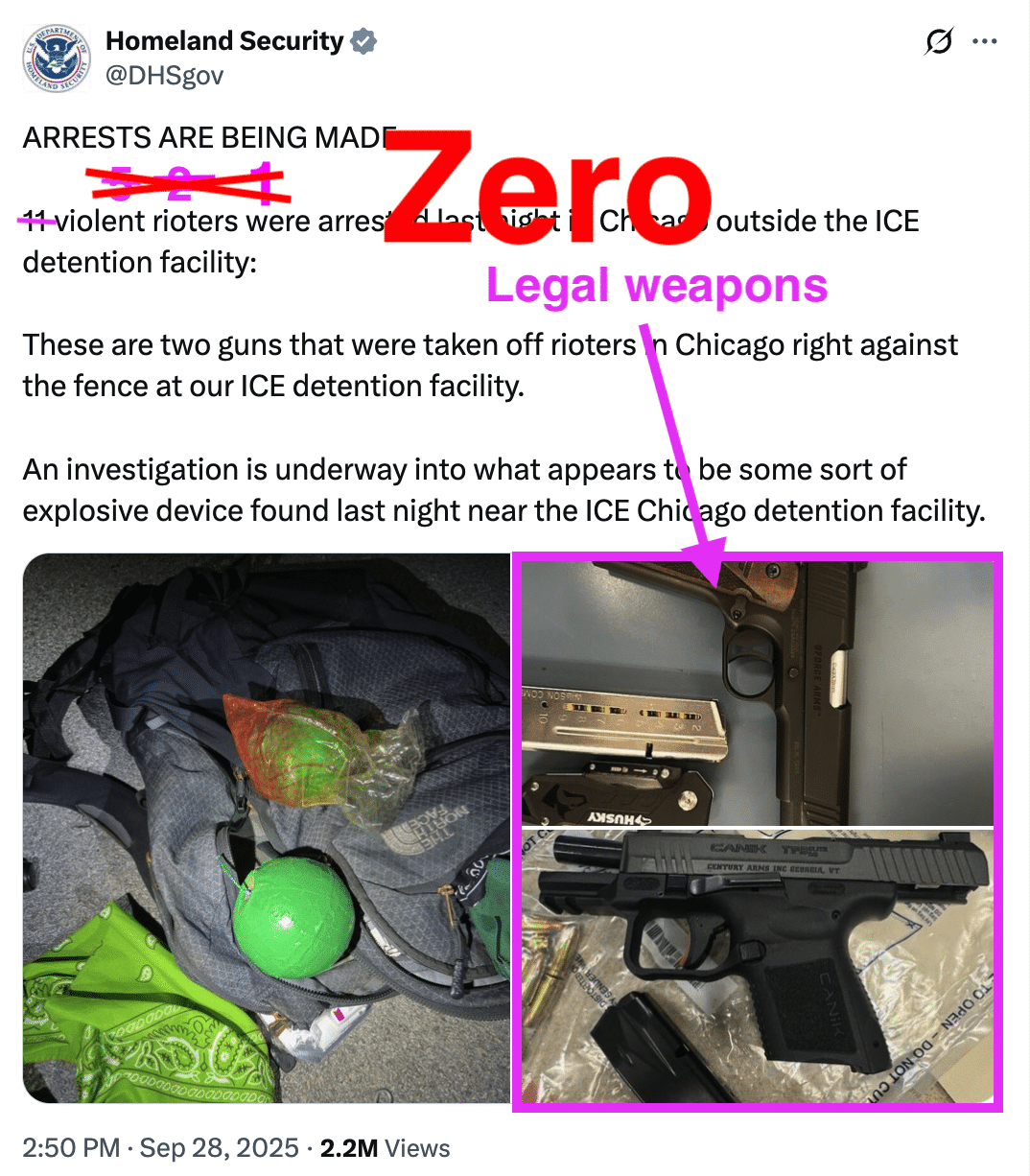
In the later discussion of the provocation, the filing noted that DHS called the eleven people arrested “violent rioters” in included two weapons that, DHS claimed, “were taken off rioters” at Broadview.

Two whole days ago, filing cited this story (at footnote 97), which noted that only five of the eleven claimed arrests were charged on the docket. The later section, as well as this story (at footnote 142), which noted that of those five, one was neurodivergent.

One of the people not formally challenged, as reflected in the lawsuit by Chicago’s civil society filed same day as Illinois’ lawsuit, journalist Stephen Held described being arrested at the “shitshow.”

The five cases that had been (and have been) filed by that point were:

  • Paul Ivery, the neurodivergent man, who tragically spoke to the cops and admitted he said, “I’ll fucking kill you right now,” to a senior Border Patrol official who admitted he “does not specifically recall what IVERY said to [him] given the commotion.” The government initially asked for him to be detained, but then agreed to his release.
  • Dana Briggs, whose hand a Border Patrol official grabbed to prevent him from handing his phone to a friend, after which (the complaint claims) Briggs hit the CBP officer in the wrist. The government agreed to his release on $10,000 unsecured bail.
  • Ray Collins and Jocelyne Robledo, a couple who were pushed as the Feds tried to extend a perimeter of the facility. In the process, the Feds found (and put in their social media post) that each had weapons. Collins, who allegedly pushed back, was detained. He filed for release, noting that the weapons he and his partner both had were licensed Concealed Carry weapons. He was released on bail on October 2.
  • Hubert Mazur. Even the complaint admits that the the alleged Border Patrol victim pushed Mazur first, which led both of them to fall to the ground. He was released on his how recognizance.

Yesterday, a day before his preliminary hearing, the government moved to dismiss the case against Mazur. the docket minute explains that when the government reviewed the video evidence of the incident, they decided they could not even charge a misdemeanor.

The government provided additional basis for its motion, noting that the government’s review, after defendant’s arrest, of additional body-worn camera video evidence caused the government to decide not to file an information in this case, in which the compliant charged the case as a misdemeanor. Further, the government confirmed on the record that prior to issuance of the complaint, the complaint affiant had sworn under oath that the affiant had reviewed video evidence that corroborated the complaint’s version of events. The Court confirmed at the hearing that such sworn affirmation was a substantial part of the basis for the Court’s initial determination of probable cause on the complaint.

This morning, the government moved to dismiss the cases against Collins and Robledo. The docket minutes for today’s hearing on the dismissal confirmed (as had been reported elsewhere) that the grand jury no billed an indictment against this couple.

The government provided additional bases for its motion, stating that a U.S. grand jury on 10/7/25 returned a “no bill” as to these defendants and thus declined to return an indictment against them. Further, the government confirmed on the record that the complaint affiant swore under oath that the affiant had reviewed video evidence that corroborated the complaint’s version of events, and the Court confirmed that such sworn affirmation was a substantial part of the basis for the Court’s initial determination of probable cause on the complaint.

There are, admittedly, several sealed dockets. NDIL still has not docketed the case of the alleged Latin King member charged with soliciting a plot against Greg Bovino, and if there were any unsealed charges filed against the people from the South Shore apartment raid, it’s only two guys arrested on warrants for a narcotics case in Texas that doesn’t mention any gang involvement.

But as of right now, those eleven charges of which DHS boasted have turned into two.

Greg Bovino, who promised a shitshow, is batting just 18% on remaining public charges, less than two weeks out.

Update: Here’s Block Club Chicago’s report on the dismissed charges, which includes interviews.

“I’ve been practicing law for 54 years and I’ve never had another client with no bill returned,” said Richard Kling, an attorney representing Collins. “This is a once-in-a-lifetime for me.”

[snip]

Kling said his client, who had also previously been jailed for more than two days following his arrest last month, was “obviously relieved” but he cautioned that prosecutors have said they still have 2 1/2 weeks to determine whether to pursue other charges related to the arrest.

On Wednesday, citing the adage that a grand jury could indict a ham sandwich, Kling told Block Club that prosecutors apparently had “less evidence than a ham sandwich” against his client.

“The grand jury, I hope, took the position that people have a right to protest,” Kling said. “They decided that the First Amendment is more important than criminal charges.”

Update: And … NDIL just moved to dismiss the Ivrey complaint — the one where he seemingly confessed.

Update: Once again, in dismissing the charges, Chicago judges are laying a record that the affiant in these cases did not do their due diligence.

ORDER as to Paul Ivery (1): Hearing held on the government’s motion to dismiss the complaint without prejudice (doc. # 10 ). The government provided additional bases for its motion on the record. Further, the government confirmed on the record that the complaint affiant swore under oath that the affiant had reviewed video evidence that corroborated the complaint’s version of events, and the Court confirmed that such sworn affirmation was a substantial part of the basis for the Court’s initial determination of probable cause on the complaint. The government made an oral motion to vacate the release order, noting that vacatur of the order is part and parcel of case dismissal. For the reasons stated on the record, the Court: (1) granted the oral motion to vacate the release order (doc. # 8 ), and (2) granted the motion to dismiss (doc. # 10 ) without prejudice without objection. The release order (doc. # 8 ) is vacated. The case is dismissed without prejudice. Signed by the Honorable Gabriel A. Fuentes on 10/10/2025. Mailed notice (aee, ) (Entered: 10/14/2025)

Share this entry

Governor Pritzker Argues Trump Is Invading Illinois Out of Animus

Very broadly speaking, the state three challenges to Trump’s invasions adopt different theories.

  • The 22-page California challenge (the TRO request was filed separately), which was filed during large scale protests, contested whether the scale of the protest merited nationalization of the Guard and invasion by the Marines
  • The 41-page Oregon challenge basically showed that Trump’s batshit claims about Portland don’t match the reality on the ground, noting that to the extent there were significant protests, they subsided long before Trump called in the Guard
  • The 69-page Illinois challenge argues that the invasion arises out of animus

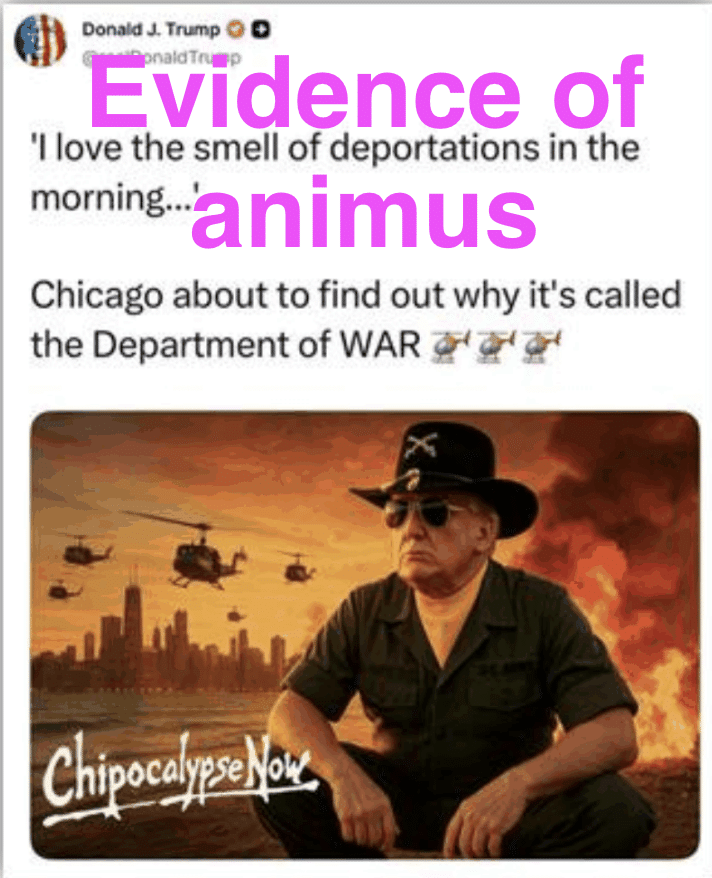
Of those 69 pages in the Illinois suit, 21 are dedicated to describing Trump’s animus, which it dates as starting in 2013, continued though his first presidential term, and even came out during the interregnum.

44. The supposed current emergency is belied by the fact that Trump’s Chicago troop deployment threats began more than ten years ago. In a social media post from 2013 Trump writes “we need our troops on the streets of Chicago, not in Syria.”

[snip]

47. Three years ago, in 2022, Trump was between his presidential terms. In two separate speeches that summer, Trump shared his plans for Chicago, stating in July 2022 that the “next president needs to send the National Guard to the most dangerous neighborhoods in Chicago.” He reiterated that point at the August 2022 CPAC speech, saying that the problem was “these cities that were run by Democrats going so bad so fast.”

It shows how Trump and Stephen Miller’s targeting

57. On April 18, 2025, Stephen Miller, White House Deputy Chief of Staff for Policy and the Homeland Security Advisor leveled the accusation that “Sanctuary cities shield criminal illegal aliens from removal.” Although not a lawyer, he opined that “these cities are engaged in systemic criminal violations and that they are engaged in a scheme to nullify and obstruct the duly enacted laws of the United States of America.” Miller specifically cited Chicago, along with Los Angeles and Boston, saying the cities were “waging war against the very idea of nationhood.”

It showed how, in May, DHS ditched its first draft list of sanctuary jurisdictions to get rid of the Republican ones on the list.

63. In the midst of these immigration-related federal defunding actions and responsive lawsuits, DHS published, on May 29, 2025, a list of 500 purported “sanctuary jurisdictions” around the country. It accused them of “shamefully obstructing” the Trump administration’s deportation plans and “shielding dangerous criminal aliens.” Fox News Channel 32 Chicago accurately characterized the list as an escalation of “efforts to penalize states and cities that limit cooperation with federal immigration authorities.”

64. However, days later, based on widespread news reporting as early as June 1st, that first sanctuary jurisdiction list was gone. As reported, very soon after publishing the list, the Trump administration faced objections from Republican stronghold jurisdictions that found themselves on the list. The Department of Homeland Security quickly and quietly removed the list from the website where it had been posted.

65. Then on July 25, 2025, the federal district judge presiding over the United States’ lawsuit regarding Illinois’s, Chicago’s and Cook County’s immigration-related laws and policies dismissed the case. United States v. Illinois, No. 25 CV 1285, 2025 WL 2098688, *27 (N.D. Ill. July 25, 2025). In concluding that there was no claim for the United States to pursue, the court held that “the Sanctuary Policies reflect [Illinois’s, Chicago’s and Cook County’s] decision to not participate in enforcing civil immigration law—a decision protected by the Tenth Amendment and not preempted by the INA. Finding that these same Policy provisions constitute discrimination or impermissible regulation would provide an end-run around the Tenth Amendment. It would allow the federal government to commandeer States under the guise of intergovernmental immunity— the exact type of direct regulation of states barred by the Tenth Amendment.” Id.

66. Less than two weeks later, the Trump administration posted a new version of its sanctuary jurisdiction target list. That August 5, 2025, publication shortened the list from about 500 to just 35 jurisdictions. The new sanctuary “jurisdiction” list targeted twelve states (including Illinois, California, and Oregon), the District of Columbia, eighteen cities (including Chicago), and four counties (including Cook County).

It tracks a number of things Kristi Noem and Greg Bovino did to create a pretext for invasion, focusing closely on Bovino’s boat trips around the river, but also describing the way Noem went out of the way to address protestors directly (the Chief of Police of Broadview was pretty unhappy about that event).

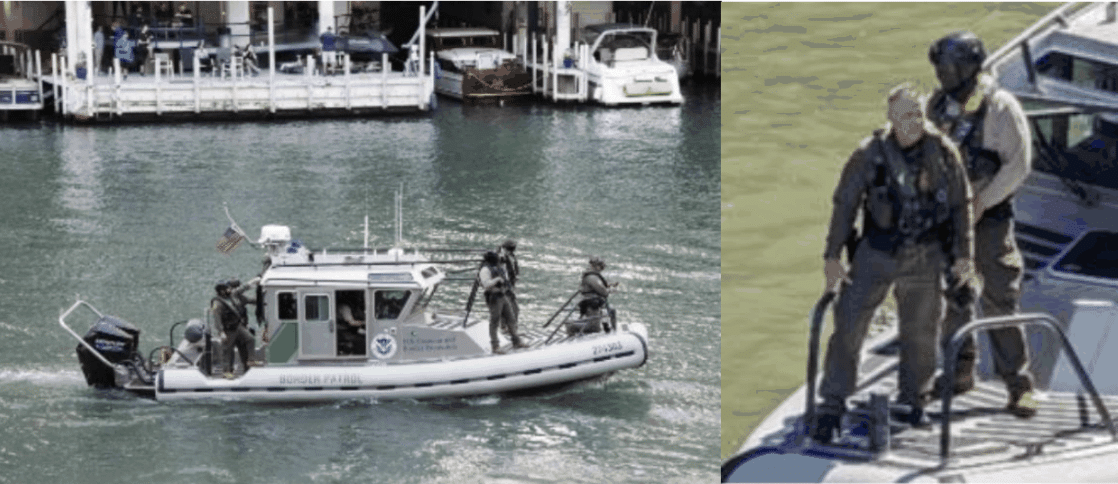
106. As this DHS show of force in Broadview was escalating, CBP appeared in tactical gear with large weapons in hand around the City of Chicago. On September 25, 2025, Greg Bovino, head of the CBP operations in Chicago, led a small fleet of “Border Patrol” boats downtown on the Chicago River, with officers armed with semi-automatic rifles. Photographs in the local news showed the boats passing the upscale Riverwalk, in the area of the Trump Tower:

107. The CBP boats were seen again on the Chicago River in the following days, seemingly doing nothing more than eponymous showboating.

108. However, the day after the Border Protection’s first unimpeded river fleet cruise, DHS executed a memo expressing an urgent need for support in Illinois from the “Department of War.” Specifically, on September 26, DHS requested from DoD 100 troops to protect ICE facilities in Illinois with “immediate and sustained assistance” because of a fictional “coordinated assault by violent groups . . . actively aligned with designated domestic terror organizations . . . .” DoD’s National Guard Bureau informally made this request to Illinois for its National Guard troops on September 27, which Illinois refused the following day.

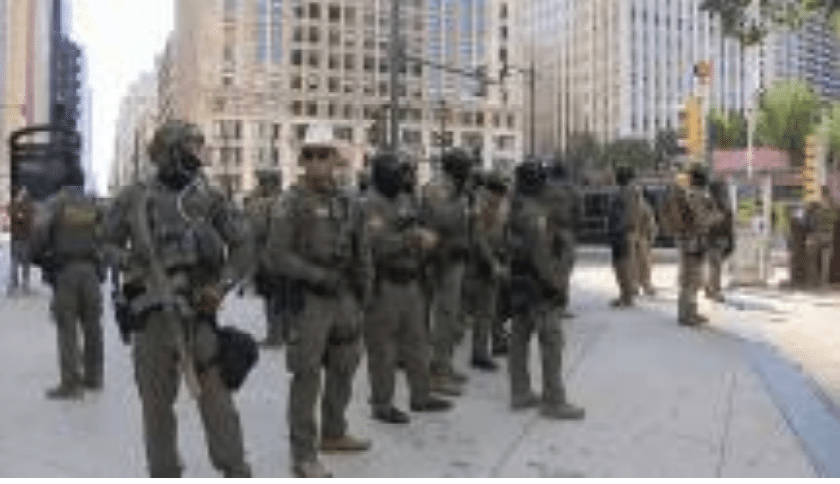
109. Two days after this request, on Sunday, September 28, around 100 DHS agents, dressed in militaristic tactical gear and carrying semi-automatic rifles, patrolled the Chicago business district near Millenium Park and Michigan Avenue. They positioned themselves in large groups on major pedestrian thoroughfares in tourist and commercial areas.

[snip]

112. On October 3rd, 2025, Kristi Noem, the United States Secretary of Homeland Security, orchestrated a visit to the Broadview facility designed to provoke those who could hear or see the visit. Throughout this visit, rather than avoiding the protesters, Secretary Noem and her entourage, including Bovino, entered areas congested with protesters, even when there were alternative routes that would have avoided those areas.

113. Defendant Noem was videotaped speaking to assembled DHS agents about protestors outside of the ICE facility in which she stated: “Today, when we leave here we’re going to go hard. We’re going to hammer these guys that are advocating for violence against the American people . . . we’re going to go out there and we’re going to make sure that there’s consequences for the way that they’re behaving and that we’re going to prosecute them” Noem’s comments about protestors “advocating for violence against the American people” are unsupported by public reports, and appear to conflate the First Amendment-protected speech of protestors with political violence.

114. Noem then introduced Bovino, who began his speech saying, “It’s roll up time here, state instrument is a hard power, you’re going to be put into full effect.” Although at that time demonstrators were confined to a free speech area blocks from the ICE facility, and managed by ISP and local police, Bovino called demonstrators an “unsafe crowd.” He further stated, “we’re going to roll them all the way out of here, and when they resist what happens? They get arrested. So it’s now going to be a free arrest zone . . . I’m giving them one warning . . . They’re getting it here as soon as we leave.”

115. Subsequently, Secretary Noem’s motorcade, in a large armored, tactical vehicle known as a BearCat, exited the facility through an entrance congested with protesters, rather than the alternative, which was not. She then proceeded to an area with protesters on all sides and exited the vehicle. Because she affirmatively went to the protest area, the U.S. Secret Service was required to extend the protective perimeter, resulting in federal agents engaging with protesters and prompting ISP involvement. There was no legitimate purpose under federal law for this conduct by defendant Noem.

Sadly, they didn’t describe Russian useful idiot Benny Johnson’s role in all this, because his false claims are a key part of the effort to stoke violence (and, probably, to mislead Trump about what is really happening).

It cites a number of Trump’s false Truth Social claims and fundraising emails, including this one from September 6.

And it describes Trump’s incendiary language to describe peaceful protest, including his declaration of a war from within.

120. A few days later, on September 30 at the Pentagon, Trump and Hegseth addressed a gathering of about 800 top military leaders. Trump took the opportunity again to attack Chicago, stating: “You know, the Democrats run most of the cities that are in bad shape. We have many cities in great shape too, by the way. I want you to know that. But it seems that the ones that are run by the radical left Democrats, what they’ve done to San Francisco, Chicago, New York, Los Angeles, they’re very unsafe places and we’re going to straighten them out one by one.” He went on to say, “And this is going to be a major part for some of the people in this room. That’s a war too. It’s a war from within.”

121. Trump then stated that he had informed defendant Hegseth, “we should use some of these dangerous cities as training grounds for our military National Guard, but military, because we’re going into Chicago very soon.” Defendant Hegseth has now taken formal action to do so.

It used Trump’s invitation for Pete Hegseth to use Chicago as a “training ground” as the introduction of the rest of the complaint.

The complaint describes the shooting of a Chicago man and the lies DHS told about it. The Black Hawk invasion of an apartment building appears elsewhere, to show that there was no interruption of whatever that invasion was meant to be. It doesn’t mention the shooting on Saturday: but emails submitted by the ILNG show that Trump had already made the request for Guard before that event (though they happened nearly simultaneously).

I’ve seen some people speculate, because of more recent events, that Chicago would have a tougher time than Portland to prove there was no purpose for the invasion.

But this is a different, more ambitious argument, effectively showing that Kristi Noem set out to create a pretext for a long contemplated plan to invade Chicago.

Share this entry