For months, I’ve been anticipating the possibility that Trump’s politicized prosecutions will backfire, both by empowering the political martyrs they create and by exposing their own corruption.
I’m interested in this for two reasons: first, the possibility that these prosecutions will backfire, not just by creating sympathetic political martyrs, but also by further exposing Bondi and her top aides as liars violating legal ethics.
A package of filings from Congresswoman LaMonica McIver submitted last night suggests that may soon happen.
She has filed four motions:
Two crucial details lie behind all of them.
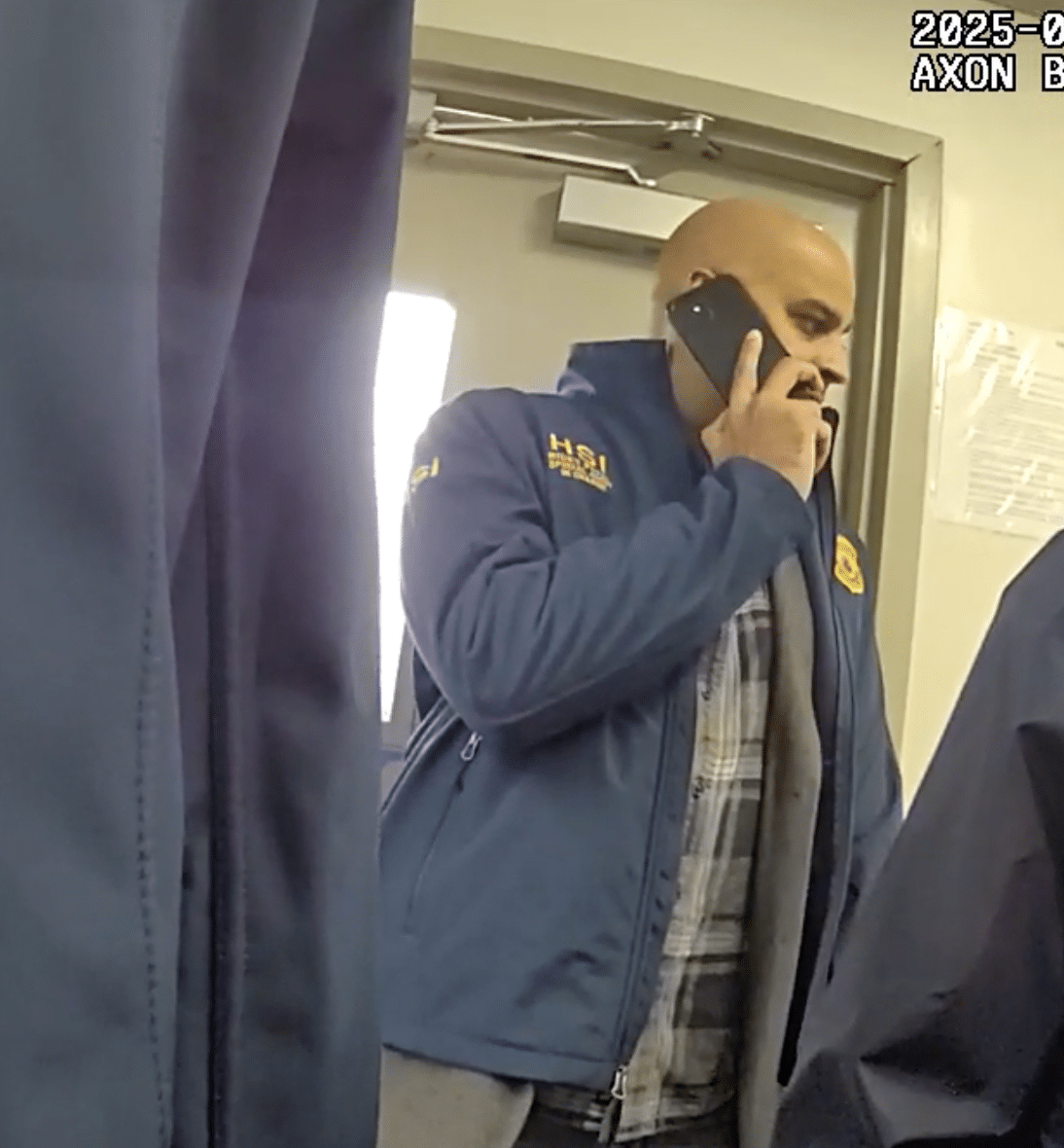
First, according to Body Cam footage provided in discovery (and available to Judge Jamel Semper), after Newark Mayor Ras Baraka left the Delaney Hall facility in response to Ricky Patel’s order to do so, the Deputy Attorney General of the United States instructed Patel (listed as V-1 in all the filings) to arrest the Mayor.
Allegation: After the Mayor complied with HSI’s instructions to “leave the secured area,” agents placed him under arrest “in the unsecured area.” Indictment at 2-3.
Evidence: After a phone call, [Ricky Patel] announced a decision to arrest Mayor Baraka: “I am arresting the mayor . . . even though he stepped out, I am going to put him in cuffs . . . per the Deputy Attorney General of the United States.” Ex. B at 1:16:27-1:17:35. Meanwhile, the Members— who were still being prevented from entering the facility—returned to the entrance gate where they learned that the agents were changing course and renewing their plan to arrest the Mayor on baseless charges. Ex. A at 1:26:40-1:26:50; Ex. H, JR Axon Body Camera Arrest.mp4, at 00:30-00:40.
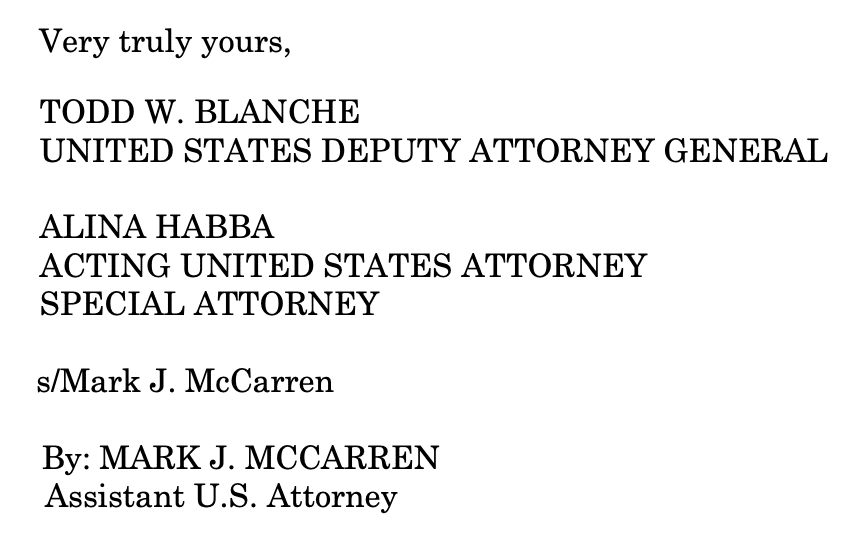
And, according to DOJ’s discovery response to McIver’s initial discovery request, Todd Blanche is signing off on correspondence in this case (possibly because Alina Habba is not a proper US Attorney).
Congressional immunity
Start with the immunity filing. After laying out her election last year (which she notes was a landslide, so let’s hope Trump sees this), McIver describes how starting on her third day in office, she prioritized oversight of immigration matters, with a town hall, a visit to a different detention facility, a letter to Kristi Noem, and a meeting with ICE. She then describes how the video produced in discovery captured her (and Rob Menendez — whose father’s earlier prosecution is the standard for Speech and Debate immunity in the Third Circuit — and Bonnie Watson Coleman) repeatedly describing their visit as congressional oversight.
Body Cam video captured them identifying theirs as a congressional oversight visit when they entered the facility. (This declaration describes the source of each video.)
Allegation: Count One alleges that on May 9, 2025, Congresswoman McIver and her congressional delegation “arrived at Delaney Hall allegedly to conduct a congressional oversight inspection.” Indictment at 1.
Evidence: Representatives McIver, Watson Coleman, and Menendez identified themselves as Members of Congress, explained they were there to conduct congressionally authorized oversight, and asserted their “right to look at the facility” and inspect its “safety, health, [and] services.” See Ex. B, CD Axon Body Camera Pre and Arrest.mp4, at 1:34-2:08.
Other video captured them questioning GEO employees as part of that oversight, while they were made to wait for an hour.
Allegation: The congressional delegation “entered the secured area and proceeded to an interior reception area.” Indictment at 2.
Evidence: The Members were told to remain in that small space for about an hour, during which they were denied access to the facility despite their repeated assertions of statutory authority. Nevertheless, the Members spent that hour pursuing their oversight mission, in part by questioning employees about the facility and its operations. During this time, unbeknownst to the Members, ICE was mobilizing its forces: high-level officials of ICE and Homeland Security Investigations (“HSI”) reported to the facility; munitions-filled vehicles took formation in its secured parking lot, and approximately 15 armed agents assembled just inside the gates. Ex. B at 6:40-13:30, 16:30-17:23, 20:09-35:14; Ex. A, NEPTZ.avi, at 23:00-23:15, 29:40-29:50, 40:50-41:05; Ex C, Axon_Body_4_Video_2025-05- 09_1418_D01AA954X.mp4, at 00:30-00:44; Ex D, Axon_Body_4_Video_2025-05- 09_1418_D01AA942W.mp4, at 00:37
More video captured McIver citing the law permitting members of Congress to conduct such oversight as ICE started its attack on Baraka.
Allegation: The “Congressional Delegation overheard this conversation and [] protest[ed].” Indictment at 3.
Evidence: Arriving by the Mayor’s side, Congresswomen McIver and Watson Coleman reprimanded the agents for “creating a problem” that did not exist. Congresswoman McIver reiterated that the agents had kept them waiting for “over an hour,” in blatant violation of federal law, and repeated, “We are here to do our oversight visit.” Congressman Menendez summed up the absurdity of the situation the agents had created: “You have an unarmed Mayor of the largest city in the state, and you have two dozen people out here and cars barricading us? This is an act of intimidation and you know it.” Ex. F at 4:32-5:58.
More video describes Patel — one of the purported victims — conceding the legality of the presence of the Members of Congress.
Allegation: An HSI agent, identified in the indictment as “V-1,” explained that “members of Congress had lawful authority to be in the secured area of Delaney Hall, but that” the Mayor “did not.” Indictment at 3.
Evidence: Although the indictment otherwise ignores the oversight context, V-1 verified the Members’ lawful authority, explaining, “congressmen are different, congresswomen are different.” Ex. F at 7:04-7:12.
Video captured the members identifying themselves as such when the melee ensued.
Allegation: As agents moved in to arrest the Mayor, Congresswoman McIver “hurried outside towards the agents” as someone “yelled ‘circle the mayor.’” Indictment at 3. Congresswoman McIver then “placed her arms around” the Mayor. Id.
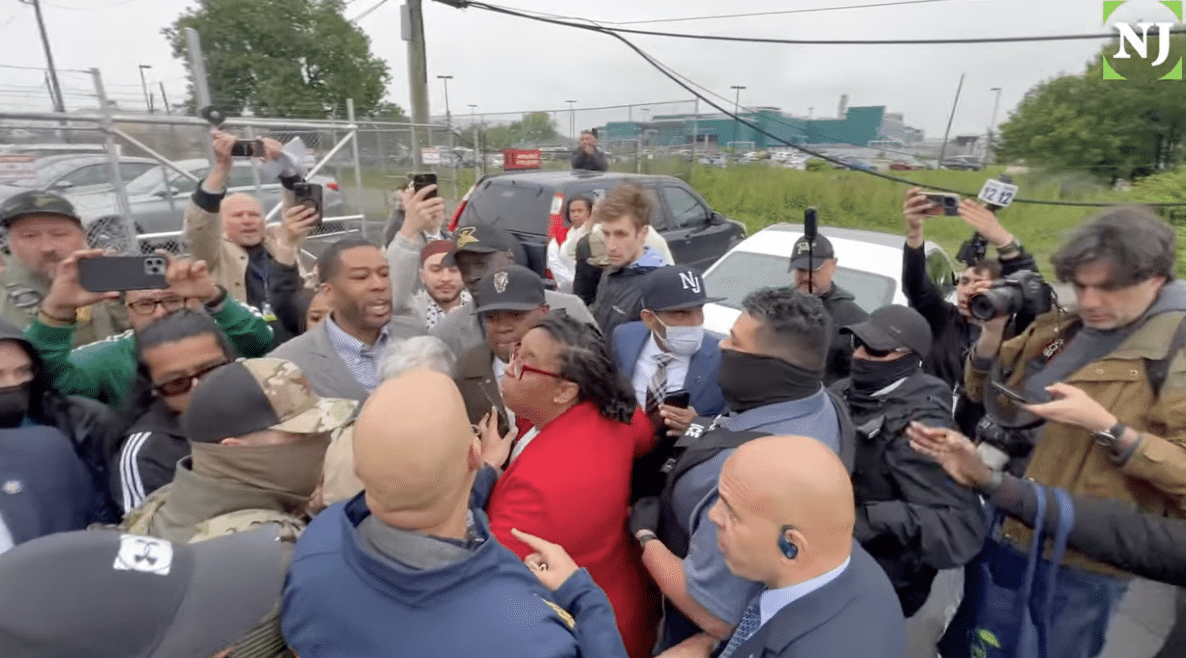
Evidence: ICE agents, heavily armed and most of them masked, rushed out of the gate to arrest the Mayor where he was on public property surrounded by reporters, his staff, and members of the public. The Members walked through the gate at approximately the same time. Ex. A at 1:26:50-1:26:56. As a crush of over a dozen agents descended on the Mayor, a man called out to “circle the Mayor,” and the Members coalesced around him, holding one another’s arms to remain upright in the crowd. Ex. A at 1:26:50-1:27:08; Ex. I, AG Axon Body Camera Arrest.mp4, at 00:47-00:55. Agents and protestors alike pushed toward the Members, destabilizing the group. The Members repeatedly asserted their federal status and instructed the agents not to touch them. Ex. I at 1:00-1:20. Agents nevertheless pressed in on the Members as the crowd formed more tightly around them.
McIver has mapped this all onto the indictment to prove that to defend the case, McIver would have to submit her actions as a Member of Congress to the jury for scrutiny.
McIver then goes on to argue that she is therefore immune under both Speech and Debate and — citing Trump v. US — separation of powers.
The separation of powers accordingly confers an immunity on the official acts of legislators symmetrical with the immunity for the President’s official acts. The Speech or Debate Clause confers immunity on legislative acts, which represent legislators’ “core constitutional powers,” and are thus absolutely immune. Trump, 603 U.S. at 606. The separation of powers extends further, making clear that legislative immunity also covers official acts, which represent “the outer perimeter of [the legislator’s] official responsibility.” Id. at 596. But that broader scope comes with a caveat: these acts are only presumptively immune. Id. at 614. Immunity for this wider class of official conduct may be rebutted when “the Government can show that applying a criminal prohibition to that act would pose no dangers of intrusion on the authority and functions of the” Legislative Branch. See Trump, 603 U.S. at 615 (cleaned up).17 The prosecution cannot do so here.
Motion to Compel
Virtually all of that narrative comes from Body Cam video provided in discovery. There’s one important exception: where an ICE agent shoved McIver so hard that she immediately said she was going to file a complaint.
Allegation: Count Two alleges that “[f]ollowing the arrest of” the Mayor, Congresswoman McIver “pushed past” another agent “using each of her forearms to forcibly strike” the agent “as she returned inside of the secured area of Delaney Hall.” Indictment at 5.
Evidence: After a few short moments, the Mayor made his way to V-1 to submit to arrest, and was promptly dragged back into the secured area and handcuffed. Congresswoman McIver followed, and an agent forcefully shoved her backward before she could reenter the secured area. NJ Spotlight News (@NJSpotlightNews), X (May 9, 2025 15:29 ET), https://x.com/NJSpotlightNews/status/1920926649777852742. Indeed, the agent’s use of force against Congresswoman McIver as she was reentering the facility was so egregious that—unlike the officers responding to the Congresswoman’s actions—she immediately informed an ICE official that she intended to file a complaint. Ex. I at 3:30-3:43. Congressman Menendez reentered with Congresswoman McIver, and Congresswoman Watson Coleman was escorted back through the gates with the help of agents. After the turmoil subsided, the Members were permitted to enter the building and complete their inspection.
That is one of the reasons she filed a motion to compel. She didn’t get Body Cam footage from at least two key ICE officers: the second guy she allegedly assaulted, and the guy who shoved her.
Second, there were as many as 15 uniformed law enforcement officers or agents with BWCs on site; several, however, apparently made no recordings. The lack of videos from those who were wearing BWCs appears to be inconsistent with applicable ICE policy and instructions at the scene from a supervisory agent. Indeed, at least two critical individuals have no BWC footage: the law enforcement agent identified in the Indictment as V-2, who is the alleged victim in Count 2; and another agent who appeared to violently shove Congresswoman McIver in the chest as she attempted to return inside the Delaney Hall gate. A government agent’s deliberate failure to activate a BWC contrary to policy and instructions clearly is relevant to the preparation of the defense. In addition, there were other agents who had no BWC at all.
In the guise of proving the full context of her visit that day, McIver has also asked for other video from the facility (which might provide more proof of the calls to people like Todd Blanche or might explain why a bunch of ICE vehicles arrived while the members of Congress were waiting).
To that end, the defense’s discovery letter requested that the government provide “all interior and exterior surveillance footage of any events on May 9, beginning at least 10 minutes before Congresswoman McIver’s arrival at Delaney Hall through at least 4:00 p.m., which is after she departed the facility’s secured perimeter.” Ex. K, Req. I.A. The government’s response was inconsistent. On one hand, the government indicated that it would attempt to locate and produce “footage of the Representatives’ tour of the Delaney Hall facility after the arrest of Mayor Baraka had taken place,” though it disclaimed the relevance of such footage. On the other hand, the government claimed that it received these two surveillance videos from GEO Group (the private company that ICE has retained to operate Delaney Hall). However, the government claims that other GEO Group materials are not in the government’s possession and suggests that the government has no other surveillance videos from stationary or fixed cameras. The government did not otherwise respond to Congresswoman McIver’s request for more complete surveillance videos, apparently taking the position that this material is not relevant. Ex. M at 1 (“To the extent this letter does not provide the requested materials, it is the position of the Government that those materials do not fall within the ambit of Rule 16”).
She’s also seeking the communications of everyone present pertaining to whether they were assaulted or not.
Although Congresswoman McIver may seek further relief from the Court to require production of those communications as this case progresses, the Court should at least order the government to disclose now:
VII.A. All contemporaneous text, voice, instant, chat or email messages – sent via either Telegram, Signal, or any other communications method, application, or medium – to, from, between, or among anyone present at Delaney Hall on May 9, 2025 and anyone else affiliated or associated with the GEO Group, DOJ, the U.S. Attorney’s Office, ICE, HSI, or DHS describing, reflecting, or implying that any government employee present on May 9 at Delaney Hall did not experience or report harm, injury, danger, or fear as a result of Congresswoman McIver’s actions.
VII.B. All written, verbal, or other reports or statements – whether or not memorialized – by any government official, individual affiliated with GEO, member of the public, or anyone else that is inconsistent with the charge that Congresswoman McIver knowingly, intentionally, or forcibly assaulted, resisted, opposed, impeded, intimidated, or interfered with federal officials on May 9.
These requests concern statements that show a lack of harm, injury, or fear by the alleged victims of the Congresswoman’s charged conduct.
Again, there’s a very sound reason to demand these communications based on the charges. But the video and the communications might also explain the involvement of Todd Blanche, Alina Habba, and Kristi Noem.
Selective Prosecution
Which brings us to the selective prosecution filing. As I said a million times when covering Hunter Biden’s selective prosecution bid (which I think might have survived if he had had money to appeal), these are almost impossible to win because you have to prove that someone similarly situated was not charged.
But McIver does that one better. She compares how DOJ dismissed all the January 6 assaults, even while charging her.
Just months ago, the Department of Justice dismissed cases against hundreds of defendants involved in the January 6, 2021, attack on the U.S. Capitol. Among these dismissals were over 160 prosecutions charging the defendants with violations of 18 U.S.C. § 111 stemming from their assault of federal law enforcement officials who were protecting the Capitol and the Members of Congress and their staff. Video footage showed these defendants throwing explosives, beating federal officers with baseball bats and riot shields, and spraying them with pepper spray, all in an effort to overturn the 2020 presidential election. The Justice Department not only walked away from those charges, but it has since fired career prosecutors, agents, and support staff for their mere participation in the investigations and prosecutions. This case charges Congresswoman LaMonica McIver, a sitting Democratic Member of Congress, with violating the same federal assault statute. But the similarity ends there. As the government concedes in the indictment, Congresswoman McIver was exercising her statutory and constitutional oversight responsibilities when she visited Delaney Hall—a privately run immigration detention facility that Immigration and Customs Enforcement (ICE) recently reopened in her District. Unlike the January 6 rioters, Congresswoman McIver had every right to be on those premises. Indeed, she was there to do her job.
There is also a palpable difference between the actions of those at the Capitol on January 6 and Congresswoman McIver’s conduct. Footage that the government has provided in discovery shows that federal officials made a series of manipulative, irresponsible, and dangerous decisions that placed dozens of bystanders, as well as three Members of Congress, at risk of physical harm. In fact, the video recorded almost two dozen armed agents and officers of ICE and Homeland Security Investigations (HSI) surging into a crowd in a public space to arrest the Mayor of Newark for supposedly trespassing on federal land. The government, of course, has since dismissed that ill-conceived and unfounded charge against the Mayor. But during that episode, it was those heavily armed law enforcement personnel who precipitated and were responsible for creating several minutes of physical chaos. In the end, as the indictment implicitly concedes, no federal agent experienced any injury whatsoever.
In that respect, too, January 6 was entirely different. That day, outnumbered Capitol Police officers stood their ground against hundreds—if not thousands—of rioters who were trying to overrun the Capitol to intimidate the legislators inside in hopes of overriding a national election. A substantial number of those brave officers were seriously injured. Yet, the Department of Justice has dropped the charges against over 160 individuals accused of that conduct.
Later in the filing, McIver cites three particularly egregious cases that were still pending when DOJ dismissed all these cases: Daniel Ball, Tim Boughner, and Jake Lang, all of whom were detained pretrial until Trump made their charges go away.
What, McIver ponders, led to the starkly different prosecutorial decisions? Well, there’s proof, in the form of a letter then Acting Deputy Attorney General and now Third Circuit Judge who might preside over any appeal, Emil Bove, sent ordering the firing of a bunch of FBI Agents who had been involved in January 6 investigations.
What explains the government’s insistence on prosecuting Congresswoman McIver, but not rioters charged with serious violence under the same statute? Senior federal officials have made ample public statements that point inexorably to the answer. In particular, the leadership of the Department of Justice, echoing the President’s official proclamation, has described the January 6 prosecutions as “a grave national injustice.”1
1 Mem. from Acting Dep. Att’y Gen. Emil Bove to Acting Dir., FBI (Jan. 31, 2025) (quoting Proc. No. 10887, 90 Fed. Reg. 8331, 8331 (Jan. 20, 2025)), https://perma.cc/C5NB-KV3V.
Motion to Restrain
In support of her selective prosecution bid, McIver also cites the statements that are the subject of her motion to restrain extrajudicial statements:
- A press release accusing the Members of Congress of breaking into the Delaney Hall.
- A Tweet disseminating a heavily edited picture of the alleged assault involving McIver.
- Another press release purporting the debunk the “fake news” correcting prior false claims about the incident.
- Yet another press release implicating McIver in an assault on an ICE officer that happened in California (which ICE was trying to blame on Salud Carbajal).
- One more press release, one of the recurrent ones that claim wildly inflated numbers for ICE assaults, again implicating McIver in those assaults.
For each of the statements, McIver notes how the communications are misleading and how they prejudice her case.
When Kilmar Abrego tried to get DHS gagged, the judge said they weren’t parties to his criminal case. But here, DHS runs the facility where this happened and employs the men who claim to have been assaulted.
McIver is asking for an order that these statements be taken down and threatens to ask for her prosecution to be dismissed if DHS continues such statements.
So here’s how this will all play out: If DOJ wants to sustain this prosecution, they will need to first defend against the Congressional immunity claim — including a potential interlocutory appeal — and Todd Blanche and John Sauer will be held to claims they made last year to get Trump out of trouble. But even as that’s proceeding, Judge Semper may well order DOJ to provide more discovery, either on her normal discovery request or to support the selective prosecution claim. Because, yeah, it is pretty shady that two of the three most important witnesses to this alleged assault somehow don’t have any Body Cam footage, and yeah, it’s pretty shady that DOJ claims not to have access to prison footage that might capture additional calls to DOJ.
Meanwhile, Baraka’s malicious prosecution lawsuit has done nothing since June; perhaps DOJ is thinking twice about defending it? In that case, Ricky Patel made sworn statements to justify Baraka’s arrest that conflict with the evidence here. If he didn’t already know, Baraka has just learned that before Patel made those statements, Todd Blanche personally ordered him to arrest Baraka, even after Baraka complied with Patel’s order to leave the facility. And if this were to go to trial, Patel’s inconsistent statements would be a central focus of the case.
I don’t know how this case will end.
But it won’t end well for DOJ.
Update: There’s one more way this filing may prove useful: the Democratic members of Congress lawsuit against DHS for denying them access to detention facilities. DOJ got a delay in their response, but the MoCs could file an amended complaint.