Posts

Trump’s Selective Drug Enforcement in Latin America

Donald Trump conducted a military invasion of Venezuela purportedly in service of arresting Nicolás Maduro to stand trial in the US.

The indictment against him (I assume it has been superseded since he was added in March of 2020) alleges that he personally was involved in negotiating FARC-sourced cocaine shipments.

5. While pursuing these and other objectives, NICOLÁS MADURO MOROS, the defendant, negotiated multi-ton shipments of FARC-produced cocaine; directed that the Cártel the Los Soles provide military-grade weapons to the FARC; coordinated foreign affairs with Honduras and other countries to facilitate large-scale drug trafficking; and solicited assistance from FARC leadership in training an unsanctioned militia group that functioned, in essence, as an armed forces unit for the Cártel de Los Soles.

Maduro’s former military intelligence head, Hugo Armando Carvajal Barrios, pled guilty in June. There’s no sign, at least not public, that Carvajal Barrios is cooperating (they’re holding a hearing this month before Judge Alvin Hellerstein because he claims not to have pled to the individual elements of the offense from which SDNY crafted an onerous sentence).

Meanwhile, I have already pointed to this excellent Bloomberg piece on the similar efforts SDNY made to bring former. President of Honduras Juan Orlando Hernández to justice. It describes how JOH’s family pitched Trump on a pardon in part by promising that with his pardon (and the return of his party to power, as has happened), Honduras would return the autonomous zones Trump allies like Peter Thiel have championed.

By July, the family and their lawyers had written an 18-page draft outlining some of the ways they might appeal to Trump’s pardon czar, Alice Marie Johnson. From Trump, they’d learned the language of modern political grievance: “Just like President Trump, President Hernández is a victim of lawfare, waged by the Biden administration.” If pardoned, Hernández would return to Honduras and dedicate himself to building a political movement in Latin America aligned with Trump’s foreign policy ambitions. The memo noted that Hondurans would go to the polls on Nov. 30 to elect a new president, and it suggested a timely pardon could energize conservatives in a region threatened by “radical left” regimes, including China and Venezuela. (Johnson didn’t respond to a request for comment.)

But it wasn’t only Trump who could benefit from a pardon. Castro, Hernández’s successor, repealed the legal framework that had established the country’s semi-autonomous economic development zones, including Próspera. That led the Honduran supreme court to declare those zones unconstitutional, triggering still-unresolved lawsuits from their investors. (Próspera continues to operate.) The memo asserted that Castro’s administration “has effectively stolen billions” from the financial backers of Próspera. The memo named Peter Thiel (“a longtime collaborator of Vice President J.D. Vance”) and Marc Andreessen (“who also donated millions to ensure that Trump’s policy goals could be achieved”).

A timely pardon—especially one delivered before the election—might remedy all that. It could also give Trump one more regional ally against the “narco-dicatorship” in Venezuela, where the Trump administration in September would begin launching military strikes against boats suspected of carrying drugs.

This kidnapping of Maduro is not about drug trafficking, though the indictment against him is real.

It’s about getting a piece of the action.

Update: Here’s the final paragraphs of a 1989 OLC opinion that then OLC head and future AG when Maduro was first indicted Bill Barr signed to rationalize the Panama invasion, on which this was surely modeled.

IV. Conclusion This Office concludes that at the direction of the President or the Attorney General the FBI may use its statutory authority under 28 U.S.C. § 533(1) and 18 U.S.C. § 3052 to investigate and arrest individuals for violations of applicable United States law, even if those actions depart from customary international law or unexecuted treaties. Moreover, we conclude that the President, acting through the Attorney General, has inherent constitutional authority to deploy the FBI to investigate and arrest individuals for violations of United States law, even if those actions contravene international law. Finally, we conclude that an arrest that is inconsistent with international or foreign law does not violate the Fourth Amendment.

35 There is some doubt whether the Fourth Amendment standard includes a requirement o f domestic law authority to arrest. The 1980 Opinion concluded that it does 4B Op O L C at 553-54. That Opinion relied principally on United States v. D i Re, 332 U S 581, 589-92 (1948), a case involving exclusion o f evidence obtained incident to an unauthorized arrest by federal officials. But it is not clear that Di Re was a Fourth Amendment decision, and it is also unclear that the-Constitution requires statutory or other authonty to arrest. See 1 Wayne R. LaFave, Search- and Seizure § 1 5(b) at 107 (2d ed. 1987) (concluding that D i Re is not a Fourth Amendment case but “simply an instance of the court utilizing its supervisory power to exclude from a federal prosecution evidence obtained pursuant to an illegal but constitutional federal arrest”). Cf George E Dix, Fourth Amendment Federalism: The Potential Requirement of State Law Authorization for Law Enforcement Activity, 14 Am J. Crim L. 1, 10 (1987) ( “There is considerable doubt. as to whether the Court has . . committed itself to the position that the fourth amendment reasonableness o f an arrest depends upon the existence o f state Jaw and the arrest’s validity under that law.”). In any event, as we have previously stated, we believe that authority exists for the Executive to authorize the FBI to make arrests in foreign countnes 3r’As to an arrest in a non-public place, there are circumstances in which an arrest warrant is required. Payton v New York., 445 U S 573, 576 (1980). While presumably an arrest warrant often could be obtained, there are limitations to the extraterritonal junsdiction o f the magistrate’s writ See 18 U.S C §§ 3041-3042 Commentators have questioned, however, whether the warrant requirements o f Payton and other cases should apply overseas. See Saltzburg, supra, 20 Va J Int’l L. at 762; Stephan, supra, 20 Va. J Int’l L at 792 n.44 37 We note that fear that our agents will be extradited for violations of foreign law during an enforcement operation authonzed by the President or the Attorney General is not a warranted concern The Secretary o f State always has discretion to refuse to extradite, even if the offense is covered by an extradition treaty entered into with another country See 18 U S C. § 3186 (Secretary of State “may” extradite the person committed under section 3184); Stndona v Grant, 619 F.2d 167 (2d Cir 1980), Wacker v. Bisson, 348 F.2d 602, 606 (5th Cir 1965). 183

WILLIAM P. BARR

Assistant Attorney General

Office of Legal Counsel

Update: Here’s the superseding indictment.The machine gun allegations are far sillier than I imagined.

“Border security is the primary element of national security.”

That sentence — “Border security is the primary element of national security” — comes from page 11 of the National Security Strategy.

Border security is the primary element of national security. Not one important element. The primary one.

That’s an insane assertion, of course. The military, the economy, real terrorism (including far right terrorism), cybersecurity, sovereign democracy all take a back seat to whatever Stephen Miller flunky had final control over the edit of the NSS, who wrote down something insane, prioritizing the border over all else.

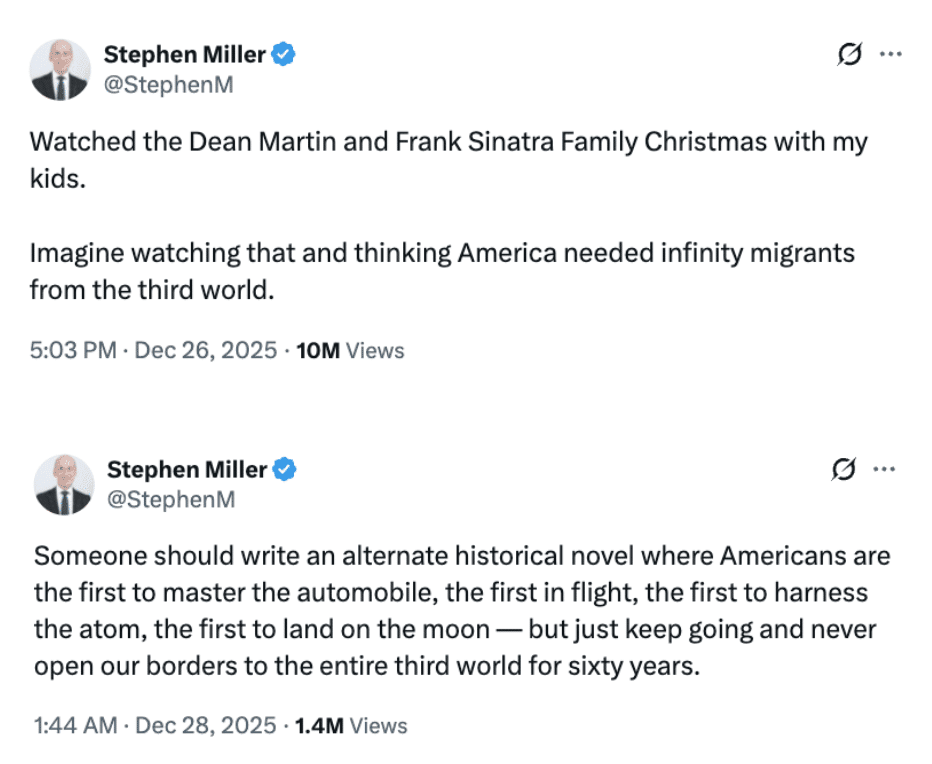
I’ve been obsessing about that comment ever since I read it, and kept thinking of it as I read this long NYT article that purports to explain Trump’s “policy” to target Venezuela. The article came out after I wrote this post attempting to understand Stephen Miller’s most prominent reversal over the last year, and in-between these two Tweets that make it very clear Miller’s entire conception about immigration to the US — even his own family’s immigration to the US — is based off his historically ignorant fantasies.
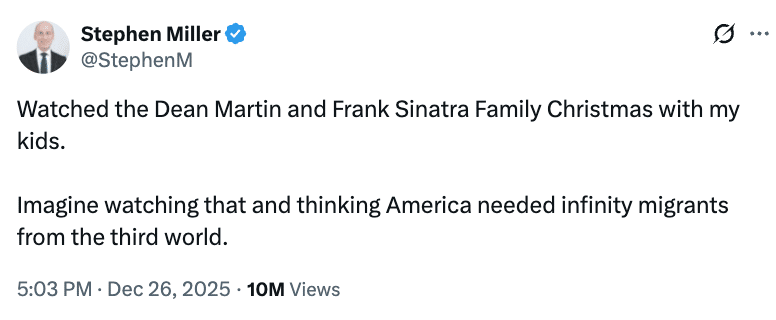
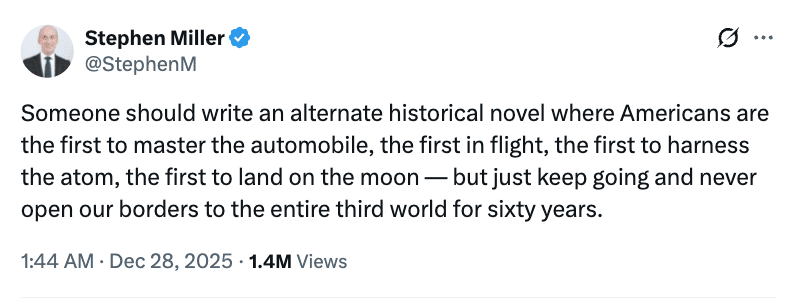
The story might be better staged as a Coen Brothers buddy movie featuring Stephen Miller, channeling Dr. Strangelove, looking for any opportunity to push harder against immigration, preferably in the form of bombing, even if it contributes to the root cause of drug trafficking and immigration, while Marco Rubio pursues the most stale kind of Cuban-American politics.

The story is so rambling, presumably because the subject and the insanity requires it, that I will attempt to map it.

NYT claims the current focus on Venezuela started when Marco Rubio signed a deal with Nayib Bukele to deport 300 people to his concentration camp.

The seeds of militarizing the approach to Mr. Maduro and Venezuelans were planted in February, when Mr. Rubio struck a deal with Nayib Bukele, the authoritarian leader of El Salvador, at his lakeside villa: The United States would pay nearly $5 million to send about 300 Venezuelans accused of being gang members to El Salvador’s Terrorism Confinement Center, or CECOT.

Soon after his visit with Mr. Bukele, Mr. Rubio designated eight Latin American criminal groups as foreign terrorist organizations. Tren de Aragua, a Venezuelan gang, topped the list.

Mr. Miller had already landed on a legal tool to bypass due process: the Alien Enemies Act, an 18th-century law that permits immediate detention and deportations of citizens of a country that has invaded the United States or is at war with it.

Mr. Trump signed an executive order in March invoking the act, with a title warning of “the invasion of the United States by Tren de Aragua.” In retrospect, the order was an important opening salvo against Mr. Maduro: It was the administration’s first formal framing of Mr. Maduro and the United States as being in a type of war. Contrary to a secret U.S. intelligence assessment, it said Tren de Aragua was an instrument of Mr. Maduro.

In this story, NYT is silent about Bukele’s goal with this deal — to obtain the return of MS-13 members who were testifying to his own ties to the gang (it is also silent about Trump’s pardon of Juan Orlando Hernández). It nods to the multiple lies Trump’s Administration told to claim the men it was sending to CECOT were gang members or even criminals (something covered at more length in this story, which it links). But it doesn’t describe how by misrepresenting the men, the Trump Administration failed to fulfill the terms of the deal made with Bukele.

Stephen Miller’s lies were a problem even for Nayib Bukele.

But NYT also doesn’t explain a temporal problem with this story: As the next major section of the story explains, at the beginning of the Administration, Ric Grenell had gotten Nicolás Maduro to accept deportation flights.

It began when Cuban American lawmakers pressed Mr. Trump early this year to end Chevron’s Biden-era confidential license. After Mr. Trump and Mr. Rubio announced in late February that they would do so, Mr. Maduro stopped accepting deportation flights of Venezuelans. Mr. Maduro had agreed to them on Jan. 31 with Richard Grenell, a special envoy for Mr. Trump.

One point of sending the men Stephen Miller falsely claimed were TdA members to CECOT was that Maduro was refusing to accept them. But Maduro had earlier agreed to accept them. So to understand the need to send planes full of men falsely claimed to be TdA members to Bukele’s concentration camp, you have to review Trump’s flip-flops on Chevron’s license to export Venezuelan oil.

That Chevron section goes like this:

  • January 31: Maduro makes a deal with Grenell.
  • February: Cuban-American Members of Congress (CAMC) pressure Trump to pull the Chevron license, which he does in late February (possibly between the time Rubio signs the deal with Bukele and the day 200 mostly-innocent men are loaded on planes?).
  • Chevron CEO Mike Wirth notes that if Chevron can’t export Venezuela’s oil, China will do so.
  • CAMC learn that Trump might reverse his decision, so threaten to vote against the Big Ugly Bill.
  • Stephen Miller pitches Trump on murderboats.
  • Trump lets Chevron license expire on May 27.
  • CAMC vote to pass Big Ugly.
  • Around the same time Trump considers a pardon for convicted drug kingpin Hernández, Marco Rubio sells Trump on a claim that Maduro is a drug kingpin.
  • July: Based in part on Wirth’s China argument, Trump reverses course, again, on Chevron license, Maduro accepts the CECOT prisoners and releases 10 Americans, including a triple murderer.

So while Trump was helping Nayib Bukele bury his ties with a dangerous gang and weighing a pitch to free convicted drug kingpin Juan Orlando Hernández, he began entertaining the idea of using the claim that Maduro is a drug kingpin so he can satisfy Stephen Miller’s need to bomb something and Marco Rubio’s Cuban-American fantasies.

Meanwhile, for reasons NYT doesn’t fully explain (though it suggests this was about SCOTUS’ decisions against the Alien Enemies Act), Stephen Miller was searching for things to bomb.

At the same time, Mr. Miller was exploring policies unrelated to Venezuela that, like the deportations, had their roots in the so-called U.S. war on terror. He looked at the idea of bombing fentanyl labs in Mexico. But it became clear that Mexican leaders would not consent, and the administration feared losing their cooperation on drug and migrant issues. The Washington Post reported earlier on Mr. Miller’s discussions about striking cartels in Mexico.

By early May, Mr. Miller’s team began asking for further options for using force against drug cartels.

White House officials and others bandied around relatively more constrained ideas, including using the C.I.A. to carry out covert strikes on docked boats that did not have people in them. But Mr. Miller’s team wanted to publicize the strikes. Officials also discussed blowing up fake drug boats to instill fear in traffickers. But Mr. Miller’s aides wanted the real thing, officials said.

This passage adds to what The Atlantic reported — that Miller wanted to murderbomb people “to paint immigrants as a dangerous menace.” But Miller demanded that he get real dead people, not just fake drug boats (and to be fair, given the degree to which various nations are tracking the specific people being murderboated, Miller was right that he needed real dead people for whatever purpose he believes this serves, even if his claim it serves that purpose is probably baseless).

Then Trump or Miller or Marco came up with a list of drug gangs they wanted to target, some of which have little relation to the danger the gangs represent, some of which are (like many of the claims about Tren de Aragua beforehand) invented.

On July 25, [Trump] signed a secret order telling the Pentagon to take action against drug-trafficking groups, putting in motion the targeting of Venezuelans.

[snip]

The two-page order contained a previously unreported written proposal for boat strikes. It directed Mr. Hegseth to target vessels in international waters carrying drugs for any of 24 Latin American “narco-terrorist” groups. The attached list included ones from Venezuela.

[snip]

The secret list of 24 groups included major cartels and groups that the Trump administration had formally designated as terrorists, along with numerous relatively obscure Mexican gangs. The same day Mr. Trump signed the directive, the Treasury Department announced sanctions against “Cartel de los Soles,” a slang term for drug corruption in Venezuela’s military, declaring it a terrorist organization led by Mr. Maduro. The name was at the bottom of Mr. Trump’s secret list.

And that’s where Trump’s flunkies turned to cutting and pasting legal rulings from the war on terror to be used in Stephen Miller’s campaign to create dead bodies that he can spin as evidence of the danger of immigrants.

Only, in their rush to brainlessly cut-and-paste from a WOT policy that was unsuccessful in its original incarnation, these geniuses failed to consider that drone strikes on the sea are different, legally, from drone strikes on land.

Around the same time, a Trump appointee with little national security law experience was drafting a Justice Department memo saying boat strikes would be lawful based on Mr. Trump’s wartime powers. The legal blessing was already developed by late July, when the Senate confirmed the top two lawyers responsible for reviewing such an operation — T. Elliot Gaiser, head of the department’s Office of Legal Counsel, and Earl G. Matthews, Pentagon general counsel. They were essentially presented with a done deal.

[snip]

Mr. Hegseth signed an execute order that created the operational framework for the attacks. Dated Aug. 5 and written without input from many career Pentagon officials, it lifted language from previous orders developed for drone strikes against Al Qaeda targets in places like rural Yemen.

It lacked elements crucial to maritime operations — including any mention of what to do with shipwrecked survivors of an attack, officials said.

[snip]

The Pentagon also bypassed a process called the Maritime Operational Threat Response, used to get input from various agencies when proposing a maritime action with international implications, said William D. Baumgartner, a retired Coast Guard rear admiral and lawyer who oversaw Caribbean operations.

Which is how Miller, Rubio, and Whiskey Pete Hegseth got themselves in trouble for even worse murder, that of survivors of the initial drone strike.

But that wasn’t yet good enough for Strangelove Miller. One of his top aides then loosened the standards from what they were in the WOT.

During the planning, an aide to Mr. Miller, Anthony Salisbury, pushed the Pentagon for ways to expand the scope of the operations, including loosening standards — like the level of confidence military officials would need that a target meets the criteria. Gen. Dan Caine, the chairman of the Joint Chiefs of Staff, advised that the military establish targeting criteria using lessons learned from the post-Sept. 11 wars. Ms. Kelly, the White House spokeswoman, said the account of Mr. Salisbury’s role was “made up.”

The NYT story ends with the unresolved problem posed by murderboats — what to do with survivors.

On the same day, WaPo described what happened when one of the only survivors — a known drug trafficker — was returned to Ecuador.

The police arrived at the airport prepared to arrest a drug trafficker — a mariner whose crewmates the U.S. military had just killed.

Andrés Fernando Tufiño Chila was one of only two people known to have survived a U.S. strike on a vessel that the Trump administration alleged was smuggling drugs from South America. President Donald Trump had described the Ecuadorian and a fellow survivor of the Oct. 16 strike in the Atlantic Ocean as “terrorists” who would be returned to their countries of origin “for detention and prosecution.”

[snip]

Tufiño, then 41, stepped off the U.S. military plane at the Quito airport on the morning of Oct. 18 in shackles, cut and bruised from the attack but walking on his own, according to Col. Carlos Ortega, then the director of anti-narcotics for Ecuador’s national police. He was already a known trafficker: He had pleaded guilty in U.S. federal court to cocaine distribution conspiracy in 2021 and served more than three years in a U.S. prison before he was deported home to Ecuador last year. Now the U.S. military had picked him up amid the wreckage of a semisubmersible vessel — a “narco sub.”

In his gang-controlled hometown, Tufiño was known as Fresco Solo, neighbors said, a skilled navigator who they alleged was recruited by criminals to smuggle drugs north.

But in transferring him to Ecuadorian custody, three officials here said, U.S. forces didn’t provide any evidence that could be used to detain him — no seized drugs, no phone or GPS records, no videos, none of the intelligence that led them to target his vessel.

On landing in Quito, U.S. officials told the Ecuadorians that the transfer was a “humanitarian” repatriation, Ortega said.

Within hours, Tufiño was let go.

There’s very little discussion in the NYT about what happens if Marco and his Cuban-American cheerleaders get their wish, a collapse of the Maduro and Cuban Communist regimes. As noted, they ignore the degree to which this policy has led to three drug traffickers — Hernández, Bukele, and Tufiño — going free. There actually is an interesting question about what will happen to the drug trade if the US makes sea trafficking less lucrative after having shut down the US-Mexico border to illegal entries. Drug markets don’t disappear; they morph, and such shifts can bring really serious unintended consequences.

After all, one of Miller’s blind spots are the American citizens who play a key role in all this trafficking. And by treating drug trafficking as an immigrant problem, he surely makes it easier for citizens to go undetected — the kind of detail real drug criminals tend not to miss.

Meanwhile “China” is mentioned just twice in NYT’s 3,400-word article laying out how a rather senseless “policy” on Latin America has developed. But then these are the same geniuses who started a trade war with China that gave China a great deal of new leverage over the United States based, in part, on claims of fentanyl trafficking.

As noted, this NYT story really would be better as a humorous buddy flick, because it is so full of idiocy.

Update: Trump is murderboating off invented intelligence not just against Latin America; it appears he did the same in Nigeria.

On Eve of Illegal Venezuelan Invasion, Pete Hegseth Utterly Destroys His Ability to Lead It

I think the trajectory of the last few weeks has been lost in the serial disclosures, so I want to summarize them here.

Mark Kelly and five other Democrats made a video reminding service members they can refuse illegal orders

On November 18, Elissa Slotkin released a video in which she and five other former military or intelligence officers — Mark Kelly, Chris DeLuzio, Maggie Goodlander, Chrissy Houlahan, and Jason Crow — reminding that they can refuse illegal orders.

One of the tactics Republicans chose to use in response was to demand that the members of Congress describe what illegal orders had been given.

An even stupider tactic was to move to prosecute the six, in Kelly’s case (because his retirement makes him susceptible to such a thing), threatening to withdrawn him from retirement to courtmartial him.

Trump and Pete Hegseth chose to give Kelly, a genuine hero, likely presidential candidate, and far more of a man than either of them, a bigger platform and fundraising draw.

WaPo publishes the first double tap story

The video from the six Democrats was likely focused on orders to target Americans, not Venezuelans (or Colombians or Trinis, all of whom have been targeted in the murderboat strikes); it specifically describes that the Trump Administration is pitting the military and intelligence community against American citizens.

But then WaPo described Pete Hegseth — verbally — giving the quintessential illegal order.

The longer the U.S. surveillance aircraft followed the boat, the more confident intelligence analysts watching from command centers became that the 11 people on board were ferrying drugs.

Defense Secretary Pete Hegseth gave a spoken directive, according to two people with direct knowledge of the operation. “The order was to kill everybody,” one of them said.

A missile screamed off the Trinidad coast, striking the vessel and igniting a blaze from bow to stern. For minutes, commanders watched the boat burning on a live drone feed. As the smoke cleared, they got a jolt: Two survivors were clinging to the smoldering wreck.

The Special Operations commander overseeing the Sept. 2 attack — the opening salvo in the Trump administration’s war on suspected drug traffickers in the Western Hemisphere — ordered a second strike to comply with Hegseth’s instructions, two people familiar with the matter said. The two men were blown apart in the water.

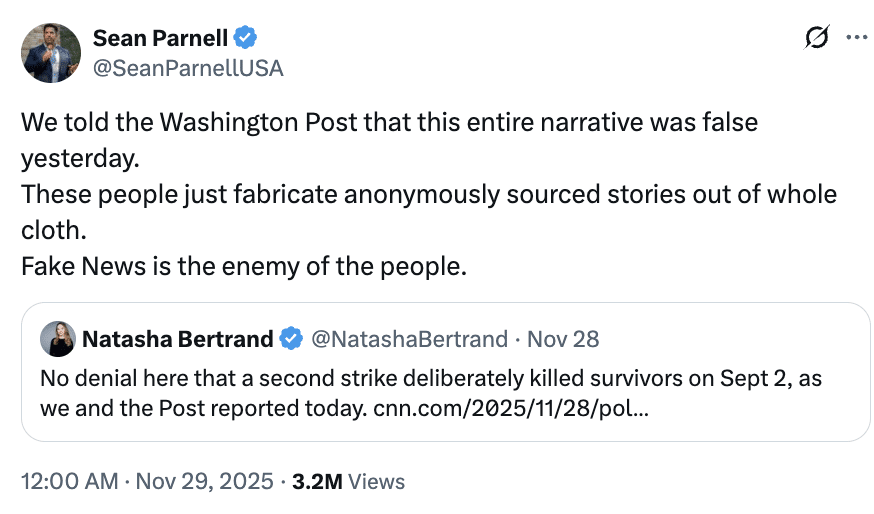
The initial response to this was the same tactic that has gotten Trump where he is: to attack the press, claiming it was fake.

Trump promises to pardon Juan Orlando Hernández, destroying pretext for war

Meanwhile, Trump totally undercut the premise behind over a year of targeting Venezuela.

There were always problems with Trump’s pretense for the murderboats and planned Venezuelan invasion, which is that Venezuela’s government leads a cartel of narcotraffickers that amounts to an invasion of the United States.

At first, Stephen Miller’s bullshit about Venezuela was rooted in false claims about Tren de Aragua. Perhaps because the Intelligence Community publicly debunked those claims (but not before Miller relied on his bullshit to send 200 mostly-innocent men to a concentration camp, where they were tortured), Miller moved onto a new predicate. Nicolás Maduro wasn’t in charge of Tren de Aragua, Miller decided; he was in charge of Cartel de los Soles.

Tren de Aragua at least exists, albeit not in anywhere near the numbers of slumlord residents as Miller has claimed. It’s not at all clear CdlS does. Plus, if it does exist, it traffics in cocaine, not fentanyl, the claimed invading drug that justifies treating drug trafficking as war (almost no right wing Senators understand this problem, which would be hilarious if it weren’t about to become the new Yellowcake).

But then Trump promised to pardon former Honduran President Juan Orlando Hernández, who actually did what Trump claims Maduro is doing, who was convicted of it, who was sentenced to decades in prison.

You cannot credibly claim to give a fuck about drug trafficking when you’re freeing major traffickers. I mean, Trump doesn’t care, but the men and women risk their lives and their liberty have to attend to the likelihood they’ll be left holding the bag for Trump’s crimes.

White House concedes the double tap but defends Hegseth

Then, as Congress — led by Senate Armed Services Committee Chair Roger Wicker — begins to investigate the operation, demanding the full video of the strike and testimony from those involved, and as legal experts made it clear that this was not just a war crime, but murder, the White House changed tack. Trump knew nothing, wouldn’t have wanted it to happen, but in fact it did happen but Pete Hegseth didn’t give the order.

While NYT was publishing a story laundering Hegseth’s claims (that he did not specifically order the murder), WaPo was back with quotes from service members recognizing that Hegseth had begun underbussing his subordinates, especially Admiral Frank Bradley.

“This is ‘protect Pete’ bulls—,” one military official, who, like others, spoke on the condition of anonymity to discuss internal conversations, told The Post.

Leavitt’s statement “left it up to interpretation” who was responsible for the second strike that killed the two survivors, a separate military official said, imploring the White House to provide clarity on the issue.

One official said of Leavitt’s statement, “It’s throwing us, the service members, under the bus.” Another person said some of Hegseth’s top civilian staff appeared deeply alarmed about the revelations and were contemplating whether to leave the administration.

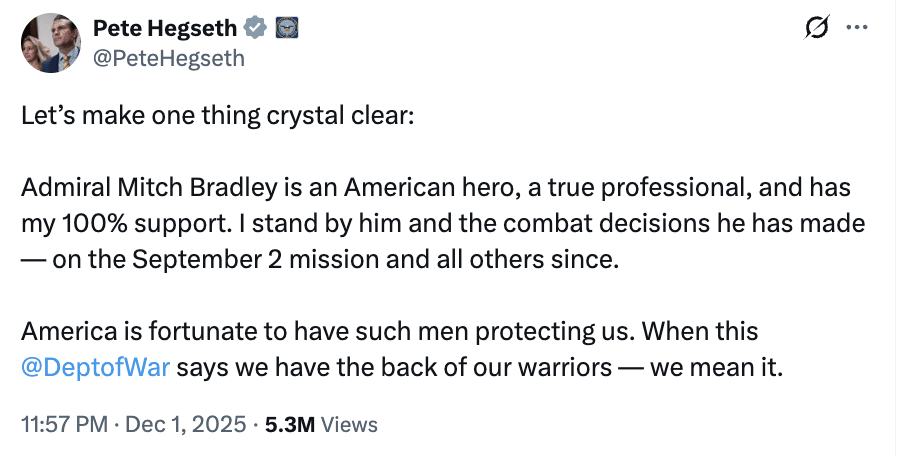
Hegseth, writing on social media Monday night, said he stands by the admiral “and the combat decisions he has made — on the September 2 mission and all others since.” His statement is likely to deepen the sense of furor among military officials who suspect Hegseth is attempting to insulate himself from any legal recourse and leave Bradley — whom the secretary called “an American hero, a true professional” — to account for the fallout alone.

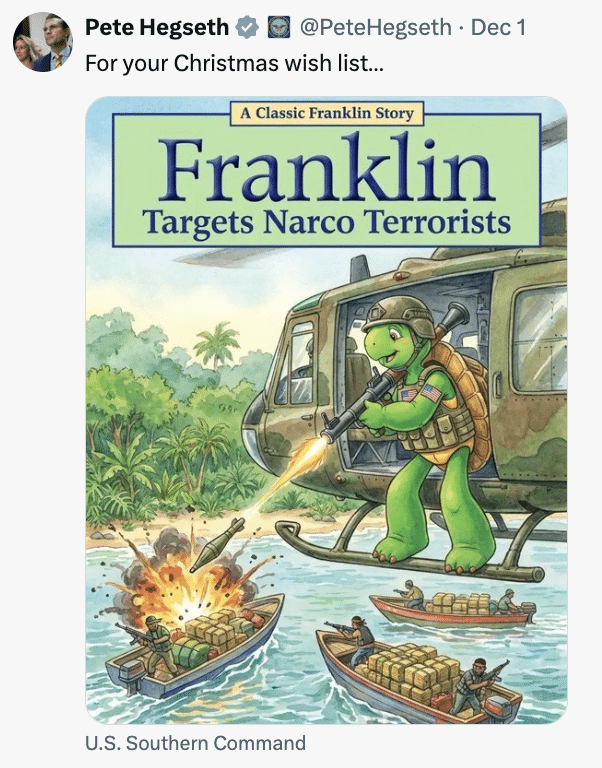
Whiskey Pete even posted a tweet claiming to have Bradley’s back while emphasizing that Bradley made the decision.

CIA’s disavowal of Rahmanullah Lakanwal

This comes amid several reports that Rahmanullah Lakanwal, the accused killer of two National Guard members last week, had done terrible things for the CIA, but then was abandoned by John Ratcliffe’s CIA before declining into bouts of depression in advance of the attack.

The struggles to start over, leave the war behind, and find work were ever present. Lakanwal was fired from his job at a laundromat because he lacked a work authorization card despite being approved for asylum and authorized to work by the Trump administration, according to his former unit mate, who fought alongside him for more than a decade.

[snip]

About a month ago, Lakanwal told his unit mate that his inability to work due to missing immigration paperwork meant his family couldn’t afford rent or food. He resorted to borrowing money from friends and former unit members, and during the conversation, he broke down in tears from frustration and desperation, his unit mate said.

“Every time, like looking [for] somebody [to] help for documents, somebody [to] help for pay the rent, he’s not going to work,” the Afghan unit mate said.

His unit mate said Lakanwal sought help in June from a CIA program designed to aid Zero Unit veterans with immigration issues. Rolling Stone reviewed a screenshot of the group chat in June where Zero Unit veterans shared information with a CIA representative about ongoing issues. Lakanwal posted messages asking for help. His last post went unanswered and was deleted by the chat’s administrator.

None of this excuses the killing. It just makes clear that Lakanwal is one of thousands of men damaged by America’s war on terror who needs — in this case, needed — help before something terrible happens. Nigel Edge, the former Marine sniper who shot up a club from his boat in Cape Fear in September, is another one.

Mark Kelly models leadership

Meanwhile, precisely because Trump and Hegseth chose to attack Kelly, he was able to stage a press conference for little other reason than to attack Trump and Hegseth’s leadership failures.

That included addressing the double tap, in which he mostly deferred to investigations, but still upheld the import of international law.

We don’t know how all this will end.

What we do know is that, in advance of a likely demand that service members do something patently illegal, Pete Hegseth has made it clear he’ll sacrifice everyone to save himself.

Murder

In the last few days, we’ve got allegations of murder against two men who worked in counterinsurgency in Afghanistan, Whiskey Pete Hegseth and Rahmanullah Lakanwal.

We don’t yet know why Lakanwal drove from Bellingham, WA, across the country, to allegedly ambush two members of the West Virginia National Guard, Sarah Beckstrom and Andrew Wolfe. Spencer Ackerman noted that if Lakanwal came to the US committed to terrorism, he learned that commitment — and a great deal of military skills — from Americans.

[T]he most sobering fact about Wednesday’s slayings is that the alleged killer, Rahmanullah Lakanwal, was all too compatible with Western Civilization.

CIA Director John Ratcliffe issued an extraordinary statement revealing that the 29-year-old Lakanwal was a “member of a partner force in Kandahar.” While a knowledgeable source with deep experience in Afghanistan cautions that the US sponsored a variety of proxy forces in southern Afghanistan, much additional reporting has identified Lakanwal as a member of the Zero Units, death squads used by the CIA during the US’s longest overseas war.

In other words, contrary to Miller and Trump, Lakanwal’s shooting spree is not the result of importing Afghan culture to America. While much will surely be revealed in Lakanwal’s upcoming trial, it looks more like the result of importing American culture to Afghanistan. The realities of blowback – the violence America experiences as the unintended consequences of the violence of US foreign policy – are what the US needs to examine in the wake of this horrifying murder if it expects to prevent the next one.

But even Ackerman doesn’t consider the possibility that something happened since — quite possibly in the last year, as Trump keeps dicking around allies of all sorts who’ve helped the United States in the past — that led Lakanwal to drive across the country only to target members of the Guard who had been uprooted from their homes to avenge Ed “Big Balls” Coristine.

The list of Republican governors who will uproot Guardsmen from their home, family, and (for many of them) regular jobs to go to DC continues to grow:

  • Ohio Governor Mike DeWine
  • South Carolina Governor Henry McMaster
  • West Virginia Governor Patrick Morrisey
  • Tennessee Governor Bill Lee
  • Mississippi Governor Tate Reeves
  • Louisiana Governor Jeff Landry

All of these men believe protecting Big Balls is a higher priority than protecting their own constituents.

How soon we forget that the entire reason why Trump invaded DC is that Ed “Big Balls” Coristine, one of the DOGE boys hired by the richest man in the world to snoop through the private heath and social security data of Americans, got beat up by unarmed teenagers?

Contrary to what Trump and his propagandists keep squealing, Lakanwal was vetted over and over again.

The Afghan national accused of shooting two National Guard members near the White House this week underwent thorough vetting by counterterrorism authorities before entering the United States, according to people with direct knowledge of the case.

Rahmanullah Lakanwal, 29, arrived in the U.S. through Operation Allies Welcome (OAW), a Biden-era program that helped resettle Afghan nationals after the U.S. military withdrawal from Afghanistan in 2021.

[snip]

A key question from critics has been whether any evacuees managed to enter the U.S. without proper vetting. Lakanwal, however, would not have been among them, according to the individuals, who requested anonymity because of the sensitivity of the investigation. One of the individuals said Lakanwal was vetted years ago, before working with the CIA in Afghanistan, and then again before he arrived in the U.S. in 2021. Those examinations involved both the National Counterterrorism Center as well as the CIA, the person said.

Lakanwal was also granted asylum earlier this year, a process that would have brought its own scrutiny, according to #AfghanEvac, a coalition that supported the relocation effort — an assertion the White House did not dispute.

But no amount of vetting can forestall every awful possibility of violence.

Similarly, we can’t even say what led our Crusader-tatted Secretary of Defense to personally order the murder of two men who survived the first murderboat operation on September 2.

Defense Secretary Pete Hegseth gave a spoken directive, according to two people with direct knowledge of the operation. “The order was to kill everybody,” one of them said.

A missile screamed off the Trinidad coast, striking the vessel and igniting a blaze from bow to stern. For minutes, commanders watched the boat burning on a live drone feed. As the smoke cleared, they got a jolt: Two survivors were clinging to the smoldering wreck.

The Special Operations commander overseeing the Sept. 2 attack — the opening salvo in the Trump administration’s war on suspected drug traffickers in the Western Hemisphere — ordered a second strike to comply with Hegseth’s instructions, two people familiar with the matter said. The two men were blown apart in the water.

Trump claims these murderboat operations combat drug trafficking. That was always suspect. Not only are many of the people killed at most low-level shippers, but killing traffickers was less useful than capturing them.

And Trump’s promise to pardon former President of Honduras, Juan Orlando Hernández, who was a major drug trafficker, suggests Trump is not so much opposed to drug trafficking, he just wants a cut.

What we do know about Hegseth, the man who ordered defenseless men to be murdered, is that the Fox News host repeatedly failed efforts to vet him — first when he was excluded from defending the Capitol after January 6, and then the multiple warnings of abuse, incompetence, and addiction reviewed during his confirmation process.

And so it was that Pete Hegseth happily uprooted Sarah Beckstrom from her home to serve as a prop for Trump’s authoritarian theater, where she was as predicted, targeted.

[M]ilitary commanders had warned that their deployment represented an easy “target of opportunity” for grievance-based violence. The troops, deployed in an effort to reduce crime, are untrained in law enforcement; their days are spent cleaning up trash and walking the streets in uniform. Commanders, in a memo that was included in litigation challenging the high-visibility mission in D.C., argued that this could put them in danger. The Justice Department countered that the risk was merely “speculative.” It wasn’t. There are costs to performatively deploying members of the military—one of which is the risk of endangering them.

Hegseth kept Beckstrom deployed even after Judge Jia Cobb ruled, six days before Beckstrom was shot, that state governors, including WV’s Patrick Morrisey, don’t have the authority to send their Guard to DC without being invited by DC.

[T]he out-of-state National Guards are likely operating in the District in a manner contrary to law. Under section 502(f), state law defines the permissible use of the National Guard under state control—i.e., which missions the governors can order their units to conduct. Here, the state governors whose units are currently operating in the District lack authority to order these missions because the District has not properly sought their aid under D.C. law and the EMAC.

This vetting failure, Pete Hegseth, happily obeyed Trump’s order to bring even more Guard troops to DC, whose mission of “crime deterrence and passive patrolling” will now require more Metropolitan Police Department effort to protect the Guard from being targeted again.

Two alleged murderers brought demons with them from Afghanistan to the US. Both together got a young woman with all her dreams and life ahead of her killed.

And yet we’re not removing the more obvious vetting problem to prevent further disasters.