Posts

Much of Todd Blanche’s Perceived Cover-Up Is Actually Incompetence

Something hilarious happened this week.

On Tuesday, Trump’s White House got Marc Caputo to write a credulous column platforming their laughable claims that they’re not responsible for how chaotic the release of the Epstein files has been, that the whole Epstein thing is just unfair to poor Donald Trump. Caputo’s column — the dutiful repetition of even ridiculous claims — is a read of Trump’s own perception of the challenge before him.

But before Caputo got to Trump’s flimsy excuses and the more damning detail — that the White House had taken over DOJ’s Xitter account — he started with his headline scoop: He allowed his sources to claim that the pain of this release will last one more week (that is, a week from Tuesday).

Only one more week.

Scoop: Trump administration expects Epstein files release could last another week

The Trump administration estimates it has about one week to go — and as many as 700,000 more pages to review — before it finishes releasing all the Jeffrey Epstein files.

[snip]

  • This will end soon,” another official said. “The conspiracy theories won’t.”

Imagine putting that prediction in writing!

The prediction lasted less than a day.

Even at the time, CNN was reporting that SDFL’s US Attorney’s Office has just solicited “volunteers” to work over the holiday to make this a one-week story.

The Justice Department’s leadership asked career prosecutors in Florida to volunteer over the “next several days” to help redact the Epstein files, in the latest Trump administration push toward releasing the hundreds of thousands of photos, internal memos and other evidence around the late convicted sex offender Jeffrey Epstein.

A supervising prosecutor in the Southern District of Florida’s US Attorney’s Office emailed the entire district office on Tuesday — two days before Christmas — announcing an “emergency request from the [Deputy Attorney General’s] office the SDFL must assist with,” according to a copy of the email reviewed by CNN. “We need AUSAs to do remote document review and redactions related to the Epstein files,” the email said.

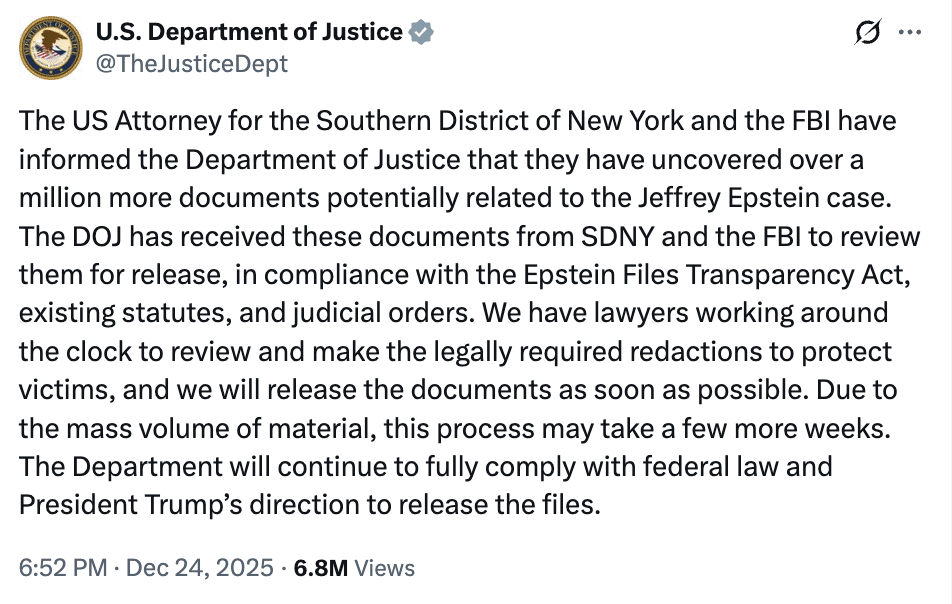
Then, DOJ explained why they needed the volunteers: they (claim they) just discovered a million more pages.

This thing won’t be done in a week or even a month. And the people smoking Caputo need to understand that’s partly due to Todd Blanche’s incompetence, and partly due to the stuff that is a cover-up.

You’re likely to disagree with this opinion, because conventional wisdom on the left holds that the chaos of the Jeffrey Epstein releases to date reflects an attempted cover-up. But the chaos we’re seeing in the Jeffrey Epstein release is not (yet), primarily, a cover-up — though DOJ is flouting the law in ways that will create further scandal that may be entirely unrelated to protecting Donald Trump.

What you’re seeing is incompetence — frankly, the same incompetence we’ve seen from day one on Trump’s efforts to corral the Epstein conspiracy theories which his followers thrive.

Consider the things that have been identified as evidence of an imagined cover-up:

  • Documents from a civil lawsuit published to docket at different times, adopting different standards of redaction, and therefore revealing accusations against Trump in just one of them
  • Documents from a civil lawsuit adopting reversible redaction
  • The handwritten letter claiming to be from Epstein to Larry Nasser purportedly written just before Epstein’s death

These actually could be readily explainable (and, indeed, all three fit one of the five rules on how to read Epstein files that Ankush Khardori offered on the day of the release — understand what kind of files you’re reading, and the biases people harbor or lies people will tell). For example, if DOJ had released the files with an inventory of the kinds of things the release would include, and the known reliability issues with various kinds of documents, then people might have been prepared to treat the claims made in civil suits with some skepticism. If DOJ had released the alleged Epstein letter with FBI’s own analysis of it, it would have persuaded people that the letter is a fake, if it is.

But DOJ did not do that.

Instead, Todd Blanche sat for a softball interview with Kristen Welker in which he did the following:

  • Falsely claimed that the delay in responding arose from any concern for the survivors
  • Guaranteed that all mention of Trump would be unredacted
  • Alluded to the real reasons for overredaction, which Welker of course ignored
  • Repeated his past bullshit excuses for letting Ghislaine Maxwell lie to his face with impunity before getting moved to Club Fed and getting a puppy
  • [Unrelatedly, but still problematically, falsely claimed politicized prosecutions did not involve Trump]

The key answer here was Blanche’s claim that DOJ needs to redact for reasons other than protecting victims.

KRISTEN WELKER:

Well, you’re talking about protecting the victims. The law directed the Justice Department to “release internal DOJ communications including emails, memos, meeting notes concerning decisions to charge, not charge, investigate or decline to investigate Epstein or his associates.” That’s the crux of what many of the victims or the survivors say they want to see. Why wasn’t that information prioritized in the first release, Mr. Blanche?

DEPUTY ATTORNEY GENERAL TODD BLANCHE:

Well, first of all it was. And there are numerous documents released on Friday that address what you just quoted from, from the statute that address internal communications within the Department of Justice and internal communications between law enforcement and the Department of Justice. But it’s for the same reason. Because many of those internal communications talk about victims. Many of those internal back and forths between prosecutors and law enforcement talk about victims and their stories. And that has to be redacted. And by the way, everybody expects us to redact that. So the same complaints that we’re hearing yesterday and even this morning from Democrats and from others screaming loudly from a hill about lack of production on Friday, imagine if we had released tons of information around victims? That would be the true crime. That would be the true wrong. And if anybody out there, I heard Congressman Raskin, the Democrat on the House Oversight Committee, releasing statements accusing Attorney General Bondi, Director Patel and myself of not doing our jobs. If they have an issue with me protecting victims, they know how to get a hold of me. But we’re not going to stop doing it.

[snip]

KRISTEN WELKER:

Okay. Let’s delve more deeply into the redactions. Is any information about President Trump redacted in any of the files that have or will be released?

DEPUTY ATTORNEY GENERAL TODD BLANCHE:

No. Not unless it’s supposed to be redacted under the law, which means victim information or any sort of privilege like attorney-client privilege. But I have no reason to believe that the lawyers that are working on this case were talking about President Trump. Because he had nothing to do with the Epstein files. He had nothing to do with the horrific crimes that Mr. Epstein committed. And so I don’t expect there will be anything redacted. But the short answer is we are not redacting information around President Trump, around any other individual involved with Mr. Epstein. And that narrative, which is not based on fact at all, is completely false. [my emphasis]

There aer several problems for Todd Blanche’s claim that there are other reasons that DOJ can redact information — he mentions attorney-client privilege, but that could quickly expand to executive privilege (indeed, elsewhere in the interview he asserts he’ll never share his communications with Trump) or deliberative. The files are also being released with every DOJ identity redacted, including Audrey Strauss and Geoffrey Berman. That may have the temporary advantage, for DOJ, of hiding who was complicit in the sweetheart deal in 2007 and which real champions of the victims, like Maurene Comey, Trump fired right in this middle of this realease.

The problem for Blanche is that judges have already ruled (in unsealing grand jury materials) that the transparency law supersedes other protections.

The Act requires disclosure of Epstein grand jury materials by requiring disclosure of “all unclassified records, documents, communications, and investigative materials.” Id. “All” is crystal clear and should be afforded its “ordinary, common-sense meaning.” … (where Congress was aware of a category and did not exclude the category from the statute, that category is covered).

And so Congress will go to Richard Berman and argue that by withholding privileged or deliberative documents or even prosecutors’ names, DOJ is not complying with the law, and they’ll have precedent on their side.

Shit, Trump will be lucky if this only goes on for another month and not twelve.

The question Welker did not ask but should have is why DOJ is stuck doing this at the last minute if the FBI conducted an even bigger review of the files back in March. Why is DOJ in a mad rush to protect survivors now? Why wasn’t DOJ protecting survivors in March?

And the answer to that question is that, obviously, that earlier review was focused not on victims but on a political calculation: would the release of pictures of Bill Clinton in a public hotel pool in Brunei (which is what got released last week) outweigh the damage of files implicating Trump and his friends (starting with Les Wexner who was named as a potential co-conspirator in some documents already released), and that the conclusion of that earlier review, in July, was that this could not be weaponized like everything else, and so Trump and Todd Blanche personally attempted to pressure Congress to prevent this release at all costs but failed, which is why they’re stuck doing a second last minute review after the earlier one in March.

And eventually, all that — including whatever lists they made in March that Blanche probably hopes to shield under claims of privilege — should be ripe for release under the law. The incompetence of this first release will lead to iterative later releases.

Which brings us to the excuses Caputo platformed. As he describes, everyone is just exasperated, because how dare people take top Trump supporters like Charlie Kirk and Jack Posobiec and Benny Johnson and Kash Patel and Dan Bongino seriously when they focus on these files?

Behind the scenes: There’s a palpable sense of exasperation and annoyance in the administration about all of the headlines pertaining to Trump and Epstein and the inability to explain everything and just get the disclosure done.

  • “It’s a combination of extreme frustration at everything: at what Congress did, at our response to it, and a concern that it won’t go away,” an official said.
  • “There’s also a little bit of indignation at the media — that this wasn’t even a story for years and years. And now, not only is it a story, but the top of many news pages on a given day.”

How dare Trump’s trolls make this a huge story?!?!?!?!

This remains the problem with Blanche’s actions and everyone else’s. They’re misunderstanding that this is the scandal they rode in on.

They can’t just rely on past tools — like weaponization, like focusing on Clinton (as Trump attempted in his most recent wail about Epstein).

Because the Epstein scandal exists not because of anything Jamie Raskin or Ro Khanna did. The Epstein scandal exists because the conspiracism of it is the core of Trump’s power. Epstein conspiracy theories were always non-falsifiable (which I wrote about here and here and a bunch of other places).

And by attempting to bulldoze Congress on the big issues — on DOJ’s own prerogatives — Todd Blanche is only going to make things worse by creating new scandals.

Share this entry

The Most Complex Friday Night News Dump, Ever?

President Trump arrived late to a healthcare announcement yesterday and didn’t take any questions.

Starting around the same time, DOJ launched some of the most complexly executed Friday Night News dumps going.

Epstein Limited Hangout

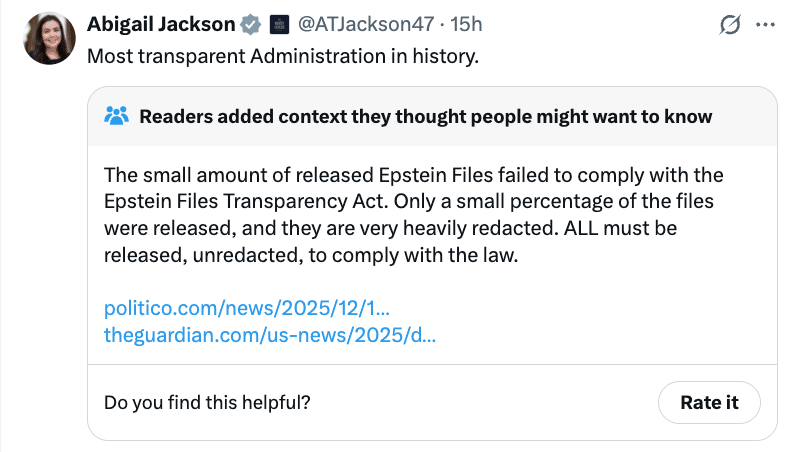
The big attraction was the release of the first batch of the Epstein files. The limited release violates the law, which required all files to be released yesterday.

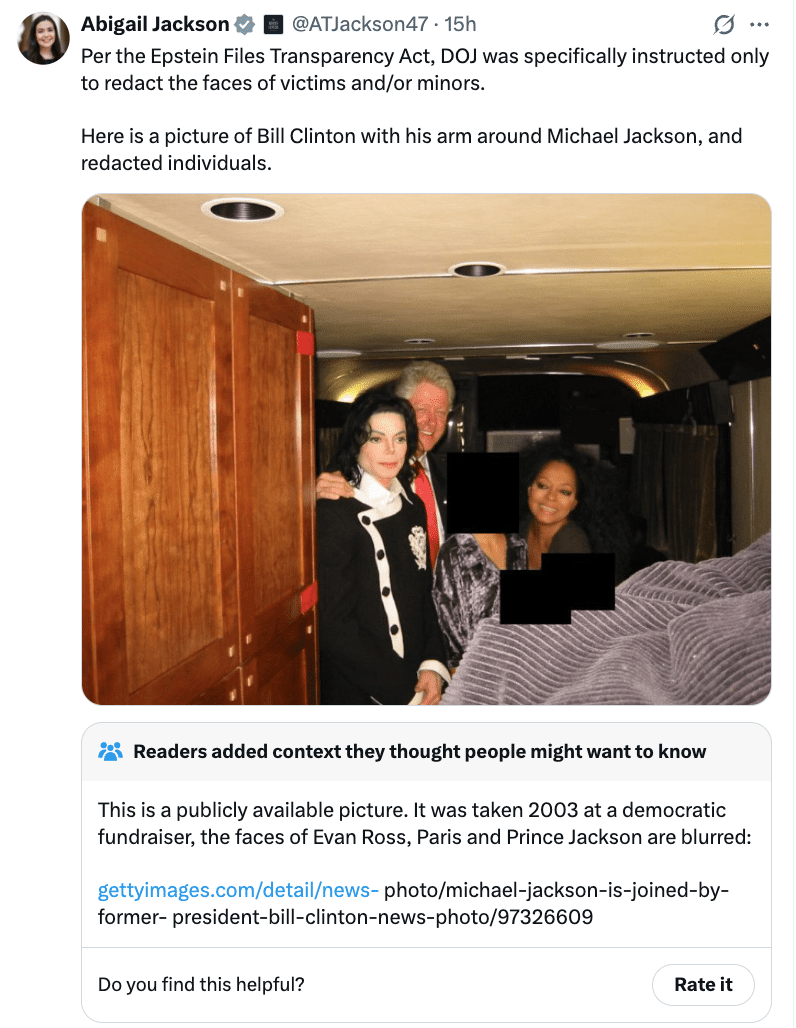
Instead, there were a whole bunch of Bill Clinton photos, the document reflecting Maria Farmer’s complaint from 1996, that went ignored for years, and redacted grand jury transcripts that clearly violate the law. [Update: They have now released the SDNY ones.] The government did not release the proposed indictment and prosecution memo for the indictment that should have been filed in 2007; that may be sealed as deliberative.

Todd Blanche’s wildly dishonest letter (particularly with regards to his claimed concern for victims, after being admonished repeatedly by judges for failing to take that responsibility seriously and a last minute bid that promised but failed to put Pam Bondi on the phone) explaining the release emphasizes how Bondi took over a hundred national security attorneys off their job hunting hackers and spies to conduct a second review; it does not mention the even bigger review the FBI accomplished in March.

The review team consisted of more than 200 Department attorneys working to determine whether materials were responsive under the Act and. if so, whether redactions or withholding was required, The review had multiple levels. First, 187 attorneys from the Department’sNational Security Division (NSD) conducted a review of all items produced to JMD for responsiveness and any redactions under the Act. Second, a quality-control team of 25 attorneys conducted a second-level review to ensure that victim personally identifying information wasproperly redacted and that materials that should not be redacted were not marked for redaction.The second-level review team consisted of attorneys from the Department’s Office of Privacy and Civil Liberties (OPCL) and Office of Information Policy (OIP)—these attorneys are experts in privacy rights and reviewing large volumes of discovery. After the second-level review team completed its quality review, responsive materials were uploaded onto the website for public production as required under the Act. See Sec. 2(a). Finally, Assistant United States Attorneys from the Southern District of New York reviewed the responsive materials to confirm appropriate redactions so that the United States Attorney for the Southern District of New York could certify that victim identifying information was appropriately protected.

That John Eisenberg’s department was in charge of a second pass on these documents is of some interest; there’s no specific competence Nat Sec attorneys would have, but Eisenberg has helped Trump cover stuff up in the past, most notably the transcript of his perfect phone call with Volodymyr Zelenskyy.

Thus far the limited hangout has shifted the focus onto Clinton and away from Trump, but as Kyle Cheney lays out, it risks creating a WikiLeaks effect, in which a focus remains on Epstein for weeks or even months.

Deputy Attorney General Todd Blanche confirmed Friday that the documents would be released on a rolling basis through the holidays — and possibly beyond. And, in court papers filed shortly after Friday’s partial release, the Justice Department emphasized that more files are still undergoing a review and redaction process to protect victims and new Trump-ordered investigations before they can be released.

The daily drip is a remarkable result for President Donald Trump, who has urged his allies to move past the Epstein files — prompting jeers from Democrats who say he’s trying to conceal details about his own longtime relationship with Epstein. Trump has maintained for years that he and Epstein had a falling out years ago, and no evidence has suggested that Trump took part in Epstein’s trafficking operation. Trump advocated for the release of the files only after Republicans in Congress rebuffed his initial pleas to keep them concealed.

[snip]

Trump is no stranger to the political power of intermittent disclosures of derogatory information. In 2016, Trump led the charge to capitalize on the hack-and-leak operation that led to daily publications of the campaign emails of Hillary Clinton and her top allies. The steady drumbeat of embarrassing releases — amplified by Trump and a ravenous press corps — helped sink Clinton’s campaign in its final weeks.

And that’s before the political and legal response to this limited hangout. Some victims are already expressing disappointment — most notably, by the redaction of grand jury material and names they know they shared, as well as the draft indictment from Florida.

Tom Massie and Ro Khanna, while originally giving DOJ the benefit of the doubt, are now contemplating measures they can take — potentially including contempt or impeachment — to enforce this law.

After Fox News was the first to report that the names of some politically exposed persons would be redacted, DOJ’s favorite transcriptionist Brooke Singman told a different story.

And Administration officials are getting burned by Elon’s fascism machine for their dishonesty.
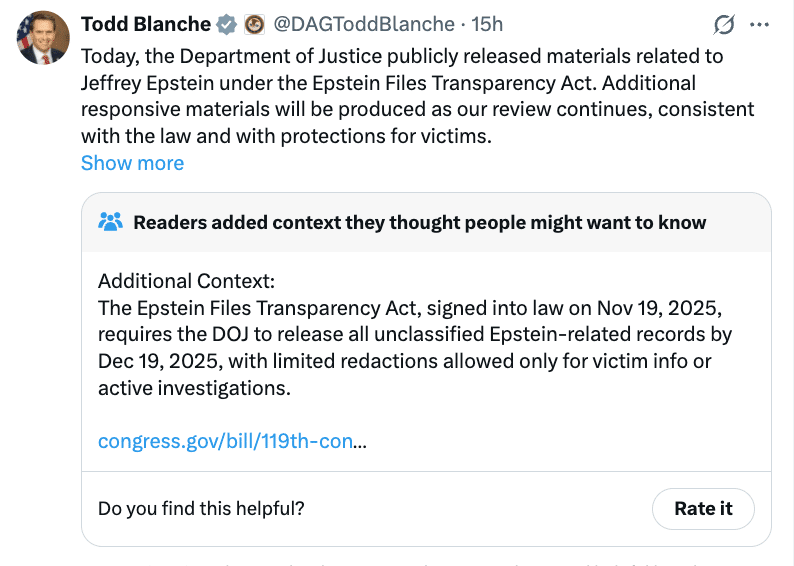
Once again, Trump’s top flunkies may be overestimating their ability to contain their scandal.

Todd Blanche behind the selective prosecution

Meanwhile, efforts by those same flunkies to punish Kilmar Abrego continue to impose costs.

There have been parallel proceedings with Abrego in the last month. Just over a week ago in his immigration docket, Judge Paula Xinis ordered Kilmar Abrego to be released from ICE custody for the first time since March, and then issued another order enjoining DHS from taking him back into custody at a check-in the next day. Effectively, Xinis found the government had been playing games for months, making claims they had plans to ship Abrego to one or another African country instead of Costa Rica, which had agreed to take him. Those games were, in effect, admission they had no order of removal for him, and so could no longer detain him.

[B]ecause Respondents have no statutory authority to remove Abrego Garcia to a third country absent a removal order, his removal cannot be considered reasonably foreseeable, imminent, or consistent with due process. Although Respondents may eventually get it right, they have not as of today. Thus, Abrego Garcia’s detention for the stated purpose of third country removal cannot continue.

But even as that great drama was happening, something potentially more dramatic was transpiring in Abrego’s criminal docket.

Back on December 4, Judge Waverly Crenshaw, who had been receiving, ex parte, potential evidence he ordered the government turn over in response to Abrego’s vindictive prosecution claim, canceled a hearing and kicked off a fight over disclosures with DOJ. Four days later he had a hearing with the government as part of their bid for partial reconsideration, but then provided a limited set of exhibits to Kilmar’s attorneys.

Then yesterday, in addition to a request that Judge Crenshaw gag Greg Bovino — who keeps lying about Abrego — Abrego’s team submitted filings in support of the bid to dismiss the indictment. One discloses that Todd Blanche’s office was pushed by people within Blanche’s office, including Aakash Singh, who is centrally involved in Blanche’s other abuse of DOJ resources, including by targeting George Soros.

Months ago now, this Court recognized that Deputy Attorney General Todd Blanche’s “remarkable” admission that this case was brought because “a judge in Maryland…questioned” the government’s decision to deport Mr. Abrego and “accus[ed] us of doing something wrong”1 may “come close to establishing actual vindictiveness.” (Dkt. 138 at 7-8). The only thing the Court found missing from the record was evidence “tying [Mr. Blanche’s statements] to actual decisionmakers.” (Id. at 8). Not anymore. Previously, the Court rightly wondered who placed this case on Mr. McGuire’s desk and what their motivations were. (Dkt. 185 at 2). We now know: it was Mr. Blanche and his office, the Office of the Deputy Attorney General, or “ODAG.” On April 30, 2025, just three days after Mr. McGuire personally took on this case, one of Mr. Blanche’s chief aides, Associate Deputy Attorney General Aakash Singh, told Mr. McGuire that this case was a [redacted]2 (Abrego-Garcia000007). That same day, Mr. Singh asked Mr. McGuire: [redacted] (Abrego-Garcia000008). Mr. McGuire responded with a timing update, saying he wanted to about a strategic question, and assuring Mr. Singh [redacted] and [redacted] (Abrego-Garcia000008). These communications and others show, as the Court put it, that [redacted] and [redacted] (Dkt. 241 at 5, 7). The “remarkable” statements “com[ing] close” to establishing vindictiveness (Dkt. 138 at 7-8) came from the same place— ODAG—as the instructions to Mr. McGuire to charge this case. The only “independent” decision (Dkt. 199 at 1) Mr. McGuire made was whether to acquiesce in ODAG’s directive to charge this case, or risk forfeiting his job as Acting U.S. Attorney—and perhaps his employment with the Department of Justice—for refusing to do the political bidding of an Executive Branch that is avowedly using prosecutorial power for “score settling.”3

2 The Court’s December 3 opinion (Dkt. 241) remains sealed, and the discovery produced to the defense in connection with Mr. Abrego’s motion to dismiss for vindictive and selective prosecution was provided pursuant to a protective order requiring that “[a]ny filing of discovery materials must be done under seal pending further orders of this Court” (Dkt. 77 at 2). Although the defense does not believe that any of these materials should be sealed for the reasons stated in Mr. Abrego’s memorandum of law regarding sealing (Dkt. 264), the defense is publicly filing a redacted version of this brief out of an abundance of caution pending further orders of the Court.

3 See Chris Whipple, Susie Wiles Talks Epstein Files, Pete Hegseth’s War Tactics, Retribution, and More (Part 2 of 2), Vanity Fair (Dec. 16, 2025), https://www.vanityfair.com/news/story/trump-susie-wiles-interview-exclusive-part-2.

While the specific content of this discovery remains redacted, the gist of it is clear: Blanche’s office ordered Tennessee prosecutors to file charges against Abrego in retaliation for his assertion of his due process rights.

We know similar documents exist in other cases — most notably, that of LaMonica McIver, Jim Comey, and Letitia James — but no one else has succeeded in getting their hands on the proof.

The Jim Comey stall

Speaking of which, the news you heard about yesterday is that DOJ filed its notice of appeal in both the Jim Comey and Letitia James’ dismissals.

The move comes after DOJ tried to indict James again in Norfolk on December 4 and then tried again in Alexandria on December 11, after which the grand jury made a point of making the failure (and the new terms of the indictment, which Molly Roberts lays out here) clear; Politico first disclosed the Alexandria filings here.

But I think the more interesting development — filed close to the time of the notice of appeals (the notices landed in my email box around 5:44-46PM ET on the last Friday before Christmas and the emergency motion landed in my email box around 5:17PM) — was yet another emergency motion in the Dan Richman case, something DOJ (under Lindsey the Insurance Lawyer’s name) keeps doing. After Judge Colleen Kollar-Kotelly issued her ruling that sort of said DOJ had to return Dan Richman’s stuff and move the remaining copy to EDVA, DOJ filed an emergency motion asking for clarification and an extension and (in a footnote) reconsideration. After Kollar-Kotelly granted the extension and some clarification (while grumbling about the tardiness and largely blowing off the motion for reconsideration), DOJ asked for another extension. Then DOJ filed a motion just informing Kollar-Kotelly they were going to do something else, the judge issued a long docket order noting (in part) that DOJ had violated their assurances they wouldn’t make any copies of this material, then ordering Richman to explain whether he was cool with this material ending up someplace still in DOJ custody rather than EDVA.

In its December 12, 2025, Order, the Court ordered the Government to “return to Petitioner Richman all copies of the covered materials, except for the single copy that the Court [] allowed to be deposited, under seal, with the U.S. District Court for the Eastern District of Virginia.” See Dkt. No. 20. The Court ordered the Government to certify compliance with its Order by 4:00 p.m. ET on December 15, 2025. Id. The Court further ordered that, until the Government certified compliance with its December 12 Order, the Government was “not to… share, disseminate, or disclose the covered materials to any person, without first seeking and obtaining leave of this Court.” See Order, Dkt. No. 20 at 2 (incorporating the terms of Order, Dkt. No. 10).

On December 15 (the Government’s original deadline to certify compliance with the Court’s December 12 Order), the Government requested a seven-day extension of its deadline to certify compliance with the Court’s December 12 Order. Dkt. No. 22. Petitioner Richman consented to this extension. Id. And the Government represented that it would “continue to comply with its obligation… not to access or share the covered materials without leave of the Court.” Id. at 11 (citing Order, Dkt. No. 10 and Order, Dkt. No. 20). So the Court granted the Government’s request for extension, thereby continuing the Government’s deadline to certify compliance with the Court’s December 12 Order to 4:00 p.m. ET on December 22. Order, Dkt. No. 26.

As of this date, the Government has not certified compliance with the Court’s December 12 Order. Accordingly, the Government is still under a Court order that prohibits it from accessing Petitioner Richman’s covered materials or sharing, disseminating, or disclosing Petitioner Richman’s covered materials to any person without first seeking and obtaining leave of this Court. See Dkt. No. 10; Dkt. No. 20; Dkt. No. 22; Dkt. No. 26. As the Government admits, the Government provided this copy of Petitioner Richman’s materials to the CISO “after the Government filed its emergency motion,” Gov’t’s Mot., Dkt. No. 31 at 1, fn. 1, in which the Government represented that it would “continue to comply with its obligation… not to access or share the covered materials without leave of the Court.” Dkt. No. 22 at 11.

In last night’s motion for emergency clarification (which had all the clarity of something written after a Christmas happy hour), DOJ explained that they couldn’t deposit the materials (which according to Kollar-Kotelly’s orders, would no longer have the single up-classified memo that Richman first shared his entire computer so FBI could get eight years ago) because there was no Classified Information Security Officer in the courthouse serving DOD, CIA, and ODNI. So they raised new complaints — basically, yet another motion for reconsideration. After having claimed, last week, that they had just a single copy of Richman’s data, they noted that actually they had it in a bunch of places, then pretended to be confused about storage devices.

d. The Court further clarified its order on December 16, 2025, stating that the Court “has not ordered the Government to delete or destroy any evidence.” ECF No. 27 at 2. But the Court has also instructed the Government that it may not “retain[] any additional copies of the covered materials.” ECF No. 20 at 2. The government has copies of the information in its systems and on electronic media. It is not clear how the government can avoid “retaining” the materials without deleting them.

e. The Court has not yet otherwise explained whether the Government must provide to Richman the original evidence “obtained in the Arctic Haze investigation (i.e., hard and/or flash drives and discs currently in the custody of the FBI,” ECF No. 22 at 9, some subset thereof (e.g., not including classified information), whether the Government must provide Richman the covered materials in some other fashion, and what else the Government must do (or not do) to comply with the December 12, 2025 order.

After they confessed, last week, that neither the discontinued e-Discovery software nor the now-retired and possibly impaired FBI agent could reconstruct what happened with Richman’s data five years ago, they insisted they were really keeping track of the data, Pinky Promise.

f. Notwithstanding the passage of time, changes in personnel, and the limits of institutional memory, the Government emphasizes that the materials at issue have at all times remained subject to the Department of Justice’s standard evidence-preservation, record-retention, and chain of custody protocols. The Government is not aware of any destruction, alteration or loss of original evidence seized pursuant to valid court-authorized warrants. Any uncertainty reflected in the Government’s present responses regarding the existence or accessibility of certain filtered or derivative working files does not undermine the integrity, completeness, or continued preservation of the original materials lawfully obtained and retained. The Government’s responses are offered to assist the Court in tailoring any appropriate relief under Rule 41(g) in a manner consistent with its equitable purpose, while preserving the Government’s lawful interests and constitutional responsibilities with respect to evidence obtained pursuant to valid warrants and subject to independent preservation obligations.

Every single thing about the treatment of Richman’s data defies this claim, which is why he had a Fourth Amendment injury to be redressed in the first place.

Nevertheless, in this their second motion fashioned as a motion for clarification, they they propose, can’t we just keep all the data and Pinky Promise not to do anything with it?

g. Rather than require the government to “return” or otherwise divest its systems of the information, the government respectfully suggests that the more appropriate remedy would simply be to direct the government to continue not to access the information in its possession without obtaining a new search warrant. It is not clear what Fourth Amendment interest would be served by ordering the “return” of copies of information (other than classified information) that is already in the movant’s possession, and that the government continues to possess, at least in the custody of a court (or the Department of Justice’s Litigation Security group, as may be appropriate given the presence of classified information). And the Court’s order properly recognizes that it is appropriate for the government to retain the ability to access the materials for future investigative purposes if a search warrant is obtained. ECF No. 20 at 1. Forcing transfer of evidentiary custody from the Executive Branch to the Judiciary would depart from the traditional operation of Rule 41(g), which is remedial rather than supervisory, and would raise substantial separation-of-powers concerns. The government respectfully suggests that the best way to do that is to allow the executive branch of government to maintain the information in its possession, rather than forcing transfer of evidence to (and participation in the chain of custody by) a court. See, e.g., United States v. Bein, 214 F.3d 408, 415 (3d Cir. 2000) (applying then-Rule 41(e) and noting that it provided for “one specific remedy—the return of property”); see also Peloro v. United States, 488 F.3d 163, 177 (7th Cir. 2007) (same regarding now-Rule 41(g)).

Having violated their promise not to make copies without permission once already, they Pinky Promised, again, they wouldn’t do so.

b. The Government shall continue not to access or share the covered materials without leave of the Court. See ECF No. 10 at 4; ECF No. 20 at 2.

And then they offered a horseshit excuse to ask for a two week extension beyond the time Kollar-Kotelly responds to their latest demands (partly arising from their own stalling of this matter into Christmas season) — that is, not a two week extension from yesterday, which would bring them to January 2, but instead two weeks from some date after December 22, which was at the time Richman’s next deadline.

a. Because it is yet not clear to the Government precisely what property must be provided to Richman by December 22, 2025 at 4:00 PM (and what other actions the Government must or must not take to certify compliance with the December 12, 2025 order as modified), the Government respectfully requests that it be provided an additional fourteen days (because of potential technological limitations in copying voluminous digital data and potential personnel constraints resulting from the upcoming Christmas holiday) from the date of the Court’s final order clarifying the December 6, 2025 order to certify compliance. 1

1 An extension of the compliance deadline is merited by the extraordinary time pressure to which the Government has been subjected and the necessity of determining, with clarity, what the Government must do to comply with the December 12, 2025 order as clarified and modified. See Fed. R. Civ. P. 60(b)(6); see also ECF No. 22 at 6–7 (summarizing applicable legal principles). [my emphasis]

They asked, effectively, to stall compliance for a month.

As a reminder, the grand jury teed up before Aileen Cannon convenes on January 12.

Kollar-Kotelly’s response (which landed in my email box at 7:06, so definitely after prime Christmas happy hour time) was … weird. In addition to granting the government part of the extension they requested (until December 29), she all of a sudden asked Richman what happened after he voluntarily let the FBI image his computer so they could ensure there was no classified information in it.

At present, in this second request, the Court would benefit from additional detail from Petitioner Richman regarding the Government’s imaging of Petitioner Richman’s personal computer hard drive in 2017. In 2017, Petitioner Richman consented to have the Government seize his personal computer hard drive, make a copy (an “image”) of his personal computer hard drive, and search his personal computer hard drive for the limited purpose of identifying and deleting a small subset of specified material. The Court is requesting information as to whether the hard drive that Petitioner Richman consented to have imaged by the Government was ever returned to Petitioner Richman, and, if so, whether any of the specified material had been removed from the hard drive that was returned.

Now maybe she’s asking this question simply to refute DOJ’s claim that any material independently held has to be held by a CISO.

The answer to this question is publicly available in the 80-page IG Report on this topic.

On June 13, 2017, FBI agents went to Richman’s home in New York to remove his desktop computer. On June 22, 2017, FBI agents returned the desktop computer to Richman at his home in New York after taking steps to permanently remove the Memos from it. While at Richman’s residence on June 22, 2017, the FBI agents also assisted Richman in deleting the text message with the photographs of Memo 4 from his cell phone.

It’s not clear why they ever kept the image in the first place (remember, they didn’t obtain a warrant to access it until well over two years later).

But I worry that Kollar-Kotelly is getting distracted from the clear recklessness — including DOJ’s most recent defiance of her order and their own Pinky Promises — for which Richman is due a remedy by the distinction between his physical property (the hard drive he got back eight years ago) and his digital property (the image of that hard drive, his Columbia emails, his iCloud, his iPhone, and iPad). The most serious abuse of his Fourth Amendment rights involved his phone, which DOJ only ever had in digital form, regardless of what kind of storage device they stored that content on (which we know to be a Blu-ray disc).

And meanwhile, everything about the government’s actions suggest they’re going to string Kollar-Kotelly along until they can get a warrant from the judge, Cannon, who once said Trump had to be given boxes and boxes of highly classified documents back because they also contained a single letter written by Trump’s personal physician and another letter published in Mueller materials.

They are just dicking around, at this point.

There’s a lot of shit going down in documents signed (as this emergency motion is) with Todd Blanche’s name. He still seems to believe he can juggle his way through politicizing the Department of Justice with some carefully executed Friday Night document dumps.

Share this entry

Judge Richard Berman: Victims Victims Victims

There are two main thrusts of Judge Richard Berman’s opinion refusing the government’s stunt request to unseal the Jeffrey Epstein grand jury materials.

First, he emphasized the victims’ rights and explicitly said DOJ had not given them enough notice of their request.

There is another compelling reason not to unseal the Epstein grand jury materials at this time, namely possible threats to victims’ safety and privacy. The Court received a very compelling letter, dated August 5, 2025, from three leading victims’ rights attorneys, who have stated: “[A]ny disclosure of grand jury material–especially material that could expose or help identify victims in any way–directly affects the CVRA’s [18 U.S.C. §3771] fairness, privacy, conferral, and protection guarantees.” [citation omitted] These attorneys represent “numerous survivors of Jeffrey Epstein, including several individuals whose names and identifying information appear in the subject materials.” Id. at 1. Whether victims do or do not favor unsealing, it is imperative that victims have adequate notice of unsealing and adequate timem to respond in advance of disclosure. See id. at 2.

Victims did not have sufficient notice before the Government filed the instant motions to unseal.

His opinion continued to focus on the victims, quoting several Jane Does and Annie Farmer. He twice recalled the powerful testimony from the victims after Epstein’s death in 2019. He insinuated that DOJ would not — and probably is not — protecting the victims as they share information with Congress.

Against that background, Berman noted that the government said it would, itself, release the files.

A significant and compelling reason to reject the Government’s position in this litigation is that the Government has already undertaken a comprehensive investigation into the Epstein case and, not surprisingly, has assembled a “trove” of Epstein documents, interviews, and exhibits. And the Government committed that it would share its Epstein investigation materials with the public.

[snip]

The Government’s “Epstein Files” are sui generis. They are investigatory and not subject to Federal Rule of Criminal Procedure 6(e).

The Government is the logical party to make comprehensive disclosure to the public of the Epstein Files. By comparison, the instant grand jury motion appears to be a “diversion” from the breadth and scope of the Epstein files in the Government’s possession. [citing Engelmayer] The grand jury testimony is merely a hearsay snippet of Jeffrey Epstein’s alleged conduct.

Berman actually went easier on DOJ than I thought he might. As noted, DOJ violated the CVPA in its approach to this. He seems worried they’re doing the same in sharing documents with Congress.

But the answer remains: Todd Blanche can’t get his “hearsay snippet” released through Berman.

Share this entry

Planning for a Cover-Up in a House with Small Children and Other Stories of How Todd Blanche Is Helping a Sex Trafficker

CNN has a story about how Trump’s impeachment defense attorney, his criminal defense attorney, the flunkie who helped frame Hillary Clinton, and his Chief of Staff will go to JD Vance’s home — where he is raising three children under the age of 10 — to discuss how to make Donald Trump’s sex trafficking problem go away.

They apparently believe that Todd Blanche can hold his own in an interview with Joe Rogan, who has long smelled the rat in this cover-up.

The administration’s handling of the Epstein case, as well as the need to craft a unified response, is expected to be a main focus of the dinner, three sources familiar with the meeting told CNN. The meeting will include White House chief of staff Susie Wiles, Vice President JD Vance, Attorney General Pam Bondi, FBI Director Kash Patel and Blanche.

With the exception of Vance, the White House considers those officials the leaders of the administration’s ongoing strategy regarding the Epstein files, two of the sources said.

The meeting comes as Trump’s administration is considering releasing the contents of Blanche’s interview last month with Maxwell. Two officials told CNN that the materials could be made public as early as this week.

There have also been internal discussions about Blanche holding a press conference or doing a high-profile interview, possibly with popular podcaster Joe Rogan, according to three people familiar with the discussions, though those conversations are preliminary. Rogan, who endorsed Trump on the eve of last fall’s election, has been highly critical of the Trump administration’s handling of the Epstein case and previously called their refusal release more information about Epstein a “line in the sand.”

To be fair to Blanche, though, he has managed to serve his client, and convicted sex trafficker Ghislaine Maxwell, well so far.

Yesterday, Maxwell’s attorney, David Markus, submitted his — well-justified — opposition to releasing the grand jury materials for Ghislaine Maxwell’s case, the ones that would feature a broad swath of victims. He as much as conceded that this might have provided a way to review the grand jury files (another benefit Blanche tried to offer), but now that Judge Paul Engelmeyer denied that request, he’s opposed to the unsealing request.

Although the government did not oppose allowing the defense to review the grand jury material to assess whether to object to its release, the Court denied that request. As a result, Ghislaine Maxwell has not seen the material and cannot take an informed position. Given that she is actively litigating her case and does not know what is in the grand jury record, she has no choice but to respectfully oppose the government’s motion to unseal it.

Maxwell’s opposition is likely enough, by itself, to rule against release of the Maxwell transcripts, which would include far more detail than Epstein’s would.

Little noticed is the line in the DOJ filing describing DOJ telling third parties — not victims — if they appear in the grand jury transcripts.

In addition, the Government is in the process of providing notice to any other individuals identified in the transcripts.

Meanwhile, DOJ confessed yesterday that they have still not notified all the victims identified in the transcripts, and only just started to notify the victims covered under the relevant victim notification law.

Seventh, regarding the Government’s approach to victim notification of the instant proceedings, as noted in its July 29 submission, the Government has provided notice of the unsealing motions to all but one of the victims who are referenced in the grand jury transcripts at issue in the motions. The Government still has been unable to contact that remaining victim. With respect to victims who are not identified in the grand jury transcripts but who have previously received victim notifications in the Maxwell and Epstein matters, the Government will over the coming days alert those victims to the fact of the unsealing motions.

That letter was posted the same day as this letter from Brad Edwards, who likely represents the largest number of known victims. He accuses the government of violating the Crime Victims’ Rights Act generally, as well as losing track of some victims who are likely implicated in the Epstein and Maxwell grand juries but only came to be represented by Edwards after their testimony. He describes that “yesterday” (that is, Monday), he contacted the government about the other victims and they responded, which suggests this newfound focus on other victims is a response to Edwards’ efforts.

Given our history fighting for the enforcement of the CVRA on behalf of Jeffrey Epstein’s many victims, we were quite surprised to learn that the government sought the unsealing of grand jury materials before this Court without first conferring with the victims or their counsel, a step required by the CVRA and reinforced by Doe v. United States, 08-80736 (S.D. Fla.). That case, litigated pro bono by undersigned counsel for more than a decade, arose precisely because the government previously violated the rights of many of these very same victims. It is especially troubling that, despite the outcome of that litigation, the government has once again proceeded in a manner that disregards the victims’ rights—suggesting that the hard-learned lessons of the past have not taken hold. This omission reinforces the perception that the victims are, at best, an afterthought to the current administration.

Of significant concern, the same government that failed to provide notice to the victims before moving this Court to unseal the grand jury materials is now the government representing to this Court that it has provided appropriate notice to the victims or their counsel and has conducted a proper review and redaction of the materials it seeks to release. Several clients have contacted us expressing deep anxiety over whether the redactions were in fact adequate. Consequently, we requested yesterday that the government identify which of our clients were referenced to the grand jury. The government responded promptly and provided clarification. However, we have strong reason to believe that additional individuals—whom we also represent—were likely referenced in those materials but were not identified to us by the government.

It remains unclear whether notice was instead provided to prior counsel, whether their omission was a government oversight, whether the government does not consider them to be victims, or whether these individuals were, in fact, not mentioned to the grand jury. Regardless of the explanation, this ambiguity raises a serious issue that must be resolved before any materials are publicly released. [my emphasis]

You know who wouldn’t have fucked up this process? The prosecutor Pam Bondi fired on Trump’s authority just as this cover-up began, Maurene Comey.

The asymmetric treatment is pissing off the victims. Annie Farmer’s attorney describes that the intent to redact third party names “smacks of a cover up.”

Any effort to redact third party names smacks of a cover up. The Government does not elaborate on what protocol it is using to redact other “third party” names or which types of individuals it seeks to protect in this way. To the extent the Government for some reason seeks to redact the names of other Epstein and Maxwell affiliates on the basis that these individuals “neither have been charged or alleged to be involved” in their crimes, the Court should exercise its independent authority to ensure that any redactions are tailored to serve compelling interests. See generally Brown v. Maxwell, 929 F.3d 41, 50 (2d Cir. 2019) (even if materials are not considered judicial documents to which a presumption of public access applies, “a court must still articulate specific and substantial reasons for sealing such material”).

I have a feeling Judge Richard Berman (who has been posting victim letters as they come in) will not take kindly to a grand jury unsealing in which people like Donald Trump and Prince Andrew get notice, but the victims do not.

This may change as Congress gets involved. Perhaps in an attempt to stave off the Massie-Khanna bid for true transparency that will ripen over the August recess, James Comer announced a bunch of subpoenas for people not named Alex Acosta or Donald Trump.

Oversight Chair James Comer (R-Ky.) announced that he was summoning nearly a dozen former officials to appear for depositions on the Epstein investigation — a list that includes former President Bill Clinton and former Secretary of State Hillary Clinton.

Former U.S. Attorneys General William Barr, Alberto Gonzales, Jeff Sessions, Loretta Lynch, Eric Holder and Merrick Garland, as well as former FBI Directors Robert Mueller and James Comey were also tapped to give testimony in connection to the case.

Comer was required to send the subpoenas after a Democratic-led subcommittee vote in July.

The move is the latest in a broader battle over the Epstein files, which took the Trump administration by storm last month as anger boiled over from within MAGA circles about the administration’s handling of the case.

The committee’s subpoena of Bill Clinton in particular seems more symbolic than substantive. No former president has ever testified to Congress under the compulsion of a subpoena — and lawmakers have tried only twice before: once in 1953, when the House Un-American Activities Committee subpoenaed Harry Truman, and once in 2022, when the Jan. 6 select committee subpoenaed Donald Trump.

While this is the rare Epstein development that Fox has covered, there’s so much about this request that reeks of a cover-up it may well backfire.

But as Lisa Rubin describes, there’s also a subpoena to DOJ — the price of the Clinton testimony — that does make demands that would, among other things, cover the transcript of the Ghislaine Maxwell interview.

By ABC’s description, Blanche got Ghislaine to perform like a trained seal, asking her to describe what he did in her presence, but not asking her about what he did when he learned she had “stolen” one of Trump’s spa girls and forced her into sex slavery.

During her nine hours speaking with Deputy Attorney General Todd Blanche last month, Ghislaine Maxwell said nothing during the interview that would be harmful to President Donald Trump, telling Blanche that Trump had never done anything in her presence that would have caused concern, according to sources familiar with what Maxwell said.

The Trump administration, meanwhile, is considering publicly releasing the transcripts from the interview, multiple sources familiar with the internal discussions told ABC News.

There are a lot of moving parts.

Including Ghislaine, to her new cozier digs, where the other inmates, including one whose daughter was trafficked, are already expressing disgust that Todd Blanche put a sex trafficker among their midst.

Julie Howell, 44, who is serving a one-year sentence for theft, told The Telegraph that “every inmate I’ve heard from is upset she’s here”.

“This facility is supposed to house non-violent offenders,” she added. “Human trafficking is a violent crime.”

[snip]

Inmates at FPC Bryan are worried about their own safety, given the widespread threats against Maxwell and lack of tight security on the prison grounds.

Howell said: “We have heard there are threats against her life and many of us are worried about our own safety because she’s here.”

Her comments will only fuel concern that could be targeted at the facility, preventing her testimony about Epstein from ever seeing the light of day.

Maxwell was allegedly moved under the cover of darkness because she had been “bombarded” with death threats from rapists who accused her of being a “snitch”, according to the Mail on Sunday.

Multiple outlets, including that CNN story, report that Trump’s close advisors think they’ve weathered this crisis because their mobsters — people like Charlie Kirk and Benny Johnson — have been distracted by other things.

One official told CNN that some of the conversation within the White House has focused on whether making the details from the interview public would bring the Epstein controversy back to the surface. Many officials close to Trump believe the story has largely died down.

We shall see.

As I wrote here, Trump and Blanche have the power to silence Maxwell, if the rapists calling her a snitch don’t get to her first.

But the moving parts and sheer cynicism of the cover-up may backfire.

Share this entry

Trump Might Pardon the Sex Trafficker Who “Stole” His Spa Girls and Other Details of the Cover-Up

Much of the traditional press (though not Chris Hayes) has missed the significance of Trump’s confession yesterday that Virginia Giuffre — recruited from Trump’s spa when she was 16 or 17 — was one of the girls that he says Jeffrey Epstein “stole.”

Reporter 1: I’m just curious. Were some of the workers that were taken from you — were some of them young women?

Trump: Were some of them?

Reporter 1: Were some of them young women?

Trump: Well, I don’t wanna say, but everyone knows the people that were taken. It was, the concept of taking people that work for me is bad. But that story’s been pretty well out there. And the answer is, yes, they were.

[inaudible]

Trump: In the spa. People that work in the spa. I have a great spa, one of the best spas in the world at Mar-a-Lago. And people were taken out of the spa. Hired. By him. In other words, gone. And um, other people would come and complain. This guy is taking people from the spa. I didn’t know that. And then when I heard about it I told him, I said, listen, we don’t want you taking our people, whether they were spa or not spa. I don’t want him taking people. And he was fine and then not too long after that he did it again and I said Out of here.

Reporter 2: Mr. President, did one of those stolen persons, did that include Virginia Giuffre?

Trump: Uh, I don’t know. I think she worked at the spa. I think so. I think that was one of the people, yeah. He stole her. And by the way, she had no complaints about us, as you know. None whatsoever.

Many, for example are forgetting what Trump said the day before: Epstein “stole” one of Trump’s girls, Trump told him to stop, and Epstein did it again.

What caused the breach with him? Very easy to explain. But I don’t want to waste your time by explaining it. But for years I wouldn’t talk to Jeffrey Epstein. I wouldn’t talk. Because he did something that was inappropriate. He hired help. And I said, don’t ever do that again. He stole people that worked for me. I said, don’t ever do that again. He did it again. And I threw him out of the place. Persona non grata. I threw him out. And that was it.

To tell Epstein to stop doing something, Trump would have had to have known he was doing something.

And the “it” is made much more clear by what “the Mar-a-Lago” told Page Six in 2007, even before Epstein had signed the sweetheart non-prosecution agreement.

Meanwhile, the Mar-a-Lago Club in Palm Beach last night confirmed a Web site report that Epstein has been banned there. “He would use the spa to try to procure girls. But one of them, a masseuse about 18 years old, he tried to get her to do things,” a source told us. “Her father found out about it and went absolutely ape-[bleep]. Epstein’s not allowed back.” Epstein denies he is banned from Mar-a-Lago and says, in fact, he was recently invited to an event there.

Before the full extent of Epstein’s abuse was public, someone at Mar-a-Lago wanted to make it clear that when Epstein did “procure girls … he tried to get her to do things.”

This member’s daughter who was “about 18,” was at least the second girl Trump learned about.

The first (or who knows? maybe she wasn’t the first!) was Giuffre.

The second (at least) was the member’s daughter.

Having now confirmed that Giuffre was among the “girls” Epstein would try to “procure” from Trump’s spa, it makes both Trump’s public acknowledgement to New York Magazine (two years after Ghislaine Maxwell “stole” Giuffre) that Epstein liked his so-called women “on the younger side” and the smutty letter sent a few months later reflected knowledge that Epstein was fucking girls.

“Voice Over: There must be more to life than having everything,” the note began.

Donald: Yes, there is, but I won’t tell you what it is.

Jeffrey: Nor will I, since I also know what it is. 

Donald: We have certain things in common, Jeffrey. 

Jeffrey: Yes, we do, come to think of it. 

Donald: Enigmas never age, have you noticed that? 

Jeffrey: As a matter of fact, it was clear to me the last time I saw you. 

Donald: A pal is a wonderful thing. Happy Birthday — and may every day be another wonderful secret.

Not just any girls, but his girls. Trump’s girls, from his spa.

And Trump is so furious that Ghislaine Maxwell stole girls from his spa that he’s saying the same thing about a pardon for her that he said about pardons for Paul Manafort and Roger Stone before he rewarded for their lies about him, that he won’t rule it out.

By all appearances, Trump will pardon the woman who stole his girls. That’s how furious he is that she groomed at least two of his girls and tried — successfully in Giuffre’s case — to turn her into a sex slave.

Meanwhile, now that Trump has placated much of the press, the cover-up continues apace. In a letter David Markus sent to James Comer (but not Oversight Ranking Member Robert Garcia — Markus was leaving nothing to chance) he said that Ghislaine would only testify to the House Oversight Committee if she:

  • Got formal immunity
  • Got the questions in advance
  • After she tests her luck with SCOTUS (in which case she won’t need to spill secrets to get out of prison)
  • If she gets clemency for the things she’ll say

In other words, she’ll only testify if that’s the only way she can leverage what she knows.

Comer immediately declined, meaning Trump faces no risk that Ghislaine’s silence will disrupt the cover-up.

Meanwhile, Pam Bondi, Todd Blanche, and Jay Clayton (but not even the AUSA who filed an appearance) have confessed that they are engaged in a headfake. Their response to Richard Berman and Paul Engelmeyer  falsely claims that the interest in these transcripts arose from the memo Pam Bondi released and not the inflammatory comments and promises Bondi, Kash Patel, and Dan Bongino made.

Attention given to the Epstein and Maxwell cases has recently intensified in the wake of the July 6, 2025 Memorandum announcing the conclusions of the Government’s review into the investigation

They minimize the concerns about victim testimony because just two people testified.

Here, there was one witness—an FBI agent—during the Epstein grand jury proceedings. There were two witnesses—the same FBI agent from the Epstein grand jury proceedings and a detective with the NYPD who was a Task Force Officer with the FBI’s Child Exploitation and Human Trafficking Task Force—during the Maxwell grand jury proceedings.

Both witnesses are still alive; the FBI agent continues to be an agent with the FBI, and the Detective continues to be a Detective with the NYPD as well as a Task Force Officer.

Consistent with applicable rules concerning the admissibility of hearsay testimony, the grand jury witnesses described statements of others, including statements of and concerning victims, many of whom are still alive.

They admit they’ll redact the names of the third parties who enabled Epstein (which they wouldn’t necessarily have to do if they released the files in their custody).

[T]he grand jury transcripts contain victim-related and other personal identifying information related to third parties who neither have been charged or alleged to be involved in the crimes with which Epstein and Maxwell were charged, to which the Government is sensitive, and which is why the Government proposes redacting the transcripts before releasing them.

But they are providing notice to those people.

 In addition, the Government is in the process of providing notice to any other individuals identified in the transcripts.

They appear to suggest that they’re not providing all the grand jury transcripts to the judges — just the underlying material.

The Court directed the Government to submit: (1) indices of Epstein and Maxwell grand jury materials, including a brief summary, the number of pages, and dates; (2) a complete set of the Epstein and Maxwell grand jury transcripts; (3) a complete proposed redacted set of the Epstein and Maxwell grand jury transcripts; and (4) a description of any other Epstein and Maxwell grand jury materials, including, but not limited to, exhibits. (Epstein Dkt. 63 at 3; Maxwell Dkt. 789 at 3). As to the final category, the Government provides a description of all of the underlying materials presented to the grand jury as well as copies of, and proposed redactions to, certain materials presented to the grand jury. [my emphasis]

They definitely don’t answer a question both judges asked: whether DOJ had asked the victims before filing this response.

The Court also directed the Government to state whether, “before filing the instant motion, counsel for the Government reviewed the Maxwell grand jury transcripts and whether the Government provided notice to the victims of the motion to unseal,”

[snip]

In addition, the Government has now provided notice to all but one of the victims who are referenced in the grand jury transcripts at issue in this motion. The Government has attempted to contact the remaining victim, but such efforts have been unsuccessful. In addition, the Government is in the process of providing notice to any other individuals identified in the transcripts.

Having not done that (and not yet spoken to one of the victims), they ask for a chance to respond to the victims’ comments about this ploy — which they should have asked about before they started it — after they file sealed responses.

[T]he Government also respectfully requests leave to file a supplemental submission once the Government and the Court have received any filings from the victims or others referenced in the transcripts.

The only thing this exercise is “transparency” has done so far is to share grand jury information with people implicated, but not charged, in Epstein’s actions.

Note, one person specifically implicated in Epstein’s crimes is Prince Andrew. To the extent he was investigated and possibly even charged under seal — which is the most obvious explanation for why he wouldn’t travel — the DOJ letter would create the appearance of a clean bill of health. But it could be buried in a different grand jury and we’d never even know.

Update: This is a very good CNN piece, including a long focus on how hard this is on the victims.

Share this entry

Judge Richard Berman Had to Remind Todd Blanche to Think of Jeffrey Epstein’s Victims

In response to his motions to unseal grand jury testimony in the Epstein and Maxwell dockets, Judges Richard Berman and Paul Engelmayer (who got the case on reassignment from Alison Nathan, who is now at Second Circuit) gave Blanche a homework assignment.

[T]he Court cannot rule on the motion without additional submissions.

[snip]

The Second Circuit has identified the following as a non-exhaustive list of factors for district courts to weigh in considering applications for disclosure:

  • the identity of the party seeking disclosure;
  • whether the defendant to the grand jury proceeding or the Government opposes the disclosure;
  • why disclosure is being sought in the particular case;
  • what specific information is being sought for disclosure;
  • the current status of the principals of the grand jury proceedings and that of their families;
  • the extent to which the desired material — either permissibly or impermissibly — has been previously made public;
  • whether witnesses to the grand jury proceedings who might be affected by the disclosure are still alive; and
  • [whether there is an] additional need for maintaining secrecy in the particular case in question.

The letters are largely identical. They both ask, for example, whether Blanche bothered to notify the victims.

The Court also directs the Government to state in the memorandum whether, before filing the instant motion, counsel for the Government reviewed the [Epstein/Maxwell] grand jury transcripts and whether the Government provided notice to the victims of the motion to unseal.

Berman, who had this to say at the hearing on dismissing the indictment against Epstein, added one detail.

The victims have been included in the proceeding today both because of their relevant experiences and because they should always be involved before rather than after the fact.

In his unsealing memo, Blanche cited the DOJ/FBI memo attempting to shut all this down, focusing on whether there was evidence to predicate a case.

On July 6, 2025, the Department of Justice and Federal Bureau of Investigation issued a memorandum describing an exhaustive review undertaken of investigative holdings relating to Jeffrey Epstein (the “Memorandum”).1 The Memorandum detailed the steps taken by the Department of Justice and Federal Bureau of Investigation to determine whether evidence existed that could predicate an investigation into uncharged third parties.

1. https://www.justice.gov/opa/media/1407001/dl?inline.

It took Judge Berman, in his paragraph instructing victims to weigh in by August 5, to also mention the later reference in the DOJ/FBI letter”

See Gov’t Motion at 1 n.1. (This is a 2 page, undated, unsigned U.S. Department of Justice and Federal bureau of Investigation memo. According to the Government, “Epstein harmed over one thousand victims. Each suffered unique trauma. Sensitive information relating to these victims is intertwined throughout the materials. This includes specific details such as victim names and likenesses, physical descriptions, places of birth, associates, and employment history.”)

Todd Blanche — the President’s defense attorney — was focused on declaring uncharged third parties free of criminal liability. Berman had to remind him that DOJ claimed this is about victims.

A SDNY AUSA, Jeffrey Oestericher, who is representing the government in some of the high profile immigration cases, has joined these dockets. Sadly, Blanche won’t have to do this homework assignment himself. Because I bet that after firing Maurene Comey, it will take some time to do the victim notification that DOJ did not do.

Remember, too, that Blanche said he was making a similar request in SDFL, but thus far it has not been identified yet. For all we know Aileen Cannon could be intervening here without public notice!

Incidentally, the 2019 transcript is worth perusing for the victims’ statements, as well as the way that Comey spoke of the victims and vice versa.

I would also like to note that, as the government has previously mentioned, this dismissal in no way lessens the government’s resolve to stand up for the victims in this case, both those who have come forward and those who have yet to do so. We agree with your Honor’s sentiment that those victims should be respected, and we appreciate your Honor’s recognition of that.

[snip]

[Brad Edwards] And on behalf of all of victims, I would like to thank your Honor for the fairness with which they’ve been treated, and the United States Attorney’s office for the way in which you have handled this investigation, and especially how you have treated the victims in this case.

[snip]

[David Boies] I want to, as prior counsel have, commend both the Court and counsel for the Department of Justice for the consideration and respect and attention that they have paid to the victims. We believe that that is not only right, as a matter of human dignity, but we think that is exactly what the law requires and intends.

Update: This, from Lawrence O’Donnell, notes that the only one Trump has said anything nice about was Ghislaine Maxwell.

Share this entry