Stephen Miller, Not (Just) Kristi Noem and Greg Bovino, Must Be Held Accountable
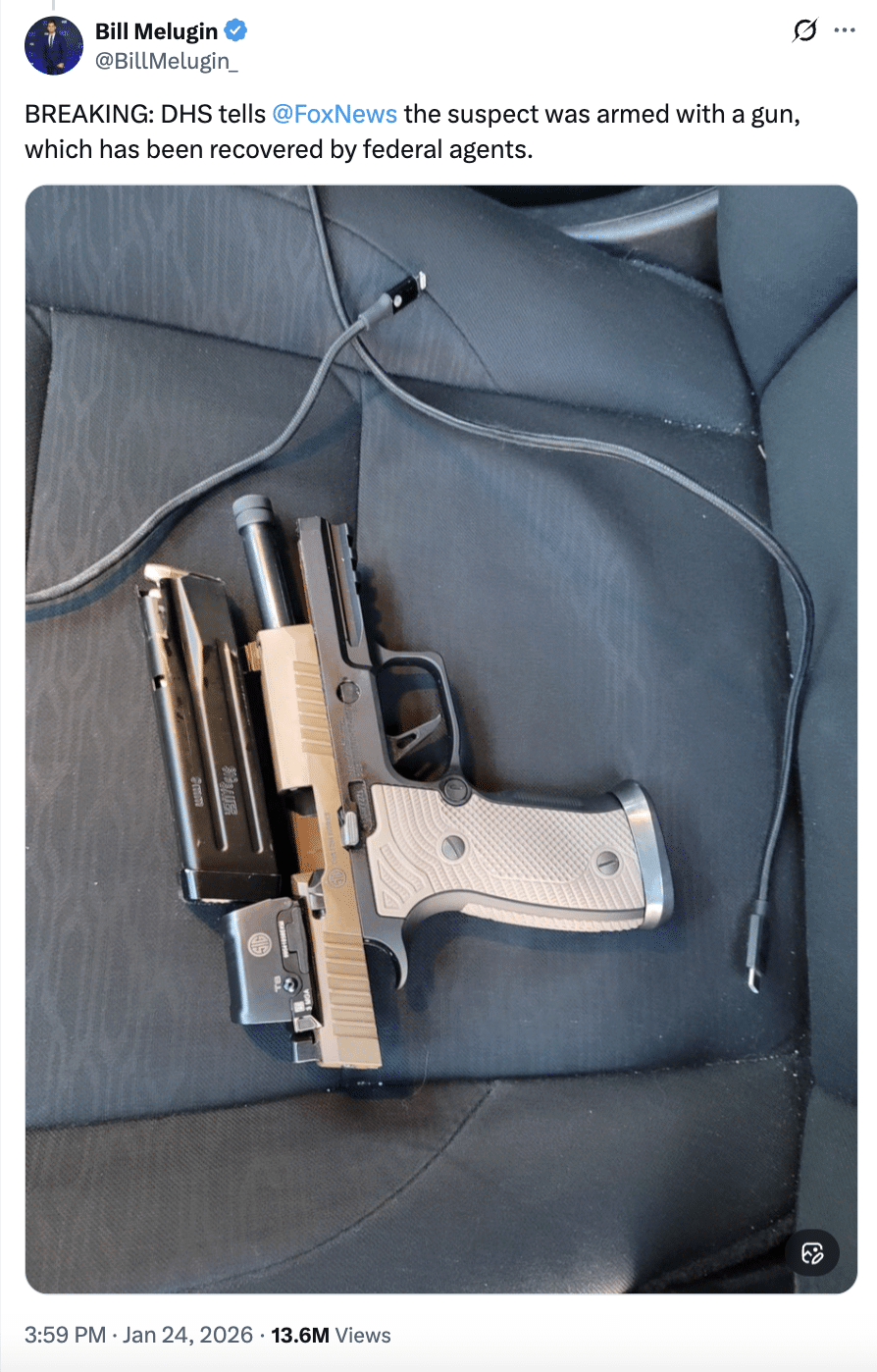
Bill Melugin, whom I call the Fox News Chief Deportation Propagandist (though he has been moved to cover Congress) was the person who first reported that Alex Pretti had a weapon.
Around 56 minutes after CBP killed Pretti at 9:02 AM CT, so 3:02 IT, they had already gotten Melugin this picture (and in the process proven that they were not securing evidence from the crime scene, which damning fact Melugin has never, AFAIK, pointed out).
Among the lies that Melugin disseminated after the murder were that:
- The person CBP was snatching was “an illegal alien wanted for violent assault”
- That Pretti “approached US Border Patrol officers with a 9 mm semi-automatic handgun”
- “[T]he armed suspect violently resisted”
- “Medics on scene immediately delivered medical aid to the subject”
- “[T]his looks like a situation where an individual wanted to do maximum damage and massacre law enforcement”
- “200 rioters arrived at the scene”
Plus, there’s no sign that CBP ever looked for an ID, so I suspect we may one day confirm that DHS claims Pretti had no ID will be proven false.
The Star Tribune debunked most of these lies.
As to the claim that the target of the operation was “wanted for violent assault”? The MN Department of Corrections has launched a dedicated website to correcting DHS lies, including a press release explaining that the guy Greg Bovino claimed they were pursuing had, in fact, been released by ICE during Trump’s first term.
In the hours following the shooting, U.S. Border Patrol Chief Gregory Bovino held a press conference asserting that the operation was targeting an individual named Jose Huerta-Chuma and characterized him as having a significant criminal history. Because federal statements have repeatedly included inaccurate information about Minnesota custody and criminal records, the DOC reviewed available records to determine whether the individual referenced had any connection to Minnesota state prison custody.
Based on DOC records and publicly available Minnesota court data:
- The individual identified by federal officials has never been in Minnesota DOC custody.
- DOC and court records show no felony commitments associated with this
Public Minnesota court records reflect only misdemeanor-level traffic offenses from more than a decade ago.- The individual is not currently under DOC supervision.
DOC records further indicate that an individual by this name was previously held in federal immigration custody in a local Minnesota jail in 2018, during President Trump’s first administration. Any decisions regarding release from federal custody at that time would have been made by federal authorities. DOC has no information explaining why this individual was released.
Importantly, the lies Melugin told were the maximal lies that adjudged liar Greg Bovino would himself tell. Fox News’ Chief Deportation propagandist immediately aired the claims of Greg Bovino, even though Melugin has to be aware of the many times Bovino has been proven a liar in court proceedings, including this two page passage from Judge Sara Ellis’ 233-page memorandum enjoining DHS from further abusive methods (which the Seventh Circuit overturned):
Turning to Bovino, the Court specifically finds his testimony not credible. Bovino appeared evasive over the three days of his deposition, either providing “cute” responses to Plaintiffs’ counsel’s questions or outright lying. When shown a video of agents hitting Rev. Black with pepper balls, Bovino denied seeing a projectile hit Rev. Black in the head. Doc. 191- 3 at 162:21–165:17; Doc. 22-44 (Ex. 44 at 0:10–12, available at https://spaces.hightail.com/space/ZzXNsei63k). In another video shown to Bovino, he obviously tackles Scott Blackburn, one of Plaintiffs’ declarants. Doc. 191-3 at 172:13–173:7; Doc. 22-45 (Ex. 45 at 0:19–30, available at https://spaces.hightail.com/space/ZzXNsei63k). But instead of admitting to using force against Blackburn, Bovino denied it and instead stated that force was used against him. Doc. 191-3 at 173:9–176:11, 179:11–181:5. Bovino also testified that, in Little Village on October 23, 2025, several individuals associated with the Latin Kings were found taking weapons out of the back of their car, and that they, as well as at least one individual on a rooftop and one person in the crowd of protesters, all wore maroon hoodies. Id. at 227:2– 228:21. He further testified that he believed the “maroon hoodies . . . would signify a potential assailant or street gang member that was making their way to the location that I was present” and that “there did begin to appear, in that crowd, maroon hoodies, both on top of buildings and in the crowd.” Doc. 237 at 18:22–19:10. But Bovino also admitted that he could not identify a street gang associated with the color maroon, id. at 19:11–13, although Hewson acknowledged that while Latin Kings members usually wear black, “they also can throw on maroon hoodies,” Doc. 255 at 264:17–20.10 Even were maroon hoodies to signify gang membership, the only evidence on footage from the relevant date of individuals dressed in maroon protesting in Little Village consists of a male wearing a maroonish jacket with an orange safety vest over it, Alderman Byron Sigcho-Lopez wearing a maroon sweater with a suit jacket over it, a female in a maroon shirt, a female in a maroon sweatshirt, and a man with a maroon hoodie under a green shirt and vest. Axon_Body_4_Video_2025-10-23_1053_D01A38302 at 10:03–10:33; Axon_Body_4_Video_2025-10-23_1106_D01A32103 at 16:12–17:17. Bovino’s and Hewson’s explanations about individuals in maroon hoodies being associated with the Latin Kings and threats strains credulity.
Most tellingly, Bovino admitted in his deposition that he lied multiple times about the events that occurred in Little Village that prompted him to throw tear gas at protesters. As discussed further below, Bovino and DHS have represented that a rock hit Bovino in the helmet before he threw tear gas. See Doc. 190-1 at 1; Homeland Security (@DHSgov), X (Oct. 28, 2025 9:56 a.m.), https://x.com/dhsgov/status/1983186057798545573?s=46&t=4rUXTBt_W24muWR74DQ5A. Bovino was asked about this during his deposition, which took place over three days. On the first day, Bovino admitted that he was not hit with a rock until after he had deployed tear gas. Doc. 191-3 at 222:24–223:18. Bovino then offered a new justification for his use of chemical munitions, testifying that he only threw tear gas after he “had received a projectile, a rock,” which “almost hit” him. Doc. 191-3 at 222:24–223:18. Despite being presented with video evidence that did not show a rock thrown at him before he launched the first tear gas canister, Bovino nonetheless maintained his testimony throughout the first and second days of his deposition, id. at 225–27; Doc. 237 at 11–17. But on November 4, 2025, the final session of his deposition, Bovino admitted that he was again “mistaken” and that no rock was thrown at him before he deployed the first tear gas canister. Doc. 238 at 9:12–21 (“That white rock was . . . thrown at me, but that was after . . . I deployed less lethal means in chemical munitions.”); id. at 10:20–23 (Q. [Y]ou deployed the canisters, plural, before that black rock came along and you say hit you in the head, correct? A. Yes. Before the rock hit me in the head, yes.”).
10 John Bodett testified at the preliminary injunction hearing about his experiences in Little Village. As a resident of that neighborhood, he stated that he observed Latin King colors to be black and gold. Doc. 255 at 84:10–17.
Everyone who has followed Stephen Miller’s invasions knows Bovino is a confirmed and committed liar. Yet Melugin still airs his claims, as if they might be credible, and rushed to do so after Pretti’s murder.
Melugin is an integral part of DHS’ propaganda apparatus.
And that’s why it matters that, yesterday, Melugin published a very long tweet describing how sad the goons are to be treated as goons. The statement is still full of bullshit (which I’ve annotated in bold comments).
NEW: Since yesterday’s deadly shooting in MN, I’ve talked to more than half a dozen federal sources [wow! six whole sources!] involved immigration enforcement, including several in senior positions, who all tell me they have grown increasingly uneasy & frustrated w/ some of the claims & narratives DHS pushed in the aftermath of the shooting.
Specifically, I’m told there is extreme frustration with DHS officials going on TV and putting out statements claiming that Alex Pretti was intending to conduct a “massacre” of federal agents or wanted to carry out “maximum damage”, [this claim was first aired by Melugin] even after numerous videos appeared to show those claims were inaccurate. While they say it was a terrible decision to show up with a gun and inject himself into a federal law enforcement operation, there is no indication Pretti was there to murder law enforcement, as videos appear to show he never drew his holstered firearm.
These sources say this messaging from DHS officials has been catastrophic from a PR and morale perspective, as it is eroding trust and credibility – comparing it to when Democrats falsely claimed the border was closed or that Haitians were being whipped at the border. [huh?]
Some of these sources have described DHS’ response to the shooting as “a case study on how not to do crisis PR”, one said they are so “fed up” that they wish they could retire, [I mean, you could just quit] another said “DHS is making the situation worse”, and another added that “DHS is wrong” and “we are losing this war, we are losing the base and the narrative.” [war? who are you in a war with?]
These sources all believe this is going to end up being what they call a “bad shoot”, a “shitty” situation that happened in seconds where agents likely heard “gun!” [one excuse], then the disarmed firearm may have had an accidental discharge [another excuse] that spooked the agents [boo!], and they shot. The agents do not have the luxury of multiple slow motion angles – and had to make split second decisions. [Alex Pretti doesn’t have the luxury of yet more thin excuses]
All of the sources support the mass deportation agenda, but have serious hesitations about the way it is being carried out [again, you could just quit] and the messaging that comes with it. Many of the sources have expressed frustration that ICE is routinely blamed for the actions of Border Patrol, a completely separate agency. [and yet ICE officer Jonathan Ross (who may have been working with Bovino) acted just as badly as Pretti’s murderers]
And as bullshit, we should treat it as yet more far right, probably white male, attempts to disavow personal responsibility for their own actions.
The entire country is seeing that the goons are trigger-happy goons, and in response, they’ve (well, six of them, anyway) run to Melugin to try to blame other goons for the bad behavior of all the goons.
The sentiment that the propaganda is not working anymore is shared more broadly, especially among Murdoch rags. WSJ issued an editorial calling on Trump to pause the invasion of MN. While it still tries to blame Pretti for helping a woman who was assaulted by CBP, it called bullshit on the lies that Stephen Miller and Kristi Noem were telling.
The Saturday shooting of Alex Pretti, as he lay on the ground surrounded by ICE agents, is the worst incident to date in what is becoming a moral and political debacle for the Trump Presidency.
Videos of an event aren’t always definitive, but this is how it looks to us. Pretti attempted, foolishly, to assist a woman who had been pepper-sprayed by agents. Multiple agents then tackled Pretti, and he had a phone in one hand as he lay on the ground. An agent discovered a concealed gun on Pretti, and disarmed him. An agent then shot Pretti, and multiple shots followed.
The Trump Administration spin on this simply isn’t believable. Stephen Miller, the political architect of the mass deportation policy, called Pretti a “domestic terrorist.” He was a nurse without a criminal record.
Kristi Noem, the Homeland Security secretary, said the fact that he carried a gun and (she said) two magazines, meant he “arrived at the scene to inflict maximum damage on individuals and to kill law enforcement.”
But he had a license to carry a gun, which was legally concealed, not carried in his hand as some claimed. He was carrying his phone. To hear the ardent gun-rights advocates of the Trump Administration claim he had malicious intentions because he carried a concealed weapon is bizarre.
[snip]
Whether he likes it or not, most of the burden now lies with Mr. Trump as the President who controls ICE. He would be wise to pause ICE enforcement in the Twin Cities to ease tensions and consider a less provocative strategy. Yes, many on the left would conclude that their civil disobedience has paid off. But Mr. Trump can still pursue enforcement with a smaller force and a strategy aimed at criminals, not at hotel maids and gardeners.
Mr. Trump and his advisers could also help themselves, and the country, by explaining what they are trying to do and sounding conciliatory. Ms. Noem and Mr. Miller aren’t credible spokesmen. Their social-media and cable-TV strategy is to own the libs, rather than to persuade Americans. [my emphasis]
And WSJ’s Trump-whisperer Josh Dawsey described Trump equivocating even as his advisors, starting with his chief gatekeeper, Stephen Miller, debate about what to do.
“I don’t like any shooting. I don’t like it,” Trump added. “But I don’t like it when somebody goes into a protest and he’s got a very powerful, fully loaded gun with two magazines loaded up with bullets also. That doesn’t play good either.”
Trump also signaled a willingness to eventually withdraw immigration enforcement officials from the Minneapolis area.
“At some point we will leave. We’ve done, they’ve done a phenomenal job,” he said. Trump didn’t offer a time frame for when agents might depart. Asked if agents would leave soon, he praised what the administration had done already in Minnesota and said, “We’ll leave a different group of people there for the financial fraud.”
[snip]
Trump’s advisers have been in discussions for weeks about the administration’s aggressive deportation policies, and Saturday’s shooting brought new urgency to those conversations.
Some of the president’s aides have come to see the increasingly volatile situation in Minneapolis as a political liability even as the White House has publicly doubled down on its operations in the city, according to administration officials. White House chief of staff Susie Wiles has taken repeated calls from Minnesota officials, the administration officials said.
Some in the administration worry that public polling and sentiment has turned against the administration’s immigration actions in cities, and some discussions have centered on how to continue deportations without clashing with protesters, officials said. Trump adviser Stephen Miller has continued to push for aggressive immigration enforcement, arguing the administration shouldn’t back down in Minneapolis.
Perhaps the savviest response among Republicans trying to talk sense to Trump came from OK Governor Kevin Stitt, who as Chair of the National Governor’s Association, has already spoken to federalism concerns during the Chicago invasion. Stitt told CNN that Trump was getting bad advice, a comment that — if Trump took it seriously — might lead him to question the garbage Stephen Miller tells him.
Oklahoma Gov. Kevin Stitt, a Republican, expressed concerns about Trump’s goals.
“Americans are asking themselves: ‘What is the endgame? What is the solution?’ We believe in federalism and state rights. And nobody likes feds coming into their states. And so what’s the goal right now? Is it to deport every single non-US citizen? I don’t think that’s what Americans want,” Stitt told CNN’s Dana Bash on “State of the Union.”
Pressed by Bash on whether federal agents needed to pull out of Minnesota, Stitt said, “I think that the president has to answer that question. He is a dealmaker and he’s getting bad advice right now.”
(It is a failure of journalism that Stitt, who is of Cherokee descent, has not been asked about the multiple ICE arrests of Native Americans in Minnesota; neither has Markwayne Mullins, among Trump’s closest allies in the Senate, who is also Cherokee.)
The Pretti murder has, whatever else it has done, made blaming liars — starting with Kristi Noem — for the illegitimacy of the DHS invasions fashionable.
It’s the kind of collapsing legitimacy I envisioned when I laid out, starting 24 days ago, that three things we should try to accomplish this year were to:
- Hold Stephen Miller accountable for his failures
- Visualize how Stephen Miller took money for cancer research and veterans care to pay for a goon army snatching grandmothers
- Discredit Key Spokespeople, including Stephen Miller, Todd Blanche’s office, DHS spox Tricia McLaughlin, and Greg Bovino.
Right wingers are looking at the polling and begging for an out and their immediate instinct is to scapegoat.
Thus far, Kristi Noem is the primary target of the scapegoating. Not even I have focused enough attention on Corey Lewandowski, not even in this post, even though he has overstayed the legal limits of the Special Government Employee appointment and has long exhibited the kind of quick trigger that DHS goons have.
Ultimately, though, Stephen Miller is responsible for both the invasions and Trump’s commitment to sustaining them, even as they destroy the US and Trump’s legacy.
From the start, Stephen Miller has believed that if he just created enough fascist spectacle, people would learn to love his thuggery. That was always failing because — it turns out — not as many people get erotic pleasure out of watching armed men roll around in the street on top of a brown person as Miller imagined; Miller created negative spectacle that drowned out his planned fascist spectacle.
Now that effort has gotten multiple people killed, Republicans want to distance themselves from it.
Their efforts to blame just Kristi Noem and/or Stephen Miller is, itself, just another propaganda campaign — after all, Bill Melugin is carrying it.
But if the right wing wants to tell that story, let’s make sure Miller is included in that story.
Update: Even NYP has called on Trump to deescalate.
Update: Kate Starbird describes that Melugin and other right wing spin artists actually got less engagement on Xitter than the left wing accounts that first posted about the murder.
Note the cluster of posts between 10am and 10:40am CST. (I’ve added a red box there.) These posts received, by far, the most engagement in our dataset. These are the posts that shape the broader discourse. And the vast majority of them were critical of ICE, sometimes implicitly, and other times explicitly calling out and blaming them for the “murder” or “execution” of “another person.” Below are a selection of the most highly reposted posts from that time:
During this same time period, a counter frame began to emerge — with the help of a Fox News journalist. Shortly after 10am CST, Bill Melugin reported via X that the victim, which he referred to as the “suspect,” had been armed. His post was sourced to DHS (the Department of Homeland Security) and contained an image of gun. This new information, which could be easily fit into a counter frame, set off a flurry of activity on the right.
We can see this in our data, as several right wing influencers posted content highlighting the “evidence” that DHS produced and using that to place blame on the victim. Here’s a selection of some of those posts, sized by number of reposts:
[snip]
These five posts, shared between 10am and 11am CST, reveal the prominent frames on the right, suggesting that the victim was responsible for his killing, that he was armed and resisting arrest, and that Democratic leadership contributed. Some of these posts seemingly extend beyond claims from official sources to make false allegations that the victim was an “illegal alien” and contested claims that he brandished and/or fired the weapon. Others simply spin the new evidence — of the victim’s gun — into alternative interpretations about the causes of the event.
But perhaps the most striking thing about this graph is that these posts from influencers on the right framing the event as self defense by ICE agents do not get anywhere near the same amount of engagement as the posts by influencers on the left framing the event as another “murder” by ICE.