Posts

Mr. Art of the Deal Struggles to Spin Three Failed Negotiations

Trump is in the process of spectacularly failing at least three high profile negotiations, all while insisting he’s making imaginary deals left and right.

No, there’s many deals.

When are they going to be announced?

You have to understand, I’m dealing with all the companies, very friendly countries. We’re meeting with China. We’re doing fine with everybody. But ultimately, I’ve made all the deals.

Not one has been announced yet. When are you going to announce them?

I’ve made 200 deals.

You’ve made 200 deals?

100%.

I’ll explain what those three are, but the larger point I want to raise is that these failures, all coming at roughly the same moment, will create a psychological and political need for Trump to seek some other way to look strong, even as these failures prove he’s not.

Harvard

Start with Harvard. That Trump failed what he intended to be a negotiation is evident by the timeline.

At first, Harvard hired Bill Burck, along with Robert Hur. Burck is a formidable lawyer, but quasi-adversaries of Trump (think Eric Adams, who also hired him) hire him because of his relationship with Trump, because he’ll be able to make a deal. When they hired Burck, it is clear, that’s what Harvard expected to do: to deal.

But in response to Trump’s White House overplaying their hand — who overplayed their hand is an open question — with a letter basically demanding to reorganize the most prestigious university in the US and a freeze of $2 billion in funding, Harvard prepared for war, both suing (adding a different set of lawyers) and launching a PR campaign that has not only explained the value Harvard (and higher education generally) brings to the US, but also set an example for and given cover to other universities, giving them the space to fight back, now more unified in opposing Trump’s power grab. While not directly a response to Trump’s attack, Harvard also has the ability and is taking steps to weather this fight financially, but doing so in ways that could influence an already volatile market.

The solidarity formed in response to Harvard’s created a problem. A WSJ piece on how elite universities came together after Harvard took a stand reports, “the Trump administration has been worried schools would team up in resistance, because it is harder to negotiate with a united front.”

After Harvard said they sue, Trump seeded the transparently bullshit story with NYT claiming that the letter — on purpose-made letterhead and signed by three officials — had been sent in error.

Then, almost immediately, came a frantic call from a Trump official.

The April 11 letter from the White House’s task force on antisemitism, this official told Harvard, should not have been sent and was “unauthorized,” two people familiar with the matter said.

The letter was sent by the acting general counsel of the Department of Health and Human Services, Sean Keveney, according to three other people, who were briefed on the matter. Mr. Keveney is a member of the antisemitism task force.

It is unclear what prompted the letter to be sent last Friday. Its content was authentic, the three people said, but there were differing accounts inside the administration of how it had been mishandled. Some people at the White House believed it had been sent prematurely, according to the three people, who requested anonymity because they were not authorized to speak publicly about internal discussions. Others in the administration thought it had been meant to be circulated among the task force members rather than sent to Harvard.

In a ridiculous attempt to reset the negotiations, White House senior policy “strategist” May Mailman blamed Harvard (whence she got her JD) for taking a signed letter seriously, but then invited them to resume negotiations with an offer of “a potential pathway to resume discussions” even while accusing Harvard of playing the victim. [!!!]

A senior White House official said the administration stood by the letter, calling the university’s decision to publicly rebuff the administration overblown and blaming Harvard for not continuing discussions.

“It was malpractice on the side of Harvard’s lawyers not to pick up the phone and call the members of the antisemitism task force who they had been talking to for weeks,” said May Mailman, the White House senior policy strategist. “Instead, Harvard went on a victimhood campaign.”

Still, Ms. Mailman said, there is a potential pathway to resume discussions if the university, among other measures, follows through on what Mr. Trump wants and apologizes to its students for fostering a campus where there was antisemitism.

Having now filed the lawsuit, Harvard plans to skip the steps many other adversaries (including the law firms) have taken, forgoing a request for a Temporary Restraining Order and Preliminary Injunction.

Harvard does not at present request a temporary restraining order or preliminary injunctive relief. Because this case concerns agency action subject to review of the administrative record under the Administrative Procedure Act, Harvard’s claims can be resolved expeditiously through cross-motions practice.

To move towards that, Harvard issued a demand for records that will show the claimed basis for Trump’s interference in Harvard is bullshit, and will also show who was involved (including at the White House, up to and including Trump himself) in manufacturing that pretense.

  • Proof that the government had found a Title VI violation: “the materials considered to conclude there was a Title VI violation, and materials considered in concluding that the government action taken—a funding “freeze”—was the appropriate, legally-justified action in response”
  • Basis to claim that Harvard had been ideologically captured, whatever that is: “the materials considered in concluding there was such ‘capture,’ and materials considered in determining, again, that a “freeze” was the appropriate and lawful response
  • Proof that Trump retaliated by withdrawing funding: “the materials considered in presenting the demands and conditions the government did, and in proceeding with the freeze when Harvard declined the conditions, are part of the record”
  • Basis for freezing specific grants (which Harvard has noted affect legal entities unrelated to Harvard itself): “All materials considered in arriving at those notices are also part of the record”
  • The communications within the government about this, including from the White House, up to and including Trump: “all materials directly or indirectly considered by agency decisionmakers in freezing funding, even if those materials include directions by White House officials”

Given that antisemitism is a transparent pretense to interfere with the university and to predicate funding on a mandated ideology, this documentation will be rather damning. As Harvard’s complaint lays out:

[T]he Government wielded the threat of withholding federal funds in an attempt to coerce Harvard to conform with the Government’s preferred mix of viewpoints and ideologies. Defendants sent Harvard the April 11 Letter and, when Harvard refused the demands, ordered the freeze of billions of dollars in federal funding.

The day after Harvard pushed to accelerate this process, Trump issued a whiny tweet partly targeting Burck (but not by name), which Kaitlan Collins reported led Eric Trump to drop him as outside ethics counsel for Trump Organization.
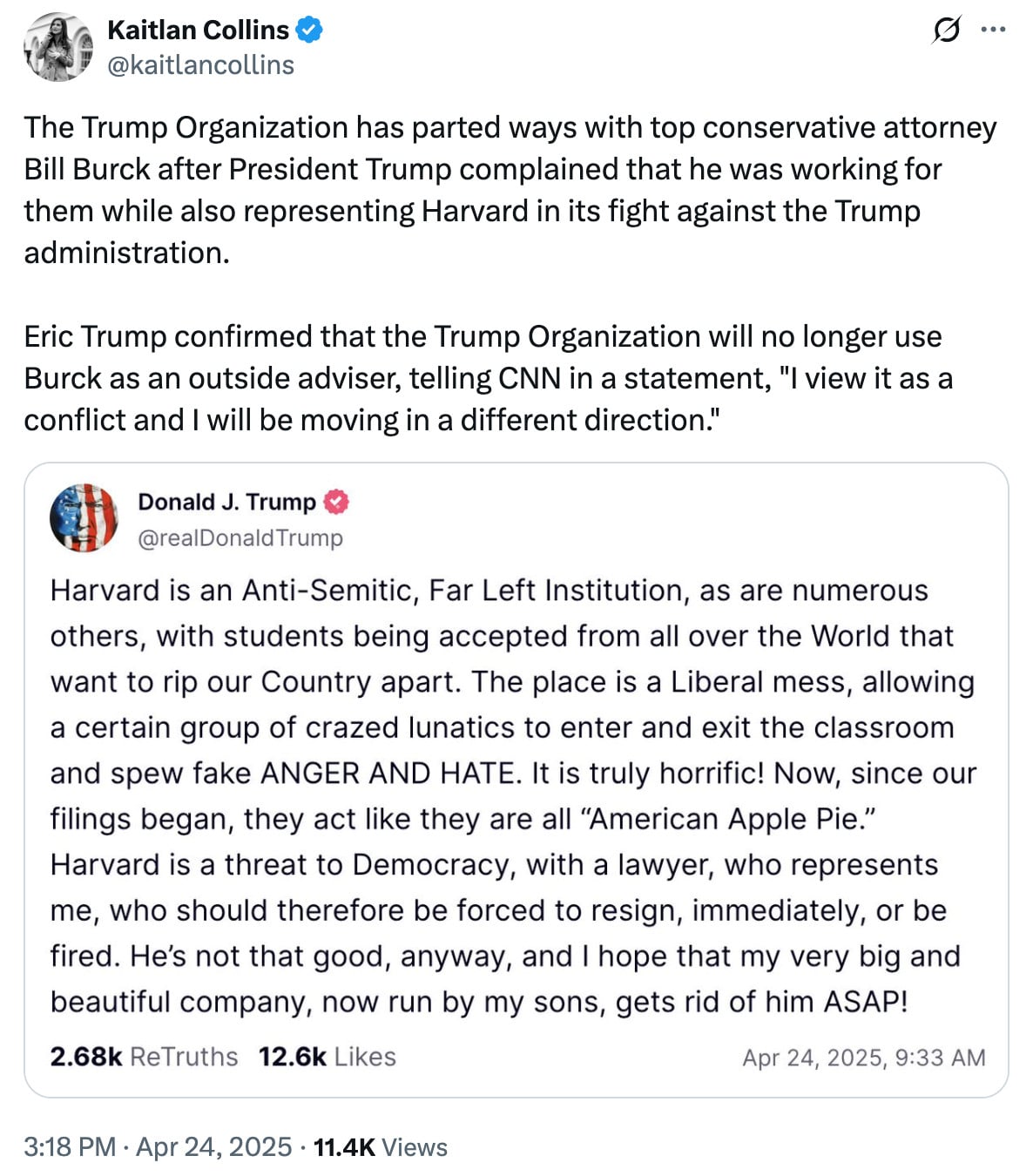
The reason Trump didn’t get what he appears to have wanted from Harvard — quiet capitulation and ongoing corruption — stems in significant part because his negotiators assumed they had more power than they had and they put that in writing, in the April 11 letter.

But according to the NYT, his negotiations also failed because he couldn’t explain what he wants.

The back and forth lacked specifics on what the administration wanted Harvard to do. The Trump administration lawyers said they would send Harvard a letter last Friday that laid out more specifics.

By the end of the workday on Friday, the letter had not arrived. Instead, overnight, the lawyers from Harvard received a letter, sent from Mr. Keveney in an email, that was far different from the one the school had expected.

I’m not sure I buy that. I suspect the letter really was what Trump wanted. He intended the “negotiation” to result in obeisance, not a deal crafted around specifics tied to the alleged antisemitism — something the law firms that capitulated have discovered to their chagrin.

Trump’s missteps with Harvard are far less consequential than the others, but it maps the same pattern: His need for adulation, his overstep, leading to failure.

Ukraine

Yesterday, Sergey Lavrov announced — in English — Russia’s terms for a deal: effectively, complete capitulation. Unless Trump takes an adversarial stance for the first time since he took office, this may well end it, with Russia and their North Korean cannon-fodder moving on to grander plans.

The dynamics around the failed Ukraine negotiation that brought us here are, in my opinion, entirely different from that with Harvard.

Those negotiations being wildly misunderstood by people — both people who should know better and people who’ve been wildly credulous in the past — treating this as a peace deal. In this funny story, for example, CNN continues to express credulity (as they have in the past), repeating Trump’s reported frustrations as if they are true, taking Trump’s public scolding of Putin as something other than performative.

President Donald Trump is frustrated his efforts to broker a peace deal between Russia and Ukraine have so far fallen short, and has privately told advisers that mediating a deal has been more difficult than he anticipated, sources familiar with the discussions told CNN.

Behind the scenes, he frequently brings up how much Russian President Vladimir Putin and Ukrainian President Volodymyr Zelensky hate one another, one of the sources said – an unsurprising fact, but one the president argues further complicates negotiations.

On Thursday, his agitation boiled over as Russia launched its worst assault on Kyiv since last summer, killing at least 12 people. The attack, Trump said, came at an inopportune moment: just as he believes he is on the verge of securing a deal, which he has told aides he wants in place by his 100th-day anniversary.

“I didn’t like last night,” Trump told reporters in the Oval Office, where he was meeting with Norway’s prime minister. “I wasn’t happy with it, and we’re in the midst of talking peace, and missiles were fired, and I was not happy with it.”

It was a rare moment of criticism directed toward Russia from a president whose ire over the course of his time back in office has mostly been aimed at the Ukrainians.

The exchange shined a light on a rising sense of exasperation among the president and his advisers at his inability to mount a successful pressure campaign against Putin to end the war. Trump bristled at a reporter’s suggestion that he had not applied pressure to the Russian leader.

“You don’t know what pressure I’m putting on Russia,” Trump snapped. “We’re putting a lot of pressure on Russia, and Russia knows that.”

Trump is frustrated that Russia won’t allow his capitulation to look like a peace deal; his pretense to care about Ukrainians just that.

Alex Finley is far more realistic, describing it as the Peace Deal that Never Was.

To be sure, I think someone coached Trump to say he wanted and was uniquely suited to craft a peace deal between Ukraine and Russia during the election. I think he believed all that when he said it! He even did some things during the transition — the beginning of it, anyway — that resembled things that you’d do if you actually expected you could make peace and win a Nobel prize for doing so (again, the kind of conceit you might encourage if you were manipulating Trump to act in a certain way).

But then, after Pam Bondi eliminated all possibility that fulfilling a quid pro quo with Russia would be investigated, this time, and in the wake of Nikolay Patrushev’s oblique warnings about campaign debts after the election, Trump — or the Russians — put Steve Witkoff in charge of “negotiations.”

This is actually consistent with what Russia was prepping to do in the 2016-2017 transition, where they sought someone someone — they tried both Jared Kushner’s buddy Rick Gerson and Erik Prince — to be an instrument whom Kirill Dmitriev could entice with financial goodies and in the process ensure “negotiations” ended as Russia wanted. It’s unclear why Gerson didn’t work out (probably timing). Prince turned out to be venal enough for the job (he was chasing a big deal with UAE), but not stupid enough. As Dmitriev was testing him in Seychelles, Prince remembered that he shouldn’t sell away US interests in Libya. And that was probably the end of things.

But Witkoff was the perfect combination of venal, stupid, and trusted by Trump. Once Russia had him in place, there was never going to be a successful negotiation. Never. There was and is only the question of how much advantage Russia can get and how much chaos in the Western alliance they can cause by letting Trump believe he might be able to claim a deal.

And the “deal” that wishcasters are treating as serious ends up delivering the quid pro quos Trump owed Russia from 2016: sanctions relief and Crimea. As Finley lays out, that was always the end goal, not peace.

This is actually the end point Trump has been trying to get us to all along, in my opinion. He desperately wants to appease Putin and do business with the man he admires. These discussions have already begun, with administration officials beginning to outline business deals (including in energy and in minerals).

My guess is Trump doesn’t care one way or the other if this “deal” gets accepted or not. If Ukraine refuses to accept it (indeed, Zelenskyy has already said the Crimea recognition point is dead on arrival), Trump will blame Ukraine for the lack of a deal and then say the US cannot wait any longer to restart business with Russia. If somehow the deal is accepted, Trump will celebrate and say now it’s time to get back to business with Russia.

I suspect the reason Trump has to pretend he is making a deal (or invent the thin appearance that Ukraine is at fault for his failure to make one) is because, most practically, there are enough Republicans who oppose his capitulation that he needs to at least provide them political cover for their lockstep support. He also needs to make it look like he’s not the big weak plaything of Vladimir Putin that he is.

While Trump’s failure to negotiate a real deal will bother him less than his failures to command obeisance from private universities and foreign countries, some of the reasons he has failed to craft even the appearance of a deal are the same.

As The Atlantic just laid out, for example, Trump’s paranoia about loyalty has made Mike Waltz an appendage at NSC, with the result that there is no policy process, no expertise, no adults.

On the priorities that matter most to the president, Waltz has less influence than Stephen Miller, the homeland-security adviser and deputy White House chief of staff for policy, whose team is part of the NSC. Miller treats the advisory body not as a forum to weigh policy options, current and former officials told me, but as a platform to advance his own hard-line immigration agenda. On the most sensitive geopolitical issues, including Russia’s war in Ukraine and U.S. interests in the Middle East, Trump’s longtime friend and special envoy, Steve Witkoff, sometimes draws on the support of the NSC staff but often operates independently, officials said.

Meanwhile, Waltz’s authority to hire and fire his own staff has been swept out from under him. Vetting by the White House’s Presidential Personnel Office, typically uninvolved in internal NSC matters, has derailed hiring and led to dismissals of career staff for infractions that include donating $50 to a Democratic Senate candidate eight years ago. (Screening for political affiliation is a prohibited employment action under federal law.)

The chaos has marginalized the NSC in the making of Trump’s foreign policy; major decisions have been reached without a traditional NSC process. Some staff with portfolios that include Russia’s war in Ukraine, for instance, first learned from news reports that Trump had decided to pause intelligence sharing with Kyiv. Once that choice was made, they were unable to answer questions that flooded in from agencies about the scope of the decision and how it would be implemented. The chaotic approach to foreign-policy decision making was also reflected in a lax attitude toward operations security, current and former officials told me. “There were always too many cellphones in the Oval Office,” one former official said. (The White House denied that cellphones are present during sensitive discussions.)

That’s how you end up with the quotes to CNN, the purported surprise on Trump’s part that Putin and Zelenskyy hated each other.

As with his other deals, Trump has absolutely no end game for the negotiation (unless it’s the financial  benefits for himself that Russia has been dangling); he doesn’t know what he wants and claims to have wildly inaccurate beliefs about how the war started, though those beliefs may be necessary fictions to justify full capitulation.

Perhaps most importantly, Russia was able to manipulate Trump into capitulating on ever-increasing Russian terms by telling Trump he is strong. Trump can’t negotiate because his belief that he’s stronger than he is makes him vulnerable.

Trade deals

And all that might be enough if he weren’t capitulating to Putin even as he and Scott Bessent search for allies who’ll help Trump undo the damage he has done by starting a trade war.

I’ve already written about how Scott Bessent pitched this idea to Trump — to pause draconian tariffs with the excuse that Trump was using the threat of them to negotiate dozens of new trade agreements — in a rush, as the economy was going to shit because of the tariffs Peter Navarro rolled out. I’ve also written how foolish Bessent — Trump’s most grown-up advisor — looks when he claims we have a bunch of friends rushing to make a deal to isolate China, even as Trump pisses off all our friends by capitulating to Putin.

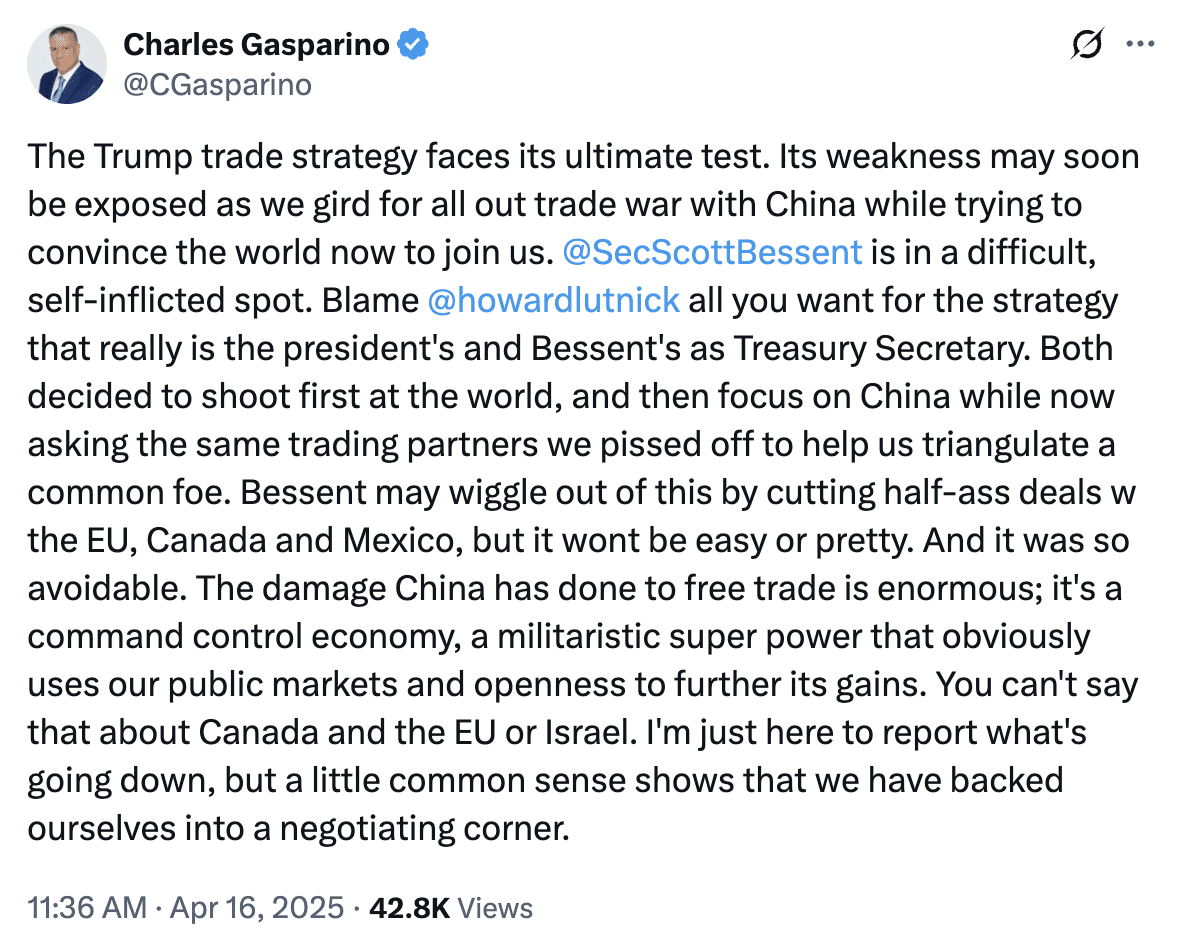
Since Bessent staved off immediate collapse by convincing Trump to adopt this “strategy,” he has settled into a rhythm. Someone like Charles Gasparino describes an imminent deal — often sourced to bankers who learned of it from private speeches by Bessent that encourage insider trading — with one or another country. The market spikes. Then the deal never happens. Sunday, when asked about Trump’s claim to have hundreds of deals, Bessent explained those are just sub deals. Along the way, Bessent confessed that they’re only focused on 17 deals plus China in the 90 day period when (Peter Navarro promised) Trump would make 200.

BESSENT: I believe that he is referring to sub deals within the negotiations we’re doing. And, you know, Martha, if there are 180 countries –

RADDATZ: But those aren’t actual deals?

BESSENT: Martha, if there are 180 countries, there are 18 important trading partners, let’s put China to the side, because that’s a special negotiation, there’s 17 important trading partners, and we have a process in place, over the next 90 days, to negotiate with them. Some of those are moving along very well, especially the – with the Asian countries.

All the while, Bessent posts frequently and obsequiously on Xitter to butter up Trump’s ego.
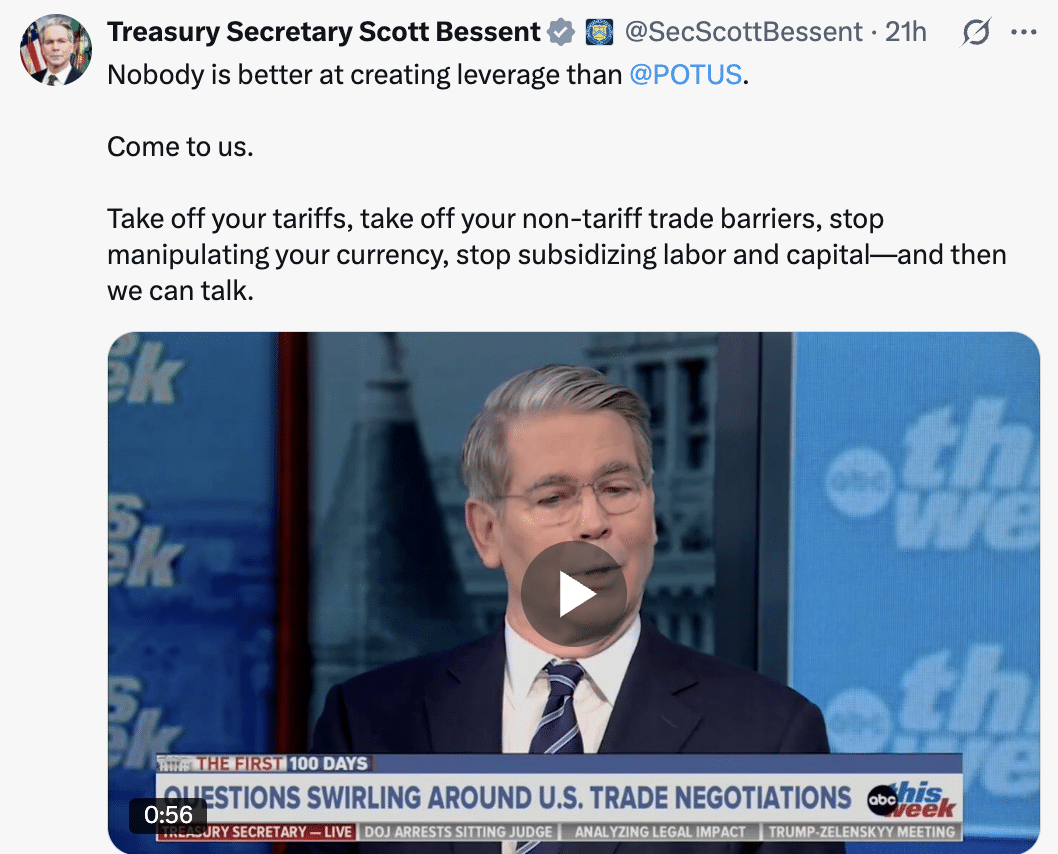
But even Gasparino admits Trump is looking for little more than some means to save face. Justin Wolfers has been having fun on TV pointing out that Trump is preparing to claim that the existing free trade deal with key allies is a big victory (like he did during early confrontations with Mexico and Colombia). And even then, the American allies with which Bessent claims will be the easiest to make deals are instead making deals with each other (and India, another country allegedly prepared to deal, is instead threatening military action against Pakistan).

As it is, China knows it has leverage over the United States, both because Trump already blinked and because he backed himself into a hole, and that’s before shortages start showing up in a few weeks. Bessent, desperate to sustain the con, insists that the Big Box stores who were issuing dire warnings exactly a week ago, today said, “I assume they preordered,” as if it’s not his job to check.

I fear that, having talked Trump off the ledge Navarro built for him, having staved off Trump frustration only by public obeisance and attacks on the press, Trump will now hold Bessent responsible for the impossibility of this task (though to be sure, Bessent appears to have oversold how easy this would be). When the shit really starts to hit the fan in a few weeks and Bessent’s proposed way out doesn’t work, Trump will need someone to blame.

At this point, I worry Bessent will be the first cabinet member to be fired, before more worthy candidates like Pete Hesgeth and Mike Waltz, because Trump will need a scapegoat. If that happens, there could be a snowball effect, not least because Bessent is the one who backed Trump off his plans to fire Jerome Powell.

Trump’s desperation to reassure the markets that all the damage he caused will have an upside increasingly results in batshit exchanges like this one.

Can you share with whom?

Because the deal is a deal that I choose. View it differently: We are a department store, and we set the price. I meet with the companies, and then I set a fair price, what I consider to be a fair price, and they can pay it, or they don’t have to pay it. They don’t have to do business with the United States, but I set a tariff on countries. Some have been horrible to us. Some have been okay. Nobody’s been great. Nobody’s been great. Everybody took advantage of us. What I’m doing is I will, at a certain point in the not too distant future, I will set a fair price of tariffs for different countries. These are countries—some of them have made hundreds of billions of dollars, and some of them have made just a lot of money. Very few of them have made nothing because the United States was being ripped off by every, almost every country in the world, in the entire world. So I will set a price, and when I set the price, and I will set it fairly according to the statistics, and according to everything else. For instance, do they have the VAT system in play? Do they charge us tariffs? How much are they charging us? How much have they been charging us? Many, many different factors, right. How are we being treated by that country? And then I will set a tariff. Are we paying for their military? You know, as an example, we have Korea. We pay billions of dollars for the military. Japan, billions for those and others. But that, I’m going to keep us a separate item, the paying of the military. Germany, we have 50,000 soldiers—

I’m just curious, why don’t you announce these deals that you’ve solidified?

I would say, over the next three to four weeks, and we’re finished, by the way.

You’re finished?

We’ll be finished.

Oh, you will be finished in three to four weeks.

I’ll be finished

This goes to the core of why Trump is facing three embarrassing failures.

Trump believes he has this power. He has to believe he has this power. He has to believe he has leverage, at least for psychological reasons, and probably for very big political ones too.

He has to sustain the con.

He also has surrounded himself with sycophants — Bessent is the least unqualified!! — who refuse to do anything but applaud his disastrous instincts. And whether it’s miscalculating in response to Harvard and then trying to deny it, sending someone who knows nothing about Russia to “negotiate” with an old KGB hand, or letting Peter Navarro anywhere close to a decision-maker, the sheer incompetence of the people who surround Trump make it less likely he could negotiate if he had a clear strategy.

But he doesn’t. We’ve heard from international partners and Harvard that he couldn’t explain what he wanted. We know what Trump wants for Russia, but as a result his demands on Ukraine keep changing.

Ultimately, Trump is staking one after another negotiation on his need for everyone — the entire world — will bow down to him.

And that may cause follow-on problems.

Most Americans won’t feel the pain of the fight with Harvard — at least, they won’t understand that the lifesaving cancer treatment they were hoping would save their lives has been shut down thanks to Trump.

Thus far, Trump has managed to spin the totality of his humiliation at the hands of Vladimir Putin. That may change. Particularly if the rest of his con starts to collapse, his claim to be a peacemaker might too. But for now, that’s a sideshow for most Americans.

The trade war is different. That has begun to cause and will cause increasingly sharp pain going forward, At some point, starting in a few weeks, Trump will face the political and psychological blowback from the damage his trade war has caused. I wouldn’t be surprised if China aimed to ensure maximal humiliation in how he does that.

And all these things are happening at once.

This certainly presents an organizing opportunity — a moment to convince Americans Trump has harmed, and their elected representatives, to take steps to reverse the damage Trump has done. A moment to point out that Trump, given the team he wanted with no limits on what he could do, shat the bed, and did so after bullying the rest of the world and losing; Trump’s opponents need to be laying the ground for accountability, with lockstep discipline, now. This is a moment to point out that Trump invented an emergency to make a power grab, and with that invented emergency created a real, global one.

That’s an opportunity. But even setting aside the likelihood of follow-on damage as Trump tries to avoid accountability, this moment of failure will also be one of extreme risk for a malignant narcissist like Trump.

These failed negotiations happened because Trump sought to create the appearance that he has unlimited power; they failed because he does not have that power. As the impact of Trump’s disastrous attack on the economy begins to hurt Americans, exposing that Trump doesn’t have the power he claims to impose his will, he will have both a psychological need to do something else to look strong, and a political need to convince Republicans he still has the power to determine their political fate.

He doesn’t have the power to win these negotiations. But he still has plenty of ways to avenge the exposure of his own weakness.

Update: Thomas Edsall interviews a bunch of experts on how Trump might respond to losing support. Most raise the kinds of concerns I do here.

Update: I beat Paul Krugman to making a similar argument because I didn’t lose power yesterday.

The Canadian election, then, demonstrates why Trumpist trade policy, and foreign policy in general, is doomed to catastrophic failure. Trump isn’t trying to drive tough substantive bargains. Mainly, he seems to want to indulge in narcissism, demanding that other nations humiliate themselves so he can put on a display of dominance. And America doesn’t have remotely enough leverage, even against Canada, to make such demands. You could say that Trump is a reverse Godfather, making offers other countries can’t accept.

Consider the state of negotiations — or, actually, non-negotiations, since talks appear to have broken down — with Japan, another country Trump appears to have thought he could bully. Japan does sell a lot to the United States and might have been willing to offer something to preserve its access to our market.

But reports indicate that Japanese representatives sent to Washington left without accomplishing anything because they found Trump’s people impossible to deal with. The Americans insisted that the Japanese make offers without giving any indication of what our side wanted — in effect, they demanded that Japan make a show of obeisance without any reason to believe that it would get anything in return. The Japanese government wouldn’t, probably couldn’t do that. After all, it has to answer to its own voters. So there is no deal.

And then there are the Chinese, who — unlike the Canadians or even the Japanese — probably have more economic leverage over us than we have over them. They have no interest in helping Trump sustain his fantasies of dominance. Bear in mind that Trump’s trade war is working out very well for them. Bloomberg reports that

President Xi Jinping’s diplomats are fanning out across the world with a clear message for countries cutting deals with Donald Trump: The US is a bully that can’t be trusted.

Unfortunately, they’re right. And Trump’s repeated insistence that the Chinese are negotiating with him, when they say they aren’t, comes across as pathetic.

Update: Dan Drezner catalogs four ways Trump broke basic rules of negotiation:

LESSON #1: Hurt the target more than one’s self. The U.S. economy is much bigger than most other economies in the world, so the administration clearly believed that it had leverage over everyone else. And, to be fair, that is likely still true of a lot of smaller countries. The administration may well succeed in wringing concessions from India or South Korea.

It is far from obvious that this is true of China or the European Union however.

[snip]

LESSON #2: Clearly articulate one’s demands. This ain’t rocket science! For a deal to be struck, the target needs to know what concessions would satisfy the coercer! Instead, there are widespread reports that even loyal allies don’t know what the Trump administration wants. Treasury Secretary Scott Bessent is even trying to claim that this is a purposeful strategy!

[snip]

LESSON #3: Minimize expectations of future conflict. All else equal, when the target anticipates more frequent coercion attempts in the future, they will be less willing to acquiesce in the present. And if Trump has succeeded in one thing, it is in making the rest of the world believe he will coerce anyone and everyone again and again and again and again. For fuck’s sake, some of his first targets during his second term were signatories to a trade deal he negotiated during his first term!

Everyone expects Trump to break deals in the future — which disincentivizes negotiating any concessions in the present.

LESSON #4: Build a multilateral coalition. Multilateral economic sanctions tend to work better than unilateral sanctions. An institutionalized coalition of sanctioners can give a target pause in a way that unilateral action might not. And, of course, Donald Trump did the exact opposite of this. Only too late did they realize that maybe coordinated approach towards China could be a good idea. Instead, now it’s China going around talking to other countries about how crazy the United States is behaving.

Share this entry

Trump Has No Policy Process, Just Wormtongue and Palace Intrigue

The last paragraph of this NYT story describing absolutely insane plans for the State Department -“eliminating almost all of its Africa operations,” “cutting offices … that address climate change[,] refugee issues, … democracy[,] and human rights concerns,” mandating use of AI for “‘policy development and review’ and ‘operational planning’,” and replacing the Foreign Service exam with loyalty oaths — describes that the Executive Order laying out those plans is not the only proposed plan out there.

It links this story, published by NYT five days earlier, describing more modest plans: closing six embassies in Africa, not the entire continent.

The Trump administration is considering plans to close 10 embassies and 17 consulates and reduce or consolidate the staff of several other foreign missions, according to an internal State Department memo viewed by The New York Times.

The closures and other reductions outlined in the document, which is undated, would pare back the American presence on nearly every continent. They represent an expansion of plans the Trump administration was working on earlier this year for closing a dozen foreign missions and laying off local staff who work in those locations.

The cuts are in keeping with President Trump’s plans to reduce federal spending across the government, as well as a proposal that State Department leaders have been considering to cut nearly 50 percent of the department’s spending.

But the new proposed reductions have raised fresh concerns that the United States will be ceding vital diplomatic space to China, including in areas of the world where Washington has a greater presence than Beijing, compromising American national security, including intelligence gathering.

The competing plans — one a memo, the other an Executive Order that would be signed by Trump and would therefore oblige memo-writers to defer to Trump’s order — comes in the wake of the ouster of Pete Marocco, the Jan6er who effectuated the destruction of USAID, from the State Department.

There are several versions of Marocco’s ouster and his fate, but this Politico story describes that Marco Rubio fired him, in part because of differing opinions about how to destroy USAID (which has long since been accomplished, but during which, Rubio repeatedly made claims about GOP-supported programs like PEPFAR that turned out to be false).

Peter Marocco, the Trump administration official in charge of dismantling USAID, left a meeting at the White House last week to return to his office at the State Department. But when he arrived, Marocco could not enter the building: security told him he was no longer an employee there, according to a person familiar with the situation.

Word of Marocco’s firing quickly tore through the Republican Party and MAGA ecosystem, startling President Donald Trump’s loyalists who viewed the aide as part of an elite cohort of administration true believers. Loud voices on the right piled on Secretary of State Marco Rubio, accusing him of undermining their disruptive agenda.

Yet Marocco’s abrupt termination, which has not been fully reported until now, was not an impulsive dismissal or a case of Rubio going rogue. This report was based on conversations with five people, including administration officials and allies, all of whom were granted anonymity to discuss sensitive internal matters. Four of the people said Rubio fired Marocco. They gave varying explanations: one administration official said Rubio and others wanted Marocco out due to what they saw as his bulldozer operating style and failure to work effectively with colleagues; others pointed to substantive disagreements between Rubio and Marocco over how to dismantle USAID. Meanwhile, Marocco allies viewed Rubio and his team as insular, controlling and obstructionist to the DOGE agenda ordered by the president.

One White House official said Rubio went to a senior White House aide for clearance to remove Marocco after tensions reached a boiling point last week. They described Marocco’s firing as “the first MAGA world killing from inside the White House.”

It also describes the backlash targeting Rubio that has resulted.

In the days since his ouster, Marocco’s MAGA allies have come to his defense and raised new suspicions of Rubio, including questions about why he would want to protect USAID and whether he’s loyal to the president.

[snip]

“He’s really not a MAGA guy, he’s a neocon,” a Trump ally said of Rubio, adding that this move “is gonna bite him.”

This is the third instance of an ugly cabinet-level dispute in the Trump Administration in recent weeks.

NYT’s account of Gary Shapley’s installment to head the IRS, without Scott Bessent’s involvement, followed by his removal at the hands of Bessent, incorporates several pieces of intrigue. First, there’s Shapley’s installment by Musk and then Bessent’s reversal of Musk’s plot.

Mr. Bessent had complained to Mr. Trump this week that Mr. Musk had done an end run around him to get Mr. Shapley installed as the interim head of the I.R.S., even though the tax collection agency reports to Mr. Bessent, the people familiar with the situation said. They spoke on the condition of anonymity to discuss private conversations.

The clash was the latest instance of Mr. Musk’s influence in the Trump administration that has alarmed top officials. It was also the latest upheaval at the tax agency, with much of its staff pushed out or quitting. Mr. Trump earlier this week called for the I.R.S. to revoke Harvard University’s tax-exempt status after the school refused to impose sweeping changes demanded by the administration.

An I.R.S. spokeswoman declined to comment on the leadership changes.

Mr. Shapley, a longtime I.R.S. agent, gained fame among conservatives after he claimed that the Justice Department had slow-walked its investigation into Hunter Biden’s taxes.

Mr. Musk’s Department of Government Efficiency pushed Mr. Shapley’s appointment through White House channels, but Mr. Bessent was not consulted or asked for his blessing, according to those with knowledge of the dynamic. Mr. Bessent then got Mr. Trump’s approval to unwind the decision within days, they said. Mr. Shapley had been working from the I.R.S. commissioner’s office as late as Friday morning.

Then, there’s Musk’s magnification of Laura Loomer’s attack on Bessent in response.

The feud between Mr. Musk and Mr. Bessent went public late Thursday night, when Mr. Musk amplified a social media post from the far-right researcher Laura Loomer accusing Mr. Bessent of colluding with a “Trump hater.”

“Troubling,” Mr. Musk wrote about Mr. Bessent’s meeting John Hope Bryant, the chief executive of the nonprofit Operation HOPE. Mr. Bryant is working on a financial literacy effort with Treasury officials.

Ms. Loomer had called that meeting a “vetting failure.”

Finally, there’s an oblique comment about DOGE boy Gavin Kliger’s removal on the same day as Shapley, one that WaPo describes in more detail: Kliger was shut out of IRS systems just as he was about to start a purge of IRS employees in the middle of tax season.

Early Friday morning, the IRS rescinded building and systems access for DOGE official Gavin Kliger, according to the people familiar with the situation. The Post could not immediately confirm the reason for the revocation.

Kliger was managing the massive layoffs at the agency that could cut the tax agency’s headcount by 25 percent. More layoff notices had been planned for Friday afternoon, the people said, but those notifications have been paused.

As laid out in declarations from USAID workers, Kliger left his digital fingerprints all over Marocco’s dismantling of USAID.

Left unsaid is whether Musk installed Shapley so as to empower Kliger to destroy the IRS just as it sets to processing this year’s tax receipts.

Thus far, we have correlation, without any insight into causation.

The far right targeting of Bessent is of particular concern, given the evidence he’s holding together the US (and with it, the global) economy with his own shoestrings. WSJ reported this week that he and Howard Lutnick had to sneak into the Oval Office to override Peter Navarro’s disastrous tariff plans.

On April 9, financial markets were going haywire. Treasury Secretary Scott Bessent and Commerce Secretary Howard Lutnick wanted President Trump to put a pause on his aggressive global tariff plan. But there was a big obstacle: Peter Navarro, Trump’s tariff-loving trade adviser, who was constantly hovering around the Oval Office.

Navarro isn’t one to back down during policy debates and had stridently urged Trump to keep tariffs in place, even as corporate chieftains and other advisers urged him to relent. And Navarro had been regularly around the Oval Office since Trump’s “Liberation Day” event.

So that morning, when Navarro was scheduled to meet with economic adviser Kevin Hassett in a different part of the White House, Bessent and Lutnick made their move, according to multiple people familiar with the intervention.

They rushed to the Oval Office to see Trump and propose a pause on some of the tariffs—without Navarro there to argue or push back. They knew they had a tight window. The meeting with Bessent and Lutnick wasn’t on Trump’s schedule.

The two men convinced Trump of the strategy to pause some of the tariffs and to announce it immediately to calm the markets. They stayed until Trump tapped out a Truth Social post, which surprised Navarro, according to one of the people familiar with the episode. Bessent and press secretary Karoline Leavitt almost immediately went to the cameras outside the White House to make a public announcement.

And multiple outlets have described Bessent’s thus far successful efforts to prevent Trump from firing Jerome Powell.

Treasury Secretary Scott Bessent has repeatedly cautioned White House officials that any attempt to fire Federal Reserve Chair Jerome Powell would risk destabilizing financial markets, according to two people close to the White House granted anonymity to share details of private discussions.

Bessent’s private message reinforces what President Donald Trump already knows but comes as the president’s anger with the Fed chair is growing because Powell hasn’t shown signs that he will cut interest rates soon. It also comes against the backdrop of widespread market turmoil over the administration’s far-reaching trade war.

Trump’s fury with Powell burst into public view on Thursday morning, when he said in a post on Truth Social that his “termination cannot come fast enough!”

But Powell’s job looks safe for now.

Bessent is a mediocre Treasury Secretary, in no way the match for his counterparts. Yet he is increasingly all that’s standing between Trump and his most feverish nutjobs and far bigger financial catastrophe.

Given Loomer’s success firing NSA Director Timothy Haugh and six NSC staffers, it may be only a matter of time before the nutjobs get to Bessent, too.

The third cabinet level blowup is more opaque. As laid out here, three of Whiskey Pete Hegseth’s top aides were escorted out of the Pentagon in the wake of a leak investigation. Politico reported that they were fired — passive voice — on Friday, but the guy who led the investigation used to explain their ouster is also leaving his current role.

Joe Kasper, Defense Secretary Pete Hegseth’s chief of staff will leave his role in the coming days for a new position at the agency, according to a senior administration official, amid a week of turmoil for the Pentagon.

Senior adviser Dan Caldwell, Hegseth deputy chief of staff Darin Selnick and Colin Carroll, the chief of staff to Deputy Defense Secretary Stephen Feinberg, were placed on leave this week in an ongoing leak probe. All three were terminated on Friday, according to three people familiar with the matter, who, like others, were granted anonymity to discuss a sensitive issue.

[snip]

Two of the people said Carroll and Selnick plan to sue for wrongful termination. The Pentagon did not respond to a request of comment.

Kasper had requested an investigation into Pentagon leaks in March, which included military operational plans for the Panama Canal, a second carrier headed to the Red Sea, Musk’s visit and a pause in the collection of intelligence for Ukraine.

But some at the Pentagon also started to notice a rivalry between Kasper and the fired advisers.

“Joe didn’t like those guys,” said one defense official. “They all have different styles. They just didn’t get along. It was a personality clash.”

The changes will leave Hegseth without a chief of staff, deputy chief of staff, or senior adviser in his front office.

“There is a complete meltdown in the building, and this is really reflecting on the secretary’s leadership,” said a senior defense official. “Pete Hegseth has surrounded himself with some people who don’t have his interests at heart.” [my emphasis]

Some of those targeted — who have long-standing ties to Hegseth, going back to his failed non-profit management — are denying any role in leaks.

Whatever the genesis of this upheaval or the partisan explanation for it, it leaves a wildly unqualified man at the top of the world’s largest military with no top aides.

There are other signs of the collapse of all management inside the White House — such as the White House attempt to explain away their attack on Harvard with a bullshit claim that they accidentally sent out a letter demanding to effectively take over Harvard University.

Everywhere you look you have to wonder whether Susie Wiles is as much in charge as Amy Gleason is at DOGE, whether her title of Chief of Staff is just a convenient fiction to cover up for the reality that Trump does whatever the last person in the room tells him to do.

And often as not, the last person in the room is Stephen Miller.

We’ve already seen that the three cabinet secretaries struggling to assert control over their own agencies deferred to Stephen Miller when he told the participants of the famous Signal chat what Trump thought.

That is, it’s not just that Stephen Miller is often the last one in the room with Trump. It’s not just that Stephen Miller’s policy ideas are batshit insane (and that he’s the author of Trump’s most egregious abuses of power). It’s also that Miller often stands in as the Word of DOGE, the Word of Trump.

Kremlinologists are pointing to evidence — his demotion at Trump’s most recent cabinet meeting, for example — that Elon’s power at the White House has started to wane (while ignoring that Elon has moved onto the next phase of takeover, cashing in, cashing in, and cashing in).

But behind all the intrigue, Stephen Miller’s ascendance remains, apparently uncontested and possibly unbound.

Share this entry

Scott Bessent’s Imaginary Friends

A week ago, Scott Bessent attempted to calm a bunch of bankers by describing that he would take a lead role in negotiations with 70 countries in the wake of Trump’s tariff flip-flops.

He claimed the US still has things called “allies” who would be willing to reach quick deals that would allow him to isolate China.

Bessent said there was great interest in negotiating with the U.S. to lower tariffs, noting that Trump had already spoken with the leaders of Japan and South Korea, and U.S. officials would meet with a delegation from Vietnam on Wednesday.

“I think … at the end of the day that we can probably reach a deal with our allies, with the other countries that have been … good military allies and not perfect economic allies. And then we can approach China as a group,” Bessent said.

He added that the sweeping reciprocal tariffs announced by Trump last week represented a ceiling for tariffs if countries didn’t retaliate, but China had not heeded that advice.

“In terms of escalation, unfortunately, the biggest offender in the global trading system is China, and they’re the only country who’s escalated,” Bessent said.

Bessent is still trying to pitch that PR line — that he has a plan — as in this WSJ article (which among other things, suggests Bessent only came up with this thing he fancies is a “strategy” on April 6, after Trump had already started destroying American credibility).

The Trump administration plans to use ongoing tariff negotiations to pressure U.S. trading partners to limit their dealings with China, according to people with knowledge of the conversations.

The idea is to extract commitments from U.S. trading partners to isolate China’s economy in exchange for reductions in trade and tariff barriers imposed by the White House. U.S. officials plan to use negotiations with more than 70 nations to ask them to disallow China to ship goods through their countries, prevent Chinese firms from locating in their territories to avoid U.S. tariffs, and not absorb China’s cheap industrial goods into their economies.

Those measures are meant to put a dent in China’s already rickety economy and force Beijing to the negotiating table with less leverage ahead of potential talks between Trump and Chinese President Xi Jinping. The exact demands could vary widely by nation, given their degree of involvement with the Chinese economy.

[snip]

One brain behind the strategy is Treasury Secretary Scott Bessent, who has taken a leading role in the trade negotiations since Trump announced a 90-day pause on reciprocal tariffs for most nations—but not China—on April 9.

Bessent pitched the idea to Trump during an April 6 meeting at Mar-a-Lago, the president’s club in Florida, said people familiar with the discussion, saying that extracting concessions from U.S. trading partners could prevent Beijing and its companies from avoiding U.S. tariffs, export controls and other economic measures, the people said.

The tactic is part of a strategy being pushed by Bessent to isolate the Chinese economy that has gained traction among Trump officials recently. Debates over the scope and severity of U.S. tariffs are ongoing, but officials largely appear to agree with Bessent’s China plan.

It involves cutting China off from the U.S. economy with tariffs and potentially even cutting Chinese stocks out of U.S. exchanges. Bessent didn’t rule out the administration trying to delist Chinese stocks in a recent interview with Fox Business.

Still, the ultimate goal of the administration’s China policy isn’t yet clear.

Bessent has also said there is still room for talks on a potential trade deal between the U.S. and China. Such talks would have to involve Trump and Xi.

In the time that Bessent has been pursuing this “strategy” to make deals with our “allies” that will isolate China, Xi Jinping had a showy appearance in Vietnam, where he posed as the guardian of “the multilateral trading system, … the stability of the global industrial and supply chains, and … the international environment for open cooperation.”

Xi also urged strengthening coordination and cooperation through regional initiatives such as the East Asia Cooperation and the Lancang-Mekong Cooperation, the ministry said, citing an article by the Chinese leader published in Vietnam media.

He called such efforts necessary to “inject more stability and positive energy into a chaotic and intertwined world”.

“There are no winners in trade wars and tariff wars, and protectionism has no way out,” Xi said, without mentioning the U.S. specifically.

“We must firmly safeguard the multilateral trading system, maintain the stability of the global industrial and supply chains, and maintain the international environment for open cooperation,” he said.

Last week, China sought to get ahead of U.S. negotiators, holding video calls with the EU and Malaysia, which is chairing ASEAN this year, as well as Saudi Arabia and South Africa, by way of reaching out to Gulf countries and the Group of 20 and BRICS nations.

And Trump has continued to destroy two important American markets that foster the kinds of friendship Bessent plans to exploit: tourism

… And education:

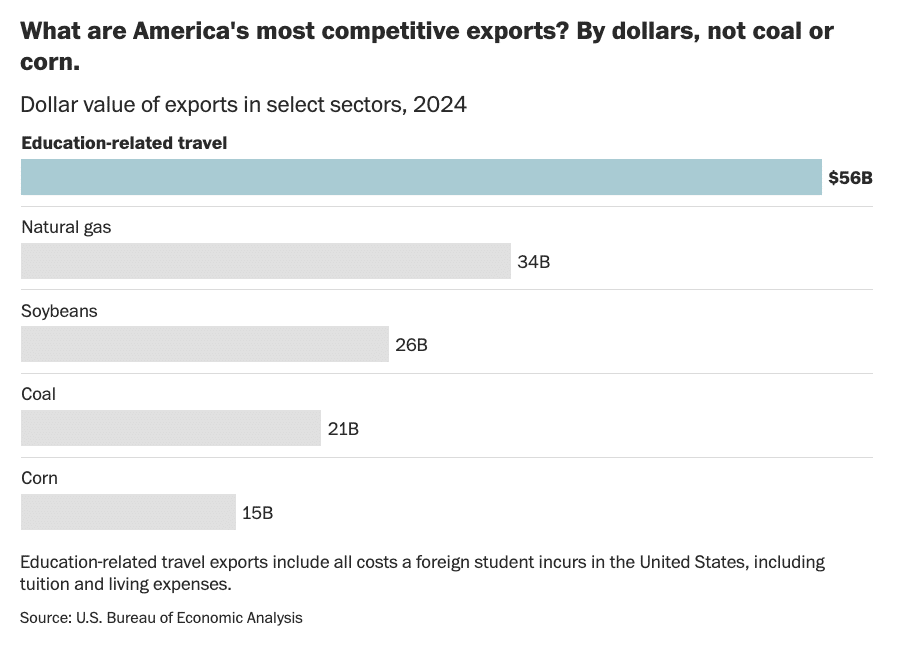
President Donald Trump says he wants to reduce our trade deficit. Yet he’s destroying one of our winningest exports: higher education.

Colleges and universities are among America’s most competitive international exporters. In dollar terms, last year, the United States sold more educational services to the rest of the world than it sold in natural gas and coal combined.

We also run a huge trade surplus in this sector, meaning that foreigners buy much more education from the United States than Americans buy from other countries. In the 2022-2023 school year, more than three times as many international students were enrolled in the United States as there were American students studying abroad. Translated to cash: Our education-services trade surplus is larger than the trade surplus in the entire completed civilian aircraft sector.

Why? Regardless of what Trumpland claims, America is really, really good at higher education.

Sure, even in spite of the damage Trump has caused to US credibility, the US retains a lot of ways to coerce its, um, friends and allies. Trump and Bessent will have a showy meeting with Japan today — a Japan that might be behind the recent US bond sell-off.

But to get just a sense of the degree to which a lot of US coverage treats the US as the sole protagonist of this story, compare this really fascinating interview with Ursula Von der Leyen.

Sure, like US sources, she brags about the friends that keep calling, coyly denying she’s now the leader of the free world while assuming that mantel.

ZEIT: You have just given the question of whether you are the new leader of the Western world a wide berth. But don’t you have to accept that Europe – the EU, with you at its head – has recently become the most important guarantor of Western values in the world?

Von der Leyen: The West as we knew it no longer exists. The world has become a globe also geopolitically, and today our networks of friendship span the globe, as you can see in the debate about tariffs. A positive side effect is that I am currently having countless talks with heads of state and government around the world who want to work together with us on the new order. This is true from Iceland to New Zealand, from Canada to the United Arab Emirates, as it is for India, Malaysia, Indonesia, Philippines, Thailand, Mexico, and South America. Right now, I could have these conversations 24 hours a day. Everyone is asking for more trade with Europe – and it’s not just about economic ties. It is also about establishing common rules and it is about predictability. Europe is known for its predictability and reliability, which is once again starting to be seen as something very valuable. On the one hand, this is very gratifying; on the other hand, there is also of course a huge responsibility that we have to live up to.

But then, amid questions about whether Europe — the lever that Bessent imagines he’ll use against China — remains friends with the US, Von der Leyen describes “reality [as] a strong ally.”

ZEIT: You have said that you are still friends with America. The problem is, of course, that the Americans are not friends with themselves. Most don’t seem to like Europe very much either. So, what is the US: a friend, a former friend, an opponent?

Von der Leyen: I’m not a fan of these kinds of classifications. There are millions of transatlantic friendships and economic, private and cultural ties that have grown over decades, and you can’t put a label on them. Right now, our relationship with each other is complicated. What is crucial in this situation is that we Europeans know exactly what we want and what our goals are. So, then we are very well placed to deal with the Americans, because they are pragmatic and open and understand clear language well.

ZEIT: The tariff conflict with the US seems to escalate and abate, and we have to wonder what on earth the basis for the negotiations is.

Von der Leyen: Reality is a strong ally. I keep pointing out how much prosperity on both sides of the Atlantic has been created by trade and that tariffs are actually like taxes on businesses and consumers. There are four points that are important to us. The first is that we are seeking to negotiate a solution. In parallel to the negotiations, we are developing countermeasures that focus on trade in both goods and services. All options are on the table. The second point is that we must be very vigilant that Chinese goods do not flood our market now because of the trade war between the US and China. So, we have protective measures in place there. The third point is that we need to build new partnerships and establish broader trade relations. The fourth point is that we need to get rid of the barriers in the single market and deepen and harmonise it.

Then, after reiterating a threat against US digital services that you should click through to read, Von der Leyen contrasts European solidarity with America’s bro culture, the same bro culture that aims to destroy US universities and tourism.

Von der Leyen: Yes, I think people have realised that in times of crisis, solidarity within a strong community is something truly precious, and has helped everyone navigate serious crises better. So whenever we overcome a crisis, this is also a victory for Europe and the European ideal. May I sing Europe’s praises?

ZEIT: Absolutely. To my knowledge, self-exaltation isn’t banned under the European Constitution.

Von der Leyen: Europe is still a peace project. We don’t have bros or oligarchs making the rules. We don’t invade our neighbours, and we don’t punish them. On the contrary, there are twelve countries on the waiting list to become members of the European Union. That’s about 150 million people. In Europe, children can go to good schools however wealthy their parents are. We have lower CO2 emissions, we have higher life expectancy. Controversial debates are allowed at our universities. This and more are all values that must be defended, and which show that Europe is more than a union. Europe is our home. And people know that, people feel that.

There is posturing all around. But Von der Leyen looks so much more like a grown-up than Scott Bessent and his imaginary friends.

It’s not just me saying that.

Even some of Trump’s closest friends question whether Trump and Bessent have any.

While both equally destructive, Trump’s efforts to destroy America’s educational and scientific leadership are at odds with his attempt to gain some advantage out of destroying global trade.

As a result, Donald Trump has left poor Scott Bessent with increasingly imaginary friends.

Update: Paul Krugman focused on the same WSJ story I did and noted the same thing: The US has spoiled its opportunity to do the kind of negotiations Trump claims to want.

Second, even if U.S. negotiators are trying to cut deals with other countries that would isolate China, they will be unlikely to succeed because Trump has lost all credibility. After all, you can’t make deals with other countries unless foreign governments believe that you will honor the agreements you make. Trump has already destroyed U.S. credibility on that front, ripping up all our existing trade agreements, then making wild changes in his own tariffs every few days.

Third, even if Trump’s promises were credible, why would a European government want to join America’s trade war with China, destroying its own supply chains? If the argument is that it’s worth paying the cost of ruined supply chains because that will protect you from Trump’s tariffs, who trusts Trump not to reimpose punitive tariffs on our supposed allies the next time he thinks they’re looking at him funny?

Share this entry

The List of Rules Marko Elez Didn’t Sign

One of the lawsuits in which it was recently disclosed that DOGE boy Marko Elez emailed information with Personally Identifiable Information to two people at GSA (which I also wrote about here) is one in which Public Citizen is representing AARP in a Privacy Act claim against Treasury. [docket]

The government provided it in that case amid a discovery dispute, mostly as a courtesy because they were filing it in New York. But it contributed to a request for more information about what the hell Marko Elez was up to.

On February 18, Colleen Kollar-Kotelly ordered the government to file any Administrative Record behind the decision to give DOGE access to Treasury. The government squawked about that order, but after plaintiffs noted that the real decision maker in this case was Treasury Secretary Scott Bessent, not the people who had submitted declarations, Judge Kollar-Kotelly ordered those submitted, which the government provided — as a 215 page exhibit — on March 10.

On March 14 — the same day Treasury disclosed Elez’ mailed files to GSA — they supplemented that record. Some of the new documents appear to include some of the details Treasury gathered as they tried to figure out what Elez had done with his access.

That includes this data, showing that when someone first tried to give Elez access to the Top Secret Treasury Mainframe, they equivocated about whether to give Elez read only (the message on January 30) or read-write (the message the next day); at the time he appears to have been granted interim Secret, not Top Secret, clearance.

The main exhibit in the Administrative Record includes a spreadsheet showing what access he was supposed to have as of February 1, reflecting the sandboxed access described in earlier filings. It doesn’t reflect this read-write access.

Plaintiffs are also interested in Elez’ access during a late January trip to Kansas City, which has never been addressed in the declarations in this case.

What plaintiffs didn’t ask about (though they do ask for backup) is the letter sent on February 5 asking Elez to please sign the rules that go along with the Fiscal Service laptop Elez used to access Treasury networks.

Those rules include the following:

  • Use Fiscal Service data, equipment, and IT systems properly and follow laws, regulations, and policies governing the use of such resources (Base Line Security Requirements, (BLSRs), Treasury Information Technology Security Program (TD-P 85-01), the Treasury Security Manual (TD-P 15-71), and Fiscal Service Policies).
  • Protect Fiscal Service data, equipment and IT systems from loss, theft, damage, and unauthorized use or disclosure. Secure mobile media (paper and digital) based on the sensitivity of the information contained.
  • Use appropriate sensitivity markings on mobile media (paper and digital).
  • Promptly report any known or suspected security breaches or threats, including lost, stolen, or improper/suspicious use of Fiscal Service data, equipment, IT systems, or facilities to the IT Service Desk at 304-480-7777.
  • Do not attempt to circumvent any security or privacy controls.
  • Logoff, lock, or secure workstation/laptop to prevent unauthorized access to Fiscal Service IT systems or services.
  • Do not read, alter, insert, copy, or delete any Fiscal Service data except in accordance with assigned job responsibilities, guidance, policies, or regulations. The ability to access data does not equate to the authority to access data. In particular, Users must not browse or search Fiscal Service data except in the performance of authorized duties.
  • Do not reveal any data processed or stored by Fiscal Service except as required by job responsibilities and within established procedures.
  • Do not remotely access Fiscal Service IT systems unless authorized to do so, such as an approved telework agreement authorizing remote access over the bureau’s VPN software.
  • Do not transport or use Fiscal Service data or equipment outside of the United States or US Territories without written approval from the CSO or CISO.
  • Do not connect Fiscal Service equipment to or access a Fiscal Service IT system from a foreign network without written approval from the CSO or CISO.
  • Do not install or use unauthorized software or cloud services on Fiscal Service equipment.
  • Take reasonable precautions to prevent unauthorized individuals from viewing screen contents or printed documents.
  • Do not open e-mail attachments, or click links, from unknown or suspicious sources.
  • Be responsible for all activities associated with your assigned user IDs, passwords, access tokens, identification badges, Personal Identity Verification (PIV) cards, or other official identification device or method used to gain access to Fiscal Service data, equipment, IT systems, or facilities.
  • Protect passwords and other access credentials from improper disclosure. Do not share passwords with anyone else or use another person’s password or other access credential such as, but not limited to, someone else’s PIV card.
  • Use only equipment and software provided by Fiscal Service or that has been approved for use by Fiscal Service’s CIO or designee to conduct Fiscal Service business.
  • Provide non-work contact information to the bureau to facilitate emergency communications.
  • Comply with Fiscal Service social media policy, including restrictions on publishing Fiscal Service information to social media and public websites. [my emphasis]

One of these rules, about not revealing data processed by Fiscal Service, would seem to apply to his sharing of information with GSA.

There’s no evidence Elez ever did sign those rules. Instead, he quit — and, without evidence, the entire world has assumed he quit because he was revealed to have made racist comments on social media.

It’s not yet clear what happened; perhaps it’ll become more clear if plaintiffs get discovery. But by all appearances, on Scott Bessent’s authority, someone at least considered giving a guy only cleared to the Secret level Read/Write access to Treasury’s Top Secret Mainframe, without first making sure he had signed a list of rules about altering or copying data.

And then he left.

Update: I’ve tweaked this reflecting the comment below that the Mainframe may be called Top Secret, without actually being classified Top Secret.

Update: Judge Kollar-Kotelly did grant more limited discovery. That includes most, but not all, details plaintiffs wanted about Elez’ email:

9. With respect to the email sent by Marko Elez referred to in paragraph 12 of the declaration of David Ambrose, ECF 48-2:

a. identify each addressee, including any cc’s or bcc’s.

b. state the date on which the email was sent.

c. identify each individual, if any, who authorized or directed Mr. Elez to send the email.

d. identify the Bureau Systems from which the Personal Information contained in the email or the attached spreadsheet was obtained.

[removed]

f. describe the nature of the information that was transmitted, including whether the information relates to the USAID files that Mr. Elez copied, as noted in paragraph 18 of Joseph Gioeli’s declaration, ECF 24-2.

Share this entry

Marko Elez “Resigned” the Day His Write Access to Payment Systems Was Discovered

According to the currently operative story, Marko Elez — the DOGE [sic] boy who had source code for Treasury’s payments system — resigned in response to a query from WSJ reporter Katherine Long about his social media posts in support of

A key DOGE staff member who gained access to the Treasury Department’s central-payments system resigned Thursday after he was linked to a deleted social-media account that advocated racism and eugenics.

Marko Elez, a 25-year-old who is part of a cadre of Elon Musk lieutenants deployed by the Department of Government Efficiency to scrutinize federal spending, resigned after The Wall Street Journal asked the White House about his connection to the account.

“Just for the record, I was racist before it was cool,” the account posted in July, according to the Journal’s review of archived posts.

“You could not pay me to marry outside of my ethnicity,” the account wrote on X in September. “Normalize Indian hate,” the account wrote the same month, in reference to a post noting the prevalence of people from India in Silicon Valley.

After the Journal inquired about the account, White House spokesperson Karoline Leavitt said that Elez had resigned from his role.

But that belief is only based on correlation, not any proof of causation. Long asked about posts that are in no way exceptional for the far right boys Elon has infiltrated into the government. And Elez resigned that same day.

Sure, Elon implied that Elez quit because the boy’s far right ideology was exposed — he led a campaign for his reinstatement. That campaign — and JD Vance’s support for it — similarly led a lot of people to believe that Elez had been reinstalled at Treasury. But multiple court filings claim that Elez resigned and never came back, at least not to Treasury.

In fact, there are two things that might provide better explanations than the discovery that like Elon himself, Elez is a racist.

As WSJ itself notes, Elez resigned the same day that Colleen Kollar-Kotelly ordered that Elez, then still identified as a Special Government Employee, be granted only read-only access to Treasury’s networks. Once Elez no longer worked for the defendants in that case — starting with Scott Bessent — then any access he had would be exempted from the order.

More importantly, as a court filing submitted yesterday reveals, Elez’ resignation happened the same day that Treasury discovered Elez’s Bureau laptop, “had mistakenly been configured with read/write permissions instead of read-only.” The filing is a declaration from Joseph Gioeli, who has been employed as the “Deputy Commissioner for Transformation and Modernization in the Bureau of the Fiscal Service” since 2023 and is a civil servant first hired in the first year of Trump’s first term.

His declaration describes how the 4-6 week “payment process engagement plan” initiated (per Thomas Krause) on January 26 required giving Elez risky access to payment systems. Gioeli describes how they tried to mitigate those risks.

11. The scope of work as envisioned in the engagement plan required access to Fiscal Service source code, applications, and databases across all these Fiscal Service payment and accounting systems and their hosting environments. This broad access presented risks, which included potential operational disruptions to Fiscal Service’s payment systems, access to sensitive data elements, insider threat risk, and other risks that are inherent to any user access to sensitive IT systems. In light of these risks, BFS and Treasury Departmental Office employees developed mitigation strategies that sought to reduce these risks.

12. These measures included the requirement that Mr. Elez be provided with a BFS laptop, which would be his only method of connecting to the Treasury payments systems, both in connecting with the source code repository and for his read-only access of the systems. He had previously been provided a Treasury laptop from the Department shortly after he onboarded, but due to Bureau security policy, that device was restricted from accessing the BFS systems and services he had requested. BFS used several cybersecurity tools to monitor Mr. Elez’s usage of his BFS laptop at all times and continuously log his activity. Additionally, the Bureau enabled enhanced monitoring on his laptop, which included the ability to monitor and block website access, block the use of external peripherals (such as USB drives or mass storage devices), monitor any scripts or commands executed on the device, and block access to cloud-based storage services. Additionally, the device contained data exfiltration detection, which alerts the Bureau to attempts to transmit sensitive data types. The laptop is also encrypted in accordance with Bureau policy, which, if the laptop were stolen or lost, would prevent unauthorized users from accessing data contained within the laptop.

13. Additional mitigation measures that were adopted included that Mr. Elez would receive “read-only” access to the systems, and that any reviews conducted using the “read-only” access would occur during low-utilization time periods, to minimize the possibility of operational disruptions. While providing a single individual with access to multiple systems and data records accessed here was broader in scope than what has occurred in the past, this read-only approach is similar to the kind of limited access the Bureau has provided to auditors for other Treasury non-payment systems, though even in those scenarios the availability of production data was significantly limited. [my emphasis]

Gioeli goes on to describe how, starting on February January 28, the Bureau gave Elez source code in a sandbox environment.

16. On January 28, 2025, the Bureau provided Mr. Elez with the Bureau laptop and with copies of the source code for PAM, SPS, and ASAP in a separate, secure coding environment known as a “secure code repository” or “sandbox.” Mr. Elez could review and make changes locally to copies of the source code in the cordoned-off code repository; however, he did not have the authority or capability to publish any code changes to the production system or underlying test environments. This repository was separate from Fiscal Service’s typical code development environment, and unlike the usual code development environment, this new repository was segmented, to ensure that no changes to the operative source code could be made. [my emphasis]

Then, six days after giving him that sandbox access, using the same laptop, they gave him read-only access to first two and then one more systems.

17. On February 3, 2025, consistent with the engagement plan and mitigation measures developed, Mr. Elez was provided with read-only access, through his Bureau laptop, to the certain BFS systems. The read-only access that Mr. Elez was provided gives the user the ability to view and query information and data but does not allow for any changes to that information and data within its source system. While this reduces risk, it does not fully eliminate the risks identified in the assessment (for example, the risk of overburdening the system with a complex read-only query). Specifically, Mr. Elez was provided read-only access to the Payment Automation Manager (PAM) Database, Payment Automation Manager (PAM) File System, and, subsequently on February 5, the Secure Payment System (SPS) Database.

After he got that access, per a review of the logs, Elez copied some files from the active database onto his Bureau laptop, on which he had the source code.

18. ISS configured his network access and assisted him in setting up the necessary tools to connect to the PAM database on February 3. His access was closely monitored by multiple BFS administrators throughout the process on February 3. That same day, he received a “walk-through” demonstration of two BFS payment systems, the PAM database and the PAM file system (the system that controls the payment file “landing zone” discussed above), to see how the systems worked. He logged in with his read-only access to these systems on February 3 during this “walk-through” demonstration. The Bureau is in the process of reviewing the logs of Mr. Elez’s activity on his Bureau laptop, and this review remains ongoing. Based on the preliminary log reviews conducted to date, it appears that on February 3, Mr. Elez copied two USAID files directly from the PAM database to his BFS laptop; on February 4 and 5, Mr. Elez accessed the PAM file system; and on February 5, Mr. Elez accessed the PAM payment processing database. These activities are consistent with the read-only access that Mr. Elez was provided and did not change or alter any BFS payment system or record within their source systems. As noted, reviews of Mr. Elez’s work are still actively occurring; I do not have any more detail to provide at this time about his activities with respect to PAM. [my emphasis]

Then, on February 5, Elez got access to the payment system itself — again, with the same laptop on which he had source code.

19. Due to scheduling constraints, Mr. Elez was unable to meet with Bureau personnel to set up his access to the SPS database until February 5. On that date, lSS held a virtual walk-through session to help him to connect to the SPS database. He accessed this database exclusively under the supervision of Bureau database administrators in a virtual walkthrough session. According to the preliminary review of logs the Bureau has conducted to date, it appears Mr. Elez accessed the SPS database only once during that walk-through demonstration on February 5. It does not appear that he accessed the database again. As part of the ongoing review, additional log reviews are currently underway to confirm this. Mr. Elez never logged into ASAP, CARS, or ITS.gov, as technical access to those systems was never established for him. [my emphasis]

The next day, “it was discovered” (Gioeli does not say by whom, which means we’re not seeing a declaration from that person) that Elez actually “had mistakenly been configured” with read/write access, rather than “read only.”

20. On the morning of February 6, it was discovered that Mr. Elez’s database access to SPS on February 5 had mistakenly been configured with read/write permissions instead of read-only. A forensic investigation was immediately initiated by database administrators to review all activities performed on that server and database. The initial investigation confirmed that all of Mr. Elez’s interactions with the SPS system occurred within the supervised, walk-through session and that no unauthorized actions had taken place. His access was promptly corrected to read-only, and he did not log into the system again after his initial virtual over-the-shoulder session on February 5. To the best of our knowledge, Mr. Elez never knew of the fact that he briefly had read/write permissions for the SPS database, and never took any action to exercise the “write” privileges in order to modify anything within the SPS database—indeed, he never logged in during the time that he had read/write privileges, other than during the virtual walk-through – and forensic analysis is currently underway to confirm this. [my emphasis]

Throughout his declaration, Gioeli stresses that they’re still investigating whether Elez did something unauthorized with his access.

21. As noted above, the Bureau used several cybersecurity tools to monitor Mr. Elez’s usage and continuously log his activity. While forensic analysis is still ongoing, Bureau personnel have conducted preliminary reviews of logs of his activity both on his laptop and within the systems and at this time have found no indication of any unauthorized use, of any use outside the scope that was directed by Treasury leadership, or that Mr. Elez used his BFS laptop to share any BFS payment systems data outside the U.S. Government.

And his declaration stops short of saying that some mitigation techniques were used. For example, Gioeli says that the enhanced monitoring on Elez’ Bureau laptop had the ability to “block the use of external peripherals (such as USB drives or mass storage devices)” and access to the cloud, but it doesn’t say whether those functionalities was used.

Plus, Gioeli’s declaration makes it clear that they have’t involved Elez in any review of his access. No one has asked Elez, for example, whether he knew he had write access to the payment system.

Similarly, in an earlier declaration submitted in the parallel DC case, Thomas Krause gave a very couched answer about whether Elez had has any ongoing access.

I currently have no reason to believe Mr. Elez retains access to any BFS payment data, source code, or systems.”

Did anyone think to ask the guy? Does anyone know where that guy is? Are you going to interview him? Or is someone deliberately trying to keep him from being questioned further?

Worse still, Thomas Krause declaration submitted in the NY case doesn’t even say that Elez has left Treasury — only that he has resigned from the role of, “working closely with engineers at the Bureau of the Fiscal Service (BFS) on information technology (IT) matters in service of BFS’s mission to promote financial integrity and operational efficiency of the federal government through accounting, financing, collection, payment, and other relevant BFS services.”

On February 6, 2025, Mr. Elez submitted his resignation from this role. On that same day, he turned in his Treasury laptop, BFS laptop, access card, and other government devices; his BFS systems access was terminated; and he has not conducted any work related to the BFS payment systems since that date.

Elez was made a Treasury employee — contrary to early reports, he was not a SGE. That may make it easier to shuffle him off somewhere else.

What Gioeli describes is the panic that ensues when a guy who had high level access quits unexpectedly. And to date, we’ve never been given a formal explanation of why he quit — or whether he was asked to do so. We certainly can’t reconcile the claims that he has been reinstated with claims that he’s not doing what he was doing at Treasury.

Everyone has always assumed that Elez quit because his racism was discovered. But given the timeline, we can’t rule out that he quit because of the access concerns (and ongoing investigation) at Treasury.

Timeline

January 21: Elez hired.

January 23: Krause hired.

January 26: Treasury focuses on USAD. Treasury also adopts a 4-6 week engagement plan.

January 28: Bureau provides Elez with Bureau laptop copies of the source code for PAM, SPS, and ASAP in sandbox.

January 31: Treasury focuses on TAS codes; Elez assists in “automating” manual review of payments. “A high-ranking career official at Treasury also raised the issue of risks from DOGE access in a memo to Treasury Secretary Scott Bessent.”

February 3: Treasury gives Elez access to PAM. Booz threat contractor delivers report warning of grave insider threat.

February 5: Treasury gives Elez access to SPS, the payment system.

February 6 (afternoon): Elez resignation.

February 7: Treasury flags but then approves four payments. WaPo publishes story about Booz report and Booz contractor is fired.

February 8: Paul Engelmeyer limits Krause’s access.

February 10: Millenium Challenge Corporation submits, but then requests not to process, a payment.

Documents

Opposition to Stay

Thomas Krause Declaration: Describing the plan to use technology to provide more oversight over payments (citing three Biden-era GAO reports, not anything DOGE has discovered).

Vona Robinson Declaration: Describing that the only payment that has been intercepted at Treasury was a payment to the Millenium Challenge Corporation.

Michael Wenzler Declaration: Describing the hiring, employment status, revisions thereof, of Thomas Krause and Marko Elez, and also confirming Elez’ resignation from Treasury.

Joseph Gioeli Declaration: Describing the circumstances of Elez’ access and the investigation into what he did with it.

Share this entry