Posts

How City of Chicago Beat Back Stephen Miller’s Shoddy Propaganda … So Far

No one has confessed they were wrong that JB Pritzker’s late August messaging was enough to stave off an invasion.

Shortly after Pritzker had that press conference on August 27, Trump announced he was going to invade New Orleans instead of Chicago, implying that he wanted to be invited to invade.

President Donald Trump said on Wednesday that he may deploy federal troops to New Orleans next, not Chicago, and is waiting for governors to ask for help — a shift in his rhetoric about moving into major U.S. cities uninvited.

“We are making a determination now: Do we go to Chicago? Or do we go to a place like New Orleans where we have a great governor, Jeff Landry, who wants us to come in and straighten out a very nice section of this country that has become quite – quite tough, quite bad?” Trump said during an Oval Office meeting alongside Poland’s new president.

“You have New Orleans, which has a crime problem. We’ll straighten that out in two weeks, easier than D.C.,” Trump said.

That was a walk-back of his declaration just 24 hours earlier that “we’re going in” to Chicago, a city he has long maligned for violent crime but has a Democratic governor who opposes Trump’s deployment of federal troops in his state.

That led to a wave of wishcasting that Pritzker’s strong words (particularly as compared to what Gavin Newsom had done) were enough to stave off invasion.

They weren’t.

The details in Illinois’ lawsuit that has, thus far, at least, halted the invasion by the National Guard, reveal that even as lefties were celebrating the effect of Pritzker’s firey rhetoric, ICE was laying the groundwork to create the excuse to send in troops.

On September 2, 2025—as President Trump was repeatedly threatening a troop deployment in Chicago—ICE’s Chicago Field Director Russell Hott and Assistant Field Director Jimmy Bahena met with Broadview’s Chief of Police, Thomas Mills.76 In that meeting, Director Hott informed Chief Mills and his staff that, beginning the next day, a large number of federal agents, including approximately 250 to 300 CBP agents, would begin arriving in Illinois to assist with a ramped-up immigration enforcement campaign in the Chicagoland area.77 Director Hott stated their goal was to make large numbers of immigration-related arrests and stated that the ICE facility in Broadview would be the primary processing location for the operation.78 Director Hott stated that the facility would operate continuously, seven days per week for approximately 45 continuous days.79

Director Hott also informed Chief Mills that ICE officials expected numerous protests, including potential property damage and assaults against law enforcement personnel, similar to what had occurred in Los Angeles earlier in the year. 80 ICE officials also expected there to be impacts on traffic and businesses in the immediate vicinity of ICE’s detention center, located at 1930 Beach Street in Broadview. 81 [my emphasis]

Broadview Police Chief Thomas Mills described in a declaration how the arrival of agents in tactical gear changed the tone of the crowd.

21. At around 10:00 a.m. that morning, 20-30 federal agents parked their vehicles in the parking lot on the opposite side of Beach Street and began to walk across the street toward the ICE facility. The agents were dressed in camouflage tactical gear and had masks covering their faces. September 12 was the first day that I recall seeing federal agents on scene dressed in that manner. It was a very noticeable shift in my mind.

22. As agents approached the ICE facility that day, September 12, the tone of the crowd of protestors changed. The crowd grew louder and began to press closer to the building. Broadview Police officers positioned ourselves on the public way, between the 1930 Beach Street building and the crowd, attempting to keep the crowd on the public way and off of ICE’s property. When the federal agents went into the building, the crowd calmed down, and Broadview Police officers relocated to the outer perimeter of the crowd.

For 44 days and counting, Stephen Miller’s goons have been trying to create a pretext to federalize law enforcement in Chicago.

Along the way, they’ve engaged in a whole bunch of propaganda: making false claims of assault to explain away ICE assaults, setting up dramatized attacks on an entire apartment building, deliberately creating “shitshows” that result in arrests that almost all get dismissed.

And at least thus far, it has not worked.

When Judge Amy Perry ruled against the National Guard deployment last week, she found that all three government affiants claiming there was unrest in Chicago that justified an invasion lacked credibility.

The Court therefore must make a credibility assessment as to which version of the facts should be believed. While the Court does not doubt that there have been acts of vandalism, civil disobedience, and even assaults on federal agents, the Court cannot conclude that Defendants’ declarations are reliable. Two of Defendants’ declarations refer to arrests made on September 27, 2025 of individuals who were carrying weapons and assaulting federal agents. See Doc. 62-2 at 19; Doc. 62-4 at 5. But neither declaration discloses that federal grand juries have refused to return an indictment against at least three of those individuals, which equates to a finding of a lack of probable cause that any crime occurred. See United States v. Ray Collins and Jocelyne Robledo, 25-cr-608, Doc. 26 (N.D. Ill. Oct. 7, 2025); United States v. Paul Ivery, 25-cr-609 (N.D. Ill.). In addition to demonstrating a potential lack of candor by these affiants, it also calls into question their ability to accurately assess the facts. Similar declarations were provided by these same individuals in Chicago Headline Club et. al. v. Noem, 25-cv-12173, Doc. 35-1, Doc. 35-9 (N.D. Ill.), a case which challenged the Constitutionality of ICE’s response to protestors at the Broadview ICE Processing Center. In issuing its TRO against DHS Secretary Kristi Noem, the court in that case found that the plaintiffs would likely be able to show that ICE’s actions have violated protestors’ First Amendment right to be free from retaliation while engaged in newsgathering, religious exercise, and protest, and Fourth Amendment rights to be free from excessive force. Id. at Doc. 43. Although this Court was not asked to make any such finding, it does note a troubling trend of Defendants’ declarants equating protests with riots and a lack of appreciation for the wide spectrum that exists between citizens who are observing, questioning, and criticizing their government, and those who are obstructing, assaulting, or doing violence.5 This indicates to the Court both bias and lack of objectivity. The lens through which we view the world changes our perception of the events around us. Law enforcement officers who go into an event expecting “a shitshow” are much more likely to experience one than those who go into the event prepared to de-escalate it. Ultimately, this Court must conclude that Defendants’ declarants’ perceptions are not reliable.6

Finally, the Court notes its concern about a third declaration submitted by Defendants, in which the declarant asserted that the FPS “requested federalized National Guard personnel to support protection of the Federal District Court on Friday, October 10, 2025.” Doc. 62-3. This purported fact was incendiary and seized upon by both parties at oral argument. It was also inaccurate, as the Court noted on the record. To their credit, Defendants have since submitted a corrected declaration, and the affiant has declared that they did not make the error willfully. Doc. 65-1. All of the parties have been moving quickly to compile factual records and legal arguments, and mistakes in such a context are inevitable. That said, Defendants only presented declarations from three affiants with first-hand knowledge of events in Illinois. And, as described above, all three contain unreliable information. [Links added]

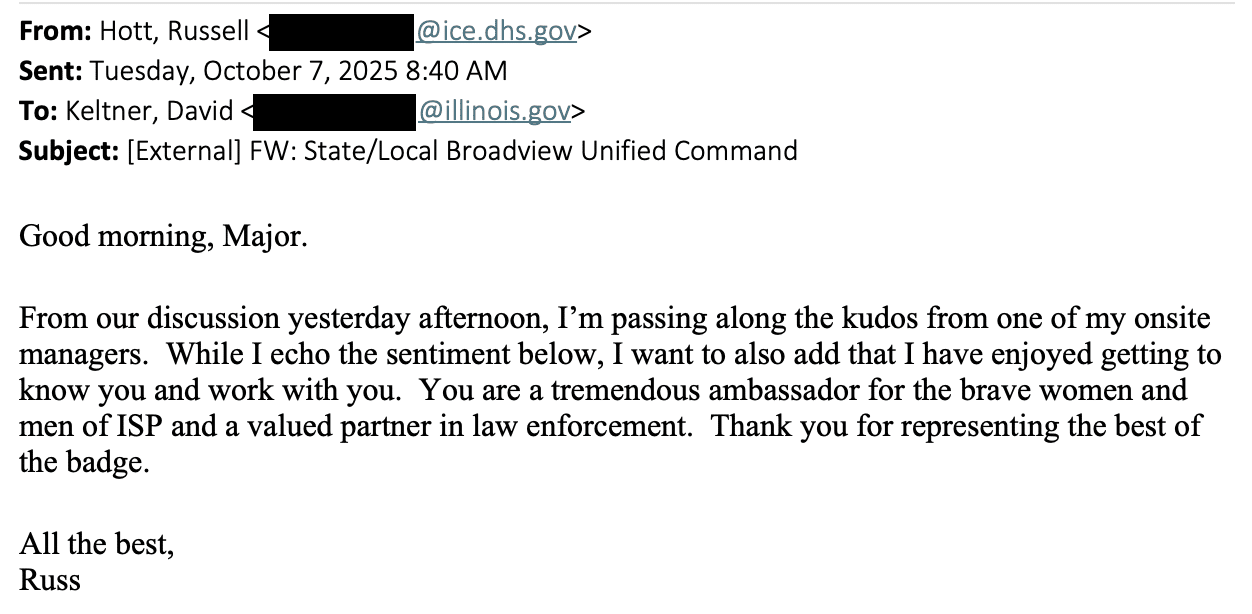
One of the most persuasive things Illinois was able to do was to show that at the same time that ERO Field Director Russ Hott was submitting a sworn declaration claiming all manner of horribles, he was sending email saying something totally different to the local cops saying something totally different.

It’s not clear, in this day and age, whether definitively proving that Stephen Miller and Kristi Noem and Greg Bovino and Tricia McLaughlin are just making shit up will be enough. Certainly, the right wingers on SCOTUS have proven just as susceptible to the Fox News propaganda bubble as Trump himself.

But thus far, at least, truth has won out over fabrications.

Update: The 7th Circuit just declined to disrupt Judge Perry’s retraining order. The panel — which included Trump appointee Amy St. Eve — cited Perry’s credibility ruling this way:

After holding a hearing and assessing the preliminary record, the court granted in part plaintiffs’ request for a temporary restraining order and enjoined the federalization and deployment of the National Guard for 14 days. The court withheld judgment on a preliminary injunction and did not extend its order to non–National Guard military forces or the President himself. The district court recognized the substantial deference due a President’s assessment of whether § 12406(2) or (3)’s factual predicates are satisfied, but it concluded nonetheless that, under its factual findings, the statutory requirements were not met. Where the declarations of the administration conflicted with the declarations of state and local law enforcement concerning conditions on the ground, the court made a credibility determination in plaintiffs’ favor. In particular, the court found that all three of the federal government’s declarations from those with firsthand knowledge were unreliable to the extent they omitted material information or were undermined by independent, objective evidence.

[snip]

Even giving great deference to the administration’s determinations, the district court’s contrary factual findings— which, at this expedited phase of the case, are necessarily preliminary and tentative—are not clearly erroneous. The submitted evidence consists almost entirely of two sets of competing declarations describing the events in Broadview. The district court provided substantial and specific reasons for crediting the plaintiffs’ declarations over the administration’s, and the record includes ample support for that decision. Given the record support, the findings are not clearly erroneous. See United States v. Nichols, 847 F.3d 851, 857 (7th Cir. 2017) (explaining that “where the district court’s factual findings are supported by the record, we will not disturb them” under clear-error review).

The opinion was more important for the way it defined rebellion (in part, because the same ruling will be the starting point for discussions of insurrection).

Although we substantially agree with the definition of rebellion set forth by the district court in Newsom, we emphasize that the critical analysis of a “rebellion” centers on the nature of the resistance to governmental authority. Political opposition is not rebellion. A protest does not become a rebellion merely because the protestors advocate for myriad legal or policy changes, are well organized, call for significant changes to the structure of the U.S. government, use civil disobedience as a form of protest, or exercise their Second Amendment right to carry firearms as the law currently allows. Nor does a protest become a rebellion merely because of sporadic and isolated incidents of unlawful activity or even violence committed by rogue participants in the protest. Such conduct exceeds the scope of the First Amendment, of course, and law enforcement has apprehended the perpetrators accordingly. But because rebellions at least use deliberate, organized violence to resist governmental authority, the problematic incidents in this record clearly fall within the considerable daylight between protected speech and rebellion.

Applying our tentative understanding of “rebellion” to the district court’s factual findings, and even after affording great deference to the President’s evaluation of the circumstances, we see insufficient evidence of a rebellion or danger of rebellion in Illinois. The spirited, sustained, and occasionally violent actions of demonstrators in protest of the federal government’s immigration policies and actions, without more, does not give rise to a danger of rebellion against the government’s authority. The administration thus has not demonstrated that it is likely to succeed on this issue.

The panel allowed Trump to keep Guard deployed, sitting in Illinois doing nothing. But they cannot patrol the streets.

Update: Trump has appealed to SCOTUS. Amy Coney Barrett has ordered Illinois to respond by Monday evening, but did not immediately overturn the stay.
Share this entry

The Brutal CBP Assault Tied to the Marimar Martinez Shooting

There have been three stories told about the incident that led to the shooting of Marimar Martinez on Saturday: DHS propagandist Tricia McLaughlin’s original statement, the claims made in a criminal complaint charging Martinez and another guy with assault, and the revelations from a detention hearing yesterday at which Martinez was released.

The differences people have noted so far are:

How many vehicles were allegedly following the Tahoe carrying the CBP officers?

Tricia McLaughlin claimed that ten cars were following the CBP vehicle.

A video from before the conflict does show a lot of vehicles, but it’s not clear how many are following as opposed to, you know, driving.

One thing the video does not show is a detail in the complaint: that there was a dark pickup truck in front of the Tahoe, which is critical to their claim they were boxed in.

Specifically, according to BPAs 2 and 3, a dark pickup truck cut in front of the CBP Vehicle, the Martinez Vehicle drove up along the driver’s side of the CBP Vehicle, the Ruiz Vehicle drove up along the passenger’s side of the CBP Vehicle, and another vehicle drove near the rear of the CBP Vehicle. According to BPAs 2 and 3, the CBP Vehicle regularly used its lights and sirens while driving.

What role did her gun play?

McLaughlin’s original statement implied, but did not state, that Martinez brandished a semi-automatic weapon at the officers.

One of the drivers who rammed the law enforcement vehicle was armed with a semi-automatic weapon. Law enforcement was forced to deploy their weapons and fired defensive shots at an armed US citizen who drove herself to the hospital to get care for wounds.

The complaint made no mention of Martinez having a gun.

At her detention hearing the other day, a prosecutor explained that there was a gun in her vehicle, apparently in her purse (for which she had a concealed carry license), but she never brandished it.

But in court Monday, Hennessy said Martinez had a loaded firearm on the passenger side of her car but never brandished it. Martinez’s attorney, Parente, said she has a valid firearm and concealed-carry license.

Who rammed who?

DHS claims that Martinez (and Anthony Ruiz, her co-defendant) rammed the Tahoe simultaneously.

According to the BPAs, at approximately the intersection of 39th and Kedzie, the Martinez Vehicle drove into and side-swiped the driver’s side of the CBP Vehicle. A moment thereafter, the Ruiz Vehicle drove into and struck the rear right quadrant of the CBP Vehicle.

Parente claims that the Tahoe drove into Martinez’ vehicle.

Parente said the video shows an agent turn a federal vehicle left into Martinez’s vehicle, after which an agent says, “Do something b—-.” The agent then exits the vehicle and shoots at Martinez.

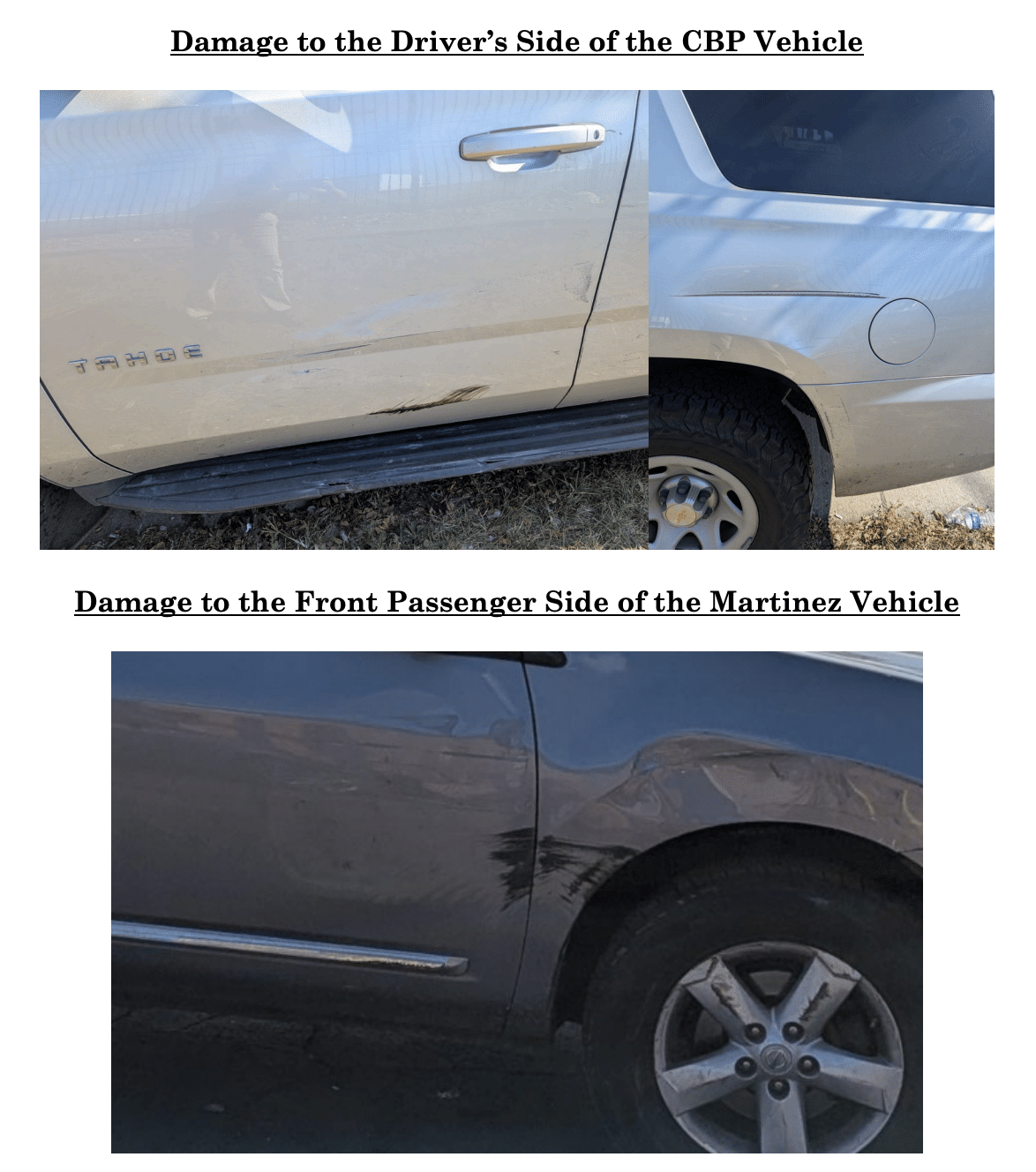
The damage to her car, with her wheel well jammed in, is consistent with her being rammed by a larger vehicle, not vice versa.

Indeed, the damage to the Tahoe is inconsistent with the claims the Border Patrol officers made to the affiant: If Martinez had hit the Tahoe on the side of the driver’s door, they would have been stuck in the car, but the driver was able to get out and shoot at Martinez. Moreover, at least some of the shots went through her windshield, meaning she would have been further back.

How the Border Patrol came to be in that neighborhood?

But the more interesting part of the tale told in the criminal complaint is how the Tahoe came to be in the neighborhood.

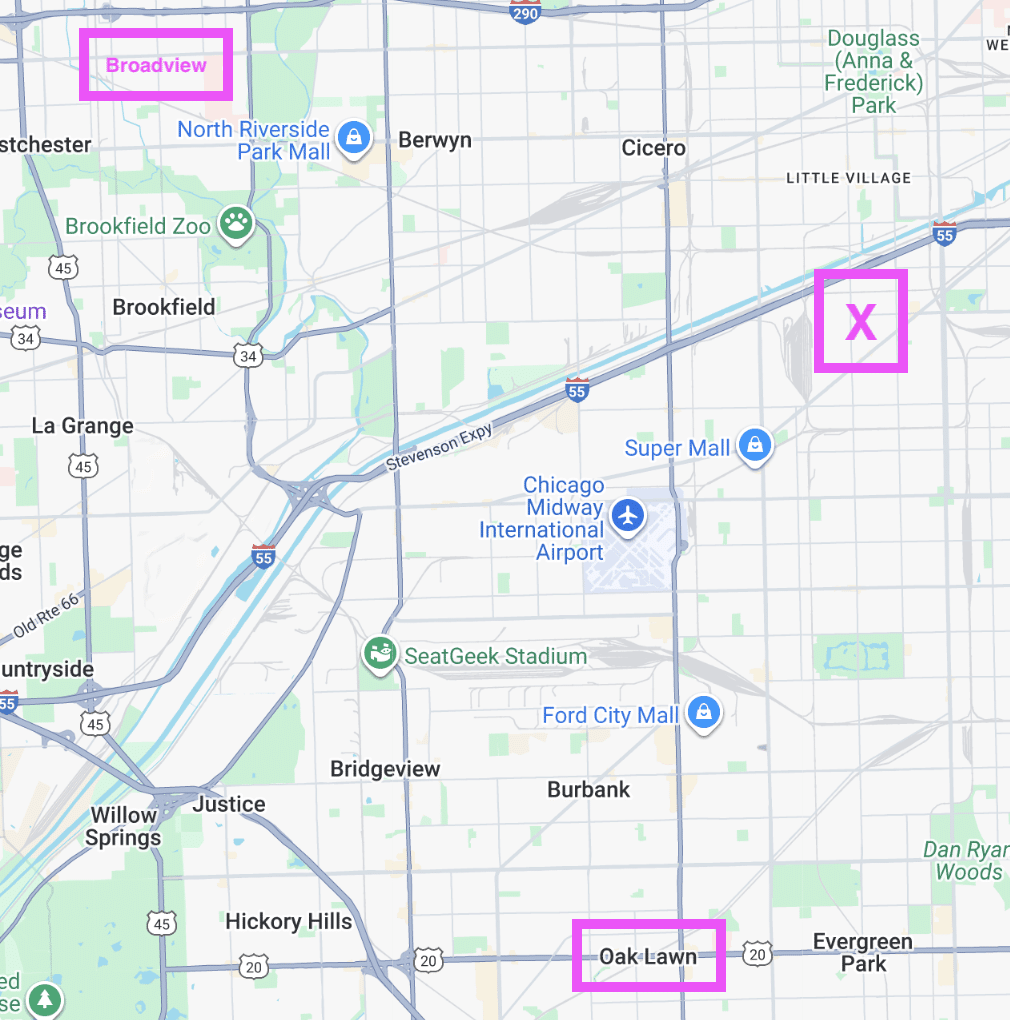
McLaughlin claimed the officers were “conducting routine patrolling in the greater Broadview area,” where the ICE facility is. The officers told the affiant a wildly different story: that they showed up in the Brighton Park area after diverting the convoy from other officers they had worked with in Oak Lawn, which is how they came to be driving north on Kedzie.

7. According to the BPAs, their assigned area of operation on or about October 4, 2025, was Oak Lawn, Illinois. According to BPA 3, while operating the CBP Vehicle in or around Oak Lawn, multiple civilian vehicles began to follow the CBP Vehicle and vehicles driven by other CBP agents. According to BPA 3, many of the civilian vehicles drove aggressively and erratically towards the CBP Vehicle, including by driving within inches of the CBP Vehicle, pulling up alongside both the passenger’s and driver’s side of the CBP Vehicle, and disobeying traffic laws, including running red lights and stop signs, driving in the wrong lane, and driving the wrong way down one-way streets in order to pursue the CBP Vehicles.

8. According to the BPAs, BPA 1 drove the CBP Vehicle away from vehicles driven by other CBP agents in an effort to draw the pursuing civilian vehicles away from the other CBP agents, which ultimately resulted in the BPAs driving the CBP Vehicle northbound on Kedzie Avenue, in Chicago

That is, Border Patrol only ended up at “approximately” the intersection of 39th and Kedzie, they claim, because they were pursued there by Martinez and others.

How Martinez knew they were federal law enforcement officers?

Which brings me to the — by far, in my opinion — biggest discrepancy.

The Tahoe was unmarked. You can’t charge someone under 18 USC 111 for ramming an unmarked car unless you can prove that they knew you were a Federal law enforcement officer.

The complaint substantiates that knowledge by claiming they were using a siren (not visible in the video above) and that Martinez was shouting “la migra” at them.

According to BPAs 2 and 3, the CBP Vehicle regularly used its lights and sirens while driving. In addition, according to BPAs 2 and 3, the driver of the Martinez Vehicle regularly and loudly referred to the BPAs as “la migra.”

Now, curiously, of the three guys, only one, the guy sitting on the passenger side rear, the furthest from Martinez, had his body worn camera turned on. That’s the camera that shows the driver of the Tahoe ramming Martinez as opposed to vice versa.

The only things the complaint uses that one bodycam to corroborate are:

  • The time of the claimed ramming, 10:29AM
  • That the driver shot “approximately” five shots at Martinez
  • What Ruiz did after the incident

It does not claim that either the sirens or Martinez’ very loud calls of “la migra” were captured in the bodycam. Virtually everything else in this complaint is based off seventeen otherwise uncorroborated claims of the Border Patrol Agents.

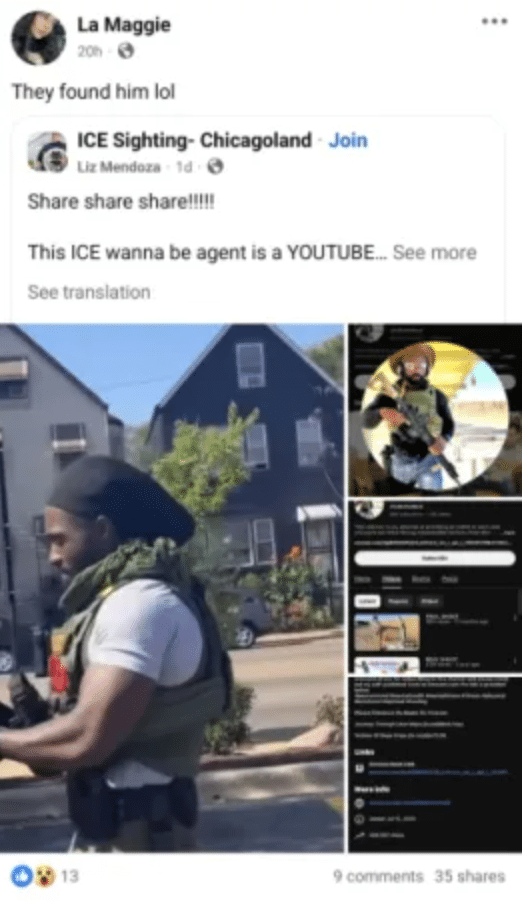
But what the complaint does not mention — but McLaughlin did — is that CBP was already out looking for Martinez because she had doxed a CBP officer as a YouTuber.

The armed woman was named in a CBP intelligence bulletin last week for doxing agents online.

[snip]

Just last week, an internal threat intelligence bulleting was circulated about the armed woman for doxing law enforcement officers online.

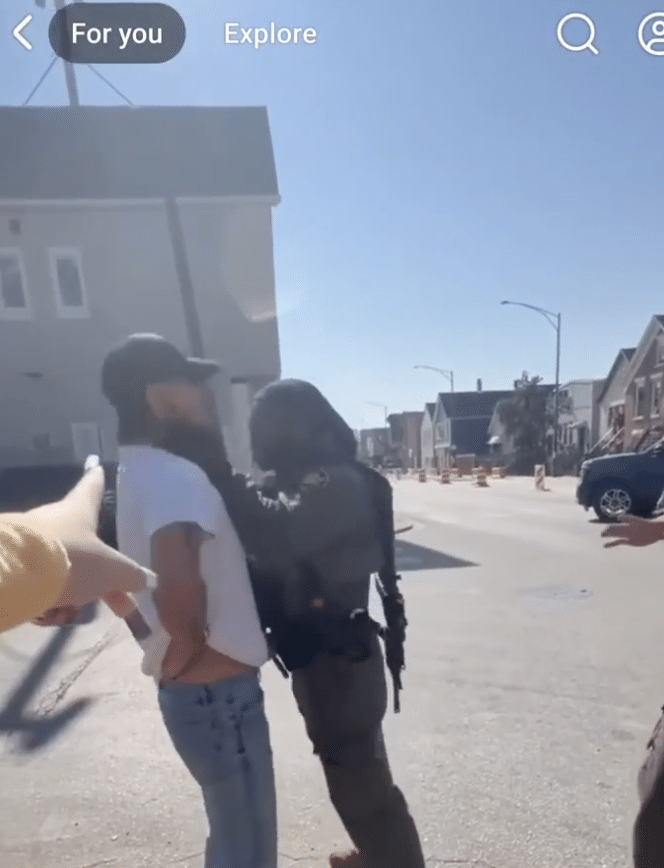
And that officer — the guy whose identity Martinez allegedly doxed — is the guy involved in a brutal assault at what I believe is just two blocks away, possibly also on Saturday.

The story McLaughlin told is that CBP happened to be chased into the Brighton Park neighborhood by the same person who had doxed their officer days earlier, she brandished a gun, and they shot in defense.

The story CBP told, after trying to figure out what story to tell, is that she rammed their car and they retaliated by shooting “defensively.” (They appear to have given up the claim that she showed them the gun, which they presumably found in a search of her vehicle.)

But another story tells that Martinez identified the YouTube channel of one of the guys who’d been patrolling the neighborhood, and days later, CBP ended up screaming, “Do something bitch” at her before they rammed her car and started shooting.

Share this entry

The “Boo Boos” and Bovino Bullshit DHS Uses to Criminalize Scrutiny

I had been meaning to return to the parts of DOJ’s omnibus response to LaMonica McIver’s motions to dismiss her indictment anyway.

And then the following things happened:

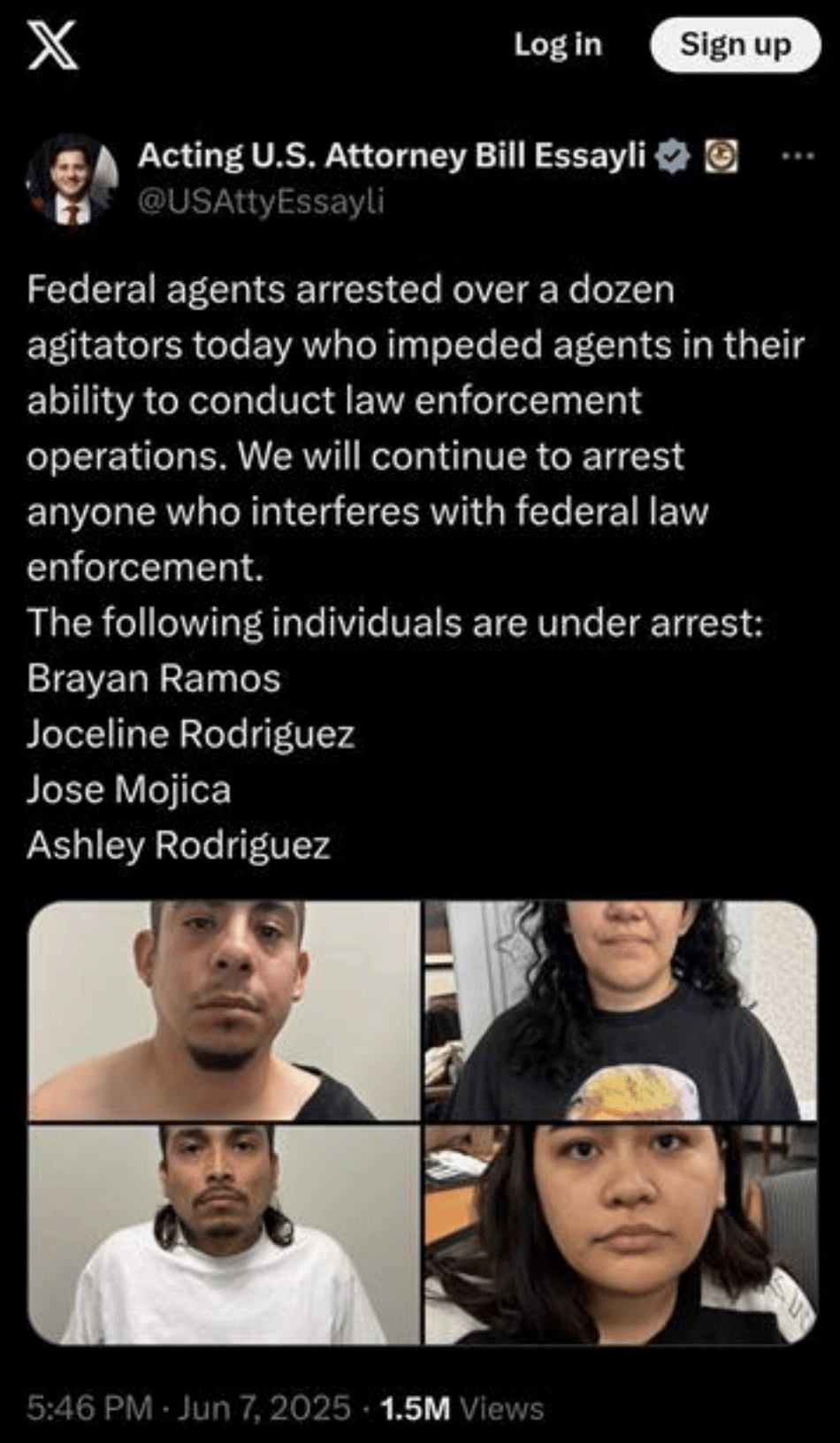
Brayan Ramos-Brito

After Brayan Ramos-Brito was arrested for being assaulted by a Border Patrol officer, after he was held in pretrial detention for a week based on several claims that DOJ later admitted were lies (including that he said he was going to grab guns and shoot the agents, when he actually said he was going to fuck up the border patrol agents), after the initial felony assault charge was dismissed and then charged as a misdemeanor (first on something inaccurately called an indictment, and only later as an Information), and after getting several adverse rulings on motions in limine, Ramos-Brito was acquitted on Wednesday.

According to LAT, a juror said Ramos-Brito was acquitted because the government presented no video evidence showing the assault. Which means senior Border Patrol official, Gregory Bovino, destroyed his credibility for naught.

U.S. Border Patrol Sector Chief Gregory Bovino — the brash agent who led a phalanx of military personnel into MacArthur Park this summer — was called as a witness Wednesday in a federal misdemeanor assault case against Brayan Ramos-Brito, who was accused of striking a federal agent.

Bovino, who flew in to testify from Chicago, the latest city targeted for an immigration enforcement surge, said he witnessed the alleged assault committed by Ramos-Brito in Paramount on June 7.

Bovino was questioned by the defense about previous comments he made referring to undocumented immigrants as “scum.”

[snip]

On a cross-examination, federal public defender Cuauhtemoc Ortega questioned Bovino about being the subject of a misconduct investigation a few years ago and receiving a reprimand for referring to undocumented immigrants as “scum, filth and trash.”

Bovino said he was referring to “a specific criminal illegal alien” — a Honduran national who he said had raped a child and reentered the United States and had been caught at or near the Baton Rouge Border Patrol station.

“I said that about a specific individual, not about undocumented peoples, that’s not correct,” he said.

Ortega pushed back, reading from the reprimand, which Bovino signed, stating that he was describing “illegal aliens.”

“They did not say one illegal alien,” Ortega said. “They said you describing illegal aliens, and or criminals, as scum, trash and filth is misconduct. Isn’t that correct?”

“The report states that,” Bovino said.

Not only did Bovino lead the staged invasion of MacArthur Park (which featured in Charles Breyer’s opinion ruling that DOD had violated the Posse Comitatus Act), but he’s the one who tried to menace Gavin Newsom during his announced plan to redistrict California. And he was caught lying to a jury.

Among the things Ramos-Brito was not permitted to do was conduct attorney-led voir dire to find out if anyone had seen Acting US Attorney Bill Essayli’s false propaganda about the arrests, posted on Xitter the day of the incident and still posted today, even after the dismissals and acquittal — yet more lies DHS and DOJ have told about the assaults that DHS officers have caused.

Sydney Reid

Meanwhile, in DC, DOJ asked to prevent Sydney Reid, who was accused of assaulting FBI agent Eugenia Bates while she was filming the ICE arrest of two people at the DC jail, from introducing the following evidence at trial:

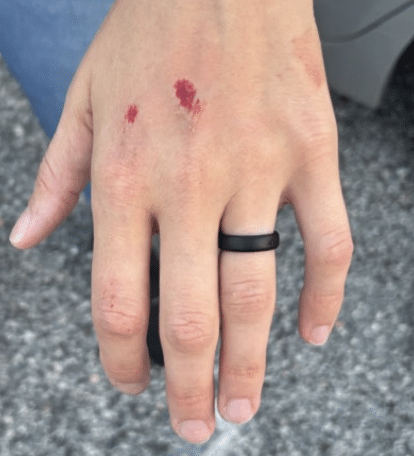
  • That Bates called her “boo boos,” “boo boos”
  • That Bates twice complained that she had to turn this thing into an assault charge:
    • “I’m going to the attorneys [sic] office for a bystander that I tussled. Dinko arrested her for ‘assault’ ughhh”;
    • “Do you want the arrest EC separate from the ‘assault’ or am I good to put it in together in one 302”
  • That she called Reid a “lib tard”

The government appears to have no complaint if Reid introduces Bates comment that she said of her “boo boos:” “I sacrificed life and limb for the mission. I think it’s worth a trump coin,” which Reid included in her response.

Still, DOJ badly wants to prevent Reid from presenting evidence that not even Bates believed this was an assault.

Brad Lander

Yesterday, the government arrested Brad Lander, again, along with dozens of others, once again for protesting the treatment of ICE targets inside Federal Plaza.

At least 11 elected officials were arrested Thursday while protesting conditions at an immigration holding facility in Manhattan where a federal judge this week extended a court order requiring the government to shape up its treatment of detainees.

The officials, including Comptroller Brad Lander, Public Advocate Jumaane Williams, State Senator Julia Salazar and Assemblywoman Jessica Gonzalez-Rojas, were among dozens of people detained during protests at 26 Federal Plaza. The government building, home to immigration court, the FBI’s New York field office and other federal offices, has become a hotbed of arrests and detention amid President Donald Trump’s crackdown on illegal immigration.

Several officials were arrested inside the building while attempting to inspect holding rooms on the 10th floor that are the subject of ongoing litigation alleging squalid conditions and overcrowding, according to a coalition of politicians, advocates and faith leaders involved in the protest.

The arrests came in the wake of an order from Judge Lewis Kaplan requiring that DHS treat those being held at 26 Federal Plaza humanely.

The Court’s preliminary injunction will not prevent defendants from pursuing the policies they have set. It merely will require that they conform to the demands of the Constitution in doing so. It is up to defendants to choose whether they wish to expend resources to conform 26 Fed to those requirements, or to alter the rate at which they are funneling arrestees into 26 Fed and other facilities, or to select or obtain facilities where detainees can be held in a humane and constitutional manner.

Here, plaintiff has demonstrated clear and imminent irreparable harm in the absence of a preliminary injunction and a likelihood of success on the merits of his First and Fifth Amendment claims arising from the substandard conditions and barriers to attorney-client communication at 26 Fed. Because the injunction would halt ongoing constitutional injuries while merely requiring adherence to standards defendants have already adopted for their immigration detention facilities across the country, the balance of the equities and the public interest decisively favor plaintiff.

This time, Lander wasn’t assaulted as he was arrested, and the government released those protesting with summonses.

But DHS continues to try to criminalize opposition to its abuses.

LaMonica McIver

Which is why two aspects of the LaMonica McIver response are notable.

One of McIver’s motions was to get DHS to take down a series of egregiously false claims that DHS and its propagandist, Tricia McLaughlin, had made about the incident at Delaney Hall. The government’s response to this was similar to that offered in the Kilmar Abrego case — that DOJ did not control DHS.

As an initial matter, it should be noted that the U.S. Attorney’s Office does not exercise authority over DHS even at a local level. Nevertheless, this Office has communicated with DHS to request that DHS remove the postings to which Defendant objects. To the extent that DHS does so, McIver’s motion will be moot.

But while DHS had not removed the offending propaganda before the court filing, they now have done so.

Nevertheless, DOJ cited some of those very same propaganda posts, which McIver also cited in her selective prosecution filing, in arguing that threats against DHS have gone up astronomically. (I’ve color coded the three references so you can see how they correspond.)

Since then, and as reflected in the multiple press releases and articles referenced by McIver, assaults and threats against DHS officers have increased exponentially.12 According to DHS, ICE officials faced an 830 percent increase in assaults between January 21 and July 14, 2025, compared with the same period in 2024.13 Seemingly recognizing the dangers that DHS officers have been uniquely facing, McIver “introduce[ed], as her first bill in Congress, the DHS Better Ballistic Body Armor Act, which would increase the availability of protective body armor designed to fit the bodies of female agents.” ECF 20-1, at 8. DHS also introduced a new policy for the protection of law enforcement officers requiring notice for a visit to its facilities, noting that the policy was “made in response to ‘a surge in assaults, disruptions and obstructions to enforcement, including by politicians themselves.’”14 In response to the DHS policy, on July 30, 2025, 12 Members of Congress filed a civil Complaint against ICE objecting to the new policy and seeking injunctive relieve.15 McIver, who was at Delaney Hall to conduct oversight, is neither a named plaintiff nor mentioned in the Complaint.

12 See, e.g., ECF 20-1, at 13 n.23 (article quoting DHS official that ICE law enforcement officers faced a 413 percent increase in assaults against them at the time), n.25 (DHS press release claiming “[a]ttacks and smears against ICE have resulted in officers facing a 413% increase in assaults”), n.26 (DHS press release discussing alleged disclosure of an ICE agent’s information by Democratic Congressman Salud Carbajal, and a subsequent alleged assault on that agent during an enforcement action); see also n.23 (article discussing incident involving Senator Alex Padilla where U.S. Secret Service purportedly “thought he was an attacker’” during a DHS press conference).

13 Id. at 13 n.27 (Press Release, Department of Homeland Security, DHS Announces ICE Law Enforcement are Now Facing an 830 Percent Increase in Assaults (July 15, 2025) (emphasis omitted), available at https://www.dhs.gov/news/2025/07/15/dhs-announcesice-law-enforcement-are-now-facing-830-percent-increase-assaults).

14 Michael Gold, ICE Imposes New Rules on Congressional Visits, N.Y. Times (June 19, 2025), www.nytimes.com/2025/06/19/us/politics/ice-congress.html; ECF 20-1, at 14 n.28; see also Homeland Security (@DHSgov), X (July 11, 2025, at 6:28 PM) (posting on X that “sufficient notice to facilitate a visit . . . is essential to keep staff and detainees safe”), https://x.com/dhsgov/status/1943799482342109463?s=46&t=-VXhB76r-zYF5BuEUXYkQ.

15 Complaint, Neguse v. U.S. Immigration and Customs Enforcement, 25-CV-02463, ECF. No 1 at 64 (D.D.C. July 30, 2025).

McIver cited these links not for the truth, but to demonstrate that as part of an effort to evade oversight, DHS was lying its ass off.

The events at Delaney Hall marked the first of three times ICE forcefully detained officials investigating its activities in the course of a month.23 And DHS has since pursued a press strategy to undermine congressional oversight authority over its facilities. Even before the end of the May 9 visit, DHS issued a press release falsely describing Congresswoman McIver and the other Members as having “stormed the [Delaney Hall] gate and broke[n] into the detention facility,” calling the visit “a bizarre political stunt.”24 A week later, DHS issued a news release to “[d]ebunk” the notion that the visit to Delaney Hall “was ‘oversight’”—“it is actually trespassing and put ICE officers and detainees at risk.”25 DHS renewed this rhetoric in July, issuing a third press release related to Congresswoman McIver, this time suggesting that her actions were “just another case of Democratic lawmakers labeling political stunts as oversight while they endanger the safety of ICE personnel.”26 DHS doubled down on that framing the next day, stating in yet another new post that “Democratic members of Congress,” including “Representative LaMonica McIver (D-NJ),” have “been caught red-handed doxing and even physically assaulting ICE officials.”27

23 Compl. ¶¶ 31-32, 43 Baraka v. Habba, 25-cv-06846 (June 4, 2025), ECF No. 1; Michael Williams et. al, US Senator Forcefully Removed From DHS Event in LA, Triggering Democratic Outcry on Capitol Hill, CNN (June 12, 2025), https://www.cnn.com/2025/06/12/politics/alexpadilla-removed-noem-press-conference; Luis Ferré-Sadurní, Brad Lander Is Arrested by ICE Agents at Immigration Courthouse, N.Y. Times (June 17, 2025), https://www.nytimes.com/2025/06/17/nyregion/brad-lander-immigration-ice.html.

24 Press Release, DHS, Members of Congress Break into Delaney Hall Detention Center (May 9, 2025), https://perma.cc/G6MH-2KXF.

25 Press Release, DHS, DHS Debunks Fake News Narratives About Law Enforcement During Police Week (May 16, 2025), https://perma.cc/9XKE-3K3U.

26 Press Release, DHS, ICE Employee Attacked by Rioters After Congressman Doxes Him to Mob at California Marijuana Facility (July 14, 2025), https://perma.cc/3GNL-PWE6.

27 Press Release, DHS, DHS Announces ICE Law Enforcement are Now Facing an 830 Percent Increase in Assaults (July 15, 2025), https://perma.cc/7YZP-PGWS.

The only one of four withdrawn press releases that DOJ did not cite here is the one falsely claiming that members of Congress arrived to Delaney Hall on a bus. They’ve also subsequently posted another bullshit post (which repeats a false claim McLaughlin made about the ICE assault of Christian Enrique Carias Torres, whose case has also been dismissed), to make sure their slander of Congressman Carbajal remains accessible.

DOJ’s use of these false (and now withdrawn) press releases creates the illusion that the new policy, unlawfully requiring a week’s notice before members of Congress conduct oversight at a detention facility, was set up in response to the assault alleged against McIver.

To claim there is “clear evidence” of discriminatory intent supporting her selective enforcement claim, McIver points to three areas: 1) press statements issued by DHS that are sharply critical of her conduct on the day she arrived at Delaney Hall to conduct an unscheduled inspection tour; 2) the implementation of a new DHS policy after the charges were against her were filed that applies to all Members of Congress requiring them to give seven days prior notice of an oversight inspection tour of certain immigration facilities; and 3) the detention/interaction by law enforcement with three Democratic politicians including Defendant within the space of approximately one month. See ECF 20-1, at 13-15, 22-23.

[snip]

Relatedly, Defendant points to the DHS policy enacted after the events at Delaney Hall on May 9, 2025, requiring Members of Congress to give at least seven days’ notice in advance of conducting an oversight inspection tour of an immigration detention facility. Defendant believes this is somehow evidence of discriminatory intent in conducting an “enforcement action” against her even though the policy was enacted after McIver had been charged. The logic of this claim is elusive, especially when the policy, at least in part, furthers the legitimate purpose of avoiding situations like that which occurred on May 9, 2025, by ensuring that appropriate security measures may be taken in advance of such an oversight visit.

All of this, of course, is an attempt to narrow the issue to what happened after Todd Blanche ordered Ricky Patel to arrest Newark Mayor Ras Baraka even after Baraka left Delaney Hall, rather than include details of the decision — from the guy now in charge of this prosecution team — to criminalize someone who had followed the orders of a cop.

To the contrary, the jury will hear such details only if McIver introduces them over the Government’s Rule 401/403/jury nullification objections. But even if those objections are overruled, the speech or debate analysis focuses on what the Government has alleged (and, thus, how the Government will prove it), not on how the defendant hopes to defend herself. Here, to prove beyond a reasonable doubt that McIver violated 18 U.S.C. § 111(a)(1), the Government will prove that on May 9, 2025, she used her forearms to forcibly strike a federal Agent who was attempting to arrest someone outside the gate to Delaney Hall, and she used her hands to forcibly grab and pull at that agent’s jacket. ECF No. 1 at 5, ¶¶ 13,14 and 16. Nothing about that touches on oversight activities.

This goes to the heart of separation of powers issues, which is why McIver’s attempt to rely on Trump v. US has real merit. Todd Blanche ordered agents from a different agency to arrest someone — Newark’s Mayor — trying to conduct oversight, even after he had left the premises. After discovering that arrest was based off false claims, they’re now trying to criminalize the physical conflict — including what McIver said in real time was an assault of her — that resulted. And in this filing, they rely on that effort to criminalize conducting oversight to excuse their unlawful attempt to evade oversight with the week notice requirement.

Over and over, DHS has been caught lying about assaults on its officers, presenting assaults of arrestees as instead assaults on their officers.

And in McIver’s case, they’re trying to double down on withdrawn propaganda to claim the problem that Todd Blanche caused can be pinned on Congressional oversight.

Share this entry