Posts

The Most Complex Friday Night News Dump, Ever?

President Trump arrived late to a healthcare announcement yesterday and didn’t take any questions.

Starting around the same time, DOJ launched some of the most complexly executed Friday Night News dumps going.

Epstein Limited Hangout

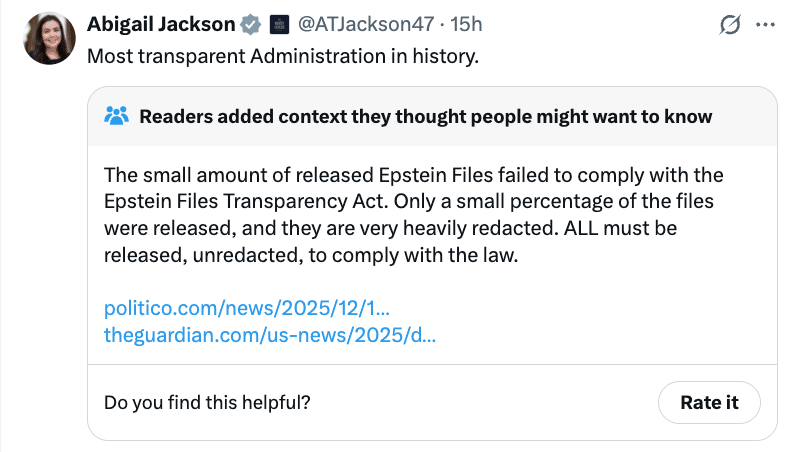
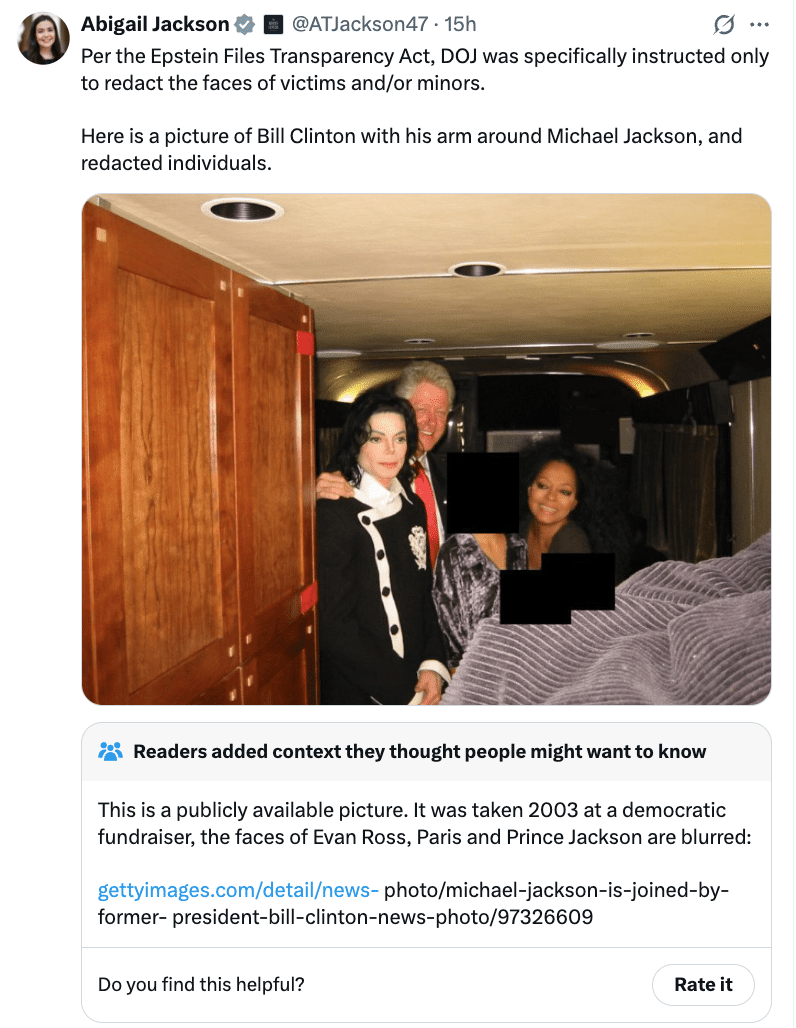
The big attraction was the release of the first batch of the Epstein files. The limited release violates the law, which required all files to be released yesterday.

Instead, there were a whole bunch of Bill Clinton photos, the document reflecting Maria Farmer’s complaint from 1996, that went ignored for years, and redacted grand jury transcripts that clearly violate the law. [Update: They have now released the SDNY ones.] The government did not release the proposed indictment and prosecution memo for the indictment that should have been filed in 2007; that may be sealed as deliberative.

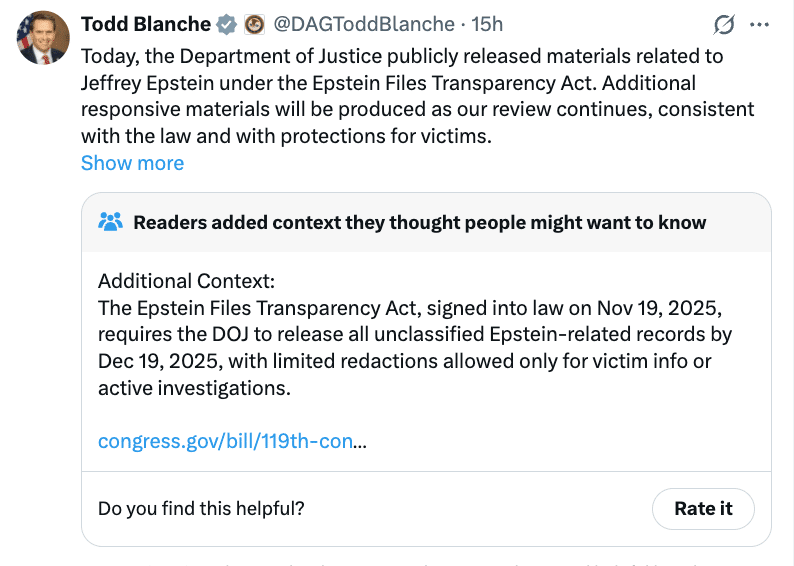
Todd Blanche’s wildly dishonest letter (particularly with regards to his claimed concern for victims, after being admonished repeatedly by judges for failing to take that responsibility seriously and a last minute bid that promised but failed to put Pam Bondi on the phone) explaining the release emphasizes how Bondi took over a hundred national security attorneys off their job hunting hackers and spies to conduct a second review; it does not mention the even bigger review the FBI accomplished in March.

The review team consisted of more than 200 Department attorneys working to determine whether materials were responsive under the Act and. if so, whether redactions or withholding was required, The review had multiple levels. First, 187 attorneys from the Department’sNational Security Division (NSD) conducted a review of all items produced to JMD for responsiveness and any redactions under the Act. Second, a quality-control team of 25 attorneys conducted a second-level review to ensure that victim personally identifying information wasproperly redacted and that materials that should not be redacted were not marked for redaction.The second-level review team consisted of attorneys from the Department’s Office of Privacy and Civil Liberties (OPCL) and Office of Information Policy (OIP)—these attorneys are experts in privacy rights and reviewing large volumes of discovery. After the second-level review team completed its quality review, responsive materials were uploaded onto the website for public production as required under the Act. See Sec. 2(a). Finally, Assistant United States Attorneys from the Southern District of New York reviewed the responsive materials to confirm appropriate redactions so that the United States Attorney for the Southern District of New York could certify that victim identifying information was appropriately protected.

That John Eisenberg’s department was in charge of a second pass on these documents is of some interest; there’s no specific competence Nat Sec attorneys would have, but Eisenberg has helped Trump cover stuff up in the past, most notably the transcript of his perfect phone call with Volodymyr Zelenskyy.

Thus far the limited hangout has shifted the focus onto Clinton and away from Trump, but as Kyle Cheney lays out, it risks creating a WikiLeaks effect, in which a focus remains on Epstein for weeks or even months.

Deputy Attorney General Todd Blanche confirmed Friday that the documents would be released on a rolling basis through the holidays — and possibly beyond. And, in court papers filed shortly after Friday’s partial release, the Justice Department emphasized that more files are still undergoing a review and redaction process to protect victims and new Trump-ordered investigations before they can be released.

The daily drip is a remarkable result for President Donald Trump, who has urged his allies to move past the Epstein files — prompting jeers from Democrats who say he’s trying to conceal details about his own longtime relationship with Epstein. Trump has maintained for years that he and Epstein had a falling out years ago, and no evidence has suggested that Trump took part in Epstein’s trafficking operation. Trump advocated for the release of the files only after Republicans in Congress rebuffed his initial pleas to keep them concealed.

[snip]

Trump is no stranger to the political power of intermittent disclosures of derogatory information. In 2016, Trump led the charge to capitalize on the hack-and-leak operation that led to daily publications of the campaign emails of Hillary Clinton and her top allies. The steady drumbeat of embarrassing releases — amplified by Trump and a ravenous press corps — helped sink Clinton’s campaign in its final weeks.

And that’s before the political and legal response to this limited hangout. Some victims are already expressing disappointment — most notably, by the redaction of grand jury material and names they know they shared, as well as the draft indictment from Florida.

Tom Massie and Ro Khanna, while originally giving DOJ the benefit of the doubt, are now contemplating measures they can take — potentially including contempt or impeachment — to enforce this law.

After Fox News was the first to report that the names of some politically exposed persons would be redacted, DOJ’s favorite transcriptionist Brooke Singman told a different story.

And Administration officials are getting burned by Elon’s fascism machine for their dishonesty.
Once again, Trump’s top flunkies may be overestimating their ability to contain their scandal.

Todd Blanche behind the selective prosecution

Meanwhile, efforts by those same flunkies to punish Kilmar Abrego continue to impose costs.

There have been parallel proceedings with Abrego in the last month. Just over a week ago in his immigration docket, Judge Paula Xinis ordered Kilmar Abrego to be released from ICE custody for the first time since March, and then issued another order enjoining DHS from taking him back into custody at a check-in the next day. Effectively, Xinis found the government had been playing games for months, making claims they had plans to ship Abrego to one or another African country instead of Costa Rica, which had agreed to take him. Those games were, in effect, admission they had no order of removal for him, and so could no longer detain him.

[B]ecause Respondents have no statutory authority to remove Abrego Garcia to a third country absent a removal order, his removal cannot be considered reasonably foreseeable, imminent, or consistent with due process. Although Respondents may eventually get it right, they have not as of today. Thus, Abrego Garcia’s detention for the stated purpose of third country removal cannot continue.

But even as that great drama was happening, something potentially more dramatic was transpiring in Abrego’s criminal docket.

Back on December 4, Judge Waverly Crenshaw, who had been receiving, ex parte, potential evidence he ordered the government turn over in response to Abrego’s vindictive prosecution claim, canceled a hearing and kicked off a fight over disclosures with DOJ. Four days later he had a hearing with the government as part of their bid for partial reconsideration, but then provided a limited set of exhibits to Kilmar’s attorneys.

Then yesterday, in addition to a request that Judge Crenshaw gag Greg Bovino — who keeps lying about Abrego — Abrego’s team submitted filings in support of the bid to dismiss the indictment. One discloses that Todd Blanche’s office was pushed by people within Blanche’s office, including Aakash Singh, who is centrally involved in Blanche’s other abuse of DOJ resources, including by targeting George Soros.

Months ago now, this Court recognized that Deputy Attorney General Todd Blanche’s “remarkable” admission that this case was brought because “a judge in Maryland…questioned” the government’s decision to deport Mr. Abrego and “accus[ed] us of doing something wrong”1 may “come close to establishing actual vindictiveness.” (Dkt. 138 at 7-8). The only thing the Court found missing from the record was evidence “tying [Mr. Blanche’s statements] to actual decisionmakers.” (Id. at 8). Not anymore. Previously, the Court rightly wondered who placed this case on Mr. McGuire’s desk and what their motivations were. (Dkt. 185 at 2). We now know: it was Mr. Blanche and his office, the Office of the Deputy Attorney General, or “ODAG.” On April 30, 2025, just three days after Mr. McGuire personally took on this case, one of Mr. Blanche’s chief aides, Associate Deputy Attorney General Aakash Singh, told Mr. McGuire that this case was a [redacted]2 (Abrego-Garcia000007). That same day, Mr. Singh asked Mr. McGuire: [redacted] (Abrego-Garcia000008). Mr. McGuire responded with a timing update, saying he wanted to about a strategic question, and assuring Mr. Singh [redacted] and [redacted] (Abrego-Garcia000008). These communications and others show, as the Court put it, that [redacted] and [redacted] (Dkt. 241 at 5, 7). The “remarkable” statements “com[ing] close” to establishing vindictiveness (Dkt. 138 at 7-8) came from the same place— ODAG—as the instructions to Mr. McGuire to charge this case. The only “independent” decision (Dkt. 199 at 1) Mr. McGuire made was whether to acquiesce in ODAG’s directive to charge this case, or risk forfeiting his job as Acting U.S. Attorney—and perhaps his employment with the Department of Justice—for refusing to do the political bidding of an Executive Branch that is avowedly using prosecutorial power for “score settling.”3

2 The Court’s December 3 opinion (Dkt. 241) remains sealed, and the discovery produced to the defense in connection with Mr. Abrego’s motion to dismiss for vindictive and selective prosecution was provided pursuant to a protective order requiring that “[a]ny filing of discovery materials must be done under seal pending further orders of this Court” (Dkt. 77 at 2). Although the defense does not believe that any of these materials should be sealed for the reasons stated in Mr. Abrego’s memorandum of law regarding sealing (Dkt. 264), the defense is publicly filing a redacted version of this brief out of an abundance of caution pending further orders of the Court.

3 See Chris Whipple, Susie Wiles Talks Epstein Files, Pete Hegseth’s War Tactics, Retribution, and More (Part 2 of 2), Vanity Fair (Dec. 16, 2025), https://www.vanityfair.com/news/story/trump-susie-wiles-interview-exclusive-part-2.

While the specific content of this discovery remains redacted, the gist of it is clear: Blanche’s office ordered Tennessee prosecutors to file charges against Abrego in retaliation for his assertion of his due process rights.

We know similar documents exist in other cases — most notably, that of LaMonica McIver, Jim Comey, and Letitia James — but no one else has succeeded in getting their hands on the proof.

The Jim Comey stall

Speaking of which, the news you heard about yesterday is that DOJ filed its notice of appeal in both the Jim Comey and Letitia James’ dismissals.

The move comes after DOJ tried to indict James again in Norfolk on December 4 and then tried again in Alexandria on December 11, after which the grand jury made a point of making the failure (and the new terms of the indictment, which Molly Roberts lays out here) clear; Politico first disclosed the Alexandria filings here.

But I think the more interesting development — filed close to the time of the notice of appeals (the notices landed in my email box around 5:44-46PM ET on the last Friday before Christmas and the emergency motion landed in my email box around 5:17PM) — was yet another emergency motion in the Dan Richman case, something DOJ (under Lindsey the Insurance Lawyer’s name) keeps doing. After Judge Colleen Kollar-Kotelly issued her ruling that sort of said DOJ had to return Dan Richman’s stuff and move the remaining copy to EDVA, DOJ filed an emergency motion asking for clarification and an extension and (in a footnote) reconsideration. After Kollar-Kotelly granted the extension and some clarification (while grumbling about the tardiness and largely blowing off the motion for reconsideration), DOJ asked for another extension. Then DOJ filed a motion just informing Kollar-Kotelly they were going to do something else, the judge issued a long docket order noting (in part) that DOJ had violated their assurances they wouldn’t make any copies of this material, then ordering Richman to explain whether he was cool with this material ending up someplace still in DOJ custody rather than EDVA.

In its December 12, 2025, Order, the Court ordered the Government to “return to Petitioner Richman all copies of the covered materials, except for the single copy that the Court [] allowed to be deposited, under seal, with the U.S. District Court for the Eastern District of Virginia.” See Dkt. No. 20. The Court ordered the Government to certify compliance with its Order by 4:00 p.m. ET on December 15, 2025. Id. The Court further ordered that, until the Government certified compliance with its December 12 Order, the Government was “not to… share, disseminate, or disclose the covered materials to any person, without first seeking and obtaining leave of this Court.” See Order, Dkt. No. 20 at 2 (incorporating the terms of Order, Dkt. No. 10).

On December 15 (the Government’s original deadline to certify compliance with the Court’s December 12 Order), the Government requested a seven-day extension of its deadline to certify compliance with the Court’s December 12 Order. Dkt. No. 22. Petitioner Richman consented to this extension. Id. And the Government represented that it would “continue to comply with its obligation… not to access or share the covered materials without leave of the Court.” Id. at 11 (citing Order, Dkt. No. 10 and Order, Dkt. No. 20). So the Court granted the Government’s request for extension, thereby continuing the Government’s deadline to certify compliance with the Court’s December 12 Order to 4:00 p.m. ET on December 22. Order, Dkt. No. 26.

As of this date, the Government has not certified compliance with the Court’s December 12 Order. Accordingly, the Government is still under a Court order that prohibits it from accessing Petitioner Richman’s covered materials or sharing, disseminating, or disclosing Petitioner Richman’s covered materials to any person without first seeking and obtaining leave of this Court. See Dkt. No. 10; Dkt. No. 20; Dkt. No. 22; Dkt. No. 26. As the Government admits, the Government provided this copy of Petitioner Richman’s materials to the CISO “after the Government filed its emergency motion,” Gov’t’s Mot., Dkt. No. 31 at 1, fn. 1, in which the Government represented that it would “continue to comply with its obligation… not to access or share the covered materials without leave of the Court.” Dkt. No. 22 at 11.

In last night’s motion for emergency clarification (which had all the clarity of something written after a Christmas happy hour), DOJ explained that they couldn’t deposit the materials (which according to Kollar-Kotelly’s orders, would no longer have the single up-classified memo that Richman first shared his entire computer so FBI could get eight years ago) because there was no Classified Information Security Officer in the courthouse serving DOD, CIA, and ODNI. So they raised new complaints — basically, yet another motion for reconsideration. After having claimed, last week, that they had just a single copy of Richman’s data, they noted that actually they had it in a bunch of places, then pretended to be confused about storage devices.

d. The Court further clarified its order on December 16, 2025, stating that the Court “has not ordered the Government to delete or destroy any evidence.” ECF No. 27 at 2. But the Court has also instructed the Government that it may not “retain[] any additional copies of the covered materials.” ECF No. 20 at 2. The government has copies of the information in its systems and on electronic media. It is not clear how the government can avoid “retaining” the materials without deleting them.

e. The Court has not yet otherwise explained whether the Government must provide to Richman the original evidence “obtained in the Arctic Haze investigation (i.e., hard and/or flash drives and discs currently in the custody of the FBI,” ECF No. 22 at 9, some subset thereof (e.g., not including classified information), whether the Government must provide Richman the covered materials in some other fashion, and what else the Government must do (or not do) to comply with the December 12, 2025 order.

After they confessed, last week, that neither the discontinued e-Discovery software nor the now-retired and possibly impaired FBI agent could reconstruct what happened with Richman’s data five years ago, they insisted they were really keeping track of the data, Pinky Promise.

f. Notwithstanding the passage of time, changes in personnel, and the limits of institutional memory, the Government emphasizes that the materials at issue have at all times remained subject to the Department of Justice’s standard evidence-preservation, record-retention, and chain of custody protocols. The Government is not aware of any destruction, alteration or loss of original evidence seized pursuant to valid court-authorized warrants. Any uncertainty reflected in the Government’s present responses regarding the existence or accessibility of certain filtered or derivative working files does not undermine the integrity, completeness, or continued preservation of the original materials lawfully obtained and retained. The Government’s responses are offered to assist the Court in tailoring any appropriate relief under Rule 41(g) in a manner consistent with its equitable purpose, while preserving the Government’s lawful interests and constitutional responsibilities with respect to evidence obtained pursuant to valid warrants and subject to independent preservation obligations.

Every single thing about the treatment of Richman’s data defies this claim, which is why he had a Fourth Amendment injury to be redressed in the first place.

Nevertheless, in this their second motion fashioned as a motion for clarification, they they propose, can’t we just keep all the data and Pinky Promise not to do anything with it?

g. Rather than require the government to “return” or otherwise divest its systems of the information, the government respectfully suggests that the more appropriate remedy would simply be to direct the government to continue not to access the information in its possession without obtaining a new search warrant. It is not clear what Fourth Amendment interest would be served by ordering the “return” of copies of information (other than classified information) that is already in the movant’s possession, and that the government continues to possess, at least in the custody of a court (or the Department of Justice’s Litigation Security group, as may be appropriate given the presence of classified information). And the Court’s order properly recognizes that it is appropriate for the government to retain the ability to access the materials for future investigative purposes if a search warrant is obtained. ECF No. 20 at 1. Forcing transfer of evidentiary custody from the Executive Branch to the Judiciary would depart from the traditional operation of Rule 41(g), which is remedial rather than supervisory, and would raise substantial separation-of-powers concerns. The government respectfully suggests that the best way to do that is to allow the executive branch of government to maintain the information in its possession, rather than forcing transfer of evidence to (and participation in the chain of custody by) a court. See, e.g., United States v. Bein, 214 F.3d 408, 415 (3d Cir. 2000) (applying then-Rule 41(e) and noting that it provided for “one specific remedy—the return of property”); see also Peloro v. United States, 488 F.3d 163, 177 (7th Cir. 2007) (same regarding now-Rule 41(g)).

Having violated their promise not to make copies without permission once already, they Pinky Promised, again, they wouldn’t do so.

b. The Government shall continue not to access or share the covered materials without leave of the Court. See ECF No. 10 at 4; ECF No. 20 at 2.

And then they offered a horseshit excuse to ask for a two week extension beyond the time Kollar-Kotelly responds to their latest demands (partly arising from their own stalling of this matter into Christmas season) — that is, not a two week extension from yesterday, which would bring them to January 2, but instead two weeks from some date after December 22, which was at the time Richman’s next deadline.

a. Because it is yet not clear to the Government precisely what property must be provided to Richman by December 22, 2025 at 4:00 PM (and what other actions the Government must or must not take to certify compliance with the December 12, 2025 order as modified), the Government respectfully requests that it be provided an additional fourteen days (because of potential technological limitations in copying voluminous digital data and potential personnel constraints resulting from the upcoming Christmas holiday) from the date of the Court’s final order clarifying the December 6, 2025 order to certify compliance. 1

1 An extension of the compliance deadline is merited by the extraordinary time pressure to which the Government has been subjected and the necessity of determining, with clarity, what the Government must do to comply with the December 12, 2025 order as clarified and modified. See Fed. R. Civ. P. 60(b)(6); see also ECF No. 22 at 6–7 (summarizing applicable legal principles). [my emphasis]

They asked, effectively, to stall compliance for a month.

As a reminder, the grand jury teed up before Aileen Cannon convenes on January 12.

Kollar-Kotelly’s response (which landed in my email box at 7:06, so definitely after prime Christmas happy hour time) was … weird. In addition to granting the government part of the extension they requested (until December 29), she all of a sudden asked Richman what happened after he voluntarily let the FBI image his computer so they could ensure there was no classified information in it.

At present, in this second request, the Court would benefit from additional detail from Petitioner Richman regarding the Government’s imaging of Petitioner Richman’s personal computer hard drive in 2017. In 2017, Petitioner Richman consented to have the Government seize his personal computer hard drive, make a copy (an “image”) of his personal computer hard drive, and search his personal computer hard drive for the limited purpose of identifying and deleting a small subset of specified material. The Court is requesting information as to whether the hard drive that Petitioner Richman consented to have imaged by the Government was ever returned to Petitioner Richman, and, if so, whether any of the specified material had been removed from the hard drive that was returned.

Now maybe she’s asking this question simply to refute DOJ’s claim that any material independently held has to be held by a CISO.

The answer to this question is publicly available in the 80-page IG Report on this topic.

On June 13, 2017, FBI agents went to Richman’s home in New York to remove his desktop computer. On June 22, 2017, FBI agents returned the desktop computer to Richman at his home in New York after taking steps to permanently remove the Memos from it. While at Richman’s residence on June 22, 2017, the FBI agents also assisted Richman in deleting the text message with the photographs of Memo 4 from his cell phone.

It’s not clear why they ever kept the image in the first place (remember, they didn’t obtain a warrant to access it until well over two years later).

But I worry that Kollar-Kotelly is getting distracted from the clear recklessness — including DOJ’s most recent defiance of her order and their own Pinky Promises — for which Richman is due a remedy by the distinction between his physical property (the hard drive he got back eight years ago) and his digital property (the image of that hard drive, his Columbia emails, his iCloud, his iPhone, and iPad). The most serious abuse of his Fourth Amendment rights involved his phone, which DOJ only ever had in digital form, regardless of what kind of storage device they stored that content on (which we know to be a Blu-ray disc).

And meanwhile, everything about the government’s actions suggest they’re going to string Kollar-Kotelly along until they can get a warrant from the judge, Cannon, who once said Trump had to be given boxes and boxes of highly classified documents back because they also contained a single letter written by Trump’s personal physician and another letter published in Mueller materials.

They are just dicking around, at this point.

There’s a lot of shit going down in documents signed (as this emergency motion is) with Todd Blanche’s name. He still seems to believe he can juggle his way through politicizing the Department of Justice with some carefully executed Friday Night document dumps.
Share this entry

“Do something, bitch!”* Kristi Noem Dressed Russia’s Useful Idiot Up to Cosplay CBP

The White House denies that Kristi Noem told President Trump that she was going to zero out counterterrorism funding for the cops in NYC who protect — among other high profile potential targets — Trump Tower.

That’s where we start this very very long story of stupid things DHS is doing that are awful in real time but, with concerted focus, may backfire. We’re seeing it in NY, we’re seeing it in the Portland and Chicago invasions, and we see the potential result in the Kilmar Abrego case.

Kristi Noem didn’t warn Trump she was stripping security funding from New York City

As New York described it in a lawsuit, on the last day of the fiscal year last week, the state learned that DHS had zeroed out security grant funding for New York City’s MTA from a news article; as of the filing of that suit, DHS had not notified New York it had withdrawn funding.

4. New York learned about the Reallocation Decision not from the government but from an online news story, which reported earlier today that “[t]he federal government will deny the [the Metropolitan Transit Authority (“MTA”)] tens of millions of dollars in requested security grant funding, withholding every dollar the agency asked for because New York City and New York state are ‘sanctuary jurisdictions.’” Dave Cole & David Myer, BIG ZERO: Trump Stiffs MTA in ‘Sanctuary City’ Tantrum, STREETSBLOG NEW YORK CITY (Sept. 30, 2025), https://nyc.streetsblog.org/2025/09/30/trump-admin-zeros-out-mta-security-grant-funding. At this time, MTA has not even received formal notice that their award was cut to nothing.

5. Upon information and belief, New York’s award was changed from the $33,898,500 that FEMA had targeted New York to receive in the Notice of Funding Opportunity (“NOFO”) to $0. As of the filing of this complaint, New York has received no explanation from DHS or FEMA, despite repeated attempts to contact the agency through the Department of Justice. But upon information and belief, New York has been targeted because the administration believes it is a “sanctuary” jurisdiction. FEMA also did not treat all “sanctuary” jurisdictions evenhandedly. Upon information and belief, at the same time as it eliminated New York’s allocation, FEMA made increases to other States’ allocations, including other “sanctuary” jurisdictions.

[snip]

9. Now today, FEMA issued increased TSGP award notifications for other states, and Plaintiffs have discovered the Reallocation Decision through the media. At 1:07 PM today, counsel in Illinois v. FEMA and Illinois v. Noem sent an email communication to the Department of Justice inquiring about the story, asking for New York’s notice of award, and alerting the government that they would file the instant lawsuit and a TRO motion before the end of the federal fiscal year tonight. Counsel followed up that email with a second. At the time of filing, New York has not received a response. The New York Attorney General’s Office was sent (not by Defendants) a power-point presentation that appears to be a genuine document prepared and presented to Congressional staff, which is aligned with the online story. That document, attached as Exhibit 3 to the Affirmation of Rabia Muqaddam, identifies the MTA as the only applicant for TSGP funding that was denied, while other applicants received greater than originally allocated awards. It further states that MTA did not receive their award “because it is based in a Sanctuary Jurisdiction city.” Id. at *25.

In a NYT article providing more details of the funding, Kathy Hochul aptly described this as Republicans defunding the cops.

“A Republican administration literally defunding the police is the height of hypocrisy — and walking away from the fight against terrorism in the No. 1 terrorist target in America is utterly shocking,” Gov. Kathy Hochul of New York said in a statement on Tuesday.

The decision to strip NY of counterterrorism funding directly violated an order issued just days earlier in a lawsuit seeking to enjoin this kind of politicized DHS process.

There’s the legal issue: how DHS continues to double down on politicizing security grants in defiance of court orders, just as the government is trying to defy Karin Immergut’s order enjoining the deployment of the Guard to Portland. A judge in NY’s lawsuit issued a TRO to prevent the cuts, as Immergut did in Oregon; a judge will hold a hearing Thursday in Chicago’s challenge to Trump’s invasion.

But holy hell! In pursuit of politics, Kristi Noem cut counterterrorism funding created in response to 9/11 to the city of New York.

At least according to the White Houseno one told the President that DHS was going to strip counterterrorism funding from a city where he owns significant property.

The cuts, which represented the largest federal defunding of police operations in New York in decades, were made by the Department of Homeland Security, without explanation and without the approval of President Trump, White House officials said.

Indeed, President Trump was blindsided by the decision to defund the police, not learning of the cuts until Gov. Kathy Hochul of New York called him on Sunday to protest the change after the fact, according to three people with knowledge of the call.

The other politicized cuts rolled out in recent days, both the cuts to transportation projects cherished by New Jersey commuters and to energy projects focused on swing congressional districts, will be fairly easy to politicize.

But to cut counterterrorism funding for New York City is self-evidently insane by any measure.

And also put Donald Trump’s flagship branded property at risk, which is probably one of the reasons he reversed the decision so quickly.

Trump Federalizes Oregon National Guard based off Fox News propaganda

The claim — however incredible — that Trump had no idea DHS was cutting counterterrorism funding from NYC is important background to the repeated pieces of evidence that Trump deployed the National Guard to Portland because he believes the propaganda he sees on Fox News.

By his own description, Trump did so based on seeing things on television “that are different from what’s happening,” as described by Governor Tina Kotek.

In an NBC News interview on Sunday, Trump himself appeared to question the narrative he used to justify the deployment following a phone call on Saturday with Kotek, who said Trump told her he’d seen videos of fires in the city that may have been from the 2020 protests.

“I spoke to the governor, she was very nice,” Trump said in the interview. “But I said, ‘Well wait a minute, am I watching things on television that are different from what’s happening? My people tell me different.’ They are literally attacking and there are fires all over the place…it looks like terrible.”

As Salon noted, Trump was under a mistaken belief that what he sees on Fox News reflects reality.

“I told him in very plain language there is no insurrection or threat to public safety that necessitates military intervention in Portland or any other city in our state,” Kotek said. “Putting our own military on our streets is an abuse of power…Here’s the deal. “We cannot be looking at footage from 2020 and assume that that is the case today in Portland.”

On Sunday, Oregon and Portland filed a 41-page lawsuit in federal court against Trump’s actions. The suit referenced a recent Fox News report cited by the president that misled viewers by wrongly presenting “outdated protest footage from 2020.” As Oregon’s Democratic Sen. Ron Wyden told reporters on Friday, “If [Trump] watches a TV show in the morning and he see Portland mentioned, he says it’s a terrible place.”

But even after Trump’s announcement, Fox continued to use old footage to paint Portland as a lawless state.

The initial order from Judge Karin Immergut, a Trump appointee, enjoining the deployment focused on how unnecessary the deployment was.

The protests generally were limited to fewer than 30 people and were “largely sedate.” Id. ¶ 25. If the protests were to increase or threaten public safety, PPB could call on additional available resources. Id. ¶ 26. But the protests have been such a minor issue, that the normal nightlife in downtown Portland has required more police resources than the ICE facility. Id.

[snip]

Defendants also express concern about danger in Portland because of incidents that have occurred elsewhere in the country. Id. ¶ 21. Most concerning is the sniper shooting in Dallas, Texas, targeting an ICE van, and the protest that followed in Chicago when a protestor was found with a firearm. Id. ¶¶ 21–22.

[snip]

Defendants’ declarants describe only four incidents of protesters clashing with federal officers in the month of September preceding the federalization order—on September 1st, 9th, 12th, and without further specification, the second week of September. Wamsley Decl., ECF 38 ¶¶ 16, 18; Cantu Decl., ECF 40 ¶ 15. The first involved protesters setting up a makeshift guillotine to intimidate federal officials; the second involved four people shining overpowered flashlights in the eyes of drivers; the third involved someone posting a photograph of an unmarked ICE vehicle online; and the last involved additional drivers having flashlights shone in their eyes. Cantu Decl., ECF 40 ¶ 15; Wamsley Decl., ECF 38 ¶¶ 16–18. These incidents are inexcusable, but they are nowhere near the type of incidents that cannot be handled by regular law enforcement forces. They also occurred at least two weeks before President Trump issued his directive.

She compared that to the nonsense Trump put in his Truth Social posts leading up to his declaration.

On September 19, 2025, President Trump explained that the administration was going to “get rid of” the “problems” in cities, including Chicago, Memphis, and Portland. Marshall Decl., ECF 9 ¶ 25. He described that in Portland people were “out of control” and “crazy.” Id. On September 25, 2025, the President again described Portland, exclaiming that “nobody’s ever seen anything like it” with activity happening “every night,” with people that “just burn the place down.” Marshall Decl., ECF 9 ¶ 26. President Trump commented on “professional agitators” in Portland who are “paid a lot of money by rich people,” “anarchists,” and “crazy people” who try to “burn down buildings, including federal buildings,” with Portland having activity “every night . . . for years.” Id. He promised to do a “pretty big number” on the “people in Portland that are doing that.” Id.

The order is best understood as laying out that DOJ was absolutely unable to substantiate the things Trump said in his Truth Social posts that were the ostensible purpose for the deployment. This great Greg Sargent interview with Oregon’s Attorney General, Dan Rayfield, describes how easy it was to prove Trump deployed the Guard based on delusions.

Sargent: Well, to go into the guts of that, by law, Trump can only federalize the National Guard if there’s an invasion by a foreign nation, a rebellion, or if the laws can’t be executed with regular forces. The crucial thing though is that while the president has a fair amount of deference in determining whether those things are happening, you can’t just make it up whole cloth. The judge cited a few examples of violence but said it doesn’t come close to reaching those conditions. Can you talk about the importance of that aspect of the ruling?

Rayfield: Yeah, and I think it’s important for all of us to be grounded. We actually do want a rational president to have deference in being able to determine when there’s an emergency that might necessitate the military, right? You wouldn’t want to second-guess a president—is this an invasion or is this not? You want to give them a ton of deference to react immediately.

What made this very unique is that, right now, it’s not even a close call. You can give all the deference you want to the president, and still—none of those circumstances exist.

And I often joke, the only rebellion going on in Oregon right now is when I try to feed my son a vegetable. So it’s just a very strange dynamic. The president is really just fixated on social media gossip, which is incredibly reckless to rely upon when you’re deploying the United States military.

Sargent: Well, I want to try to get at Trump’s bad faith in all this. The judge cited a tweet from Trump after a period of really minimal activity outside the Portland ICE facility. Trump tweeted that he’s directed the defense secretary to protect, quote, “war-ravaged Portland and any of our ICE facilities under siege from attack by Antifa and other domestic terrorists.”

The judge looked at that and said Trump can’t just make up “facts on the ground”—said Trump was “untethered from the facts.” So, AG, didn’t Trump’s bad faith work against him here?

Rayfield: Unquestionably, right? But that’s what’s so amazing about our court system in the United States. It’s a place where we get to go in and talk about truth. We get to talk about facts. And we have a judge—no matter where they come from in life—who gets to evaluate the circumstances on the ground and make these decisions.

It doesn’t matter what the president says. You can say whatever you want, but you still have to be able to back it up with real facts. And to be able to push back against the president and say, Hey, no, this is unacceptable, is incredibly important.

The man is delirious. DOJ cannot substantiate the reality he is living in.

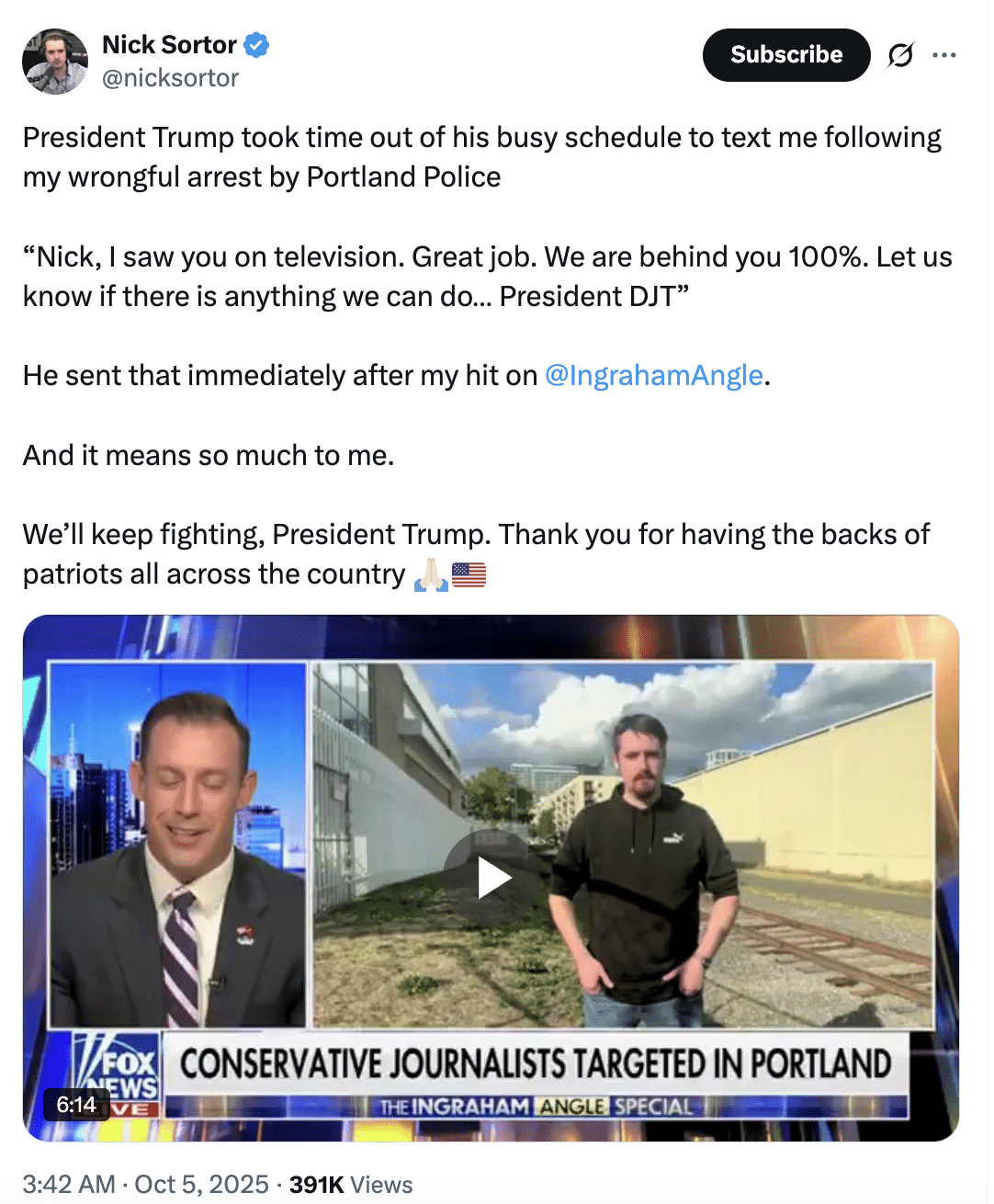
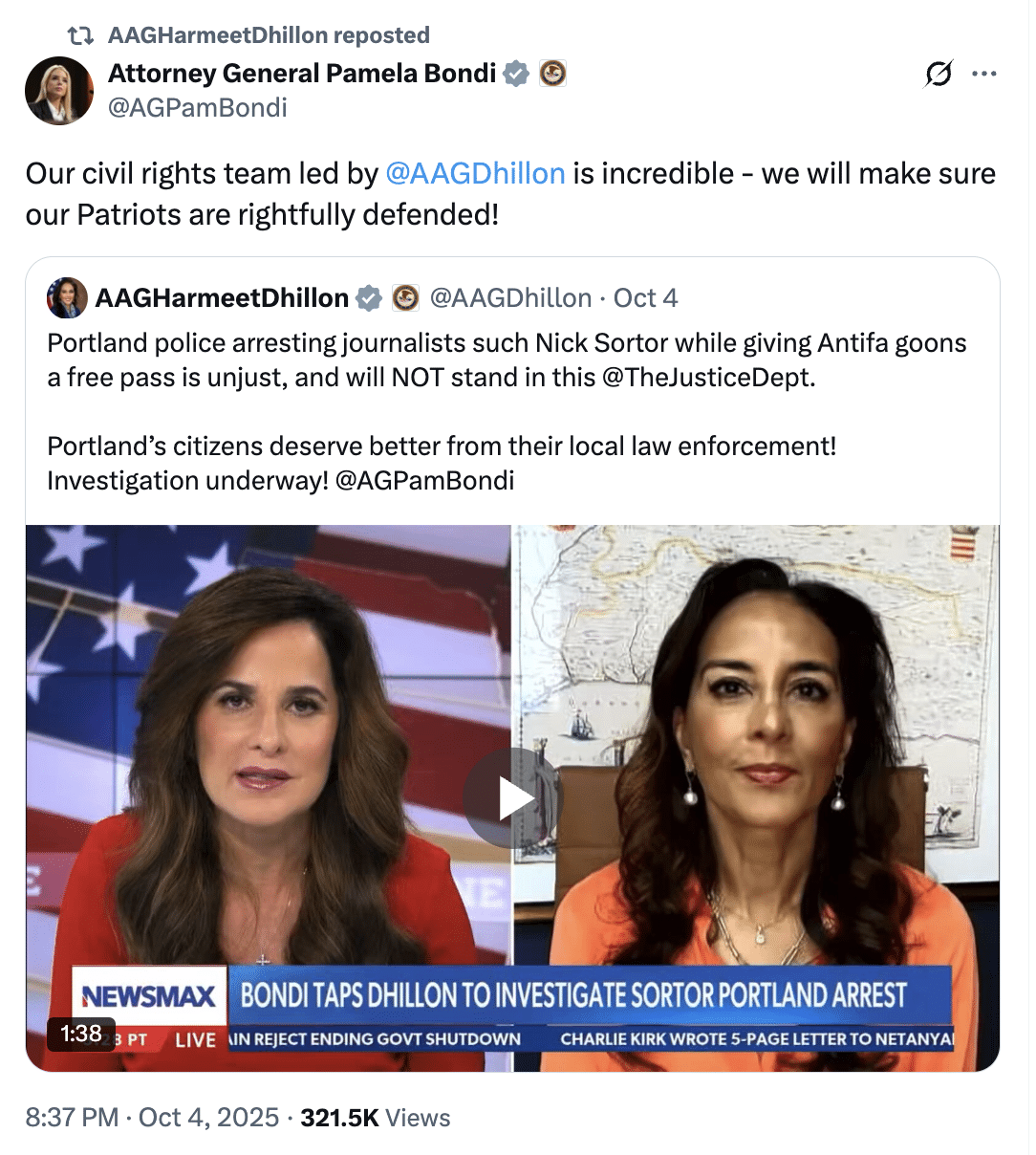
And yet the far right keeps churning out propaganda in hopes of justifying an invasion. Even as this hearing was going on, right wing provocateur Nick Sortor was whining that he had been arrested outside the ICE facility.

Not only did DHS get him released from Portland custody, but one after another top official decided they were going to investigate Portland for arresting an outside agitator.

Trump even took some time out to encourage the outside agitator.

There are multiple problems with this big rush to defend Sortor. Not only does Sortor have a history of doing this and ties to far right extremists, not only was the conflict caught on video showing him making physical contact first, not only has ICE elsewhere violently assaulted real journalists (meaning Civil Rights Division is selectively intervening), but according to the press release, Federal authorities started arresting people before Portland arrested Sortor.

PPB was monitoring the protest during the evening and observed some protest participants engaging in fights.

At about 8:09 p.m., PPB Dialogue Officers (DLOs) observed two men fighting near the ICE building driveway. The DLOs called in additional resources and officers were responding when the fight ended following one participant being knocked to the ground. He did not lose consciousness and never requested medical help. Both involved were detained by federal law enforcement and were later released. Neither party indicated they wanted to make a police report.

PPB continued to monitor the situation and responded after seeing additional fights break out. At about 11:16 p.m., RRT moved in and arrested three people were arrested and all booked into the Multnomah County Detention Center (MCDC) on charges of Disorderly Conduct in the Second Degree:

Angela Davis, 49, of Vernonia, Oregon

Nicholas Sortor, 27, of Washington, DC

Son Mi Yi, 43, of Portland

DOJ is saying that Portland can’t arrest people who travel across the country to spark unrest in Portland. And Sortor has been out since then trying to provoke violence.

When this goes to court — and undoubtedly it will in some form — DOJ will be stuck defending the premise that DOD has to invade Portland because right wingers with close ties to the President traveled across the country to stoke unrest.

And they did so in conjunction with an invasion premised on persistent false propaganda shown on Fox News.

Sunday, Trump was babbling some more about what’s going on in Portland, claiming that the reason Mayors don’t want the Guard is that they’re too terrified of … the inflated frog personas, I guess.

Kristi Noem dresses up a Russian useful idiot to produce propaganda about Chicago

Which leads us to Chicago.

I suggested, last week, that one reason Trump’s immigration invasions are so unpopular is they result in so many videos showing ICE butt cracks and beer bellies, poorly trained-men rolling around in a street like greased pigs as they try to arrest brown men. That negative spectacle, going viral, has drowned out the staged attempts to pitch the violence against brown people in eroticized terms.

Which is an important thing to remember when reviewing just the last few days of outrageous abuse: there is the abuse, there is the staged spectacle, and there is the effort (as with Nick Sortor) to use the resultant spectacle to provide a pretext to justify further invasion.

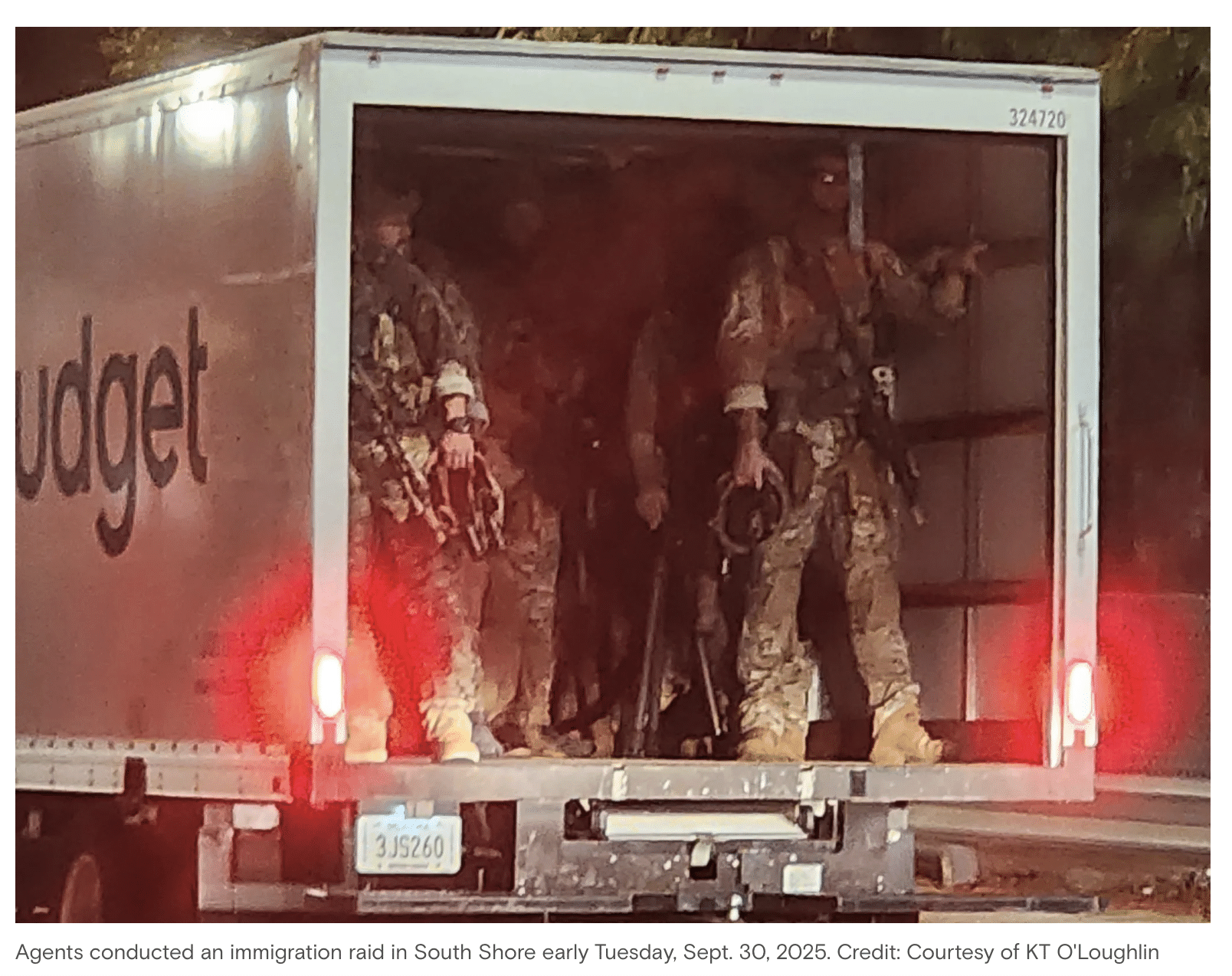
Consider that DHS produced a highly produced video of its assault on a South Shore apartment building last week, which may do more to explain the timing of the raid — which started at 1AM and thus necessitated strobe lighting — than any law enforcement purpose (to say nothing of the fact that judges ordinarily require warrants be executed after dawn). Since it was hours before even the US citizens detained in the raid got back into their apartments, there were few live videos of the raid — though one neighbor took a picture of Noem’s goons apparently traveling the same way the extremist group, Patriot Front, travels: in the back of a rental truck.

It wasn’t until after residents were able to return to their homes that they found that ICE had taken an already squalid place into a hell hole.

Dan Jones stood outside with police officers to file a report after his valuables — from his mattress and iPad down to his air fryer — were stolen after agents broke his door.

Jones slept at an aunt’s house following the raid and returned to find clothing and garbage that wasn’t his all over his apartment floor.

A small moving crew said they had been hired after the raid to clear out now-vacant units — but didn’t say by who. Doors were boarded up. In one room, there were zip ties and blood stains on the floor next to baby shoes. Flies swarmed around open fridges.

Water damage had caved in ceilings. Strollers and air conditioners and more things left behind blocked the middle of dark hallways. The lobby elevators were broken, with their buttons perpetually lit on the down arrow.

There was a strong odor everywhere.

Jones said the building’s “dirty” conditions predated the raid, but this was the worst he’d seen the place. It was the first of the month and his rent was due.

“It looks like hell,” Jones said. “ICE really just a gang.”

There’s reason to suspect that one beneficiary of this raid, like similar ones in Colorado targeted at apartments significantly rented by Venezuelans, is the slum landlord who had neglected the building.

As I noted, Illinois’ lawsuit against the Federal government focuses on how Noem and her chief goon, Greg Bovino, staged a number of other photo ops around the city, including the confrontation they staged with protestors.

I’ve also laid out the significant discrepancies in the claims surrounding CBP’s shooting of Marimar Martinez, discrepancies that could doom that prosecution even if the central allegation, that she rammed the CBP vehicle, were true (which her attorney contests).

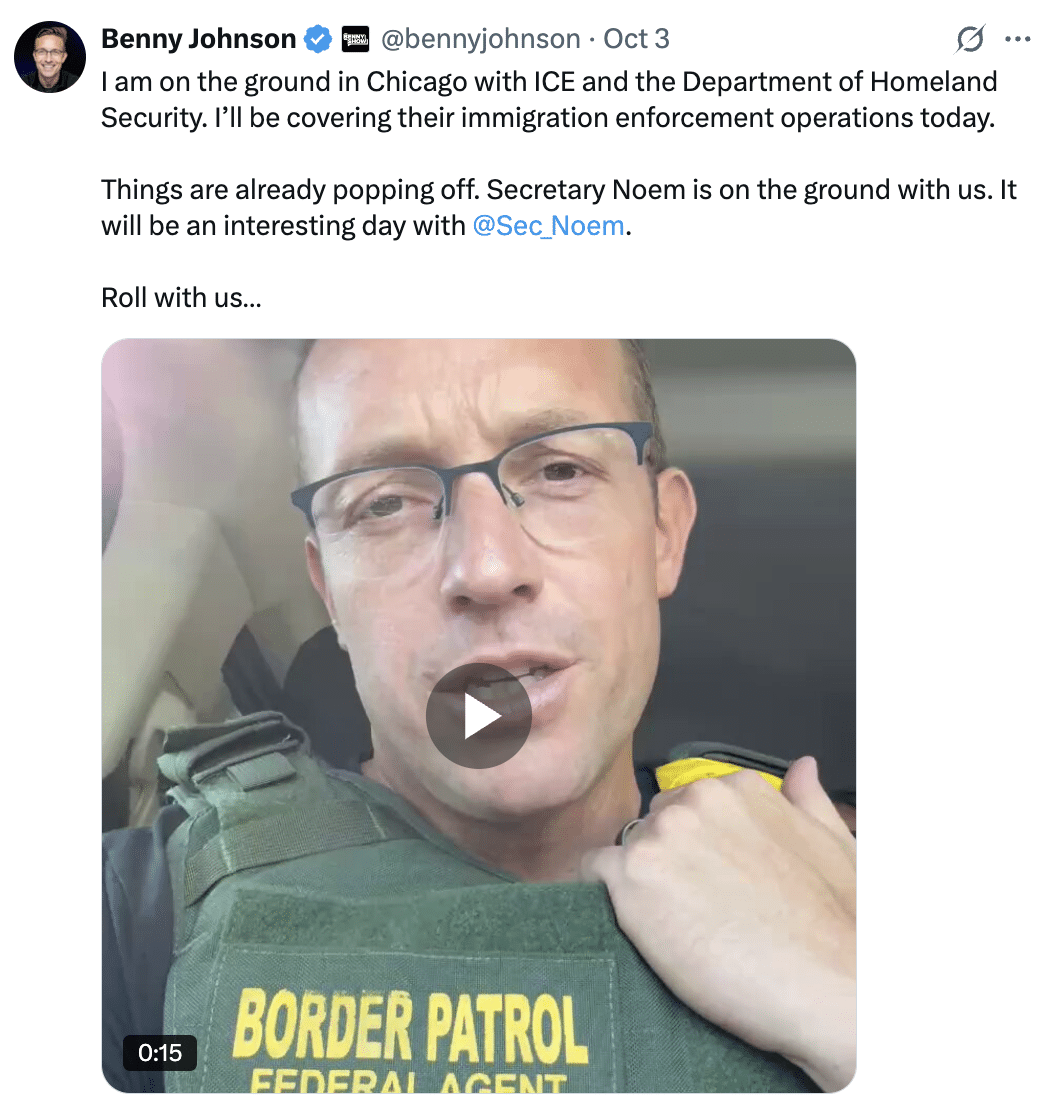
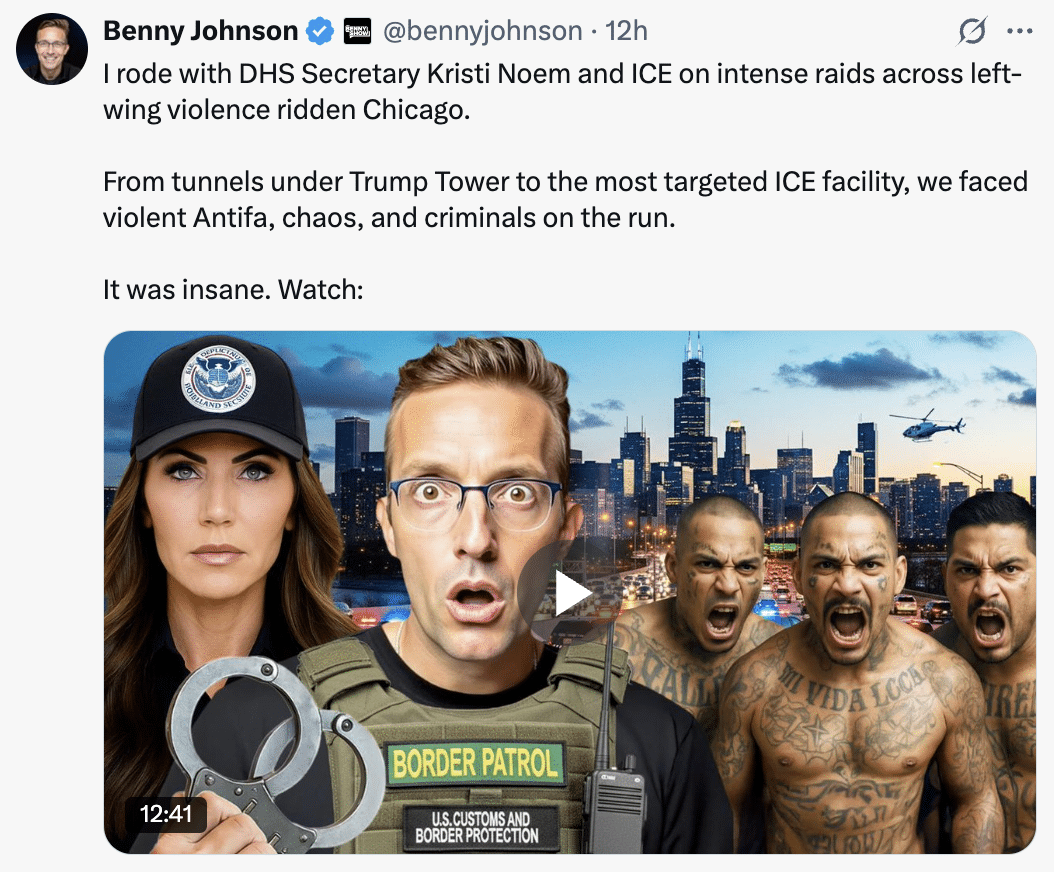
Where Noem’s urge to create propaganda may get her in trouble is how she invited Russia’s useful idiot, Benny Johnson, to tag along wearing Border Patrol armor.

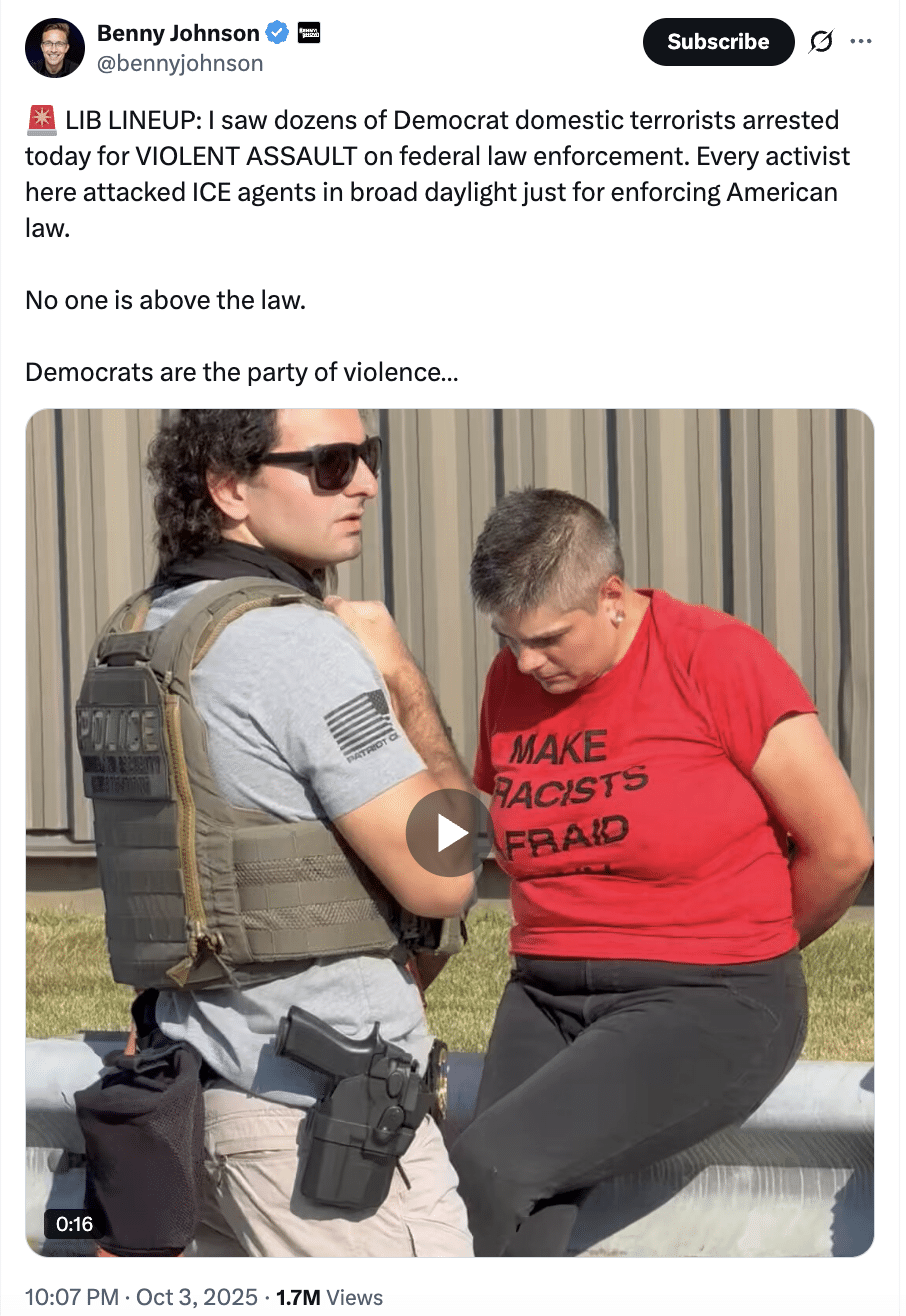
Among other things Benny did on his cosplay cop caper was to post a video of protestors as they were being arrested, claiming they were being arrested for “VIOLENT ASSAULT.”

Of the Federal charges filed since then, just one has been from Broadview (it was assault, but even that one sounds like someone charged for being pushed by the Feds). If, in fact, these people weren’t charged — much less with assault — this would be slander. Since he was dolled up as a “Border Patrol Federal Agent,” even if they were arrested, this will be a privacy violation that might endanger any charges the Feds tried to file.

Worse, Benny’s AI slop video from the cosplay should make it easy for Chicago to show that — as in Portland — Trump’s people are simply making (literal) shit up about Chicago.

In multiple states, Trump’s Administration is relying on provocateurs (in Benny’s case, once funded by the Russian government and still scrutinized for his unnatural YouTube growth) to spread outright slop claims to justify these invasions.

There’s so many ways this could backfire.

Kilmar Abrego gets Vindictive Prosecution discovery

Which brings us, after much delay, to the potential consequences for all this.

The other day, Judge Waverly Crenshaw granted Kilmar Abrego discovery associated with his motion for vindictive prosecution. He cited a range of public comments government officials made about the case. He focused closely on Todd Blanche’s admission that the government only started investigating Abrego after his habeas case got traction.

Most tellingly, Attorney General Bondi’s direct report, Deputy Attorney General Todd Blanche, linked Abrego’s criminal charges to Abrego’s civil lawsuit in Maryland. Strikingly, during a television interview Deputy Attorney General Blanche revealed that the government started “investigating” Abrego after “a judge in Maryland . . . questioned” the government’s decision, found that it “had no right to deport him,” and “accus[ed] [the government] of doing something wrong.” Kilmar Abrego Garcia was indicted on ‘very serious’ charges, US deputy attorney general says, Fox News (June 6, 2025), https://www.foxnews.com/video/6373969491112.

[snip]

Deputy Attorney General Blanche’s remarkable statements could directly establish that the motivations for Abrego’s criminal charges stem from his exercise of his constitutional and statutory rights to bring suit against the Executive Official Defendants, rather than a genuine desire to prosecute him for alleged criminal misconduct. 1

1 It may be that Deputy Attorney General Blanche’s opinion distressed former Chief of the Criminal Division of the U.S. Attorney’s Office in the Middle District of Tennessee, Ben Schrader. It is alleged that Mr. Schrader resigned on May 21, 2025—the day Abrego was indicted—because of what some have suggested were his “concerns that th[is] case was being pursed for political reasons.” Katherine Faulders et al., Kilmar Abrego Garcia Brought Back to US, Appears in Court on Charges of Smuggling Migrants, ABC News (June 6, 2025), https://abcnews.go.com/US/mistakenly-deported-kilmar-abrego-garcia-back-usface/story?id=121333122.

Judge Crenshaw suggested this list, from Abrego’s lawyers, would be a good starting point for discovery (though he said bullet e should be narrowed):

a. Material concerning the predication and reasons for opening the investigation that led to the indictment, including, but not limited to, communications between the Department of Justice (“DOJ”) and DHS, such as email, text messages, and other correspondence;

b. Communications among DOJ, DHS, the State Department, and/or the White House about the inception or progress of the investigation, such as email, text messages, and other correspondence;

c. Material concerning the decision made by the Federal Bureau of Investigation (“FBI”) and/or Homeland Security Investigations (“HSI”) in or around 2022 not to pursue any investigation or prosecution of the November 30, 2022 traffic stop;

d. Material concerning the government’s change in position and decision to prosecute this case;

e. Material concerning negotiations and the decision to return Mr. Abrego to the United States after he was removed from the United States to El Salvador in March of 2025, including, but not limited to, communications among DOJ, DHS, the State Department, the White House, and/or the government of El Salvador, such as email, text messages, and other correspondence;

f. Material concerning the departure of Ben Schrader, formerly the Chief of the Criminal Division of the U.S. Attorney’s Office in Nashville, Tennessee, whose resignation was reportedly prompted “by concerns” that the instant case “was being pursued for political reasons.”1 See, e.g., United States v. Adams, 870 F.2d 1140, 1146 (6th Cir. 1989) (allowing discovery in connection with vindictive prosecution claim); United States v. Fieger, No. 07-CR-20414, 2008 WL 205244, at *16 (E.D. Mich. Jan. 24, 2008), as amended (Feb. 1, 2008). [my emphasis]

Bullets b and f get you directly from decisions made in the White House and shared with Blanche to their effect on the AUSA who quit because of the way this went down — and it may well lead to a deposition of both Blanche and Schrader.

We’re in uncharted territory here. Even if DOJ doesn’t find a way to appeal this, there will be a heated fight over privileged communications (which will implicate Trump v. US when this inevitably gets to SCOTUS).

But this was the predictable outcome of a bunch of boneheaded things DHS and DOJ did back in April.

It’s also a measure of where all the things they’re doing right now could be headed … a few months down the road.

* The “do something bitch” comment is what a CBP officer said before shooting Marimar Martinez on Saturday in Chicago.

Update: Now Oregon’s GOP is making fabrications about what Portland looks like, based off old pictures of South America. And Broadview’s Mayor is claiming ICE made false 911 calls to their office.

Share this entry