DOJ’s Politically Illegitimate Basis for Political Illegitimacy in Nicolás Maduro Indictment
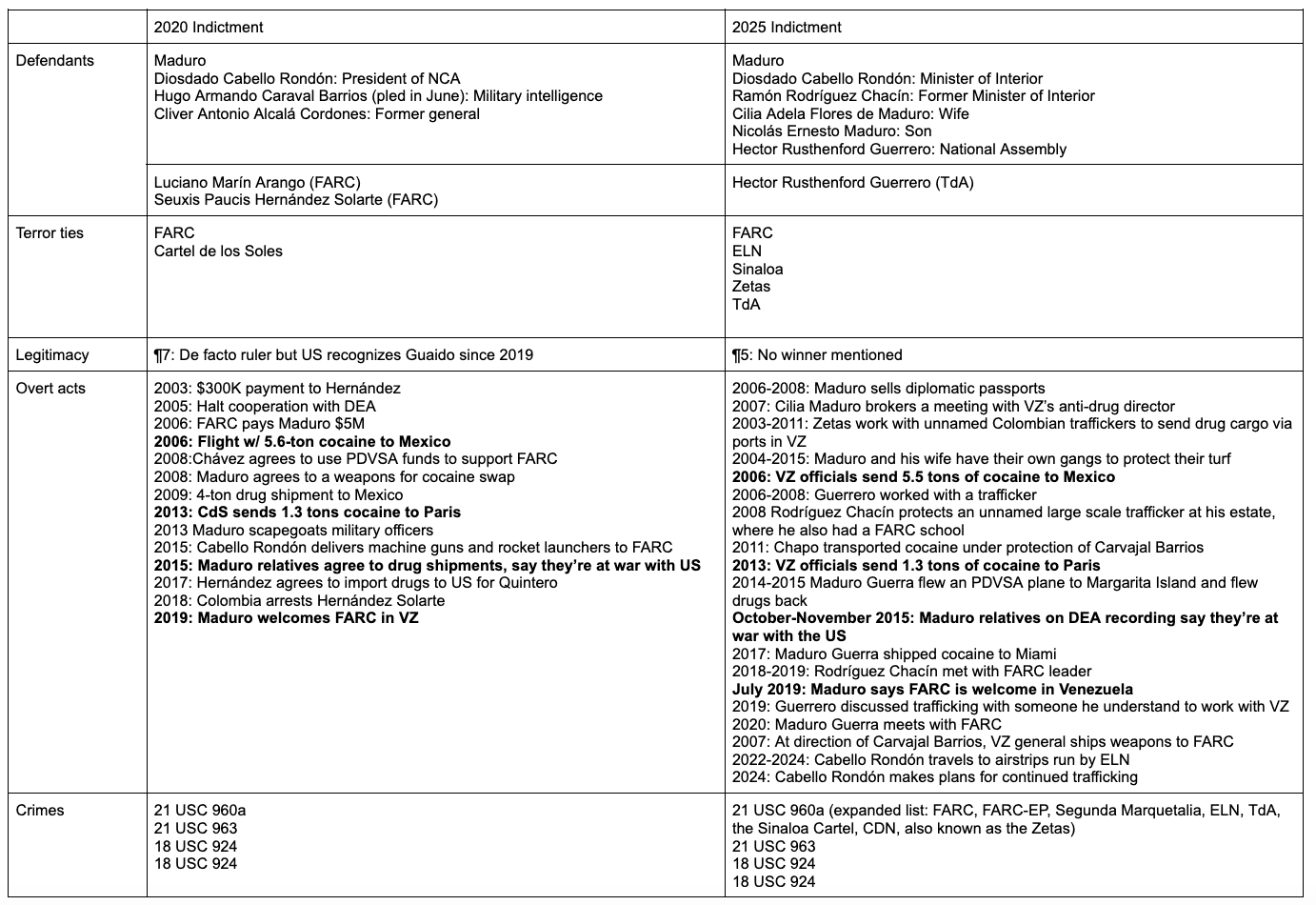
As I’ll explain below (and mapped in this table), the superseding indictment against Nicolás Maduro and his wife unsealed yesterday is a more political document than the one that first charged Maduro in 2020. One important difference lies in how DOJ attempted to claim Maduro is not the leader of Venezuela, which will be a key element required to overcome any immunity claim Maduro will surely invoke.
Before I explain the differences between these indictments, let me stress that both are real indictments, documenting decades of corruption and cooperation with drug traffickers and terrorists. Prosecutors worked hard to pull them together and investigators (in the US and around Latin America) and sources no doubt risked their lives to make it possible.
The charges remain the same as in 2020
Both indictments charge the same four crimes:
- Narco-Terrorism Conspiracy (21 USC 960a)
- Cocaine Importation Conspiracy (21 USC 963)
- Two counts of use of machine guns or destructive devices in furtherance of the conspiracies (18 USC 924)
The latter charges, charging Maduro for possessing machine guns, have attracted some mockery, including from me. DOJ is at the same time arguing that DC must allow semi-automatic weapons and at the same time charging a foreign leader with possessing machine guns. The charges are there (and were put there years ago) because they’re a way to get significant sentencing enhancements for other crimes. The presentencing memo for Hugo Armando Caraval-Barrio, who was charged with Maduro in 2020 and pled guilty in June, added so many sentencing enhancements they’re having a multi-day hearing later this month to fight about which ones apply. But given the evolution of gun prohibitions in the US since Bruen (issued in 2022), Maduro may try to challenge this charge, though Caraval-Barrio pled to those same charges in June.
DOJ includes Sinaloa, los Zetas, and Tred de Aragua for reasons that likely have to do with Stephen Miller’s fever dreams
In addition to adding overt acts that happened since 2020, the Narco-Terrorism Conspiracy charged in the newly unsealed indictment is interesting — and may have further significance — because it added several new cartels that have been deemed terrorist organizations last year. The 2020 indictment focused on FARC, the left wing Colombian terrorist organization that trafficked drugs, and Cartel de Soles (the vague name used for Maduro’s corruption). But in the last year, the Trump Administration has, for the first time (and controversially), designated drug cartels that engage in extreme violence as terrorist organizations. So the new indictment names not just FARC and ELN — Colombian terrorists whom Maduro gave shelter — but Sinaloa and the Zetas, along with Tren de Aragua.
24. It was a part and an object of the conspiracy that NICOLAS MADURO MOROS, DIOSDADO CABELLO RONDON, and RAMON RODRIGUEZ CHACIN, the defendants, and others known and unknown, would and did engage in conduct that would be punishable under Title 21 , United States Code, Section 841 ( a), if committed within the jurisdiction of the United States, to wit, the distribution of, and possession with the intent to distribute, five kilograms and more of mixtures and substances containing a detectable amount of cocaine, knowing and intending to provide, directly and indirectly, something of pecuniary value to a person and organization that has engaged and engages in terrorism and terrorist activity (as defined in Title 8, United States Code, Section 1182(a)(2)(B)), or terrorism (as defined in Title 22, United States Code, Section 2656f(d)(2)), to wit, the following organizations that have been designated by the United States Secretary of State as FTOs pursuant to Section 219 of the INA, during times relevant to this Superseding Indictment: FARC, FARC-EP, Segunda Marquetalia, ELN, TdA, the Sinaloa Cartel, CDN, also known as the Zetas, and each organization’s members, operatives, and associates, having knowledge that such organizations and persons have engaged and engage in terrorist activity and terrorism, in violation of Title 21, United States Code, Section 960a. [my emphasis]
This is one of the things I view as political. There’s far more substance behind the FARC allegations than the Sinaloa and Zetas ones. The Zetas allegation relies on the Zetas’, working with unnamed Columbian traffickers, use of Venezuelan ports from 2003 to 2011. The Sinaloa allegation relies on Caraval-Barrio’s protection of Chapo Guzmán in 2011. Both those allegations took place long before Marco Rubio included the Mexican cartels in his new designations. But by including them in this indictment, DOJ makes this application of such crimes applicable in Mexico, an ominous inclusion given Trump’s overt threats to pull the same kind of invasion in Mexico next.
The Tren de Aragua is likewise thin. In the 2020 indictment, two FARC leaders were included as co-conspirators, but that reflected a sustained relationship with Maduro as laid out in the overt acts. The TdA inclusion here relies on a similar move, including its leader, Hector Ruthsenford Guerrero Flores as a co-conspirator. But his inclusion relies on two overt acts that don’t involve Maduro: Guerrero’s actual trafficking with someone not alleged to be part of this conspiracy, and comments made in a Venezuelan prison in 2019. (These may be the comments that US intelligence services have deemed to be unreliable.)
f. Between approximately 2006 and 2008, HECTOR RUSTHENFORD GUERRERO FLORES, a/k/a “Nifio Guerrero,” the defendant, worked with one of the largest drug traffickers in Venezuela, Walid Makled. Members of the Venezuelan regime helped protect Makled’s cocaine shipments that were transported from San Fernando de Apure, Venezuela, to Valencia, Venezuela, and were then sent by plane from the Valencia international airport to Mexico and other locations in Central America for eventual distribution to the United States. Between in or about 2008 and in or about 2009, GUERRERO FLORES also provided another major Venezuelan drug trafficker with protection for cocaine shipments moving through Venezuela, including by providing armed men who carried, among other automatic weapons, AK47s, MP5s, and AR-15s, as well as grenades. At times, GUERRERO FLORES personally accompanied large cocaine loads as they were guarded by the teams of armed men, en route to airports or airstrips for transport north and eventual distribution to the United States. GUERRERO FLORES was paid a fee per kilogram of cocaine transported or received and he sometimes received an interest in portions of these massive cocaine shipments in lieu of payment. The traffickers that GUERRERO FLORES worked with moved thousands of kilograms per shipment, multiple times per month, resulting in the distribution of hundreds of tons of cocaine to the United States. In or about 2009, Makled was charged with narcotics offenses in this District and is a fugitive.
[snip]
o. In or about 2019, TdA’s leader, GUERRERO FLORES, discussed drug trafficking with an individual he understood to be working with the Venezuelan regime. Over multiple calls, GUERRERO FLORES offered to provide escort services for drug loads, explaining that GUERRERO FLORES and TdA had control of the coastlines of Venezuela’s Aragua State. GUERRERO FLORES, speaking from TdA’s base of operations in Tocor6n Prison, explained that TdA could handle the logistics of every aspect of the drug trade, including the use of storage compartments that GUERRERO FLORES called “cradles” located on a beach in Aragua State. In doing so, GUERRERO FLORES confirmed TdA’s ability to protect over one ton of cocaine.
That is, neither is TdA necessary to substantiate the narco-trafficking charges, which are well-substantiated based on protection of FARC, nor is the substance of TdA’s inclusion all that convincing.
At all.
But no doubt Stephen Miller will use this — a grand jury finding probable cause tying TdA to Maduro — to attempt to renew his Alien Enemies Act deportations.
Adding the family, leaving behind the key co-conspirator
On top of swapping FARC co-conspirators for a TdA one, the newly unsealed indictment adds Maduro’s wife and son as co-conspirators.
The inclusion of Maduro’s son is better substantiated. The indictment alleges that his plane was used to ship drugs, he shipped drugs to Miami, and he met with FARC (though neither he nor his mother are included in the narco-trafficking charge).
The inclusion of Cilia Maduro — who was shipped to SDNY along with her husband — rests on her allegedly accepting a bribe in 2007 to broker a meeting between a trafficker and Venezuela’s corrupt top anti-drug cop.
b. In approximately 2007, CILIA ADELA FLORES DE MADURO, the defendant, attended a meeting in which FLORES DE MADURO accepted hundreds of thousands of dollars in bribes to broker a meeting between a large-scale drug trafficker and the director of Venezuela’s National Anti-Drug Office, Nestor Reverol Torres. The drug trafficker later arranged to pay a monthly bribe to Reverol Torres, in addition to approximately $100,000 for each flight that was transporting cocaine to ensure the flight’s safe passage, a portion of which was then paid to FLORES DE MADURO. In or about 2015, Reverol Torres was charged with narcotics offenses in the Eastern District of New York and is a fugitive.
But prosecutors likely included Maduro’s family — and snatched Cilia along with her spouse — to acquire leverage against him.
One more point about alleged co-conspirators. In the wake of yesterday’s invasion, Diosdado Cabello Rondón, who is incorporated into the narco-trafficking charge and was already in 2020, was the first person to call for calm, calling the Americans terrorists.
At the crack of dawn, Diosdado Cabello, the regime’s second-in-command, appeared on state-run Venezolana de Televisión, clad in tactical vest and helmet and surrounded by members of the political police. Cabello called the U.S. attack “treacherous and vile” and urged his supporters “not to lose their composure, to avoid despair.” “Avoid situations that favor the invading enemy,” he said. Cabello questioned the role of “international organizations” in this crisis, accusing them of being “complicit in a massacre of civilians.” The leader addressed his men on camera with the two central slogans of the regime’s security forces: “Always loyal, never traitors” and “To doubt is treason.”
This analysis of the aftermath notes that you’d have to take out more of Maduro’s aides, including Cabello, to defeat his government.
For more than a decade, real power in Venezuela has been held by a small circle of senior officials. Analysts and officials say though that the system depends on a sprawling web of loyalists and security organs, fueled by corruption and surveillance.
Within the inner circle, a civilian-military balance reigns. Each member has their own interests and patronage networks. Currently Rodriguez and her brother represent the civilian side. Padrino and Cabello represent the military side.
This power structure makes dismantling Venezuela’s current government more complex than removing Maduro, according to interviews with current and former U.S. officials, Venezuelan and U.S. military analysts and security consultants to Venezuela’s opposition.
“You can remove as many pieces of the Venezuelan government as you like, but it would have to be multiple actors at different levels to move the needle,” said a former U.S. official involved in criminal investigations in Venezuela.
A big question mark surrounds Cabello, who exerts influence over the country’s military and civilian counterintelligence agencies, which conduct widespread domestic espionage.
“The focus is now on Diosdado Cabello,” said Venezuelan military strategist Jose Garcia. “Because he is the most ideological, violent and unpredictable element of the Venezuelan regime.”
Donald Trump conducted a months-long operation to carry out an arrest, he claims. But somehow they left behind someone alleged to be just as culpable in the headline charges of the indictment, Cabello.
Disavowing democracy in attempting to negate Maduro’s immunity claim
Yesterday, Trump and Marco Rubio claimed that Maduro’s Vice President, Delcy Rodriguez, would do as she was told. Then she went on TV and said Maduro was still the president and Venezuela would never again be the colony of an empire. It’s unclear whether she’s misleading Marco Rubio or the Venezuelan people, or simply trying to find middle ground.
But her claim to authority only comes through Maduro.
And that’s important because, as Oona Hathaway explained this in an interview with Isaac Chotiner, whether or not Maduro is and was a head of state is central to what will surely be an attempt to claim he is immune from all this.
What do you mean, exactly, about his “seizure and indictment”? Venezuela had an election. It was not a free election. He declared himself President, and he’s broadly recognized as the President of Venezuela, but, again, he was not freely elected by the people of Venezuela. That could justify his indictment in an American court?
I should back up. As part of this military operation, at least one of the key goals seems to have been the capture of Maduro and his wife, who have been indicted for criminal charges in the Southern District of New York. The only way they can do that is if they’re claiming that he’s not a head of state, because heads of state get immunity and heads of state are not subject to criminal prosecution in the domestic courts of other states. That’s just a basic rule of international law. The United States has long recognized it.
So you were not saying that the fact that he stole an election per se means you can grab him and try him in an American court but, rather, that if he were not a head of state, that would at least allow for trying him in an American court, which normally would not be the case?
Right. So if he’s not actually a head of state, then head-of-state immunity doesn’t apply. And it’s connected to this broader question of the use of military force in that it may be that they would make a claim—although I haven’t yet seen this—that because he’s not the legitimate head of state that somehow they have a legal authority to use force to grab him. But, again, the two don’t connect. So the problem is that merely saying that he’s not head of state doesn’t then justify the use of military force in Venezuela.
[snip]
So if Maduro goes to trial in an American court, is this going to be a contested legal issue about whether he can even be tried based on whether he is the head of state of Venezuela? Is that something that American courts are going to have to weigh in on?
Yes, it is something that the American courts are going to have to weigh in on. It definitely is the case that his lawyers will make the argument that he’s a sitting head of state at the time that he was seized and that he remains the sitting head of state and therefore, under international law and under U.S. law, he should be given immunity, which means that he’s not subject to the jurisdiction of U.S. courts and can’t be criminally charged. This has come up once before with the criminal indictment of Manuel Noriega, the former leader of Panama, when the U.S. invaded Panama in 1989 and seized Noriega and then brought him back to the United States and indicted him for drug smuggling and money laundering.
Back then, Noriega argued that he enjoyed head-of-state immunity, and the executive branch argued that he didn’t because the United States had not recognized him as a legitimate leader of Panama. That gives us a hint as to what is likely to happen in this case. My guess is that the United States will argue that it’s never recognized Maduro as a legitimate leader of Venezuela and therefore he doesn’t receive immunity. And the courts are going to be in the position of having to decide whether they defer to the executive branch’s determination that he’s not head of state or whether they make an independent assessment of his legitimacy as a leader of Venezuela.
How did the Noriega case play out?
In the Noriega case, the courts deferred to the executive branch. They said they were going to accept that the executive branch said that he’s not a constitutional head of state, and therefore he can, in fact, be prosecuted.
Seems quite possible they will do so again now.
It seems likely they’re going to do the same thing. I mean, this is a weaker argument on the part of the executive branch.
Both indictments attempt to deal with this issue. The 2020 one does so by pointing to the US’ 2019 endorsement of Juan Guaidó.
In or about 2018, MADURO MOROS declared victory in a presidential election in Venezuela. In or about 2019, the National Assembly of Venezuela invoked the Venezuelan constitution and declared that MADURO MOROS had usurped power and was not the president of Venezuela. Since in or about 2019, more than 50 countries, including the United States, have refused to recognize MADURO MOROS as Venezuela’s head of state and instead recognized Juan Guaidó as the interim president of Venezuela. In or about January 2020, the United States Department of State certified the authority of Guaidó, as the interim president of Venezuela, to receive and control property in accounts at the United States Federal Reserve maintained by the Venezuelan government and the Central Bank of Venezuela.
The Trump Administration went all-in on declaring Guaidó interim president and … that went nowhere.
This equivalent paragraph in the newly unsealed indictment doesn’t say who runs Venezuela.
5. NICOLAS MADURO MOROS, the defendant, a Venezuelan citizen, was previously the President of Venezuela, and is now, having remained in power despite losses in recent elections, the de facto but illegitimate ruler of the country. MADURO MOROS also previously held a seat in Venezuela’s National Assembly between in or about 2000 and in or about 2006, acted as the Venezuelan Minister of Foreign Affairs between in or about 2006 and in or about 2013, and acted as the Vice President of Venezuela in or about 2013. MADURO MOROS succeeded to the Venezuelan presidency after former President Hugo Chavez died in or about 2013 and, during MADURO MOROS’s own presidency, continued to participate in cocaine trafficking with drug dealers and narco-terrorist groups. In or about 2018, MADURO MOROS declared victory in a disputed and internationally condemned presidential election in Venezuela. In or about 2019, Venezuela’s National Assembly invoked the Venezuelan constitution and declared that MADURO MOROS had usurped power and was not the legitimate President of Venezuela. Nonetheless, MADURO MOROS continued to exercise the powers of the Venezuelan presidency, causing more than 50 countries, including the United States, to refuse to recognize MADURO MOROS as Venezuela’s head of state. In or about 2024, Venezuela held another presidential election that was again widely criticized by the international community, in which MADURO MOROS declared himself the winner despite widespread condemnation.
Most independent observers believe Edmundo González won last year’s election. María Corina Machado just won a Nobel Prize as the leader of the opposition (though she claims González is the rightly elected President).
Yet not only doesn’t this indictment name either of them, yesterday Trump said of Machado, “She’s a very nice woman, but she doesn’t have the respect.”
I’ll leave it to experts like Hathaway to unpack whether Trump’s explicit denial of those with a real democratic claim to power has any impact on an immunity claim that Maduro is sure to mount. Her observation that SCOTUS, especially this SCOTUS, will likely defer to the Administration.
I’m simply observing that this indictment was designed, from the start, to rely on illegitimate claims about the lawful president in Venezuela. It had puppet power built into it.
Again, none of this says that the guts of this indictment are suspect. They’re not.
But it’s the packaging of it — a shift that occurred since Trump last indicted Maduro in 2020 — that could have significantly broader repercussions.