SignalGate: “This Chat’s Kinda Dead”

DOD IG has released the unclassified version of the report confirming what was clear months ago: Whiskey Pete Hegseth has no business leading DOD.

He was wildly uncooperative with the investigation, refusing to be interviewed, refusing to let DOD inspect his phone, refusing to turn over other threads.

But Whiskey Pete may not look quite as stupid as JD Vance.

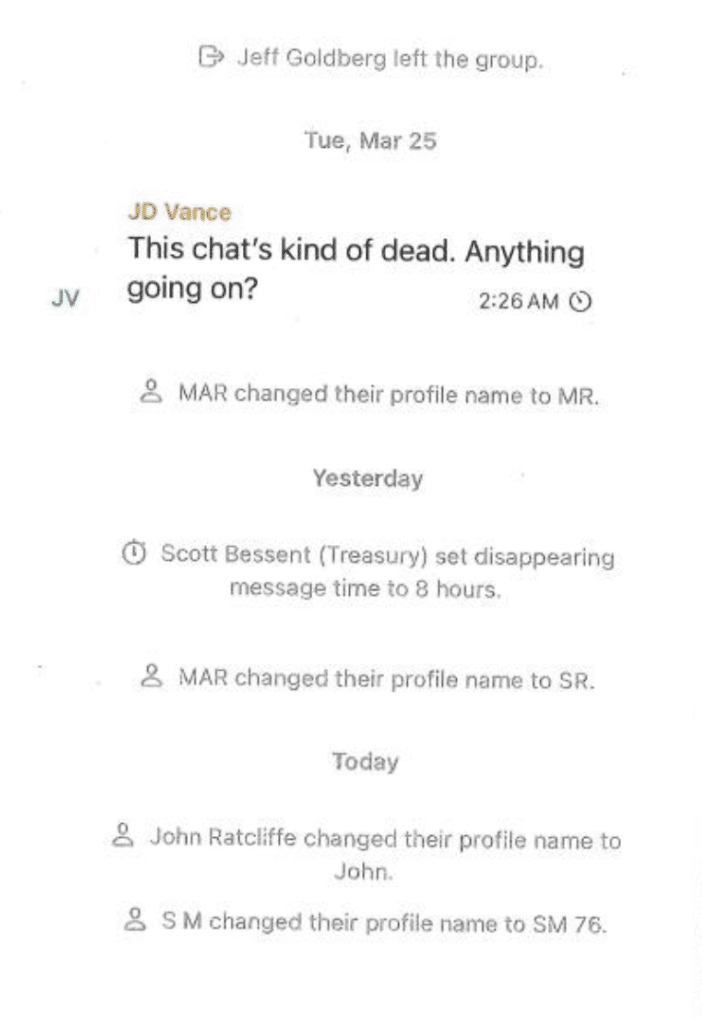
You see, Whiskey Pete turned over the Signal chat that was left on his phone after all the autodeleting these scofflaws had been doing. Most of the thread was gone. But there was a single text that post-dated Jeffrey Goldberg’s departure from the list, something the Deputy General Counsel used to suggest the Atlantic thread might not be reliable (a claim DOD IG refused to put in the body of the report because, some people still refuse bullshit).

After Jeff Goldberg left the group, JD Vance said, “This chat’s kind of dead. Anything going on?”

One after another participant on the thread changed their ID, perhaps in hopes … I don’t know what they fuck they were thinking.

These are dumb people.

No one more so, though, than JD.

Share this entry

The Hacking Hole Where John Bolton Should Be

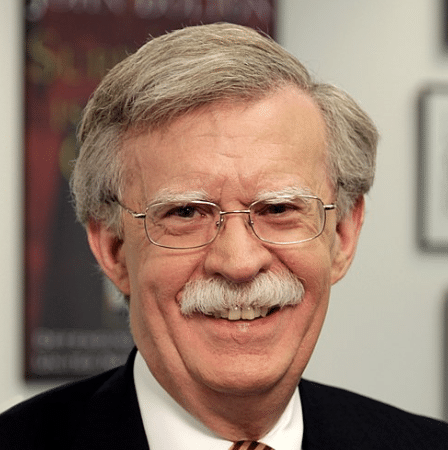
Unless DOJ disguised him, the hack of John Bolton described in his indictment didn’t show up in the Iranian hack-and-leak indictment. It should have. After listing the 2022 attempt to assassinate Bolton (where he is described as “a former US National Security Advisor,” the indictment lists a slew of people that Iran IRGC attempted to hack (starting in 2020) and (starting in 2021) nine people it succeeded in hacking before it hacked Roger Stone and four other Trump flunkies.

Bolton should have, could have, been included along with those nine people.

As the (nifty color-coded) timeline below makes clear, Bolton told the FBI about the hack of him, on July 6, 2021, just as the Iranian hackers were setting up infrastructure to hack a set of people that include those, like Bolton, who played a role in the Qasem Soleimani assassination and Trump’s hardline first term approach with Iran.

To be sure, there are potentially good reasons why Bolton is not in there. There’s a sealed notice of related case in the Bolton docket (at docket entry 6), which could reflect charges against the people who hacked him, charges that might have been filed shortly after he alerted the FBI about the hack. Prosecutors could have left Bolton out to obscure that he told the FBI about the hack (and that therefore the FBI had been working backwards from that ever since, which is consistent with the timeline). Prosecutors could have left Bolton out because the criminal investigation into him remained open.

All plausible reasons to leave him out.

But when you put the hack and assassination targeting of Bolton on the same timeline as the hack-and-leak targeting first fellow Iran hawks and then the Trump campaign, as well as the second alleged assassination attempt by Asif Merchant, all presumed to be IRGC, it raises further questions.

First, one reason I was interested in Merchant’s disclosure yesterday that he was under surveillance from the moment he arrived in the US in April 2024 is because it suggests US spies were already well aware of the efforts to retaliate for the Soleimani killing. Indeed, the timeline explains how the FBI was magically able to get CHSes in both the Shahram Poursafi and the Asif Merchant attempt to hire hit squads to target Bolton and others: the FBI identified those people via those intercepts and flipped them early on in the plot.

It does raise questions about whether the FBI also knew of the hack-and-leak targeting Bolton in advance. The FBI would have been tracking the IRGC closely after their 2020 effort to attack Democrats under the guise of the Proud Boys (an earlier plot that makes the targeting of Proud Boy ally Roger Stone more interesting).

There is some separation between these two plots. While Poursafi eventually had access to non-public intelligence targeting Bolton, he didn’t even know Bolton’s home address at first, which he would have known if he had the emails stolen from Bolton available to him. But the hack-and-leak indictment, at least, lists as one of the goals of the hacking campaign, “to advance the IRGC’s malign activities, including ongoing efforts to avenge the death of Qasem Soleimani,” and the first hack included, of someone at State who led the Abraham Accords, implies that’s how they used, “travel, lodging and other information” from someone who was “a senior U.S. Department of State official at the time of Qasem Soleimani’s death and therefore of interest to the IRGC.” Near the tail end of the Poursafi complaint, so just weeks before the hack of that victim, Poursafi turned to another target.

But that’s the other reason this timeline is of such interest. The progression with Bolton went Hack > Extortion > Assassination Attempt. Bolton could simply have cooperated with the IRGC, but instead he went to the FBI (which has now led to his prosecution).

Trump, however did not.

It was over two months between the time hackers got into Roger Stone’s Hotmail account in May 2024 and the time the hack became public. In July, when they first became aware of the hack, the campaign affirmatively decided not to report it to the FBI.

Trump’s mistrust of federal agencies has complicated the investigation into Iran’s cyberattack on his campaign. When a technology firm first discovered the breach, campaign aides huddled to discuss what they should do. After hours of discussions in July, they decided they trusted the software experts to handle the matter and did not call the FBI. Co-campaign manager Susie Wiles, whose email account was targeted, was among those who questioned whether they could trust the Justice Department. The fears centered on giving federal officials access to campaign email servers and whether they would leak information out publicly.

As I noted at the time, Trump made that decision after relentlessly (and falsely) accusing the FBI of failing to get the server from the DNC hack. The decision was understandable (once you account for Trump’s venality and paranoia), because according to the initial reports, the hackers claim to have gotten information on Trump’s legal cases, not just his campaign.

The sender would not speak on the telephone with a Post reporter but indicated they had access to additional information, including internal campaign emails and documents related to Trump’s court cases.

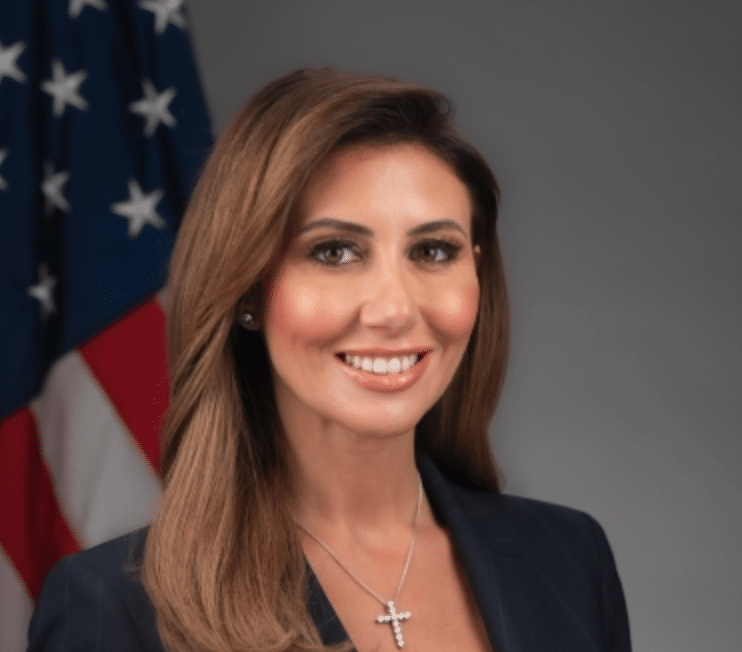
And one reason that’s interesting is because — as Reuters disclosed only this summer — the lawyer targeted in the attack was Lindsey Halligan, who had no public role on the campaign but who did represent Trump on the stolen documents case.

In online chats with Reuters on Sunday and Monday, the hackers, who go by the pseudonym Robert, said they had roughly 100 gigabytes of emails from the accounts of White House Chief of Staff Susie Wiles, Trump lawyer Lindsey Halligan, Trump adviser Roger Stone and porn star-turned-Trump antagonist Stormy Daniels.

Which brings me back to Merchant, to the delay in turning over his own conversations until October 28.

Two public things might explain that delay (there are no doubt a bunch of secret things that could too): The conviction of Ryan Routh, who did have Iranian ties, though no Iranian role in his assassination attempt was publicly disclosed, and the indictment of Bolton, which disclosed that Bolton alerted the FBI to this hack back in 2021, just months before the FBI would preempt an assassination effort targeting Bolton as well.

The FBI took far greater efforts to rein in any publication of the materials stolen from Trump’s people than they ever have on another leak save WikiLeaks’ biggest document dumps. I can’t help but wonder whether there’s more about the Trump hack we weren’t told.

Timeline

December 19, 2018: Hackers establish account using Israeli politician’s name.

April 15, 2019: IRGC designated as FTO.

January 3, 2020: Trump kills Qasem Soleimani.

April 11, 2020: Hackers get an account in the name of a SCOTUS spouse.

October 22, 2020: Treasury sanctions IRGC for tampering in 2020 election.

June 16, 2021: Bolton and DOJ enter settlement on book.

July 6, 2021: Bolton representative tells FBI Iran has hacked Bolton.

July 7, 2021: Hackers register fake domain mailerdaemon.online.

July 25, 2021: Hacker threatens to release Bolton materials.

I do not think you would be interested in the FBI being aware of the leaked content of John’s email (some of which have been attached), especially after the recent acquittal. 

This could be the biggest scandal since Hillary’s emails were leaked, but this time on the GOP side!

Contact me before it’s too late…

July 28, 2021: Bolton representative tells FBI about threat.

July 29, 2021: Bolton rep tells FBI he would delete account.

August 5, 2021: Iran threatens Bolton again.

OK John … As you want (apparently), we’ll disseminate the expurgated sections of your book by reference to your leaked email…

October 22, 2021: Shahram Poursafi asks Individual A to photograph Bolton. Individual A suggests CHS.

November 9, 2021: Hackers register fake domain mailer-daemon.live. CHS contacts Poursafi; Poursafi asks if he could hire someone to “eliminate someone.”

November 14: Poursafi tells CHS he doesn’t need pictures anymore. After searching for it online, Poursafi provides Bolton’s DC office address with name of scheduling assistant.

November 18: Poursafi note with Bolton’s name, website, social media handle, and former title.

November 19: CHS asks for home address and asks how to do it.

November 21: Poursafi ups the payment to $300,000.

November 23: CHS tells Poursafi he traveled from Texas to DC; Poursafi still did not have home address, but that Bolton walked or was driven to work.

December 7, 2021: Poursafi says because of a recent failed operation, Iran did not approve payment.

December 10, 2021: Poursafi told the CHS that Bolton didn’t go outside often.

December 12, 2021: Hackers register tinyurl.ink.

December 14, 2021: Hackers create persona based on DC think tank employee and phish State employee (Victim 1). 

December 16, 2021: Poursafi asked CHS to refer to Bolton by name “Benham.”

December 20, 2021: With Bolton’s consent, CHS sent pictures of Bolton leaving his office.

December 22, 2021: Poursafi sends picture of cash he claims is for CHS.

January 3, 2022: Iranian President Ebrahim Raisi says Trump and other high ranking Trump officials need to face trial for Soleimani killing. Poursafi tells CHS the murder was not timed to coincide with anniversary of Soleimani death. Poursafi says he has a source who says Bolton is at home.

January 5, 2022: CHS tells Poursafi he would do the job on January 16 or 17.

January 7, 2022: IRGC head Esmail Ghani promises revenge.

January 10, 2022: CHS asks if Ghani’s speech was a reference to this job.

January 15, 2022: CHS claims to have three vans. Poursafi warns not to talk operational details on phone, instructs CHS to crush phone and/or change Poursafi contact to “Mark” in it.

January 18, 2022: CHS sent Poursafi public information stating that Bolton might be traveling; Poursafi said that Bolton was not. “The information does not appear to have been publicly available. POURSAFI did not specify whether his source was a person conducting surveillance, a cyber intrusion, or another type of source.”

January 20, 2022: Poursafi told CHS Bolton did not have a body guard, had not yet left town.

January 28, 2022: Poursafi instructs CHS to get surveillance cameras for Bolton’s home and office.

January 29, 2022: Poursafi instructs CHS to restore social media account.

February 1, 2022: Poursafi told CHS the area around Bolton’s home was clear.

April 13, 2022: Poursafi pushes CHS to do a second job.

April 28, 2022: Poursafi told CHS to finish the second job in six days.

April 30, 2022: Hackers create another persona, persona 3.

May 9, 2022: Jalili accesses persona 3 account, other hackers arrive in office, send test message to book author.

May 31, 2022: Hackers register mailer-daemon.me.

June 18, 2022: Hackers create persona 4, phish victim 1.

August 2, 2022: Hackers create spoof of think tank, with two more personas.

August 5, 2022: Shahram Poursafi complaint.

August 6, 2022: Hackers start stealing from victim 1, including his passport.

Early August 2022: Hackers create persona based on DC journalist/think tanker (victim 4).

August 23, 2022: Victim 4 responds to phish.

August 29, 2022 through October 5, 2022: Hackers hack former Homeland Security Advisor (Victim 5).

October 4, 2022: Hackers pose as assistant to Victim 1 to contact peace organization employee (Victim 2), using stolen passport and get Victim 2 to buy business class ticket for Victim 1.

October 26, 2022: Hackers used Victim 1 passport to query about UAE conference.

November 23, 2022: Hackers create persona based on UAE embassy employee in DC, then use account to invite Victim 1, a former senior CIA person (Victim 6), a former US Ambassador to Israel (Victim 7), and a former Deputy CIA Director (Victim 8) as well as other targeted persons to a party at UAE embassy.

December 20, 2022 to January 23, 2022: Hackers compromise Victim 6’s personal email.

January 16, 2023: Hackers create encrypted app account in the name of DC think tank employee and phish Iranian Human Rights worker (Victim 9).

April 2024: Hackers try to phish Victim 5.

April 13, 2024: Merchant arrives in Houston.

April 22, 2024: Merchant pitches CHS on business.

May 23, 2024: Hackers attempt to log into Roger Stone’s account.

May 24 ,2024: Hackers use recovery code to access Stone’s account.

June 3-4, 2024: Merchant presents plan.

June 10, 2024: Merchant and CHS meet fake hitmen.

June 12, 2024: Hackers access Stone’s account and access campaign official (Victim 11).

June 13, 2024: Merchant establishes code.

June 15, 2024: Hackers use Stone’s account to attempt to phish Victim 13 (Susie Wiles?).

June 18, 2024: Merchant arranges payment with US-based associate.

June 20, 2024: Hackers hack a second Stone account.

June 21, 2024: Via WhatsApp Merchant’s cousin arranges payment.

June 27, 2024: Hackers send Trump debate prep to two people on Biden’s campaign; neither responded.

July 3, 2024: Hackers send Trump info to another Biden associate; that person did not respond.

July 12, 2024: Merchant arrest.

July 20, 2024: Hackers use 2FA hack to access Trump lawyer [Lindsey Halligan?], Victim 12.

July 22, 2024: Hackers started pitching content to journalists, including by pitching one journalist on things campaign official said to Susie Wiles about that journalist’s reporting.

August 9, 2024: Microsoft report on Iran hack.

August 10, 2024: Politico reports hack; WaPo follows.

August 13, 2024: Hackers ousted from Victim 11 account and Victim 12 account.

August 14, 2024: Google report on Iran hack.

August 31, 2024: Hackers pitch more journalists (including me).

September 24, 2024: Iran hack-and-leak indictment.

October 2, 2024: FISA notice in Merchant prosecution.

December 20, 2024: Initial CIPA request in Merchant prosecution.

July 1, 2025: Hackers attempt to sell Susie Wiles, Lindsey Halligan, Stone, and Stormy Daniel emails.

July 11, 2025: CIPA filing in Merchant prosecution.

August 11, 2025: CIPA meeting in Merchant prosecution.

September 23, 2025: Ryan Routh guilty verdict.

October 18, 2025: Bolton indicted.

October 28, 2025: Delayed discovery provided in Merchant prosecution.

November 12, 2025: Ex parte communication in Merchant prosecution.


Purple: Shahram Poursafi complaint

Blue: Iran hack-and-leak indictment

Pink: Asif Merchant complaint

Green: Bolton prosecution

 

Share this entry

Asif Merchant Says EDNY Screwed Up Its Intercepts

Asif Merchant wants EDNY to provide all the spying the FBI did targeting him — or at least the spying that they say matches the calls he made while they were surveilling him.

As you’ll recall, Merchant is the Pakistani guy that EDNY arrested in July 2024 for allegedly soliciting someone to kill political targets, possibly including Donald Trump. Since then, Merchant has been sitting in prison, under communication restrictions, awaiting trial, which is currently scheduled for February 23, 2026. On October 2, 2024, DOJ informed Merchant they used FISA to find him. Just over a year ago, on December 20, 2024, DOJ kicked off the Classified Information Procedures Act (CIPA) process. It filed a CIPA Section 4 motion (where the government asks to withhold certain materials that aren’t relevant or helpful to the defense) on July 11, and met with Judge Eric Komitee about it on August 11, after which point Komitee ordered the government to provide the materials they had discussed with the Court Information Security Officer.

In a letter asking the judge to intervene in a discovery dispute, Merchant’s lawyers reveal that the initial story DOJ told — that the guy Merchant asked to help him find a hit squad simply went to the FBI which is where the FBI first learned of the plot — is inaccurate. In fact, Merchant was under FISA surveillance even before he arrived in the United States in April 2024 and he was closely surveilled the entire time he was in the US.

Discovery has revealed that Asif was under investigation before he arrived in the United States, and he was under surveillance from the moment he arrived in this country. In addition, Asif was the subject of electronic surveillance under the Foreign Intelligence Surveillance Act (“FISA”). (See Notice of Intent to Use ForeignIntelligence Surveillance Act, Docket Entry No. 20). As a result, the government is in possession of his communications which it obtained through this electronic surveillance. In addition, Asif was also under surveillance by teams of agents. The government produced reports from these surveillance teams, which indicate that Asif was constantly speaking on his phone. In addition, Asif was also under surveillance by teams of agents. The government produced reports from these surveillance teams, which indicate that Asif was constantly speaking on his phone. The government also set-up a hidden camera in a hotel room where he stayed for a number of days, which also indicates that Asif made a number of calls on his cellphone (though the calls can be difficult to hear). Both the surveillance reports and the hidden camera cover only a portion of the time between Asif’s entry into the United States and his arrest. 

On November 8, 2024, the government produced five recordings of Asif’s intercepted telephone calls. On October 28, 2025,1 Defendant received sixty-four additional audio-recordings of Asif’s telephone calls from the government. These sixty-nine recordings, however, do not match up with the phone calls noted in the surveillance reports. Moreover, given the frequency with which Asif used his phone while under surveillance and while his phone was subject to monitoring (as can be observed on the surveillance videos produced by the government, for example), the government is likely in possession of many additional recordings that have not been produced. In addition to the sixty-four recordings, the October 21, 2025, production included a number of FBI reports that were redacted.

1 The government’s cover-letter is dated October 21, 2025. (See Docket Entry No.60).

Among the many concerns Merchant’s lawyers raised was why they didn’t get this discovery until October 28 (with a letter dated October 21).

During the November 25, 2025, meet and confer, the Defense (1) expressed concerns about the timing of the October 28, 2025, production and asked why the government had not produced the recordings at an earlier date, since they appear to have been in the government’s possession throughout the pendency of this case;

But his attorneys are also asking for all the intercepts of Merchant, particularly those that match with the surveillance of him.

Both the surveillance reports and the camera recording indicate that he used his cellphone constantly. The recordings produced by the government, however, do not match the communications which occurred during the surveillance. In other words, many more recordings of Asif should exist that correspond to telephone calls noted in the reports or indicated by the footage. Second, the additional recordings are material. Asif is accused of coordinating anti-American activity and assassinations on behalf of a foreign government over the course of the approximately three months he was in the United States. The content of the recordings is relevant to show his actual activity during that time period, and the government’s refusal to produce the recordings implies that these communications do not constitute evidence of the alleged plot. On the other hand, the additional recordings would show him engaging in activity and discussing matters unrelated to the allegations in this case.

Probably, these problems simply reflect a delayed CIPA decision that they had to share the intercepts and incompetence, possibly arising from the competence drain under Trump.

But the revelation that the FBI was watching Merchant when he arrive in April 2024 is interesting for a slew of reasons, which I’ll return to.

Share this entry

Alina Habba: A Parking Garage Lawyer with $1 Million in Sanction Penalties

In the first appellate court decision on Donald Trump’s persistent effort to put Insurance Lawyers, Election Deniers, and other sundry actors play-acting as US Attorneys, the Third Circuit has unanimously ruled that Alina Habba really is nothing more than a Parking Garage lawyer.

Habba is not the Acting U.S. Attorney for the District of New Jersey by virtue of her appointment as First Assistant U.S. Attorney because only the first assistant in place at the time the vacancy arises automatically assumes the functions and duties of the office under the FVRA. Additionally, because Habba was nominated for the vacant U.S. Attorney position, the FVRA’s nomination bar prevents her from assuming the role of Acting U.S. Attorney. Finally, the Attorney General’s delegation of all the powers of a U.S. Attorney to Habba is prohibited by the FVRA’s exclusivity provision. Therefore, we will affirm the District Court’s disqualification order.

This ruling, if applied elsewhere, would cause problems for Lindsey the Insurance Lawyer, Sigal the Election Denying Laywer, and Bill the Chapman Nut, as well — including Essayli, whom a judge ruled could act as First AUSA.

Abbe Lowell, who represents Letitia James in EDVA, argued this case before the court.

The Third Circuit ruling comes even as the Eleventh Circuit ruled that Alina the Parking Garage lawyer is not only just a Parking Garage lawyer, but a frivolous one at that, sustaining the $1 million in fees on her and her liege Donald Trump.

Share this entry

Trump Fired the People Who Could Dispute His False Claims about Ukraine Aid

Trump is having a tantrum because Volodymyr Zelenskyy called out Trump for parroting Russia disinformation.

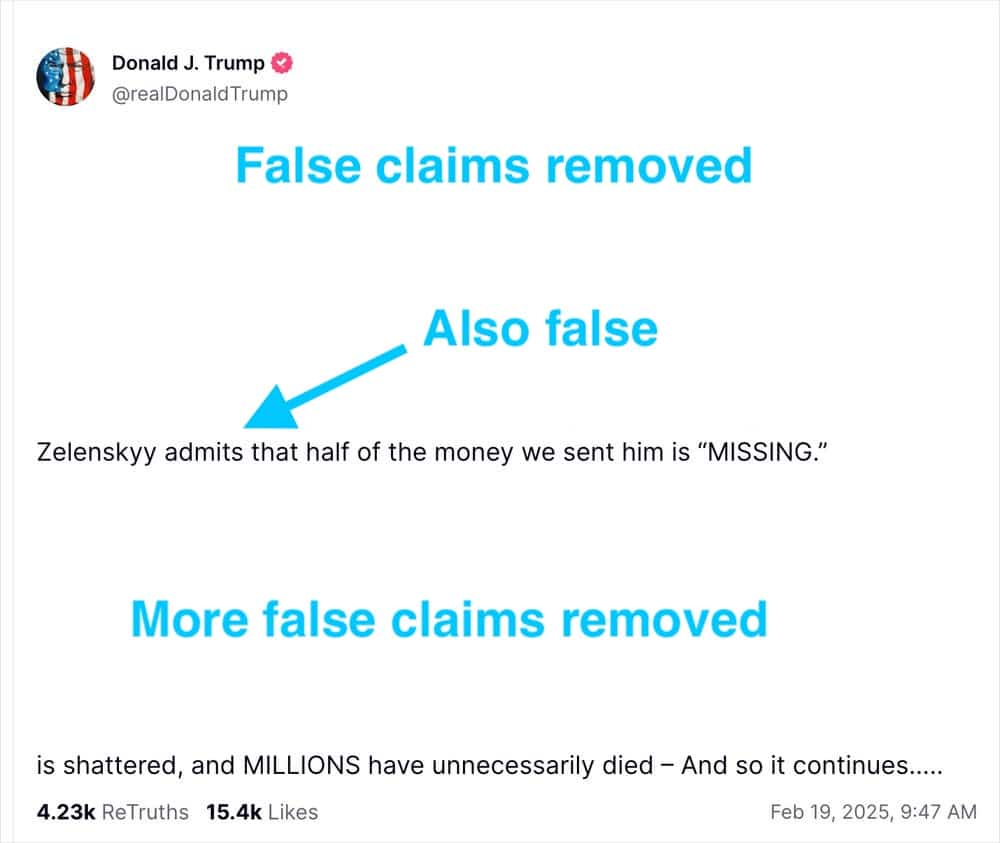
The President sent out a post riddled with false claims, including that Zelenskyy has admitted to losing half the money the US has given.

Politifact debunked that claim earlier this month (while catching Elon Musk in — gasp!! — a lie about it).

“One-hundred billion (dollars) of these 177, or 200, some people even say, we have never received,” Zelenskyy said, according to the translation of the clip. “We are talking about specific things, because we got it not with money but with weapons. We got $70 something billion worth of it. There is training, there is additional transport. There are not only prices for weapons, there were humanitarian programs, social et cetera.”

It was not clear what exactly Zelenskyy was including in his accounting of the military support Ukraine has received, but his comments align with the public data on how Ukraine aid is being spent.

The money is not missing or laundered, as some posts claimed. It’s being spent as Congress intended: on U.S. weapons manufacturing, nonmilitary support in Ukraine and support elsewhere in the region.

I’m particularly interested in the disinformation that Trump and Elon are spreading about the money Ukraine has received (though this is not new — it’s one way Trump undercut support for funding last year).

As you know, I’ve been pretty obsessed (one, two, three) by the way that Trump and DOGE have repeatedly pointed to fraud identified by some of the Inspectors General that Trump fired to substantiate their claim there are hundreds of billions of dollars of fraud to find.

Effectively, DOGE is using Trump’s own mismanagement of COVID to justify their assault on the federal government.

But that’s not the only subgroup of Inspectors General Trump targeted on his fourth day on the job. By terminating State Department Inspector General Cardell Richardson and DOD Inspector General Robert Storch, followed weeks later by Paul Martin after he released a report showing the impact of cuts on USAID, Trump has fired the main people responsible for oversight of aid to Ukraine.

Indeed, both Richardson and Storch talked about how their firing will disrupt the work of tracking the aid to Ukraine.

In his declaration submitted with their wrongful termination lawsuit, Richardson emphasized that by firing him, Trump has prevented him from continuing to supervise that oversight work.

4. The work of the OIG advances U.S. foreign policy objectives and the nation’s national security. For instance, my office was responsible for overseeing programs that provided funding to support Ukraine in its war against Russia. Overseeing programs that fund initiatives in other countries makes OIG’s work uniquely challenging.

5. This crucial work is ongoing, and my unlawful termination has prevented me from continuing to supervise it during my lawful term of office.

And Storch tied his role in supervising Ukraine funding to key national security interests. He specifically described the import of tracking “the most sensitive equipment and technology provided to Ukraine.”

3. The work of DoD’s Office of the Inspector General (“OIG”) helps to safeguard U.S. national security. For example, as Inspector General, I was the Lead Inspector General, and then the congressionally-designated Special Inspector General for Operation Atlantic Resolve (“SIG OAR”), which operation includes U.S. assistance to Ukraine. I worked closely with colleagues from the Offices of Inspector General for the State Department, the U.S. Agency for International Development, and others from across the oversight community on this and the other two ongoing overseas contingency operations, which relate to countering ISIS and assisting local partners in Iraq and Syria (Operation Inherent Resolve) and to furthering U.S. policy goals in Afghanistan (Operation Enduring Sentinel).

4. As SIG OAR, I was responsible for all oversight related to U.S. security assistance to Ukraine, and for coordinating and reporting on oversight of all aspects of U.S. assistance. One of many areas where my office’s programmatic oversight has been particularly consequential is evaluating DoD’s efforts to ensure the accountability of the most sensitive equipment and technology provided to Ukraine. As has been publicly reported, assistance to Ukraine became a highly partisan issue, and it was only because of the non-partisan nature of the OIG that we were able to do this impactful oversight and to do it authoritatively and credibly. All told, as of January 2025, during my tenure as Inspector General, my office had (1) issued approximately four dozen programmatic oversight reports covering all aspects of U.S. security assistance, and (2) coordinated with our oversight colleagues on dozens more, all as transparently reported on the public website whose development I led, www.UkraineOversight.gov.

Given Trump’s abject capitulation to Putin and his overt efforts to replace Zelenskyy, I can’t help but wonder whether blinding this oversight was part of the plan. As Storch alludes, the US sent a whole bunch of sophisticated tools to Ukraine, and I’m sure there are people who’d like to put them to uses other than helping Ukraine repel Russia’s attack.

Whatever the case, when reporters push back on Trump’s false claims about Zelenskyy, they might include a question about why, if he cared about oversight of the money spent with Ukraine, one of his first acts in office amounted to gutting it.

Update: Daniel Dale has a fact check of all the lies Trump is telling about Zelenskyy.

Share this entry

Emil Bove Throwing Gold Bars Off the Titanic

As multiple outlets have reported, the woman appointed to lead the DC US Attorney’s Office Criminal Division, Denise Cheung, resigned yesterday after refusing orders from Ed Martin and Emil Bove to order a bank to freeze appropriated EPA funds based on probable cause (as opposed to just the possibility) that a crime was committed.

As Reuters reported, Cheung was asked to open a criminal investigation, and then asked to freeze funds based on probable cause that a crime was committed. When she refused, she was ordered to resign.

Denise Cheung, who supervised criminal cases at the U.S. Attorney’s Office in Washington, said she had been ordered to open a probe into a contract that she did not identify and that she believed the request was not supported by evidence, in a letter reviewed by Reuters.

When she declined to launch a grand jury investigation citing a lack of evidence, she said she was ordered instead to pursue an asset seizure to prevent the recipient of the contract from drawing down the government funds.

[snip]

“When I explained that the quantum of evidence did not support that action, you stated that you believed that there was sufficient evidence,” she wrote.

“Based upon the evidence I have reviewed, I still do not believe there is sufficient evidence to issue the letter you described, including sufficient evidence to tell the bank there is probable cause to seize the particular accounts identified.”

Cheung said in her letter she was ordered to resign. She announced her departure early Tuesday.

Effectively, she was ordered to chase Lee Zeldin’s conspiracy theories, in turn based on a Project Veritas video of a single staffer who was almost certain inebriated (even before you consider PV’s practice of misleadingly editing videos).


Politico’s trade outlet (subscriptions to which are being cut everywhere as a purported cost-savings) explains what really happened, including that Zeldin may be the one violating the law in attempting to clawback appropriated funds.

[I]f Zeldin tries to claw back money from the Greenhouse Gas Reduction Fund without cause, it could put the government at risk of breaching its contracts with some or all the green bank participants, experts say. And that could cost taxpayers more in damages than the sum Zeldin hopes to recover.

“If the government abrogates the contract without legal justification, then it will eventually owe damages to these people when they sue, but will not be getting the services that are under contract here,” said David Super, a professor of law and economics at Georgetown University Law Center.

During the Biden administration, EPA officials worked with the Treasury Department to contract Citibank as the financial agent for two grant programs — the $14 billion National Clean Investment Fund, or green bank, and the $6 billion Clean Communities Investment Accelerator program, which seeks to build green lending capacity at institutions that serve low-income communities.

That means the money is in accounts at Citibank in the names of the eight awardees for those two programs. The money and income from any interest belongs to the grantees to be used for purposes consistent with their award agreements with EPA. But Citibank reports extensively to Treasury and EPA on any transactions.

People familiar with the contract between Citibank and Treasury and granted anonymity to discuss a private contract say it has provisions to allow EPA and Treasury to exercise a security interest on those accounts if it discovers the awardees have engaged in conduct that meets official definitions of waste, fraud and abuse.

In those instances, the federal government could freeze accounts or recover funds. But Zeldin did not reference any specific instances of misconduct when he announced his plans for the green bank program Wednesday on the social media site X. He also stated that EPA had found no evidence of “any wrongdoing” on the part of Citibank.

Click through for further explanation that there is oversight in place — or would be, if not for Trump’s firing spree.

In a functioning bureaucracy, DOJ would tell Zeldin that he’s the one out of order, unless and until more evidence than a Project Veritas video is developed.

But that’s not what happened. In her resignation letter, Cheung describes that she first reached out to the FBI and then spent much of a day engaged in a good faith effort to assess the allegations.

Earlier yesterday. I was asked to review documentation supplied by the Office of the Deputy Attorney General (ODAG) to open a criminal investigation into whether a contract had been unlawfully awarded by an executive agency before the change in Administration and to issue grand jury subpoenas pursuant to this investigation. I was told that there was time sensitivity and action had to be taken that day because there was concern that contract awardees could continue to draw down on accounts handled by the bank handling the disbursements. I conferred with others in the Office, all of whom have substantial white collar criminal prosecution experience, and reviewed documentation provided by ODAG, in determining whether the predicate for opening such a grand jury investigation existed. Despite assessing that the existing documents on their face did not seem to meet this threshold, an ODAG representative stated that he believed sufficient predication existed, including in the form of a video where statements were made by a former political appointee of the executive agency in question.

After eight years of Republican insistence that one should never predicate an investigation solely on oppo research, and less than two weeks after SDNY closed a criminal investigation into Project Veritas based on suspicion they committed crimes in pursuit of political hit jobs, DOJ was pressuring prosecutors to open an investigation relying primarily on a Project Veritas video.

I contacted a supervisor at the Washington Field Office (WFO) of the FBI and provided him with the materials received from ODAG and also referenced the possible existence of the video and statements made by the head of the executive agency. I further conveyed ODAG’s desire to send out the freeze letter to the bank as soon as possible as to avoid subsequent payouts. The FBI-WFO supervisor forwarded links of these statements and the video, which I also reviewed. Despite the federal holiday yesterday, the FBI-WFO supervisor, as well as other FBI-WFO managers, spoke frequently throughout the day yesterday with me to discuss the matter, including what, if any, possible criminal charges might be applicable, as well as the sufficiency of the evidence of any criminal offense or the connection of any alleged crime to the accounts at issue.

During this period, I sent a draft freeze letter provided by the FBI-WFO supervisor to the PAUSA at 4:31 p.m. In an email sent at 4:46 p.m., the PAUSA conveyed suggested language “in case it [was] helpful” from the ODAG representative, which included language represented to be from the Second Circuit, including the phrase “the government has probable cause to believe that the funds on deposit in the above-referenced account(s) at [named bank] are subject to seizure and forfeiture to the United States based upon violations…” I subsequently informed the PAUSA that the suggested language was not appropriate to the matter at hand.

Despite expressing some concern about the current lack of evidence of any apparent crime and the need to send out any such freeze letter, FBI-WFO personnel were able to consult with necessary individuals, including legal counsel, at their office. I was told that if FBI-WFO was unwilling to send out such a freeze letter, that you would direct someone from USAO-DC to send out such a correspondence to the bank. However, that contingency did not come to pass, as FBI-WFO determined that they were willing to send out the freeze letter, but asked that I first send them an email stating that, based on the evidence, there was possible evidence of certain criminal violations. I emailed them the following statement: “Based upon the information we received from ODAG and public-source materials, including a video of statements by a former [executive agency] official, USAO-DC believes that there may be conduct that constitutes potential violations of 18 U.S.C. Sec. 371 (conspiracy to defraud the United States) and 18 U.S.C. Sec. 1343 (wire fraud) that merits additional investigation.”

After they received this email, FBI-WFO subsequently issued a letter to the bank recommending a thirty-day administrative freeze on certain assets. After this letter was issued at approximately 7:28 p.m. yesterday night, I received a call from the PAUSA and you shortly thereafter. You expressed your dissatisfaction about the adequacy of the FBI-WFO letter and criticized that the language merely “recommended” that a freeze of the accounts take place, notwithstanding that the same language was used in the draft I sent to the PAUSA earlier in the day. You also directed that a second letter be immediately issued to the bank under your and my name ordering the bank not to release any funds in the subject accounts pursuant to a criminal investigation being run out of USAO-DC. When I explained that the quantum of evidence did not support that action, you stated that you believed that there was sufficient evidence. You also accused me about wasting five hours of the day “doing nothing” except trying to get what the FBI and I wanted, but not what you wanted. As I shared with you, at this juncture, based upon the evidence I have reviewed, I still do not believe that there is sufficient evidence to issue the letter you described, including sufficient evidence to tell the bank that there is probable cause to seize the particular accounts identified. Because I believed that I lacked the legal authority to issue such a letter, I told you that I would not do so. You then asked for my resignation.

By going public like this, Cheung alerts the magistrates who might approve such orders and Judge James Boasberg who would oversee any grand jury investigation that this investigation is being predicated without probable cause.

But she also makes clear that Martin and Bove are going to predicate criminal investigations off the flimsiest propaganda, perhaps, in part, as cover that Trump is the one breaking the law by violating the Impoundment Act. And if they need to get rid of career prosecutors with over two decades of experience to do that — the gold bars of the Department of Justice — they won’t hesitate.

Share this entry

Dale Ho Asks for Signed Consent from Eric Adams; Alex Spiro and Bill Burck Don’t Provide It

In his first order following Emil Bove’s submission of his request to dismiss the Eric Adams prosecution, Judge Dale Ho notes the same thing I was among the only people to mention: Bove claimed that Adams had consented to dismissal without prejudice in writing, but he did not include that consent with the filing.

ORDER as to Eric Adams: The motion to dismiss states that “Defendant Eric Adams has consented in writing to this motion,” see ECF No. 122 at 1, but no such document has been provided to the Court. Defendant is therefore ORDERED to file his “consent[] in writing” on the docket by 5:00 pm ET today. The parties are further ORDERED to appear before the Court for a conference on February 19, 2025, at 2:00 pm in Courtroom 318 of the Thurgood Marshall Courthouse, 40 Foley Square, New York, NY. The parties shall be prepared to address, inter alia, the reasons for the Government’s motion, the scope and effect of Mayor Adams’s “consent[] in writing,” ECF No. 122 at 1, and the procedure for resolution of the motion. SO ORDERED. (Status Conference set for 2/19/2025 at 02:00 PM in Courtroom 318, 40 Centre Street, New York, NY 10007 before Judge Dale E. Ho) (Signed by Judge Dale E. Ho on 2/18/2025) (See ORDER as set forth) (lnl) (Entered: 02/18/2025) [my emphasis]

Here’s what I wrote over the weekend:

[T]here are obvious documents we’d all like to see that, if these other documents are formally aired in this case, I expect Judge Ho to request, starting with the notes someone from SDNY took at a January 31 hearing. Bove also described written submissions from prosecutors and Adams’ team in his response and a February 3 memo from SDNY that, he describes, denied a quid pro quo. He also claims Sassoon, “acknowledged previously in writing” that there was no quid pro quo, which may be that February 3 memo. And there are all the letters that are public but not formally before him.

Again, Judge Ho may demand all that if and when he begins to look closely.

But there’s another document that is missing, conspicuously so.

Bove’s Nolle Prossequi motion describes that Adams has consented to dismissal, but he does not include it.

Through counsel, Defendant Eric Adams has consented in writing to this motion and agreed that he is not a “prevailing party” for purposes of the Hyde Amendment. See P.L. 105- 119, § 617, 111 Stat. 2440, 2519; 18 U.S.C. § 3006A note.

This is, quite frankly, either insane or rank incompetence. There is no way any judge, former ACLU voting rights lead or not, would accept a dismissal without prejudice without seeing that documented.

Sometime after Judge Ho issued that order, Alex Spiro (the attorney Eric Adams shares with Elon Musk) and Bill Burck (who serves as Trump Organization’s outside ethics advisor), submitted a filing claiming that they know nothing about a quid pro quo. The last thing they did, they claim, was to submit the January 3 letter Emil Bove asked for in writing.

Acting Deputy Attorney General Bove invited us to a meeting at which he asked us to address how the case might be affecting Mayor Adams’s ability to do his job and whether there was evidence of politicization. At that meeting, which occurred on January 31, 2025, we explained that the indictment and upcoming trial were impeding Mayor Adams in myriad ways, including as to enforcement of federal immigration laws, and that Damian Williams’s post-SDNY conduct raised serious concerns about his motives in authorizing the prosecution. Ms. Sassoon and her colleagues were present and actively participated in the meeting. We had a polite and professional debate under questioning from Mr. Bove. At the conclusion of the meeting, Mr. Bove asked us and the SDNY lawyers to memorialize our respective positions in writing, which we did in a letter we submitted to the Department on February 3, 2025, a copy of which is attached as Exhibit A.

We heard nothing further until February 10, 2025, when we learned from the press that the Department had decided to dismiss the case. We had no heads up or prior notice. We never coordinated with the Department or anyone else. [my emphasis]

The thing is, the February 3 letter — the last that Spiro and Burck heard, they say — mentions nothing about dismissal without prejudice. This is the only mention of dismissal.

An honest balancing of these concerns against the unsupported prosecution theories in this case militates strongly in favor of dismissal.

So now they’re on the hook for submitting some other document, signed before Friday, that consents to having this indictment hang over Adams’ head while he does all the things he claims he wants to do for NYC.

Update: Ho’s order itself says the motion to dismiss is not itself conclusive.

The government’s determination to abandon a prosecution is “entitled to great weight” and to a “presumption [of] good faith[,] . . . but it is not conclusive upon the Court; otherwise there would be no purpose to Rule 48(a), which requires leave of Court to enter the dismissal.” United States v. Greater Blouse, Skirt & Neckwear Contractors Ass’n, 228 F. Supp. 483, 486 (S.D.N.Y. 1964) (Weinfeld, J.). Thus, “[w]hile there can be no doubt that the government has broad discretion in deciding which cases to prosecute and how to prosecute those cases, once the government has involved the judiciary by obtaining an indictment or a conviction, its discretion is tempered by the courts’ independent obligations.” Blaszczak, 56 F.4th at 259 (Sullivan, J., dissenting).

Rule 48(a)’s requirement of judicial leave . . . contemplates exposure of the reasons for dismissal.” United States v. Ammidown, 497 F.2d 615, 620 (D.C. Cir. 1973). “Since the court must exercise sound judicial discretion in considering a request for dismissal, it must have sufficient factual information supporting the recommendation.” 3B Charles Alan Wright & Arthur R. Miller, Federal Practice and Procedure § 802 (4th ed. 2013). In granting a motion under Rule 48(a), the Court “should be satisfied that the reasons advanced for the proposed dismissal are substantial.” Ammidown, 497 F.2d at 620.

Update: Spiro and Burck have now sent the consent letter, dated February 14, with a cover letter, dated today.

The document creation time for the latter,

Precedes the letter created on Friday.

If they had sent it by email on Friday, as the lawyers claim, they would have a PDF copy from then.

Update: A few more details about the consent issue. Bove’s February 10 memo instructed Sassoon to get that signed consent — and that it be signed by the defendant, not his lawyer.

You are directed, as authorized by the Attorney General, to dismiss the pending charges in United States v. Adams, No. 24 Cr. 556 (SDNY) as soon as is practicable, subject to the following conditions: (1) the defendant must agree in writing to dismissal without prejudice; (2) the defendant must agree in writing that he is not a prevailing party under the Hyde Amendment, Pub. L. 105-119 (Nov. 26, 1997); and (3) the matter shall be reviewed by the confirmed U.S. Attorney in the Southern District of New York, following the November 2025 mayoral election, based on consideration of all relevant factors (including those set forth below).

That’s a no-brainer. The existing consent is simply not sufficient: SDNY would need proof that the lawyers advised Adams on the significance of the without prejudice dismissal and that he, not they, consented.

But then Sassoon’s letter makes it clear that Bove negotiated this at some unidentified time before she sent the letter on February 13.

Mr. Bove specifies that Adams must consent in writing to dismissal without prejudice. To be sure, in the typical case, the defendant’s consent makes it significantly more likely for courts to grant motions to dismiss under Rule 48(a). See United States v. Welborn, 849 F.2d 980, 983 (5th Cir. 1988) (“If the motion is uncontested, the court should ordinarily presume that the prosecutor is acting in good faith and dismiss the indictment without prejudice.”). But Adams’s consent— which was negotiated without my office’s awareness or participation—would not guarantee a successful motion, given the basic flaws in the stated rationales for dismissal. See Nederlandsche Combinatie, 428 F. Supp. at 116-17 (declining to “rubber stamp” dismissal because although defendant did not appear to object, “the court is vested with the responsibility of protecting the interests of the public on whose behalf the criminal action is brought”). Seeking leave of court to dismiss a properly returned indictment based on Mr. Bove’s stated rationales is also likely to backfire by inviting skepticism and scrutiny from the court that will ultimately hinder the Department of Justice’s interests. In particular, the court is unlikely to acquiesce in using the criminal process to control the behavior of a political figure.

It’s unclear when that could have happened, if Spiro and Bove didn’t speak between February 3 and February 10.

Share this entry

Why Elon Musk Can’t Run DOGE [sic] Anymore

Yesterday, Judge Tanya Chutkan had a Presidents Day hearing on a lawsuit challenging DOGE’s actions. While she reportedly seemed inclined not to grant an emergency restraining order, she did order the government to provide her with two pieces of information: how many people had and were going to be fired, and what Elon Musk’s status is.

In a response and declaration, the government blew off the first question, but on the second, denied that Musk has the power of DOGE. He’s just a senior Trump advisor, one solidly within the White House Office, and so firewalled from the work of DOGE, yet still protected from any kind of nasty disclosure requirements.

But as the attached declaration of Joshua Fisher explains, Elon Musk “has no actual or formal authority to make government decisions himself”—including personnel decisions at individual agencies. Decl. ¶ 5. He is an employee of the White House Office (not USDS or the U.S. DOGE Service Temporary Organization); and he only has the ability to advise the President, or communicate the President’s directives, like other senior White House officials. Id. ¶¶ 3, 5. Moreover, Defendants are not aware of any source of legal authority granting USDS or the U.S. DOGE Service Temporary Organization the power to order personnel actions at any of the agencies listed above. Neither of the President’s Executive Orders regarding “DOGE” contemplate—much less furnish—such authority. See “Establishing and Implementing the President’s Department of Government Efficiency,” Exec. Order No. 14,158 (Jan. 20, 205); “Implementing the President’s ‘Department of Government Efficiency’ Workforce Optimization Initiative,” Exec. Order 14,210 (Feb. 11, 2025).

The statement is quite obviously an attempt to retcon the structure of DOGE [sic], one that Ryan Goodman has already found several pieces of evidence to debunk.

But it is a testament that the suit in question — by a bunch of Democratic Attorneys General, led by New Mexico [docket] — might meet significant success without the retconning of Elon’s role.

Partly for more general benefit, let me talk about the various kinds of lawsuits filed so far against Trump’s attacks.

Kinds of plaintiffs:

  • Imminent, individual personal injury: The cases that have had the most success, so far, are examples of individuals who describe a specific imminent injury. The most obvious such example is a number of Trans women prisoners who’ve argued, successfully so far, that they face a very high likelihood of assault and/or rape if they are moved to male prisons.
  • Unions or other representatives of federal workers: These lawsuits address the imminent injury of privacy violations or firing and other mistreatment. The most successful (and eye-popping) so far has been the American Foreign Service Association lawsuit challenging the USAID shutdown [docket], in which a Doe employee yesterday provided another horrifying declaration describing another instance of a pregnant woman being deprived of promised medevac, and another from a woman in South Africa running up debt taxpayers will have to pay and about to lose access to electricity on the compound. But there are limits to the recourse that unions can seek on both these theories. For example, while Trump appointed judge Carl Nichols imposed a temporary restraining order on actions targeted at employees oversees, he has not done so for the USAID personnel stuck without the ability to fix anything in DC, because being put on paid leave is not the same kind of injury as being stuck overseas with no access to security warnings.
  • States (all with Democratic Attorneys General): The states are arguing a variety of things, both contractual breaches and injuries to their citizens. Contractual challenges may have little ability to halt ongoing destruction.
  • Private entities, like corporations or associations: These entities are often arguing contractual breaches, or privacy damages. The latter are likely to have more success than the former because of the way the Privacy Act works.

Kinds of challenges:

  • Many of these challenges claim a violation of the Administrative Procedures Act, basically arguing that the government changed the rules without going through the process they are required to use to change the rules.
  • Many lawsuits also claim violations of the Privacy Act, which requires that the government follow certain rules if they’re accessing your data in new ways. Thus far, the government has argued that employees have more limited protections than private citizens.
  • Underlying many of these suits are claims about the Impoundment Act and Separation of Powers because the government is not spending money the way Congress said it had to, but argued through an APA challenge. These challenges are particularly important because a key project of Project 2025 is to effectively strip Congress of the power of the purse.
  • Some lawsuits have tried to get at cybersecurity violations or even hacking (Computer Fraud and Abuse Act) claims, but thus far with little success. In any case, those would pivot on how DOGE [sic] got access to various computer systems, and in most cases, a senior Agency official ultimately relented to give them access.
  • This lawsuit, and another similar one brought by 26 anonymous USAID employees, argue that Elon Musk’s role in all this violates the Appointments Clause. This basically argues that Elon is acting as a superior officer, which requires Senate confirmation.

The injury suffered by each set of plaintiffs and legal theory largely limits the ability of judges to weigh in. So, for example, if a suit is arguing only Privacy Act violations, a judge can do no more than limit the dissemination outside of authorized channels of the data of the plaintiffs, something that has been ineffective once agencies started giving DOGE formal authorization to access computer servers. If a suit worries about firings, but the government instead puts tons of people on paid leave (as happened with USAID), then the plaintiffs are not yet suffering an irrevocable injury.

Here’s how the Appointments Clause theory, arguing that Elon is exercising powers that need to be created by Congress and confirmed by them, looks in the complaint.

64. Although he occupies a role President Trump—not Congress—created and even though the Senate has never voted to confirm him, Mr. Mr. Musk has and continues to assert the powers of an “Officer[] of the United States” under the Appointments Clause. Indeed, in many cases, he has exceeded the lawful authority of even a principal officer, or of the President himself.

65. As explained below, Mr. Musk: (1) has unprecedented and seemingly limitless access across the federal government and reports solely to President Trump, (2) has asserted significant and sweeping authority across a broad swath of federal agencies, and (3) has engaged in a constellation of powers and activities that have been historically associated with an officer of the United States, including powers over spending and disbursements, contracts, government property, regulations, and agency viability.

66. In sum, Mr. Musk purports to exercise and in fact asserts the significant authority of a principal officer on behalf of the United States. Yet, he does not occupy an office created by Congress and has not been nominated by the President or confirmed by the Senate. As a result, all of Mr. Musk’s actions are ultra vires and contrary to law.

You can see why the White House has decided that Elon is boxed away inside the White House with no direct control over the dismantling of government bureaucracy. The retconning of his role is all the more obvious when you understand that the right wing judges on SCOTUS feel very strongly about the Appointments Clause. And Trump is on the record relying on it, most spectacularly in convincing Aileen Cannon that Jack Smith had to be confirmed by the Senate before he could indict Trump.

In practice, Trump is saying Elon can dismantle entire agencies without Senate confirmation, but Jack Smith couldn’t prosecute him as a private citizen without it.

Or he was. Now he’s arguing that all this is happening without Elon’s personal direction.

There is plenty in the complaint already that debunks this, not least the narrative of how Elon started disappearing USAID even before, by his own description, Trump approved.

93. With a budget of over $40 billion, USAID accounts for more than half of all U.S. foreign assistance. USAID has missions in over 100 countries. As of January 2025, USAID had a workforce of over 10,000, with approximately two-thirds serving overseas.

94. On Saturday, February 1, 2025, a group of about eight DOGE personnel entered the USAID building and demanded access to every door and floor, despite only a few of them having the requisite security clearance.34 The areas to which they sought access included a sensitive compartmented information facility—commonly known as a SCIF—an ultra-secure room where officials and government contractors take extraordinary precautions to review highly classified information. DOGE personnel, aided by phone calls from Mr. Musk, had pressured USAID officials for days to access the secure facility and its contents.35

95. When USAID personnel attempted to block access to some areas, DOGE personnel, including Mr. Musk, threatened to call federal marshals. Under threat, the agency personnel acquiesced, and DOGE personnel were eventually given access to the secure spaces.

96. Later that day, top officials from USAID and the bulk of the staff in USAID’s Bureau for Legislative and Public Affairs were put on leave. Some of them were not notified but had their access to agency terminals suspended. USAID’s security official was also put on leave.36 97. Within hours, USAID’s website vanished. It remains inoperative.37

98. On Sunday, February 2, 2025, Mr. Musk tweeted, “USAID is a criminal organization. Time for it to die.”

38 Later, he tweeted, “We spent the weekend feeding USAID into the woodchipper.”39

99. Mr. Musk provided no support for his claim that USAID is a criminal organization. 100. On Monday, February 3, 2025, Mr. Musk stated that he was in the process of closing the agency, with President Trump’s blessing. Mr. Musk stated: “I went over it with him [President Trump] in detail, and he agreed that we should shut it down. And I actually checked with him a few times [and] said ‘are you sure?’ The answer was yes. And so we’re shutting it down.”40

Now, before DOJ gave this answer and blew off Judge Chutkan’s order to provide details of the ongoing firing spree, she seemed inclined not to grant a restraining order to stop all this.

It’s unclear whether this defiance will change that. Or, at the very least, whether it will lead to more questions about whether White House wrote any of this down.

What is clear is that the White House recognizes a real risk if Elon is held accountable for all the things Elon has done.

Share this entry

John Barrasso Declares Programs Protecting Christian Minorities and Combatting Migration “Wrong”

On an appearance on Fox News Sunday yesterday, Senator John Barrasso claimed Democrats are “filing lawsuit after lawsuit because they want the border to remain open, they want to have boys playing in girls’ sports, and they want to spend money on things that people think are ridiculous — these transgender comic books, operas, surgery in foreign countries — all of these things are wrong.”

It’s unclear whether Wyoming’s Senator has simply pickled his brain with too much Fox News, made the grave mistake of believing any single thing Karoline Leavitt and/or Elon Musk says, or simply been ill-served by his staffers.

Several of the spending issues he alluded to, for example, have been publicly explained (and represent State Department funding, not USAID funding).

The rest were awarded by the State Department’s Office of the Under Secretary for Public Diplomacy and Public Affairs. In 2022, it granted $70,884 to an Irish company for “a live musical event to promote the U.S. and Irish shared values of diversity, equity, inclusion, and accessibility.” A grant for $25,000 was awarded in 2021 to a university in Colombia “to raise awareness and increase the transgender representation” through the production of an opera, with an additional $22,020 coming from non-federal funding. And $32,000 awarded in 2022 to a Peruvian organization funded “a tailored-made comic, featuring an LGBTQ+ hero to address social and mental health issues.”

The bigger problem for the badly misled Senator Barrasso, however, is in claiming that “all of these things are wrong,” he is saying he opposes a bunch of programs that did get shut down, including protecting the religious freedom of Christian minorities in Asia and Africa and combatting migration to the United States at its source.

That’s what declaration after declaration after declaration submitted in lawsuits reveal. Many these lawsuits haven’t been filed by Democrats; some of which have been filed by representatives of small businesses devastated because Donald Trump has decided to renege on billions of dollars of signed contracts, which is the key injury alleged in one of the more sweeping Temporary Restraining Orders thus far.

More importantly, rather than halting things that Barrasso is sure are wrong, they’ve halted programs that go to the core of what Trump claims he supports.

Disrupting migration at its source in El Salvador and Venezuela

One USAID contractor, Chemonics, describes several programs designed to disrupt migration to the US at its source. It describes the disruption of a program targeting El Salvador:

Working with urban municipalities and communities to counter incentives to join gangs and creating safe public spaces, addressing the root causes of migration to the U.S. from El Salvador;

[snip]

In El Salvador, each day the stop work order is in effect undermines progress made by Chemonics enhancing safety, economic opportunities, and safer environments. These work stoppages disrupt services designed to prevent organized crime and reduce migration, and they impede the development and implementation of long-term policies and organizational capacity of our government counterparts to sustain these gains.

And another program facilitating Venezuelan migration to Colombia, in lieu of migration to the US.

Helping resettle Venezuelan migrants permanently in Colombia by supporting Colombian visa processes and assisting with job skills training and placement to prevent migration to the U.S. southern border;

[snip]

In Colombia, 11 one-stop-shops for Venezuelan migrants to obtain temporary visas and nine workforce development centers now lack the resources necessary to operate, leaving migrants without access to social integration services. Agreements that Chemonics had negotiated with four banks to provide bank account registration and other financial services for migrants could not be signed, resulting in reputational harm. Similarly, each day the stop-work order remains in place, we lose the engagement of more than 1,500 private sector companies across different sectors that had agreed to promote job hiring and placement of Venezuelan migrants and connect migrant-led businesses to market opportunities. Chemonics fears that, without access to these services, more Venezuelan migrants will turn to illegal smuggling and human trafficking to on-migrate to the U.S. border.

Protecting Christian minorities

One contractor described that its human rights defenders protecting Christian communities from terrorists are at risk.

In Burkina Faso, human rights defenders who are working to track violence by the military junta and terrorist groups that have targeted Christian communities are at risk of being killed because the program can no longer help them relocate to safer locations and provide them with food, shelter, and subsistence support.

The American Bar Assocation also described having programs supporting religious freedom in Asia shut down.

With our partners in Indonesia, ABA is actively pursuing six religious freedom cases, including 4 representing Christian churches who were denied necessary permits to hold worship services and 2 representing Shia and Ahmadiyya Muslims who were accused of blasphemy/heresy

Combatting human trafficking

The ABA also supports programs fighting human trafficking in the Congo and Colombia.

The ABA is building the long-term capacity of the Congolese government, lawyers, and local service providers to combat human trafficking and violence against women, children, and other vulnerable groups around the country. ABA’s partners include medical, legal, psychological, shelter, and economic support providers alongside security actors, Congolese government representatives, and judicial personnel who receive training, technical assistance, capacity building, and direct distribution of goods or services for survivors. The project also works with local NGOs to raise public awareness on existing laws, rights, referral pathways, and resources for survivors to collectively improve long-term attitudes toward victims of trafficking and violence against women, children, and other vulnerable groups.

[snip]

In Colombia, ABA ROLI is implementing the Child Protection Compact (CPC) Partnership program, which aims to strengthen investigations, prosecutions and adjudications of child and adolescent trafficking cases through institutional strengthening as well as advocacy and increased access to justice. Emphasizing sustainable outcomes, this program adopts highly participatory approaches that increase commitment of the government, ensures sustained technical knowledge, and has developed tools and standard operating procedures, and improved law enforcement’s practices to obtain reliable data. As a result of the funding freeze, despite Colombia’s efforts to address the worst forms of child labor, children will still remain subjected to commercial sexual exploitation, illicit activities, forced labor, and recruitment by criminal groups.

Competing with China for Congo’s resources

One USAID employee describes how the evacuation and defunding has put programs designed to provide Congo alternate markets to those of China have been put at risk.

My portfolio focuses on establishing conflict-free supply chains of critical minerals from the DRC to the U.S. The overarching objective of my role is to strengthen the supply chain of DRC’s vast critical minerals sector to the U.S. Much of my job is establishing relationships with Government of DRC officials and informing them of the benefits partnerships with the U.S. offer. Over 70% of the world’s cobalt is produced in the DRC, which is almost entirely shipped to China. My job was to help reduce the country’s dependence through increased trade with the U.S.

[snip]

[T]he shutdown is ruining the U.S.’s strong relationship with the DRC government and private sector partners in the mining sector. USAID had many partnerships and programs active in the DRC’s mining sector focused on improving the environmental and social aspects of mining so that minerals could be legally exported to the U.S. Likewise, USAID was the primary donor supporting the development of the Lobito Corridor in the DRC. We have essentially “ghosted” all of our partners and our reputation may forever be tarnished as a result. Over the past few years, the DRC had expressed their preference for U.S. partnerships and USAID worked hard to develop strong, mutually beneficial partnerships that increase trade, benefitting the DRC economy and U.S. consumers who rely on the critical minerals that only the DRC produces. This is in jeopardy. China is ready to immediately jump in and take over.

John Barrasso has a job to do, and that is to oversee the actions taken by the President, of either party.

And rather than doing the least due diligence to learn about the damage that Trump’s shutdowns have caused, Barrasso instead went on TV and — presumably without knowing the least little bit about what he was talking about — cheered the shutdown of programs protecting Christian minorities around the world.

Share this entry

DOGE2025 Is Getting the Catastrophic De-Ba’athification They Demanded

There are two stories that attracted a lot of attention last week that offer the same lesson.

The first story is the report that after firing a bunch of people in charge of securing nuclear weapons, Trump’s minions have tried to rehire them, which was first reported by CNN.

Trump administration officials fired more than 300 staffers Thursday night at the National Nuclear Security Administration — the agency tasked with managing the nation’s nuclear stockpile — as part of broader Energy Department layoffs, according to four people with knowledge of the matter.

Sources told CNN the officials did not seem to know this agency oversees America’s nuclear weapons.

An Energy Department spokesperson disputed the number of personnel affected, telling CNN that “less than 50 people” were “dismissed” from NNSA, and that the dismissed staffers “held primarily administrative and clerical roles.”

The agency began rescinding the terminations Friday morning.

The other is that the USAID is trying to prevent anyone still at the now-shuttered agency from telling the press that the life-saving grants for which Marco Rubio issued waivers have not actually been reauthorized to operate, which Greg Sargent focused on after John Hudson disclosed a memo making the order.

new internal memo circulating inside the U.S. Agency for International Development neatly captures this split. The Washington Post reports that the memo warns USAID employees not to communicate with the press about the shocking disruptions in humanitarian assistance that are being caused by the Trump-Musk attack on the agency, which are already producing horrific consequences. The memo said this transgression might be met with “dismissal.”

The memo claims to be correcting a “false narrative in the press” about the disruptions to that assistance. It notes that Secretary of State Marco Rubio last month issued a waiver to “lifesaving humanitarian assistance,” allowing it to continue despite the Trump-Musk freeze in agency spending. This has meant that this assistance has “continued uninterrupted and has never paused,” the memo claims, while warning recipients against any “unauthorized external engagement with the press.”

Now, at one level, this chaos is happening because many of the people enacting these cuts are DOGE boys with no idea what they’re looking at. Don Moynihan (who is an indispensable source on the policy issues of all this) uses the nukes case as one example to make the same point: because ignorant people were making the firing decisions, they eliminated a slew of critical positions.

Musk’s management style when it comes to downsizing has been to cut to the bone, and then hire back if he fired too many. This philosophy might make sense if you are running a social media company where its not a big deal if Twitter goes down for a couple of hours. It makes less sense where the a) failure of government systems has big and sometimes irrevocable costs, and b) it is not easy to replace expertise once you have eliminated it. On the latter point, many public jobs take time to develop knowledge of the policy domain, organizational practice and tasks. Those are not qualities that are easy to rebuild if you just spent a year training a new employee who has now been fired.

[snip]

Let me note that I feel like this lesson should not be necessary. We should not need to spell this one out. One measure of the collapse of the Soviet Union was that they could no longer afford to keep staff to secure nuclear warheads. Why would the US voluntarily downgrade it’s own capacity to manage its nuclear arsenal? And yet, DOGE fired 1 in 5 federal staff that manage the nation’s nuclear stockpile.

Have you heard about the National Nuclear Security Administration before? Probably not. It’s one of those jobs that we hopefully never need to think about, because if we do that means something has gone badly wrong. But it’s also one of those jobs that someone needs to ensure is staffed appropriately to make sure something does not go badly wrong. As a citizen, its fine if you are not aware of NNSA, but bear in mind that when the right attacks wasteful bureaucracy, these sort of invisible agencies performing important tasks are some of what they are talking about.

Apparently DOGE does not know much about the NNSA either. To be fair, when you have zero experience of government, why should you? But if you have zero experience of government, you should also probably not be in the position of firing 300 of the guys who take care of the nukes. CNN reported that the fired staffers included “staff who are on the ground at facilities where nuclear weapons are built. These staff oversee the contractors who build nuclear weapons, and they inspect these weapons.”

After enough members of Congress got upset, the firings were rescinded. Just one problem. DOGE made the firings effective the day they were received (no notice, not severance), immediately shutting down access to government emails. And they did not have contact information to tell NNSA employees they were unfired.

[snip]

Under Biden, the IRS had received long-awaited and much needed funds that allowed it to rebuild after a period of sustained downsizing, and was becoming more effective.
The IRS represented a very simple test for the credibility of DOGE. Was it really interested in efficiency and state capacity? If so, you support the tax enforcement, the biggest return on investment in government, generating somewhere between $5-9 for every additional $1 spent on enforcement.

Or did DOGE want to minimize parts of the state that bothered billionaires?

We have our answer. In the middle of tax season, the IRS was told to lay off thousands of workers hired as part of the rebuilding project.

Part of the DOGE hype is that after they fire everyone, they will figure out better ways to do the job using, uh, AI and such. But there is no second act where it gets better. They don’t have a plan to fix what they are breaking because they don’t understand or care about the damage they are doing. Breaking government is the point. It is not as if DOGE has some magical IRS plan up their sleeve. There is no plan.

The story is not just that these DOGE boys have no idea what they’re looking at, being so incompetent that the word “nuclear” doesn’t even spark their interest.

It’s that after ideologues fire competent bureaucrats, they’re often left without a way to turn the bureaucracy back on again when they realize they actually needed it.

Take the first example, the people ensuring the security of America’s nuclear arsenal. As NBC followed up, after Congressional lobbying and a press campaign convinced someone to reverse the NNSA firings, the DOGE boys had no easy way to contact those who had been fired to order them to return to work.

National Nuclear Security Administration officials on Friday attempted to notify some employees who had been let go the day before that they are now due to be reinstated — but they struggled to find them because they didn’t have their new contact information.

In an email sent to employees at NNSA and obtained by NBC News, officials wrote, “The termination letters for some NNSA probationary employees are being rescinded, but we do not have a good way to get in touch with those personnel.”

AP has a follow-up noting — among other things — that the key jobs were in Texas, Eastern Washington, South Carolina, and Tennessee. These are not just crucial jobs for national security, but many of them represent job losses in Republican areas.

Something similar has happened at USAID.

It shouldn’t have, because there, one key player shutting down the agency, Pete Marocco, actually worked at USAID in the first Trump term. The declaration he has submitted in multiple suits admitted he shut down already-committed funds on his own authority, without Marco Rubio’s involvement. He described that after he started firing administrators, administrators were unable to answer his questions, which he deemed insubordinate rather than just a natural consequence of firing the people who might be able to answer his questions. Nevertheless, his inability to get answers is what he used to justifying shutting everything down.

As a former USAID staffer, Marocco should have the competence to know better — but ProPublica describes why his own past insubordination may be a better explanation for his war against the agency.

The flood of USAID lawsuits has produced an associated flood of sworn declarations that describe, from the perspective of people involved, what is really happening.

For example, as part of a suit by the American Foreign Services Association, a program officer described that, even though she supervises 30 emergency food assistance programs, she had not (as of February 7) been able to get a waiver for any of them, resulting in food rotting in warehouses.

For example, while it was announced that most USAID funding would be frozen, a waiver is supposed to be available for life-saving humanitarian assistance, which would apply to the more than 30 emergency food assistance programs I support. Without my knowledge, the partners I manage, nearly all of which work on lifesaving, emergency food assistance, were sent email notices from their Agreement Officers directing them to fully or partially stop their work. As an Agreement Officer Representative for these awards, I am required to be copied on any communications, which never happened. While I tried to obtain a waiver for the programs I manage, there was no guidance on the process by which our patterns could obtain a waiver and none of the programs were ever formally approved to keep running. I am skeptical that the waiver actually exists. At this point, if a waiver does in fact exist, the implementation has been so chaotic with so many employees either furloughed or on administrative leave that as a practical matter it isn’t available to those who need it. While the programs I manage are under a stop work order, food commodities sit in warehouses rotting and scheduled food distributions to vulnerable populations do not happen and children miss follow-up appointments for treatment of severe malnutrition.

A contracting officer’s declaration in the same suit described the conflicting management orders, the lack of access to experts, and the technical access limits that made it impossible to implement the waiver program.

As a Contracting Officer, some of the awards on this list were perplexing and the sudden push to do this while nearly all of our counterparts with technical knowledge about where awards were in the waiver process and what the programmatic purpose of each award were locked out of the network and suspected to be on administrative leave.

There was an approved tab with one single PEPFAR award despite the fact that the Agency has many different PEPFAR awards and we were told a waiver had been granted for PEPFAR and Emergency Food Assistance. There were no Emergency Food Assistance awards on the approved tab. Concerns were raised by Contracting Officers and Regional Legal Officers alike who replied all to Matthew’s email with concerns. We asked for clarification on the reason for the contract terminations and for confirmation that OAA had consulted with OMB and made a determination consistent with the Executive Order on realigning foreign aid. If these awards had not received such a determination, the termination would be in violation of the executive order. We received no reply to those questions. A contracting officer replied all to the email asking if Congressional notification had been made on these terminations and noted that Congressional notification is required when a termination will involve reduction in employment of 100 or more contractor employees which these actions would likely result. It was also asked if USAID had taken steps to adhere to our Congressionally authorized and funded responsibilities on these terminations.

These emails received no reply from OAA leadership and our working level supervisors urged us to proceed with the terminations and meet the deadlines.

Subsequently at approximately 6PM that same day, Nadeem Shah, Deputy Director of Washington Operations for OAA, sent around an email entitled “PLEASE PAUSE ALL AWARD TERMINATIONS” asking staff to hold off on all award terminations in Matthew’s previous email.

[snip]

When my technical bureau’s access was supposedly restored yesterday, we quickly discovered that they do not have access to our Agency File system called ‘ASIST’ nor do they have access to our financial system in direct violation of the TRO issued the night of February 7, 2025. This makes it incredibly hard for them to provide programmatic information to help with the program review process. To date, the technical bureaus have not had any opportunity to provide any inputs or relevant information for the programmatic review. I am extremely concerned that Agency and State Dept leadership do not have the relevant information needed to thoroughly evaluate programming

Importantly, this seems to suggest that PEPFAR — one of the programs that Republicans have vociferously championed — was only partly restored because someone didn’t understand the multiple programs it involves.

Another staffer in the same AFSA lawsuit, a controller, described how bureaucratic and technical problems have prevented people from disbursing funds even for the programs that have gotten waivers.

9. On February 3, the situation changed yet again. As of that date, every time I tried to hit the “certify” button to begin a disbursement, I received an error message stating that I did not have authority to proceed. I contacted Phoenix Security to inquire if there was a technical problem in the system and was told “on Friday January 31, we were instructed to remove the ability to certify payments.” They did not indicate who instructed them, only stating “Unfortunately I am unable to reverse this decision.”

10. On February 5, all USAID controllers received another diplomatic cable indicating that USAID personnel could no longer process payments themselves but must request approval from a Senior Bureau Officer before forwarding the payment packages for processing. However, as of February 11, nobody can agree on who is the appropriate SBO for USAID payments and the State Department hasn’t processed a single payment based on the new procedure.

11. As of February 9, when I try to log into Phoenix, I receive a new error message stating that my sign-in attempt has failed. I have even less access to Phoenix after the February 7 court order than I did before that date.

12. I have been in touch with many colleagues and all report the same experience. To my knowledge, worldwide there are no USAID financial management personnel, including controllers, that can access Phoenix.

13. I have not been able to process payments under any of the waivers included in the January 24 cable, including legitimate expenses incurred prior to January 24 under existing awards or those for employee operating expenses. Though the waivers exist on paper, in reality all USAID funds have remained frozen because of technological barriers added to the system, I don’t know by whom. Phoenix will not let us disburse anything.

In a different USAID-related lawsuit by contract recipients, the head of a faith-based non-profit, Mark Hetfield, described how attempts to get waivers looked in practice.

11. On February 3, 2025, HIAS also received a revised “Notice of Suspension” for its work in Chad from PRM via email stating that HIAS should stop all work under the grant unless exempted from suspension as “existing life-saving humanitarian assistance” defined by the Department as “core life-saving medicine, medical services, food, shelter, and subsistence assistance, as well as supplies and reasonable administrative costs as necessary to deliver such assistance.” See February 3, 2025, Letter from Philip Denino, PRM Grants Officer, annexed to this declaration as Exhibit F. In his cover email, Mr. Denino stated that “PRM will follow up shortly to set up a meeting to discuss the specific HIAS programming in Chad that falls under the exemption for life-saving humanitarian assistance.” See February 3, 2025, Email from Philip Denino, annexed to this declaration as Exhibit G. That meeting with PRM took place the next day, February 4, during which HIAS and PRM staff discussed what activities would qualify as “lifesaving humanitarian assistance.” PRM asked HIAS to provide an overview of HIAS’ activities conducted in Chad pursuant to the award that HIAS deemed exempt from the 90-day suspension. HIAS prepared and sent the requested overview. See February 7, 2025, Email from Guillermo Birmingham to Philip Denino, annexed to this declaration as Exhibit H. However, after the meeting, Mr. Denino sent a follow up email indicating they he had been “given guidance that PRM will not be providing any additional information regarding the application of the waivers/exemptions to activities” and that he could only refer us to the revised Suspension Memo to guide us in resuming activities. See February 4, 2025, Email from Philip Denino to Guillermo Birmingham, annexed to this declaration as Exhibit I. Nor would we be able to receive funds to continue work under a waiver/exemption since all federal government payment portals were and are not functioning, making the purported waiver/exemption process cited in PRM’s revised Notice of Suspension useless.

12. On February 10, HIAS’ Chief Financial Officer again asked PRM for guidance on what would qualify as an emergency exemption from the indefinite suspension of PRM funds. In response, PRM’s Grants Officer stated, “I can’t provide guidance. It was determined much higher than me.” HIAS’ CFO then expressed concern to PRM that the lack of guidance coupled with the inability of aid organizations to access payments is making it impossible for organizations to provide the lifesaving humanitarian services identified by PRM as exempt in their revised Suspension Notice. See February 10, 2025, Email exchange between Guillermo Birmingham and Philip Denino, annexed to this declaration as Exhibit J.

He included a stack of backup, including the email instructing that Comptrollers were instructed not to provide any guidance on what was considered life-saving programming covered by the waivers.

Ultimately, USAID simply refused to tell grant recipients whether they had received a waiver or not, and if so for which parts of their programming. And it wouldn’t matter anyway because the computer systems on which it all runs are not functioning. State doesn’t want employees telling the press that life-saving grants haven’t been resumed, because Marco Rubio doesn’t want to confess to Republicans that he failed to deliver what he promised them.

Whether intentional at USAID or the inevitable outcome of arbitrary ignorance, the effect is the same.

It’s not just that the DOGE2025 attack on government has destroyed critical expertise. But absent that expertise, Trump’s minions are finding it difficult to reverse the ill effects of their initial assault, because the initial damage they do to both systems and expertise makes it far harder to reverse their initial failures.

Last July, JD Vance envisioned this process as a de-Ba’athification, which he imagined was targeted at a caricature of liberal culture, but which in reality targeted the civil service. Someone who served in Iraq really did set out to recreate the same insanely stupid policy decision that made Iraq a decade-long clusterfuck — he really did set out to launch that same kind of attack on his own government.

We’ve seen this movie before. It was, perhaps, Americas biggest failure ever.

Share this entry