
The Storytelling We Need to Rebuild Belief in Government
After Trump spent a year destroying government, there have been several attempts in recent days to tell the story of what Trump took away with his assault on government. This is a story we need to tell, and tell far better, in the new year if we want to hold Trump accountable and not just reverse the damage he did, but use his destruction as a way to rebuild better.
Consider this WaPo story, “The year Trump broke the federal government.”
It tells the stories of hundreds of Federal workers, including those who left and those who stayed through the DOGE and Russ Vought massacres. It is great! But it also only mirrors the full story (and potentially buried in a holiday weekend).
It very poignantly captures the cruelty of Trump’s firings, such as this anecdote about a woman killing herself just after Elon Musk’s Five Things emails started.
In Virginia, the family of Centers for Medicare and Medicaid Services worker Caitlin Cross-Barnet checked her into a mental health facility. She was struggling with despair after a difficult hysterectomy, and because she felt Trump was unraveling the government. In daily calls to her husband, she asked about changes to the federal workforce. Six days after the “What did you do” email, she killed herself.
While it describes many benefits shuttered, it doesn’t describe what happened to the people affected by these losses.
What happened, for example, when those working a suicide prevention line could no longer offer their clients privacy?
Veterans who called to confess thoughts of suicide could hear people speaking in the background.
What happened when LGBTQ+ veterans stopped showing up for counseling appointments?
The psychologist’s LGBTQ+ patients stopped showing up to their appointments.
What is the impact of rising rates of mental illnesses among service members, now left neglected in the wake of another firing?
Another morning gone with no chance to turn to his studies of rising rates of mental illness among service members. Or his proposals, languishing for almost a year now, on how the government could drive those down.
What happened when the government fired a bunch of people focusing on educational access for Native Americans (even while moving health experts to Indian Health Services)?
Her job was helping administer grants to support Native American students. Then she remembered. She’d once served as president of an affinity group for Native Americans and Alaskans at the department.
You might ask what happened to the people Erica Hagen might be harmed in advance of her firing.
She thought about all the frozen programs she had helped oversee: One treating and preventing HIV. Another educating children in rural areas. A third reducing plastic in the oceans.
But a number of people have told the story of what happened with Marco Rubio cut USAID, both in sheer terms — the hundreds of thousands who’ve already died and the 14 million who may one day die, but also the children dying of hunger in Kenya or the cholera outbreak in South Sudan.
What happened to those who might benefit from sustainable energy programs that got cut?
At the Energy Department, one worker prepared memos arguing that his projects would cut costs for American homes and businesses. Someone decided to cancel many anyway. So he, like other employees, began deleting: Any mention of “carbon.” “Sustainability.” The word “green.”
What about FDA inspections that didn’t happen? Who got sick?
A Food and Drug Administration staffer couldn’t purchase dry ice or environmental swabs, nor pay the highway tolls that safety inspectors incurred driving for work.
One I’m self-interested in, as a former Great Lakes resident, what happened when they cut the carp program?
In the Midwest, union leader Colin Smalley watched his Army Corps of Engineers unit dwindle. Among the departed: An employee so knowledgeable about rock blasting that the government brought him back the first time he tried to retire. A staffer who was spearheading a novel project to stun invasive carp with electric shocks. How, Smalley asked his wife, could they ever replace someone who knew how to electrify rivers?
The answer, I think, is that this is one of the few things Gretchen Whitmer won by normalizing Trump.
The story describes how Trump’s cuts delayed efforts to prepare Colorado for fire season — ostensibly something Trump cares about. But did it exacerbate fires or did we get lucky?
In a Colorado branch of the Forest Service, one man was designated purchaser for the entire office. Anyone who wanted to buy horse fodder or irrigation pipes had to wait until the man returned from weeks-long firefighting trips. The new system meant staff were a week late buying chainsaw fuel, delaying the thinning of flammable forest brush. “In 15 years, I have never seen us so unprepared for fire season,” the local fire management officer told staff at a meeting, according to one worker in attendance.
The nation’s parks and forests are rotting from neglect. What does that look like?
In Lander, Wyoming, three Forest Service retirees noticed fences tilting over, docks slipping into lakes, mountain roads caving inward from water pressure.
Like the USAID cuts, this is story that is already getting told elsewhere; it is a story that is generating a lot of localized anger.
This great video from Molly Jong-Fast, which includes a bunch of great regulators — like Lina Khan, Alvaro Bedoya, Doha Mekki, and Elizabeth Wilkins — who got fired addresses many of these impact questions.
I’m a big fan of all these people and Khan (who’ll have a platform working for Mayor Mamdani) can explain the import of regulation to anyone. All of these fired experts are exceptional at explaining how overturning regulation harms people, like construction workers or taxi drivers or renters or chicken farmers.
But imagine a video that started from one or another harm that mentioned repeatedly — such as the harms, including encouraging suicide, caused by bots and AI. That’s a story that would resonate with mothers, as opposed to primarily Democrats who want to strategize how to reverse Trump’s destruction.
To be sure: at 39:00, Wilkins talks about how important story telling is. She describes that we need to explain all this in terms of villains. “Tell the story of who is the bad guy in this story, who is the hero of this story.” But we also need to invite every American into the story, because they’ve lost something from Trump’s assault on government.
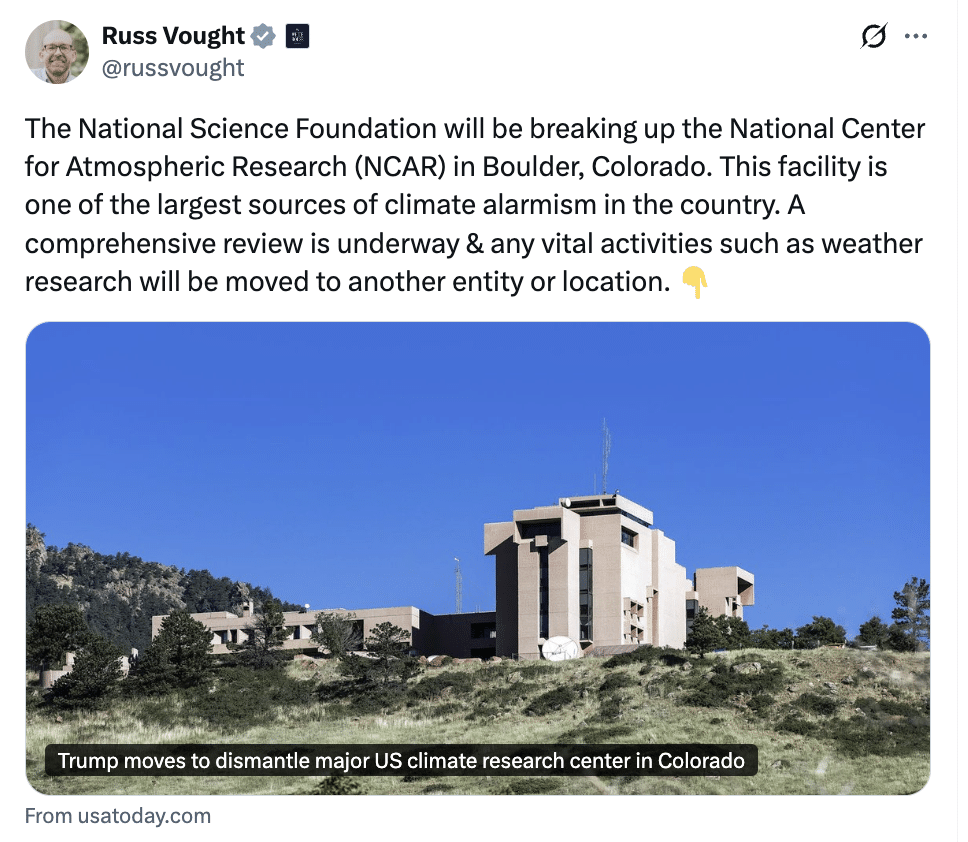
One (very) simple example really resonated with me, at least. In a piece explaining the value of NCAR to Americans in advance of Trump’s assault on it, It’s just a list of eight things that are not (as Russ Vought targeted) “climate alarmism.”
In accessibly wonky terms, it translates some of the things NCAR does — like making flights safer — into things people care about.
As a child, I remember hearing news stories about commercial airplanes crashing due to wind shear. Microbursts, which are localized downburst of sinking air associated with thunderstorms, were often the culprit. The Low-Level Wind Shear Alert System developed by NCAR researchers has helped to virtually eliminate microburst-related wind shear crashes. Such advances, along with Terminal Doppler Radar, are examples of the R&D machine at work for our benefit even as you may not realize it as your plane takes off or lands safely. Additionally, many of the computer algorithms used to alert pilots and airline managers about turbulence were developed at NCAR. Likewise, NCAR’s aircraft icing products have been a staple in the aviation industry and distributed by NOAA’s Aviation Weather Center.
Regular fliers are already outraged by the continued enshittification of air travel, including Crash Sean Duffy’s reversal of consumer protection rules imposed by Pete Buttigieg.
Here’s one aspect, turbulence, that Trump is actively planning to make worse.
Again, I think all of these are really good stories. I’m just looking ahead — not to elections, or even to what Khan will do as a key aide to the Mayor of New York — but to ways we can better tell stories about what Trump took away, about what Trump stole from the American people, so we can hold him accountable.


Excellent points. I would just add one edit to the piece and the last sentence in particular. If we really want long-term productive change, we need to tie all this to the Republicans as enablers as well. If Trump died tomorrow, many of these problems would likely continue. We need to emphasize in this story-telling that it’s not just Trump; it’s the Republicans who are doing harm to our country and beyond.
Yes!! All of them. The Never Trumpers, etc. All of them who facilitated and smoothed the way for a Trump Republican person..
The air will tell the story, the water will tell the story, the climate, the roads, the courts, the schools and so much else. I don’t think it’ll take too long to see the environmental catastrophes of the fifties and sixties again.
The products on the shelves will tell the story, the conditions in urban areas, the poverty in rural areas. I don’t think the repubs will be able to blame this on Biden. It’ll take decades to ameliorate.
The people on the street will tell the story. The health of the American people will tell the story. How long will that take to fix?
But those stories are trailing indicators. By the time they are noticed and irrefutable (a “boiling frog” situation) much harm will have already been done. We need to tell irrefutable stories about here and now.
Those trailing indicators are here now. All the day to day effort which keeps things moving and maintained. How long til the trailing indicator of health insurance makes itself felt?
How do you tell zealots their faith is misguided?
I don’t think it’ll be too hard to dissuade the zealots when they see they are getting less than nothing for their zealotry. And that starts in a week.
(And he ain’t gonna last too much longer. Always best to pick a young middle-aged, physically vigorous guy for dictator.)
It’s tricky, though, when he’s had so many enablers, starting with Repubs in Congress and followed closely by six faux jurists. “They said I could,” and he’d be right.
The problem for me, and for the many friends and neighbors I talk to about all this, is the firehose aspect of the Trump administration’s depredations. There are simply too many horrors for most to sort out, and universally they report feeling overwhelmed.
My close friends who watch the news all day have become paralyzed. They’ve turned their attention to redoing their floors, with CNN blaring mercilessly in the foreground. I try to counsel picking an issue (mine has been the cruelty directed at immigrants, now hitting close to home) but during these shortest days of the year I find it hard to stay on message, and not simply give my attention to family stuff and the new kitten.
January will be my hardest test. it always is. I want to focus on something that matters but just surviving myself typically takes most of my will (I have a history of suicidal depression that surges this time of the year). I would appreciate anyone’s very specific suggestion on where I can divert my own pain to helping others without passing the kind of background test designed to filter out people like me with a history of mental illness.
I feel your pain.
We’ve passed the shortest day. Nights will get shorter, days will get brighter.
I make sandwiches for somebody I know. It’s a small thing but it helps them get on with their life.
gruntfuttock, I have found that it’s the small things that make the most difference. First, they are doable: making a sandwich is a task that wouldn’t seem daunting. More important, you spread your good wishes in an immediate (and also not intimidating) way: you get to *see* the effect.
This is a beautiful idea.
I make sandwiches for deposit in the Love Fridge (a series of 24-7 little food pantries here in Chicago). Today I added bags of holiday M&Ms. I could just put the sandwich makings in the fridge/pantry cupboard, but actually making the sandwiches does me a world of good.
[Thanks for updating your username from “Annieb” to meet the 8-letter minimum. Please be sure to use the same username and email address each time you comment so that community members get to know you. /~Rayne]
Ever try these – SAD lamps? In this case SAD is an acronym (Seasonal Affective Disorder)
https://nymag.com/strategist/article/best-sad-lamps.html
I got the Carex daylight elite based on this article. Yesterday I used it for the first time. This morning I felt better when waking up than I have in decades. Everyone is different, and every day is different, but I’m glad that I finally took that step.
I have tried them, Matt, many years ago. My now-retired psychiatrist lent me this large, unwieldy device that I put some effort into using, because my difficulty with January (especially the early part of it) goes back a long way.
Sad…ly, the device did provide lots of light but the light didn’t seem (after a consistent month) to help my mood.
But it’s a great suggestion!
As an alternative to SAD lamps, you might want to consider using LED plant lamps. GE makes good ones that look white, so no weird purple light. I use loads of them for my plants, and they cheer up the room, which looks sunlit any time of year. I have them on a track lighting track over the LR window. They’re not too hard on the electric bill if you don’t overdo it.
Perhaps a few thoughts may help at this time of year .I set up a Go Fund Me for an organization that helps kids with cancer , plus their families with paying for hotels and activities during these intense periods . Just by chance a friend told me that he lost his son and they provided food and support for 4 months before he passed away and he sang their praises to the heavens ! So it feels terrific to drop off cash plus I have donated artwork and will help the Audubon Society as the kids need to see wild birds in a clean environment when they recover ! And your previous insights are incredibly thought provoking so please be aware that you have a huge artist / educator admirer here without any political. talk for a moment .
I’m curious, GoodKarma–why did you set up a separate GoFundMe instead of donating directly to the organization (sounds like St. Jude)? I donate directly, and I would appreciate knowing if I’m not helping in the best way possible. Thanks!
Why that’s a very good question as I caught long haul covid and have had it 4 times now from my students ! Not in a position to donate a great deal but this seemed to offer the best possibilities for helping and I’ve knocked myself out for art related projects for kids so this is second nature …Aquariums and martial arts may help too …Stay smiling please ! I care obviously .
[Welcome back to emptywheel. Please use the SAME USERNAME and email address each time you comment so that community members get to know you. You attempted to publish this comment as “Good Karma” triggering auto-moderation; spaces and punctuation matter. It has been edited to reflect your established username. Please check your browser’s cache and autofill; future comments may not publish if username does not match. /~Rayne]
Lastly , many kids need mentors .I loved helping them with papers ,books and things that we take for granted it does change their lives , and ours .Big Sisters for you and we loved talking about world issues also , besides how to open a bank account .
[Moderator’s note: please see your comment at 11:01 pm. /~Rayne]
I’m involved with a local Indivisible group. Like many places in the country, when the SNAP crisis hit, we organized to serve hot meals to people who needed food. We did this 4 Saturdays in November. Members cooked up casseroles, soups, stews, and chili, they baked bread and desserts, and we served them in the basement of the church that provides our meeting place. Since this was out of the blue, we didn’t get a huge number of people (we prepared enough for 160 people each week) but everything not served was packaged as individual meals that were distributed through the same church, and they went fast. By the fourth Saturday, it had turned into a social event for the volunteers and people from the community–decks of cards pulled out, conversations held.
It was a lot of work, but we are talking about how to make this an ongoing thing in 2026. It wasn’t just about feeding people, it was about the interaction and human contact people need.
You might consider finding where food is served to people in need and volunteering. The work of preparing, serving, and cleaning up is a good distraction, it’s tangible help, and you can connect with folks. I wonder if the loss of connection among people is a hidden factor that has led to the bleak political time we are in.
Nord Dakota, I live in one of the poorest neighborhoods of New Haven, which is a sanctuary city; this neighborhood has the highest percentage of immigrants, and ICE has made incursions among my neighbors. I moved here 19 months ago (from a much more upscale part of town) and have wanted to do more here, super-locally.
I haven’t missed any protests. Our indivisible group hit a road bump a few months ago because the most galvanizing member’s parent died, but we are rallying each other.
But in this economy, I know that people near me must be struggling and hungry. (Hell, I’m struggling…but ICE would have a hard time deporting *me*). Your experience/dedication with feeding others is inspiring; I paid for college by working in food services, so it’s pretty familiar! Thanks for a great idea.
“The Storytelling We Need …”
At the risk of stating the obvious: “Notice and Accountability” are two sides of the same coin and are most effective when they are formulated symmetrically:
For each of the many failures of the Trump administration, risk is created, thereby making the harm that accrues possible, perhaps likely, maybe inevitable. By describing, in detail and ahead of time, both how the risk that the administration creates foreseeably causes various types of harm, the administration is put ON NOTICE. So if/when the harm does accrue there is already established, in a descriptive statement, an “If (risk)…, then (harm) …” / “cause and effect” relationship. This makes the administration both ACCOUNTABLE for that harm (“But for …”) and subject to assertions that they intended the harm to occur (“Cruelty does seem to be the point.”). Here, Marcy has done this well. Thank You.
Through stories well told, “Notice and Accountability” is its own form of risk management and may prevent future harm that otherwise might be inevitable. Having gone to school in Boulder, Colorado … those working at the very prestigious NCAR (“EN CAR”) were considered among the best and brightest. I hope that they, in particular, are allowed to continue to do their lifesaving work.
Every year 2nd graders in the Boulder Valley School District studies weather as one of their science units. The pinnacle of that study is a field trip to NCAR, where those scientists Mr. Raven lauds share their knowledge and expertise with all these excited 7 and 8 year olds.
They’d come into the art room so jazzed to create collaborative murals illustrating various weather events.
NCAR and all the other federal labs in and around Boulder are such an important part of the community on so many levels, and do such necessary and amazing work for our whole country. It’s pure insanity to dismantle them. Unless of course, you’re a felon and thief who wants to part everything out chop shop style.
This post is why the decision by Bari Weiss to spike a well-vetted 60 Minutes piece yesterday on the CECOT prison to which a bunch of ICE detainees were sent is such a big deal.
60 Minutes built itself on long-form video storytelling, something quite unique in the news business up until the birth of cable news networks. “Here’s a story that takes more than 180 seconds to tell. To do it justice takes 15 minutes or 30 or maybe 60. But unlike the evening news, telling these big stories is what we do.”
Back in the day, a CEO or government worker being greeted by their office administrator with the words “60 Minutes is here to see you” was the very definition of “You know you’re going to have a bad day when . . . .” No one wanted to see Mike Wallace sitting in their waiting room.
Now Trump is going after the storytellers.
CBS caved when Trump sued them for the way 60 Minutes edited an interview with Kamala Harris. “It’s only $16M,” said CBS, thinking this was a one-off. But Trump learned a lot about CBS at that point. He learned they could be pressured. So he kept pushing.
CBS hired noted rightwing flack Bari Weiss to run their news division, hoping this would placate Trump and allow their various mergers and acquisitions to go forward. But the bully is not placated by compliance. The bully is emboldened.
So now, Bari Weiss gets a veto on every story at CBS News, and she’s not afraid to use it.
Storytellers matter, and I suspect a lot of CBS News storytellers are looking for a new place to do their storytelling unimpeded by Trump and Weiss.
60 Minutes has long had its problems, like all corporate media; their ventures into “true crime” territory have made the worst of Dateline look like Ida Tarbell. But that was before the Harris interview capitulation; as you note, Peterr, it certainly seems to have signaled to the bully that he could have his way. And so he has. Again.
As EW so insistently notes, if the powerful won’t stand up, it is up to us–if nothing else, to take their power away. I found some reason to watch 60 Minutes segments before, but none now.
Yep, they have to for their own professional integrity if nothing else. Amazing how much we can lose in just one year.
Thing is, the 60 Minutes CECOT exposee exists and people will clamor to see it. The addition of Stephen Miller won’t help the administration.
In other Trump violations of the law, ‘Bring it on,’ says Mr. Smith to Washington, ‘and let me speak in public.’
As I understand this situation, Bari Weiss wanted them add a segment with a Trump admin spokesman presenting the WH POV. Except that the 60m reporter insists they contacted the WH multiple times and each time the WH declined comment, so…
Maybe this segment will see the light of day if clamored for enough by the public, but they’d probably have to insert a clip of Stephen Cheung railing about how the whole piece is fake news concocted by radical left lunatic reporters (and that’s the best-case scenario). Scott Pelley made a public speech a week ago saying in effect “They haven’t touched us yet” (they=Bari Weiss, us=60 Minutes). Well Scotty, only took a week…
Who knew putting Barely Wise…erm, Bari Weiss, in charge of an award-wining, historic, legacy news organizatin would have such a consequential adverse effect.
One of the things the legacy media usually does poorly is to cover the other media outlets. I was curious, so I checked the ABC, CBS, and NBC News websites. NBC has a story about the 60 Minutes debacle near the top of its page. CBS has a story far, far down its front page. ABC has no story at all at about 7:25 CST.
ABC is compromised by being up for sale. It can’t afford to offend potential buyers. *sigh*
We have to do something about media ownership as well as media business models in this country.
Gotta say it once more. Sorry, but I’ve seen it too often. That’s just the way the matzoh crumbles; into a half-baked cracker.
Sleepy TACO: “Energy prices are down.”
Reality: My electricity rate is 19% higher from a year ago. Heating oil is 25 cents/gal higher from a year ago.
We have an interim 11% increase pending PSC decision on a 19% requested increase in January. By any chance are you in Xcel’s service area?
At least when my parents belonged to a rural electric co-op, they would get dividends from time to time.
I’m in eastern PA so I’m with PECO.
Michael Lewis, possibly, is already working on a new book about this. If he is, it will complete a trilogy of his works on the unsung workers in public sector bureaucracy to go along with his books The Fifth Risk and Who Is Government?
My notes on The Fifth Risk are at https://hubeventsnotes.blogspot.com/2019/11/the-fifth-risk.html
The story is this: The United States of America is no longer under nation of laws. We are ruled by a dictator who controls and ignores the law. The only hope we have left is that the military will refuse the illegal orders he’ll give when Republicans lose the midterm elections in a landslide. Trump will order all voting machines impounded, void the election results and declare himself president for life. When protesters surge into the the streets, as they must, he’ll order the military to shoot to kill (blowing up innocent fishermen off Venezuela against all international and military law is the prelude) and the future of the nation will depend on whether the military will refuse those orders. That’s why Trump went ballistic when Mark Kelly et al reminded the military of their obligation to refuse. Who will stop Trump? Democrats are powerless, Republicans are owned, the Supreme Court is owned, most of the press is owned and court orders are a joke to Donald Trump and his billionaire cabal. All our institutions are failing. Unless we face that now, we are already lost.
I’m a pessimistic cynic and even I think that’s too dark. Frankly, I have hope that the US military will be able to find in itself the fortitude to tell their CinC to pound sand if/when he gives them orders to use force domestically. Beyond that, there are still many levers of civil society still open to the loyal opposition, as have been documented here in recent posts.
It’s not yet as dark as 1939, and even then the British knew to carry on the fight. I would hope freedom-loving Americans would be able to do the same.
Sean
I agree with both of you. We’ve been ambushed by a failure of imagination, and it behooves us to at least bring the darkest, and more dire, possibilities into the light, so as to be prepared or rationally dismiss. We must recognize that there is no bottom to Trump, and many of this cultists will leap off the cliff willingly. A new social order is coming, for better or worse; we need to invest In our vision so that their’s doesn’t come to fruition.
Trump admin pauses leases for some offshore wind projects citing ‘national security concerns’
https://abcnews.go.com/Politics/trump-admin-pauses-leases-offshore-wind-projects-national/story?id=128616972
– and –
Trump administration’s coal-plant meddling will harm WA ratepayers
https://www.seattletimes.com/opinion/editorials/trump-administrations-coal-plant-meddling-will-harm-wa-ratepayers/
Then…
Trump Admin touts its embrace of new technology.
https://www.whitehouse.gov/issues/tech-innovation/
=====
That steady diet of McDonalds is not working fast enough for me.
My brain is playing tricks on my eyes. I read “national security concerns” in your comment as “fictional security concerns.”
@P-villain December 22, 2025 at 6:15 pm
======
Every “security concern” that the dumbass raises is fictional.
https://www.msn.com/en-us/news/politics/judge-strikes-down-trump-order/ar-AA1SSi5W
======
That idiot orange clown thinks all he has to say is “national security risk” and his EOs are safe.
Is this possible? Even if so, is it worthwhile?
During Trump’s first term I had hoped that the legacy media had enough sense of self-respect that they could be shamed at times to do a better job of telling the story. I no longer believe that is true. Yes, many of the journalists do good work, but they do not consistently and coherently tell the stories that need to be told. And, of course, the information landscape has changed dramatically.
The smaller progressive media like Emptywheel often do a great job telling the stories that need to be told. But I’m afraid the accumulation of these disparate voices also does not tell a coherent story that reaches enough of those that need to hear it. And, as mentioned, because there is a firehouse of news blasting at us all the time, it is even harder to paint a clear picture.
So, out on a limb here, but is it possible for a number of these excellent progressive voices to coordinate the storytelling by focusing on one topic (e.g., immigration, science/climate change, corruption, the constitution and the law, the economy) every two weeks or so. Tell the same story through different lenses. But keep repeating the message/the story that needs to be heard. Will inundating the new information environment with a (mostly) one-topic focus with great examples and analysis possibly lead to breaking through and help people form a clear picture this particular story?
Just wondering.
For CANADIANS here:
https://bsky.app/profile/jasonparis.bsky.social/post/3mam565pyes24
4:05 PM · Dec 22, 2025
This was RePosted by National Security Counselors [sorry, forgot his name].
There are no links available.
Globe and Mail journalist Andrea Woo:
https://bsky.app/profile/andreawoo.bsky.social/post/3mam7quktns2u
4:51 PM · Dec 22, 2025
https://toomuchtv.substack.com/p/transcript-60-minutes-cecot-story
Ken White [PopeHat] RePosted this THREAD from Akiva Cohen:
https://bsky.app/profile/akivamcohen.bsky.social/post/3mamb5jkqms2g
5:16 PM · Dec 22, 2025
Marisa Kabas provides a link to download here:
https://bsky.app/profile/marisakabas.bsky.social/post/3mamcha3al22d
5:39 PM · Dec 22, 2025
WATCH: The 60 Minutes CECOT Segment
I was sent the CECOT segment anonymously in a group chat.
https://www.muellershewrote.com/p/watch-the-60-minutes-cecot-segment
Allison Gill Dec 22, 2025
It’s apparently been uploaded to the Tube of You, according to a comment in this post, and Boasberg has ruled that the government f’d up by sending people there.
https://www.dailykos.com/stories/2025/12/22/2359675/-So-spiking-that-60-Minutes-story-was-meant-to-head-off-judge-s-CECOT-ruling
harpie! You are such a blessing here!!! Thank you!
It’s not Trump any more, although that was bad enough. It’s just his sickness talking now. He should be in assisted living. And he is surrounded by blood-sucking ghouls.
Trump’s body is rapidly breaking down, laboring with simple tasks, hemorrhaging energy, riddled with the unmistakable tells of a man whose systems are failing. Have you seen the way he clings to a lecturn as it were a walker?
Trump’s hate-addled mind is becoming more and more clouded in an ever-thickening haze of deterioration, and almost certain sundowning. His outbursts have grown more impulsive, his decisions have become more desperate, and the once indestructible facade of strength is crumbling.
Trump is dying before our lying eyes.
“His outbursts have grown more impulsive” … but up to this point they apparently have not become physical. States of fear-based high emotions, together with contaminated thinking, can easily progress to overt physicality towards those who are seen as an immediate threat. Trump’s Air Force One confrontation with the reporter included an emphatic “Quiet Piggy” verbalization, along with a provocative pointing of his finger. This arguably is just short of an assault, and as such is evidence of risk of future battery (remember, we have three more years). The extent of harm that would accrue, were this to happen, should go without saying. Democratic lawmakers should put their republican colleagues ON NOTICE that, should such a “progression” take place, they will be HELD TO ACCOUNT for beginning immediate impeachment proceedings. (FYI: For me to think that it would have to come to this makes me sad.)
The Democrats have a fork ahead in their road: whether to advance left-wing populism and attack the brozillionaire class explicitly, or whether instead to keep courting upper middle class suburban voters with a more moderate tone.
The party that turns on the billionaires first will win elections for awhile. Particularly if Musk, Thiel, etc. are portrayed as hostile foreign interests. Which they should be.
“Attack the brozillionaire class explicitly”… Shit, the amount the brozillionaire cohort would have to sacrifice to solve a lot of problems is ones they’d hardly notice. Same with regulation.
I know what they say about the repetition of talking points on the right. We are not propagandists.
I heard Marcy’s post as a clarion call to expose the consequences of not only the Trump administration’s corruption, abuse and mismanagement, but also its immediate and ongoing institution of Project 2025 plans that Trump denied during his campaign and all the way into the first days of his second disastrous presidency. Not to mention the whole cast of macabre characters starting with Musk-DOGE and including his Cabinet officials.
I appreciate thinking together about effective solutions. At the risk of being a doomsayer w/out a clear solution, I’d like to name another aspect of our current dilemma.
In order to educate most people about a topic (ex: wealth disparity & relationship to democratic processes), several things need to be in place: reliable narrator(s) – such as we have here; consistent and iterative facts/data; attention over time so layering of data and meaning making can occur; and compassion relative to the topic woven throughout as needed.
I’m sure I’ve left something out, but it’s been awhile since I was regularly constructing penetrating narratives that stuck (or I hoped would).
This is why I have so much contempt for the tech broligarchs – because their vile/evil, profit driven, attention grab is a cancer on our world.
Whammy
AdVance with wiles and politics:
Feeble steps, slips of the tongue,
The 25th seeps into ‘26,
Snatch what can’t be unrung.
Trump’s 2025 brought fear,
His fubar full of whammy,
But kudos and good cheer
for Eileen Higgins in Miami.
The Virgina Indictment Signer:
no ham sandwich or pan burger,
Who’s left to wine and dine her,
Let’s ask Abigail Spanberger.
Habba (& Trump’s AG) prefers he
clam up on her new work peril,
But popping up to New Jersey,
Here’s props to Mikie Sherrill.
Trump’s old con, mojo’s gone, he
falls asleep in meetings,
Yet for Zohan Mamdani
he had a vibrant greeting.
AdVance with wiles and politics:
Feeble steps, slips of the tongue,
The 25th seeps into ‘26,
Snatch what can’t be unrung.
…wiles/Wiles…I think I get it! While Susie’s Wiling away for awhile, I’ll idle away for an idyll on Epstein’s rape isle. If only I could stow away on his private jet…unfortunately I am *way* overage.
I love the positivity ; )
I just ran across this fantastic interview on a Volts podcast
https://www.volts.wtf/p/the-cure-for-misinformation-is-not
(Sorry, I’m not sure how to post a link on this blog, and I was unable to find the explanation somewhere.)
The ideas in this conversation describe important ingredients towards helping us understand how to rebuild belief in government, science, etc.
Another excellent column with a great message – We need to re-frame our arguments against the Trump regime in more energetic terms. I went to a seminar put on recently by the Minnesota DFL, which is the Democratic Farmer Labor party in Minnesota. The speaker talked, of course, about George Lakoff’s “framing” and how important it is to put things into the correct emotional frame. Trump always talks about Democrats “stealing things”. We need to talk about how Republicans are STEALING our clean air and RAPING our land and VIOLATING our bodies. Make it visceral. Make it personal. Republicans do.
This aspect is a huge part of why one of the tactics used by US (GOP) big oil coalition (& int’l cohorts) was so devastatingly effective: their climate science ‘debate’ framing.
It’s not just that for decades, they insisted that ‘the science’ was still a matter of debate, but only scientific debate, and exclusively among ‘climate’ scientists.
This framing, among other things, not only figuratively, but literally exsanguinated environmental relations as a matter of public interest and political debate; much further than they already were in our culture, which was already a considerable baseline difficulty in terms of not just the challenge of jerry-rigging these matters into forms conducive to journalistic ‘storytelling’ training, but what is left outside of the frame by the limitations of protagonist/antagonist narratives.
To say nothing of its convenience to GOP identity politics narratives and how that makes matters worse in terms of communicating about anthropogenic aspects of climate change and the point being policies.
#tu
“…Republicans are STEALING our clean air and RAPING our land and VIOLATING our bodies. Make it visceral. Make it personal.”
And the effects will be evident, too. Brutally, in your face. At 73, I remember how things were before the environmental cleanup, and before integration. I’m thinking many who aren’t old enough to remember how it was may not believe it’s possible. Remember acid rain?
YES Marcy! Dynamite.
‘Trump’ is authoritarian framing. So dangerous. Ruth Ben-Ghiat uses the term, “personalization of politics.”
And there is no excuse for how long the far right in USA has gotten away with pinning identity politics on Dems; another, more insidious form of that.
As if I don’t have Rush Limbaugh on an indelible loop since the late 80’s, like a static night terrors tape of getting my kidneys pounded by dirty cops, reminding me why I wince and go cold every time someone uses the sacharin sweet term, “communities.”
The relentless terrorist harangue against Feminazis, Pervs, Gang-bangers, ‘Liberal NYT’ -hah, and oh, what’s this? Treehuggers. Helluva birthmark, Hal.
(That’s a Gary Larsen Far Side cartoon of one deer to another with a bullseye on his back.)
What’s diabolical about ‘ex’ GOP operatives’ helicopter advise to Dems every Morning Joe, not to argue outside the omissions of the ‘Trump’ vs democracy frame they’ve foisted on us, lest we make them uncomfortable and they squeeze harder, is that, to the extent that anyone followed that advise, we surrendered our democracy in advance.