
Brian Cole’s Lawyers Admonish Jeanine Pirro for Yapping Her Mouth
When DOJ released its detention memo for accused January 6 pipe bomber Brian Cole, the MAGAts showed almost no interest; they’re too busy claiming to have discovered benefits fraud in Minnesota first charged under Merrick Garland’s DOJ.
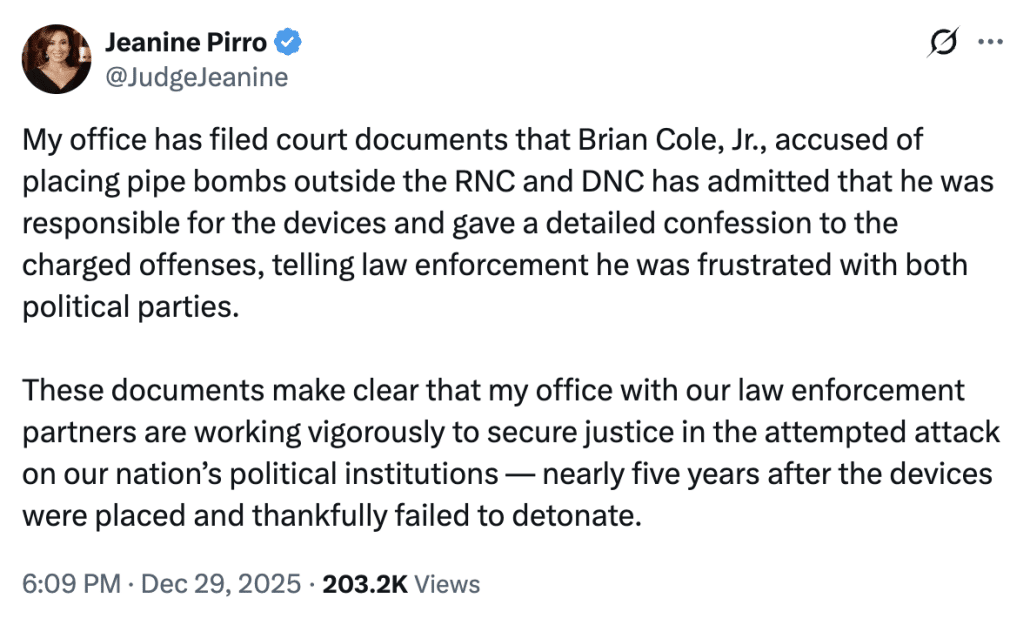
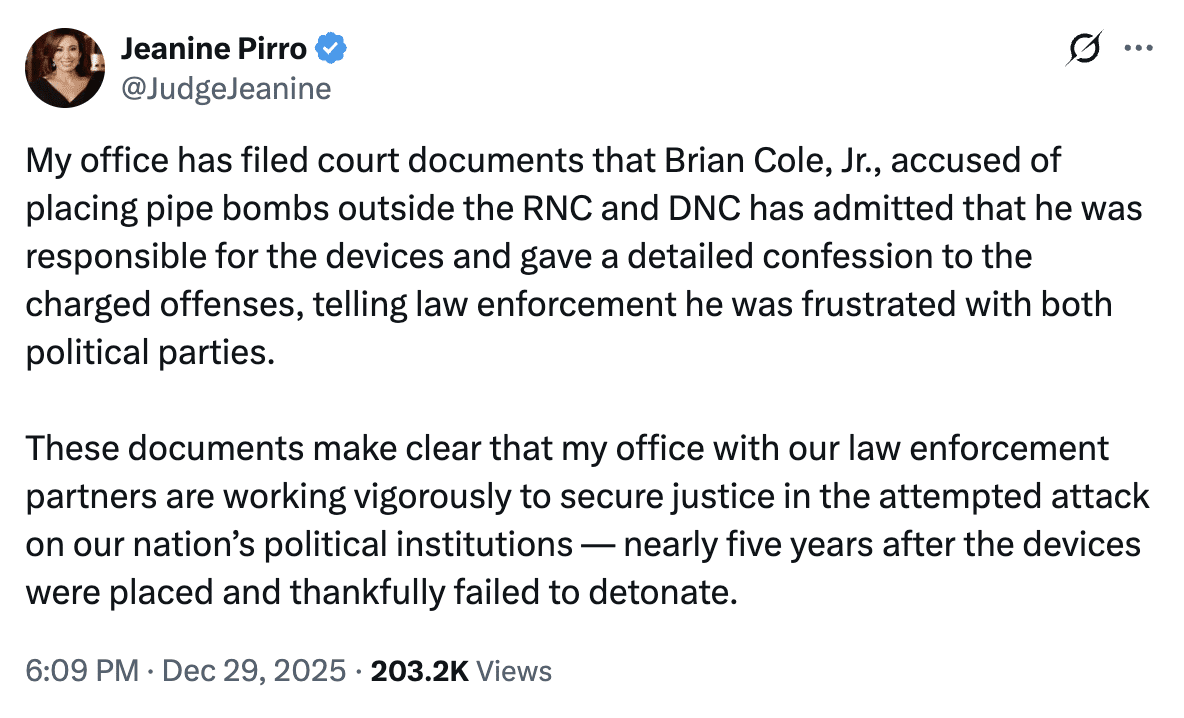
But Jeanine Pirro did. She want on social media and repeated the apparent miscitation of Cole’s own words I laid out here, treating a comment made in the present tense this month — “I really don’t like either party at this point” — as if it were a comment about his mindset on January 5, 2021.
Unsurprisingly, Cole’s attorneys took note, arguing in their bid for bail that the “government-induced excitement” around Cole’s arrest should not factor into bail consideration and in fact is a violation of local rules about prejudicing a case.
The government-induced excitement around the arrest of Mr. Cole should not take this Court’s focus away from two essential principles of law that govern bail hearings.1
1 Indeed the U.S. Attorney has made numerous comments in contravention of Local Criminal Rule 57.7(b), specifically concerning the “existence or contents of any confession, admission, or statement given by the accused” ((b)(3)(ii)) and “opinion[s] as to the accused’s guilt or innocence or as to the merits of the case or the evidence in the case” ((b)(3)(vi)). See https://abcnews.go.com/US/pipe-bomb-suspect-disappointed -2020-election-results-us/story?id=128157568 (U.S. Attorney Pirro telling the media that based on the evidence, it is “unmistakable” that Mr. Cole is guilty and that “[t]his guy was an equal opportunity bomber.”); see also https://www.facebook.com/judgeje aninepirro/posts/my-office-has-filed-court-documents-that-brian-cole-jr-accusedofplacing-pipe-b/1424070829083142/ (U.S. Attorney Pirro posting on Facebook that Mr. Cole “has admitted that he was responsible for the devices and gave a detailed confession to the charged offenses”).
The rest of their opposition memo provides mere hints of how or whether they might defend this case.
It describes the evidence against Cole as circumstantial evidence of past guilt, not proof of ongoing risk at issue in the present.
The government’s showing is entirely retrospective and circumstantial. Even if credited, the government’s evidence describes an isolated window on a single evening nearly four years ago. It does not point to a “pattern of troubling activity” that would typically warrant detention in other cases. Klein, 539 F. Supp. 3d at 155. No device detonated, and the government has not alleged any comparable conduct or dangerous affiliations in the years since. This circumstantial proof—absent a direct forensic tie or evidence of ongoing threats—cannot overcome the Bail Reform Act’s default in favor of release subject to appropriate conditions. See Munchel, 991 F.3d at 1283 (The “threat [to the community] must also be considered in context.”).
It describes the pipe bombs as having “weapon characteristics,” perhaps questioning whether they really were functioning bombs at all.
According to the affidavit, both devices were rendered safe by the U.S. Capitol Police and later assessed by the FBI Laboratory to have “weapon characteristics,” with components consistent with improvised explosive devices.
It cites relevant DC Circuit opinions on pretrial release that just happen to be January 6 cases, here, Federico Klein — the former Trump State Department official with ties to Argentina’s fascist governments who was released on pretrial bail but ultimately sentenced to 70 months in prison — and Eric Munchel (AKA the Zip Tie Guy), whose pretrial release set the standard for many other January 6 defendants, but who was ultimately sentenced to 57 months in prison. Elsewhere the filing cites Bruno Cua, who was sentenced to just a year in prison after his pretrial release, largely because he was so young and impressionable during the events at hand.
All three, of course, have since been pardoned.
But Cole’s attorneys don’t mention those back stories to the detention precedents which must be applied to Cole too. Nor do they explain what they mean when they say the specific conditions that led young Bruno Cua to stalk the halls of the Capitol created a “specific risk profile for Mr. Cole,” just like it did Cua.
Finally, the unique conditions surrounding January 5–6, 2021, are unlikely to recur in a way that would present the same risk profile for Mr. Cole.
But that comment suggests they’re skeptical — perhaps have already seen reason to be skeptical — that Cole was telling the truth when he asserted there was no tie between his alleged planting of the pipe bombs and January 6, as the government’s detention memo asserts but does not quote directly.
They have reason to do that, of course. If planting the pipe bombs was part of January 6, then Cole may already have been pardoned, just like Klein and Munchel and Cua.
They do, however, confirm that Cole has been diagnosed with being on the spectrum.
Mr. Cole is an African American adult who has been diagnosed with Autism Spectrum Disorder, Level 1 and with obsessive compulsive disorder;
And like most bail memos, they include letters from character witnesses.
The only sign that today’s combined detention hearing and preliminary hearing, scheduled for 1PM before a Magistrate Judge who presided over only a (relative) handful of January 6 cases, might harbor some surprises is a repeat of their more explicit demand in a different filing that DOJ prove probable cause.
The defense understands that the detention hearing will begin with preliminary discussions that concern whether a rebuttable presumption that Mr. Cole should be detained arises in this case. The defense’s position is that the government cannot continue to keep Mr. Cole in custody absent a valid finding of probable cause.
One reason to do that is it raises the bar on pretrial detention.
True, the Bail Reform Act creates a rebuttable presumption “that no condition or combination of conditions will reasonably assure . . . the safety of the community if . . . there is probable cause to believe that the person committed” one of an enumerated list of crimes. 18 U.S.C. § 3142(e)(2). But for purposes of making that determination, “[a] grand jury indictment, by itself” is what establishes the probable cause “to believe that a defendant committed the crime with which he is charged.” Taylor, 289 F. Supp. 3d at 62 (quoting Stone, 608 F.3d at 945); see also United States v. Smith, 79 F.3d 1208, 1210 (D.C. Cir. 1996) (“[T]he indictment alone would have been enough to raise the rebuttable presumption that no condition would reasonably assure the safety of the community.”)
But who knows. There might be more.


Yes, I’ve been curious about where a grand jury indictment fits into this. Not a lawyer so just the question, not an opinion.
DOJ had tried to push the preliminary hearing out so they could come in with an indictment. Which makes me wonder why, from a defense standpoint. Do they intend to raise issues — possibly the pardon, possibly DOJ’s misrepresentation of Cole’s motive and ties to Trump (thus the import of his race) — at today’s hearing that might make it harder to get an indictment?
I’m not sure.
It strikes me as a way to semi-publicly attack the DOJ for semi-misconduct, both past and future: “Quit trying to try things in the press and do it in the courtroom. Pushing the hearing back simply serves to give the DOJ more time to play to the public.”
Given the pattern and practice of Pirro, Lindsey the Insurance Lawyer, Bondi, Patel, et al. to do just that, it certainly is an approach worth taking, both pushing back inside and outside the courtroom.
I don’t understand this:
“It describes the pipe bombs as having “weapon characteristics,” perhaps questioning whether they really were functioning bombs at all.”
” According to the affidavit, both devices were rendered safe by the U.S. Capitol Police and later assessed by the FBI Laboratory to have “weapon characteristics,” with components consistent with improvised explosive devices.”
That looks to me like they’re suggesting that it was intended to be a functioning bomb (IED). If it wasn’t, how could it have been “rendered safe?”
I would expect that the “rendered safe” line means either that they separated the black powder from an igniter or detonator or that they soaked the black powder in water to keep it from exploding. Either one of those approaches would make it unable to explode. It could have been a non-functional as a weapon but still dangerous if he had an igniter in the black powder but a nonfunctional ignition circuit. Some low current igniters can be set off accidentally by strong radio waves, for example.
[I am not a bomb disposal tech but I do use small quantities of black powder in hobby rocketry]
Retired US Army EOD tech,
In every case you approach the improvised device as a device that is able to cause harm or death, until determined to be inert. In either case the approach is the same, use a render safe procedure (RSP), that separates parts of the device so that it cannot function as designed.
Most procedures that we use are classified so people who create said devices do not know how we do what we do.
Rendered safe means
1. A live(can explode) device has been rendered safe(unable to explode)
OR
2. A device is determined to be inert. (is not able to explode in any manner)
Knowing these were pipe bombs I know the normal RSP procedure they probably used, and whether live or inert, the procedure is used .
One way defense attorneys attack cases like this is to undermine the claim that these were really bombs. There’s a bunch of reasons to think that may, in fact, be true in this case, particularly given the uncertainty about whence he got black powder (the filing claims he made it but does not show literal receipts).
You may be overthinking this. We can probably take that as meaning a CP officer took steps to leave the apparent explosive device in a state where it could not be detonated, whether it was filled with black powder or sawdust.
Cut a wire connecting the timer with the pipe, for example.
In real life EOD techs do NOT cut wires. Too many ways to design a devise where cutting said wire causes the devise to function, and making your day go very bad.
I’m not able to read anybody’s mind but I think Marcy’s implying that Pirro may be conflating “rendered safe” with “deemed safe” or “deemed inoperative” — a similar deception to her verb-tense shell-game ploy.
Rendered Safe is the term EOD techs use all through NATO and US law enforcement. It means a trained EOD tech has done what ever is required to make a explosive device non explosive, and is safe for transport, storage and if needed inspection both technical and criminal.
It has a specific meaning for all civilian law enforcement
Hanlon’s Razor looks like a dull sledgehammer compared with the Trump Administration generally and the DOJ in particular, so it gets harder to parse these cases and filings as time goes on and the decent employees quit or retire.
Here’s a question that might have gotten my check for law school tuition returned to me uncashed, but…”Would pre-trial publicity and public statements by AUSA “Judge” Jeannie potentially taint the GRAND JURY pool and result in a mistrial?”
(Side-note: Lobbying for “Pam Bondi-related head trauma/concussion/brain damage” to be added into the next ICD version)
I think (IANAL) that it’s a good question about Pirro’s motor-mouth interfering with a GJ.
Also, re your request to add a code to the ICD for Bondi’s condition: I would think a genetic abnormality may also play a role. Or over-use of bleaching agents in the area surrounding her brain?
It appears to me that a lot of the ex-media people who have been appointed by this maladministration are still behaving as if they’re in media, not government.
yeah, I’ve noticed that too and I guess it’s all part and parcel of creating a media spectacle and being on tv promoting this administration’s spin and invective
Their media presence was the entire reason for their being hired. After the 2016 election, Trump held auditions for “central casting” types among experts. After 2021, he used Fox News (and worse) appearances as auditions. Rather than getting briefed on their actions, he gets second-hand media accounts, in-person ass-kissing, and staged events as “progress reports”.
The media presence IS their main job, the rest is implementing whatever demands Trump makes of them. He clearly judges them by the media content they generate. His text addressed to Bondi was a demand he see evidence of indictments in the media, not any concern with her ability to win convictions. The performances of people like Patel, RFK. Noem, etc make a lot more sense if you grant what their job really is.
Time to reread Guy DeBord’s Society of the Spectacle and, even better, Some Comments on the Society of the Spectacle?
My notes on these useful books:
https://hubeventsnotes.blogspot.com/2017/04/notes-from-society-of-spectacle.html
https://hubeventsnotes.blogspot.com/2025/07/notes-on-some-comments-on-society-of.html
Amateur bombs can be somewhat “unpredictable”. The weird technical description “weapon characteristics” may be their way of saying it could have exploded. With the FBI we have these days, its hard to say what their intent was, if they had any. I still can’t get over the insanely casual way they handled “Hunter’s laptop”. High school nerds have better process.
A steel pipe with end caps and a timer connection, but without a battery to produce a spark or an explosive mixture inside the pipe has “weapon characteristics.”
But once those (or any) missing components are added, it is a weapon, not a weapon look-alike. “Weapon characteristics” indicates a mere facsimile of a weapon…or a botched attempt at making one.
Thank you. In movies of the 1930s, jailbreaks were facilitated by inmates carving pistols out of bars of soap and dying them black with shoe polish giving the soap “weapon characteristics”. A pointed finger in a suit or jacket pocket offers the same “weapon characteristics”. To my writer’s brain “weapon characteristics” means it is NOT a weapon.
I also see a glaring omission on the list of components on this post
Brian Cole’s Lawyers Admonish Jeanine Pirro for Yapping Her Mouth
1. No battery, thus no power in the device since a timing device and wires are present .
2. No initiating component for the explosive train to function, IE no blasting cap, squib etc
Given the components on the list it could contain weapons type characteristics if assembled in certain ways, and must be considered dangerous and treated as such until a proper RSP is done.
Given that building a fake pipe bomb is still a felony.
This detention memo also seems to show that DOJ does not intend to include, in the indictment, information about the accused’s whereabouts before January 6, and the weeks leading up to it. (Allison Gill in The Daily Beans says they have cited the whereabouts of the accused prior to and after several factory reset around the planting of the bomb, but the data prior to Jan 6 is left out.). Did they not scrape the data, or are they not wanting to show where Cole was, to try to keep him from being connected?
Do they need to chose whether or not to connect him to Jan 6, and will use that data when they chose their direction?
[Welcome back to emptywheel. Please use the SAME USERNAME and email address each time you comment so that community members get to know you. You attempted to publish this comment as “Little old lady who” triggering auto-moderation; it has been edited to reflect your established username. Please check your browser’s cache and autofill; future comments may not publish if username does not match. /~Rayne]
Marcy,
1.20.2025 Presidential Pardon, (per White House.) “all J6 related convictions. …pardoned….” If the indictment doesn’t address defendants, Dec 14, 2024 DC activities and other date’s, will that make it harder for defense to allege J6 insurrection connection, to take advantage of presidential pardon of J6rs? Note FBI quote in detention memo “…The FBI explosives examiner
assessed that the pipe bombs were constructed using all the components necessary to explode and
that they were viable explosive devices.”