
DOJ’s Politically Illegitimate Basis for Political Illegitimacy in Nicolás Maduro Indictment
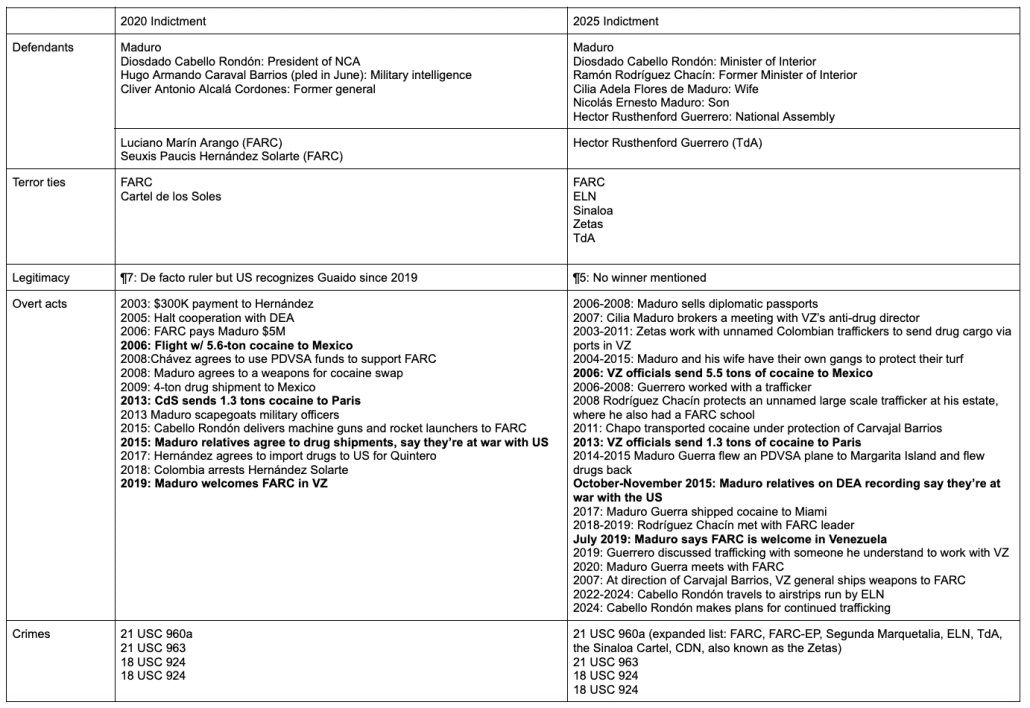
As I’ll explain below (and mapped in this table), the superseding indictment against Nicolás Maduro and his wife unsealed yesterday is a more political document than the one that first charged Maduro in 2020. One important difference lies in how DOJ attempted to claim Maduro is not the leader of Venezuela, which will be a key element required to overcome any immunity claim Maduro will surely invoke.
Before I explain the differences between these indictments, let me stress that both are real indictments, documenting decades of corruption and cooperation with drug traffickers and terrorists. Prosecutors worked hard to pull them together and investigators (in the US and around Latin America) and sources no doubt risked their lives to make it possible.
The charges remain the same as in 2020
Both indictments charge the same four crimes:
- Narco-Terrorism Conspiracy (21 USC 960a)
- Cocaine Importation Conspiracy (21 USC 963)
- Two counts of use of machine guns or destructive devices in furtherance of the conspiracies (18 USC 924)
The latter charges, charging Maduro for possessing machine guns, have attracted some mockery, including from me. DOJ is at the same time arguing that DC must allow semi-automatic weapons and at the same time charging a foreign leader with possessing machine guns. The charges are there (and were put there years ago) because they’re a way to get significant sentencing enhancements for other crimes. The presentencing memo for Hugo Armando Caraval-Barrio, who was charged with Maduro in 2020 and pled guilty in June, added so many sentencing enhancements they’re having a multi-day hearing later this month to fight about which ones apply. But given the evolution of gun prohibitions in the US since Bruen (issued in 2022), Maduro may try to challenge this charge, though Caraval-Barrio pled to those same charges in June.
DOJ includes Sinaloa, los Zetas, and Tred de Aragua for reasons that likely have to do with Stephen Miller’s fever dreams
In addition to adding overt acts that happened since 2020, the Narco-Terrorism Conspiracy charged in the newly unsealed indictment is interesting — and may have further significance — because it added several new cartels that have been deemed terrorist organizations last year. The 2020 indictment focused on FARC, the left wing Colombian terrorist organization that trafficked drugs, and Cartel de Soles (the vague name used for Maduro’s corruption). But in the last year, the Trump Administration has, for the first time (and controversially), designated drug cartels that engage in extreme violence as terrorist organizations. So the new indictment names not just FARC and ELN — Colombian terrorists whom Maduro gave shelter — but Sinaloa and the Zetas, along with Tren de Aragua.
24. It was a part and an object of the conspiracy that NICOLAS MADURO MOROS, DIOSDADO CABELLO RONDON, and RAMON RODRIGUEZ CHACIN, the defendants, and others known and unknown, would and did engage in conduct that would be punishable under Title 21 , United States Code, Section 841 ( a), if committed within the jurisdiction of the United States, to wit, the distribution of, and possession with the intent to distribute, five kilograms and more of mixtures and substances containing a detectable amount of cocaine, knowing and intending to provide, directly and indirectly, something of pecuniary value to a person and organization that has engaged and engages in terrorism and terrorist activity (as defined in Title 8, United States Code, Section 1182(a)(2)(B)), or terrorism (as defined in Title 22, United States Code, Section 2656f(d)(2)), to wit, the following organizations that have been designated by the United States Secretary of State as FTOs pursuant to Section 219 of the INA, during times relevant to this Superseding Indictment: FARC, FARC-EP, Segunda Marquetalia, ELN, TdA, the Sinaloa Cartel, CDN, also known as the Zetas, and each organization’s members, operatives, and associates, having knowledge that such organizations and persons have engaged and engage in terrorist activity and terrorism, in violation of Title 21, United States Code, Section 960a. [my emphasis]
This is one of the things I view as political. There’s far more substance behind the FARC allegations than the Sinaloa and Zetas ones. The Zetas allegation relies on the Zetas’, working with unnamed Columbian traffickers, use of Venezuelan ports from 2003 to 2011. The Sinaloa allegation relies on Caraval-Barrio’s protection of Chapo Guzmán in 2011. Both those allegations took place long before Marco Rubio included the Mexican cartels in his new designations. But by including them in this indictment, DOJ makes this application of such crimes applicable in Mexico, an ominous inclusion given Trump’s overt threats to pull the same kind of invasion in Mexico next.
The Tren de Aragua is likewise thin. In the 2020 indictment, two FARC leaders were included as co-conspirators, but that reflected a sustained relationship with Maduro as laid out in the overt acts. The TdA inclusion here relies on a similar move, including its leader, Hector Ruthsenford Guerrero Flores as a co-conspirator. But his inclusion relies on two overt acts that don’t involve Maduro: Guerrero’s actual trafficking with someone not alleged to be part of this conspiracy, and comments made in a Venezuelan prison in 2019. (These may be the comments that US intelligence services have deemed to be unreliable.)
f. Between approximately 2006 and 2008, HECTOR RUSTHENFORD GUERRERO FLORES, a/k/a “Nifio Guerrero,” the defendant, worked with one of the largest drug traffickers in Venezuela, Walid Makled. Members of the Venezuelan regime helped protect Makled’s cocaine shipments that were transported from San Fernando de Apure, Venezuela, to Valencia, Venezuela, and were then sent by plane from the Valencia international airport to Mexico and other locations in Central America for eventual distribution to the United States. Between in or about 2008 and in or about 2009, GUERRERO FLORES also provided another major Venezuelan drug trafficker with protection for cocaine shipments moving through Venezuela, including by providing armed men who carried, among other automatic weapons, AK47s, MP5s, and AR-15s, as well as grenades. At times, GUERRERO FLORES personally accompanied large cocaine loads as they were guarded by the teams of armed men, en route to airports or airstrips for transport north and eventual distribution to the United States. GUERRERO FLORES was paid a fee per kilogram of cocaine transported or received and he sometimes received an interest in portions of these massive cocaine shipments in lieu of payment. The traffickers that GUERRERO FLORES worked with moved thousands of kilograms per shipment, multiple times per month, resulting in the distribution of hundreds of tons of cocaine to the United States. In or about 2009, Makled was charged with narcotics offenses in this District and is a fugitive.
[snip]
o. In or about 2019, TdA’s leader, GUERRERO FLORES, discussed drug trafficking with an individual he understood to be working with the Venezuelan regime. Over multiple calls, GUERRERO FLORES offered to provide escort services for drug loads, explaining that GUERRERO FLORES and TdA had control of the coastlines of Venezuela’s Aragua State. GUERRERO FLORES, speaking from TdA’s base of operations in Tocor6n Prison, explained that TdA could handle the logistics of every aspect of the drug trade, including the use of storage compartments that GUERRERO FLORES called “cradles” located on a beach in Aragua State. In doing so, GUERRERO FLORES confirmed TdA’s ability to protect over one ton of cocaine.
That is, neither is TdA necessary to substantiate the narco-trafficking charges, which are well-substantiated based on protection of FARC, nor is the substance of TdA’s inclusion all that convincing.
At all.
But no doubt Stephen Miller will use this — a grand jury finding probable cause tying TdA to Maduro — to attempt to renew his Alien Enemies Act deportations.
Adding the family, leaving behind the key co-conspirator
On top of swapping FARC co-conspirators for a TdA one, the newly unsealed indictment adds Maduro’s wife and son as co-conspirators.
The inclusion of Maduro’s son is better substantiated. The indictment alleges that his plane was used to ship drugs, he shipped drugs to Miami, and he met with FARC (though neither he nor his mother are included in the narco-trafficking charge).
The inclusion of Cilia Maduro — who was shipped to SDNY along with her husband — rests on her allegedly accepting a bribe in 2007 to broker a meeting between a trafficker and Venezuela’s corrupt top anti-drug cop.
b. In approximately 2007, CILIA ADELA FLORES DE MADURO, the defendant, attended a meeting in which FLORES DE MADURO accepted hundreds of thousands of dollars in bribes to broker a meeting between a large-scale drug trafficker and the director of Venezuela’s National Anti-Drug Office, Nestor Reverol Torres. The drug trafficker later arranged to pay a monthly bribe to Reverol Torres, in addition to approximately $100,000 for each flight that was transporting cocaine to ensure the flight’s safe passage, a portion of which was then paid to FLORES DE MADURO. In or about 2015, Reverol Torres was charged with narcotics offenses in the Eastern District of New York and is a fugitive.
But prosecutors likely included Maduro’s family — and snatched Cilia along with her spouse — to acquire leverage against him.
One more point about alleged co-conspirators. In the wake of yesterday’s invasion, Diosdado Cabello Rondón, who is incorporated into the narco-trafficking charge and was already in 2020, was the first person to call for calm, calling the Americans terrorists.
At the crack of dawn, Diosdado Cabello, the regime’s second-in-command, appeared on state-run Venezolana de Televisión, clad in tactical vest and helmet and surrounded by members of the political police. Cabello called the U.S. attack “treacherous and vile” and urged his supporters “not to lose their composure, to avoid despair.” “Avoid situations that favor the invading enemy,” he said. Cabello questioned the role of “international organizations” in this crisis, accusing them of being “complicit in a massacre of civilians.” The leader addressed his men on camera with the two central slogans of the regime’s security forces: “Always loyal, never traitors” and “To doubt is treason.”
This analysis of the aftermath notes that you’d have to take out more of Maduro’s aides, including Cabello, to defeat his government.
For more than a decade, real power in Venezuela has been held by a small circle of senior officials. Analysts and officials say though that the system depends on a sprawling web of loyalists and security organs, fueled by corruption and surveillance.
Within the inner circle, a civilian-military balance reigns. Each member has their own interests and patronage networks. Currently Rodriguez and her brother represent the civilian side. Padrino and Cabello represent the military side.
This power structure makes dismantling Venezuela’s current government more complex than removing Maduro, according to interviews with current and former U.S. officials, Venezuelan and U.S. military analysts and security consultants to Venezuela’s opposition.
“You can remove as many pieces of the Venezuelan government as you like, but it would have to be multiple actors at different levels to move the needle,” said a former U.S. official involved in criminal investigations in Venezuela.
A big question mark surrounds Cabello, who exerts influence over the country’s military and civilian counterintelligence agencies, which conduct widespread domestic espionage.
“The focus is now on Diosdado Cabello,” said Venezuelan military strategist Jose Garcia. “Because he is the most ideological, violent and unpredictable element of the Venezuelan regime.”
Donald Trump conducted a months-long operation to carry out an arrest, he claims. But somehow they left behind someone alleged to be just as culpable in the headline charges of the indictment, Cabello.
Disavowing democracy in attempting to negate Maduro’s immunity claim
Yesterday, Trump and Marco Rubio claimed that Maduro’s Vice President, Delcy Rodriguez, would do as she was told. Then she went on TV and said Maduro was still the president and Venezuela would never again be the colony of an empire. It’s unclear whether she’s misleading Marco Rubio or the Venezuelan people, or simply trying to find middle ground.
But her claim to authority only comes through Maduro.
And that’s important because, as Oona Hathaway explained this in an interview with Isaac Chotiner, whether or not Maduro is and was a head of state is central to what will surely be an attempt to claim he is immune from all this.
What do you mean, exactly, about his “seizure and indictment”? Venezuela had an election. It was not a free election. He declared himself President, and he’s broadly recognized as the President of Venezuela, but, again, he was not freely elected by the people of Venezuela. That could justify his indictment in an American court?
I should back up. As part of this military operation, at least one of the key goals seems to have been the capture of Maduro and his wife, who have been indicted for criminal charges in the Southern District of New York. The only way they can do that is if they’re claiming that he’s not a head of state, because heads of state get immunity and heads of state are not subject to criminal prosecution in the domestic courts of other states. That’s just a basic rule of international law. The United States has long recognized it.
So you were not saying that the fact that he stole an election per se means you can grab him and try him in an American court but, rather, that if he were not a head of state, that would at least allow for trying him in an American court, which normally would not be the case?
Right. So if he’s not actually a head of state, then head-of-state immunity doesn’t apply. And it’s connected to this broader question of the use of military force in that it may be that they would make a claim—although I haven’t yet seen this—that because he’s not the legitimate head of state that somehow they have a legal authority to use force to grab him. But, again, the two don’t connect. So the problem is that merely saying that he’s not head of state doesn’t then justify the use of military force in Venezuela.
[snip]
So if Maduro goes to trial in an American court, is this going to be a contested legal issue about whether he can even be tried based on whether he is the head of state of Venezuela? Is that something that American courts are going to have to weigh in on?
Yes, it is something that the American courts are going to have to weigh in on. It definitely is the case that his lawyers will make the argument that he’s a sitting head of state at the time that he was seized and that he remains the sitting head of state and therefore, under international law and under U.S. law, he should be given immunity, which means that he’s not subject to the jurisdiction of U.S. courts and can’t be criminally charged. This has come up once before with the criminal indictment of Manuel Noriega, the former leader of Panama, when the U.S. invaded Panama in 1989 and seized Noriega and then brought him back to the United States and indicted him for drug smuggling and money laundering.
Back then, Noriega argued that he enjoyed head-of-state immunity, and the executive branch argued that he didn’t because the United States had not recognized him as a legitimate leader of Panama. That gives us a hint as to what is likely to happen in this case. My guess is that the United States will argue that it’s never recognized Maduro as a legitimate leader of Venezuela and therefore he doesn’t receive immunity. And the courts are going to be in the position of having to decide whether they defer to the executive branch’s determination that he’s not head of state or whether they make an independent assessment of his legitimacy as a leader of Venezuela.
How did the Noriega case play out?
In the Noriega case, the courts deferred to the executive branch. They said they were going to accept that the executive branch said that he’s not a constitutional head of state, and therefore he can, in fact, be prosecuted.
Seems quite possible they will do so again now.
It seems likely they’re going to do the same thing. I mean, this is a weaker argument on the part of the executive branch.
Both indictments attempt to deal with this issue. The 2020 one does so by pointing to the US’ 2019 endorsement of Juan Guaidó.
In or about 2018, MADURO MOROS declared victory in a presidential election in Venezuela. In or about 2019, the National Assembly of Venezuela invoked the Venezuelan constitution and declared that MADURO MOROS had usurped power and was not the president of Venezuela. Since in or about 2019, more than 50 countries, including the United States, have refused to recognize MADURO MOROS as Venezuela’s head of state and instead recognized Juan Guaidó as the interim president of Venezuela. In or about January 2020, the United States Department of State certified the authority of Guaidó, as the interim president of Venezuela, to receive and control property in accounts at the United States Federal Reserve maintained by the Venezuelan government and the Central Bank of Venezuela.
The Trump Administration went all-in on declaring Guaidó interim president and … that went nowhere.
This equivalent paragraph in the newly unsealed indictment doesn’t say who runs Venezuela.
5. NICOLAS MADURO MOROS, the defendant, a Venezuelan citizen, was previously the President of Venezuela, and is now, having remained in power despite losses in recent elections, the de facto but illegitimate ruler of the country. MADURO MOROS also previously held a seat in Venezuela’s National Assembly between in or about 2000 and in or about 2006, acted as the Venezuelan Minister of Foreign Affairs between in or about 2006 and in or about 2013, and acted as the Vice President of Venezuela in or about 2013. MADURO MOROS succeeded to the Venezuelan presidency after former President Hugo Chavez died in or about 2013 and, during MADURO MOROS’s own presidency, continued to participate in cocaine trafficking with drug dealers and narco-terrorist groups. In or about 2018, MADURO MOROS declared victory in a disputed and internationally condemned presidential election in Venezuela. In or about 2019, Venezuela’s National Assembly invoked the Venezuelan constitution and declared that MADURO MOROS had usurped power and was not the legitimate President of Venezuela. Nonetheless, MADURO MOROS continued to exercise the powers of the Venezuelan presidency, causing more than 50 countries, including the United States, to refuse to recognize MADURO MOROS as Venezuela’s head of state. In or about 2024, Venezuela held another presidential election that was again widely criticized by the international community, in which MADURO MOROS declared himself the winner despite widespread condemnation.
Most independent observers believe Edmundo González won last year’s election. María Corina Machado just won a Nobel Prize as the leader of the opposition (though she claims González is the rightly elected President).
Yet not only doesn’t this indictment name either of them, yesterday Trump said of Machado, “She’s a very nice woman, but she doesn’t have the respect.”
I’ll leave it to experts like Hathaway to unpack whether Trump’s explicit denial of those with a real democratic claim to power has any impact on an immunity claim that Maduro is sure to mount. Her observation that SCOTUS, especially this SCOTUS, will likely defer to the Administration.
I’m simply observing that this indictment was designed, from the start, to rely on illegitimate claims about the lawful president in Venezuela. It had puppet power built into it.
Again, none of this says that the guts of this indictment are suspect. They’re not.
But it’s the packaging of it — a shift that occurred since Trump last indicted Maduro in 2020 — that could have significantly broader repercussions.


Thank you for this. Great analysis and summary.
Two observations:
1. Having watched VP Delcy Rodriguez’ statements (I grew up in Latin America), she hit all the deep-seated Latin American anti-Imperialist Yankee notes that run very deep: “we are the sons and daughters of Simon Bolivar,” “we are not slaves,” and we have liberty, independence, and the rightful possession of our natural resources. She then mobilized the army and the citizens of Venezuela; later she addressed other Latin American countries saying, “if this can happen to us, it can happen to you.”
True, she may be a great actress and a consummate demagogue, but she didn’t signal capitulation. (Of course, if she is that good, that usually happens more slowly and in private.) And of course, this turn of events is good for her personally.
Whatever the case, she is a much better performance artist than her U.S. equivalents. (Which isn’t a high bar, I grant you.)
2. I found it very interesting that the first indictment was filed March 5, 2020–just before COVID shut everything down. If this whole Venezuela kidnapping was conceived and organized earlier– in 2020–it might be that the extraction was originally planned as a wag-the-dog operation to boost Trump’s electoral chances in 2020. And Bill Barr, for reasons you note in an earlier post, would surely have supported it.
In 2026, there are new stakeholders of course–Miller, Rubio, etc., but if this is in part a long-planned wag-the-dog performance art, it makes one ponder: “Why now?”
There is an article in the Jan. 4th digital edition of the NY Times by Anatoly Kurmanaev, Tyler Pager, and others that discusses VP Delcy Rodriguez: “How Trump Fixed On a Maduro Loyalist as Venezuela’s New Leader. Apparently she is well-regarded by the oil companies. And, since she was in Moscow, she may also have Putin’s imprimatur.
In the same edition of the NY Times there is an essay by a Venezuelan political scientist that addresses the abysmal condition of Venezuela under Maduro. It does not seem likely that the removal of Maduro will be sufficient to help Venezuela. It also doesn’t help that Trump snubbed the candidate elected in 2024.
As for “wag the dog” – the Epstein files and Jack Smith’s deposition are sufficiently painful for Trump to give him another reason to attack Venezuela.
When a show trial is wanted, Maduro is hastened to the court house the day after taken.
When a show trial is not wanted, Epstein is found dead in a holding cell.
Justice moves in mysterious ways.
Remember that the guy paying Rudy to go collect disinformation from Russian spies in 2019-2020 was a Venezuelan trying to avoid indictment, Alejandro Betancourt. ANd a bunch of people have been noting that Fiona Hill testified in 2019 there was a quid pro quo: The US gives Russia Ukraine while Russia permits the US to replace Maduro.
So that could be one explanation.
And thanks for the comment on Rodriguez. It’s not clear the US would know if she’s playacting until she did or did not deliver. One reason I’m so focused on Cabello is bc the US could require that she deliver him as an ask, which it’s not clear she could do and could set off a nasty civil war.
Interesting.
Here’s a few more dates:
4/30/19: 2020 coup planning begins after Guaido recognized; coup attempt will involve a security company involved with Trump rallies and discussed with Keith Schiller, and who claimed high level contacts in Trump admin
August 2019: Giuliani meet in Spain w Betancourt, who claims unsubstantiated to have funded Guaido (link above by Emptywheel)
3/26/20: Barr press conference, Maduro charges unsealed, State offers $15 million reward
5/3/2020: failed coup by Goodreau/Silvercorp aka Operation Gideon aka Bay of Piglets
1/10/25: Biden increase reward to $25M, along with extending protections for Venezuelan refugees
8/7/25: Bondi announce reward doubles to $50 million
https://apnews.com/article/miami-us-news-ap-top-news-venezuela-south-america-79346b4e428676424c0e5669c80fc310
https://www.justice.gov/archives/opa/pr/nicol-s-maduro-moros-and-14-current-and-former-venezuelan-officials-charged-narco-terrorism
https://www.reuters.com/article/world/us-announces-reward-up-to-15-million-for-venezuelas-maduro-idUSKBN21D2M7/
https://www.bbc.com/news/articles/cwy1wn1x521o
https://www.nytimes.com/2025/01/10/world/americas/biden-bounty-nicolas-maduro.html
Another possibly relevant date:
2/5/20 IMPEACHMENT vote in Senate
The Senate votes 52-48 to acquit Trump on abuse of power charges.
He’s probably been reading emptywheel, applies to US as well.
“Aharon Barak, world-renowned jurist and former Supreme Court Chief Justice: Israel is no longer a liberal democracy. This is what you can do to help.”
https://x.com/UnxeptableD/status/2007755021304139878
Trump is like Sollozo in The Godfather. He shoots Vito Corleone to make a deal with Sonny Corleone, then later when this has failed he is still willing to sit with Michael Corleone. Trump is okay to leave the “family” (regime) in power. This isn’t about drugs and it isn’t about democracy. This is just business, nothing personal. Taking out Maduro was largely for the purpose of spectacle and a show of force to convince Delcy Rodrigez the VP of Venezuela to play ball. “We are going to run the country”. No, all they want is a quick oil deal, cutting out the Venezuelan people from their own natural resources. Their goal is that the oil money will flow but not in in the coffers of the US or Venezuela. The money will flow in someone’s pocket, surely including Trump, and perhaps Rubio’s family of criminals. Who are the top oil executives on the US side of this reckless action? Clearly some of those are in on the scheme.
Maureen Tkacik, at The American Prospect, had a really good piece on this a few weeks ago. She’s always worth reading, in my opinion.
https://prospect.org/2025/11/26/30-billion-dollar-identity-theft-of-venezuela/
Thank you for the good comparison and analysis!
You may just want to correct
Cocaine Important Conspiracy
to
Cocaine Importation Conspiracy
[Welcome to emptywheel. Please choose and use a UNIQUE username with a minimum of 8 letters. We adopted this minimum standard to support community security. Because your username is too short (there are other Chris and Christophers in the community), your username will be temporarily changed to match the date/time of your first known comment until you have a new compliant username. /~Rayne]
I wonder what lucky duck gets to preside over this trial. And what will they do with Maduro’s wife? Is she named anywhere? Finally, who gets to clean up the mess left behind? If its correct that Miller and Rubio drove this for external ends (the Alien Sedition act and overthrowing Cuba’s government) who are they going to delegate to “run” Venezuela?
I’ve seen lots of commentary about Trump’s language at the press conference, how this is “really” about oil. Its pretty clear to me oil was merely part of the story used to sell Trump on the kidnapping. Does anyone seriously think Trump planned this? He was offered a showy and poorly thought out spectacle and he bought it. Now somebody has to clean up. I hear Paul Bremer is available.
Personally, I think oil was the major reason for the snatch. I’m curious to see if the Kushner and Trump organizations maneuver to obtain reconstruction contracts in the coming months and how much, or how little, of the oil proceeds are plowed back to the Venezuelan people.
Clinton appointee Alvin Hellerstein has apparently been assigned to the case.
He has been presiding over this case for years (15 years?).
When U.S. oil companies start doing serious cost/benefit analysis about going after Venezuelan oil, taking into account the massive corruption, culture of bribery and rampant gang violence in that country (Venezuela has one of the highest murder rates in the world), Trump and Rubio could be left (to quote The Godfather) with their dicks in their hands, having alarmed the country, the world and most significantly, their own MAGA voters to no purpose whatsoever.
I was impressed that Trump was coming right out and saying it’s for the oil. But I think now the act of Trump saying it’s for oil is a smokescreen. It is about oil for some of his friends. It’s about Prospero for some of his friends. Etc. And Trump’s getting a cut from all of them of course. There’s the Epstein Files but I’m sure Trump still thinks he can out run the revelations in the Files. There’s whispers in his ear of being a forever president which is a good contender. There’s creating a growing excuse to have his body entombed somewhere in DC. There’s one reason I’m thinking a lot about today is that he just can. He wanted to shoot protesters in the legs. He wanted to drop a nuclear bomb. And who knows what else he wanted to do- chemical weapons in the US? Just a little puff? Now, in Venezuela he gets to indulge a lot of what he thinks should be his toys to play with as an American president. And maybe he thinks he can give Venezuela to one of his kids? Side thought- Trump is going be dead long before he can spend the money he’s squeezing from people/corps, what’s his kids going to do with the money? Yikes. Talk about the curtain being pulled back on families/people with a lot of money.
#te
Is there some rule that only democratically elected leaders are legitimate? Does that mean Putin, Xi, and all the other dictators are next?
But of course, rightwingers play Calvinball and never have consistent rules. Trump loves ruthless dictators and thinks democratically elected leaders are wimps. Maduro’s mistake was that he let his enemies get to Trump first when he should have been bringing him literal gold, offering to invest a bajillion dollars in America, and blaming Sleepy Joe for everything bad. I bet he’s kicking himself now and wondering if it’s too late to buy some gold bars.
Yes, “democratically elected” cannot be the touchstone for who gets to be a head of state. Last I checked, Great Britain had a hereditary monarchy with a king as the head of state for Great Britain and the commonwealth, and no election was involved. Yet I don’t think anyone would suggest that Charles III is not a legitimate head of state.
I would assume the definition of what is a legitimate head of state would depend on the de jure system of government in each country, as specified by their system of constitutional law.
So for absolute monarchies it would be the king, queen, sultan, emir etc., and for theocracies it would be the head cleric/clerical counsel, etc. and for parliamentary democracies it would be the president and/or prime minister (and for hybrid countries with both a constitutional monarchy and a parliamentary democracy, both the monarch and the
And thus the “legitimacy” would be based on whether that ruler came into power properly based on the laws of the country in question. So for Venezuela, which purports to be a parliamentary democracy, it’s the winning of a free and fair election that grants legitimacy, whereas in the UK it would be based on whether the proper rules about succession to the throne were followed when the existing monarch dies (so if Princess Anne or Andrew Mountbatten-Windsor had seized the throne instead of Prince Charles, they would be an illegitimate head-of-state because they weren’t the first-born child of the previous monarch, not because they were not democratically elected).
INAL though, nor an expert on international law. But it makes sense to me, and would thus be why 50+ countries have refused to recognize Maduro as the legitimate “head-of-state” – because he cheated under the Venezuelan system.
whoops ran out of time for my edit!
(and for hybrid countries it would be some combination, like for countries like the UK and Canada with both a constitutional monarchy and PD, it would probably cover both the monarch and the head of government, tho the exact details would surely be dependent on the actual precedent at issue… which Steve Vladeck says are based on ancient common-law doctrines, so are probably quite complex in how they are interpreted and interwoven into the various international system of laws.)
In a response above Marcy mentions that people are remembering
Fiona Hill’s impeachment hearing testimony in October 2019.
One example:
https://bsky.app/profile/portlandken.bsky.social/post/3mbkvasixyc2q
9:36 PM · Jan 3, 2026
Here’s an old Twitter THREAD [on xcancel] from Laura Rozen that also mentions it:
Xcancel.com/lrozen/status/1199006716274335746
8:47 AM – 25 Nov 2019
Marcy wrote two articles here mentioning Fiona Hill + Venezuela:
1] Gordon Sondland’s Statement Protects, Does Not Break with, Trump
https://www.emptywheel.net/2019/10/17/gordon-sondlands-statement-protects-does-not-break-with-trump/ October 17, 2019
2] Moron-Contra and Gordon Sondland’s Venezuela Involvement
https://www.emptywheel.net/2019/11/26/moron-contra-and-gordon-sondlands-venezuela-involvement/ November 26, 2019
Here are two articles linked in the Rozen THREAD:
Trump Saves Citgo, Repped by His Ex-Aides, From New Sanctions Citgo buffed up its ties to Trump before and after his election. Now, it gets exempted from a new round of Venezuela sanctions. https://www.thedailybeast.com/donald-trump-just-gave-a-big-carve-out-to-citgo-an-oil-giant-repped-by-his-ex-aides/
Lachlan Markay Published Aug. 25 2017
Exclusive: Meeting Maduro – Inside a U.S. businessman’s oil deal with Venezuela
https://www.reuters.com/article/us-venezuela-politics-sargeant-exclusive/exclusive-meeting-maduro-inside-a-u-s-businessmans-oil-deal-with-venezuela-idUSKCN1QH0JS/ Aram Roston February 28, 2019
Here’s a live link to that Rozen THREAD:
https://xcancel.com/lrozen/status/1199006716274335746
Nov 25, 2019 · 4:47 PM UTC
Third link from Rozen THREAD:
Summary of Fiona Hill’s Deposition Testimony [10/14/19]
https://www.lawfaremedia.org/article/summary-fiona-hills-deposition-testimony Jacob Schulz Monday, November 11, 2019, 4:28 PM
Internal link to 10/14/19 Fiona Hill testimony transcript [See pages 58 and 59]:
https://docs.house.gov/meetings/IG/IG00/CPRT-116-IG00-D010.pdf
Big Stuff and Little Matters
Big stuff and the little matters
served by Putin’s chef on platters,
with poison from his cyber adders,
rends rule of law to bits and tatters.
As for those with tiny bladders
whose pajama feet and pitter patters
can only reach the light on ladders,
the future seems to be in shatters.
It’s not the first time we’ve discussed
the paths we follow, dust to dust,
and how often we have cussed,
or reasons for a boom or bust.
At times we fumed or else we fussed
that a primal greed and lust
screwed the honest and the just
and eroded common trust,
Until we all fell off the tracks
that had protected all our backs,
and learned it fundamentally stacks
up to kleptocrats and hacks.
It seems they like to run in packs
and don’t care if they step on cracks,
But with whatever else it lacks,
it’s never the whole ball of wax.
Little matters but the big stuff,
like making bribes on the cuff,
or squeezing ‘til they have enough
lies to cover up their bluff.
Mad-hatters line up in a huff,
preen and prance, dance and fluff,
spewing Putin’s favorite guff,
pause, then toot another puff.
Mobsters, monsters, who can tell
wise guys from the wishing well
when they dunk on those with nil
but the truth that rings a bell,
Warning us with its knell
of yet another new bombshell,
Corruption holds us in its spell,
Let’s conquer it with our groundswell.
11/21/19
Thank you, as always, for adding your Special Savage Sauce, SL! <3
A couple of things that probably will take time before we learn the truth:
1). VZ has great oil reserves; however it is a very heavy crude that is mostly used for diesel, asphalt and related types of applications. It also requires expensive and specialized refining processes and equipment.
2). VZ has let its oil production capability dismiss for the last 15 to 20 years. Experts estimate that it would take 10 years and $100B+ to bring it from the current <1MB/day to about 4MB/day.
3). The price of oil is relatively low presently (although there is higher demand for diesel fuels) and big oil companies are very noncommittal about whether they have any interest in re-entering VZ.
4). The price of oil futures has not budged. Perhaps this is partly due to the long and expensive time horizon as well as the uncertainty of how this will play out.
5). Most of the refining capability for the type of oil that VZ produces is located in the gulf coast of the US. Moreover, most of that capability is not used anywhere close to full capacity. These refiners have been processing mostly heavy oil from Canada. Those refiners may be in favor of this action since it means that their production capacity (and profits) could go up significantly.
6). Most of the VZ oil production until recently was bought by China.
7). Russia has had a long relationship with VZ leadership and the VZ VP lives in Moscow.
In short, there are many moving parts here and many yet to be answered questions.
And Trump is trying to strongarm the majors to invest now but it may not work for the reasons you lay out.
An interesting article below, but one that creates more questions rather than provide answers:
https://bsky.app/profile/ericcolumbus.bsky.social/post/3mbmizrudys2q
Remember that Star Trek episode where Kirk, Bones, Uhura, and Scotty were beamed onto an alternative universe evil Enterprise? I keep telling myself that all worked out okay.
The “evil” Spock found out where they were from and helped them get home. (It didn’t help *him* in the long run. See “Dark Mirror” by Diane Duane.)
If Diane Duane wrote it, it’s canon.
https://africa.businessinsider.com/local/markets/libya-posts-decade-high-crude-output-in-2025-solidifying-top-african-producer-status/fttnfzh?op=1 –> Libya posts decade-high crude output in 2025, solidifying top African producer status
Solomon Ekanem
03 January 2026 09:15 AM
Capital sets terms and conditions.
Venezuela’s oil is crappy and no oil company is going to invest in it until things hit over $150/barrel. And that’s assuming that there is no sign of blowback from the Venezuelan population that could lead to nationalization of the oil reserves, again.
I am curious if former Honduran President Juan Orlando Hernandez, and convicted drug kingpin, will be called as a witness about what he and his loyalist did to get him a pardon, and what he did to become a convicted drug kingpin.
What about the inclusion of Tren de Aragua membership? What are the chances that that blows up when TdA’s “deal” with Salvadorian Prez Nayib becomes an issue? And how will it make sense for the indictment to have Madura be a member of so many different gangs/cartels? Is a judge going to take seriously “Madura is in charge of three cartels that regularly kill each other” without tossing a lot of aspects of the indictment?
I don’t know about $150 per barrel, but you are indeed correct that feasibility has to be shown to continue investment. FWIW, I see that DoJ is not charging the Cartel del Soles claim because they wouldn’t be able to prove its existence in court. The story line served its purpose in riling up the rubes.
The U.S. produces a lot of oil, however, most of it is ‘light sweet’ crude. U.S. refineries, by design, handle ‘heavy sour’ crude, the kind produced by S.A., Mexico, Venezuela, and now, Canada. Light sweet, when refined, makes more usable product than heavy sour, resulting in it bringing a higher price on the open market. For years, U.S. producers have been selling light sweet and buying heavy sour for gulf coast refineries, and pocketing the difference in price. It’s a win-win.
If U.S. refiners can get heavy sour from Venezuela at a big discount from the world market, the pocketed difference could be significant.
What do you mean by “and now, Canada”?
The refineries were built before Canada developed the Alberta fields, which produce heavy crude.
The now in “and now, Canada” had me confused as commercial production of oil from the Athabasca oil sands began in 1967.
I think you get this correctly. America is short on diesel, which one needs to dig up rare earths to make batteries and electric vehicles. Watching the cannibalization of the earth to build “sustainable” systems has been another reason to keep on drinking in 2026.
With that said, I am going to try to get Laramie to let the beavers come back along the south fork of the Laramie river instead of wiping them out every year.
The military uses diesel, and heavier kerosene grade jet fuel, see, e.g., https://military.polaris.com/en-us/mrzr/
Some items use diesel, but most ships for example use JP-5 to limit the need to segregate already restricted fuel storage on board. I think some of the amphibs might still use DFM.
Cuba gets 40% of its oil from Venezuela. Trmpists can just sit back and let Cuba slide into their laps.
My guess is that Colombia is the better candidate for the next “action.”
Pee Wee German’s wife, Katie Miller, is now threatening Greenland that action will be “soon.”
https://www.instagram.com/p/DTGUxy3jBL3/
https://www.thedailybeast.com/magas-next-target-issues-warning-to-trump-after-shock-invasion/
ew reports that Tom Cotton *did* get advance notice of this mess.
https://bsky.app/profile/emptywheel.bsky.social/post/3mbmkctjbnc2z
Which means that they intentionally left out the rest of Congress.
I like “Mike Stone” and EW’s discussion of types of oil. When I was a kid, I lived for a few years on St. Croix in the USVI.
Hess (later Hovensa) had a refinery there which refined Venezuelan oil. The refinery provided jobs for locals, although management was mostly white (either from Europe or Venezuela) , and helped the economy to weather the seasonality of a tourist economy. The aging refinery fully closed in 2012. This was the same refinery that Trump re-opened in his first term, spraying the locals with noxious fumes and liquid for a short while before being closed again.
I wonder if the attempt to re-open was just part of a grift, or also part of his “fascination” with Venezuela. Could there be a link with recent actions?
Although the Orange Pustule has not stepped into Venezuela because of a neo-con philosophy, a la Bush, Cheney, Rumsfeld, and Wolfowitz; he obviously forgot the lessons of Iraq, Vietnam, Iran, El Salvador, Chile, and Guatemala…
YOU BREAK IT, YOU BUY IT.
I don’t know enough about Venezuela, but if there is an extended power vacuum, diminished Venezuela upper-class standard of living, illegitimate ascension to power, or heavy destabilization, Trump may find himself in his own protracted mess. The folks that he has in his cabinet don’t have a thimble-full of understanding of how to get out of that.
The fact that Trump and Co. are relying on civilian (not military) authority to justify the raid—“this was nothing more than a law enforcement action to capture a criminal indicted in SDNY”—would seem to present several problems at trial. For openers, the US conducted a number of airstrikes as part of the raid, killing at least 40 people with no adjudicated connection to Maduro’s alleged crimes. Those casualties might be justified if this was a military action targeting an enemy’s armed defenses, but (I presume) you can’t murder people who are just doing their jobs as part of a “law enforcement action to capture a criminal.”
In the Panama precedent, Bush was careful to rely on military authority to justify the invasion—Panama declared war against the US and attacked US military personnel.
Am I off base here?
Based on what Steve Vladeck has written, you are definitely *not* off base!
“… it is the epitome of bootstrapping to use the idea of “unit self-defense” as the basis for sending troops into a foreign country *so that* a handful of civilian law enforcement officers can exercise authority they wouldn’t be able to exercise *but for* the military support. My friend and former State Department lawyer (and Cardozo law professor) Bec Ingber has written in detail about why the “unit self-defense” argument (link in original article) is effectively a slippery slope toward all-out war, and she’s right.”
He also discusses the difference between this situation and the Panama precedent that you mentioned (which you are correct about), highly recommend reading the whole article!
https://www.stevevladeck.com/p/200-five-questions-about-the-maduro
Off base or on, that is my question, too. Almost no reporting mentions how many Venezuelans were killed. NYTimes has something buried on their website mentioning 40 killed, and talking about just one woman killed when US bombed an apartment building: https://www.nytimes.com/2026/01/03/world/americas/venezuela-airstrike-civilian-deaths.html Something behind Miami Herald’s paywall reports claims that the US forces killed the Presidential security guards “in cold blood” : https://www.miamiherald.com/news/nation-world/world/americas/venezuela/article314164693.html But presumably regular military manning radars & air defence positions within their own country were also killed.
Do these “bit players” not count? Did journalists never read “Rosencrantz and Guildenstern are Dead”? Does our legal system allow for innocent 3rd parties to be preemptively killed to protect those serving an arrest warrant on someone else? In their country, not ours? Is there at least a ratio, or can we kill unlimited numbers of civilians in their own country as collateral damage to capture 1 or 2 people we assert are “terrorists”?
Colombian President Petro commenting on the US; “A clan of pedophiles wants to destroy our democracy. To keep Epstein’s list from coming out, they send warships to kill fishermen & threaten our neighbor with invasion for their oil.”
https://bsky.app/profile/onestpress.onestnetwork.com/post/3mbkytvw3j227
Touché.
That bsky Petro thread had a downstream image about Epstein matters not going away. Similarly, the executive editor of Mediate posted a video of a Carville rant, the theme being distractions from Epstein will not work, said Carville’s way –> https://www.mediaite.com/media/news/its-all-about-epstein-wake-up-james-carville-accusing-trump-of-using-venezuela-strike-as-a-giant-diversionary-tactic-in-fiery-rant/
in addition to wiping january 6th anniversary off the map
Halliburton brings ICSID claim against Venezuela
From nakedcapitalsim.com, “On December 11, as the Trump administration was escalating its military campaign against Venezuela by trying to impose a total siege on the country’s oil and gas sector, the US oilfield services company Halliburton quietly filed a suit against Venezuela at the World Bank’s international arbitration court, ICSID….
a large part of the losses and foregone profits Halliburton is seeking to claw back stems from Washington’s economic sanctions on Venezuela. [Halliburton was one of a number of US oil services companies that was forced to cease all operations in Venezuela in April, 2020 — not due to rules set by the Venezuelan authorities but rather to the first Trump administration’s ratcheting sanctions on the country.] What’s more, the case was filed at the World Bank’s International Centre for Settlement of Investment Disputes, to which Venezuela has not even been party since 2012….
firewalled article https://globalarbitrationreview.com/article/halliburton-brings-icsid-claim-against-venezuela published by the Global Arbitration Review that was translated into Spanish and posted by the Madrid-based legal firm Bullard Falla Excurra on its LinkedIn page (translated back into English by yours truly, emphasis also my own [not xyxyxyxy]):
On December 11, 2025, Halliburton filed a claim against Venezuela with the International Centre for Settlement of Investment Disputes (ICSID) under the Barbados-Venezuela Bilateral Investment Treaty. The case will be processed under the Additional Facility Rules, given that Venezuela withdrew from the ICSID Convention in 2012. The dispute stems from Halliburton’s gradual withdrawal from the Venezuelan market between 2016 and 2020, after reporting losses of approximately US$199 million. These losses were attributed to the devaluation of the Venezuelan bolívar and the deteriorating economic and political conditions in Venezuela, which affected its ability to meet payments to its clients, including PDVSA, the state-owned oil company. Halliburton also notes that changes in the Venezuelan government’s exchange rate and US sanctions further complicated the viability of its operations in the country. Halliburton, which had operated in Venezuela since 1940, was forced to cease operations in 2020 [by US sanctions], although it maintained local assets and equipment in the country.
The arbitration is in its initial phase. Details regarding the specific claims and the exact amount claimed have not yet been disclosed. This case is one of seven pending ICSID arbitrations against Venezuela.”…
https://www.nakedcapitalism.com/2025/12/halliburton-just-filed-isds-case-against-venezuela-for-profits-lost-due-to-us-sanctions-on-venezuela.html
I’m a lawyer myself and am deeply puzzled by the machinegun counts. As I understand it there’s no assertions that the possession or conspiracy involved machineguns in the US. In fact there’s an acknowledgement that it didn’t occur in any federal district. So it seems that the US government is prosecuting a foreign national for possession outside the US of guns that are illegal under US law.
If this is correct then wouldn’t all US gun owners be subject to prosecution in countries that prohibit individual gun ownership? It seems ridiculous to even say it. But how are those two counts against Maduro any different?
Small correction: it’s Carvajal, not Caraval.
Can Denmark declare the Trump administration a criminal organization for having threatened the country’s national security (takeover of Greenland), and issue an arrest warrant for all of them? I mean, what goes around …