
Garbage In, Garbage Out: The Problem with a FISA Drone Court

Since the Administration turned over the OLC memos authorizing the killing of Anwar al-Awlaki Thursday, there’s been a sudden surge of support for setting up a FISA type court for targeted killing (actually, for drone targeting; I guess Americans being killed by cruise missile or gun still won’t get due process).

There are a lot of problems with such a court, which I hope to explore at length in upcoming weeks.

But, in the same way John Brennan undermined the very premise of drone targeting in his hearing (by attesting that the judge and jury in the existing targeting program is not competent to serve as judge and jury), he also undermined the value of a FISA Drone Court.

In this exchange, Richard Burr finds a way to corner John Brennan into agreeing that he trusted information gotten in the torture program. Burr gets Brennan to admit that he submitted declarations to the FISA court that may have relied on information gained from torture.

Burr: I’m still not clear on whether you think the information from CIA interrogations saved lives.  Have you ever made a representation to a court, including the FISA court, about the type and importance of information learned from detainees including detainees in the CIA detention and interrogation program?

Brennan: Ahm, first of all, in the first part of your question, as to you’re not sure whether I believe that there has been information … I don’t know myself.

Burr: I said I wasn’t clear whether I understood, whether whether I was clear.

Brennan: And I’m not clear at this time either because I read a report that calls into question a lot of the information that I was provided earlier on, my impressions. Um. There, when I was in the government as the head of the national counterterrorism center I know that I had signed out a number of um affirmations related to the uh continuation of certain programs uh based on the analysis and intelligence that was available to analysts. I don’t know exactly what it was at the time, but we can take a look at that.

Burr: But the committee can assume that you had faith if you made that claim to a court or including the FISA court, you had faith in the documents in the information that was supplied to you to make that declaration.

Brennan: Absolutely. At the time if I had made any such affirmation, i would have had faith that the information I was provided was an accurate representation.

To corner Brennan, however, Burr also gets him to admit that a number of FISA-approved programs were probably based on torture.

The government was wiretapping people based on tortured confessions the Senate Intelligence Committee has now, a decade later, deemed unreliable.

And because of how rarely FISA-derived information gets double checked, we’ll never learn which wiretaps were approved based on tortured evidence.

Compare that to what has happened even in the Gitmo habeas cases, even with some limits on discovery. Because detainee lawyers got to challenge the information behind accusations, and because the source of accusations were somewhat public, it made it much easier to challenge the accusations from certain detainees, especially Abu Zubaydah, who had been tortured. Indeed, the government dropped a number of charges originally derived from Abu Zubaydah.

As a threshold matter, intelligence is different from evidence. And a FISA Court would be relying on the former.

But because it operates in secret, it would never be able to vet out the intelligence of dubious provenance, whatever the reason. It was torture 9 years ago when Brennan was making dicey declarations. We’re still seeing questionable allegations from informants work through the system (even in the regular courts!). It could be the self-interested claims of our foreign partners, setting up the death of someone they don’t like.

In the FISA Court, unlike a regular court, there’s no way to clean up Brennan’s torture-based declarations.

The very same day Congres started talking about a FISA Drone Court in earnest, John Brennan demonstrated how dodgy some of the representations submitted to the existing FISA Court have been. That ought to give us pause before we extend the court’s warrants to death, in addition to wiretaps.
Share this entry

They Knew the Evidence against Anwar al-Awlaki Was Weak When They Killed Him

In case you don’t want to read these two long posts, I want to point to two passages from the white paper that show, on two key points, the government wasn’t even claiming Anwar al-Awlaki was the “senior operational leader of Al Qaeda or associated forces” they keep saying he was when they killed him.

First, on the issue of whether someone is an imminent threat or not, the white paper says a person is an imminent threat if he has “recently been involved in activities posing an imminent threat against the US” and has not renounced those activities.

Moreover, where the al-Qa’ida member in question has recently been involved in activities posing an imminent threat of violent attack against the United States, and there is no evidence suggesting that he has renounced or abandoned such activities, that member’s involvement in al-Qa’ida’s continuing terrorist campaign against the United States would support the conclusion that the member is an imminent threat.

And this part of the definition requires only that the target be an al Qaeda member, not a “senior operational leader.”

And then, when examining whether killing an American overseas counts as murder, the white paper says the President can order the murder of an al Qaeda member who poses an imminent threat to the US.

Similarly, under the Constitution and the inherent right to national self-defense recognized in international law, the President may authorize the use of force against a U.S. citizen who is a member of al-Qa’ida or its associated forces who poses an imminent threat of violent attack against the United States.

Again, the American need only be a member, not a senior operational leader.

These are, to be sure, two short passages in a much longer memo. But consider how they work with the 3-part criteria laid out in the memo, which requires only that 1) John Brennan determines that someone is an imminent threat,  2) John Brennan determines that capture is not feasible, and 3) that the killing be consistent with applicable law of war principles.

Once you get to that “imminence” designation, you can kill the American, based on John Brennan’s say so. And “imminence,” for these purposes, can be as weak as past involvement (not leadership — and remember they once said that actions that lead to actions that pose a threat can get you killed, too) in activities that pose an imminent threat of violent attack on the US, so long as you haven’t formally renounced those activities.

This, I strongly suspect, is why Ron Wyden keeps asking “Does the President have to provide individual Americans with an opportunity to surrender before using lethal force against them?” Because as the white paper stands, being uninvolved with any attack for at least a year and perhaps as long as 20 months — which may well be the case with Awlaki — doesn’t count as renunciation.

I have suggested this language may have gotten introduced in a second memo, not long before they killed Awlaki in September 2011, at a point when all the evidence against him was very stale and had gotten weaker over time (the government moved to protect something under CIPA in the UndieBomber case just a week before Awlaki was killed, though that could have been the first memo).

Whether that’s what happened, though, it seems highly unlikely the language would be in the white paper if it weren’t in some document somewhere authorizing Awlaki’s killing.

Which seems to suggest they couldn’t prove — even if they once had been able to — that Awlaki was the senior operational leader they have insisted him to be. And so they wrote the memo to authorize the killing anyway.

Share this entry

Article II or AUMF? “A High Level Official” (AKA John Brennan) Says CIA Can Murder You

I’m not sure whether Michael Isikoff decided to stamp his version of the white paper all over with “NBC News” to make sure we all knew who was the go-to for sanctioned leaks, or whether Dianne Feinstein and the Administration asked him to do so to make it all but unreadable.

But I’m grateful that Jason Leopold has now liberated another copy that he has made available in readable form. Because now that I can read it, it becomes even more clear why Ron Wyden has persistent questions about whether the Administration killed Anwar al-Awlaki based on authorities granted under the the 2001 Authorization to Use Military Force or Article II.

Contrary to what I said in this post, the memo is actually very nearly balanced, never ultimately committing to whether it relies on AUMF or Article II. In fact, the white paper often employs a dual structure, invoking both the AUMF and self-defense in the same sentence or successive ones. At times, that dual structure is sound. At other times — as with its invocation of Hamdi — it uses the dual structure to rhetorically adopt a precedent for Article II authority that has only been granted under the AUMF.

The most troubling incidence of that comes in one of the white paper’s most extensive sections, analyzing whether 18 USC 1119’s prohibition on murdering Americans overseas includes a public authority exception for those acting in an official capacity. While bmaz promises to refute the argument they do make, for the military it does seem to make sense. A soldier at war can kill someone without being subject to murder charges, right? But applying such a public authority exception to the CIA — which is prohibited from breaking US law under the National Security Act — effectively asserts that if the President authorizes the CIA to murder Americans, based solely on his Article II authority, it can murder Americans.

This dual structure, then, seems to serve more to allow rhetorical argumentative moves that would be astonishing if made to apply to the CIA alone than to authorize DOD to kill Anwar al-Awlaki.

Read more

Share this entry

Is One of the Anwar al-Awlaki Memos a Revised Imminence Standard?

I’ve been working on a theory on why the white paper is so crappy based, in part, on a problem international law experts keep making. For my purposes, Noura Erakat’s description of the problem will suffice, but a ton of people have raised it.

Imminence is one element of the law of self defense and has no bearing upon the lawfulness of a target where there is an existing armed conflict. Instead, in ongoing hostilities, the legality of a target is a status-based assessment that distinguishes combatants from civilians. Unless he surrenders, a combatant can be killed regardless of activity. In contrast, a civilian retains his immunity unless he directly participates in hostilities, which is subject to a wholly distinct legal analysis. The point is this: if Al-Awlaki, or another target, is indeed a combatant in the U.S.’s ongoing hostilities authorized by the 2001 Authorization for the Use of Military Force (AUMF), an imminence analysis is not relevant at all.

If, as the white paper sort of suggests, the AUMF is what justifies Anwar al-Awlaki’s killing and the government had evidence he was operational (that is, a legitimate combatant with AQAP after the point when AQAP was added to the official AQ roster) then imminence should be moot. So why is it in there, particularly in such a crazyass form?

Consider, though, that we know there are multiple memos: two, according to DiFi, in the opening moments of the John Brennan hearing, though Ron Wyden insisted the Committee hadn’t received all the targeted killing memos and DiFi may have said they’re waiting on 8 more.

Also we know that Ron Wyden has been asking whether the Administration killed Awlaki under AUMF or Article II authorities, suggesting that the Administration may be making arguments based on one or another in different memos.

So I’m going to advance the wildarsed guess that — rather than being a simple summary of the June 2010 memo we know about — the white paper is actually a pained amalgam meant to encompass the more radical memos, while still retaining some patina of whatever decent argument Marty Lederman and David Barron made in June 2010.

Read more

Share this entry

When Bob Goodlatte Joins the Chorus Demanding the Memos…

To date, the push to release the targeted killing memos has come from a few civil libertarians in both parties — Ron Wyden and his usual allies in the Senate, Jerry Nadler and a few allies on the House Judiciary Commitee, Mike Lee — and Chuck Grassley, who is good on issues of oversight. There was John Cornyn’s attempt to get the memo last year, and Susan Collins — carrying over a decent oversight stance from her work at the Homeland Security Committee — joined Wyden’s effort earlier this week.

Thus, with just a few exceptions, the push has been led by a fairly small group of people who continually push such issues.

Until now. Bob Goodlatte, James Sensenbrenner, and Trent Franks have just joined their Democratic counterparts demanding memos pertaining to all drone strikes, asking for signature strikes by name (this is effectively a restatement of this request from the Democrats in December).

The House Judiciary Committee’s jurisdiction in this area is clear: we are the congressional committee with responsibility over civil liberties, the Constitution, and criminal law enforcement, as well as oversight of the Justice Department. Irrespective of the role of the Intelligence Committees, our role and responsibility with regard to this matter is also well established through our longstanding participation in oversight of other national security programs, including those involving our surveillance agencies that have arisen in the wake of the 9.11 [sic] terrorist attacks. We believe that our authority and responsibility to review the legal justifications for the administration’s drone program is beyond dispute.

[snip]

We are disappointed that three prior requests to review these memoranda by members of the Committee have gone unanswered.

It will be interesting to see what their motive is for getting involved: whether it’s the sense that their prerogative has been slighted (as it has) or whether they figure there must be something in the memos if Obama is going to such ridiculous lengths to hide them.

Whatever it is, though, this development suggests the calls are becoming increasingly bipartisan and mainstream.

In any case, this represents at least the 15th request for these memos.

Share this entry

Did Administration Stall Congressional Oversight Just to Beat ACLU in Court?

In an interview with WSJ last March, White House Counsel Kathryn Ruemmler said that publicly explaining the drone program would be “self-defeating.”

White House Counsel Kathy Ruemmler acknowledged Mr. Obama has developed a broader view of executive power since he was a senator. In explaining the shift, she cited the nature of the office.

“Many issues that he deals with are just on him, where the Congress doesn’t bear the burden in the same way,” she said. “Until one experiences that first hand, it is difficult to appreciate fully how you need flexibility in a lot of circumstances.”

[snip]

Ms. Ruemmler said Mr. Obama tries to publicly explain his use of executive power, but says certain counterterrorism programs like the drone campaign are exceptions. Opening them to public scrutiny would be “self-defeating,” she said.

At the time, I thought she was treating the NYT and ACLU as “the public.” After all, in a debate over releasing the targeted killing memos in the situation room in November 2011, she had warned that releasing the memo might weaken the government’s position in litigation, presumably the FOIA battle with the two entities.

The CIA and other elements of the intelligence community were opposed to any disclosures that could lift the veil of secrecy from a covert program. Others, notably the Justice and State departments, argued that the killing of an American citizen without trial, while justified in rare cases, was so extraordinary it demanded a higher level of public explanation. Among the proposals discussed in the fall: releasing a “white paper” based on the Justice memo, publishing an op-ed article in The New York Times under Holder’s byline, and making no public disclosures at all.

The issue came to a head at a Situation Room meeting in November. At lower-level interagency meetings, Obama officials had already begun moving toward a compromise. David Petraeus, the new CIA director whose agency had been wary of too much disclosure, came out in support of revealing the legal reasoning behind the Awlaki killing so long as the case was not explicitly discussed. Petraeus, according to administration officials, was backed up by James Clapper, the director of national intelligence. (The CIA declined to comment.) The State Department, meanwhile, continued to push for fuller disclosure. One senior Obama official who continued to raise questions about the wisdom of coming out publicly at all was Janet Napolitano, the Homeland Security director. She argued that the calls for transparency had quieted down, as one participant characterized her view, so why poke the hornet’s nest? Another senior official expressing caution about the plan was Kathryn Ruemmler, the White House counsel. She cautioned that the disclosures could weaken the government’s stance in pending litigationThe New York Times has filed a lawsuit against the Obama administration under the Freedom of Information Act seeking the release of the Justice Department legal opinion in the Awlaki case. [my emphasis]

But having now updated my timeline of the over 14 requests members of Congress have made for the targeted killing memos, she seems to lump Congress with the ACLU and NYT.

More troubling, though: it appears the White House stalled its response to Congress for almost nine months simply to gain an advantage in the ACLU FOIA lawsuits.

Here are the relevant dates: Read more

Share this entry

Members of Congress Have Asked for the Targeted Killing Memos 14 15 18 Times 19 Times

With all the discussion of targeting killing memos, I thought it time to update my list of all the times members of Congress have asked for the memos. Note that the number still doesn’t reflect all requests, as a number of these requests refer to previous undated requests. It also doesn’t include, for example, efforts that were bypassed legislatively, as when John Cornyn tried to include an amendment as part of FISA.

In other words, Congress has asked, and continues to ask, for these memos.

February 2011: Ron Wyden asks the Director of National Intelligence for the legal analysis behind the targeted killing program; the letter references “similar requests to other officials.” (1)

April 2011: Ron Wyden calls Eric Holder to ask for legal analysis on targeted killing. (2)

May 2011: DOJ responds to Wyden’s request, yet doesn’t answer key questions.

May 18-20, 2011: DOJ (including Office of Legislative Affairs) discusses “draft legal analysis regarding the application of domestic and international law to the use of lethal force in a foreign country against U.S. citizens” (this may be the DOJ response to Ron Wyden).

October 5, 2011: Chuck Grassley sends Eric Holder a letter requesting the OLC memo by October 27, 2011. (3)

November 8, 2011: Pat Leahy complains about past Administration refusal to share targeted killing OLC memo. Administration drafts white paper, but does not share with Congress yet. (4)

February 8, 2012: Ron Wyden follows up on his earlier requests for information on the targeted killing memo with Eric Holder. (5)

March 7, 2012: Tom Graves (R-GA) asks Robert Mueller whether Eric Holder’s criteria for the targeted killing of Americans applies in the US; Mueller replies he’d have to ask DOJ. Per his office today, DOJ has not yet provided Graves with an answer. (6)

March 8, 2012: Pat Leahy renews his request for the OLC memo at DOJ appropriations hearing.(7)

June 7, 2012: After Jerry Nadler requests the memo, Eric Holder commits to providing the House Judiciary a briefing–but not the OLC memo–within a month. (8)

June 12, 2012: Pat Leahy renews his request for the OLC memo at DOJ oversight hearing. (9)

June 22, 2012: DOJ provides Intelligence and Judiciary Committees with white paper dated November 8, 2011.

June 27, 2012: In Questions for the Record following a June 7 hearing, Jerry Nadler notes that DOJ has sought dismissal of court challenges to targeted killing by claiming “the appropriate check on executive branch conduct here is the Congress and that information is being shared with Congress to make that check a meaningful one,” but “we have yet to get any response” to “several requests” for the OLC memo authorizing targeted killing. He also renews his request for the briefing Holder had promised. (10)

July 19, 2012: Both Pat Leahy and Chuck Grassley complain about past unanswered requests for OLC memo. (Grassley prepared an amendment as well, but withdrew it in favor of Cornyn’s.) Leahy (but not Grassley) votes to table John Cornyn amendment to require Administration to release the memo.

July 24, 2012: SSCI passes Intelligence Authorization that requires DOJ to make all post-9/11 OLC memos available to the Senate Intelligence Committee, albeit with two big loopholes.

December 4, 2012: Jerry Nadler, John Conyers, and Bobby Scott ask for finalized white paper, all opinions on broader drone program (or at least a briefing), including signature strikes, an update on the drone rule book, and public release of the white paper.

January 14, 2013: Wyden writes John Brennan letter in anticipation of his confirmation hearing, renewing his request for targeted killing memos. (11)

Update

January 25, 2012: Rand Paul asks John Brennan if he’ll release past and future OLC memos on targeting Americans. (12)

February 4, 2013: 11 Senators ask for any and all memos authorizing the killing of American citizens, hinting at filibuster of national security nominees. (13)

February 7, 2013: Pat Leahy and Chuck Grassley ask that SJC be able to get the memos that SSCI had just gotten. (14)

February 7, 2013: In John Brennan’s confirmation hearing, Dianne Feinstein and Ron Wyden reveal there are still outstanding memos pertaining to killing Americans, and renew their demand for those memos. (15)

Update:

February 8, 2013: Bob Goodlatte, Trent Franks, and James Sensenbrenner join their Democratic colleagues to renew the December 4, 2012 request. (16)

Update:

February 13, 2013: In statement on targeted killings oversight, DiFi describes writing 3 previous letters to the Administration asking for targeted killing memos. (17, 18, 19)

Share this entry

Patrick Leahy Is Confused

Senate Judiciary Committee Chair, Patrick Leahy appears to be confused.

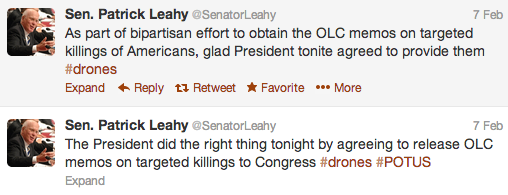
Early in the week, Leahy was one of 11 Senators who signed Ron Wyden’s letter demanding the Office of Legal Counsel targeted killing memos

After it was announced that President Obama would release the memos — but just to the Senate Intelligence Committee — he celebrated the move.

At that point, Leahy’s presumably largely liberal 10,000 followers would have believed that the President had finally fulfilled minimum standards of oversight.

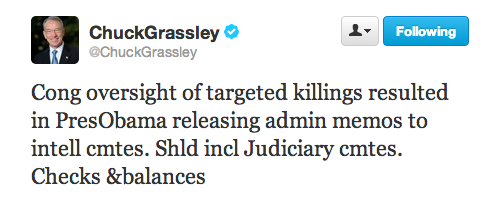
Meanwhile, his colleague on the Senate Judiciary Committee complained about the move.

Grassley’s 65,000 followers would have correctly learned (assuming they’re fluent in Grasslese) that Obama had not yet given the memos to the committee that oversees the people who wrote the memos.

It turns out, the same day they sent these tweets, Leahy and Grassley sent a letter to the President “respectfully requesting” any and all memos.

We were informed last evening that you had directed the Department to provide copies of relevant OLC opinions to members of the Senate Select Committee on Intelligence, but not this Committee.

[snip]

Our Committee plays an important role in providing congressional oversight over important national security and intelligence activities conducted by the Executive Branch, and our Members and our staff have frequently been provided access to highly classified documents. Given the important constitutional issues implicated by the targeted killing of U.S. citizens by our Government, and given our Committee’s jurisdiction over these issues and the Department, we respectfully request that you direct the Department to promptly provide our Committee with access to unredacted copies of any and all legal opinions drafted by OLC that pertain to the targeted killing of U.S. citizens abroad.

This is not exactly the way to conduct oversight, in my opinion, to contribute to the Administration’s limited hangout, leading people to believe the President isn’t, still, stonewalling.

Let’s be clear. According to both Ron Wyden and Dianne Feinstein, the Administration hasn’t even provided all the memos to the Intelligence Committees (it provided 2, but there are 8 more).

It seems the Administration plans to drib and drabble this demand, perhaps long enough to get past the date, tentatively scheduled for Valentines Day, when people will start voting for John Brennan’s nomination to be be CIA Director. That is, it seems the Administration plans to outlast these demands for accountability.

And Pat Leahy, insofar as he is muddling the issue of all memos to all the oversight committees (and the very least), is helping.

Share this entry

One of Just Four Overseers on Drone Targeting Believes First Amendment Protected Activities Merit Execution

While the Gang of Four do not have access to the CIA’s kill list (and therefore did not know whether Samir Khan was on it before his death), they are the only people outside the Executive Branch who had, before today, seen the government’s rationale for killing Anwar al-Awlaki (and DOJ still has 8 memos on targeted killing to turn over). Thus, up until today, the Gang of Four has been the only outside review on that killing, 16 months after Awlaki’s death.

That’s all very nice because last March, in the context of the Administration’s refusal to turn over these memos, Dianne Feinstein offered this guarantee that the targeted killing program — and all other counterterrorism programs — are constitutional.

The Attorney General presented the administration’s legal analysis for the use of force against terrorists, including Americans. I believe it is important for the public to understand the legal basis and to make clear that our counterterrorism efforts are lawful under the Constitution, U.S. law and the law of war.

We are made safer by strikes against terrorists who continue to lead and carry out attacks on the United States. There are legal limits to this authority and great care is taken to ensure it is exercised carefully and with the absolute minimum of collateral damage. The Senate Intelligence Committee is kept fully informed of counterterrorism operations and keeps close watch to make sure they are effective, responsible and in keeping with U.S. and international law. [my emphasis]

That’s it. One of the only assurances that Awlaki’s death, and everyone else’s, is legal.

Which is all the more troubling given that DiFi’s judgement of what makes someone a legitimate target is so outrageous it made even John Brennan pause.

DiFi presented a series of terrorist attacks and asked Brennan to validate that Awlaki was, in fact, involved. It went something like this:

DiFi: Did he have connection to Umar Farouk Abdulmutallab?

Brennan: Yes.

DiFI: Can you tell us what that was?

Brennan: I prefer not to.

DiFI: Did he have a connection to Fort Hood?

[long pause and serious squirming]

Brennan: As a member in AQAP he had a role in inciting a number of individuals. There were a number of occasions where individuals, including Awlaki, has been in touch with Nidal Hasan.

DiFi: Did Faisal Shahzad tell interrogators he was inspired by Awlaki.

Brennan: Yes

DiFI: Last October, was he involved [not sure she used that word, and she means October 2010] in the failed attempt to bring down cargo aircraft?

Brennan: Awlaki was involved in overseeing a number of attacks–there was a relationship there.

Now, it is rather telling that Brennan didn’t want to address Abdulmutallab; I think it possible that there are problems with Abdulmutallab’s confession, as I lay out here. That said, there is also NSA information (leaked by Pete Hoekstra and made fairly obvious by the Webster report) and, probably, information from people infiltrated into AQAP, meaning Brennan needed to protect sources and methods.

And the toner cartridge plot is pretty weak, too, as Jabir al-Fayfi reportedly testified that others from AQAP were really in charge of the operation.

But for DiFi to suggest that Awlaki could be killed because of his role in the Nidal Hasan attack is outright irresponsible. After all, FBI read the correspondence between Hasan and Awlaki in real time. And yet having read it all — and having read whatever else email Awlaki received between June 2009 and December 24, 2009 when the US first tried to kill Awlaki — they still didn’t consider Awlaki to be operational (though one office following him believed he aspired to be).

As of January 7 and June 16, 2009, the FBI knew Anwar al-Aulaqi was an anti-American, radical Islamic cleric and the subject of a Tier <redacted> FBI counterterrorism investigation. San Diego believed [<redacted> that Aulaqi was [developing ambitions beyond radicalization] <redacted>. WFO viewed him at that time as merely inspirational. The FBI’s full understanding of Aulaqi’s operational ambitions developed only after the attempted bombing of Northwest Airlines Flight 253 on Christmas Day 2009.

Indeed, William Webster spent years trying to figure out whether FBI should have known Hasan was planning an attack from the emails, which is a much closer call. But even after reading everything that might have transpired between the two, no one believes that Awlaki had anything more than an inspirational role.

And yet one of the only four people outside the Administration who has attested to the legality of the strike on Awlaki thinks this should be part of the case to justify a due process free execution.

It got worse from there. She went on to insist that [rough transcript] ” Awlaki was not, by far, an American citizen of whom America would be proud.”

But like writing a bunch of First Amendment protected hateful propaganda, being “an American of whom America would not be proud” is not reason to be executed.

Dianne Feinstein, however, thinks it is.


Share this entry

John Brennan Decimates the Logic of Drone Program

John Brennan will be confirmed as CIA Director.

But along the way he has utterly decimated the drone program’s legitimacy.

Twice in his confirmation hearing, he insisted he was not a lawyer. Most notably, Carl Levin went to some length to try to get Brennan to admit waterboarding was torture. Brennan said that he thought it was reprehensible, but he repeatedly stopped short of saying it was torture because “I’m not a lawyer.” Over and over again, he is not a lawyer.

He is, however, almost certainly, the “informed, high-level official of the US government who [determines] that the targeted individual poses an imminent threat of violent attack against the United States.” That person not only determines whether capture would be “feasible” and what “imminent” means. But he decides whether killing the person would be “consistent with law of war principles.”

In other words, this man, who can’t (or refuses to) say whether waterboarding is torture because he is not a lawyer, is entrusted every Tuesday to make far more difficult legal decisions, both on the subjective feasible and imminent questions, but also on specific international laws.

In other words, according to the guy who has been acting as judge and jury for the last four years, the guy who has been acting as judge and jury is completely incompetent to act as judge and jury.

Share this entry