The Bankrupt Premise of Trump’s Venezuela Colony
The headline and opening paragraphs of a 1,400-word story basically reporting that Trump had sat for the interview Joe Biden had denied the NYT (okay, they didn’t mention the latter bit) focus on Trump’s plan to run Venezuela’s oil industry indefinitely.
Trump Says U.S. Oversight of Venezuela Could Last for Years
President Trump said on Wednesday evening that he expected the United States would be running Venezuela and extracting oil from its huge reserves for years, and insisted that the interim government of the country — all former loyalists to the now-imprisoned Nicolás Maduro — is “giving us everything that we feel is necessary.”
“Only time will tell,” he said, when asked how long the administration will demand direct oversight of the South American nation, with the hovering threat of American military action from an armada just off shore.
“We will rebuild it in a very profitable way,” Mr. Trump said during a nearly two-hour interview. “We’re going to be using oil, and we’re going to be taking oil. We’re getting oil prices down, and we’re going to be giving money to Venezuela, which they desperately need.”
[snip]
During the wide-ranging interview with The New York Times, Mr. Trump did not give a precise time range for how long the United States would remain Venezuela’s political overlord. Would it be three months? Six months? A year? Longer?
“I would say much longer,” the president replied.
That he said that is surely news. And while I assume David Sanger will do a follow-up story that might explain this, NYT did not here.
The headline gives Trump something he badly needs — false assurances to oil companies that have been disabusing Trump of his insane notions that oil will pay for a Venezuela invasion that the US would stick around to make investments worthwhile.
But it doesn’t get into all the problems with Trump’s rapidly moving attempt to turn this into a win: even with that much longer security guarantee, it’s not at all clear this will work.
It started 10 days before the invasion, when Trump told oil companies they had to invest now to get reimbursed for nationalizations in the past.
Administration officials have told oil executives in recent weeks that if they want compensation for their rigs, pipelines and other seized property, then they must be prepared to go back into Venezuela now and invest heavily in reviving its shattered petroleum industry, two people familiar with the administration’s outreach told POLITICO on Saturday. The outlook for Venezuela’s shattered oil infrastructure is one of the major questions following the U.S. military action that captured leader Nicolás Maduro.
But people in the industry said the administration’s message has left them still leery about the difficulty of rebuilding decayed oil fields in a country where it’s not even clear who will lead the country for the foreseeable future.
“They’re saying, ‘you gotta go in if you want to play and get reimbursed,’” said one industry official familiar with the conversations.
The offer has been on the table for the last 10 days, the person said. “But the infrastructure currently there is so dilapidated that no one at these companies can adequately assess what is needed to make it operable.”
Apparently, Trump didn’t heed these warnings, and in the aftermath of the invasion he has made grandiose promises that oil would pay for the invasion.
To be fair, his first announcement — that “the Interim Authorities in Venezuela” had agreed to give the United States (or perhaps Trump personally) between 30 and 50 MILLION Barrels of High Quality, Sanctioned Oil” which would “be sold at its Market Price, and that money will be controlled by me, as President of the United States of America, to ensure it is used to benefit the people of Venezuela and the United States!” may well be an effort to pay for the costs of the invasion.
It’s not at all clear a $2 billion payment would even do that.
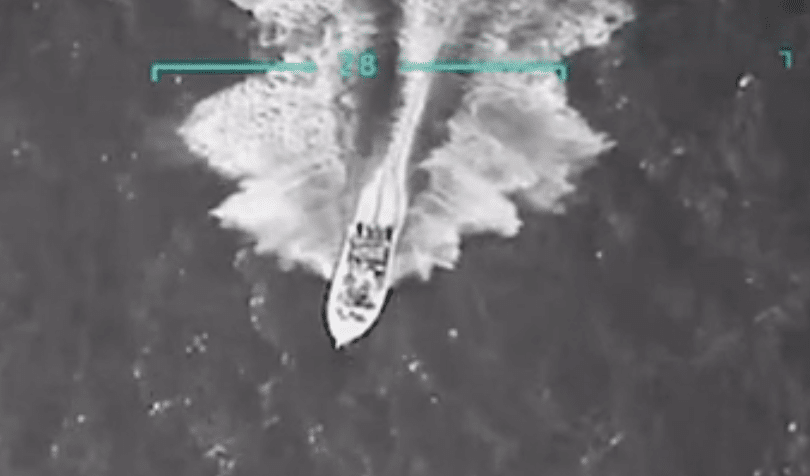
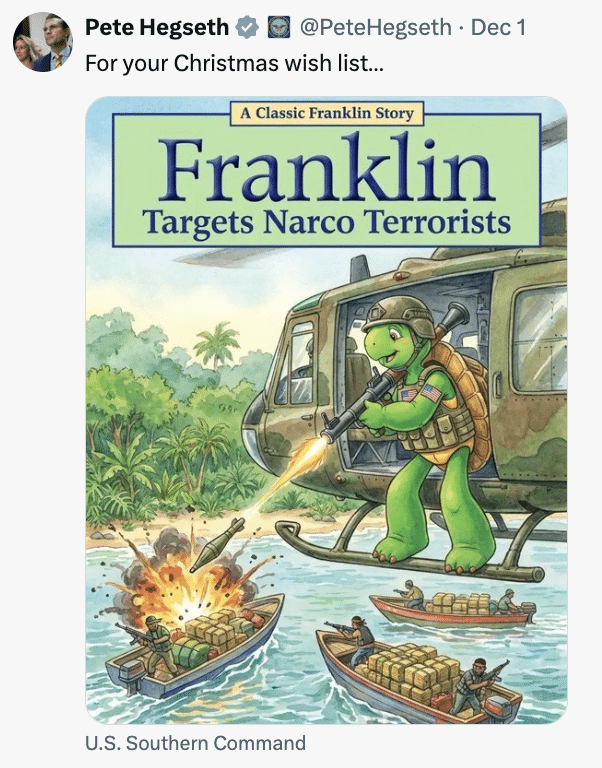
DOD has been conducting periodic murderboat strikes every several days, each of which surely costs millions of dollars.
One hellfire missile, for example, typically costs about $150,000, and reaper drones cost around $3,500 per hour to fly. An F-35 costs around $40,000 per hour to fly. The cost per flight hour of an AC-130J gunship is not public but its predecessor, the AC-130U, which was phased out in 2019, cost over $40,000 per hour to fly.
The Gerald Ford has been in the Caribbean since November 16, which works out to be about $424 million (though there were already ships there). One of the $50 million Chinooks used in the attack was badly damaged. Similarly, the Delta Force lead was seriously injured, so taxpayers are paying his recovery and possibly his retirement. There were 150 aircraft used in the attack.
It was a tremendously successful attack.
It wasn’t cheap.
But within days of promising that oil would pay for his new colony, outlets started reporting that taxpayers might have to subsidize that effort.
Donald Trump has suggested US taxpayers could reimburse energy companies for repairing Venezuelan infrastructure for extracting and shipping oil.
Trump acknowledged that “a lot of money” would need to be spent to increase oil production in Venezuela after US forces ousted its leader, Nicolás Maduro, but suggested his government could pay oil companies to do the work.
“A tremendous amount of money will have to be spent and the oil companies will spend it, and then they’ll get reimbursed by us or through revenue,” the president said.
The reasons why are clear: even assuming Venezuela remains stable long enough to develop investments (the promise Trump is floating to the NYT), the cost of refining Venezuelan oil is just too high, particularly given current prices.
The energy-intensive upgrading process also increases the carbon footprint of these heavy grades, which could push up costs further if more governments start taxing emissions or raising existing levies.
Breakeven costs for key grades in the Orinoco belt already average more than $80 a barrel, according to estimates by consultancy Wood Mackenzie. That places Venezuelan oil at the higher end of the global cost scale for new production. By comparison, heavy oil produced in Canada has an average breakeven cost of around $55 a barrel.
Exxon’s breakeven target for its global oil production by 2030 is $30 a barrel, driven by low-cost fields in Guyana and the U.S. Permian shale basin. Chevron has a similar target, while Conoco has a long-term plan to generate free cash flow even if oil prices fall to $35 a barrel. Oil , currently trades at around $60.
While energy boards have increasingly supported greater exploration in recent years, they are insisting that this be done with spending discipline in mind in the face of rising global supplies and uncertainty over the energy transition.
Here’s a table from Bloomberg that shows that Venezuela, even ignoring the potential instability, is just not a competitive investment.
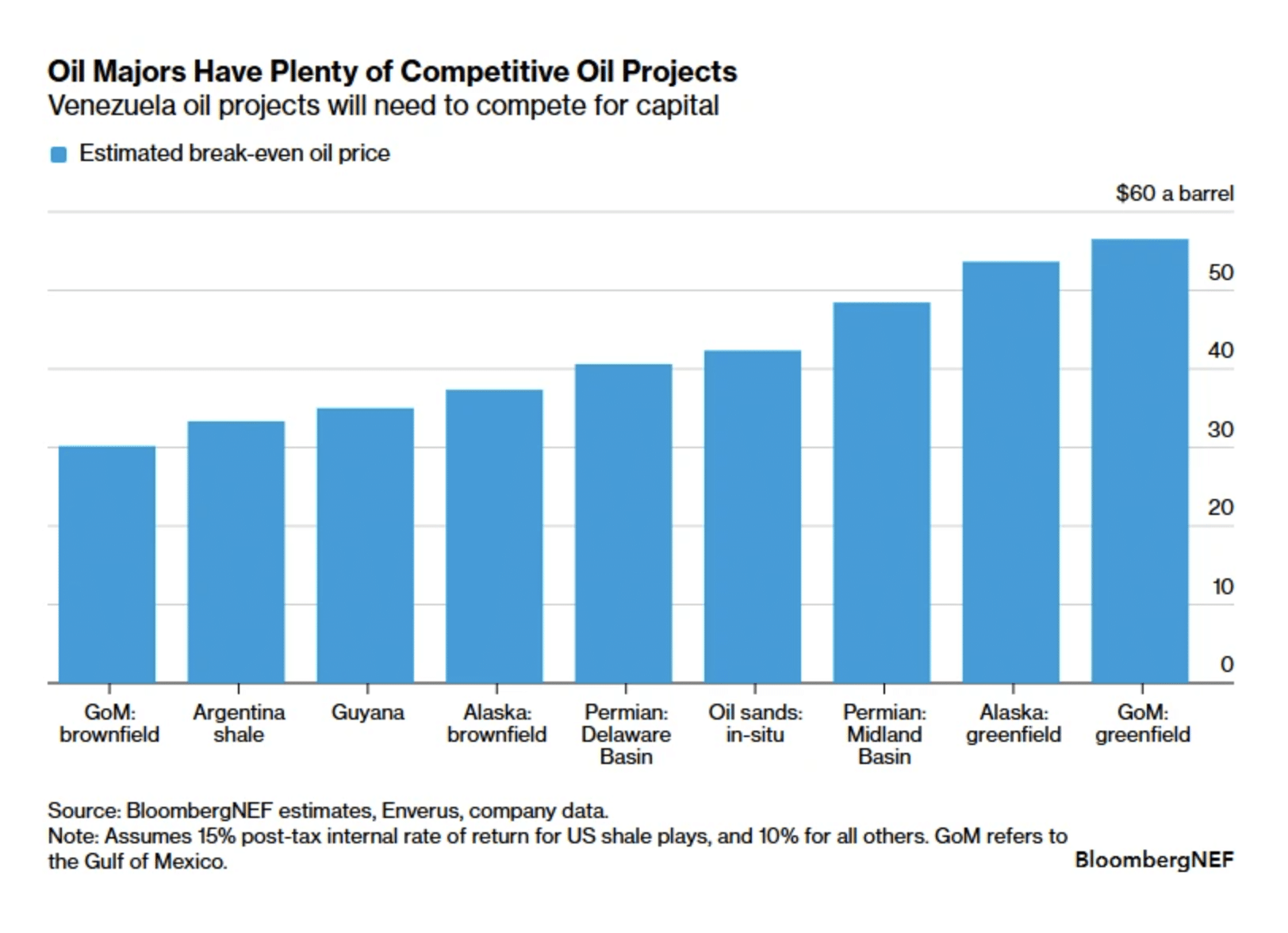
The rest of the article explains what better alternatives the majors are investing in.
Trump seems not to understand this math (or he’s engaged in another con job), because he keeps bragging about the price of oil coming down which … yeah, that’s the point. That’s precisely why imagining you’re going to have willful takers for your offer to invest in expensive-to-refine Venezuelan oil at today’s prices is a pipe dream.
Thus the bribes … er, subsidies, that American taxpayers will end up paying. On top of any deployment, taxpayers will bribe oil companies.
So it doesn’t make sense for the oil companies.
But it also doesn’t make sense for Venezuelans, because the first thing Trump’s backers will demand is that Venezuela pay off years of debt.
Analysts estimate Venezuela now owes $150-$170 billion and JP Morgan calculates that $102 billion of that is in the form of bonds, while bilateral debt to China totals $13-$15 billion.
Venezuela has not reported debt figures for around a decade and state oil company Petroleos de Venezuela (PDVSA) has in the meantime struck complex oil-backed debt deals with China.Despite Washington’s ousting of Maduro, the main hurdles to a debt restructuring remain in place.
U.S. sanctions — including against Venezuela’s interim President Delcy Rodriguez – mean that even sitting down for creditor talks could breach U.S. Treasury Department curbs.
[snip]
“The U.S. administration has an interest in moving the restructuring forward, because without that restructuring, these oil companies will not be participating and will not be investing anything,” said Ed Al-Hussainy of Columbia Threadneedle Investments, which has Venezuelan bond exposure.
“The possibility of a U.S. government financial line of credit or a guarantee or a backstop of some sort is going to be music to the ears of investors,” the portfolio manager added.
Lee Robinson, founder of Altana Wealth which also holds Venezuelan bonds, said there was enough at stake for the U.S. itself to put a loan in place to kickstart Venezuela’s recovery.
JP Morgan said a recognition of Rodriguez’s new government by the Trump administration would open many questions.“Should the Fund be bypassed in favour of a faster-track, oil-based bilateral program, we could be going down the road of a faster-track, less orthodox bond restructuring than what we have seen in the years since the pandemic and the advent of the Common Framework,” JP Morgan said.
Sounds like the taxpayers will be on the hook for the debt restructuring, just like the bailout to keep “libertarian” Javier Milei in office.
Moe Tkacik has written a bunch on the extraction involved here, as in this November story on Juan Guaidó’s role in it, during the last time Trump tried to milk Venezuela, making it easier for Paul Singer to acquire CITGO.
On January 23, 2019, when Guaidó proclaimed himself the “interim president” of an incredulous Venezuela, Secretary of State Mike Pompeo announced that the Trump administration would recognize Guaidó as the Bolivarian Republic’s genuine leader, and unveiled a suite of tough new sanctions on PDVSA, pitched as a bid to force Maduro to step down. The whole thing seemed like a joke, a throwback to the days when our foreign-policy establishment insisted a drug-trafficking warlord on an island of six million was the “real” leader of the world’s most populous country—though at least most Chinese knew who Chiang Kai-shek was when he fled to Taiwan in 1949 to preside over what the United Nations insisted on calling the “Republic of China.” Only the Miami Herald noted an unusual provision of the new arrangement, explained by then-Treasury Secretary Steve Mnuchin, who told the newspaper “that if Guaidó succeeds in forming a government, the money” from international sales of Venezuelan oil that he was freezing under the new sanctions regime “would go to him.” On Twitter, Guaidó promised this new arrangement would “prevent the looting from continuing.”
[snip]
Venezuela, PDVSA, and Citgo were legally separate entities. But in mid-February, Guaidó named entirely new slates of board members to PDVSA, its U.S. holding company, and Citgo, a move Rodríguez knew would strengthen Crystallex’s case. That same week, the glass manufacturer Owens-Illinois, which had been awarded a half-billion-dollar arbitration judgment over two Coke bottle factories Chávez had expropriated in 2010, sued Citgo on the basis that it was an “alter ego” of the state. Owens-Illinois had expert witness assistance from none other than José Ignacio Hernández, whom Guaidó had just named the attorney general of the shadow government.
That is, Trump proposes to fix the problem he, in significant part, caused in his first term.
Plus, until you fix Venezuela’s corruption problem — which Trump has pointedly declined to do in retaining Delcy Rodríguez, partly because he’s relying on Maduro’s suppression regime to offer stability to oil companies, partly because he affirmatively loves corruption — then the Venezuelan people aren’t going to see anything, even while Trump is attempting to oust China’s slightly more favorable float.
And all this is happening on a time frame — big investments and risks on the front end, very long timetable for returns to anyone — that I imagine China is taking some solace about being surprised, if it was surprised, by looking at how Trump’s obsession with becoming a petro-autocrat leaves it untouched to dominate renewables for the foreseeable future, renewables that will continue to put pressure on oil prices in a way that Trump seems not to understand.
And all that assumes Trump, or Dalcy Rodríguez, can ensure stability, something for which there’s no evidence. All that assumes that no one decides to make a target of the resources Trump has put in the middle of an increasingly volatile Caribbean.
Trump is literally making up Colonialism 2.0 on the fly. And the serially bankrupt businessman appears to be doing funny math at every turn.
So yeah, Trump is making expansive claims to the NYT. But they are part of an elaborate con job to prevent this Venezuela adventure from backfiring in a spectacular way.