
Is Democracy the Problem, or Money-Corrupted Governance?

I’ve been pondering this NYT story–which is presented as news yet which in fact is analysis attempting to provide a general explanation for protests in democracies–since it came out. Its general explanation for why so many people are protesting is that people–primarily youth–have grown disillusioned with voting.

Hundreds of thousands of disillusioned Indians cheer a rural activist on a hunger strike. Israel reels before the largest street demonstrations in its history. Enraged young people in Spain and Greece take over public squares across their countries.

Their complaints range from corruption to lack of affordable housing and joblessness, common grievances the world over. But from South Asia to the heartland of Europe and now even to Wall Street, these protesters share something else: wariness, even contempt, toward traditional politicians and the democratic political process they preside over.

They are taking to the streets, in part, because they have little faith in the ballot box.

Note, the title of the article (which presumably the authors didn’t write) refers to a “scorn for vote,” but even this last sentence focuses on the ballot box, rather than the system the ballot box supports. The article doesn’t offer any polling to show this generation (or even just protest participants) are objecting to voting, per se, nor does it question why the record number of youth who came out to vote in the US in 2008 are now among those occupying Wall Street. Rather, it offers these quotes from a protest participants.

“Our parents are grateful because they’re voting,” said Marta Solanas, 27, referring to older Spaniards’ decades spent under the Franco dictatorship. “We’re the first generation to say that voting is worthless.”

[snip]

“We elect the people’s representatives so they can solve our problems,” said Sarita Singh, 25, among the thousands who gathered each day at Ramlila Maidan, where monsoon rains turned the grounds to mud but protesters waved Indian flags and sang patriotic songs.

“But that is not actually happening. Corruption is ruling our country.”

[snip]

Mr. Levi, born on Degania, Israel’s first kibbutz, said the protests were not acts of anger but of reclamation, of a society hijacked by a class known in Hebrew as “hon veshilton,” meaning a nexus of money and politics. The rise of market forces produced a sense of public disengagement, he said, a feeling that the job of a citizen was limited to occasional trips to the polling places to vote.

“The political system has abandoned its citizens,” Mr. Levi said. “We have lost a sense of responsibility for one another.”

All three of these speakers are talking about something more than democracy. They’re talking about democracy that has been delegitimized by its insulation from voters; two specify that corruption is the culprit.

In other words, the article claims to report something about protestors’ attitude towards democracy, while mostly downplaying the role that money has had in the failed governance that results from that democracy, though the protests focus on the latter.

The authors fail to distinguish between democracy and capitalism in other ways, too. In one case, for example, they use a quote talking about capitalism to support a claim they make about voting.

Frustrated voters are not agitating for a dictator to take over. But they say they do not know where to turn at a time when political choices of the cold war era seem hollow. “Even when capitalism fell into its worst crisis since the 1920s there was no viable alternative vision,” said the British left-wing author Owen Jones. [my emphasis]

And while they say, “the protest movements in democracies are not altogether unlike those that have rocked authoritarian governments this year,” they only examine the technological similarities, the reliance on social media in both. They don’t bother to consider the commonality between Tunisians demanding jobs, Israelis demanding affordable housing, Europeans fighting austerity or (in the case of London’s riots) for some kind of future. And while they link to news on Occupy Wall Street, they don’t even mention Wisconsin, perhaps because the involvement of unions and middle class teachers would spoil their desired narrative, which claims protestors are also bypassing unions.

A globalized economy has presented similar problems leading to similar protests in democracies and authoritarian regimes alike, but the NYT’s reporters want to claim this is about democracy and not economics.

All of which builds to their judgment, one terribly sourced paragraph spinning these protests as a profoundly undemocratic movement.

While the Spanish and Israeli demonstrations were peaceful, critics have raised concerns over the urge to bypass representative institutions. In India, Mr. Hazare’s crusade to “fast unto death” unless Parliament enacted his anticorruption law struck some supporters as self-sacrifice. Many opponents viewed his tactics as undemocratic blackmail. [my emphasis]

“Critics have raised,” “many opponents viewed.” None of them named or quoted in the article, but all critically deployed to interpret the evidence the reporters set forth as being primarily about democracy and not about so-called capitalism (otherwise known as elite looting).

For the record, I do believe there’s commonality among these protests. Not just the ones the authors puzzle through in Israel, India, and Europe, but also those in Madison, Wall Street, Egypt, and Tunisia. I do believe it’s worth reflecting on this commonality. But I find it telling that an article published in the most elite news institution and complaining that, “protesters have created their own political space online that is chilly, sometimes openly hostile, toward traditional institutions of the elite,” interprets the commonality here as a rejection of democracy, not a rejection of elite looting.
Share this entry

The Problem with Purportedly Apolitical Policy Wonks: Their Faulty Logic

Peter Orszag opines from the politically sheltered comfort of his gig at Citigroup that we have too much democracy.

I’ll say more about specific claims he makes below, but first, let me point out a fundamental problem with his argument. He suggests we need to establish institutions insulated from our so-called polarization to tackle the important issues facing this country. That argument is all premised on the assumption that policy wonks sheltered from politics, as he now is, make the right decisions. But not only is his own logic faulty in several ways–for example, he never proves that polarization (and not, say, money in politics or crappy political journalism or a number of other potential causes) is the problem. More importantly, he never once explains why the Fed–that archetypal independent policy institution–hasn’t been more effective at counteracting our economic problems.

If the Fed doesn’t work–and it arguably has not and at the very least has ignored the full employment half of its dual mandate–then there’s no reason to think Orszag’s proposed solution of taking policy out of the political arena would work.

Here’s Orszag’s initial claim that polarization is dooming our country.

During my recent stint in the Obama administration as director of the Office of Management and Budget, it was clear to me that the country’s political polarization was growing worse—harming Washington’s ability to do the basic, necessary work of governing. If you need confirmation of this, look no further than the recent debt-limit debacle, which clearly showed that we are becoming two nations governed by a single Congress—and that paralyzing gridlock is the result.

There are a couple of problems with this. First, in response to the debt limit charade, voter approval of Congress and the President pretty much tanked. And while we don’t know how voters will act on their disgust with Congress’ (and the President’s) inaction, polling at least suggests that Congress will pay for the debt limit fiasco. It also suggests that support for the Tea Party, the architect of that fiasco, continues to decline. Which seems to suggest that democracy is working, it will end up punishing elected representatives for playing games with our country’s future, it will have precisely the result you’d want for such idiocy.

Add in the fact that Orszag later points to the automatic triggers that that flawed political process put in place.

Beyond automatic stabilizers, we also need more backstop rules: events that take place if Congress doesn’t act. In this sense, the fiscal trigger created as part of the debt-limit negotiations is a good step forward. It leads to automatic spending reductions if Congress doesn’t enact measures to reduce the deficit; in other words, it changes the default from inaction to action.

In other words, Orszag points to the debt-limit fiasco (and returns to it in his closing paragraph) as the best example of the problem with politics, but then points to the automatic triggers that resulted from that fiasco as a good thing. I don’t necessarily agree with him on that point, but his own logic doesn’t make any sense. He’s simultaneously saying the debt limit fight was the worst thing ever, but applauding the result.

Curiously, while Orszag tries to claim that the problem with all of Congress is polarization, rather than polarization being a problem in the House and Senate rules being a problem in the Senate (plus, the money in politics and crappy political journalism I mentioned earlier), he makes no mention of the number of centrists in the Senate. Perhaps that’s because the centrists back policy proposals (like immediate cuts) to the right of what Orszag proposes in his piece (which notes that economists advocate holding off on cuts and advocates for progressive taxation). The most likely outcome of more non-partisan or bipartisan commissions, then, are policies that aren’t the ones Orszag champions.

Which means the key to these so-called independent commissions would immediately get us into the question of who chooses them? Peter Orszag cites, among others, former Vice Chair of the Fed, Alan Blinder with approval; but he has been criticized for his own failed independence. Will we use the process that resulted in the selection of Ben Bernanke and the rest of the current Fed, that hasn’t even fulfilled its mandate, much less necessarily made the right decisions on restoring our economy?

In short, Orszag promises that independent wonks will make the right decisions for the country. But in making that argument he shows that even policy wonks sheltered from politics, like him, allow bad logic and personal biases to cloud their decisions.

Share this entry

Take Back the American Dream Conference Next Week

[youtube]_zJp8hZTRiE[/youtube]

One of the highlights of Netroots Nation this year was Van Jones’ way-too-early keynote. He offered a speech–and an organizing opportunity, Rebuild the Dream Movement–that addressed a lot of the angst of progressives. Since that time, there have been a series of Rebuild the Dream meetings, but it has yet to take off in the way it should.

I’m hoping that next week’s Take Back the American Dream conference will change that.

Campaign for America’s Future has been changing its name for the last several years as the politics merit it, and CAF has been involved in the Rebuild the Dream movement.

But their conference has also long been one of the best coalition building opportunities. (For example, it got unions working with bloggers long before Netroots Nation did.) In addition to several appearances from Jones and further organizing the Rebuild the Dream movement, there will be good panels on foreclosure and manufacturing and combating Koch money in elections.

I’ll be there, reporting on the shindig. But if you’re able, I really encourage you to come too. (And if you do, let me know so I can look out for you!)

Update: Added the right Van Jones video.

Share this entry

We’re Not Even Spending Enough to Educate Our Service Members’ Children

Between 2002 and 2008, USAID spent $408 million on schools in Afghanistan. A significant chunk of $857 went to Iraqi education in the first several years after invasion.

Yet as American service men and women have been overseas protecting these school building projects, their own children’s schools have been neglected.

The Pentagon has placed 39 percent of its 194 schools in the worst category of “failing,” which means it costs more to renovate than replace them, reports to Congress show . Another 37 percent are classified in “poor” physical shape, which could require either replacement or expensive renovations to meet standards. (See the full list of poor and failing schools here)

Schools run by public systems on Army installations don’t fare much better: 39 percent fall in the failing or poor categories, according to a 2010 Army report .

A Defense Department task force is evaluating the 159 military base schools operated by local public systems.

Not surprisingly, the school conditions–as well as the special needs that arise from having parents gone for extended periods–has contributed to declining performance.

At specific schools, principals said the impact on academic performance is unmistakable. Vern Steffens, who heads Fort Riley’s Jefferson Elementary School, which already has a “poor” rating for its deterioration, said he worried about low test scores as well. He noted that as the proportion of students with a deployed parent rose over the last two years, from 23 percent to 41 percent, reading test proficiency rates plummeted 23 percentage points.

Because of that drop, in 2010, Jefferson did not make what’s known as “adequate yearly progress,” a measurement of how well schools are meeting standards required under the No Child Left Behind Act. At the time of state testing, 2,800 soldiers in the post’s Combat Aviation Brigade were in the process of deploying — including 175 parents at a school with 349 students.

“They were focused on their dads leaving,” said Steffens, not on tests.

DOD knows this is a problem. But Congress has not funded DOD’s plan to fix it (to say nothing of funding the public schools that serve bases but are funded locally).

Over the past decade, as the nation waged two wars, annual military spending skyrocketed 150 percent to $729 billion while money for the military’s schools has risen less quickly — about 50 percent, to $1.9 billion. Money for school construction has amounted to even less, an average $81 million annually from 2001 to 2010 — barely the cost of a RQ-4 Global Hawk reconnaissance vehicle, the latest “drone” used by the U.S. Air Force. That’s only enough money to replace two of the more than 130 substandard schools each year. At that rate, it would take 67 years to replace or renovate all 134 poor and failing schools. By then, of course, there’d be more of them.

Last August, the Defense Department’s education agency unveiled a plan that could take up to seven years to replace or renovate its failing and poor schoolhouses — at $3.7 billion. “Military personnel already make a lot of sacrifices,” said Fitzgerald, the acting director, explaining the Defense Department’s “good news” investment. “What the department is trying to do is to make sure their children are not sacrificed as well.”

But Congress has committed only $484 million for the current fiscal year, enough to repair or replace 10 schools.

[snip]

Meanwhile, the government each year spends another relatively small amount, $30 million, on “impact aid” for public schools with students whose parents work in the military.

It’s bad enough that we’re not even taking care of these kids while their parents serve. It’s bad enough that we’re not making a special effort for the kids struggling with their parents’ multiple deployments.

But the military remains one of the few remaining routes through which working class families can break into the middle class. Yet if, by joining the military, service members consign their kids to inadequate schooling, even military service won’t help their kids achieve a middle class lifestyle.

At some point, funding our empire over funding our country will become unsustainable, even for those policing our empire.

Share this entry

So Much for the Apolitical Fed

The claim that the Federal Reserve is insulated from politics has always been a farce. Greenspan did a number of ideologically inconsistent things that just happened to help Republicans. And given that the banks run the Fed, it would be impossible to say it is isolated from the politics of the MOTUs (which is increasingly the politics of Congress, anyway).

Nevertheless, when a transpartisan group threatened to require Fed audits during the Dodd-Frank debates, people on both sides of the aisle objected because it would politicize the Fed.

No such worries for the top four Republicans, I guess.

Dear Chairman Bernanke,

It is our understanding that the Board Members of the Federal Reserve will meet later this week to consider additional monetary stimulus proposals. We write to express our reservations about any such measures. Respectfully, we submit that the board should resist further extraordinary intervention in the U.S. economy, particularly without a clear articulation of the goals of such a policy, direction for success, ample data proving a case for economic action and quantifiable benefits to the American people.

It is not clear that the recent round of quantitative easing undertaken by the Federal Reserve has facilitated economic growth or reduced the unemployment rate. To the contrary, there has been significant concern expressed by Federal Reserve Board Members, academics, business leaders, Members of Congress and the public. Although the goal of quantitative easing was, in part, to stabilize the price level against deflationary fears, the Federal Reserve’s actions have likely led to more fluctuations and uncertainty in our already weak economy.

We have serious concerns that further intervention by the Federal Reserve could exacerbate current problems or further harm the U.S. economy. Such steps may erode the already weakened U.S. dollar or promote more borrowing by overleveraged consumers. To date, we have seen no evidence that further monetary stimulus will create jobs or provide a sustainable path towards economic recovery.

Ultimately, the American economy is driven by the confidence of consumers and investors and the innovations of its workers. The American people have reason to be skeptical of the Federal Reserve vastly increasing its role in the economy if measurable outcomes cannot be demonstrated.

We respectfully request that a copy of this letter be shared with each Member of the Board.

Sincerely,

Sen. Mitch McConnell, Rep. John Boehner, Sen. Jon Kyl, Rep. Eric Cantor

Especially nice is that McConnell’s signature is first. You know, the guy who has said his single most important goal is to make Obama a one-term President?

To be fair, there are reasons to oppose QE3, which is the most likely form any Fed intervention would take. Masaccio described last year, for example, how it hurts savers. So it’s not that I’m sure QE3 would do anything but goose the stock market. But I am shocked that more people aren’t objecting to this naked political ploy.

Further, these Republicans pretend that the Fed doesn’t already have a clear mandate to do something about the economy. Mind you, the Fed has mostly forgotten itself that, in addition to “maintaining stable prices” it is supposed to achieve maximum employment. But it is part of its charter to pursue policies that will bring unemployment down from 10%.

That seems to be precisely what the Republican leadership is trying to prevent.

These boys have blatantly broken one of the rules of the Village, which is that it at least pretend that politics is not directing the Fed. Thus far, though, the Village wailers have not yet commented on it.

Update: Now that I note the coincidence, I wonder whether Lamar Alexander’s letter announcing he was stepping down from his leadership position–sent the same day as the leadership letter to Bernanke–is more than a coincidence. After all, the decision amounted to an admission that Republican partisanship was impeding actual useful policy. His letter focused on the Senate, mind you, not on inappropriate interventions in the Fed. Still, I wonder whether this was a factor?

Share this entry

We’re Losing More Tech Jobs Than Socks Jobs to China

Some of the more amazing stories about China’s domination of manufacturing these days pertain to the cities in China that make most of just one of the world’s consumer goods, like socks.

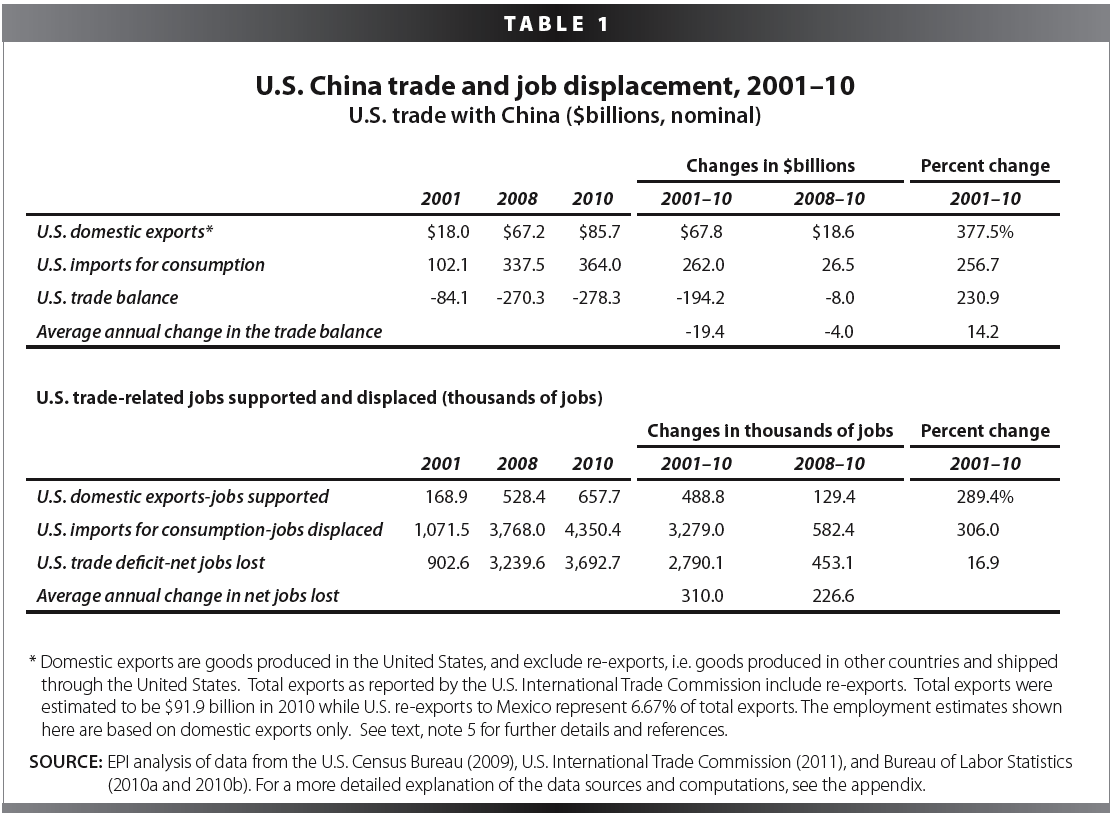
But a new study from the Economic Policy Institute makes it clear we haven’t just lost textile jobs to China, we’ve lost high tech manufacturing jobs too. The study finds, for example, that since China joined the WTO, the outsourcing of tech manufacturing to China has been the biggest driver of our trade deficit with China.

Within manufacturing, rapidly growing imports of computer and electronic parts (including computers, parts, semiconductors, and audio-video equipment) accounted for more than 44% of the $194 billion increase in the U.S. trade deficit with China between 2001 and 2010. The growth of this deficit contributed to the elimination of 909,400 U.S. jobs in computer and electronic products in this period. Indeed, in 2010, the total U.S. trade deficit with China was $278.3 billion—$124.3 billion of which was in computer and electronic parts.

Global trade in advanced technology products—often discussed as a source of comparative advantage for the United States—is instead dominated by China. This broad category of high-end technology products includes the more advanced elements of the computer and electronic parts industry as well as other sectors such as biotechnology, life sciences, aerospace, and nuclear technology. In 2010, the United States had a $94.2 billion deficit in advanced technology products with China, which was responsible for 34% of the total U.S.-China trade deficit. In contrast, the United States had a $13.3 billion surplus in ATP with the
rest of the world in 2010.

As a result, those parts of the country where such tech jobs had been concentrated have been inordinately affected.

The trade deficit in the computer and electronic parts industry grew the most, displacing 909,400 jobs—32.6% of all jobs displaced between 2001 and 2010. As a result, the hardest-hit congressional districts were in California, Texas, Oregon, and Massachusetts, where remaining jobs in those industries are concentrated.

[snip]

The three hardest-hit Congressional districts were all located in Silicon Valley in California, including the 15th (Santa Clara County, 39,669 jobs, 12.23% of all jobs in the district), the 14th (Palo Alto and nearby cities, 28,866 jobs, 9.0%), and the 16th (San Jose and other parts of Santa Clara County, 26,478 jobs, 8.72%).

Now, to a great degree, we already knew this. IBM sold its PC division to China in 2004. And whereas stories of abusive conditions for those who make branded goods used to focus on sneakers, they now focus on Apple’s products.

But it also ought to be a wake-up call. It took some time for the upheaval caused by NAFTA to thoroughly devastate the Rust Belt and parts of the south. And while CA may be large and diverse enough to recover from the loss of these jobs, in other places (surprisingly, perhaps, NH, which lost the highest percentage of its jobs to China), they’re not.

Plus, there’s the whole problem of lost capabilities. As this manufacturing goes to China, we lose the symbiotic effect of having people manufacture–say–iPhones down the road from the folks losing designing the new ones. Thus, while in the short term it may be easy for Steve Jobs to churn out new products sending this stuff to China, in the post-Steve Jobs era, particularly with this lost symbiosis, it may be harder to continue to innovate.

But don’t worry. I’m sure working class Californians will be just as happy in their service jobs as Michiganders are. Which is to say, not that much.

Share this entry

No, Class Warfare WILL Create Jobs!

A number of people are talking about the spectacle of Representative John Fleming complaining about tax cuts on the wealthy him, suggesting that it will lead him to cut jobs. [my transcription]

Chris Jansing: With all due respect, Congressman, the WSJ estimated that your businesses, which I believe are a [sic] Subway sandwich shops and UPS stores–very successful–brought you last year over $6 million dollars.

Fleming: Yeah, that’s before you pay 500 employees, you pay rent, you pay equipment, and food. Ah, the actual net income of that was only a mere fraction of that amount.

Jansing: So you’re saying that if you have to pay more in taxes, you would have to get rid of some of those employees? These are not as successful businesses–

Fleming: I would say that since my net income–and again, that’s the individual rate that I told you about–the amount that I have to reinvest in my business and feed my family is more like $600,000 of that $6.3 million. And so by the time I feed my family, I have only $400,000 left over to invest in new locations, upgrade my locations, buy more equipment.

Now, aside from the point that Laura Clawson makes–which is that even if most of his costs are wages, then he’s only paying each of those claimed 500 employees $11,400 a year, and aside from the point that Sam Seder makes–which is that this $600,000 is on top of the $174,000 he makes as a Member of Congress (which of course also means he doesn’t have to pay for his own health care), Fleming is blowing smoke about how business owners are taxed.

They’re taxed after all business investments are deducted, not before.

That is, assuming Fleming isn’t paying himself a wage (it doesn’t sound that way given the way he mixes his reinvestment and “feed the family” amounts), then what happens is he reinvests $400,000 of his net profits, and then takes what is left over, $200,000, which is what he’d be taxed on. Say he paid an effective tax rate of 32% on that, so $64,000.

Under Obama’s plan, Fleming would:

  • Pay the tax rate he would have paid in 2001–effectively about 35%
  • Lose some deductions (only because of his Congressional salary though–without it, what he claims is his take home pay would not be high enough to hit the $250,000 income level at which those deductions are removed)

So say he paid 35% (he also might lose what I presume is a deduction for a second home in DC). That would mean he’d pay taxes of $70,000.

His poor family! Having to eat off of just 2.6 times the median pre-tax income of $49,445 in this country (not counting the Congressional salary, of course).

Lucky for Fleming, there is a way he can keep paying the same amount in taxes. If he reinvested $417,142 rather than $400,000 in his business, then he’d still pay the same $64,000. Sure, his family would really suffer, living off of just 2.4X the median pre-tax income (still ignoring the Congressional salary). [Update: As Mary points out, I’ve oversimplified this–100% of the investments aren’t deductible in the first year.]

But since he seems to be making a 10% return on his business, that’s not actually a bad idea–it’s as good an investment as you’re going to find in this day and age.

And the best part? Given the shitty wages he apparently pays his employees, the extra $17,142 he invests back in his businesses would more than … create a job!

Share this entry

The $648 Monthly Fine for Not Having a Job

As part of the President’s deficit reduction plan, he proposes changing the rules to allow debt collectors to call people on their cell phones.

Allow agencies to contact delinquent debtors via their cellular phones. The Administration also proposes to amend the Communications Act of 1934 to facilitate collection of debts owed to or guaranteed by the Federal Government, by facilitating contact of delinquent debtors who are most readily reached on their cell phones. This provision is expected to provide substantial increases in collections, particularly as an increasing share of households no longer have landlines and rely instead on cell phones.

As soon as I read this, I thought of the widow in Hawaii whom Bank of America called 48 times a day because her late husband had missed one mortgage payment.

Deborah Crabtree, of Honolulu, Hawaii tragically lost her husband to cancer on Aug. 3. The bank to which he owed money, Bank of America, didn’t even wait for a day after his death to begin calling Crabtree to remind her that her husband had missed a $3,000 mortgage payment on their home.

Crabtree told Bank of America that she had $5,000 on hand, and that she needed this money to buy food and bury her husband. Convinced that Crabtree should be using this money to pay them, Bank of America repeatedly “robo-called” Crabtree during her husband’s wake, sometimes with only 15 minutes between each call.

Now, Crabtree is suing the bank, alleging that it called her up to 48 times a day, even repeatedly demanding evidence that her husband was dead, and once receiving it, losing it. Crabtree’s complaint cites the emotional distress and mental anguish caused by Bank of America’s behavior.

So under Obama’s proposed rules, BoA might call someone 48 times a day on their cell phone? Say each one were billed as a 1 minute call, that would amount to 1,440 minutes a month–maybe double a pretty normal 700 minute/month plan. The remainder of those minutes might be billed at $.45 per minute, or a grand total of $648 a month, all so a debt collector can get money for Uncle Sam.

Add in the fact that the most likely group to fall in this category–students with federally backed loans, particularly those who used those federally backed loans to go to diploma mill for-profit colleges–and you’ve effectively got the Federal government penalizing these young adults a second time because they were preyed upon by a previously under-regulated industry a first time. Not to mention graduating from school into the post-crash economy.

In short, while I understand the necessity of finding a way to collect debt from those who don’t have a land-line, I also see how this policy will become the Bankruptcy Bill of the housing crisis, a policy with easily foreseeable devastating consequences that will exacerbate the popping of the next bubble that will pop.

Share this entry

A Gang of Deficit Fairy Phantoms

Over the weekend, the Atlanta Journal-Constitution’s GA politics section published an article claiming that Saxby Chambliss’ Gang of Six has become a Gang of 38.

Saxby Chambliss’ Gang of Six has grown to 38 U.S. senators from both parties, who on Thursday urged the debt reduction “supercommittee” to aim high and secure $4 trillion in budget savings.

The Georgia Republican was joined by Sen. Mark Warner, D-Va., and a group too large to fit on the news conference stage to send a message to the 12-member joint committee created in the summer’s deal to raise the debt ceiling.

It’s nice of Chambliss’ home paper to present this unquestioningly.

But your first tip-off that something’s wrong is the quote of their other home Senator, Johnny Isakson, talking about just pulling the trigger on deficit cuts, to know something’s not right here.

“Nobody needs to really look too far for what we need to do,” said Sen. Johnny Isakson, R-Ga. “They just need to be willing to pull the trigger.”

After all, one of the tax reforms the Catfood Commission and the Gang of Six pushed was to cut the mortgage deduction. And, as a former realtor, Isakson is the real estate industry’s biggest friend in Congress. I’m guessing it would take a great deal to get Isakson to vote for cuts to the deduction.

Mind you, Chambliss did get 17 Democrats plus Lieberman and 18 Republicans to sign to … something. That something is an agreement in principle.

As a bipartisan group of Senators, we will encourage and support the Super Committee in fulfilling its mission. We are here to support a deficit reduction package consistent with the following principles that should:

  • Include enough deficit reduction to stabilize the debt as a share of the economy, and put the debt on a downward path, and provide fiscal certainty. We believe a reasonable target is at least $4 trillion, including previously enacted deficit measures. This will send the right message to the financial markets.
  • Use the established, bipartisan debt and deficit reduction frameworks as a starting point for discussions.
  • Focus on the major parts of the budget and include long-term entitlement reforms and pro-growth tax reform.
  • Be structured to grow the economy in the short, medium and long-term.
  • Work to include the American public and the business community in a broader discussion about the breadth of the issues, challenges and opportunities facing us. [my emphasis]

It does point to “existing frameworks,” aka, the Catfood Commission/Gang of Six. But using that as a “starting point” for discussions does not equate to an agreement from 36 Senators to cut the home mortgage deduction. Nor does it reflect broad support for further DOD cuts, which was also in the Catfood recommendations.

Nevertheless, if you happen to be a constituent of the following Democratic Senators, you might want to ask them why they are aiming to cut our social safety net:

  • Begich
  • Bennet
  • Carper
  • Conrad
  • Coons
  • Hagan
  • Klobuchar
  • Landrieu
  • McCaskill
  • Manchin
  • Nelson
  • Pryor
  • Shaheed
  • Tester
  • Mark Udall
  • Warner
  • Wyden

Interestingly, Klobuchar seems to have been added at a late minute. Also note that Dick Durbin is not on this list, even while he voted for the Catfood recommendations.

Share this entry

Trash Talk: NCAA Shame, Ephs and Jeffs

Marcy is correct, the article this week in the Atlantic magazine by Taylor Branch is an absolute must read. Entitled The Shame of College Sports, the article opens with a 2001 investigatory hearing in front of the Knight commission, a NCAA oversight board where slimy promoter Sonny Vaccaro matter of factly tells the Commission exactly what is going on in their sport; the Commission is incredulous, in denial and clearly thinks Vaccaro is scum. The reverse is, of course, the truth.

The list of scandals goes on. With each revelation, there is much wringing of hands. Critics scold schools for breaking faith with their educational mission, and for failing to enforce the sanctity of “amateurism.” Sportswriters denounce the NCAA for both tyranny and impotence in its quest to “clean up” college sports. Observers on all sides express jumbled emotions about youth and innocence, venting against professional mores or greedy amateurs.

For all the outrage, the real scandal is not that students are getting illegally paid or recruited, it’s that two of the noble principles on which the NCAA justifies its existence—“amateurism” and the “student-athlete”—are cynical hoaxes, legalistic confections propagated by the universities so they can exploit the skills and fame of young athletes. The tragedy at the heart of college sports is not that some college athletes are getting paid, but that more of them are not.

It is a long article that stretches in time from the beginning of college football in the late 1800s through the Cam Newton sham “investigation and disposition” prior to last season’s BCS Championship game. Coming on the heels of the stunning article on the corruption surrounding the Miami Hurricanes football program, it is a pretty stark reminder of just how filthy big time college athletics really are.

Many people have taken to advocating that college athletes be paid – above and beyond their scholarship terms – for their “services”. College basketball analyst Jay Bilas rants about doing so near daily in his Twitter stream. Personally, I am not sure that is the solution either. Do athletes at USC and Notre Dame get paid more because their brands bring in more? How much do each athlete get paid? Does Andrew Luck get paid a lot more than his left tackle? What about the universities not in say the top 64 programs, whose programs may not even be profitable, what do they do? What about basketball, baseball and track athletes? What about the girls and Title IX? I don’t know what the answer is, but I don’t like this one.

Interestingly enough, two of the most notoriously dirty major programs square off today when the Ohio State Felons take on the Miami Hurriconvicts in Miami. Nearly ten years ago, these two teams played for the National Championship (which Ohio State, true to their criminal form, stole from the Hurricanes on a horrid no-call on interference in the end zone in the last seconds). Now it is just another game. If only they could both lose.

To try to find a ray of clean and hope in this sick muck, let’s talk about teams that still play for the love of the game and the sport. Or so I am told. That’s right, I’m talking Ephs and Jeffs! The Williams Ephs open their 2011 season today at the always tough Bowdoin at Whiitier Field. While bitter arch rival, the Amherst Jeffs, open their season on the road against the fierce Bates Bobcats. Man, the stories we could tell about these games. Hopefully Marcy, Neil and/or Adam Bonin will come along and tell those stories cause, well you know, the ASU Sun Devils didn’t ever play those guys, I got nuthin!

In other games of note, Boise State already just tore up Toledo last night, and don’t be fooled, Toledo is a pretty good team. The BCS needs to get their heads out of their asses and give Boise some love. And Kellen Moore is simply amazing. The one truly huge game this weekend is Oklahoma down in Seminole land to take on Florida State. Oklahoma is, as befitting the number one ranked team, the favorite; but I dunno, I think FSU may be a sleeper here and, if their QB picks up where Christian Ponder left off, will win. I am agains personally interested in seeing Arizona State, who travel to Illinois. Been quite a while since ASU has been able to withstand prosperity, so being ranked at number 22 is a little scary. If Brock Osweiler has another big game, they should be okay, but the running game is not that good right now.

As to the pros, well the Deetroit Lions are the story of the year! The Kitties get KC, who got their asses kicked last week, at home in Ford Stadium. Look for Deetroit to go 2-0! Bears and Saint and Pats versus Bolts are the only other real excitement this week. I am going to let Marcy and Randiego battle that preview out in comments.

SPECIAL UPDATE!! – Uh, it turns out we gots some restless natives in these here parts, and they been demanding extra coverage. In another CRITICAL game, likely rivaled in scope only by the epic Cowboys/49ers tilt, Colt McCoy and the Cleveland Brownies are on the road at the Colts, and the Brownies are road favorites by 3. Wow. I must say, however, the fate of this game lies with Peyton. Peyton Hillis that is;the other one ain’t walking through that door. Oh, and speaking of Deetroit, Rosalind is right, the Tigers clinched their division yesterday. Congratulations, you gotta love Jim Leyland and Justin Verlander, who may yet be the first 25 game winner in MLB in decades (since Bob Welch).

Find more Jo Jo Gunne songs at Myspace Music

Share this entry