
Wyden and Udall: They’re Blowing Smoke about Phone and Other Bulk Record Safety

When I wrote about the letter from Ron Wyden, Mark Udall, and 24 other Senators to James Clapper a month ago, I focused on the specter that Section 215 would be used to collect gun records (in response to which, the NRA let its political guns drop from flaccid fingers).

Given yesterday’s response from Wyden and Udall to Clapper’s response, I should have focused on this passage:

Senior officials have noted that there are rules in place governing which government personnel are allowed to review the bulk phone records data and when. Rules of this sort, if they are effectively enforced, can mitigate the privacy impact of this large-scale data collection, if they do not erase it entirely. Furthermore, over its history the intelligence community has sometimes failed to keep sensitive information secure form those who would misuse it, and even if these rules are well-intentioned they will not eliminate all opportunities for abuse.

In response to that passage, Clapper spent one paragraph talking about when the government can access this data and another describing the oversight over it, including,

Implementation of the program is regularly reviewed not only by NSA, but by outside lawyers from the Department of Justice and by my office, as well as by Inspectors General. The Executive Branch reports all compliance incidents on to the FISC.

Later, in response to a question specifically about violations, Clapper wrote,

Since the telephony metadata collection program under section 215 was initiated, there have been a number of compliance problems that have been previously identified and detailed in reports to the Court and briefings to Congress as a result of Department of Justice reviews and internal NSA oversight. However, there have been no findings of any intentional or bad-faith violations.

These problems generally involved human error or highly sophisticated technology issues related to NSA’s compliance with particular aspects of the Court’s orders. As required, those matters, including details and appropriate internal remedial actions, are reported to the NSA’s Inspector General, the Department of Justice, the Office of the Director of National Intelligence, the FISC and in reports provided to Congress and other oversight organizations.

To which Wyden and Udall insisted,

Their [in context, probably meaning NSA’s, though they did not specify] violations of the rules for handling and accessing bulk phone information are more troubling than have been acknowledged and the American people deserve to know more details.

Now, there are a couple of different things going on here.

First, as Wyden and Udall also note, Clapper didn’t answer their question, “How long has the NSA used the PATRIOT Act authorities to engage in bulk collection of Americans’ records? Was this collection underway when the law was reauthorized in 2006?” Clapper instead answered how long NSA was using Section 215 to get telephony metadata, answering May 2006. But we know that collection was briefed before passage of the PATRIOT reauthorization, and it appears the government used a kluged hybrid order to get it from at least the time the illegal program was revealed in 2005 until the reauthorization passed.  So this earlier use may implicate earlier violations.

Nevertheless, what Clapper claims to be human error seems to be something more, the querying of records pertaining to phone numbers that aren’t clearly terrorists (or Iranians).

And given the revelation the government has gone three hops deep into this data, the reference to “highly sophisticated technology issues” suggests more sophisticated data mining than a game of half-Bacon.

Finally, one more thing. In the debate over the Amash-Conyers amendment the other day, House Intelligence Chair Mike Rogers also boasted of the controls that — according to Wyden and Udall — have proven insufficient. But in the process of boasting, he admitted other agencies have less effective oversight than the NSA.

It is that those who know it best support the program because we spend as much time on this to get it right, to make sure the oversight is right. No other program has the legislative branch, the judicial branch, and the executive branch doing the oversight of a program like this. If we had this in the other agencies, we would not have problems. [my emphasis]

When Wyden and Udall asked this question originally, they asked specifically, “Have there been any violations of the court orders permitting this bulk collection, or of the rules governing access to these records?” While most of their questions specified NSA, that one didn’t. The FBI, not NSA, is the primary user of Section 215, though it shares its counterterrorism (and counterespionage) data with the National Counterterrorism Center.

And even Mike Rogers appears to believe “the other agencies” have problems with this kind of data.

All of which seems to suggest there have been serious problems with the NSA’s use of the phone record dragnet. But there have been even more serious problems with bulk records on other subjects as used by other agencies.
Share this entry

Candidate Obama’s Tribute to “Courage and Patriotism” of Whistleblowers Disappears 2 Days after First Snowden Revelations

Sunlight Foundation discovers the Obama Administration has removed access to his 2008 campaign promises from the White House website. It suggests one of the promises Obama may want to hide has to do with his support for whistleblowers.

While front splash page for for Change.gov has linked to the main White House website for years, until recently, you could still continue on to see the materials and agenda laid out by the administration. This was a particularly helpful resource for those looking to compare Obama’s performance in office against his vision for reform, laid out in detail on Change.gov.

According to the Internet Archive, the last time that content (beyond the splash page) was available was June 8th — last month.

Why the change?

Here’s one possibility, from the administration’s ethics agenda:

Protect Whistleblowers: Often the best source of information about waste, fraud, and abuse in government is an existing government employee committed to public integrity and willing to speak out. Such acts of courage and patriotism, which can sometimes save lives and often save taxpayer dollars, should be encouraged rather than stifled. We need to empower federal employees as watchdogs of wrongdoing and partners in performance. Barack Obama will strengthen whistleblower laws to protect federal workers who expose waste, fraud, and abuse of authority in government. Obama will ensure that federal agencies expedite the process for reviewing whistleblower claims and whistleblowers have full access to courts and due process.

It may be that Obama’s description of the importance of whistleblowers went from being an artifact of his campaign to a political liability.

To be fair, Obama did extend whistleblower protection beyond that of the law last year — though he did it largely in secret.

Of course, that came at the same time as Obama rolled out an Insider Threat Detection system that seems designed to discourage anyone from speaking out … about anything.

And then there’s the issue of all the whistleblower prosecutions.

But if Obama did hide his campaign promises specifically to hide this tribute to the “courage and patriotism” of whistleblowers, then I find the timing particularly interesting. June 8 was just two days after the first Edward Snowden release (at a time, moreover, when the Guardian had reported only issues that went to lies James Clapper and Keith Alexander had told, making Snowden’s claim to be unable to go through regular channels quite credible).

Mind you, Obama could be hiding other promises. I still think promises about mortgages and homes are his biggest failure.

Share this entry

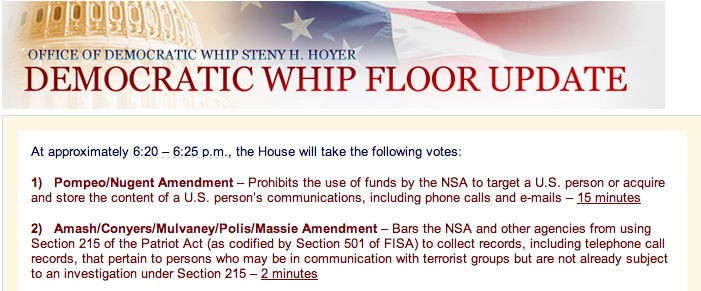
Steny Hoyer Thinks All Americans May Be Pre-Investigation Terrorist Communicators

Screen shot 2013-07-25 at 8.05.39 AM

Like Glenn Greenwald, I’m appalled by the crazy language Steny Hoyer circulated yesterday to oppose the Amash-Conyers amendment. Here’s the language:

2) Amash/Conyers/Mulvaney/Polis/Massie Amendment – Bars the NSA and other agencies from using Section 215 of the Patriot Act (as codified by Section 501 of FISA) to collect records, including telephone call records, that pertain to persons who may be in communication with terrorist groups but are not already subject to an investigation under Section 215.

The language is crazy on the macro level, as Glenn notes, but I’m also fascinated by the structure of it. First, the language reverses the structure of the actual “relevant to” language that has been blown up beyond all meaning pretending it is instead specific: “pertain to persons who may be in communication with terrorist groups.” But this language is only true if you assume every single American is a pre-investigative terrorist communicator (and to be fair, with the permission to go three hops deep into the dragnet database, we probably all are “in communication with terrorist groups”). Steny then qualifies this group (all of us, really, now that we’ve all been defined to be terrorist communicators through the genius of the half-Bacon) as “not already subject to an investigation.”

But you will be, America. You will be subject to an investigation, according to Steny Hoyer.

Then there are details of the language that suggest why the Administration panicked so badly. This language would have defunded all bulk collection under Section 215, including phone records, but also including acetone and hydrogen peroxide and probably now pressure cookers. Presumably, that’s what Keith Alexander and James Clapper explained to Congress in their TS/SCI briefings the other day (not having learned they’re better off admitting their dragnets rather than having them exposed).

Which is why I find it interesting that Steny noted this would apply to NSA “and other agencies,” which includes, but is apparently not limited to, FBI.  And these other agencies are using 215 to collect, “records, including telephone call records.” And probably including health records and geolocation and gun records and the like.

And Steny wants to make sure the FBI and other agencies can get this information about us, because after all, once you go three hops deep, every American just becomes a terrorist communicator not yet under investigation.

Share this entry

Amash-Conyers Fails 205-217

In one of the closest votes in a long time for civil liberties, the Amash-Conyers amendment just failed, but only barely, by a vote of 205-217.

The debate was lively, with Mike Rogers, Michele Bachmann, and Iraq verteran Tom Cotton spoke against the amendment; Amash closely managed time to include a broad mix of Democrats and Republicans.

The only nasty point of the debate came when Mike Rogers (R-MI) suggested Justin Amash (R-MI) was leading this charge for Facebook likes.

Update: Here’s the roll call.

Share this entry

Mike Rogers: IRS Scandal Is Real, NSA Scandal Is Not; AP Collection Is a Dragnet, Section 215 Collection Is Not

One of the four members of Congress with greatest influence over this country’s “intelligence,” House Intelligence Chair Mike Rogers, claims that the IRS scandal is real and the risk of NSA dragnet is not.

Rogers said Amash’s amendment, which stops the NSA from collecting data under the Patriot Act, was an attempt to take advantage of anger over recent scandals including the Internal Revenue Service’s targeting of conservative groups applying for tax exempt status and the Justice Department’s probe of Associated Press journalists in connection to a leak about a thwarted terrorist plot that originated in Yemen.

“It’s certainly inflammatory and certainly misleading,” Rogers said Wednesday in an interview on Michigan radio station WTKG 1230. “I think, he tried to take advantage at any rate of people’s anger of the IRS scandal, which is real, and the AP —Associated Press dragnet by the Attorney General, Benghazi —all of those things are very real and there’s no oversight function “What they’re talking about doing is turning off a program that after 9/11 we realized we missed —we the intelligence community- missed a huge clue.” [my emphasis]

Note, too, that Rogers calls the (completely inappropriate) collection of the phone records for 20 AP phone lines a “dragnet,” but somehow doesn’t think the collection of the phone records for every single American is also a dragnet.

Again, this dude plays a significant role in this country’s “intelligence.”

From there, Rogers declined into outright misinformation.

Rogers added that NSA’s telephone data collection program has helped thwart over 50 terrorist plots.

The Section 215 collection — the only thing that would be affected by the Amash-Conyers amendment — has had a role in (per Keith Alexander’s latest claims) 13 plots.

Not 50.

13.

I can’t think of a better way for Mike Rogers to demonstrate that these programs have insufficient oversight — in which the Intelligence Committees play a crucial role — than to open his yap and make such ludicrous statements.

Share this entry

“Section 215 Is Silent”

Justin Amash has a useful fact sheet on the Amash-Conyers amendment that would defund dragnet 215 collection. (If you haven’t yet called your Congressperson and told her to support the amendment, please do so!)

As a whole, the fact sheet clears up some misconceptions about the amendment, making it clear, for example, that the amendment only returns the meaning of Section 215 to the intent Congress had when it first passed.

Given that the fact sheet — dated today — appears to post-date yesterday’s TS/SCI briefing by Keith Alexander and James Clapper, I am particularly interested in these two sentences.

The administration has not provided a public explanation as to how the telephone records of all Americans are “relevant” to a national security investigation.  Similarly, Sec. 215 is silent as to how the government may use these records once it has obtained them.

The language seems to suggest the Administration has provided a classified explanation as to how phone records became “relevant to” a massive terrorism investigation.

More interestingly, the next sentence points to the Administration’s silence about how the government can use this dragnet collection.

That’s a concern I’ve long had. After all, only FISA Court minimization might, with very strict language, prevent the National Counterterrorism Center from simply copying the dragnet database and data mining it with abandon. And so I find it interesting that a document released after yesterday’s TS/SCI hearing mentions the possibility the government does something with it beyond what they’ve stated publicly.

If this were a Ron Wyden statement, I’d take it as a big hint. I’m not sure it is meant as such here, but it does heighten my concerns that this data is circulated far more widely than the government has admitted.

Share this entry

The Liars Are “Very Concerned” Program They Lied About Will Be Defunded

Buried at the bottom of a broader story on opposition to the Amash-Conyers amendment, CNN offers a very solicitous account of the White House statement opposing it, making no note of how absurd the entire premise is.

The White House issued a statement Tuesday evening, saying that it opposes the amendment and urges the House to reject it. “In light of the recent unauthorized disclosures, the president has said that he welcomes a debate about how best to simultaneously safeguard both our national security and the privacy of our citizens,” the statement said. “However, we oppose the current effort in the House to hastily dismantle one of our intelligence community’s counterterrorism tools. This blunt approach is not the product of an informed, open, or deliberative process.”

CNN does, however, provide James Clapper and Keith Alexander an opportunity to give their readout of the TS/SCI briefings they gave Congress.

In spite of reporting describing it as a lobbying session, these noted prevaricators claim their job wasn’t to persuade, it was just to answer questions.

“Our mission wasn’t to convince the House to do anything other than to provide information for them to make a decision,” Alexander told CNN.

Asked if they satisfied lawmakers and persuaded them not to change the program, Alexander would only say it was useful to “get the facts on the table.”

Sort of gives you the impression they failed to persuade, huh?

But if their mission was really to “provide information” and “get the facts on the table,” then what have all the unclassified briefings been about? Is this claim they were only now “providing information” yet another indication that they were, perhaps, misinforming before? Again?

That, to me, is a big part of this story: that two men who have lied repeatedly about these programs felt the need to conduct Top Secret briefings to provide information that hadn’t been provided in the past.

All of which makes me very unsympathetic to Clapper’s stated worry.

A day before the House is expected to vote on restrictions to the National Security Agency’s controversial phone surveillance program, the director of national intelligence told CNN Tuesday he would be “very concerned” if the measure were to pass.

This program is problematic for several reasons: it is overkill to achieve its stated purpose and it violates the intent of the Fourth Amendment.

But add to that the trust those overseeing the program chose to piss away by lying about this collection repeatedly in the past.

If Amash-Conyers does pass (and it’s still a long-shot unless each and every one of you manages to convince your Rep to support it), it will be in significant part because Clapper and Alexander abused the trust placed in them.

Update: HuffPo covers this straight, too, though at least it includes Demand Progress’ views.

Share this entry

After 7 Years of Refusing Any Public Debate, Executive Decries Congress for Not Being “Open”

Here’s what the Administration thinks about the Amash-Conyers amendment (which it calls the Amash Amendment, perhaps not wanting to name a Democrat who has been involved in historic fights against out-of-control executive power in the past), which would defund dragnet Section 215 collection.

In light of the recent unauthorized disclosures, the President has said that he welcomes a debate about how best to simultaneously safeguard both our national security and the privacy of our citizens. The Administration has taken various proactive steps to advance this debate including the President’s meeting with the Privacy and Civil Liberties Oversight Board, his public statements on the disclosed programs, the Office of the Director of National Intelligence’s release of its own public statements, ODNI General Counsel Bob Litt’s speech at Brookings, and ODNI’s decision to declassify and disclose publicly that the Administration filed an application with the Foreign Intelligence Surveillance Court. We look forward to continuing to discuss these critical issues with the American people and the Congress.

However, we oppose the current effort in the House to hastily dismantle one of our Intelligence Community’s counterterrorism tools. This blunt approach is not the product of an informed, open, or deliberative process. We urge the House to reject the Amash Amendment, and instead move forward with an approach that appropriately takes into account the need for a reasoned review of what tools can best secure the nation.

I find it interesting, first of all, that they sent this after Keith Alexander had his shot to lobby Congress in a Top Secret/SCI briefing. I guess they didn’t come away with a high degree of confidence Amash-Conyers was going to fail.

Then consider the head-spinning logic:

  • Unauthorized disclosures led to a Presidential claim he welcomes a “debate”
  • It lists several examples in which Executive Branch figures tell the public details about this surveillance (note the White House didn’t mention the NSA documents, which had to be withdrawn for inaccuracies); it calls these “proactive” in spite of the fact that they are all clear reactions to that unauthorized disclosure
  • It reiterates that it considers these one-way communications discuss[ions]
  • After saying one-way communication is discussion, the Administration says, “this blunt approach is not the product of an informed, open, or deliberative process”
  • Having made this ridiculous argument, the White House says it wants a “reasoned review”

Hell, if I were a self-respecting member of Congress, I’d support Amash-Conyers even if I weren’t already predisposed to, if only because this is such a crazy bat-shit claim to reason and openness.

The Executive Branch has had 7 years to have an open debate. It chose not to have that open debate. Now that one has been brought to it by Congress, it pretends Congress is the one at fault for the lack of informed or open process.

Share this entry

Working Post on Government Motion in Moalin Prosecution

As I described in this post, the government’s opposition motion to Basaaly Saeed Moalin’s challenge to the FISA intercepts used to convict him is a doozy. I showed there how complex the collections used to convict him were (and presumably still are).

This is going to be a working post cataloging all the other interesting aspects of the government’s motion.

The page numbers are to hard page numbers; PDF page numbers are one number higher.

P1: Note the first redacted footnote modifying FISA. The footnote may discuss the other things also including under FISA, including the Section 215 application.

P1: For a variety of reasons — not least that the government only noticed the physical surveillance application under FISA after Moalin challenged the FISA intercepts — I think the “physical” searches have some relation to the electronic surveillance as well. Note the footnoted sentence is followed by an entirely redacted passage (on P2) that itself is footnoted.

P3: The last sentence of the first paragraph reads, “After [Aden] Ayrow [the Somali warlord Moalin may have first been targeted off of] was killed, the defendants continued to collect funds and transmit them to Somalia to support violence against the TFG and its supporters.” Note, most of the money Moalin transfered did not go to al-Shabaab (and given footnote 5, I suspect the government knows of even more money that went to entirely acceptable charitable causes).

Read more

Share this entry

Of Course the NSA Can’t Search Its Own Emails…

Justin Elliott reports that when he tried to FOIA emails between National Geographic and the NSA, the world’s premier digital spying agency said they couldn’t search their own emails.

“There’s no central method to search an email at this time with the way our records are set up, unfortunately,” NSA Freedom of Information Act officer Cindy Blacker told me last week.

The system is “a little antiquated and archaic,” she added.

I filed a request last week for emails between NSA employees and employees of the National Geographic Channel over a specific time period. The TV station had aired a friendly documentary on the NSA and I want to better understand the agency’s public-relations efforts.

A few days after filing the request, Blacker called, asking me to narrow my request since the FOIA office can search emails only “person by person,” rather than in bulk. The NSA has more than 30,000 employees.

This shouldn’t surprise him though. Fort Meade apparently can’t keep a close-circuit video stream running either, if the stream to the media room at the Bradley Manning trial was any indication.

I think Elliott went about this all wrong, though.

These are, after all, US Person emails. And the NSA doesn’t get US Person emails directly. Rather, they “target” the email of someone overseas, and get all the US Person emails “incidentally.”

All Elliott has to do is FOIA emails involved with the documentary in question overseas and declare he needed the NSA side of it to understand the foreign intelligence he had gathered.

And if that doesn’t work, Elliott should just ask GCHQ for the emails, as that seems to be the other cute workaround.

Share this entry