Microsoft’s Very Public Spat in the Cloud

A few weeks back, I did a Salon piece laying out how both the US and UK were claiming they can demand data stored in a cloud in any country. The UK is doing that with their new DRIP law, which will increase their ability to demand data from companies within and outside of the UK. The US is doing that by serving warrants on US companies for data stored in their clouds overseas.

The next battle in the latter war will take place on Thursday, at a hearing in NYC. In anticipation, Microsoft’s counsel Brad Smith wrote a WSJ op-ed to make the spat good and public. Here’s how he describes the government’s efforts to use Third Party doctrine to get around border limits on warrants.

Microsoft believes you own emails stored in the cloud, and that they have the same privacy protection as paper letters sent by mail. This means, in our view, that the U.S. government can obtain emails only subject to the full legal protections of the Constitution’s Fourth Amendment. It means, in this case, that the U.S. government must have a warrant. But under well-established case law, a search warrant cannot reach beyond U.S. shores.

The government seeks to sidestep these rules, asserting that emails you store in the cloud cease to belong exclusively to you. In court filings, it argues that your emails become the business records of a cloud provider. Because business records have a lower level of legal protection, the government claims that it can use its broader authority to reach emails stored anywhere in the world.

Courts have long recognized the distinction between a company’s business records and an individual’s personal communications. For example, the government can serve a subpoena on UPS to disclose business records that show where a customer shipped packages, but it must establish probable cause and get a warrant from a judge to look at what a customer put inside.

[snip]

Microsoft believes the higher legal protection for personal conversations should be preserved for new forms of digital communication, such as emails or text and instant messaging.

This is a battle about cloud storage. But it’s also a proxy war for questions of how the government conducts its more secret surveillance — as well as a very public show of opposing the government’s more expansive claims (the amici in this case include other companies — like AT&T — that have never complained about the government’s surveillance requests but that have good reason to make a good show of complaining here).

Which makes it interesting that Microsoft is so aggressively reaching out to the public.


Share this entry

A Good Idea that May Backfire: FISCR Fast Track

I’ve written several posts about Leahy’s USA Freedom already. To recap:

  • The bill is definitely an improvement off of USA Freedumber, though it retains “connection” chaining language I’m seriously concerned about
  • The bill permits the government to collect “bulky” collections in at least two ways: the use of IP addresses and non-individual persons (aka corporations)
  • The bill inexplicably exempts the FBI from reporting requirements on back door searches

My last new concern about the bill pertains to a measure that means well, but might backfire.

The bill includes language designed to provide for appeals of significant issues, first to the FISA Court of Review, and then to SCOTUS.

(j) REVIEW OF FISA COURT DECISIONS.—After issuing an order, a court established under subsection (a) shall certify for review to the court established under subsection (b) any question of law that the court determines warrants such review because of a need for uniformity or because consideration by the court established under subsection (b) would serve the interests of justice. Upon certification of a question of law under this paragraph, the court established under subsection (b) may give binding instructions or require the entire record to be sent up for decision of the entire matter in controversy.

(k) REVIEW OF FISA COURT OF REVIEW DECISIONS.—

(1) CERTIFICATION.—For any decision issued by the court of review established under subsection (b) approving, in whole or in part, an application by the Government under this Act, such court may certify at any time, including after a decision, a question of law to be reviewed by the Supreme Court of the United States.

(2) SPECIAL ADVOCATE BRIEFING.—Upon certification of an application under paragraph (1), the court of review established under subsection (b) may designate a special advocate to provide briefing as prescribed by the Supreme Court.

(3) REVIEW.—The Supreme Court may review any question of law certified under paragraph (1) by the court of review established under subsection (b) in the same manner as the Supreme Court reviews questions certified under section 1254(2) of title 28, United States Code.

That is, it provides a way for FISC to ask FISCR to review their work, and for FISCR to ask SCOTUS to review their work.

To some degree, the more eyes that look at these novel decisions, the better.

But neither the FISCR review nor the SCOTUS review requires even the Special Advocate. While FISCR has, in the past, permitted amici, they (and Yahoo, in the case where Yahoo appealed FISC’s 2007 recision on Protect America Act) were shooting in the dark. the new advocate, such as it exists, would be able to argue before FISCR if the court wanted it.

So to a significant extent that would result in the same people (the government and the Court’s permanent staff, on one side, and the unproven advocate on the other) arguing the same issue over and over. with the courts themselves choosing to have their own decisions certified by the higher courts.

With the potential result that you’d have appellate decisions or even a SCOTUS instruction without ever giving a real adversary a shot at the issue. If FISC responded to the phone dragnet question before the way they have since Snowden leaked details of it, they would have gotten it certified to confirm their authority.

One addition to Leahy’s bill could exacerbate that. His bill requires the FISC to consult with PCLOB on appointees as  Advocates. With today’s PCLOB, that’d be a good thing. But if Republicans win back the Senate — especially if Mitch McConnell retains his seat — you’d see another PCLOB member the likes of Elisabeth Collins Cook and Rachel Brand. Both are really smart. But both were architects of the surveillance regime while serving as DOJ Policy AAGs. Add a third of that ilk, and PCLOB could load up the Advocates corp with people like Steven Bradbury.

Moreover, for the foreseeable future, Justice John Roberts will be handpicking these judges, which doesn’t give me a lot of confidence.

I just think the Advocate system is unproven right now. It may work out, it may be gamed to reinforce the dysfunction of the court. And the record of the FISCR — especially Laurence Silberman’s efforts to rule FISA illegal in 2002 — give me no confidence this kind of self-appeal would do anything but sanction bad decisions.

Mind you, the Leahy bill also permits the government to go on denying aggrieved people of review of Section 215 collection, so it’s not clearly anyone else will get standing to challenge this program in particular.

But it seems like the FISC system is so dysfunctional, there’s no reason to pre-empt the possibility of real adversarial court function.

Update: Orin Kerr thinks this is unconstitutional.

Share this entry

Leahy USA Freedom’s Bulky Corporate Persons

As I said in my post the other day, the definition of Specific Selection Term in the Leahy version of USA Freedom addresses almost all my concerns about bulk collection under USA Freedom Act.

But not all of them.

I have two concerns.

First, some background. The bill actually uses two definitions of “specific selection term.” The definition as it applies to traditional Section 215, PRTT, and NSL collection is,

(i) means a term that specifically identifies a person, account, address, or personal device, or another specific identifier, that is used by the Government to narrowly limit the scope of tangible things sought to the greatest extent reasonably practicable, consistent with the purpose for seeking the tangible things; and [my emphasis]

It defines “address” this way:

ADDRESS.—The term ‘address’ means a physical address or electronic address, such as an electronic mail address, temporarily assigned network address, or Internet protocol address.

That’s my first concern. IP addresses can represent entire companies. And who knows what the NSA might consider “temporarily assigned network addresses”?

Then there’s the difference between that definition of “specific selection term” and the more narrow one used with the prospective contact chaining at telecoms, which is:

CALL DETAIL RECORD APPLICATIONS.—For purposes of an application submitted under subsection (b)(2)(C), the term ‘specific selection term’ means a term that specifically identifies an individual, account, or personal device. [my emphasis]

You’ll note the bill targets “individual” for its contact chaining, but “person” for the rest of Section 215 collection. The obvious reason to do that is if you’re collecting on an entire corporate person, like Western Union (which WSJ and NYT reported CIA uses Section 215 to collect on).

The bill does include limits on what kinds of corporate persons can be collected. The bill explicitly prohibits using electronic communication service providers and cloud providers as specific selection terms, unless they are being investigated.

(II) a term identifying an electronic communication service provider (as that term is defined in section 701) or a provider of remote computing service (as that term is defined  in section 2711 of title 18, United States Code), when not used as part of a specific identifier as described in clause (i), unless the provider is itself a subject of an authorized investigation for which the specific selection term is used as the basis of production.

That still seems to leave a whole slew of corporate persons who can be the selection term for collection.

The bill limits that collection in another way, through minimization procedures.

‘(C) for orders in which the specific selection term does not specifically identify an individual, account, or personal device, procedures that prohibit the dissemination, and require the destruction within a reasonable time period (which time period shall be specified in the order), of any tangible thing or information therein that has not been determined to relate to a person who is—

(i) a subject of an authorized investigation;

(ii) a foreign power or a suspected agent of a foreign power;

(iii) reasonably likely to have information about the activities of—

(I) a subject of an authorized investigation; or

(II) a suspected agent of a foreign power who is associated with a subject of an authorized investigation; or

(iv) in contact with or known to—

(I) a subject of an authorized investigation; or

(II) a suspected agent of a foreign power who is associated with a subject of an authorized investigation,

unless the tangible thing or information therein indicates a threat of death or serious bodily harm to any person or is disseminated to another element of the intelligence community for the sole purpose of determining whether the tangible thing or information therein relates to a person who is described in clause (i), (ii), (iii),  or (iv)

This language is almost certainly not new — as CDT’s otherwise decent analysis suggests. We know the FISC has been modifying orders more and more in recent years. We don’t know — we have to rely on Congress, blindly — whether these minimization procedures are more strict or (likely, because other parts of this bill are) less restrictive than what the FISC itself has been imposing.

But even the existence of this language — and the differential use of “person” and “individual” — makes it clear the bill still permits the bulk collection of data. It just requires the agency in question to purge the data … sometime.

The question is whether this “agency protocol” — what Chief Justice John Roberts said was not enough to protect Americans’ privacy — is sufficient to protect Americans’ privacy.

I don’t think it is.

First, it doesn’t specify how long the NSA and FBI and CIA can keep and sort through these corporate records (or what methods it can use to do so, which may themselves be very invasive).

It also permits the retention of data that gets pretty attenuated from actual targets of investigation: agents of foreign powers that might have information on subjects of investigation and people “in contact with or known to” suspected agents associated with a subject of an investigation.

Known to?!?! Hell, Barack Obama is known to all those people. Is it okay to keep his data under these procedures?

Also remember that the government has secretly redefined “threat of death or serious bodily harm” to include “threats to property,” which could be Intellectual Property.

So CIA could (at least under this law — again, we have no idea what the actual FISC orders this is based off of) keep 5 years of Western Union money transfer data until it has contact chained 3 degrees out from the subject of an investigation or any new subjects of investigation it has identified in the interim.

In other words, probably no different and potentially more lenient than what it does now.

Share this entry

Leahy Freedom Act Exempts FBI from Counting Its Back Door Searches

As I said in my post last night, Pat Leahy’s version of USA Freedom Act is a significant improvement over USA Freedumber, the watered down House version. But it includes language that no one I’ve met has been able to explain. I believe it may permit the NSA to have its immunized telecom providers contact chain on (at least) location, and possibly worse. Thus, it may well be everyone applauding the bill — including privacy NGOs — are applauding increased use of techniques like location spying even as judges around the country are deeming such spying unconstitutional. I strongly believe this bill may expand the universe of US persons who will be thrown into the corporate store indefinitely, to be subjected to the full brunt of NSA’s analytical might.

But that’s not the part of the bill that disturbs me the most. It’s this language:

‘(3) FEDERAL BUREAU OF INVESTIGATION.—

Subparagraphs (B)(iv), (B)(v), (D)(iii), (E)(iii), and (E)(iv) of paragraph (1) of subsection (b) shall not apply to information or records held by, or queries conducted by, the Federal Bureau of Investigation.

The language refers, in part,  to requirements that the government report to Congress:

(B) the total number of orders issued pursuant to section 702 and a good faith estimate of—

(iv) the number of search terms that included information concerning a United States person that were used to query any database of the contents of electronic communications or wire communications obtained through the use of an order issued pursuant to section 702; and

(v) the number of search queries initiated by an officer, employee, or agent of the United States whose search terms included information concerning a United States person in any database of noncontents information relating to electronic communications or wire communications that were obtained through the use of an order issued pursuant to section 702;

These are back door searches on US person identifiers of Section 702 collected data — both content (iv) and metadata (v).

In other words, after having required the government to report how many back door searches of US person data it conducts, the bill then exempts the FBI.

The FBI — the one agency whose use of such data can actually result in a prosecution of the US person in question.

We already know the government has not provided all defendants caught using 702 data notice. And yet, having recognized the need to start counting how many Americans get caught in back door searches, Patrick Leahy has decided to exempt the agency that uses back door searches the most.

And if they’re not giving defendants notice (and they’re not), then this is an illegal use of Section 702.

There is no reason to exempt the FBI for this. On the contrary, if we’re going to count back door searches on US persons, the first place we should start counting is at FBI, where it likely matters most. But the Chair of the Senate Judiciary Committee has decided it’s a good idea to exempt precisely those back door searches from reporting requirements.


Share this entry

Improved USA Freedom Retains “Connection” Chaining and “Foreign Intelligence” Retention

Thanks to this NYT editorial, everyone is talking about Patrick Leahy’s version of USA Freedom, which he will introduce tomorrow.

Given what I’ve heard, my impression is the editorial is correct that Leahy’s bill is a significant improvement off of USA Freedumber.

That’s not saying much.

It tightens the definition for Specific Selection Term significantly (though there may still be limited cause for concern).

It improves the FISA Advocate (but not necessarily enough that it would be meaningful).

It improves transparency (but there’s one aspect of “improved” transparency that actually disturbs me significantly).

It pretends to fix concerns I had about the PRTT minimization, but I don’t think it succeeds.

Still, an improvement off of the USA Freedumber.

I’m not convinced that makes it an acceptable improvement off of the status quo (especially the status quo requiring court approval for each seed). That’s because — from what I’ve heard — Leahy’s bill retains the language from USA Freedumber on contact chaining, which reads,

(iii) provide that the Government may require the prompt production of call detail records—

(I) using the specific selection term that satisfies the standard required under subsection (b)(2)(C)(ii) as the basis for production; and

(II) using call detail records with a direct connection to such specific selection term as the basis for production of a second set of call detail records;

Now, I have no idea what this language means, and no one I’ve talked to outside of the intelligence committees does either. It might just mean they will do the same contact chaining they do now, but if it does, why adopt this obscure language? It may just mean they will correlate identities, and do contact chaining off all the burner phones their algorithms say are the same people, but nothing more, but if so, isn’t there clearer language to indicate that (and limit it to that)?

But we know in the equivalent program for DEA — Hemisphere — the government uses location to chain people. So to argue this doesn’t include location chaining, you’d have to argue that NSA is satisfied with less than DEA gets and explain why the language of this bill specifically prohibits it. (The bill — as USA Freedumber before it did — requires NSA to use Call Detail Records at each step; that may or may not impose such limits.)

I remain concerned, too, that such obscure language would permit the contact chaining on phone books and calendars, both things we know NSA obtains overseas, both things NSA might have access to through their newly immunized telecom partners.

In addition, Leahy’s bill keeps USA Freedumber’s retention language tied to Foreign Intelligence purpose, allowing the NSA to keep all records that might have a foreign intelligence purpose.

Why, after having read PCLOB’s 702 report stating that, “when an NSA analyst recognizes that [a communication] involves a U.S. person and determines that it clearly is not relevant to foreign intelligence or evidence of a crime,” destruction of it, which is required by the law, “rarely happens,” would anyone applaud a Section 215 bill that effectively expands retention using that very same utterly meaningless “foreign intelligence” language? And with it may expand the permitted dissemination of such data?

The bill is definitely an improvement over USA Freedumber. But until someone explains what that connection chaining language does — and includes limiting language to make sure that’s all it will ever do — I have no way of knowing whether Leahy’s bill is better than the status quo. As it is, however, it is certainly conceivable Leahy’s bill will result in more innocent Americans ending up in the corporate store.

(I may have two more new concerns about Leahy’s bill, but I’ll hold those until I see what precise language the bill uses for them.)

Share this entry

NSA’s Disingenuous Claims about EO 12333 and the First Amendment

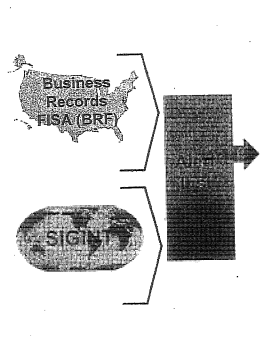
SIGINT and 215Thanks to John Napier Tye’s Sunday op-ed, some surveillance watchers are just now discovering EO 12333, which I’ve written some 50 posts about over the last year.

Back in January, I focused on one of the most alarming disclosures of the 2009 phone dragnet problems, that 3,000 presumed US person identifiers were on an alert list checked against each day’s incoming phone dragnet data. That problem — indeed, many of the problems reported at the beginning of 2009 — arose because the NSA dumped their Section 215 phone dragnet data in with all the rest of their metadata, starting at least as early as January 4, 2008. It took at least the better part of 2009 for the government to start tagging data, so the NSA could keep data collected under different authorities straight, though once they did that, NSA trained analysts to use those tags to bypass the more stringent oversight of Section 215.

One thing that episode revealed is that US person data gets collected under EO 12333 (that’s how those 3,000 identifiers got on the alert list), and there’s redundancy between Section 215 and EO 12333. That makes sense, as the metadata tied to the US side of foreign calls would be collected on collection overseas, but it’s a detail that has eluded some of the journalists making claims about the scope of phone dragnet.

Since I wrote that early January post, I’ve been meaning to return to a remarkable exchange from the early 2009 documents between FISC Judge Reggie Walton and the government. In his order for more briefing, Walton raised questions about tasking under NSA’s SIGNIT (that is, EO 12333) authority.

The preliminary notice from DOJ states that the alert list includes telephone identifiers that have been tasked for collection in accordance with NSA’s SIGINT authority. What standard is applied for tasking telephone identifiers under NSA’s SIGINT authority? Does NSA, pursuant to its SIGINT authority, task telephone identifiers associated with United States persons? If so, does NSA limit such identifiers to those that were not selected solely upon the basis of First Amendment protected activities?

The question reveals how little Walton — who had already made the key judgments on the Protect America Act program 2 years earlier — knew about EO 12333 authority.

I’ve put NSA’s complete response below the rule (remember “Business Records” in this context is the Section 215 phone dragnet authority). But basically, the NSA responded,

  • Even though the alert list included IDs that had not been assessed or did not meet Reasonable Articulable Suspicion of a tie to one of the approved terrorist groups, they at least had to have foreign intelligence value. And occasionally NSA’s counterterrorism people purge the list of non-CT IDs.
  • Usually, NSA can only task (a form of targeting!) a US person under a FISA authority.
  • Under EO 12333 and other related authorities, NSA can collect SIGINT information for foreign and counterintelligence purposes; its collection, retention, and dissemination of US person is governed by Department of Defense Regulation 5240.1-R and a classified annex. (see page 45 for the unclassified part of this)
  • Since 2008, if the NSA wants to target a US person overseas they need to get and comply with a FISA order.
  • NSA provides First Amendment protection in two ways — first, by training analysts to spy “with full consideration of the rights of United States persons.”
  • NSA provides First Amendment protection under EO 12333 by prohibiting NSA “from collecting or disseminating information concerning US persons’ ‘domestic activities’ which are defined as ‘activities that take place in the domestic United States that do not involve a significant connection to a foreign power, organization, or person.'”

The First Amendment claims in the last two bullets are pretty weak tea, as they don’t actually address First Amendment issues and contact chaining is, after all, chaining on associations.

That’s all the more true given what we know had already been approved by DOJ. In the last months of 2007, they approved the contact chaining through US person identifiers of already-collected data (including FISA data). They did so by modifying DOD 5240.1 and its classified annex so as to treat what they defined (very broadly) as metadata as something other than interception.

The current DOD procedures and their Classified Annex may be read to restrict NSA’s ability to conduct the desired communications metadata analysis, at least with respect to metadata associated with United States persons. In particular, this analysis may fall within the procedures’ definition of, and thus restrictions on, the “interception” and “selection” of communications. Accordingly, the Supplemental Procedures that would govern NSA’s analysis of communications metadata expressly state that the DOD Procedures and the Classified Annex do not apply to the analysis of communications metadata. Specifically, the Supplemental Procedures would clarify that “contact chaining and other metadata analysis do not qualify as the ‘interception’ or ‘selection’ of communications, nor do they qualify as ‘us[ing] a selection term,’ including using a selection term ‘intended to intercept a communication on the basis of. .. [some] aspect of the content of the communication.” Once approved, the Supplemental Procedures will clarify that the communications metadata analysis the NSA wishes to conduct is not restricted by the DOD procedures and their Classified Annex.

Michael Mukasey approved that plan just as NSA was dumping all the Section 215 data in with EO 12333 data at the beginning of 2008 (though they did not really roll it out across the NSA until later in 2009).

Nowhere in the government’s self-approval of this alternate contact chaining do they mention First Amendment considerations (or even the domestic activities language included in their filing to Walton). And in the rollout, they explicitly permitted starting chains with identifiers of any nationality (therefore presumably including US person) and approved the use of such contact chaining for purposes other than counterterrorism. More importantly, they expanded the analytical function beyond simple contact chaining, including location chaining.

All with no apparent discussion of the concerns a FISC judge expressed when data from EO 12333 had spoiled Section 215 data.

We will, I expect, finally start discussing how NSA has been using EO 12333 authorities — and how they’ve represented their overlap with FISA authorized collection. This discussion is an important place to start. Read more

Share this entry

Fact-Checking 9/11 Anniversary Report on Info and Dragnets with 9/11 Report

In Salon, I point out something funny about the report released on Tuesday to mark the 10 year anniversary of the release of the 9/11 Commission report. The report says we must fight the “creeping tide of complacency.” But then it says the government has done almost everything the 9/11 Commission said it should do.

There is a “creeping tide of complacency,” the members of the 9/11 Commission warned in a report released on Tuesday, the 10-year anniversary of the release of their original report. That complacency extends not just to terrorism. “On issue after issue — the resurgence and transformation of al Qaeda, Syria, the cyber threat — public awareness lags behind official Washington’s.” To combat that “creeping tide of complacency,” the report argues, the government must explain “the evil that [is] stalking us.”

Meanwhile, the commissioners appear unconcerned about complacency with climate change or economic decline.

All that fear-mongering is odd, given the report’s general assessment of counterterrorism efforts made in the last decade. “The government’s record in counterterrorism is good,” the report judged, and “our capabilities are much improved.”

If the government has done a good job of implementing the 9/11 Commission recommendations but the terror threat is an order of magnitude worse now, as the report claims, then those recommendations were not sufficient to addressing the problem. Or perhaps the 13 top security officials whom the Commission interviewed did a slew of other things — like destabilizing Syria and Libya — that have undermined the apparatus of counterterrorism recommended by the original 9/11 Commission?

Which is a polite way of saying the 10-year report is unsatisfying on many fronts, opting for fear-mongering than another measured assessment about what we need to do to protect against terrorism.

Perhaps that’s because, rather than conduct the public hearings with middle-level experts, as it boasted it had done in the original report, it instead privately interviewed just the people who’ve been in charge for the last 10 years, all of whom have a stake in fear and budgets and several of whom now have a stake in profiting off fear-mongering?

Suffice it to say I’m unimpressed with the report.

Which brings me to this really odd detail about it.

The report takes a squishy approach to Edward Snowden’s leaks. It condemns his and Chelsea Manning’s leaks and suggests they may hinder information sharing. It also suggests Snowden’s leaks may be impeding recruiting for cybersecurity positions.

But it also acknowledges that Snowden’s leaks have been important to raising concerns about civil liberties — resulting in President Obama’s decision to impose limits on the Section 215 phone dragnet.

Since 2004, when we issued the report, the public has become markedly more engaged in the debate over the balance between civil liberties and national security. In the mid-2000s, news reports about the National Security Agency’s surveillance programs caused only a slight public stir. That changed with last year’s leaks by Edward Snowden, an NSA contractor who stole 1.7 million pages of classified material. Documents taken by Snowden and given to the media revealed NSA data collection far more widespread than had been popularly understood. Some reports exaggerated the scale of the programs. While the government explained that the NSA’s programs were overseen by Congress and the courts, the scale of the data collection has alarmed the public.

[snip]

[I]n March, the President announced plans to replace the NSA telephone metadata program with a more limited program of specific court-approved searches of call records held by private carriers. This remains a matter of contention with some intelligence professionals, who expressed to us a fear that these restrictions might hinder U.S. counterterrorism efforts in urgent situations where speedy investigation is critical.

Having just raised the phone dragnet changes, the report goes on to argue “these programs” — which in context would include the phone dragnet — should be preserved.

We believe these programs are worth preserving, albeit with additional oversight. Every current or former senior official with whom we spoke told us that the terrorist and cyber threats to the United States are more dangerous today than they were a few years ago. And senior officials explained to us, in clear terms, what authorities they would need to address those threats. Their case is persuasive, and we encountered general agreement about what needs to be done.

Senior leaders must now make this case to the public. The President must lead the government in an ongoing effort to explain to the American people—in specific terms, not generalities—why these programs are critical to the nation’s security. If the American people hear what we have heard in recent months, about the urgent threat and the ways in which data collection is used to counter it, we believe that they will be supportive. If these programs are as important as we believe they are, it is worth making the effort to build a more solid foundation in public opinion to ensure their preservation.

This discussion directly introduces a bizarre rewriting of the original 9/11 Report.

Given how often the government has falsely claimed that we need the phone dragnet because it closes a gap that let Khalid al-Midhar escape you’d think the 9/11 Commission might use this moment to reiterate the record, which shows that the government had the information it needed to discover the hijacker was in the US.

Nope.

It does, however, raise a very closely related issue: the FBI’s failure to discover Nawaf al Hazmi’s identity. Read more

Share this entry

David Medine’s PCLOB Defense

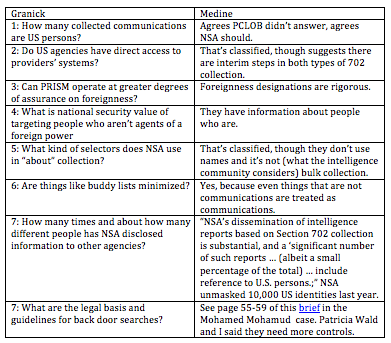
Today, David Medine attempts to answer (most) of the questions Jennifer Granick argues weren’t answered in the Privacy and Civil Liberties Oversight Board’s report on Section 702. Here’s my summary of how he does so:

Screen shot 2014-07-22 at 9.15.15 AM

Even while Medine “challenges” Granick’s assessment that her questions weren’t answered, he admits “Professor Granick may not find that all of her questions have been fully answered.”

And that’s clear from my summary: for classification reasons, PCLOB didn’t answer the questions about volume of US person communications collected (question 1) or the kinds of selectors used (question 5), and only hinted at an answer to whether NSA had direct access to providers’ networks (question 2). As I’ve suggested, even with the 100 new pieces of data PCLOB got declassified, their subjection to obviously bogus government classification claims discredits their report.

The most useful response Medine provides Granick — though not for what it says about the underlying question — is to inform us that buddy lists and a bunch of other things are treated as communications.


  1. “Do intelligence agencies minimize address books, buddy lists, stored documents, system backups and/or other electronic transmissions where there is no human being on the received end of the transmission as “communications” under the minimization procedures? Or are those fair game?”

The report answers this question directly: “Everything that is collected under Section 702 is treated as a ‘communication’ and therefore is protected by the applicable minimization procedures.” PCLOB report at p. 127 n. 524. As explained elsewhere in the report, the statute itself “requires that all acquired data be subject to minimization procedures.” PCLOB report at p. 50 (emphasis added).

In a sense, Granick’s original question was overtaken by events when it was confirmed — both in the WaPo’s analysis of 702 collected data and in PCLOB — that minimization doesn’t work as mandated by law (though PCLOB seems relatively untroubled by that). Sure, US person names in an address book will be masked, but they won’t be destroyed because they have no foreign intelligence value. So even US person names in buddy lists will be available for analysis.

But Medine’s answer — emphasizing that “everything .. is treated as ‘communication'” — is important for his answer regarding what the government uses for upstream selectors. Read more

Share this entry

Dick Durbin’s Obscure Transparency Bid

Steven Aftergood notes that the Senate Appropriations Committee has included a reporting requirement on NSA on its “bulk collection” programs.

That’s all well and good, if the language isn’t stripped before final passage. But there are a couple of limits to the language.

First, the reporting requirements on Section 215 only go back to 2009.

For the last 5 years, on an annual basis, the number of records acquired by NSA as part of the bulk telephone metadata program authorized by the Foreign Intelligence Surveillance Court, pursuant to section 215 of the USA PATRIOT Act, and the number of such records that have been reviewed by NSA personnel in response to a query of such records;

Of course, the program changed significantly in 2009; the collection scope may have narrowed at that point. And many of the abuses were ended in that year.

And there are two problems with the requirement to provide a list of all “bulk collection” programs.

A report, unclassified to the greatest extent possible, and with a classified annex if necessary, describing all NSA bulk collection activities, including when such activities began, the cost of such activities, what types of records have been collected in the past, what types of records are currently being collected, and any plans for future bulk collection.

We know the intelligence community only includes programs that use no discriminator as “bulk collection.” So the report would list what the IC considers bulk collection, not what normal human beings do.

In addition, only NSA would have to report its bulk programs. We know, for example, that the FBI has a Pen Register program that presumably involves some bulk. That would not show up in this list.

So, great! Transparency!

But not transparency that will tell us what we need to know.

Share this entry

Edward Snowden’s Smut

In an interview with the Guardian published yesterday, Edward Snowden claimed that compromising pictures get shared around NSA.

Made a startling claim that a culture exists within the NSA in which, during surveillance, nude photographs picked up of people in “sexually compromising” situations are routinely passed around.

Boing Boing transcribed his comments on it.

The usual whiners are suggesting Snowden is making this up and demanding proof.

They seem to have forgotten the proof we’ve already seen of NSA officially retaining sexually compromising material. Here’s what Bart Gellman described in a follow-up to WaPo’s recent report on the data collected under Section 702.

Among the large majority of people who are not NSA targets, many of the conversations in our sample are exceedingly private. Often they are very far from publishable, without editing.

Him: “How about you [verb, possessive adjective, noun]

Her: “I [verb] if you [another verb].”

Him: “That can be arranged.”

Her: “I really need punishment.”

Another young woman, also not a target, responds to a suitor who proposes to pay a visit.

Her: “don’t think that would b fair on the guy im seeing”

Him: “you can be a bit naughty at times lol”

Her: “Yeah lol”

The conversation proceeds from there.

This is stuff officially retained by NSA. This is stuff they claim has foreign intelligence value. This is sexually compromising. And Gellman says many of the retained communications are like that.

Sure, I get that NSA wants to contact chain on who’s fucking whom, just as they want to chain on who’s calling whom.  But to do that, they’re retaining smut.

Share this entry