The Oversight Black Hole of the Merkel Tap

In one of the better pieces on White House and anonymous NSA official claims about whether President Obama knew of the wiretaps on Angela Merkel, the NSA spokesperson gets to the crux of the issue.

“NSA is not a free agent,” said NSA spokesperson Vanee Vines. “The agency’s activities stem from the National Intelligence Priorities Framework, which guides prioritization for the operation, planning, and programming of U.S. intelligence analysis and collection.” The framework is approved by the top leaders of the government, but it leaves the question of how best to gather intelligence to the individual agencies.

This statement gets at why the anonymous NSA source claims that someone — whether it be Keith Alexander or another briefer — informed Obama of the tap on Merkel in 2010 and that he authorized it continue and the White House’s rebuttal that he didn’t know about the wiretaps on world leaders.

The account suggests President Barack Obama went nearly five years without knowing his own spies were bugging the phones of world leaders. Officials said the NSA has so many eavesdropping operations under way that it wouldn’t have been practical to brief him on all of them.

They added that the president was briefed on and approved of broader intelligence-collection “priorities,” but that those below him make decisions about specific intelligence targets.

The senior U.S. official said that the current practice has been for these types of surveillance decisions to be made at the agency level. “These decisions are made at NSA,” the official said. “The president doesn’t sign off on this stuff.” That protocol now is under review, the official added.

That is, the President approves the National Intelligence Priorities Framework and gets the results of the collection authorized by it, but he may not know specifically how each piece of intelligence was collected. I have no doubt Obama approved a continued focus on EU leaders in the aftermath of the financial crisis, but find it plausible that he did not know that would include monitoring Merkel’s private cell phone.

Here’s how the NIPF describes it working.

1. The National Intelligence Priorities Framework (NIPF) is the DNI’s sole mechanism for establishing national intelligence priorities.
2. Intelligence topics reviewed by the National Security Council (NSC) Principals Committee (PC) and approved by the President semi-annually shall form the basis of the NIPF and the detailed priorities established by the DNI.
Read more

Share this entry

The Institutional Subjectivity of the White Affluent US Nation

In a really worthy read, Bill Keller and Glenn Greenwald debate the future of journalism.

Sadly, however, in his first response to Keller’s self-delusion of belonging to the journalistic tradition of “newspapers that put a premium on aggressive but impartial reporting[] that expect reporters and editors to keep their opinions to themselves,” Greenwald seemed to cede that such journalism constitutes, “concealing one’s subjective perspectives.” That permitted Keller to continue his self-delusion that his journalism — at both the level of reporter and that reporter’s larger institution — achieved that silence about opinions until they started fighting about the role of national allegiance and national security.

That argument developed this way.

Greenwald: Former Bush D.O.J. lawyer Jack Goldsmith in 2011 praised what he called “the patriotism of the American press,” meaning their allegiance to protecting the interests and policies of the U.S. government. That may (or may not) be a noble thing to do, but it most definitely is not objective: it is quite subjective and classically “activist.”

[snip]

Keller: If Jack Goldsmith, the former Bush administration lawyer, had praised the American press for, in your words, “their allegiance to protecting the interests and policies of the U.S. government” then I would strongly disagree with him. We have published many stories that challenged the policies and professed interests of the government. But that’s not quite what Goldsmith says. He says that The Times and other major news outlets give serious consideration to arguments that publishing something will endanger national security — that is, might get someone killed.

For what it’s worth, I think Keller is clinging to the first thing Goldsmith said,

Glenn Greenwald complained that “the NYT knew about Davis’ work for the CIA (and Blackwater) but concealed it because the U.S. Government told it to” (my emphasis).  That is inaccurate.  The government asked the Times not to publish, as it often does, and the Times agreed to the request, which it sometimes does.  The final decision rested with the Times, which listens to the government’s claims about national security harm and risk to individual lives, and then makes its own decision.   The Timesdoes not, in my opinion, always exercise this discretion wisely.

And ignoring what Goldsmith went on to say,

I interviewed a dozen or so senior American national security journalists to get a sense of when and why they do or don’t publish national security secrets.  They gave me different answers, but they all agreed that they tried to avoid publishing information that harms U.S. national security with no corresponding public benefit. Some of them expressly ascribed this attitude to “patriotism” or “jingoism” or to being American citizens or working for American publications.   This sense of attachment to country is what leads the American press to worry about the implications for U.S. national security of publication, to seek the government’s input, to weigh these implications in the balance, and sometimes to self-censor.  (This is a natural and prudent attitude in a nation with the fewest legal restrictions in the world on the publication of national security secrets, but one abhorred by critics like Greewald.)  The Guardian, al Jazeera, and Wikileaks, by contrast, worry much less, if at all, about U.S. national security interests.

That is, Goldsmith noted both that at an institutional level US news outlets entertained the requests of the government, and that at a reportorial level, individuals prioritized US “national security.”

And from there, Keller repeatedly ignored or dismissed the efforts Greenwald, in his Edward Snowden reporting, or WikiLeaks, in its Cablegate publications, made to protect lives of individuals.

It’s not until Greenwald’s response where he gets to the crux of the issue.

As for taking into account dangers posed to innocent life before publishing: nobody disputes that journalists should do this. But I don’t give added weight to the lives of innocent Americans as compared to the lives of innocent non-Americans, nor would I feel any special fealty to the U.S. government as opposed to other governments when deciding what to publish. Read more

Share this entry

“An internal and an external review”

I’ll have more to say about WSJ’s report that Obama was unaware that the NSA was wiretapping 35 world leaders tomorrow.

But in my opinion, the most important detail in it reveals in addition to Obama’s James Clapper Committee to Make You Love the Dragnet, he has an internal review.

This summer, President Obama launched two reviews—an internal one and an external one. He highlighted them in a speech in August as part of a series of measures being taken to respond to the domestic uproar over NSA’s extensive spying practices in the U.S.

[snip]

The internal review, among different U.S. national security agencies, will be informed by findings from the external review, which is expected to deliver its final report in December, said White House spokeswoman Caitlin Hayden. [my emphasis]

Frankly, I don’t buy that Obama “highlighted” both these speeches in August. He highlighted his “independent” review, but mentioned nothing else that I can see.

Fourth, we’re forming a high-level group of outside experts to review our entire intelligence and communications technologies. We need new thinking for a new era. We now have to unravel terrorist plots by finding a needle in the haystack of global telecommunications. And meanwhile, technology has given governments — including our own — unprecedented capability to monitor communications.

So I am tasking this independent group to step back and review our capabilities — particularly our surveillance technologies. And they’ll consider how we can maintain the trust of the people, how we can make sure that there absolutely is no abuse in terms of how these surveillance technologies are used, ask how surveillance impacts our foreign policy — particularly in an age when more and more information is becoming public. And they will provide an interim report in 60 days and a final report by the end of this year, so that we can move forward with a better understanding of how these programs impact our security, our privacy, and our foreign policy.

Nor did the White House provide any details on reviews in the readout of the Angela Merkel conversation last week.

In other words, I suspect that for some reason — probably for a variety of them — Obama has decided that The James Clapper Committee to Make You Love the Dragnet is insufficient to the task of restoring confidence in the dragnet, so has people internal to the Administration working on fixes, probably tasked well after the Clapper committee, if not in the last week.

Or maybe he has just invented the existence of an “internal review” so as to explain why he is prepared to admit that 35 world leaders were being wiretapped by the NSA and anything else that proves inconvenient.

The National Security Agency ended a program used to spy on German Chancellor Angela Merkel and a number of other world leaders after an internal Obama administration review started this summer revealed to the White House the existence of the operations, U.S. officials said.

Officials said the internal review turned up NSA monitoring of some 35 world leaders, in the U.S. government’s first public acknowledgment that it tapped the phones of world leaders.

After all, the Guardian reported on the 35 world leaders (which the WSJ notes), and only after that we learn there’s an “internal review” that raised this as a point of concern? (Perhaps, too, this serves as a convenient fiction to accord with whatever Obama has told Angela Merkel on various occasions.)

WSJ spends much of the rest of the story trying to suggest the James Clapper Committee to Make You Love the Dragnet is not, as all evidence indicates, kabuki.

I don’t buy that, nor do I buy that there was really an “internal review” before things got really hot this week.

But I do hope that having been forced to create at least the appearance of a second review, Obama will use it as an opportunity to make more changes than he otherwise had planned on.

Update: Adding to my suspicion that the Administration created an “internal” review in the last few days, National Security Rice is now tweeting about it.

Share this entry

Did Lying Keith Just Accuse Obama of Lying?

I noted the other day the reason the non-denial confirmation that NSA wiretapped Angela Merkel raised the stakes for what President obama told the Chancellor in June about the spying. Did he give assurances she hadn’t been tapped?

If he did, anonymous leakers from the NSA’s vicinity suggest, he knowingly lied.

In Germany, Der Spiegel reported that the NSA’s Special Collection Service (SCS) had listed Merkel’s phone number since 2002. The number was still on the list – marked as “GE Chancellor Merkel” – weeks before Obama visited Berlin in June, raising the possibility that the German leader had been under surveillance for more than a decade. In an SCS document cited by the magazine, the agency said it had a “not legally registered spying branch” in the US embassy in Berlin, the exposure of which would lead to “grave damage for the relations of the United States to another government”.

The White House refused to comment on that report – or others that emerged in Germany overnight, raising questions about how much Obama personally knew about the spy operation.

[snip]

The German tabloid Bild reported that Obama was personally informed about US surveillance against Merkel by the director of the NSA, Keith Alexander, in 2010, and allowed the operation to continue. The newspaper cited “a secret intelligence employee who is familiar with the NSA operation against Merkel”. The Bild article also claimed that intelligence gathered by US spies based in Berlin was not channelled to NSA headquarters in Forte Meade, Maryland, but directly to the White House.

The newspaper Frankfurter Allgemeine Sonntagszeitung reported that when Obama spoke to Merkel over the phone on Wednesday, he assured the German leader he had not previously known her phone had been monitored. [my emphasis]

Much of this is obviously coming from Germany’s own national security establishment. But the Bild leak is clearly identified as a US source. The NSA is now denying it (in language that seems desperate to deny that Alexander was Bild’s source).

NSA chief General Keith Alexander “did not discuss with President Obama in 2010 an alleged foreign intelligence operation involving German Chancellor Merkel, nor has he ever discussed alleged operations involving Chancellor Merkel,”

That said, any certainty about what Obama got briefed would move likely come from ODNI, which is likely just as tired of taking the fall for the Snowden leaks.

Nevertheless, someone at NSA and/or associated with the Embassy in Germany is trying to hang this on the President.

Obama’s public line has already been that his Administration will assess whether we should be doing something, whether or not we can. I’m not all that convinced, particularly given the puffery of his Committee to Make You Love the Dragnet, he really means that. But even the hint that some at NSA want to hang this on the President might make him much more critical of what its doing.

Share this entry

James Clapper versus DOJ (and NSA) on Upstream Collection Transparency

Screen shot 2013-10-26 at 12.31.00 PM

Last week, David Ignatius wrote a column declaring the Director of National Intelligence position under James Clapper “Mission Accomplished!” It’s mostly a beat sweetener, but I’m intrigued by his claim that James Clapper forced the NSA to declassify more of the 2011 John Bates decision than they wanted to.

But there are welcome signs that this jury-rigged structure may finally be starting to work as the DNI responds to budget pressures and the scandals surrounding National Security Agency’s surveillance programs. Clapper has recently taken steps that forced the National Security Agency (NSA) to accept greater transparency and stopped the military agencies from wasteful spending on duplicative satellite imagery.

[snip]

One example is Clapper’s pressure on the NSA to disclose more about its surveillance programs. The NSA initially wanted to “redact” (a fancy word for censor) far more of a 2011 ruling by the Foreign Intelligence Surveillance Court that the agency had engaged in illegally broad surveillance. Clapper thought NSA lawyers were suppressing too much, so he instructed his general counsel, Robert Litt, to go back through the document and make public more information. Clapper ignored NSA and Justice Department protests, including to the White House, and backed Litt’s less-redacted version.

That 2011 opinion is one of the most important disclosures so far (and the more I think about it the more I’m convinced it was a dangerous rubber stamp). So I’m grateful as much of it was released as it was.

But I’m intrigued by what this account says of upstream collection (and the searching on US person data collected under FISA Amendments Act) generally.

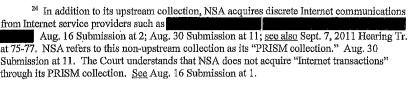
As the screen cap above shows, even while the opinion made it clear what “upstream” collection is (and other documents released, Dianne Feinstein’s public comments, and the footnote below have made it clear the telecoms conduct the collection), it kept the actual language describing the process redacted.

Screen shot 2013-10-26 at 12.53.09 PM


Assuming Ignatius description that Clapper pushed for this level of disclosure is correct, consider Clapper’s gimmicky efforts to deny or refuse to discuss other upstream collection under EO 12333. That would say Clapper pushed to make more of this FAA upstream collection public, but has gone to some effort to deny the other direct collection under EO 12333.

Meanwhile, remember the way David Kris’ paper, which was reviewed by DOJ, managed to raise Internet metadata and EO 12333, but largely indirectly.

They’re awfully squirrely about the upstream collection, perhaps because they are increasingly targeting US persons using EO 12333. But it’s worth following.

Share this entry

The “Voluntary” Cooperation that Comes from Coercion of Licensing Agreements?

The Guardian today describes how hard GCHQ worked to prevent its intercepts from being discoverable in trials. It did so for two reasons: to prevent a political firestorm about the extent of the collection.

A briefing memo prepared for the board of GCHQ shortly before the decision was made public revealed that one reason the agency was keen to quash the proposals was the fear that even passing references to its wide-reaching surveillance powers could start a “damaging” public debate.


Referring to the decision to publish the report on intercept as evidence without classification, it noted: “Our main concern is that references to agency practices (ie the scale of interception and deletion) could lead to damaging public debate which might lead to legal challenges against the current regime.”

And to protect the telecoms, some of whose cooperation (I’m guessing British Telecom and Vodaphone, based on other reporting, but that is a wildarsed guess) goes beyond the requirements of the law.

In an extended excerpt of “the classified version” of a review prepared for the Privy Council, a formal body of advisors made up of current and former cabinet ministers, the document sets out the real nature of the relationship between telecoms firms and the UK government.

“Under RIPA [the Regulation of Investigatory Powers Act 2000], CSPs in the UK may be required to provide, at public expense, an adequate interception capability on their networks,” it states. “In practice all significant providers do provide such a capability. But in many cases their assistance – while in conformity with the law – goes well beyond what it requires.

The story references back to its earlier coverage on Tempora, the UK collection off cables, largely to note how different this description of the telecoms’ cooperation is from what they claimed back in June.

But given this description of their extensive cooperation, this detail from the original Tempora story sure looks more interesting.

The papers seen by the Guardian suggest some companies have been paid for the cost of their co-operation and GCHQ went to great lengths to keep their names secret. They were assigned “sensitive relationship teams” and staff were urged in one internal guidance paper to disguise the origin of “special source” material in their reports for fear that the role of the companies as intercept partners would cause “high-level political fallout”.

The source with knowledge of intelligence said on Friday the companies were obliged to co-operate in this operation. They are forbidden from revealing the existence of warrants compelling them to allow GCHQ access to the cables.

“There’s an overarching condition of the licensing of the companies that they have to co-operate in this. Should they decline, we can compel them to do so. They have no choice.”

Back in June, an anonymous source said the telecoms cooperate because their licensing depends on it. Now we learn that the government considers their cooperation voluntary, some of it beyond what is required.

I don’t know whether telecom law operates in the UK like in the US, but if the government premises licensing based on cooperation, it might get to the question I raised here, when I noted how the government reserved getting Department of Commerce involved in cases where companies didn’t provide the “voluntary” cooperation with cyberdefense the government demanded.

I think it’s quite possible the government (possibly both the US and UK) is/are demanding “voluntary” cooperation from the companies they license (on threat of losing their licenses). But remember, on a lot of this stuff, the government has held that companies can “voluntarily” turn over data (especially stuff facetiously called “foreign” based on false claims about the transit of data) without process if they want to.

So coerce the telecoms (and possibly, broadband) to cooperate under threat of licensing problems, then claim that this “voluntary” cooperation permits data sharing that otherwise would require legal process.

And in doing so, conduct a dragnet so vast that no judge would ever approve it.

Is that how it works?

Share this entry

“Too much transparency defeats the very purpose of democracy”

In truly bizarre testimony he will deliver to the House Intelligence Committee next week, Paul Rosenzweig argues that “too much transparency defeats the very purpose of democracy.” He does so, however, in a piece arguing that the government needs what amounts to be almost full transparency on all its citizens.

The first section of Rosenzweig analysis talks about the power of big data. It doesn’t provide any actual evidence that big data works, mind you. On the contrary, he points to one failure of big data.

When we speak of the new form of “dataveillance,” we are not speaking of the comparatively simple matching algorithms that cross check when a person’s name is submitted for review¾when, for example, they apply for a job. Even that exercise is a challenge for any government, as the failure to list Abdulmutallab in advance of the 2009 Christmas bombing attempt demonstrates.[11] The process contains uncertainties of data accuracy and fidelity, analysis and registration, transmission and propagation, and review, correction, and revision. Yet, even with those complexities, the process uses relatively simple technologically—the implementation is what poses a challenge.

By contrast, other systems of data analysis are far more technologically sophisticated. They are, in the end, an attempt to sift through large quantities of personal information to identify subjects when their identities are not already known. In the commercial context, these individuals are called “potential customers.” In the cyber conflict context, they might be called “Anonymous” or “Russian patriotic hackers.” In the terrorism context, they are often called “clean skins” because there is no known derogatory information connected to their names or identities. In this latter context, the individuals are dangerous because nothing is known of their predilections. For precisely this reason, this form of data analysis is sometimes called “knowledge discovery,” as the intention is to discover something previously unknown about an individual. [my emphasis]

Nevertheless, having not provided evidence big data works, he concludes that “There can be little doubt that data analysis of this sort can prove to be of great value.”

The reference to Abdulmutallab is curious. At the beginning of his testimony he repeats the reference.

In considering this new capability we can’t have it both ways.  We can’t with one breath condemn government access to vast quantities of data about individuals, as a return of “Big Brother”[4] and at the same time criticize the government for its failure to “connect the dots” (as we did, for example, during the Christmas 2009 bomb plot attempted by Umar Farouk Abdulmutallab.

This formulation — and the example of Abdulmutallab even more so — is utterly crazy. Having big data is not the same thing as analyzing it correctly. Criticism that the Intelligence Community failed to connect the dots — with the UndieBomb attack, but even with 9/11 — assumes they had the dots but failed to analyze them or act on that analysis (as the IC did fail, in both cases). Indeed, having big data may actually be an impediment to analyzing it, because it drowns you. And while Rosenzweig suggests the only big data failure with Abdulmutallab involved not placing him on a watch list, that’s false. The NSA had wiretaps on Anwar al-Awlaki which, according to the government, collected information tying Abdulmutallab to an attack.

Yet they didn’t respond to it.

And you know what? We measly citizens don’t know why they didn’t respond to it — though we do know that the FBI agents who were analyzing the Awlaki data were … you guessed it! Overwhelmed.

Before anyone involved in government claims that big data helps — rather than hinders — they should have to explain why a full-time tap on Anwar al-Awlaki didn’t find the guy who was texting him about a terrorist attack. Read more

Share this entry

Did Obama Lie to Merkel in Berlin?

As I noted here and the NYT lays out in more detail, Obama spoke with Angela Merkel about US spying in Germany in June when he was in Berlin.

The first disclosures from Der Spiegel in June almost soured the long-planned meeting between Mr. Obama and Ms. Merkel in her capital, which the president visited as a candidate in 2008, delivering a speech before an estimated 200,000 people.

In June, there were far fewer, carefully screened and invited Germans and Americans on hand to hear Mr. Obama at the Brandenburg Gate, the symbol of Berlin’s unity and freedom since the Berlin Wall fell in 1989.

Shortly beforehand, Mr. Obama and Ms. Merkel stood side by side in her chancellery, fielding questions about American surveillance of foreigners’ phone and e-mail traffic. Pressed personally by Ms. Merkel, the president said that terrorist threats in Germany were among those foiled by intelligence operations around the world, and Ms. Merkel concurred.

A month later, Merkel quipped that she had not been wiretapped.

In July, Ms. Merkel joked with television interviewers asking about the situation, “I know of no case where I was listened to.”

Yet in the last few days, Merkel has discovered this is not true. The White House’s non-denial — “The President assured the Chancellor that the United States is not monitoring and will not monitor the communications of Chancellor Merkel” — makes it fairly clear the United States was monitoring her communications.

All of which raises the stakes for whatever explanation Obama offered in June.

The NSA’s strategy since Edward Snowden first leaked has been to emphasize (as Obama seems to have with Merkel) its use for counterterrorism. It has been increasingly clear NSA badly wants to hide the sheer scale of its spying — that it could effectively be taking everything. But even from the earliest leaks, it has been clear the US was spying on diplomats, particularly from the EU. So it should not be surprising that it is also spying on Merkel.

That said, it sounds like this tap, of Merkel’s private cell phone (which presumably had some kind of security, particularly given the involvement of Germany’s security services to assess whether it had been tapped), was probably a more deliberate tap than the broader spying NSA conducts, probably a TAO exploit. Not something that happens incidentally.

I would imagine Merkel would be pissed in any case, and gravely concerned about the topics of interest. (I’m acutely interested, for example, whether the US has shared any information about the plight of the Euro with the banks that have largely devastated the Euro.)

But there’s also the question of whether Obama gave Merkel assurances that have now turned out to be false.

Note, this article on how leaks are making it harder for the US to tout openness and human rights while secretly doing the opposite is closely related–it’s well worth your read.

Share this entry

NSA Has Conquered Canada and Mexico Now

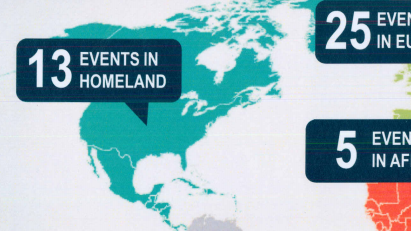
Screen shot 2013-10-23 at 3.13.35 PMTo accompany its excellent piece on the NSA’s Zombie Lie about having prevented 54 terrorist attacks, ProPublica republished the map NSA released to seed the Zombie Lie (visual aids help with propaganda, I understand).

I noticed for the first time how the NSA has simply incorporated Canada and Mexico into the “Homeland.”

I wouldn’t have mentioned it at all, but one of the events they’re almost certainly including among the 13 is the Manssor Arbabsiar “plot” to kill the Saudi Ambassador. That plot, at least as DEA’s informant crafted the tale, involved targets in Argentina, too (and, of course, the plotting took place in Mexico).

Though perhaps the most telling aspect of the whole map is how the whole terrorism thing goes blank once you get south of Mexico. There, of course (and in Mexico as well), we’re stopping “Narcoterrorists,” not “terrorists.”

Finally, it’s funny that NSA is so inaccurate with their maps, given that some of their spying depends on boundary arbitrage, the placement of collection points outside of the US, so it can collect US person data while pretending not to.

Share this entry

James “Too Cute By Half” Clapper’s Denial

James Clapper made a somewhat unprecedented denial of Le Monde’s report (French, English) about the NSA’s dragnet, denying the eye-popping numbers on the volume of French spying (70.3 million in a month) we do.

October 22, 2013

Recent articles published in the French newspaper Le Monde contain inaccurate and misleading information regarding U.S. foreign intelligence activities.  The allegation that the National Security Agency collected more than 70 million “recordings of French citizens’ telephone data” is false.

While we are not going to discuss the details of our activities, we have repeatedly made it clear that the United States gathers intelligence of the type gathered by all nations.  The U.S. collects intelligence to protect the nation, its interests, and its allies from, among other things, threats such as terrorism and the proliferation of weapons of mass destruction.

The United States values our longstanding friendship and alliance with France and we will continue to cooperate on security and intelligence matters going forward.

Now, for what it’s worth, this seems the product of somewhat bad translation of the English for the Le Monde article, which started as this,

Parmi les milliers de documents soustraits à la NSA par son ex-employé figure un graphique qui décrit l’ampleur des surveillances téléphoniques réalisées en France. On constate que sur une période de trente jours, du 10 décembre 2012 au 8 janvier 2013, 70,3 millions d’enregistrements de données téléphoniques des Français ont été effectués par la NSA.

And then a worse translation back into English, which produced this,

Amongst the thousands of documents extracted from the NSA by its ex-employee there is a graph which describes the extent of telephone monitoring and tapping (DNR – Dial Number Recognition) carried out in France. It can be seen that over a period of thirty days – from 10 December 2012 to 8 January 2013, 70,3 million recordings of French citizens’ telephone data were made by the NSA.

I’m not going to explain this perfectly, but effectively it took a verbal that could mean the tape recording or the data notation of calls and turned it into a gerund that has the connotation in English of a discrete tape recording (note also the really cloddish use of the passive in a situation where you wouldn’t use it in English).

And from that, Clapper pounced on the “recordings” and presented them — in a quotation taken out of context — as discrete phone calls recorded individually. NSA’s not doing that, he says.

But we knew that. What they’re doing is intercepting call data in bulk and then sorting through what they want to keep.

It’s worth noting that the comment on the Boundless Informant screen Le Monde gets this from, however, refers to a more accurate calls “interceptées.” None of that excuses Le Monde’s presentation of it as such, particularly not its weak English translation which Clapper exploited (which isn’t, however, the actual language that has given François Hollande an opportunity to pretend to be shocked, and his English-only gotcha would be useful in refuting this for actual French readers). But that’s one source of the gotcha.

Now, as I said, this is relatively unprecedented. In the recent “interview” with Keith Alexander, NSA issued non-denial denials about info sharing with Israel. But there have been few very specific denials like this one.

And why would there be? Should we now assume all the other facts that have come out, anywhere in the world, are true? That Clapper has gone out of his way to do so, it seems, suggests the IC doesn’t dispute any other facts, which is almost certainly not the case, but nevertheless a fair assumption given their attention to this discrete point.

The one exception to this general rule, though, suggests why Clapper may have used this bad translation to claim gotcha! It just so happens to pertain to the WSJ story on upstream Internet collection, Read more

Share this entry