A week ago, on January 8, Donald Trump bitched out his US Attorneys (as well as those play-acting as US Attorney) — some, apparently, by name — because they are not focusing enough on prosecuting his perceived adversaries.
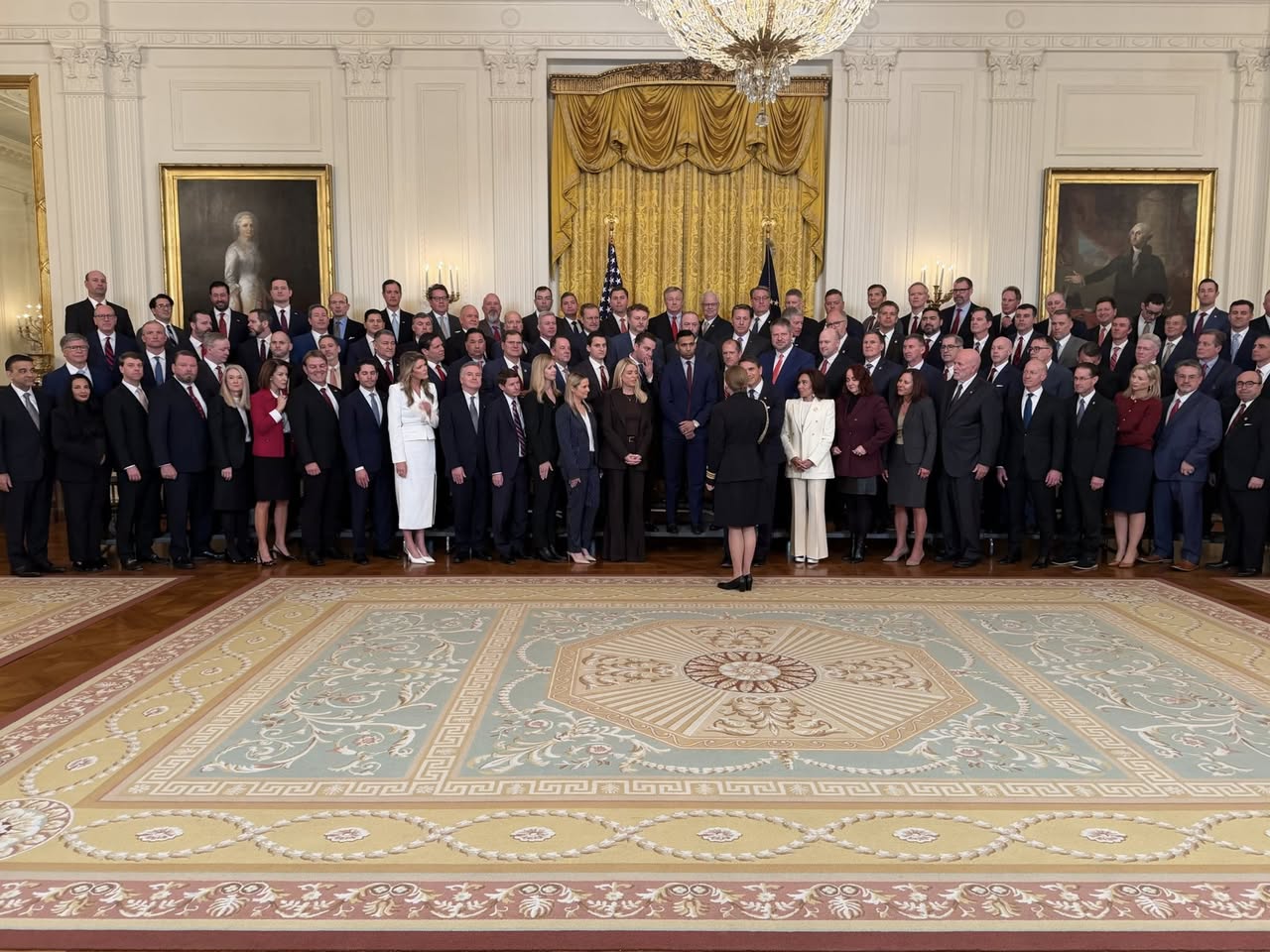
Dozens of U.S. attorneys, who lead prosecutors’ offices around the country, went to the White House Thursday for what was supposed to be a ceremonial photo shoot. After Attorney General Pam Bondi introduced the group of prosecutors, Trump criticized them as ineffective, saying the group was making it difficult for Bondi and Deputy Attorney General Todd Blanche to do their jobs, the people said.
[snip]
Among his grievances with prosecutors, Trump complained that the Justice Department hadn’t yet brought a case against one of his most prominent Democratic adversaries, Sen. Adam Schiff of California, the people said.
The department has been investigating whether Schiff engaged in mortgage fraud. The senator has called the probe a bogus attempt at political retribution.
The president criticized some specific prosecutors by jurisdiction and said he felt betrayed, the people said.
[snip]
Trump’s blowup at Justice Department prosecutors comes as the president ramps up pressure on the agency to more aggressively pursue his priorities. He has complained repeatedly in recent weeks about Bondi, calling her an ineffective enforcer of his agenda.
As WSJ noted in its story on this, the day after Trump’s tantrum, Jeanine Pirro sent a subpoena to Jerome Powell, setting off a crisis for Trump.
Also in the wake of that attack, the Minnesota US Attorney’s Office decided to investigate Renee Good’s network rather than the guy who shot her, Jonathan Ross, leading to the resignation of six AUSAs in MN and possibly some in the Civil Rights Division in DC, though Pam Bondi — who looked stunning for a 59 year old a year ago but now looks like shit — now claims she fired those MN AUSAs and Harmeet Dhillon claims the Civil Rights attorneys left for other reasons.
Donald Trump has made it the top focus of his DOJ to prosecute his enemies, and as a result, DOJ has been hemorrhaging experience for a year now.
That’s on top of the singular focus on Stephen Miller’s jihad against immigrants, which has led DOJ to reassign lawyers from national security cases to immigration cases (indeed, that’s one of the stated reasons why Bondi fired Robert McBride, because the First AUSA for one of the key national security divisions in the country didn’t sufficiently chase immigration cases).
But there’s another staffing choice that became public in recent weeks.
As multiple outlets have covered and as Jay Clayton detailed in two letters (January 5; January 15) to Judges Richard Berman (who presided over the Epstein case) and Paul Engelmayer (who picked up the Ghislaine Maxwell case after Alison Nathan moved to the 2nd Circuit) — DOJ has dedicated up to 580 people (the 500 reported last week, plus another 80 added this week) to replicating the review that over a thousand FBI personnel did a year ago, this time accounting for victim privacy and “independent privileges” not permitted under the act.
To date, the Department has employed over five hundred reviewers to review and redact millions of pages of materials from the investigations into Epstein and his convicted coconspirator, Maxwell.2 The SDNY alone, in conjunction with the Department, has dedicated significant resources (including AUSAs as well as other SDNY personnel), which this week has been supplemented by approximately 80 attorneys from the Department’s Criminal Division, who will coordinate and work with SDNY during the review of documents identified as likely to contain victim information. As part of that review, the Department is identifying not only those materials the publication of which are required under the Act, but also those that carry independent privileges as well as the need to redact victim-identifying information, among other things. Act, § 2(c).3
3 Any materials withheld on this basis of course will be disclosed in a report to Congress. Act § 3.
We still have no explanation for what the hell Bondi did in the last review, such that she has to dedicate 580 attorneys to replicate the review (though the explanation probably lies in the matters DOJ plans to claim privilege over).
But not only is the need to replicate the work that taxpayers already paid for drawing from national security cases, but it is drawing from other high profile sex trafficking cases.
On Tuesday, Judge Valerie Caproni, who is presiding over the prosecution of the Alexander brothers — who are accused of trafficking seven women and a girl (with more victims accusing the brothers) using means not that dissimilar from Epstein’s modus operandi — laid into prosecutors for delays in turning over discovery for a trial currently due to start this month.
On Tuesday, another federal judge in the Southern District of New York told prosecutors to hold off of the Epstein assignment to focus on another marquee sex crime prosecution: the case of Oren, Alon and Tal Alexander — a trio of wealthy brothers in real estate accused of using their status to rape and traffic dozens of women.
With that case set to head to trial later this month, U.S. District Judge Valerie Caproni told prosecutors that they need to focus on expeditiously sending over discovery materials.
“A few people can be strung from the Epstein case given that these people are on trial,” said the Obama appointee. “Epstein is dead.”
See InnerCity Press’ live tweeting here.
So here’s how Pam Bondi has used the resources at DOJ.
DOJ has been firing or chasing out personnel — about 5,500 people, according to Justice Connection, not all of them lawyers — since Trump started. A great many of those ousted were ousted, whether by choice or firing, because they refused to pursue Trump’s unethical weaponization.
That’s not good enough, Trump said last week. He needs the hollowed out DOJ to pursue his enemies faster.
Meanwhile, Pam Bondi is so incompetent or corrupt, she has to replicate work she already did, reviewing the Epstein files. 1,000 FBI personnel last March, 580 attorneys now. As a result, she’s neglecting current sex trafficking prosecutions.
And we have yet to tally what the impact of the reassignment of attorneys who focus on real national security issues. Many of them are chasing Stephen Miller’s fever dreams.
F[ucking] A[sshole] Bill Essayli submitted his response to David Huerta’s motion to dismiss his information (see this post for an explanation of why I’m calling Essayli, “F[ucking] A[sshole]”).
Here’s a summary of the argument: Huerta intentionally blocked the only available entrance of the search (but not arrest) location, he did this via means other than standing in front of a van, and encouraged others to do so, which led (after Ryan Ribner assaulted Huerta) LAPD to declare a riot.
During the execution of a search warrant, defendant intentionally blocked the only available entrance of the Warrant Location. He did this by sitting down and walking in circles directly in front of the entrance of the Warrant Location, making it impossible for any law enforcement vehicles to enter or exit, without defendant moving. In addition, he also successfully encouraged other individuals to join him in blocking the entrance of the Warrant Location in the same manner eventually contributing to LAPD declaring a riot at the Warrant Location. As defendant concedes in the Motion, defendant was told explicitly he “shouldn’t block or impede the [law enforcement vehicle] that would be arriving.” (Dkt. 55 at 14.)
Even this passage conflates two things Huerta did — sit, and picket, before the van showed up — with blocking it.
But the most interesting part of the passage is that word “available,” which is doing a lot of work. Along with the filing, DOJ submitted seven exhibits: three compilations of video (filed manually, so we don’t get them), and the interview reports from HSI Special Agent J Smith (who seems to have overseen the search), a second interview with the van driver, Brian Gonzalez, an interview with HSI Special Agent Andre Lemon, who helped Gonzalez change a tire, and a picture of the tire that got slashed while or shortly after Huerta was being assaulted. These late interviews appear to be an attempt to salvage the case with witnesses besides Ryan Ribner and Carey Crook, the guys who assaulted Huerta. DOJ is spinning a new story that because of what happened with Huerta — that is, because Ribner, especially, assaulted the SEIU CA President — HSI had to flee the site of the search hours earlier than they otherwise would have, which limited the number of undocumented workers they could detain, which wasn’t supposed to be the point of the search.
As Lemon described, they fled out a back gate.
SA Lamon stated they loaded the vehicle with “Some of the detainees and snuck out of the back gate”.
You see, from the moment I read this line in Ribner’s affidavit supporting the arrest warrant, I was pretty sure there was another gate ready to open, just like Chekov’s gun, a plot point that must be resolved.
Our trusty cyber expert also suggests that the van entering the gate of the facility — the predicate for making Huerta move and therefore the predicate to tackling him, injuring him, and then arresting him — may not, after all, be the only entrance. He describes that “as far as I was aware,” it was.
As far as I was aware, this gate was the only location through which vehicles could enter or exit the premises.
I wonder whether his awareness has changed over the weekend.
Ribner said a bit more about Chekov’s gate in the arrest report (and also revealed that he left in a caravan via “the secondary gate,” which he did not otherwise explain).
ERO SDDO C C approached SSA Ribner to discuss a plan to safely escort an ERO USG vehicle into the facility. SSA Ribner provided the same information to SDDO C as he did to the DEA agents regarding subjects potentially impeding/blocking agents and USG vehicles. SDDO Cr asked if there was another entrance/exit to the facility; SSA Ribner related that he did not have knowledge of a secondary entrance/exit. SSA Ribner related that agents would need to go outside of the gate and encircle the sides of the van to make sure it isn’t blocked and/or damaged. SDDO C asked how agents would move the pickup truck [playing loud music] from the driveway. SSA Ribner advised that he would verbally request the driver to move the truck. [my emphasis]
DOJ didn’t bother to ask Crook whether he knew of a second gate last August, as it became clear neither his nor Ribner’s testimony was credible. But his interview report describes that Crook, “recalled himself and GS Ribner coming up with a plan for the main gate to slightly open to allow the van to enter the property and then close it after the van entered,” just before he made a claim — that Huerta had “straddle[d] the hood of the van” and “ma[de] his body an X,” a claim no other witnesses nor the video corroborated.
The “main gate.”
You only call something a main gate if you know there’s another.
Brian Gonzalez — the guy who drove the van and all of a sudden remembered David Huerta being close to it after he got a permanent job at CBP and had a follow-up call, probably the guy DOJ hopes will be their star witness given problems with calling Ribner or Crook to the stand –was not asked about any gates in his first interview (or the follow-up, where his memory about Huerta evolved).
But in his interview last week, he was asked about the gate.
Before I explain what he said, note that the F[ucking] A[sshole] Bill Essayli confessed in his response that earlier — right up until the moment David Huerta arrived, Essayli seems to suggest — DHS had no problem getting cars and vans through the entrance where protestors were.
Shortly thereafter, between 10:30 a.m. and 11:45 a.m. demonstrators began to show up at the Warrant Location and congregated near the entrance to the front gate. During this initial period, before defendant arrived, the demonstrators did not block the driveway and repeatedly allowed vehicles to enter and exit the Warrant Location through the front gate. (Ex. 1 at 7:30-7:35; 8:16-8:27; Ex. 2 at 4:25-5:25, 7:49-7:53, 8:22-8:26, 9:45-9:48, 11:47-11:58.)
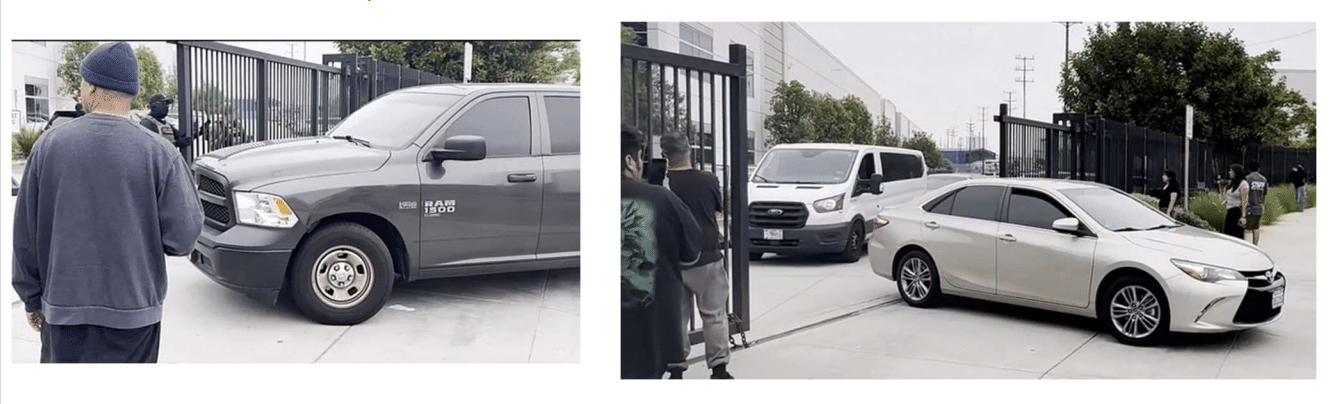
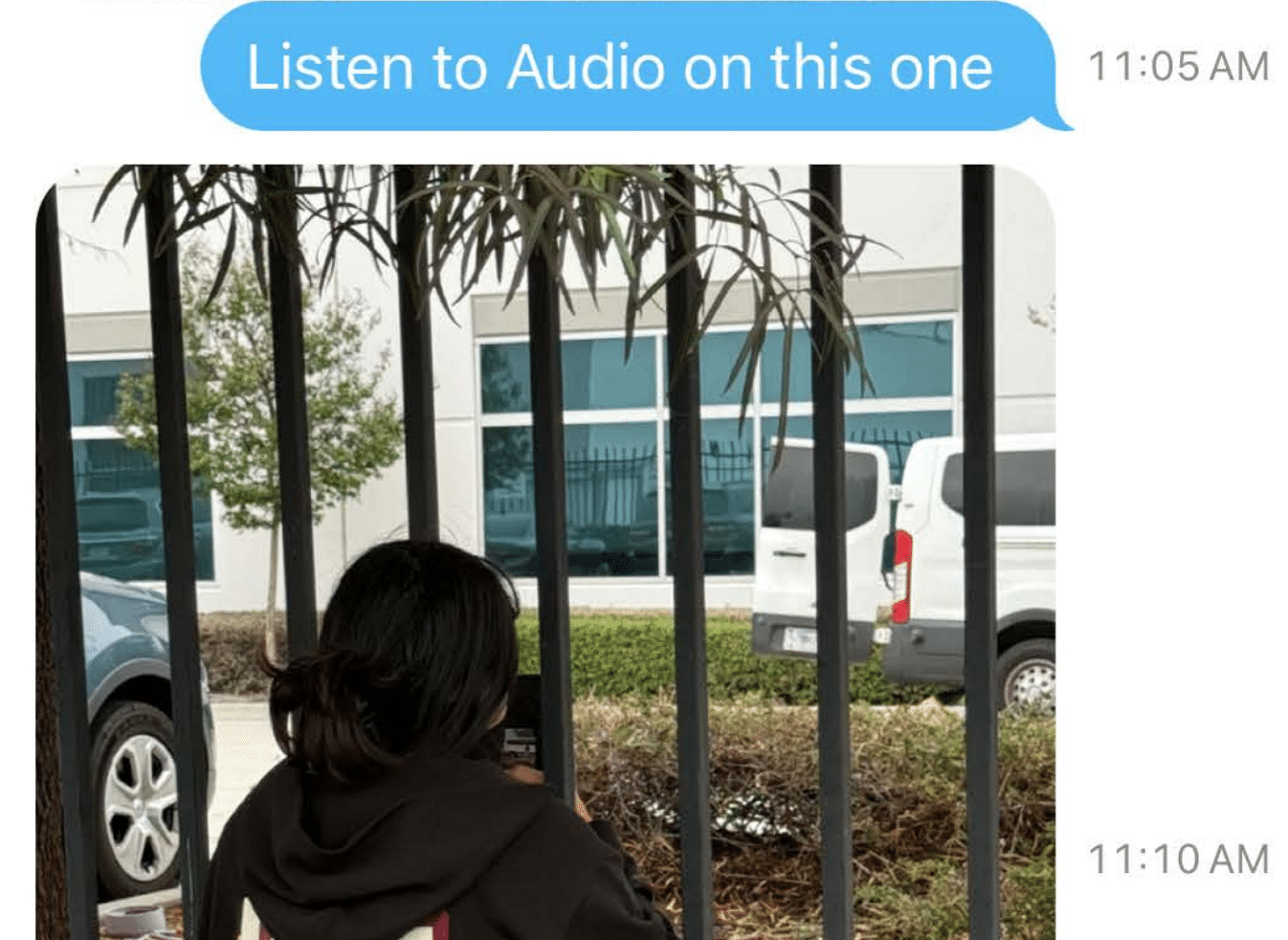
There was a white van captured in one of Jeremy Crossen’s photos, showing a time stamp of 11:10 (it’s possible the van in one or both of these pictures is the one driven by Gonazalez; per Google his drop-off at the Federal Building was a 9-minute drive away).
Crossen’s countersurveillance report describes what may be this van — at around that time, a van and a beige car were able to pass through the gate because someone asked nicely for the protestors to move and they complied.
At approximately 11:25 a.m., The southwest gate of the business opened, and a beige Toyota sedan and a white ICE ERO transport van approached the south apron of the driveway. As the gate opened, UHM-1 ran from where he was standing, just east of the apron. UHM-1 initially stood center driveway of the apron, blocking the egress of the car and van while filming. An unidentified agent standing just north of the gate ordered UHM-1 to move and he subsequently complied.
Half an hour later, per Crossen’s report, a mini-convoy came up at a time when Huerta was legitimately in front of the gate, if we can believe any of these reports (we can’t).
At approximately 11:54 a.m., A black Government Jeep Grand Cherokee, along with several other government vehicles, approached the apron of the driveway from E. 15 Street. The vehicle th remained stopped as both the gate was closed and standing protesters were blocking the apron of the driveway, preventing the vehicle from pulling closer to the south gate for entry into the business. At this time, TFO Crossen observed HUERTA, LENEHAN, UHF-8 and UHM-7 sit down on the ground, approximately two to four feet from the closed gate. TFO Crossen both audibly heard and video recording HUERTA motioning with his left hand with an “enviting motion” to the crowd around him, yelling “Sit down! Sit Down!” repeatedly. HSI Supervisory Special Agent (SSA) Ryan Ribner approached the closed gate from the other side and informed the seated protesters they were impeding the vehicles and needed to move. Upon hearing this, HUERTA, while still seated, “scooted” forward, where he was now seated on his knees, right against the gate. HUERTA ignored SSA Ribner’s orders to move because they were impeding law enforcement vehicles attempting to enter the business. HUERTA yelled to SSA Ribner, “What are you doing! What are you doing! I can’t hear you through your fucking mask! How are you keeping me safe by doing this!” SSA Ribner, calmly again admonished HUERTA that he was impeding law enforcement vehicles from entering.
Those vehicles do not appear in Ribner’s report, as far as I can tell, at all.
There’s no resolution to what happened to those vehicles, though. They disappear from the narrative by the time the van driven by Gonzalez shows up, which is when seven people move to block the van, and oh by the way, so does David Huerta, added as an afterthought in Crossen’s report.
At approximately 12:15 p.m., a white Law enforcement van pulls up to the apron of the driveway, just south of the main south gate with its siren and emergency lights activated. As the vehicle pulled up, agents opened the south gate, and several agents walked from inside the property compound to the apron of the driveway to assist with moving protestors so the emergency vehicle could gain entrance. As most of the crowd moved for the loud audible siren and emergency police lights, LENEHAN, GARDUNO, CUERVO, ALTAMIRANO, UHM-7, and an unidentified Hispanic female, later identified as Edith DIAZ (DOB: /1977; COC UNK) and UHM-8, who was now out of his unoccupied vehicle, which was playing loud music and blocking the apron, ran closer to and in front of the law enforcement vehicle to block it.. HUERTA also moved toward the emergency van with activated lights and siren and stood approximately two feet from the front bumper, directly in front of it, ignoring the emergency lights, activated siren and ignoring agents orders to move.
With all that in mind — with the way that Ribner stages confrontation over the expected appearance of Gonzalez’ van — here’s what Gonzalez said in his interview last week:
Gonzalez stated that he called Enforcement and Removal Operations (ERO), Supervisory Detention and Deportation Officer (SDDO) Carey Crook when he was about a block away from the location.
Gonzalez stated that he drove past the crowd at the front gate and asked SDDO Crook if he could come through the back.
Gonzalez stated that SDDO Crook informed him that the back gate was locked and they didn’t have the keys to the lock.
At noon, when Ribner was staging a confrontation with the people he believed were “vicious, horrible people,” he didn’t know there was a second gate.
But somehow Gonzalez, who found out just that morning he’d be doing this drive and had already done one pick-up that day, knew there was one. Not only Gonzalez knew of it. But Crook — whom Ribner claims asked him, Ribner, if there were a second gate — not only knew of one, but knew it was locked.
When they needed to get by protestors before Ribner had assaulted David Huerta, they asked nicely and everyone complied.
When they needed to get by protestors after Ribner had assaulted David Huerta, they knew exactly how to do that: go out the back door gate, which it turns out they had keys to.
Update: On Thursday, Huerta asked to delay the trial until May. I suspect this reflects a bid by DOJ to implicate Huerta — possibly even to supersede him with a felony — for the punctured tire.
b. Defendant contends that the omnibus opposition and the recent discovery productions of the government raise issues that warrant additional investigation and the need for additional pretrial filings. Moreover, defendant anticipates making additional discovery requests based on and in response to the recent productions of by the government that raise new trial issues.
c. In light of the foregoing, counsel for defendant also represents that additional time is necessary to confer with defendant, conduct and complete an independent investigation of the case, conduct and complete additional legal research including for potential pre-trial motions, review the discovery and potential evidence in the case, and prepare for trial in the event that a pretrial resolution does not occur. Defense counsel represents that failure to grant the continuance would deny them reasonable time necessary for effective preparation, taking into account the exercise of due diligence.
June 6: Arrest
9:00 AM: HSI task force officer (and Inglewood cop) Jeremy Crossen arrives under cover
9:20: Agents start executing search
9:57: Crossen interacts with Asian woman
10:26: Crossen interacts w/Hispanic protestor, claims he is monitoring the police
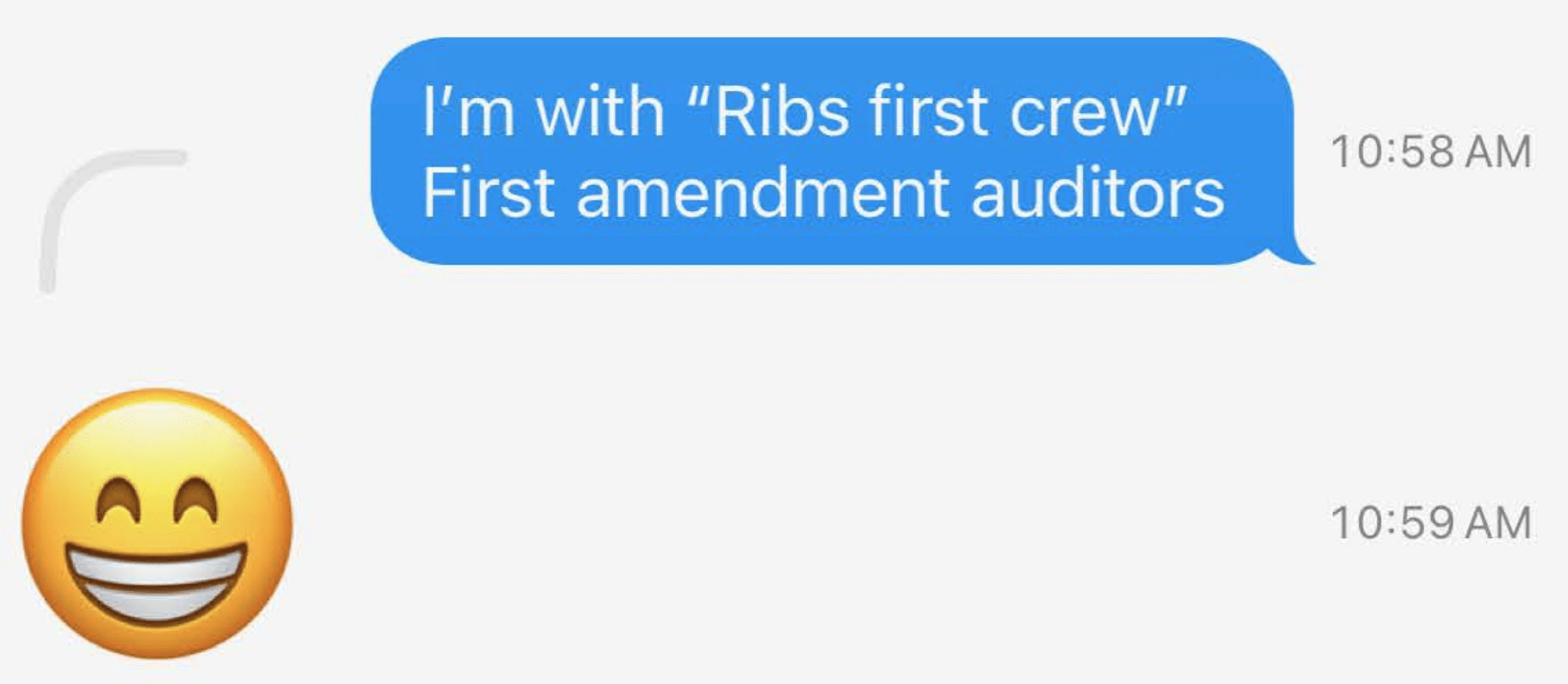
10:33: Crossen texts Ribner
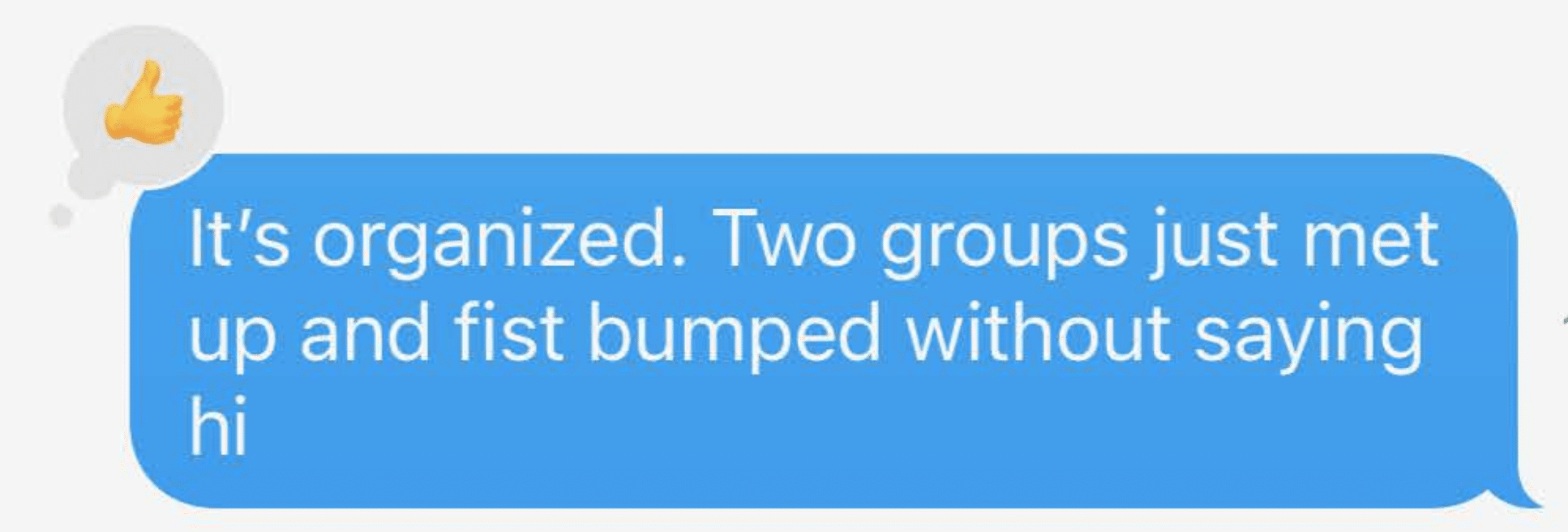
11:07: Crossen sees pick-up without plates whose Hispanic driver films
11:19: Crossen describes a Hispanic woman with a neck gaiter; his report provides background on a Kids of Immigrants sweatshirt she wears; start time of alleged criminal conduct
11:25: A sedan enters the gate; after an agent instructs those filming it to step away, they do; Crossen texts Ribner,
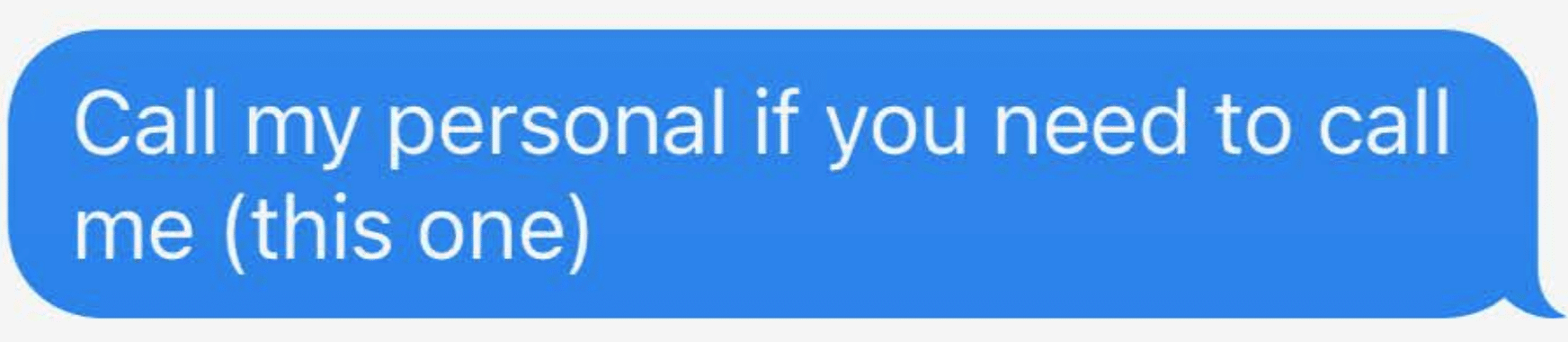
11:31: A Hispanic woman whom Crossen IDs by name shows up, makes phone calls
11:36: Crossen describes a white woman by name, describes that she masked as the crowd grew
11:37: Crossen describes the Hispanic leader of ACCE Action, Council Member Jose Delgado, show up, make calls
11:49: Crossen claims he sees Huerta walk up
11:51: A white woman from Tenants Union starts yelling obscenities
11:53: Ribner instructs Crossen to focus on Huerta

11:54: Huerta and others sit in front of the gate
12:01 PM: Ribner leaves the property and assaults Huerta [note his report timeline goes haywire in here]
12:00-12:09: Crossen texts Ribner
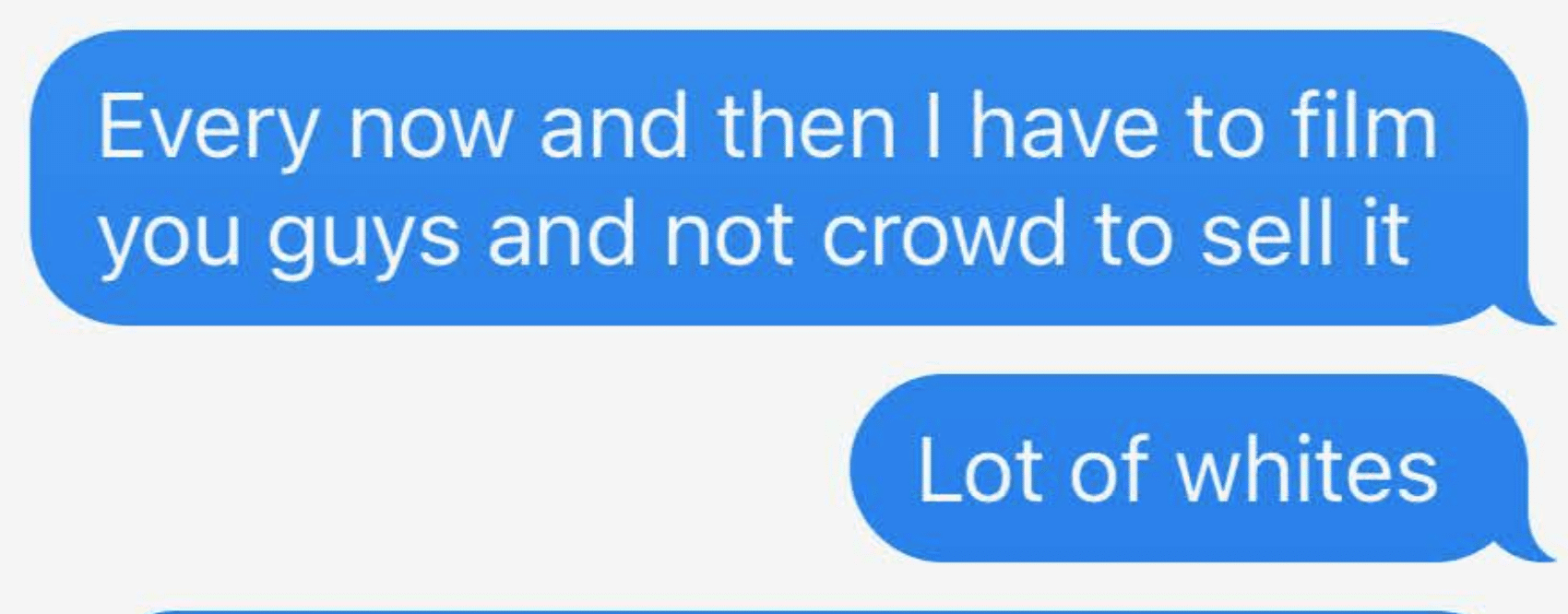
12:15: Crossen claims van arrives (his description describe others who were in front of the van, then says Huerta also was)
12:15: Ribner calls 911 (claiming this is about pepper spray)
12:18: Crossen describes a scrimmage line
12:20-12:40: Discussions about Huerta’s attempt to call his attorney
12:30: LAFD responds; Huerta asks to be brought to the hospital; Crossen describes LAFD arrival this way:
At approximately 12:28 p.m., TFO Crossen observed a Los Angeles City Fire truck with activated emergency lights and loud audible siren, attempting to gain entry to the business, still being blocked by protestors, to render aid for HUERTA, inside the business, who had been exposed to OC Spray, during his arrest.
12:40: Ribner reports arrest to CACD US Attorney office
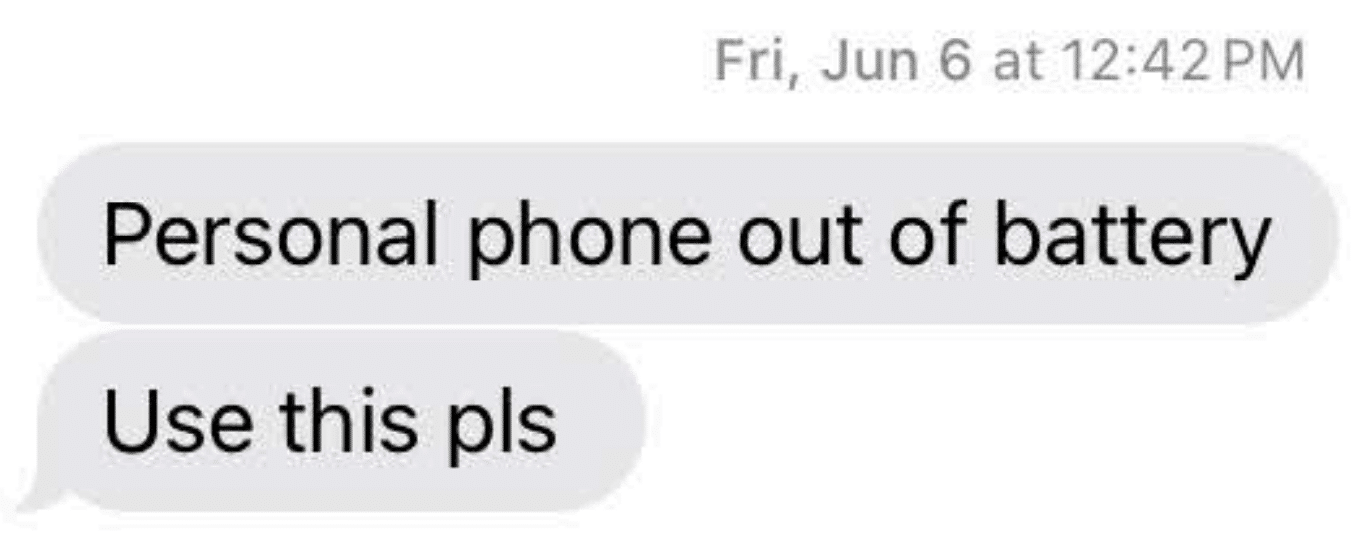
12:42: Ribner tells Crossen his personal phone is out of battery, asks him to use his government one
12:47: Ribner admits he used pepper spray
1:05: Ribner speaks to USAO again
1:30: Huerta taken to hospital w/agent in car
2:45: Ribner asks Crossen for pictures of Huerta
Unmarked time: Mayor Bass shows up to hospital room; they ask her to leave (and she does)
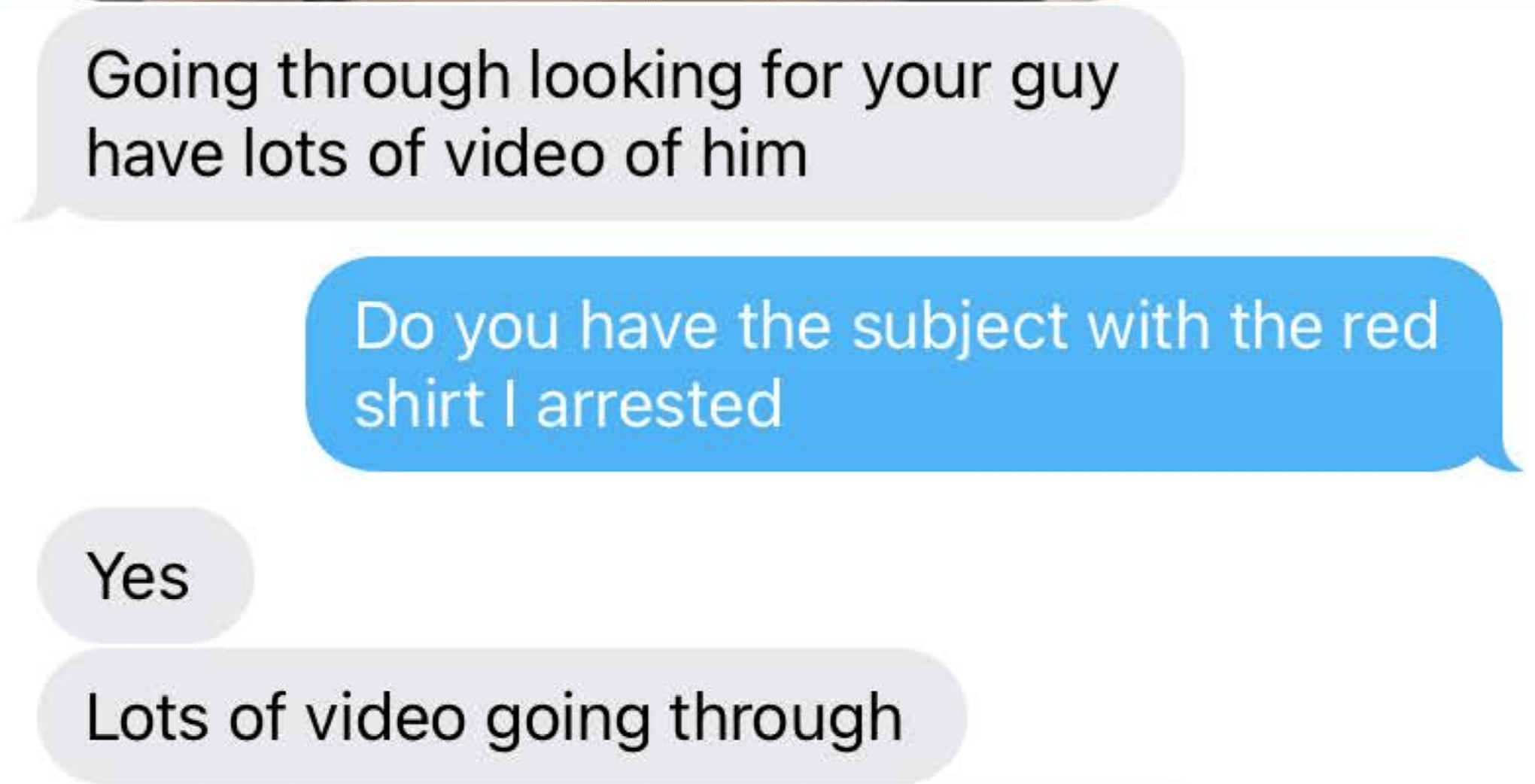
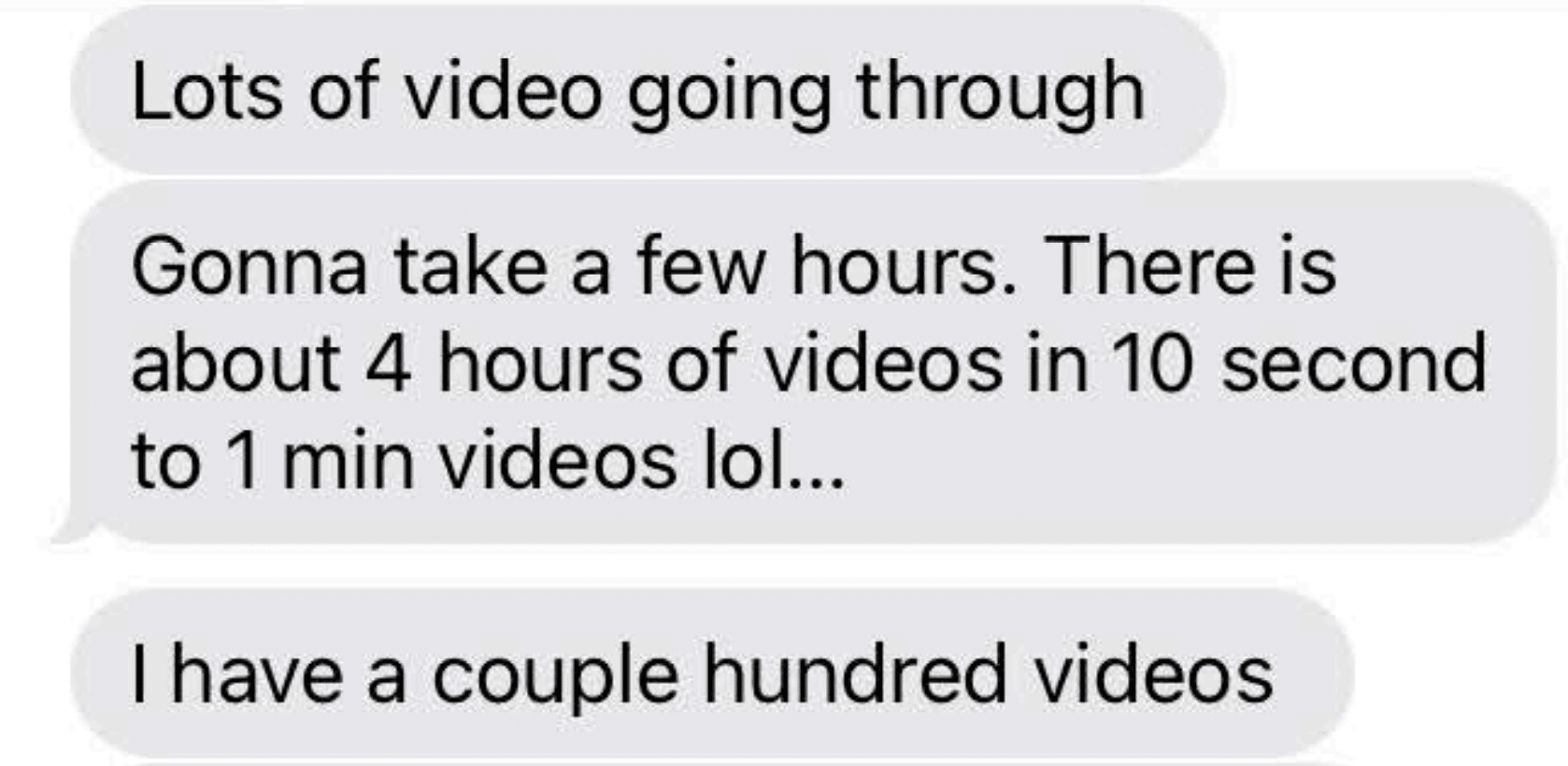
9:12: Crossen sends last clip from videos to Ribner (the discovery turned over provides nowhere near the “4 hours” or “100 videos” that Crossen told Ribner, five hours earlier, that he had taken (though the defense did not include all the texts in their exhibit)
9:36: Ribner obtains warrant for Huerta’s phone
10:30: Huerta attorney turns over the phone
June 8: Huerta charged with felony conspiracy
June 9: Case opened
June 17: Date created for one photo provided in discovery
June 19: Initial incident report; Ribner would later (in his September 10 interview) admit he wrote the report from memory and simply did not “recall that he told HUERTA, ‘You are not impeding’. He does not know why he did not include that statement in his report and agrees that his statement could sound exculpatory.”
June 23: Countersurveillance report from Crossen
July 2: Second set of discovery
July 17: Third set of discovery
July 28: Fourth set of discovery (including agent texts)
August 20: USAO interviews Brian Gonzalez, who drove the van allegedly blocked
August 27: USAO interviews Carey Crook; he told AUSAs that, contrary to Ribner’s claim, Huerta did not assault him
August 27: USAO interviews Crossen
September 9: USAO reinterviews Gonzalez; he says he does not remember Huerta straddling the van, as Crooks claimed
September 10: USAO interviews Ribner
September 11: Gonzalez starts at a new job at CBP
September 17: Later case opening date, possibly focusing on the lying agents
October 17: Huerta charged with misdemeanor
November 5: Huerta’s attorneys ask AUSA to identify the obstructive conduct
December 19: AUSA finally provides vague description of conduct
January 2: Interview of HSI Special Agent J Smith
January 9: Second interview with Brian Gonzalez
January 9: Interview with HSI Agent Andre Lemon
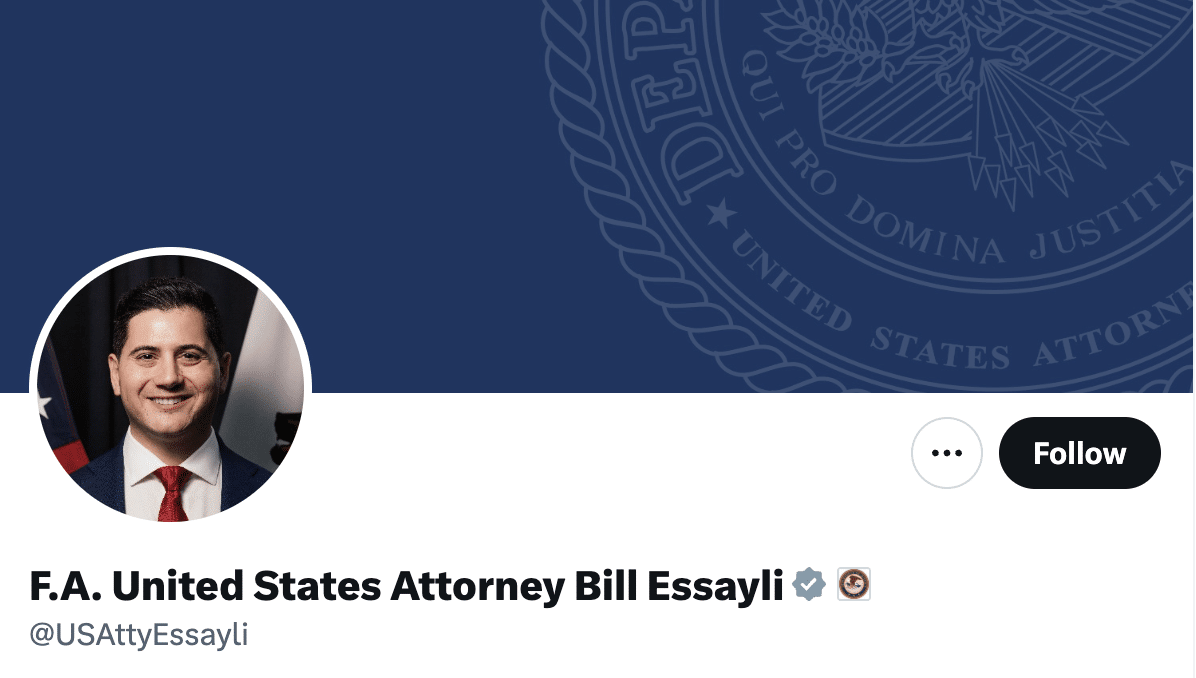
First Assistant AUSA Bill Essayli, who continues to serve most functions of US Attorney in Los Angeles even after Judge Michael Seabright ruled he’s not lawfully the US Attorney, has an identity crisis.
And it’s not his continued attempts to use textual gimmicks to obscure that he’s not the US Attorney, as the way he adds the initials “F.A.” in his Xitter profile as if his given name is “Fucking Asshole.”
Though the defendant who first forced a ruling that Essayli was playacting, Jaime Hector Rodriguez, continues to insist that Essayli can’t just change his title in a bid to keep powers he does not lawfully possess.
The simple answer is that Mr. Essayli is exercising power he does not possess. He has transcended the land of statutes. He is wielding significant authority, but the whole point is that he lacks that authority: it was not validly conferred on him by Congress. No powers are conferred on “a FAUSA” by statute, id., because the FAUSA position is absent from the statutes, R.M. 9–10. But this FAUSA has inferior-officer powers, because he is exercising powers he has never been conferred. E.g., R.M. 9 & n.2. This is just another way for the government to cast the trick it has played in benign language: appoint an ineligible individual to a vacant office, give him a different title not set out in the statutes, and thereby avoid all statutory limits on the appointment.
Lindsey Halligan’s similar identity problem in EDVA is heating up too.
Rather, I’m talking about the identity issues that threaten to destroy his efforts to criminalize doxing in the immigration context.
In US v. Raygoza, Essayli charged three women who followed an ICE officer — believing he was headed to conduct another snatching — only to arrive at his home. They continued to livestream, and from a neighbor’s property, they both invited others to come to the neighborhood but also announced to his neighbors that he’s la migra.
Yesterday, Fucking Asshole Bill Essayli responded to Sandra Samane’s and Ashleigh Brown’s motions to dismiss (Brown is represented by the same FPDs who made a frivolous assault charge against her go away last year). It’s not so much that their arguments were rock solid; motions to dismiss are really difficult to win. Rather, it’s that in the course of two footnotes, Fucking Asshole Bill Essayli revealed grave problems with his case. The second explained why a separate motion moved to dismiss the second count of the indictment, doxing, the crime which the defendants allegedly conspired to commit.
4 Defendants failed to state the actual home address of R.H. on social media, and instead said the number of a neighbor’s home approximately 100 feet from that of R.H. Because 18 U.S.C. § 119 criminalizes making publicly available “the home address” of covered individuals, the government has moved to dismiss the substantive count (Count Two).
The definition of restricted personal information as used in the law pertains only to the alleged victims own address; the defendants here livestreamed his neighbor’s address (in detention filings in her now-dismissed assault case, Brown explained that they stayed some distance from the victim’s house so as to comply with her release conditions).
A still graver problem for Fucking Asshole Bill Essayli is that — in a filing that elsewhere focuses closely on the terms specifically defined in the doxing statute (“restricted information” and “covered persons”) and on the import of the definitions generally (which is normal in responding to a void for vagueness challenge), Fucking Asshole Bill Essayli uses his first footnote to offer a definition of doxing.
1 Doxxing is short for “dropping documents.” Vangheluwe v. Got News, LLC, 365 F. Supp. 3d 850, 858 (E.D. Mich. 2019). The practice involves “using the Internet to source out and collect someone’s personal and private information and then publicly releasing that information online.” Id. The “goal of doxxing is typically retribution, harassment or humiliation.” Id.
He’s got two problems with that footnote.
First, what the defendants did — follow a guy home unwittingly and livestream where they ended up — is entirely different from “using the Internet to source out and collect someone’s personal and private information,” which only underscores that no one alleges that the defendants specifically sought out the ICE guy’s address. They didn’t dox him, according to the definition in this footnote.
Worse still, the defined goal of doxing in that footnote — “retribution, harrassment[,] or humiliation” — differs from the intent requirement in the statute:
(a) In General.—Whoever knowingly makes restricted personal information about a covered person, or a member of the immediate family of that covered person, publicly available—
(1) with the intent to threaten, intimidate, or incite the commission of a crime of violence against that covered person, or a member of the immediate family of that covered person; or
(2) with the intent and knowledge that the restricted personal information will be used to threaten, intimidate, or facilitate the commission of a crime of violence against that covered person, or a member of the immediate family of that covered person,
The defendants may have doxed the ICE goon. They may well have decided to humiliate him in front of his neighbors by revealing that he is an ICE goon.
But there’s a chasm between hoping to humiliate someone who does a disfavored job and intending for someone to use that information to commit a crime of violence against them. Fucking Asshole Bill Essayli attempts to dodge that by saying the conspiracy should not incorporate the elements of the count he’s seeking to admit and also stating that they won’t argue the defendants intended a crime of violence to happen to the ICE guy.
Separately, Brown argues the indictment must be dismissed because it does not specify the “crime of violence” Brown allegedly intended to incite. (Brown Mot. 19-21.) Even assuming this argument is applicable to the conspiracy alleged in Count One and not just the substantive count the government has moved to dismiss, at trial the government does not intend to proceed on the theory that defendants conspired to release R.H.’s home address with the intent to incite the commission of a crime of violence against him, or did so with the intent and knowledge that the restricted information would be used to facilitate the commission of a crime of violence against him. Defendant’s argument with respect to this portion of the statute is thus moot.
But he never gets around to addressing the larger point. Humiliation is not a crime of violence. But it is also not a threat or even intimidation.
The problem with this is made more apparent when Fucking Asshole Bill Essayli engages in a hypothetical dismissing Brown’s attempt to say she couldn’t have doxed the victim, because his address was already public. Brown’s tack would lead to absurd results, Fucking Asshole Bill Essayli says, because if it held, then how would they criminalize someone threatening the daughter of a judge (like Trump’s doxing of Barack Obama, something Trump has done), and how would they criminalize a defendant posting a witness’ address with the intent they they be intimidated by the criminal’s mob (again, something Trump has done more than once or twice or a hundred times).
And to interpret the statute as Brown would have it would lead to absurd results. Take, for example, the hypothetical of a judge’s daughter posting a photograph on Instagram that reveals her home address: a photograph of her family standing outside her home where the mailbox is visible. A defendant who later appears before the judge would not be subject to prosecution for posting the judge’s home address on an online forum with the intent to threaten the judge due to the daughter’s prior Instagram post. Similarly, a juror, informant, or witness would be cut off from statutory protection if a defendant’s family member or gang associate followed her home and posted the address on Facebook to intimidate her, but her address was already listed in the Whitepages.
In both those cases, of course, a prosecutor could — and should have, in the case of serial criminal Donald Trump — charged that as obstruction, witness tampering.
But these hypotheticals only underscore the point: in a filing asserting that doxing is done for humiliation, Fucking Asshole Bill Essayli is dodging language that requires further intent, not just to humiliate a goon in front of his neighbors, but to threaten him.
Threatening someone with social opprobrium is not the same as threatening someone with physical violence.
Yet the former is what Fucking Asshole Bill Essayli attempts to criminalize here.
Fucking Asshole Bill Essayli wants to criminalize any effort to shame someone for doing a shameful job. And while the argument may well get beyond this effort to dismiss the indictment, he has confessed in this filing that these women didn’t commit the charged crime.
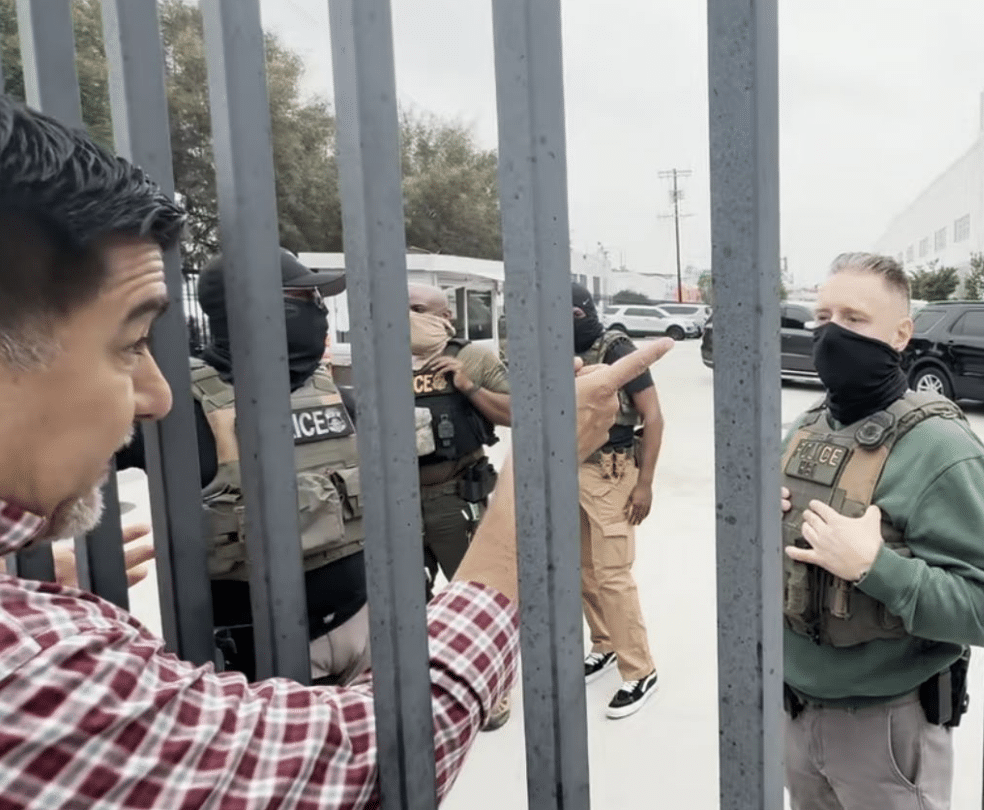
215 days before Jonathan Ross shot Renee Good dead after Good’s wife, Becca, engaged in First Amendment protected taunting of Ross, HSI Special Agent Ryan Ribner rushed through a gate at at a Los Angeles garment factory and — along with ICE Officer Carey Crook — assaulted SEIU CA President David Huerta, targeting Huerta rather than several other people who were more directly blocking a van, the purported crime in question.
Huerta argued in a motion to dismiss on First Amendment grounds submitted last week, days before Good’s killing, that Ribner and Crook did not arrest Huerta for obstructing a Federal officer, which is what got charged after DOJ abandoned a claim that Huerta had conspired to impede officers, much less the assault that they contemplated charging initially, but because Huerta had engaged in that First Amendment protected taunting.
It may well be that Ribner lied when he claimed he didn’t learn Huerta was a powerful union leader until after he assaulted him. Months later, the undercover officer working the crowd, Jeremy Crossen, admitted people in the crowd referred to Huerta as a union “member,” though that didn’t appear in either the texts that got shared with Huerta in discovery — which described the institutional affiliation of others — or a countersurveillance report he wrote weeks after the assault, where he included the research he had done after the fact for everyone but the state president of one of the most powerful unions in the country, the guy who got assaulted.
But if Huerta wasn’t targeted because he’s a powerful Democrat (in Ribner’s report there’s a weird claim that the agent guarding Huerta in the hospital only “feigned” interest when Mayor Karen Bass showed up to Huerta’s hospital room), then the record shows little else beyond speech.
According to videos turned over in discovery, Ribner started predicting Huerta would go to jail based solely off taunting, mostly about their masks.
Mr. Huerta asked them, “How are you keeping us safe?” Agent Ribner’s response was: “You are gonna go to jail. You are not impeding us. You are not impeding us. You’re going to jail, [unintelligible from 0:00:09–00:11] and you’re going to jail.” Id. at 0:00:01–00:12. Mr. Huerta then repeatedly asked him, “What are you doing?” and told him, “I can’t hear you through your fuckin’ mask,” and pointed at Agent Ribner. Id. at 0:00:14–00:17. Agent Ribner can be heard replying: “You’re gonna go to jail, you’re going to jail.” Id. at 0:00:17. For the next few minutes, Mr. Huerta continued to protest in front of the gate, including conversing with Agent Ribner, Officer Crook, and other officers, including, according to agents’ after-the-fact reports, “aggressively”4 asking the officers to identify themselves, stating “What are you going to do… Where’s your fucking badge number… What’s your fucking name?” Ex. B at 9. He also allegedly stated: “You’re not police! You’re not fucking police! You’re not keeping me safe!”
Indeed, Ribner’s own report describes himself predicting that Huerta and others would obstruct them, so he instructed his colleagues to be prepared to make arrests.
Later, HUERTA approached the gate and began yelling and about wanting to see agents’ faces. At times HUERTA was putting his arms through the fence as he yelled, and on at least one occasion he pointed as well. HUERTA stated, “Your boss” [believed to be referring to President Trump] wants things “made in America”. HUERTA went on and said that the things were manufactured inside of Ambiance. HUERTA appeared to be aggressive and angry by his voice, demeanor, and facial features. At some point HUERTA walked up to the gate and asked either about the purpose or legit impact of agents’ duties. SSA Ribner asked HUERTA the purpose of what he was doing [regarding being belligerent with law enforcement]. HUERTA made a comment that he lived in the community and /or cared about the community. SSA Ribner advised HUERTA that “we” [agents] also live in the community. SSA Ribner made the comment to HUERTA in the hopes of obtaining HUERTA’s compliance by advising HUERTA that law enforcement agents are just like him and care about the community and are also part of the demographic of the southern California area.
[snip]
STRONG, and LENEHAN would highly likely block or impede law enforcement vehicles, cause damage to USG property, or commit a battery against agents as they attempt to depart. SSA Ribner informed the DEA agents that if anyone in the crowd impedes, blocks, or physically batters an agent that arrests would be made. [my emphasis]
“He pointed as well”!!! And from that (and perhaps in his view that Huerta was Hispanic? — though several other people present looked more obviously Hispanic), Ribner concluded Huerta was aggressive.
Even though a vehicle had already entered the gate Ribner stood behind without major obstruction, Ribner predicted that a white detainee van that pulled up shortly after the conflict with Huerta occurred, while the gate was still closed, would incite some response. Huerta was on the public sidewalk in front of the gate, though several other people were more directly in front of the van’s path. But when the gate did open, at which point Huerta was to the side of the van, Crook and Ribner rushed Huerta and pushed him down.
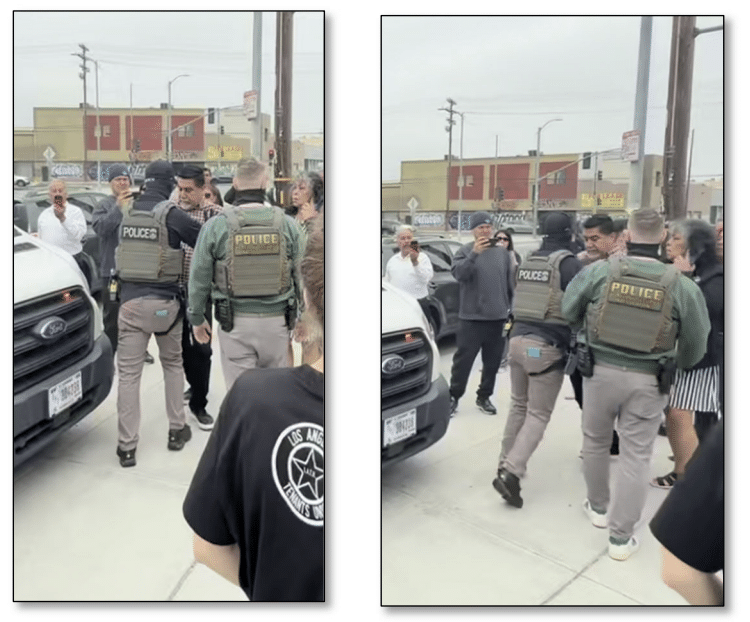
That’s when Ribner conducted a brutal arrest, even applying pepper spray to his hand and smothering Huerta’s face with it, because — he claimed after Huerta sought hospital treatment for a head injury — Ribner did not want Huerta to hit his head on the curb he was driving it into.
SSA Ribner decided to deploy a chemical agent (pepper spray) on HUERTA due to HUERTA actively resisting arrest, the angered crowd, and HUERTA’s safety as his head was near a cement curb and SSA Ribner didn’t want him suffering an injury. Due to the concern of over spraying the chemical agent with others nearby (SDDO C and the crowd) or spraying HUERTA directly in the eyes, SSA Ribner decided to spray a small amount of the chemical agent in his hand and place his hand near the upper nose area of HUERTA’s face. HUERTA began to make noises and say that he couldn’t breathe.
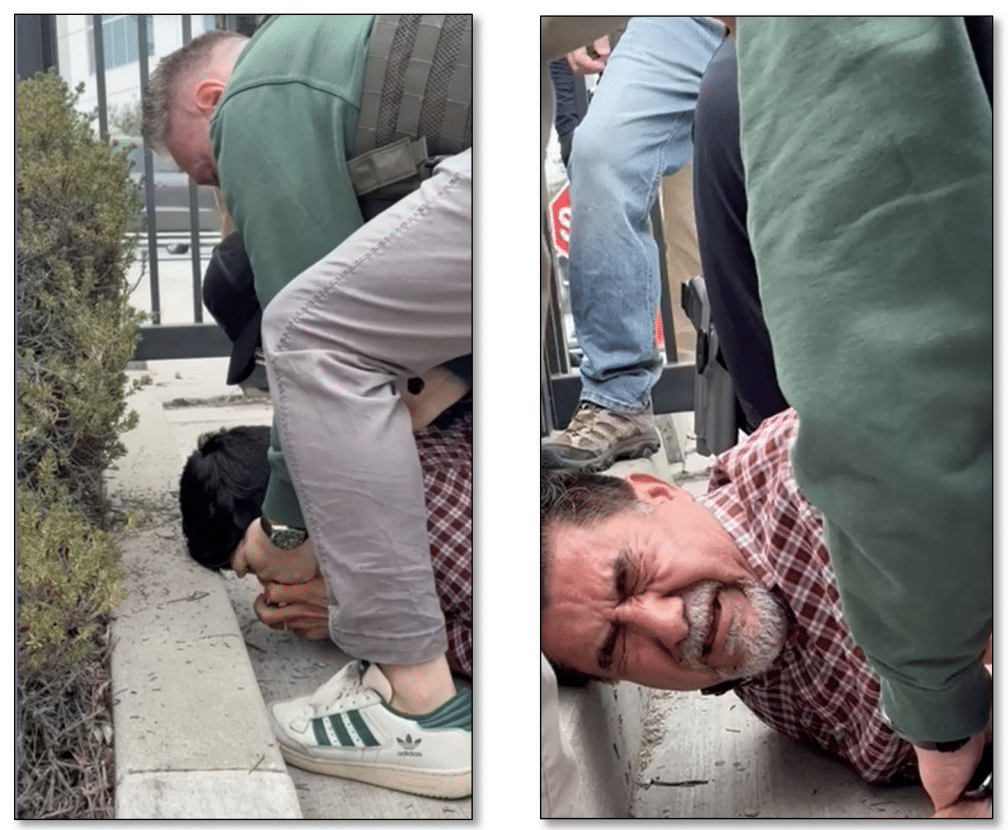
Huerta’s head got slammed, and Huerta sought immediate hospital care. In his arrest report — again, written after he learned Huerta had a head injury — Ribner describes feeling no lump on Huerta’s head but said he did so to help Huerta to clean the pepper spray that Ribner’s post hoc reports claim he specifically avoided getting in his eyes out of Huerta’s eyes.
Agent’s Note: During the arrest encounter SSA Ribner never personally observed HUERTA strike his head on the ground. Additionally, when SSA Ribner was decontaminating HUERTA, he placed his hands on the back of HUERTA’s head to help move his head back to place water in his eyes and face area. SSA Ribner never felt any bumps or cuts on the back of HUERTA’s head. Additionally, SSA Ribner didn’t observe any physical bumps or cuts on HUERTA’s head.
As so often has happened after DHS assaults and hurts someone, that night make-believe US Attorney Bill Essayli accused Huerta of assault.
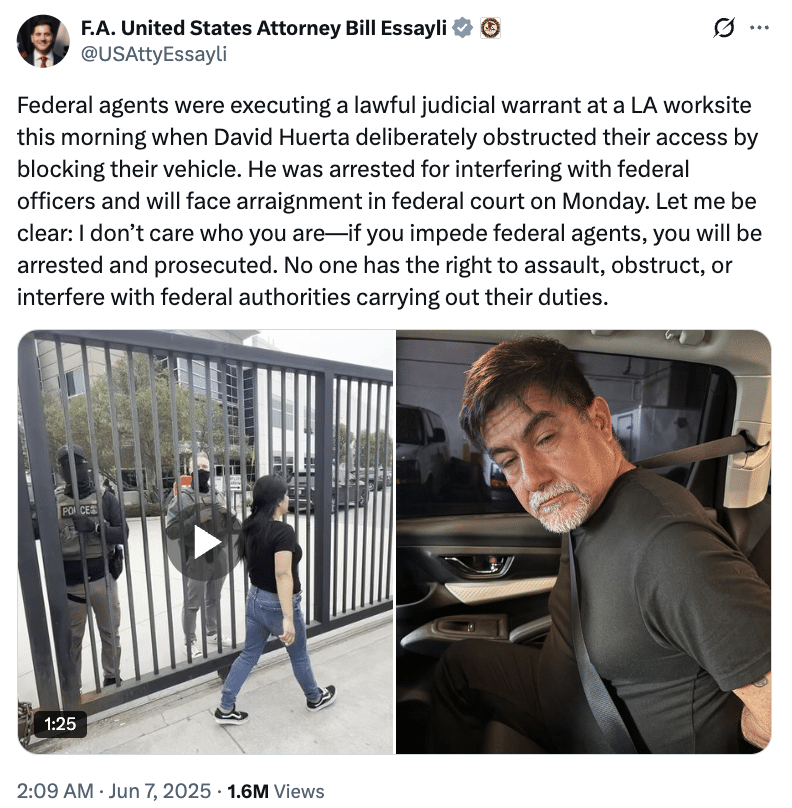
And sometime later, Ribner was in a meeting with Todd Blanche, and Essayli promised Blanche this would go to trial in September or October.
GS Ribner stated he spoke with United States Attorney Bill Essayli about this case and others, such as the Deputy Attorney General (DAG) and Special Agent in Charge Eddie Wang. During the briefing, USA Essayli told the DAG that “this case is going to trial in September or October
It did not go to trial in September or October. Instead, as AUSAs learned more about what happened, they gave up the felony charge.
As you can tell from Ribner’s attempt to build in deniability for the head injury, Ribner obviously tried to reverse-engineer his actions, to provide some excuse for the assault.
As I noted at the time, when Ribner wrote the arrest affidavit back in June, he absurdly claimed that Huerta intimidated him because he banged on the gate.

“Banged on a gate” and “pointed as well”!?!?! No wonder they asked to detain Huerta pretrial.
Ribner’s initial arrest report (the same report where he denied knowledge of a head injury, which he wrote almost two weeks after the arrest) is full of things — including some alleged assaults by protesters, but also including exchanges like the local San Diegans who, days before the Huerta assault, shouted “shame” until ICE abandoned their effort to raid a local restaurant — that Ribner cited to explain why he implanted an undercover agent at the scene to seek out a vast conspiracy Ribner was sure existed.
Mostly, though, I suspect it was the shame.
Huerta was lucky. Because he’s an American citizen, he couldn’t be shunted off to a GEO prison and refused access to his attorneys, which is what make-believe US Attorney Essayli did to prevent Carlitos Ricardo Parias from unpacking the problems with the claims of assault against him. Because — unlike Renee Good — Huerta survived, DOJ had to try to invent a criminal case out of Ribner’s own actions.
But, it appears that by August, after several delays in attempting to indict Huerta, the whole charade started falling apart. Ribner’s report (which, on top of the obvious retconning of his actions, did not match the documented timeline in a few other areas) and the absence of any crime was bad enough. But the witness stories didn’t match, even though there’s good reason to believe they were coordinated after the fact. In addition to claiming he noticed Huerta arrive in real time rather than after Ribner called him out, Crossen described Huerta push back, something not captured in video (and which Crossen may not have been able to see from where he stood). Carey Crook (the guy who first pushed Huerta), falsely claimed Huerta had splayed himself across the van in an X, and similarly invented a claim that Ribner had sprayed Huerta, rather than smother his face in pepper spray. The driver of the van, Brian Gonzales, didn’t remember seeing Huerta in a first interview, but in a follow-up the day before he would start a new permanent job at CBP, he did, though he disputed Crook’s claim that Huerta had splayed across the van grill.
Crossen explained that his video didn’t capture Huerta in front of the van because he started filming just after that. He said he did all this on his personal phone because his government phone wasn’t working that day (in addition to the motion to dismiss, Huerta is also demanding the Cellebrite metadata for the texts extracted from the personal phones both Ribner and Crossen used that day). He admitted that Ribner gave instructions on how to write up his countersurveillance report, but didn’t tell him what to say.
Ribner’s was the last interview from this period when DOJ was stalling the case, a week before a new case opening date possibly focused on Ribner. When asked to describe his actions, as problems with the arrest must have become evident, Ribner explained simply that the peaceful protesters were “vicious, horrible people.”
GS Ribner stated HUERTA and other protesters are “vicious, horrible people”.[In reference to a still photo of video 2774 at 0:03], GS Ribner identified HUERTA. He recalled telling HUERTA, “You better not block the cars”. He stated that HUERTA was not in the way of vehicles or personnel at this point.
Stephen Miller has told all Trump supporters, especially those who work at DHS, that people who support immigration are vicious, horrible people. And he gave them rules of engagement that invited assaults like this, assaults they simply bury in often-failed attempts to criminalize the victim.
It’s surprising it took seven months before someone Stephen Miller has defined as a vicious horrible person got killed.
June 6: Arrest
9:00 AM: HSI task force officer (and Inglewood cop) Jeremy Crossen arrives under cover
9:20: Agents start executing search
9:57: Crossen interacts with Asian woman
10:26: Crossen interacts w/Hispanic protestor, claims he is monitoring the police
10:33: Crossen texts Ribner
11:07: Crossen sees pick-up without plates whose Hispanic driver films
11:19: Crossen describes a Hispanic woman with a neck gaiter; his report provides background on a Kids of Immigrants sweatshirt she wears; start time of alleged criminal conduct
11:25: A sedan enters the gate; after an agent instructs those filming it to step away, they do; Crossen texts Ribner,
11:31: A Hispanic woman whom Crossen IDs by name shows up, makes phone calls
11:36: Crossen describes a white woman by name, describes that she masked as the crowd grew
11:37: Crossen describes the Hispanic leader of ACCE Action, Council Member Jose Delgado, show up, make calls
11:49: Crossen claims he sees Huerta walk up
11:51: A white woman from Tenants Union starts yelling obscenities
11:53: Ribner instructs Crossen to focus on Huerta
11:54: Huerta and others sit in front of the gate
12:01 PM: Ribner leaves the property and assaults Huerta [note his report timeline goes haywire in here]
12:00-12:09: Crossen texts Ribner
12:15: Crossen claims van arrives (his description describe others who were in front of the van, then says Huerta also was)
12:15: Ribner calls 911 (claiming this is about pepper spray)
12:18: Crossen describes a scrimmage line
12:20-12:40: Discussions about Huerta’s attempt to call his attorney
12:30: LAFD responds; Huerta asks to be brought to the hospital; Crossen describes LAFD arrival this way:
At approximately 12:28 p.m., TFO Crossen observed a Los Angeles City Fire truck with activated emergency lights and loud audible siren, attempting to gain entry to the business, still being blocked by protestors, to render aid for HUERTA, inside the business, who had been exposed to OC Spray, during his arrest.
12:40: Ribner reports arrest to CACD US Attorney office
12:42: Ribner tells Crossen his personal phone is out of battery, asks him to use his government one
12:47: Ribner admits he used pepper spray
1:05: Ribner speaks to USAO again
1:30: Huerta taken to hospital w/agent in car
2:45: Ribner asks Crossen for pictures of Huerta
Unmarked time: Mayor Bass shows up to hospital room; they ask her to leave (and she does)
9:12: Crossen sends last clip from videos to Ribner (the discovery turned over provides nowhere near the “4 hours” or “100 videos” that Crossen told Ribner, five hours earlier, that he had taken (though the defense did not include all the texts in their exhibit)
9:36: Ribner obtains warrant for Huerta’s phone
10:30: Huerta attorney turns over the phone
June 8: Huerta charged with felony conspiracy
June 9: Case opened
June 17: Date created for one photo provided in discovery
June 19: Initial incident report; Ribner would later (in his September 10 interview) admit he wrote the report from memory and simply did not “recall that he told HUERTA, ‘You are not impeding’. He does not know why he did not include that statement in his report and agrees that his statement could sound exculpatory.”
June 23: Countersurveillance report from Crossen
July 2: Second set of discovery
July 17: Third set of discovery
July 28: Fourth set of discovery (including agent texts)
August 20: USAO interviews Brian Gonzalez, who drove the van allegedly blocked
August 27: USAO interviews Carey Crook; he told AUSAs that, contrary to Ribner’s claim, Huerta did not assault him
August 27: USAO interviews Crossen
September 9: USAO reinterviews Gonzalez; he says he does not remember Huerta straddling the van, as Crooks claimed
September 10: USAO interviews Ribner
September 11: Gonzalez starts at a new job at CBP
September 17: Later case opening date, possibly focusing on the lying agents
October 17: Huerta charged with misdemeanor
November 5: Huerta’s attorneys ask AUSA to identify the obstructive conduct
December 19: AUSA finally provides vague description of conduct
A part of the video Jonathan Ross — the ICE agent who shot and killed Renee Good — took of the shooting has gotten little attention.
Before Renee’s wife Becca taunts Ross, “You want to come at us? You want to come at us? I say you go get some lunch, big boy,” and after she notes the plate of the vehicle would still be the same when ICE visits them later that day, Becca identifies herself as a US citizen and a “former fucking veteran, disabled veteran.”
If Becca is, indeed, a veteran, it would mean one veteran shot the spouse of another in a neighborhood of Minneapolis, where both lived.
Ross deployed with the Indiana National Guard to Iraq as a machine gunner.
Deployed to Iraq as a member of the Indiana National Guard from November 2004 to November 2005, Specialist Ross of the 138th Signal Battalion earned the Army Commendation Medal, the Army Good Conduct Medal, the Global War on Terrorism Medal and the Iraq Campaign Medal among others, according to the guard.
During his time in Iraq, Ross was a machine gunner on a combat logistical patrol team, court documents show.
Renee’s second husband and the father of her six year old son, Tim Macklin, was an Air Force veteran.
This not only was a conflict between authoritarianism and tolerance, but it appears to have been a conflict between American veterans.
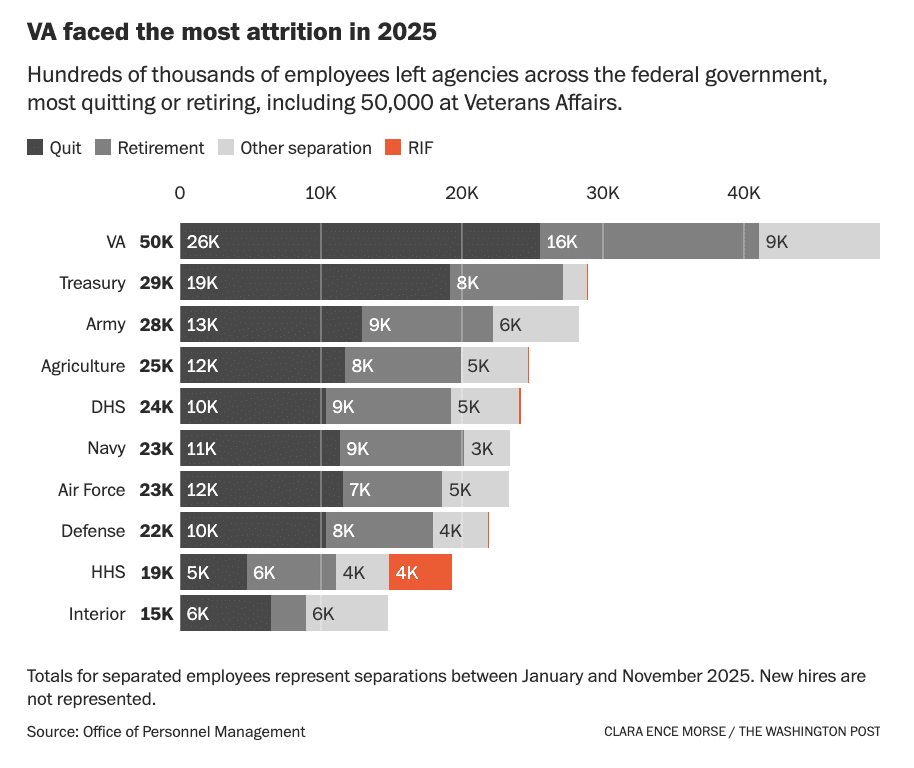
That’s worthwhile background to this WaPo story, which catalogs which agencies shrunk in the first year of the Trump Administration and which have ballooned. The article shows that the Veterans Administration lost the most employees (the largest number through attrition), over 50,000 people.
That includes around 3,000 nurses (3% of the total) and 2,000 claims examiners (10% of the total).
Meanwhile, DHS ballooned in size, adding more than 6,000 ICE goons (reflecting a 30% increase) and almost 1,000 CBP officers.
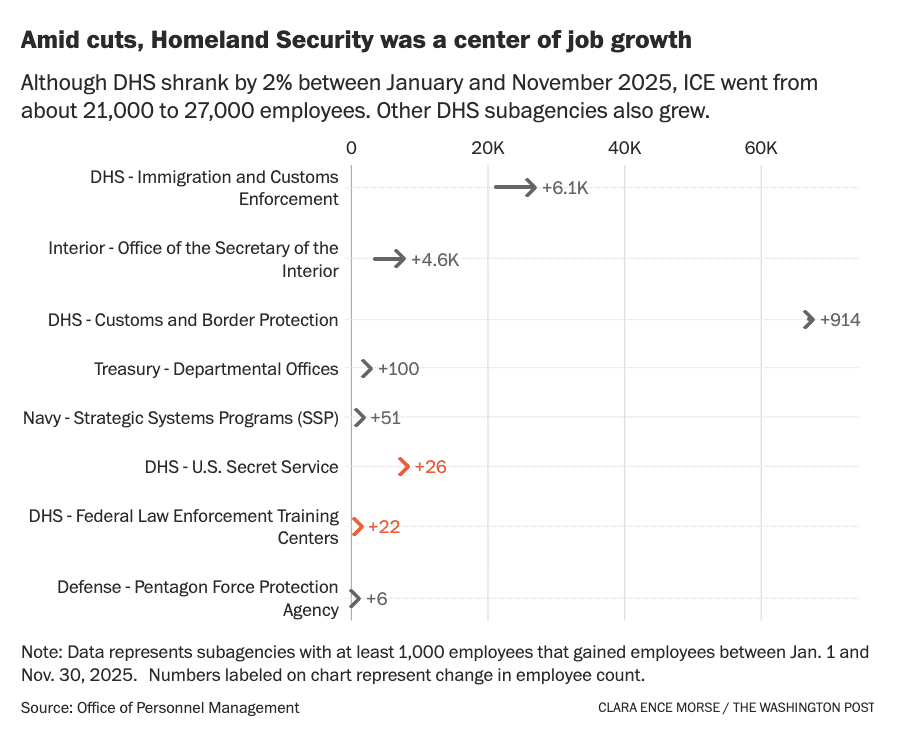
Ross is not one of these new hires; he worked at CBP for eight years and has been working at ICE for ten years.
Republicans — and because this was done via Trump management, DOGE, and the Big Ugly Bill, with virtually no input from Democrats — took service away from veterans and instead hired a bunch of people to invade blue states instead.
Republicans — Stephen Miller — decided snatching grannies was more important than providing veterans medical care.
The American Prospect has been closely following the staffing woes at the VA — which is basically a bid to privatize much of it, including this recent story explaining why new staffing cuts will endanger mental heath care not just for veterans, but for the entire country.
In late November, a mental health leader at a major VA medical center learned about a directive issued to the 18 Veterans Health Administration (VHA) regional offices, known as VISNs (Veterans Integrated Service Networks). Department of Veterans Affairs’ leaders in Washington were imposing lower caps on employee positions nationwide. Directors of local VA medical centers and clinics had a month to decide which vacant positions to eliminate, and which job offers to rescind. None of these identified positions would be filled because they would be swept from organizational charts entirely. At his facility, 60 percent of the unfilled positions would be lost, including 23 in mental health.
“The past nine months have been very challenging,” the mental health leader told the Prospect. “But this is really going to impact patient care.” He also worried about the effect of cuts on the VA’s critical teaching mission. “The VA trains 50 percent of psychologists in the country,” he said. “Now, we may not have enough staff to supervise trainees.” In the midst of a national mental health professional shortage, reducing VA training capacity ultimately impacts access to mental health care for both veterans and nonveterans alike.
Again, Donald Trump is taking services away from veterans, and then hiring them to invade blue cities as if they were Fallujah.
The results were all too predictable.
Listen on Spotify (transcripts available)
Listen on Apple (transcripts available)
Update: We’re going to do some house cleaning around here, with a refresh of the site in the next bit. One thing I’m trying to do is put up resource pages on particular topics, which will be available from the front page. You’ve seen me do this with the Hunter Biden and Jim Comey cases, as well as DOGE debunkings. Some will be more formal, some will serve to capture links and try to understand what we’re seeing.
Have a look!
Remember how I predicted that the inclusion, based on very thin allegations including Tren de Aragua’s leader, Hector Rusthenenford Guerrero Flores, in Nicolás Maduro’s superseding indictment, that Stephen Miller would use the probable cause finding to renew his bid for Alien Enemies Act deportations?
The Tren de Aragua is likewise thin. In the 2020 indictment, two FARC leaders were included as co-conspirators, but that reflected a sustained relationship with Maduro as laid out in the overt acts. The TdA inclusion here relies on a similar move, including its leader, Hector Ruthsenford Guerrero Flores as a co-conspirator. But his inclusion relies on two overt acts that don’t involve Maduro: Guerrero’s actual trafficking with someone not alleged to be part of this conspiracy, and comments made in a Venezuelan prison in 2019. (These may be the comments that US intelligence services have deemed to be unreliable.)
f. Between approximately 2006 and 2008, HECTOR RUSTHENFORD GUERRERO FLORES, a/k/a “Nifio Guerrero,” the defendant, worked with one of the largest drug traffickers in Venezuela, Walid Makled. Members of the Venezuelan regime helped protect Makled’s cocaine shipments that were transported from San Fernando de Apure, Venezuela, to Valencia, Venezuela, and were then sent by plane from the Valencia international airport to Mexico and other locations in Central America for eventual distribution to the United States. Between in or about 2008 and in or about 2009, GUERRERO FLORES also provided another major Venezuelan drug trafficker with protection for cocaine shipments moving through Venezuela, including by providing armed men who carried, among other automatic weapons, AK47s, MP5s, and AR-15s, as well as grenades. At times, GUERRERO FLORES personally accompanied large cocaine loads as they were guarded by the teams of armed men, en route to airports or airstrips for transport north and eventual distribution to the United States. GUERRERO FLORES was paid a fee per kilogram of cocaine transported or received and he sometimes received an interest in portions of these massive cocaine shipments in lieu of payment. The traffickers that GUERRERO FLORES worked with moved thousands of kilograms per shipment, multiple times per month, resulting in the distribution of hundreds of tons of cocaine to the United States. In or about 2009, Makled was charged with narcotics offenses in this District and is a fugitive.
[snip]
o. In or about 2019, TdA’s leader, GUERRERO FLORES, discussed drug trafficking with an individual he understood to be working with the Venezuelan regime. Over multiple calls, GUERRERO FLORES offered to provide escort services for drug loads, explaining that GUERRERO FLORES and TdA had control of the coastlines of Venezuela’s Aragua State. GUERRERO FLORES, speaking from TdA’s base of operations in Tocor6n Prison, explained that TdA could handle the logistics of every aspect of the drug trade, including the use of storage compartments that GUERRERO FLORES called “cradles” located on a beach in Aragua State. In doing so, GUERRERO FLORES confirmed TdA’s ability to protect over one ton of cocaine.
That is, neither is TdA necessary to substantiate the narco-trafficking charges, which are well-substantiated based on protection of FARC, nor is the substance of TdA’s inclusion all that convincing.
At all.
But no doubt Stephen Miller will use this — a grand jury finding probable cause tying TdA to Maduro — to attempt to renew his Alien Enemies Act deportations.
They’re so fucking predictable. (This is the appeal of one of the AEA cases to the Fifth Circuit.)
Appellees respectfully submit this letter pursuant to Federal Rule of Appellate Procedure 28(j) to advise the Court of an indictment against co-conspirators Nicholas Maduro, the leader of Tren De Aragua (“TdA”) Hector Rusthenford Guerrero Flores, and several of Maduro’s family members and high-ranking officials. Ex. A. Among other charges, Maduro and his high-ranking officials are alleged to have “worked directly with” several “narco-terrorist organizations” to funnel deadly drugs into the United States, including “TdA, which controls a criminal network able to assist with the transportation of cocaine within Venezuela and on the Venezuelan coast.” Id. ¶¶ 20, 24.
The indictment reinforces the Proclamation’s findings that the Maduro Regime and TdA have formed a “hybrid criminal state” directed by the Regime. This significant development further refutes Petitioners’ argument that the Government no longer treats TdA as entwined with the Maduro Regime. Indeed, in announcing the apprehension and indictment of Maduro, the President made clear that Maduro has “waged a ceaseless campaign of violence, terror, and subversion against the United States of America, threatening not only our people, but the stability of the entire region.” Ex. B at 8:07-8:27. In particular, “Maduro sent savage and murderous gangs, including the bloodthirsty prison gang, Tren de Aragua, to terrorize American communities nationwide” through murder and taking “over apartment complexes.” Id. at 8:27-9:24. The President emphasized that “Tren de Aragua… [was] sent by Maduro to terrorize our people,” providing examples of Americans victimized by their terror campaign. Id. at 11:41-12:51. These new developments underscore the Maduro Regime’s control over TdA and TdA’s violent invasion or predatory incursion on American soil. As a result, it is even clearer that the President’s invocation of the Alien Enemies Act was part of a high-level national security mission that exists outside the realm of judicial interference.
Mind you, ACLU’s Lee Gelernt makes mincemeat of this ploy in response.
The government’s January 5 letter contends that Maduro’s indictment shows that he and TdA were intertwined. But the indictment’s allegations cannot erase the administration’s own repeated assertions that the United States was in a non-international armed conflict with TdA to justify its boat strikes—not a conflict with a “foreign nation or government” as required by the AEA. Pet’rs’ En Banc Br. 8, 31–41. At a minimum, the conflicting assertions undermine the request for deference.
Moreover, the indictment confirms that, even in the government’s view, Maduro’s alleged actions were not military, but rather criminal offenses properly handled through the justice system. Indeed, the administration stated that the Venezuelan operation was a “law enforcement” operation. Appellees’ 28(j) Letter, Ex. B at 38:58–39:57.
The government also fails to address why the Proclamation’s assertions are not fatally undermined by Maduro’s ouster given that the Proclamation specifically says that “Maduro” and the “Maduro regime”—not Venezuela as a “foreign nation”—direct TdA. While the Proclamation’s assertions never justified the claim that Maduro directed TdA (a claim refuted by 17 of 18 national security agencies1 ), there is now no longer anything to defer to given that Maduro is in a U.S. jail. Indeed, President Trump himself has declared that Maduro’s capture means that “[t]here will no longer be threats” to Americans from Venezuela or TdA. Id. at 11:41– 12:24.
Finally, the indictment undercuts the Proclamation’s factual assertion that “Cártel de los Soles” is a “narcoterrorism enterprise” central to enlisting TdA to send drugs as a “weapon” against the United States. The indictment now describes Cártel de los Soles as simply a loose “patronage system” that is part of “a culture of corruption” for elites’ personal enrichment—not a cartel at all. Appellees’ 28(j) Letter, Ex. A at 8; see Charlie Savage, Justice Dept. Drops Claim That Venezuela’s ‘Cartel de los Soles’ Is an Actual Group, N.Y. Times, Jan. 6, 2026, https://www.nytimes.com/2026/01/05/us/trump-venezueladrug-cartel-de-los-soles.html.
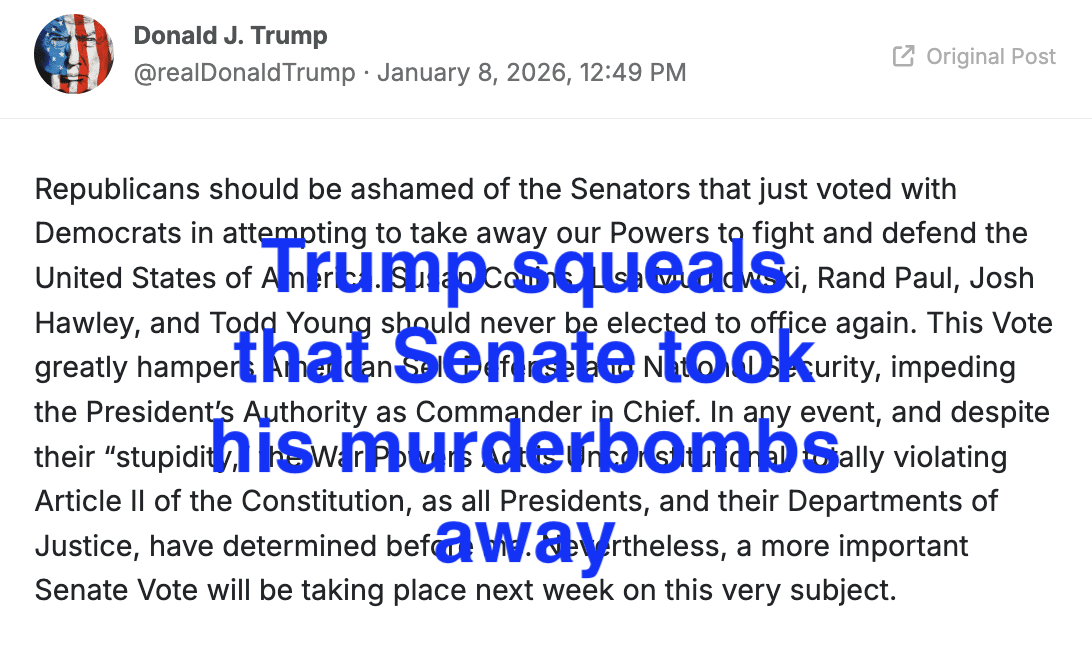
And that was yesterday. That same day, the Senate passed Tim Kaine’s War Powers Resolution prohibiting Trump from invading further without approval from Congress, with Todd Young, Lisa Murkowski, Susan Collins, Rand Paul, and Josh Hawley’s support.
While not yet binding (and as Trump noted in his squealed response, Lindsey Graham is going to try to reverse this, and the House would have to pass it too), the WPR will make it harder for even the Fifth Circuit to sustain Trump’s claims that this is an invasion.
Nevertheless, it didn’t stop Kristi Noem to use TdA as her excuse for the second DHS shooting this week, this of two people in Oregon.
It’s all just lies on top of lies, and until Appellate judges start calling Trump’s team on it, entire lives will be upended or ended based on the lies Stephen Miller invents in his feverish nightmares of power.
Stephen Miller’s breeding partner created a worldwide scandal by posting a picture of Greenland as an American flag.
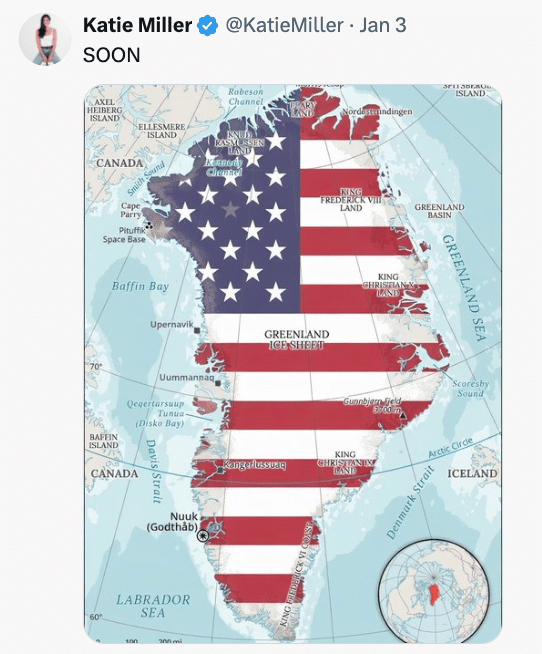
The map from a far right podcaster, however well-connected, was actually less important than that the US President, the same day, told Michael Scherer, “we do need Greenland” because it was “surrounded by Russian and Chinese ships,” a sentiment Trump repeated on Air Force One yesterday.
During our call, Trump, who had just arrived at his golf club in West Palm Beach, was in evident good spirits, and reaffirmed to me that Venezuela may not be the last country subject to American intervention. “We do need Greenland, absolutely,” he said, describing the island—a part of Denmark, a NATO ally—as “surrounded by Russian and Chinese ships.”
Of course, since both Katie Miller and Donald Trump largely parrot what they’ve recently heard, both comments likely reflected the views of Stephen Miller.
Meanwhile, this passage of a story describing how Trump really hasn’t (yet) committed regime change, but instead decapitated the Venezuelan state only to leave Maduro’s cronies in place (for now), attracted a flood of confirmation bias.
Two people close to the White House said the president’s lack of interest in boosting Machado, despite her recent efforts to flatter Trump, stemmed from her decision to accept the Nobel Peace Prize, an award the president has openly coveted.
Although Machado ultimately said she was dedicating the award to Trump, her acceptance of the prize was an “ultimate sin,” said one of the people.
“If she had turned it down and said, ‘I can’t accept it because it’s Donald Trump’s,’ she’d be the president of Venezuela today,” this person said.
I have no doubt Trump was pissed María Corina Machado got the Nobel Prize and he did not. But a Miami Herald story published just six days after Machado’s recognition described that Delcy Rodriguez had been pitching a Madurismo without Maduro via back channels for months.
A group of senior Venezuelan government officials, led by Vice President Delcy Rodríguez and her brother Jorge, who is president of the National Assembly, have quietly promoted a series of initiatives in recent months aimed at presenting themselves to Washington as a “more acceptable” alternative to Nicolás Maduro’s regime, according to people with direct knowledge of the talks.
The proposals, funneled through intermediaries in Qatar, sought to persuade sectors of the U.S. government that a “Madurismo without Maduro” could enable a peaceful transition in Venezuela—preserving political stability without dismantling the ruling apparatus.
According to the sources, Qatari mediators presented to the U.S. two formal proposals this year, one in April and another in September. Both outlined potential governing mechanisms without Maduro in power. In those scenarios, Delcy Rodríguez would serve as the institutional continuity figure, while retired Gen. Miguel Rodríguez Torres, who is currently in exile and is not related to the Rodriguez siblings, would head a transitional government.
The central argument, the sources said, was that the Rodríguez siblings represent a “more palatable” version of so-called chavismo — the socialist ideology named for deceased leader Hugo Chávez — for Washington, since neither has been indicted on narcotrafficking charges by U.S. courts. However, former regime officials— whose accounts have been used by U.S. prosecutors in cases linked to the so-called Cartel of the Suns—have implicated both siblings in logistical support and money laundering operations.
Delcy Rodriguez is also the person who, according to the indictment charging Marco Rubio’s old roomie, former Congressman David Rivera, with acting as an unregistered agent of Venezuela (for which he is due to stand trial next month) who ordered CITGO to serve as a front for the contract. As part of the contract, Rivera lobbied Rubio in 2017 on a Maduro succession plan.
Delcy Rodriguez has been in the thick of such efforts from the moment Trump first became President.
So while the attribution of Trump’s sidelining of Venezuela’s democratic opposition — by a single person “close to the White House” — to the President’s narcissism surely has some truth, I’m more interested in that same story’s report that Stephen Miller may actually take on some of the duties of Viceroy that Trump initially assigned to the Miami-raised Spanish speaking Marco Rubio, not least because that may explain why Trump chose decapitation — retention of the oppressive Maduro regime — over regime change, replacement with a democratic one.
Having dismantled much of the U.S. foreign policy infrastructure since he came to power, Trump depends on a small number of trusted personnel and business associates to handle core issues such as his peace plan in Gaza, negotiations between Ukraine and Russia, and now Venezuela.
The National Security Council staff has been gutted and the administration has yet to nominate an assistant secretary of state to handle the Western Hemisphere.
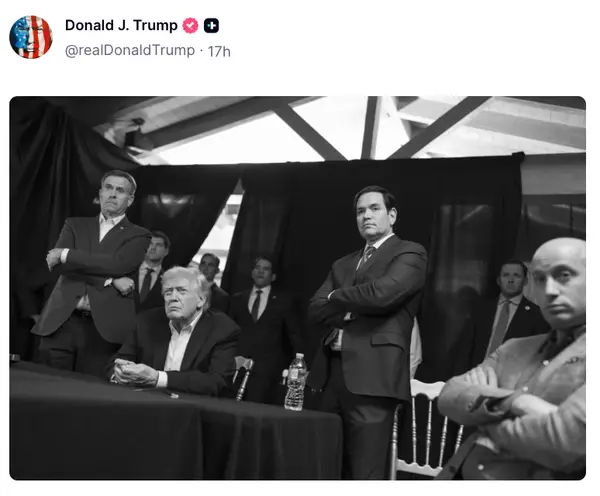
The White House is weighing giving Stephen Miller, Trump’s deputy White House chief of staff and homeland security adviser, a more elevated role in overseeing post-Maduro operations in Venezuela, according to one person with knowledge of the conversations, who, like others, spoke on the condition of anonymity to discuss sensitive dealings.
Miller has been the architect of the administration’s anti-immigration and border policy, and took a central role in the effort to remove Maduro. He was among the handful of top administration officials flanking the president during the news conference Saturday at Trump’s Mar-a-Lago Club.
War on the Rocks argues that too many people are trying to read Trump’s decision to invade Venezuela as a statement of his ideology, rather than the result of the chaotic fight for influence within his White House.
Many observers of this administration underestimate the power struggle inside the administration and how it scrambles the output. Venezuela has been an interesting case of this. My hypothesis here is that Venezuela has been an outlet of sorts for the hawks, especially Secretary of State Marco Rubio but also others. There has been no sustained appetite for confrontation with Russia or China, and only limited room to maneuver on those fronts without significant escalation risks. Iran and Venezuela, by contrast, offered arenas for hawkish foreign policy.
[snip]
When it comes to predicting the president’s next move, too many politicians and analysts assume coherence where there is division, chaos when there is improvisation, and restraint where there is only selectivity. Trump’s foreign policy behavior emerges not from doctrine but from friction. Venezuela offered a target that felt weak, morally disreputable, geographically proximate, and manageable.
Under Trump, foreign policy outcomes are less the product of grand strategy than of episodic alignment. Observers should stop asking whether a given action is consistent with Trump’s supposed beliefs and start asking whether it is legible to him as fast, dominant, and containable. They should pay closer attention to intra-administration dynamics and to how ideas persist even when not immediately acted upon. Otherwise, the failure to predict Venezuela will not be an outlier.
Given the WaPo report (which came after Viceroy Rubio bombed on the Sunday shows) that Miller will be playing in a key role in America’s new colony, I want to situate the Venezuelan coup in Miller’s own history.
It is my belief — this is a hunch based entirely on observation, not any insider reporting — that Miller made himself indispensable when he helped Trump pull himself together after the Butler assassination attempt. Trump was completely dysfunctional after the near-death experience (I don’t blame him — everyone would be floored by that trauma). I would argue that Trump has never actually reclaimed his poise since then — throughout the campaign, he was already surpassing all decency on his political attacks, and he frequently got lost on the campaign trail, including his sundowning episode on the campaign trail. Everything people point to now as proof that he is unfit to be President was evident on the campaign trail. But Trump buried his collapse under ever grandiose fascist theater, much of it orchestrated by Miller, leading up to Trump’s fascist rally at Madison Square Garden, and shortly after, to election victory.
Whether or not that’s the case, it is clear that in the same period, Miller started laying the groundwork to use Venezuela as a propaganda foil for his assault on democracy, which I documented here.
But then, on July 18, 2025, Trump swapped Venezuelans from CECOT for 10 Americans in Venezuela, seemingly dealing Stephen Miller a major defeat in his plan to rely on AEA.
I questioned why that happened here. And on the same day, NYT provided what is in retrospect even more critical background, a batshit insane story I glossed here. As the entire CECOT drama was proceeding, Trump was dicking around the Miami Hispanic community, which was clamoring to pressure Maduro, first halting then renewing Chevron’s Venezuela license.
Trump’s flip-flopping over the Chevron license would lead up to Trump’s command, ten days before the actual invasion, that oil companies prepare to invest in Venezuela if they want compensation for equipment Maduro seized.
But we know that, after Miller first pitched Trump on drone strikes in Mexico, and then he and Rubio (Miller to support his fascist project including hopes to return to using the AEA declaration, Rubio to cater to Miami’s Cuban-American desires) pitched Trump to instead attack Venezuelan-related drug trafficking. On July 25 — a week after returning the hundreds of mostly innocent men to Venezuela — Trump signed an order to begin the murderboat campaign, with murderboat strikes beginning in September. That same day, Marco Rubio pretended this was all about the election Maduro stole last year. Another week later, Pam Bondi upped the reward to help capture Maduro — $50 million we don’t yet know whether has been claimed.
This would have been the period when CIA and Delta Force started practicing the snatch of Maduro.
According to a new WSJ story, it wasn’t yet a foregone conclusion that Trump would approve the attack. Maduro remained dancing in videos that reported inflamed Trump, and dancing in negotiations to leave peacefully (even as Delcy Rodriguez was working back channels to assume power in his wake).
And immediately after Trump’s Administration imagined that they had proven their concept of decapitation without regime change, Trump started listing other places he would attack, including Cuba — high on Rubio’s list — but also Mexico (which Miller had had to defer earlier), Colombia, and Greenland.
If Marco Rubio had unilaterally won these battles, the chances would have been greater for genuine regime change; and his failure to deliver may soon sour his constituency on the snatch.
That this was, at least for the moment, decapitation, suggests Miller presided in the end.
After all, Trump also immediately likened the snatch operation to Miller’s domestic efforts to subjugate both civil society, including universities, law firms, and hospitals treating trans children, but also entire blue states, with paramilitary invasions launched in the name of deportation.
Miller’s goals are to demand subservience from everyone on threat of invasion, if not death, the stated means of keeping Delcy Rodriguez on track.
In the end, Stephen Miller is perfectly happy to get in bed with proud socialists, it turns out, so long as he can appropriate their authoritarian tools to his own ends.
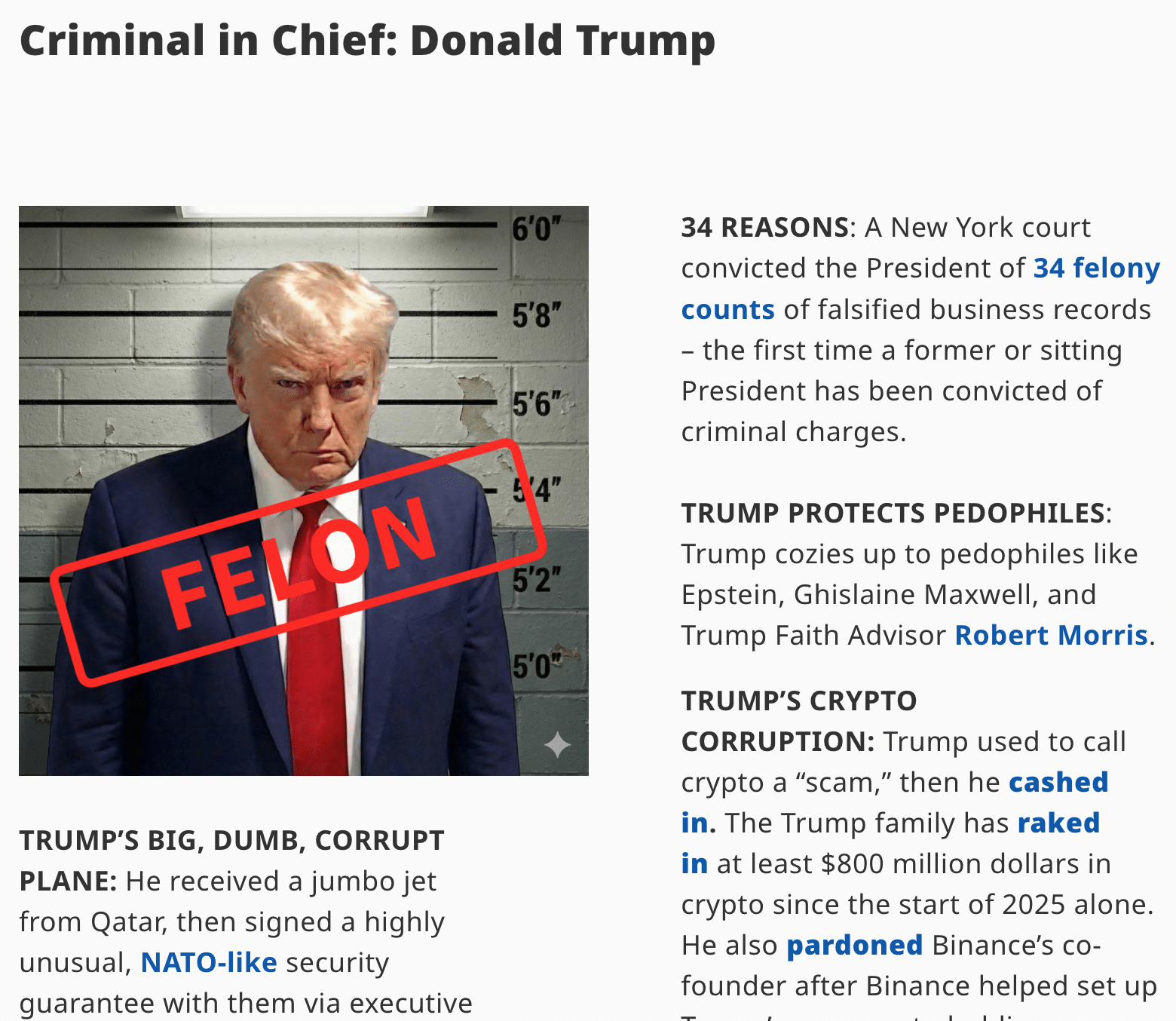
Back before everyone checked out for the holidays, I did an inventory of the progress we’ve made in four ways to fight fascism (in comments ApacheTrout reminded I should have the courts in there too).
I wrote it intending to kick off the new year with a post of things we can do, or do better. Here we are!
But first, let me explain where I’m coming from. Much of what follows builds on my belief that we’ve been fighting Donald Trump wrong.
Polarization is his superpower. It’s how he has gotten out of every single one of his political jams in the past: by turning his own scandal into a polarizing pivot, thereby turning his own failures and crimes into a matter of tribalism. Once he has done that, he invents some new bullshit story (usually stoking grievance), and getting right wingers to believe it because of that polarization.
This is why I’m such an asshole about the way people serve as data mules for Trump’s tweets: because those damn things are little polarization machines, which always serve to make him the center of attention around which society is re-polarized.
The way to combat someone whose superpower is polarization is not to exacerbate that polarization. It is to use his own tools — grievance and conspiracism — against him.
Back in May, before the Epstein files had created a full-blown crisis for the Trump Administration, Phil Bump and Mike Rothschild wrote about how conspiracism can undermine someone with power (which I added to here).
Think of how important conspiracism and grievance were to (at least per the Robert Draper profile) Marjorie Taylor Greene’s turn against Trump:
Simplifying and ignoring her potential political ambitions, Trump became the thing everyone suspected was being hidden in the Epstein files, and that led to cognitive dissonance that led MTG to revisit a lot of her other differences with Trump.
So some of my logic, below, is simply to focus on the things that are likely to get Trump supporters or sympathizers to feel betrayed by him including by holding people close to him accountable for shitty things we are pretty sure are going to occur. It includes:
One more point about this. This post is not a To Do list for the DNC (though some people on Bluesky will undoubtedly treat it as such). It’s a To Do list for myself, most of all, but one that others can borrow if they find it useful. Many of these things are attentional activities that are about repetition and focus as much as congressional oversight or electoral politics.
These are meant to be stories we can tell, regardless of what someone in Congress or some candidate in Iowa does.
Remember that Marc Caputo column — it was published on December 23 — stating that the Epstein releases could last a whole ‘nother week? On the day that would mark that week, December 30, Devlin Barrett published a story saying that, “The document review” of what is now believed to be 5.2 million documents “is expected to take until at least Jan. 20, according to a person familiar with the matter.” Even if they could finish it by January 20 (they won’t), that’ll just be the first go-around. DOJ has not done what they need to do to document the redactions, so there’ll be demands from Congress for them to do that (with obvious areas — including DOJ names and some deliberative documents specifically included in the law, where they’re in violation), they’ll need to repeat the entire process over again, Congress will begin to bring more legal pressure, and all the while survivors will be pointing out things they missed.
A week, Marc Caputo reported, as if that were credible!
This will go on for some time. This will go on for a very long time.
Still, while the Epstein scandal has been absolutely instrumental in loosing Trump’s grip on things, people are naive in thinking that will be enough. “My friends will get hurt,” Trump predicted, but what does it really mean for Trump’s power that Les Wexner has been implicated in the Epstein scandal as a co-conspirator? What is the use of creating right wing cognitive dissonance about Les Wexner, when Wexner is not the oligarch currently helping Trump destroy the country?
In my opinion, the Epstein scandal is a tool. It undercuts Trump’s ability to grab and redirect attention. It can create moments of cognitive dissonance, as it did for MTG. It is a way to turn Trump’s conspiracism and populism against him and may make other related narrative lines more salient. And if there’s a surprise disclosure — perhaps about Melania’s origin story — all the better. But as you keep the focus on Epstein, remember that there needs to be a direction beyond Epstein as well, a direction which incorporates the oligarchs who are still key players in Trump’s network of power.
The Broligarchs who’ve been a key part of Trump’s power are one way to do that (and that’s before we’ve really gotten into Steve Bannon and Peter Thiel’s ties to Epstein).
Tesla Takedown was one of the most successful campaigns of 2025. At a time when Tesla faced cheaper competitors worldwide, the protests incurred a cost on Musk for his DOGE depredations.
Elon was installed in the White House in significant part by fellow South African “alien invader” David Sacks, who is even more conspiratorial and even more pro-Russian than Musk. Sacks was installed in the White House as a Special Government Employee (who, Elizabeth Warren suggests, has overstayed his welcome) to force a bunch of policy decisions that suck for America but ensure that Broligarchs won’t pay any consequences for their rash business deals. When one or both of crypto and AI crash (this is a really good story on how and why AI will burst), he’ll be there to ensure the government bails them out, as he did after playing a role in the failure of Silicon Valley Bank.
And even as Trump sheds support based on his mockery of affordability, even as MTG split with Trump over that and his support for crypto, Sacks is trying to brand Democrats as being more populist than even Zohran Mamdani is.
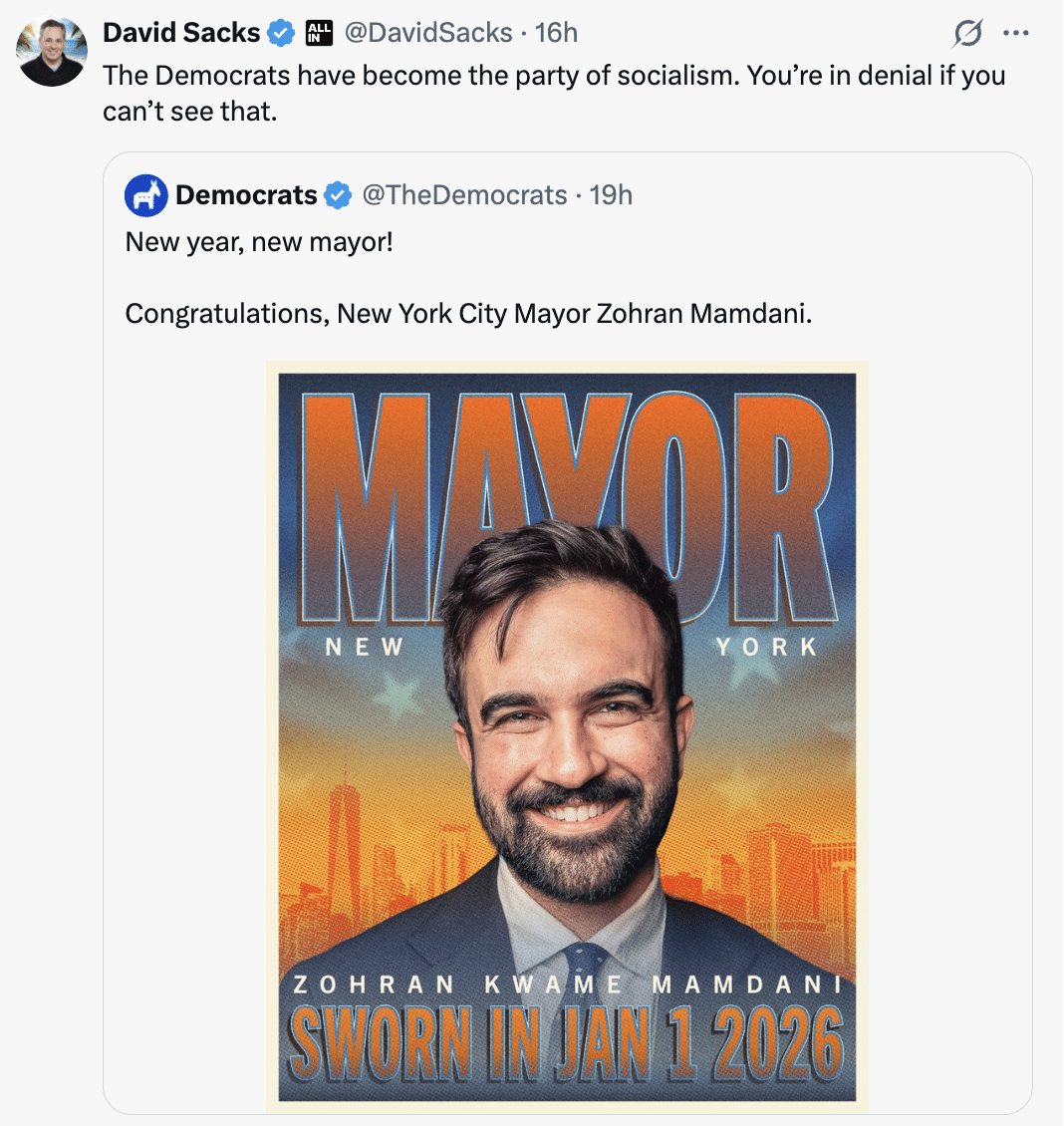
Fine. You want Democrats to be the party attending to the needs of working people? You’ve just made the GOP the party of “alien invader” billionaires who got tax cuts as millions lost their health care.
This happened even as AI has become a political liability. It has happened as local groups successfully stave off new data centers. It has happened as more instances of AI-inflamed suicide, murder, and porn — including porn exploiting children — appear. And it happens before the aforementioned crash.
Sacks and the other Broligarchs are going to do something for which they’ll try to dodge accountability. Now is the time to make sure his name comes up as people look for culprits.
Another thing that will lead people to defect is to realize that Trump is a loser. He has done things — like the takeover of the Kennedy Center — that makes it easy to demonstrate he’s a loser in tangible fashion. Better still, every time Trump attaches his name to something, it provides an opportunity to hijack that brand, as comedian Toby Morton auspiciously managed to do by anticipating Trump’s most venal instincts and buying the domain.

The same is true of his businesses. Trump and his entire family is getting rich off the presidency 2.0. But his businesses are built as cons, sometimes Ponzi schemes. The idea is to leverage the loyalty of MAGAts to get them to invest in something, run up its value, only to collapse, leaving the most vulnerable screwed. In the past, at least, the cult effect was such that even MAGAts bilked by Trump associates, as with Steve Bannon’s Build the Wall graft, were reluctant to turn on the fraudsters; that may change. But at the very least, the volatile nature of Trump’s frauds makes it easy to show that as a businessman, he’s a loser.
While there has been good reporting on Trump’s corruption — see, for example, NYT’s nifty visualization from New Year’s Eve — there has not been a systematic effort to take on his corruption.
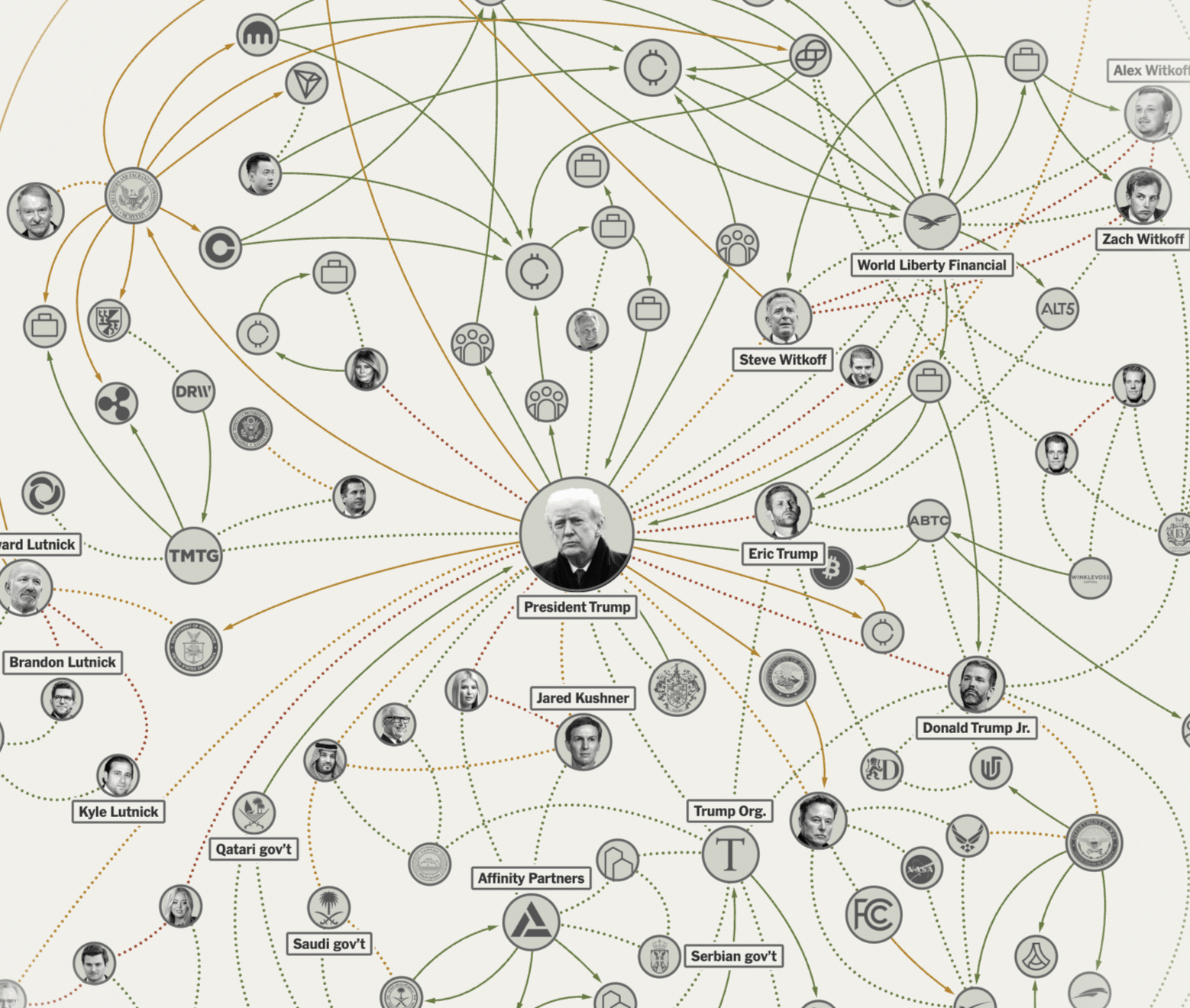
Nevertheless, possibly because of the Epstein scandal, a majority of the country does think Trump is corrupt.
That may actually not be in a bad place to be as we move into 2026. That’s because Democrats can make Republican inaction in the face of Trump’s corruption a campaign issue (and then, if it leads to a Democratic sweep in midterms, the electoral buy-in will be in place to do a lot of oversight and defunding of Trump’s corruption).
Trump’s pardons are similar. There’s actually a solid stream of reporting on how corrupt they are, without yet any political direction to it. Democrats running against Republican incumbents — especially in the Senate — should state as presumed that it is the job of Senators to respond to the kind of naked corruption Trump is engaged in.
Where activists can magnify the good reporting on both Trump’s corruption and his pardons is to focus on the victims. This is actually showing up in the reporting on both topics. WaPo focused on the victims of Trevor Milton who might have gotten restitution had Trump not pardoned him. LAT similarly focused on the victims fucked over by Trump’s pardon of David Gentile.
Rosenberg, a retired wholesale produce distributor living in Nevada, has supported Trump since he entered politics, but the president’s decision in November to commute the sentence of former private equity executive David Gentile has left him angry and confused.
“I just feel I’ve been betrayed,” Rosenberg, 68, said. “I don’t know why he would do this, unless there was some sort of gain somewhere, or some favor being called in. I am very disappointed. I kind of put him above this kind of thing.”
Trump’s decision to release Gentile from prison less than two weeks into his seven-year sentence has drawn scrutiny from securities attorneys and a U.S. senator — all of whom say the White House’s explanation for the act of clemency is not adding up. It’s also drawn the ire of his victims.
“I think it is disgusting,” said CarolAnn Tutera, 70, who invested more than $400,000 with Gentile’s company, GPB Capital. Gentile, she added, “basically pulled a Bernie Madoff and swindled people out of their money, and then he gets to go home to his wife and kids.”
This superb Bloomberg story on the extent to which the Juan Orlando Hernández pardon unraveled years of work starts with a murder arranged by the network.
Five minutes later, González was circling a roundabout when a gray van braked in front of him. At the same time, a green SUV crowded his rear bumper. A motorcycle carrying two men emerged on his left. A man on the back of the bike fired six shots through the driver-side window. González’s head slumped toward his shoulder, and he tilted forward, held upright by the seatbelt. He died instantly.
More than a dozen men streamed out of the two vehicles that had sandwiched his Nissan. They scrambled to collect the spent shell casings on the ground, then scattered other casings across the pavement—decoys to complicate ballistics tracing. They jumped back into their vehicles, circled the roundabout and took the same road Julián had just driven down.
When they approached the Slaughterhouse, the gates opened to let them in, then closed behind them.
Every one of these pardons has a victim — and that’s before you get into the people newly victimized by people who’ve been pardoned by Trump, which NYT covered in November and others are tracking as well.
A New Jersey fraudster who was pardoned by President Trump in 2021 was sentenced to 37 years in prison this month for running a $44 million Ponzi scheme, one of a growing number of people granted clemency by Mr. Trump only to be charged with new crimes.
The man, Eliyahu Weinstein, was pardoned by Mr. Trump in 2021 and was re-indicted by the U.S. attorney’s office in New Jersey three years later. He was accused of swindling investors who thought their money was being used to buy surgical masks, baby formula and first-aid kits bound for Ukraine, and a jury convicted him in April of several crimes, including conspiracy to commit securities and wire fraud.
[snip]
Some of those pardoned for their role in the Jan. 6, 2021, riot at the U.S. Capitol have quickly drawn new attention from law enforcement. The group Citizens for Responsibility and Ethics in Washington said in June that at least 10 of the more than 1,500 who were pardoned had been rearrested and charged, and the number has only grown since then.Earlier this month, a man who was pardoned after having participated in the Jan. 6 attack was charged with sex crimes against two children. Another man whose original sentence Mr. Trump commuted in 2021 was recently sentenced to 27 months in prison after convictions on physical and sexual assault, among other crimes.
These stories provide an important way to explain the costs of Trump’s corruption.
And while we’re talking about telling these stories: We must never ever cede the ground of crime to Stephen Miller’s attempt to brand immigrants as criminals.
Trump — a felon who freed hundreds of cop assailants on his first day on the job — has an entire infrastructure devoted to trying to spin brown people as criminal. Every time that infrastructure goes into action, including with the effort to brand Somalis in Minnesota as inherently fraudulent when Trump himself is a serial fraudster, we need to repeat, relentlessly, that Trump is a serial criminal who coddles other criminals.
This is something Gavin Newsom just started doing, with an entire website devoted to cataloging Trump’s crime and that of his pardon recipients.
Do not let a conversation about crime go by without focusing on how much of it Trump does.
Crime, in Trump’s era, is a rich white man’s thing. And while it will take a lot of work to adjust a lot of racist priors, until people start seeing Trump as a criminal it will be far too easy for them to make excuses for him.
I focused on Stephen Miller — and the import of making his failures clear — last week.
The import of shifting how we speak of Miller’s considerable power is clear. That’s true because he frankly has done huge damage, even to Trump’s goals, and well more so to average Americans. He’s someone that people, including Republicans, can scapegoat for Trump’s failures (and they’ll be right). And if we don’t make sure that happens, then he’ll scapegoat brown people.
Again, are Somali day care workers or billionaires systematically defrauding average people the problem? One easy to way to drown out Miller’s case that it’s the former is to make it clear how much he personally has harmed average Americans.
Relatedly, particularly as the huge injection of funding Republicans approved last year starts landing at DHS, it will become increasingly necessary to tie the goon squads in the streets to the loss of benefits elsewhere.
We need to make it clear that this is a direct trade. 50,000 ICE goons in, 300,000 other government employees out, including people who cure cancer, help learning disabled kids get through school, protect our National Parks, ensure your Social Security comes on time, and care for veterans.
Christopher Ingraham did a handy graphic to show the trade-off.
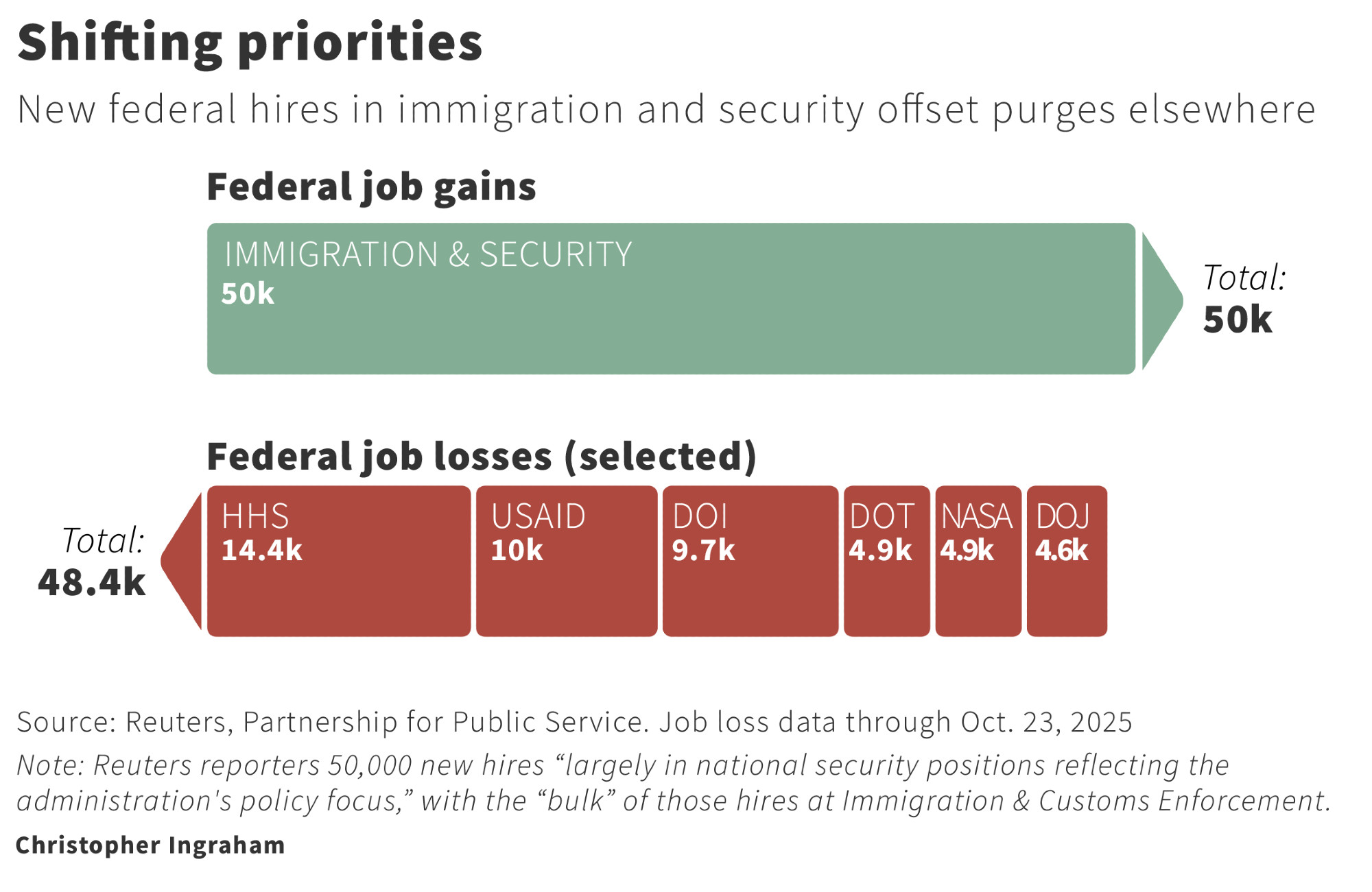
Stephen Miller’s dragnet is unpopular in the abstract and wildly unpopular in the lived sense, even — if meekly — among local Republican leaders.
But it still retains support of a big chunk of the population, probably because Trump officials routinely blame their own failures to address American problems on migrants, when as often as not, Trump’s response to immigration is the source of the problem.
America can’t have nice things, like cures for cancer and welcoming public schools, because Republicans in Congress took the money used to pay for those things and gave it to Stephen Miller to use to invade America’s neighborhoods.
Right wingers like Jonah Goldberg and David French have expressed alarm by an old promo for a 60 Minutes piece (the piece itself was from October) that an influencer reposted yesterday, describing dozens of times when the government lied in court filings.
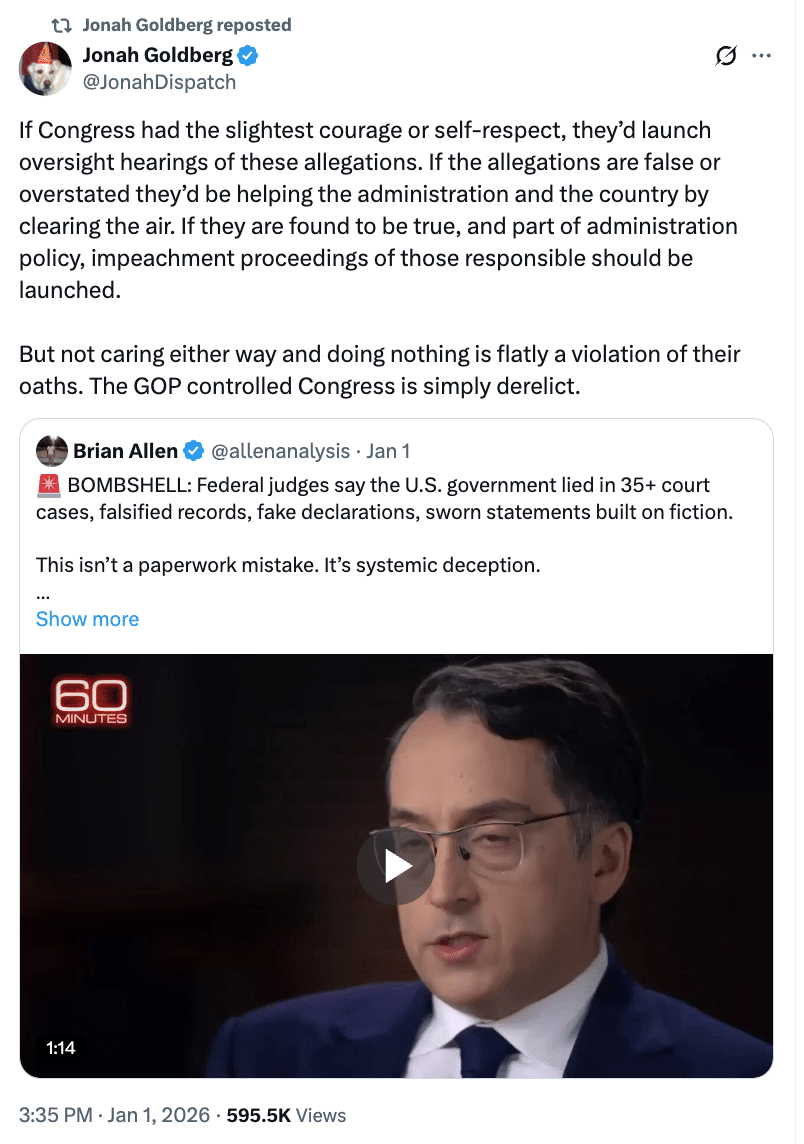
Judges have caught Trump’s DOJ in several major lies since then. In Chicago, Judge Sara Ellis wrote a 233-page opinion documenting the many lies DHS has told about their Chicago invasion.
And in December, judges in both Kilmar Abrego’s case caught the government obfuscating. In the criminal case, on December 30, Judge Waverly Crenshaw unsealed a December 3 opinion describing how Nashville’s US Attorney lied about how centrally involved Todd Blanche’s office was in demanding Abrego face trial.
The central question after Abrego established a prima facie case of vindictiveness is what information in the government’s control sheds light on its new decision to prosecute Abrego, after removing him from the United States without criminal charges. These documents show that McGuire did not act alone and to the extent McGuire had input on the decision to prosecute, he shared it with Singh and others. (Doc. No. 178-1). Specifically, the government’s documents may contradict its prior representations that the decision to prosecute was made locally and that there were no outside influences. For example, Singh contacted McGuire on April 27, 2025, to discuss Abrego’s case. (See Doc. No. 229 at Abrego-Garcia000001). On April 30, 2025, Singh asked McGuire what the potential charges against Abrego would be, whether the charging document would reference Abrego’s alleged MS-13 affiliation, and asked for a phone call before any charges were filed. (Id. at Abrego-Garcia000007–000008). In a separate email on April 30, 2025, Singh made clear that Abrego’s criminal prosecution was a “top priority” for the Deputy Attorney General’s office (Blanche). (Id. at Abrego-Garcia000037). He then told McGuire to “sketch out a draft complaint for the 1324 charge [making it unlawful to bring in and harbor certain aliens].” (Id.). On May 15th, McGuire emailed his staff that “DAG (Blanche) and PDAG would like Garcia charged sooner rather than later.” (Id. at Abrego-Garcia000060).
And as I’ve already noted, Judge Paula Xinis cataloged the many deliberately ignorant declarations DOJ filed about whether DHS had deportation plans for Abrego when she ruled that he must be released.
Respondents showcased Cantú’s ignorance about the content of his Declaration pertaining to Costa Rica. As the pointed questions of Respondents’ counsel made clear, Cantú’s lack of knowledge was planned and purposeful.
Counsel: So paragraph 4, final sentence [of the Cantú Declaration], do you see where it says the word—the words “certain understandings”?
Cantú: I found it. Yes, I do. I see it.
Counsel: What are the certain understandings referenced in the last sentence?
Cantú: I don’t know . . .
Counsel: What are the “contingencies” referenced in the last sentence?
Cantú: I do not know . . .
Counsel: What are the “interim developments” referenced in paragraph 5?
Cantú: I don’t know.
ECF No. 107 at 26:8–27:12 (counsel for Respondents, Jonathan Guynn (“Guynn”), questioning Cantú). See also id. at 53:8–9 (Guynn, at sidebar with Court, stating “I’ll just say I told you this was exactly what was going to happen,” regarding the witness’ ignorance on Costa Rica as a viable country of removal).
Ultimately, Respondents’ calculated effort to take Costa Rica “off the table” backfired. Within 24 hours, Costa Rica, through Minister Zamora Cordero, communicated to multiple news sources that its offer to grant Abrego Garcia residence and refugee status is, and always has been, firm, unwavering, and unconditional.
It’s a problem that, after huge scoldings like these, right wing critics of Trump don’t understand how much Trump’s people lie — not least because the Supreme Court still credits the most outlandish claims Trump makes, even after they’ve been thoroughly debunked by lower court judges.
Many of these lies are coming from the same people: Stephen Miller, Todd Blanche’s office, DHS spox Tricia McLaughlin, and Greg Bovino.
It is remarkable that so many of these people have been caught lying to courts (or publicly, about people before courts). But it needs to become common knowledge for everyone, so every time Tricia says something, they start from the assumption she’s lying, because she almost always is.
There comes a time when the credibility of systematic liars not named Trump collapse entirely such that every utterance they make discredits the claims they try to sell. Tricia McLaughlin, at least, is close those levels of propaganda, and Stephen Miller is not far behind.
Within days of his inauguration last year, Trump signed an EO — adding to one he signed in 2019 — claiming to oppose antisemitism. There has been some discussion about the bad faith of this EO and a DOJ lawyer implementing it, Michael Velchik, once wrote a paper from Hitler’s perspective. While it is explicitly targeted at universities (and has been a key tool to attempt to takeover universities), it nevertheless claimed to oppose antisemitism everywhere.
It shall be the policy of the United States to combat anti-Semitism vigorously, using all available and appropriate legal tools, to prosecute, remove, or otherwise hold to account the perpetrators of unlawful anti-Semitic harassment and violence.
This is the kind of statement of principle that can form the basis of political pressure — particularly as the MAGAt movement splinters around the overt antisemitism of people like Nick Fuentes and Candace Owen, and as political opportunists like Ted Cruz attempt to exploit that splinter.
We’re going to have to fight this battle in any case. As part of the revocation of everything Eric Adams did after he was indicted for bribery yesterday, Zohran Mamdani revoked an EO that gave Israel preferential treatment, which Israel is using to stoke division; yet Mamdani preserved the office Adams opened to combat antisemitism.
We need to call out the dripping antisemitism of Trump’s team, from top (at least JD Vance, who refuses to disavow Fuentes) to bottom.
There are two key Trump aides who should be targeted. Most notably, Paul Ingrassia, who had to withdraw his nomination to be Special Counsel after Politico exposed texts in which he confessed to a Nazi streak been installed at GSA instead. In addition, Kingsley Wilson became DOD spokesperson in spite of Neo-Nazi comments. NPR has done good work unpacking these ties.
Republicans plan on exporting fascism via US tech platforms.
That’s not new. I’ve been talking about Elon’s plans to use Xitter as a machine for fascism for some time.
But since then, Trump’s minions worked it into the National Security Strategy.
And, in the wake of the EU’s sanctions against Elon Musk for — basically — lying about why I have a blue check, Marco Rubio stripped the visas of five people, including US Green Card holder Imran Ahmed, a long time adversary of Elon’s.
But there are several developments that suggest it is time to renew efforts to defend disinformation research, not least the White House’s absurd effort to attack real journalism, what is sure to be a snowballing failure on Bari Weiss’ part to make propaganda popular, and the meltdown the head of DOJ’s Civil Rights division, Harmeet Dhillon, had over the holidays about right wing “misinformation” targeting Pam Bondi.
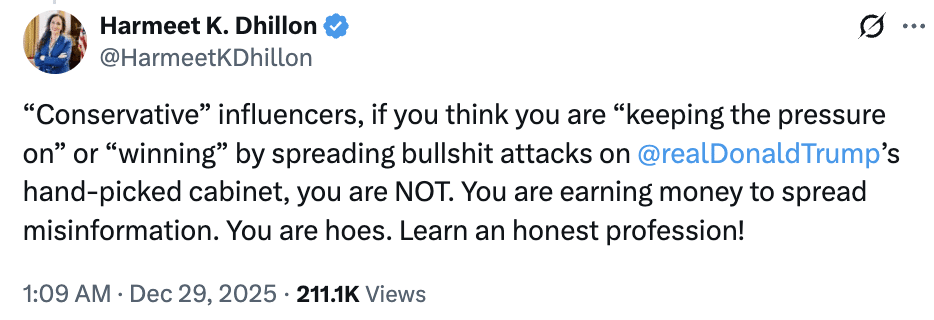
The right wingers are doing what they themselves established is unlawful. And that presents both political and legal opportunities to demonize their propaganda.
Which in turn cycles back to the increasing problem of AI propaganda, including Grok’s flagrant willingness to nudify children in recent days.
Some people write short resolutions. I guess I write 4,000-word To Do lists. Join me in my efforts!