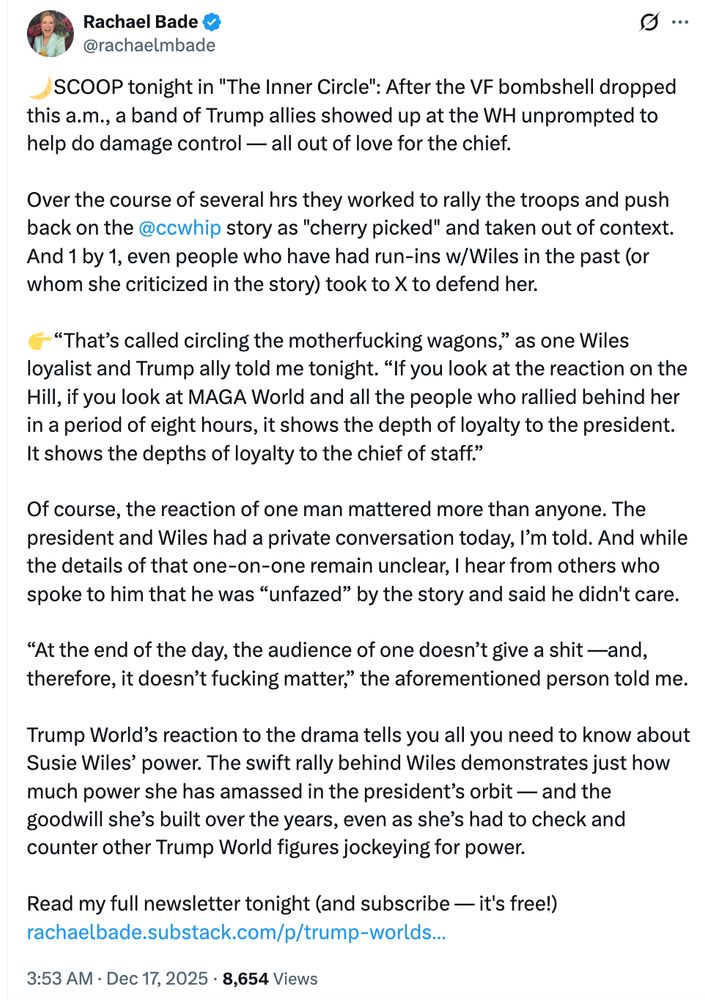
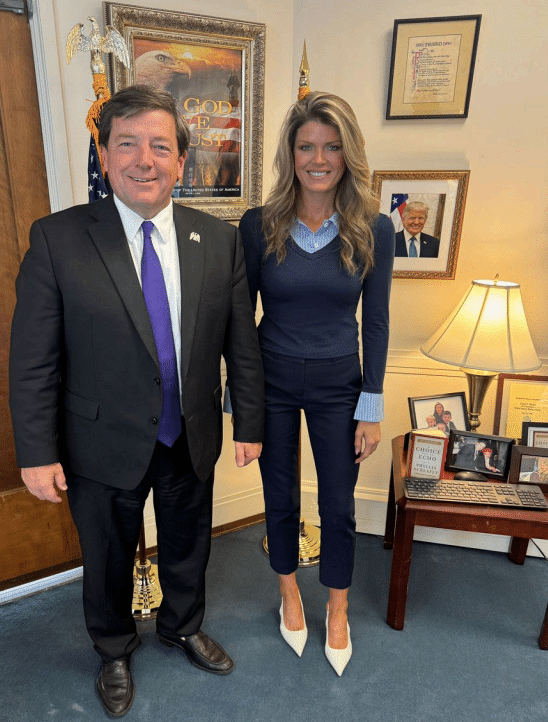
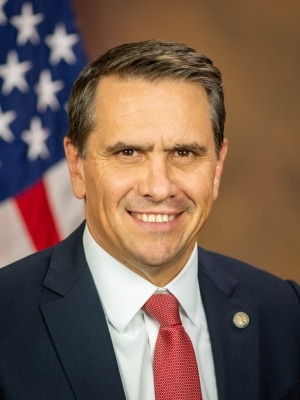
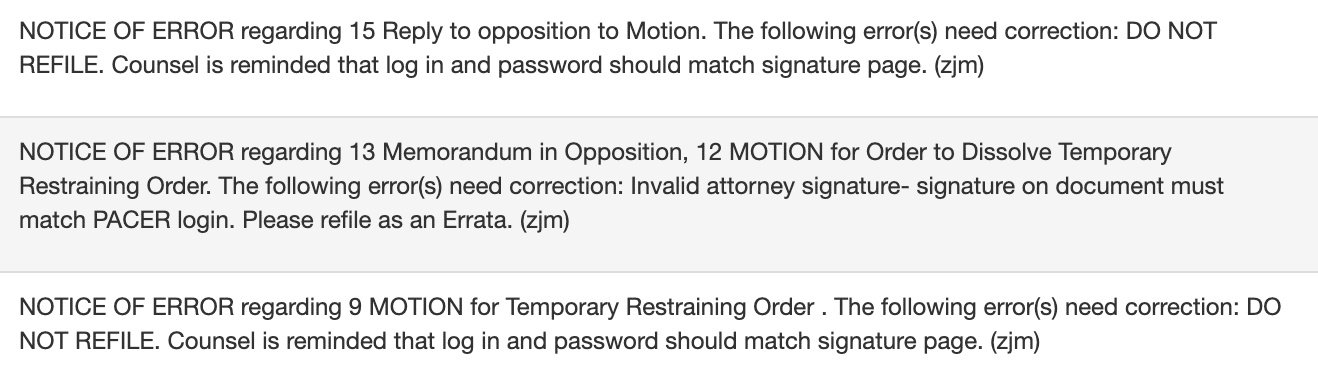
Ed Martin and Lindsey Halligan posing together in his office. They both look really weird, with him being bottom-heavy and forward leaning,and her propped up on ugly shoes.

Lindsey Halligan Can’t Tell the Difference between a Man, a Woman, and a Ham Sandwich

Oh hey!

If it’s Thursday, it must be get no-billed by the Letitia James grand jury again!

Virtually every outlet (Politico, NYT, WaPo, AP, CNN) reports that DOJ tried again to indict New York’s Attorney General, once again getting no-billed by the grand jury. Maybe, just maybe, there’s not probable cause that Attorney General James did what frothers claim she did?

The day was not entirely a loss for Lindsey the Insurance Lawyer Masquerading as a US Attorney, though.

She almost managed to comply with Judge Colleen Kollar-Kotelly’s order yesterday to comply with Judge KK’s earlier order from last Saturday.

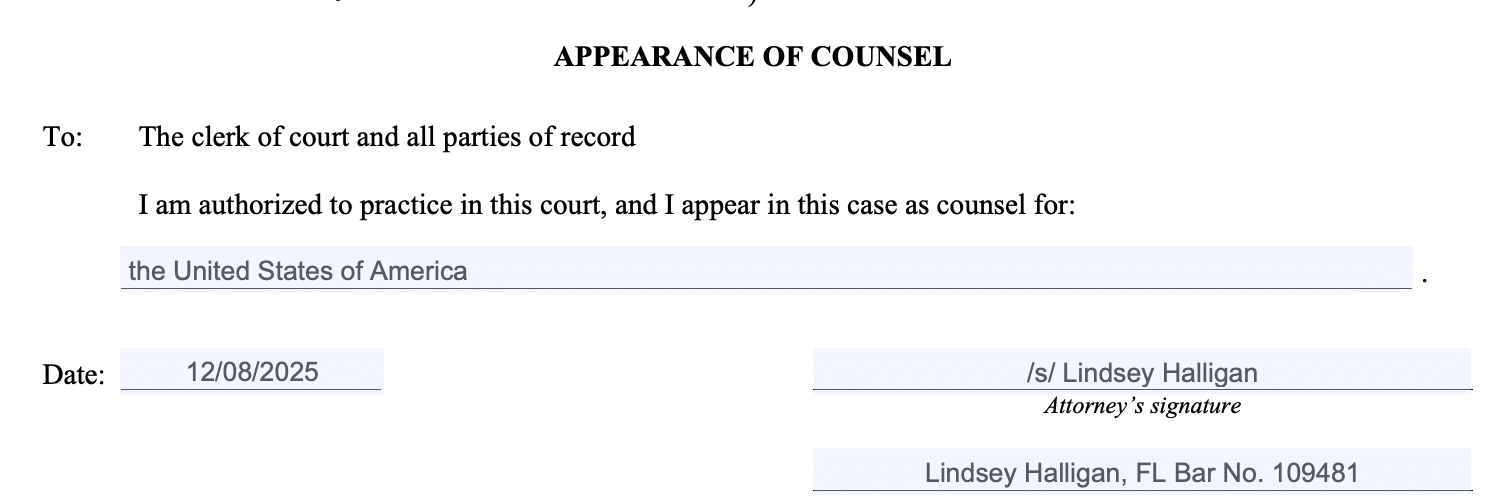
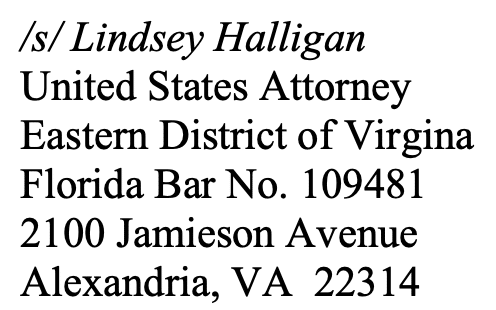
Before Judge KK’s deadline of 10 AM, Lindsey the Insurance Lawyer Masquerading as a US Attorney filed something called, “NOTICE of Appearance by Lindsey Halligan on behalf of UNITED STATES OF AMERICA (Halligan, Lindsey) (Entered: 12/11/2025),” dated Monday, which looks like this:

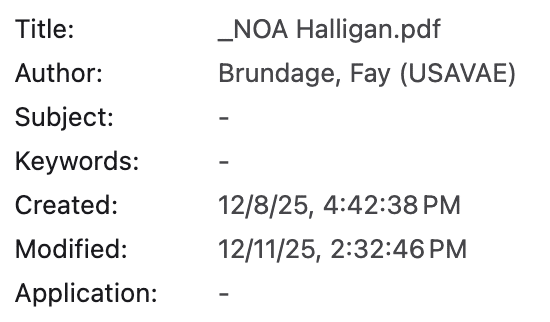
The metadata shows that Fay Brundage created the document. It also shows that it was actually created on December 8, as if they thought the better of actually filing a notice of appearance.

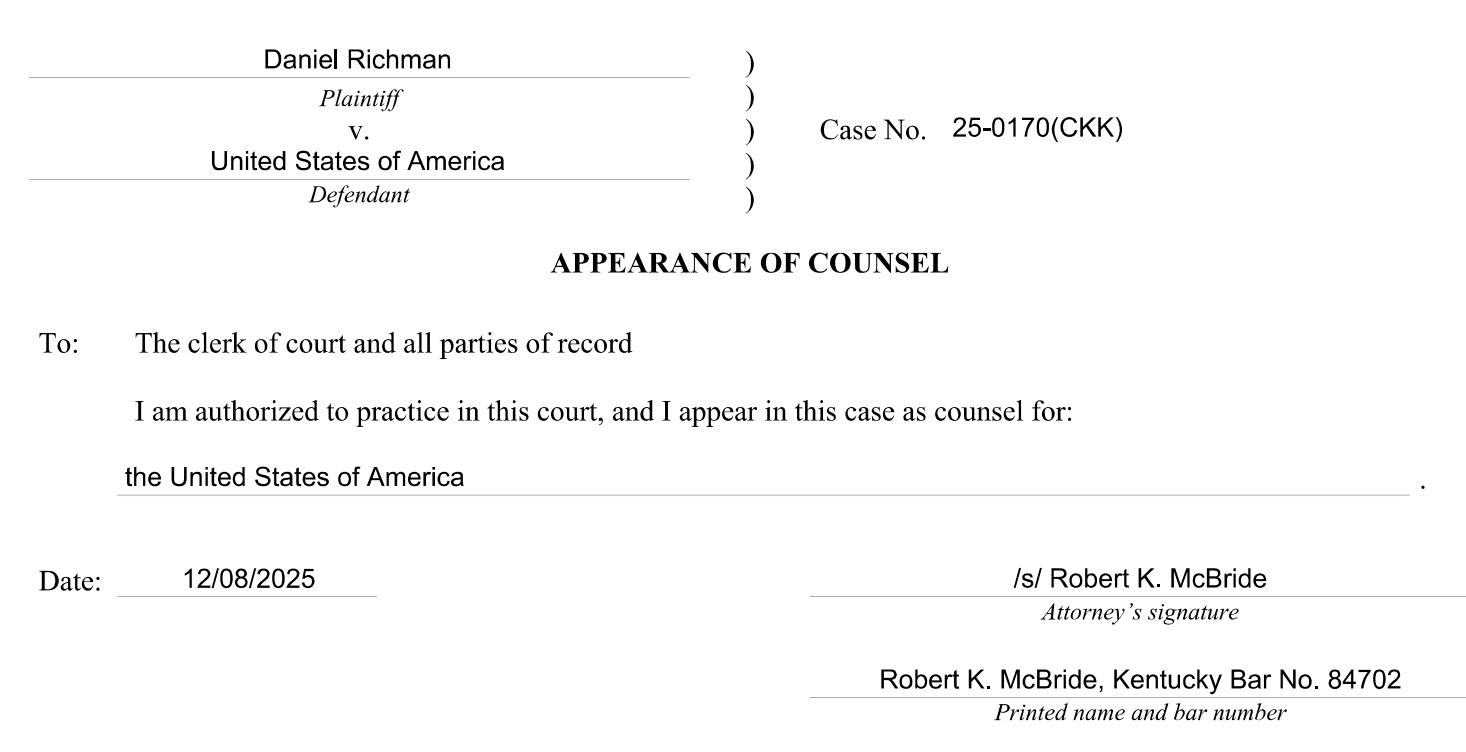
And at the same time, Robert McBride filed something called, “NOTICE of Appearance by Robert Kennedy McBride on behalf of UNITED STATES OF AMERICA (McBride, Robert) (Entered: 12/11/2025),” also dated Monday, which looks like this:

The metadata for that show no one changed the metadata from the original US Courts template created in 2008.

Hours and hours after Judge KK’s deadline, Lindsey the Insurance Lawyer Masquerading as a US Attorney filed something called, “NOTICE Certificate of Compliance by UNITED STATES OF AMERICA (Halligan, Lindsey),” meant to comply with this order from Judge KK.

The United States and its agent, the Attorney General of the United States, are ORDERED to identify, segregate, and secure the image of Petitioner Richman’s personal computer that was made in 2017, his Columbia University email accounts, and his iCloud account; any copies of those files; and any materials obtained, extracted, or derived from those files (collectively, “the covered materials”) that are currently in the possession of the United States.

The United States and its agents, including the Attorney General of the United States, are further ORDERED not to access the covered materials once they are identified, segregated, and secured, or to share, disseminate, or disclose the covered materials to any person, without first seeking and obtaining leave of this Court.

Here’s the language of the certificate of compliance, which is also dated December 8, which — hey! — is closer than Lindsey the Insurance Lawyer Masquerading as a US Attorney normally gets.

On December 6, 2025, the Court entered an Order [DE 10] stating that the government would “identify, segregate, and secure the image of Richman’s computer that was made in 2017, his Columbia University email accounts, and his iCloud account; any copies of those files; and any materials obtained, extracted, or derived from those files . . . currently in the possession of the United States.” The Court further ordered the government to not access, share, disseminate, or disclose these materials without further permission of the Court. Finally, the Court required the government to certify compliance with the Order by 12:00 p.m. ET on December 8, 2025.

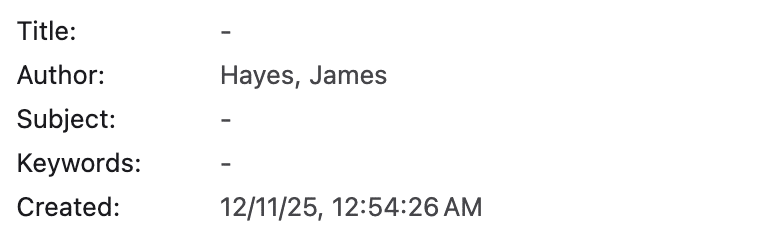
The metadata shows that our good friend James Hayes — the guy in the thick of efforts to try to use material unlawfully accessed — is back, if only in spirit.

According to Carol Leonnig, Lindsey will be formally nominated to be US Attorney (which was already in the works). But Chuck Grassley pushed back on Trump’s complaints about the confirmation process (though without mentioning blue slips specifically). Honestly, it would be a lot of fun to have a Lindsey the Insurance Lawyer confirmation hearing.

But she may be too busy studying up on the difference between a man, a woman, and a ham sandwich.

Share this entry

Judge Colleen Kollar-Kotelly Demands Someone at DOJ Put Ethical Skin in the Game

Around mid-day (maybe my time? maybe yours?), everything went wrong in the Dan Richman docket, in his bid to stop DOJ from violating his Fourth Amendment rights in their bid to indict Jim Comey.

The Clerk alerted the filers of four of the last filings they had fucked up.

Richman’s attorneys — lawyers from NY who filed docket # 9 and 15 — had filed a document signed by the people who posted it under someone else’s PACER login. The Clerk reminded Richman’s lawyers the person who actually signs into PACER to file something must have signed the document.

The other error was potentially more serious. DOJ’s two filings, 12 and 13, which were DOJ’s identical bid to lift the restraining order on accessing Richman’s data and opposing Richman’s motion for a TRO, noticed a different error. Best as I can explain it, the guy who filed this stuff, John Bailey, is not on the filings at all.

Not scintillating, perhaps. But nevertheless a testament to the fact that this docket, with its NY lawyers for Richman and a mix of shady lawyers for DOJ, were not doing what the clerk’s office checks to make sure the people actually making court filings have ethical skin in the game.

This came after another apparent problem in the docket. By all appearances, Pam Bondi had blown off Judge Colleen Kollar-Kotelly’s order that someone at DOJ confirm they were following her order that the entire government will stay out of Dan Richman’s stuff until Friday.

The Attorney General of the United States or her designee is further ORDERED to certify that the United States is in compliance with this Order no later than 12:00 p.m. ET on Monday, December 8, 2025.

It turns out DOJ’s failure to file anything on the docket was just another problem with the docket.

After both DOJ and Richman filed their filings yesterday (which I wrote about here) and after neither responded to Judge KK’s order that if they want to discuss these files, they may need to do a filter protocol, Judge KK weighed in again.

She noticed the same thing I did!! None of the people making these claims wanted to put their own ethical skin in the game. This is, significantly, what she seemed to be looking for when she made sure Richman got someone to file a notice of appearance.

Today’s order reveals what happened with her order to file a notice of compliance by Monday: They emailed it, two minutes before her deadline (but fucked up Lindsey the Insurance Lawyer’s filing … and anything else would frankly shock me at this point, because this has happened with pretty much everything filed under her name since she first showed up for Trump).

In response to this Court’s [10] Order dated December 6, 2025, Attorney Robert K. McBride sent an email to this Court’s Chambers at approximately 11 :58 a.m. ET on December 8, 2025, attaching a document certifying the Government’s compliance with the Court’s [10] Order, along with proposed Notices of Appearance for himself and Attorneys Todd W. Blanche and Lindsey Halligan. 1

1 The document that the Court is construing as a proposed Notice of Appearance for Attorney Halligan was attached with the filename “NOA Halligan,” but the substance of the document appeared to be a Notice of Appearance for Attorney Blanche. Another document attached to Attorney McBride’s email, entitled “NOA Blanche” was identical to this document except that it omitted Attorney Blanche’s Bar number.

She then laid out the two problems I did here. “[P]roviding documents by email is not a substitute for filing them on the docket.” “Attorney Bailey’s electronic signature does not appear in the body of the Government’s [12] Response and Motion–only the electronic signatures of Attorneys Blanche, Halligan, and McBride appear-and Attorney Bailey has not filed a notice of appearance.”

And then she laid out the problem with it — the reason I’ve been watching it closely this week.

To ensure that counsel who are accountable for the Government’s representations and legal positions in this matter are accurately identified in the official record of this case, it is ORDERED that all counsel of record for the Government shall file notices of appearance no later than 10:00 a.m. ET tomorrow, December 11, 2025.

She needs someone to hold accountable. She needs ethical skin in the game.

And then she ordered someone to file a certification of compliance on the docket, like she originally expected, by tomorrow morning.

It is further ORDERED that, no later than the same deadline, 10:00 a.m. ET tomorrow, December 11, 2025, the Government shall file on the docket its certification of compliance with this Court’s [10] Order dated December 6, 2025.

Who knows what happens next?!?!

What I do know is Todd Blanche and his buddies are awfully squirmy about what they’re doing. And I’m not the only one who noticed.

Update: Here are two other dockets in which Todd Blanche played a key role:

  • In LaMonica McIver, in which he is witness, substitute US Attorney, and the guy who bypassed PIN, only the AUSAs appear.
  • In Jeffrey Epstein (and Ghislaine Maxwell), in which Blanche was the only signer of the original motion to unseal and in the district where he worked as an AUSA, he did file a notice of appearance, before others filed after him. Of course he got admitted in DC via representing Trump.

Update: Welp. DOJ failed. Robert McBride and Lindsey Halligan filed notices of appearance (albeit in each other’s names). Todd Blanche did not.

But they did not, as Judge Kollar-Kotelly ordered them to do, filed their certification of compliance to the docket.

Share this entry

The False Claims Todd Blanche, Robert McBride, and Some Lady Impersonating a US Attorney Tell to Justify a Crime

Update: I realize that DOJ never complied with this part of Judge Kollar-Kotelly’s order.

The Attorney General of the United States or her designee is further ORDERED to certify that the United States is in compliance with this Order no later than 12:00 p.m. ET on Monday, December 8, 2025.

This court filing is a smokescreen.

DOJ — in the persons of Todd Blanche, some lady impersonating a US Attorney, and First AUSA Robert McBride — have responded to Dan Richman’s demand that they stop illegally rifling through his data.

It’s a remarkable filing for two reasons.

First, they cite a bunch of precedents claiming that one cannot use Rule 41 to thwart a prosecution. Best as I can tell, every single one of those precedents pertain to someone trying to withhold his own property to thwart his own prosecution. Michael Deaver trying to stop a Special Prosecutor investigation of himself. Paul Manafort trying to thwart a prosecution of himself. Justin Paul Gladding in a case where he was trying to get his own non-CSAM data back after a conviction. A grand jury case where the subject of the investigation tried to get his files back.

None of these apply here.

Effectively, Todd Blanche is saying Dan Richman has to lay back and enjoy digital compromise to allow the FBI to prosecute his friend and who cares if they’re breaking the law to do so.

But I’m also struck by the lies Blanche and the lady impersonating a US Attorney tell along the way. Consider this passage.

Richman served as a special government employee at the FBI between June 2015 and February 2017.1 Shortly after his departure from the FBI, the Government began investigating whether Richman had disclosed classified information to The New York Times concerning Comey’s decisionmaking process concerning the FBI’s investigation into former Secretary of State Hillary Clinton’s use of a private email server. See CM/ECF No. 1-1 at 3. The investigation demonstrated, among other things, that Comey had used Richman to provide information to the media concerning his—that is, Comey’s—decisionmaking process concerning the Clinton email investigation and that Richman had served as an anonymous source in doing so.

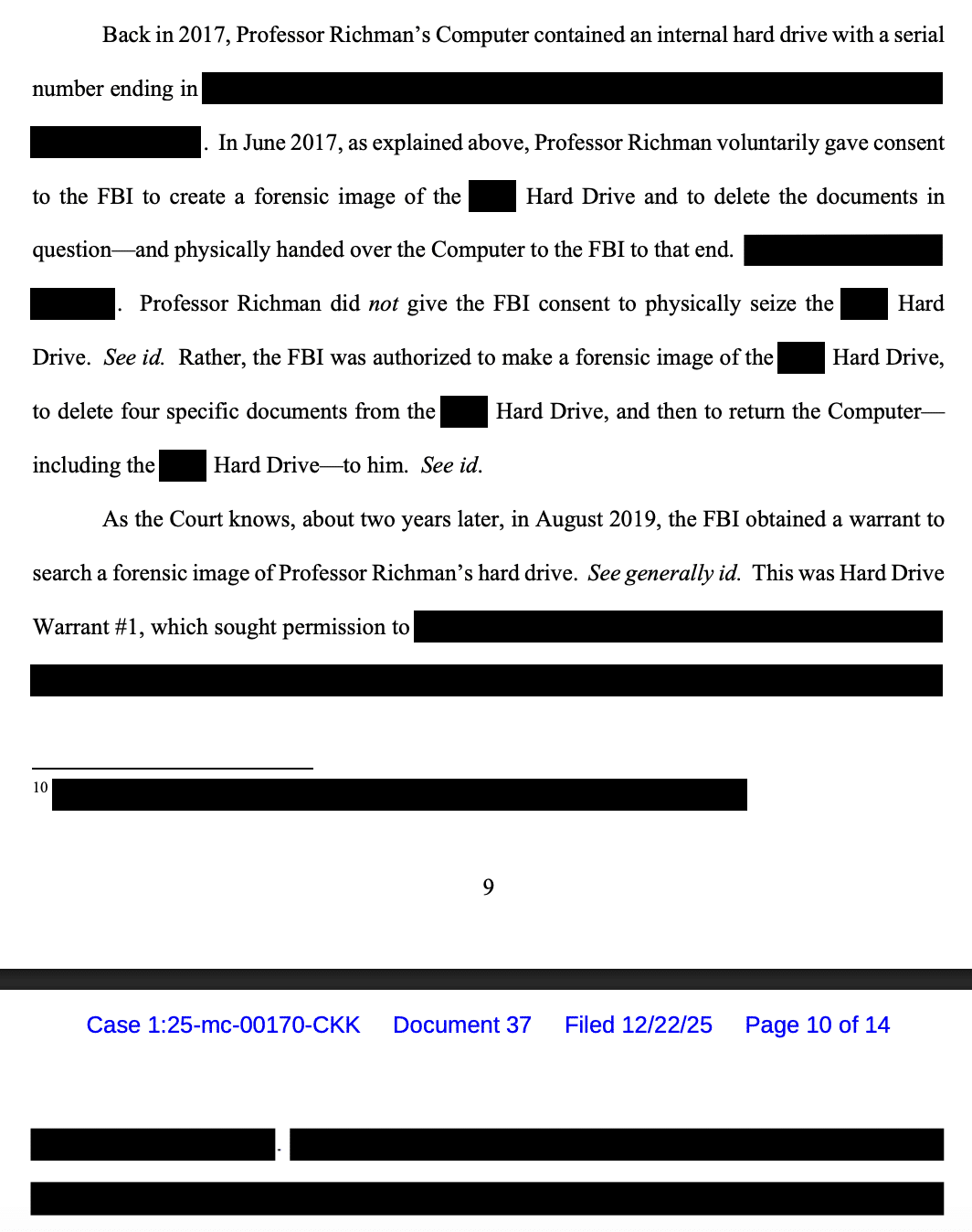
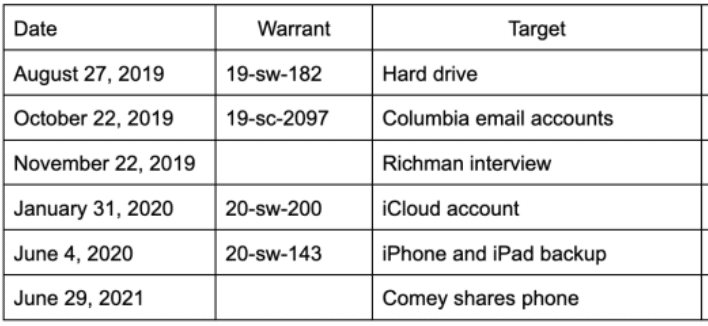
During the course of the investigation, the Government sought and obtained four search warrants in this district authorizing the Government to search for and seize evidence of violations of 18 U.S.C. §§ 641 and 793 from certain email accounts utilized by Richman, a hard drive containing a forensic image of his personal computer, and his iCloud account.2 See CM/ECF No. 1-1 at 3.

Comey provided relevant testimony to the Senate Judiciary Committee shortly before his employment as FBI Director was terminated, and again in September 2020. In May 2017, he testified in response to questioning from Senator Grassley that he had never authorized someone at the FBI to serve as an anonymous source regarding the Clinton email investigation. And in September 2020, he reaffirmed that testimony in response to questioning from Senator Cruz.

1 The government has provided the concise factual summary herein out of an abundance of caution as a result of the Court’s December 6, 2025 temporary restraining order (the “TRO”). See CM/ECF No. 9 at 4. Should the Court have meant the TRO to permit the government to use materials obtained via the relevant search warrants as part of this litigation, the government is prepared to provide a more detailed factual summary if necessary.

2 The investigators sought to obtain evidence of violations of 18 U.S.C. § 641 because it appeared that Richman and Comey were using private email accounts to correspond regarding official government business, i.e., that their correspondence were “record[s]” of the United States. See id.

First, the passage makes a confession, one that Lindsey the Insurance Lawyer Impersonating a US Attorney’s Loaner AUSAs never made: the use of May 2017 files involving attorney-client privilege had no basis in the prosecution, because they long post-dated the time Dan Richman left the FBI.

The filing misstates the genesis of Arctic Haze and the focus on Dan Richman. The investigation didn’t start by focusing on Richman. The focus on Richman appears to have started when John Durham discovered his communications while rifling through the image he shared with the Inspector General (a detail that seems quite sensitive, given the redactions).

The claim that the investigation demonstrated that Comey used Richman,

to provide information to the media concerning his—that is, Comey’s—decisionmaking process concerning the Clinton email investigation and that Richman had served as an anonymous source in doing so.

Is not backed by anything in the public record. Richman was not anonymous when doing this in fall 2016, and there’s no evidence that Comey asked Richman to do this in February 2017, where he was also an on-the-record source.

This filing obscures the fact that when Comey told Chuck Grassley he had not leaked anything anonymously, it preceded the time when Richman did share his memos anonymously, and he disclosed that publicly a month later, meaning it could not conceivably have been a lie on May 3, 2017 (before he shared the memo) or after June 8, 2017, in September 2020, because he had already disclosed it.

McBride claims he’s not using the unlawfully accessed materials in this filing, but he did disclose something new: that Richman and Comey were investigated under 18 USC 641 not because Comey shared a memo that the Inspector General would later rule was official FBI material, but because they were conducting official business on personal accounts (which is rich given that Lindsey the Insurance Lawyer masquerading as US Attorney used Signal for official business).

The lies are important for a reason beyond the cynicism: They obscure that if the FBI tried to get a warrant for these very same files, they would never be able to access the files they want.

And so they’re telling Dan Richman to just lay back and enjoy the Fourth Amendment violations.

Update: Richman’s response says exactly what I did (but in fancy lawyer-speak): The citations DOJ relied on all pertain to someone trying to get their own content back to prevent their own prosecution.

[I]n every single case cited by the government on this point, the movant was the target of an active investigation or the defendant in a charged criminal case. See In re Sealed Case, 716 F.3d at 604, 607 (observing that “the [DiBella] Court . . . found that each motion was tied to a criminal prosecution in esse because both movants had been arrested and indicted at the time of appeal” and that the movant in the case before it was “the subject of an ongoing grand jury investigation”) 6 ; Martino v. United States, 2024 WL 3963681, at *1 (3d Cir. Aug. 28, 2024) (movant was the “subject of an ongoing grand jury investigation” and brought a Rule 41(g) Motion tied to “his criminal prosecution”) (emphasis added); United States v. Nocito, 64 F.4th 76, 79 (3d Cir. 2023) (movant entities were owned by person charged with crime); In re Grand Jury, 635 F.3d 101, 105 (3d Cir. 2011) (finding DiBella’s second requirement met because “the property was seized in connection with an ongoing grand jury investigation of which the appellant is a target”) (emphasis added); In re Warrant Dated Dec. 14, 1990 & Recs. Seized From 3273 Hubbard Detroit, Mich. on Dec. 17, 1990, 961 F.2d 1241, 1242 (6th Cir. 1992) (involving “records . . . sought in connection with a criminal investigation of the appellants for tax evasion, filing of fraudulent tax returns, and conspiracy”).

Professor Richman is not a subject, target, or defendant. Though the government elides this fact, it bears repeating: because Professor Richman is not a prospective criminal defendant, he has no suppression remedy to address an ongoing violation of his constitutional rights. His property was seized five years ago, pursuant to warrants tied to a separate and since concluded investigation, and there is no indictment and no pending criminal case.

I actually think they might envision including him in a Grand Conspiracy indictment. But they’re pretending they’re not currently working on this and so got too cute for their own good — he notes that they twice dismissed his claims of irreparable harm because he was only at risk of being a witness at trial.

Share this entry

Judge Colleen Kollar-Kotelly Asks DOJ for Signs of Life

Judge Colleen Kollar-Kotelly granted Dan Richman his request for a Temporary Restraining Order, preventing the government from snooping in his stuff, one that goes through Friday. And while I agree with Gerstein and Cheney (and Bower and Parloff) that it could have the effect of thwarting another indictment of Jim Comey — indeed, it may undercut an attempt to stonewall Richman — I find KK’s order interesting for other reasons.

Partly, it’s the way she’s demanding signs of life from DOJ.

Judge KK attempts to forestall a stonewall

As a reminder, Judge Cameron Currie threw out the indictment against Jim Comey on November 24, the Monday of Thanksgiving week. Two days later, the day before Thanksgiving, Richman cited that dismissal and the expired Statute of Limitations in his bid to get his data back. As far as I know, no one noticed it until Anna Bower pointed to it on Tuesday.

Notably, Richman attached the warrants used to obtain his records as sealed exhibits.

The same day Bower noted it (the day it was assigned), December 2, Judge KK issued an order, half of which dealt with Richman’s sealing request, which she provisionally granted. But she also told him that if he wants to keep the government out of his data, he needs to get a Temporary Restraining Order. Her order emphasized that that request must submit some sign of life from DOJ.

Finally, Petitioner Richman’s 1 Motion requests that this Court “issue a temporary restraining order enjoining the [G]overnment from using or relying on in any way” the materials at issue in his 1 Motion while this matter is pending. Consistent with Local Rule of Civil Procedure 65.1, it is ORDERED that Petitioner Richman shall file his application for a temporary restraining order by separate motion, accompanied by a certificate of counsel that either (1) states the Government has received actual notice of the application and “copies of all pleadings and papers filed in the action to date or to be presented to the Court” in connection with the application; or (2) identifies “the efforts made by the applicant to give such notice and furnish such copies.”

A Certificate of Service Richman filed later that day explains part of the reason KK made that order: For some reason, the motion was not docketed. So, Richman attorney Mark Hansen explained that he formally served Jocelyn Ballantine and DC USAO on December 1.

This Corrected Certificate of Service corrects the service date listed for the public redacted Motion for Return of Property and accompanying attachments, see ECF No. 1 at 3, and the sealed version of that Motion with accompanying attachments, see ECF No. 2, from November 26, 2025, to December 1, 2025. Although Petitioner filed those papers on November 26, 2025 and intended to serve them on that date, the filings were not docketed at that time. I promptly caused the filings to be served on counsel for respondent upon receiving notification from the Clerk’s Office, on December 1, 2025, that the filings had been accepted for submission and docketed.

But to comply with the other part of her order, Richman’s attorneys also included the emails they exchanged with Ballantine. And among the things those emails showed is that after agreeing to attorney Nick Lewin’s midafternoon December 3 request to respond by close of day on December 4,

Based on the government’s use of such property in connection with the Comey case (as described in Judge Fitzpatrick’s November 17, 2025 opinion), we are concerned that, absent a TRO, the government may continue to use the property in a manner that violates Professor Richman’s rights – particularly in light of recent news reports that the DOJ may seek a new indictment of Mr. Comey. However, if the government has no such intention and will agree to refrain from searching, using, or relying in any way upon Professor Richman’s property pending resolution of the Rule 41(g) motion, that would address our concerns and obviate the need for a TRO.

Please let us know the government’s position by COB tomorrow.

[snip]

Nick,

Thanks for your email. I will reach out to the appropriate people at DOJ with your request and will respond to you tomorrow by COB.

Jocelyn

Ballantine had not responded by 9PM on December 4.

Hi Jocelyn,

Did you get an answer? Please let us know.

Ballantine had a good excuse: she was busy prosecuting accused pipe bomber Brian Cole. Nevertheless, when she did respond at 9:12PM Thursday night, she said that her leadership — Jeanine Pirro — had already engaged with DOJ leadership (Bondi spent part of Thursday with Pirro bragging about the pipe bomber arrest), but she would not have an answer until “early next week.”

Thank you so much for the prompt. I met with my leadership today, and they have engaged Department of Justice leadership. I have also shared your pleadings and request with the prosecutors who handled the Comey prosecution out of EDVA.

I do not have an answer for you this evening, but I expect to have one early next week.

That’s what led Richman to file his motion for a TRO, maybe around 10PM Friday night. Judge KK responded just under a day later.

Her order specifically ruled that DOJ knows about Richman’s request.

Third, the Court finds that the Government has received actual notice of Petitioner Richman’s [9] Motion, ensuring that the Government is positioned to act promptly to seek any appropriate relief from this Order. Specifically, counsel for the Government may move to dissolve or modify this Order immediately upon entering an appearance, and the Court will resolve any such motion “as promptly as justice requires.” Fed. R. Civ. P. 65(b). Under the circumstances, the Court will allow and consider such a motion at any time upon contemporaneous notice to counsel for Petitioner Richman. See id. (providing that such a motion may be filed “[o]n 2 days’ notice to the party who obtained the order” or “on shorter notice set by the court”).

And barring the government requesting a different schedule, Judge KK’s order set up the following schedule:

  • Richman should “promptly” serve Judge KK’s order and everything filed in the docket to Pam Bondi (KK identifies Bondi by title specifically).
  • By noon on Monday, “the Attorney General of the United States or her designee” must confirm “the United States,” so everyone!, is in compliance with KK’s order not to “access … share, disseminate, or disclose” Richman’s data “to any person.”
  • By Tuesday at 9AM, DOJ must respond to both of Richman’s requests.
  • He must reply by 5PM that day.
  • The order will expire at 11:59PM on Friday night if Judge KK has not issued an order first.

If DOJ follows Judge KK’s order, then it will have the effect of:

  1. Slightly accelerating the response deadline for DOJ, which may have been due sometime on Tuesday anyway, while dramatically accelerating Richman’s reply, which is now due that same day.
  2. Flip the default status of Richman’s data, restricting DOJ from accessing it before Judge KK issues an order rather that allowing them to access it until any such order is in place.

In other words, the government can’t stall Richman’s effort in a bid to use the data in the interim. If DOJ follows the order, then it would prevent DOJ from using the data to get a new indictment before such time as Ballantine responds, “early next week.” Unless DOJ got an indictment on Friday with hopes of a big show arrest tomorrow morning, then KK would have thwarted any effort to stonewall Richman’s assertion of his rights.

If DOJ blows off the order, it’ll make it even easier for Comey to argue any indictment is malicious (unless, of course, he has to argue that to Aileen Cannon).

Did Judge KK smell a rat?

That’s the logistics of the order. The other parts of it are more interesting.

First, KK’s analysis on the TRO is cursory: just one paragraph stating that the government probably has violated Richman’s Fourth Amendment rights by searching his data without a warrant.

The Court concludes that Petitioner Richman is likely to succeed on the merits of his claim that the Government has violated his Fourth Amendment right against unreasonable searches and seizures by retaining a complete copy of all files on his personal computer (an “image” of the computer) and searching that image without a warrant. See United States v. Comey, No. 1:25-CR272-MSN-WEF, 2025 WL 3202693, at *4–7 (E.D. Va. Nov. 17, 2025). The Court further concludes that Petitioner Richman is also likely to succeed in showing that, because of those violations, he is entitled to the return of the image under Federal Rule of Criminal Procedure 41(g).

That’s on the third page of the four-page memo.

Before she gets there (and in addition to formally finding that DOJ has notice of Richman’s request), she focuses on the way DOJ is playing dumb. She notes she has spoken to unnamed people from DC USAO, who were helpful on administrative matters, thank you very much.

First, although the Court has been in communication with attorneys from the U.S. Attorney’s Office for the District of Columbia, 1 the U.S. Attorney’s Office for the District of Columbia has not yet entered an appearance to make representations on behalf of the Government, and counsel for the Government has not yet been identified. See Pet’r’s Ex. A, Dkt. No. 9-2.

1 These attorneys have helpfully facilitated communication on administrative matters. The Court appreciates counsel’s prompt assistance on these matters.

But no one, including Jocelyn Ballantine, wants to put their name on this docket.

And that’s a problem, Judge KK notes, because until someone files notice of appearance, there’s no formal way to start figuring out who has the data.

Second, the Government has not yet indicated who has custody of the material at issue, and neither the Petitioner nor the Court can determine the identity of the custodian until the Government appears in this case. Given that the custody and control of this material is the central issue in this matter, uncertainty about its whereabouts weighs in favor of acting promptly to preserve the status quo.

Maybe it’s something those helpful DC USAO personnel told her. Maybe it’s the way Ballantine deftly shared Richman’s motion with the Loaner AUSAs at EDVA, but not the DOJ leadership with whom Pirro had consulted by late day Thursday.

It’s like Colleen Kollar-Kotelly suspects DOJ is hiding the ball, and that’s why she ordered Richman to go right to the top with his request, to ensure Pam Bondi can’t pretend she’s ignorant of his request.

The perma-sealed Bill Barr dockets

There’s something else sketchy going on here.

As I noted, Richman attached the warrants used to seize his stuff. They’re still sealed and Judge KK has provisionally permitted them to remain that way.

But why are they still sealed?

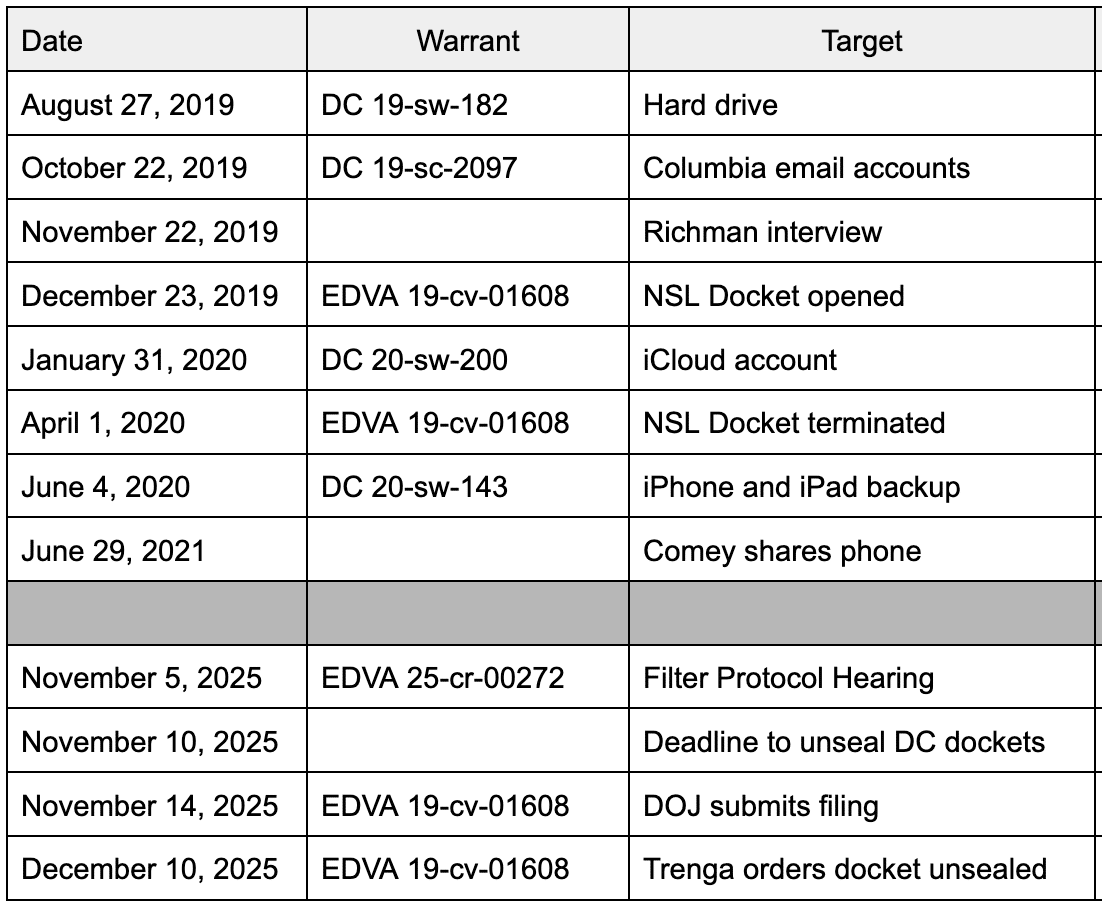
Back on November 5, Magistrate Judge William Fitzpatrick ordered the Loaner AUSAs to get them unsealed or, if not, then to file a motion justifying the seal in DC.

ORDERED that the Government shall, on or before November 10, 2025, move in the issuing district to unseal the four 2019 and 2020 search warrants referenced in the Government’s Reply to Defendant’s Response to the Government’s Motion for Implementation of Filter Protocol (ECF 132), together with all attendant documents, or, in the alternative, file a motion in the issuing district setting forth good cause as to why the subject search warrants and all attendant documents should remain under seal, in whole or in part;

In that same order, he ordered that there’d be a discussion about unsealing all the references to the warrants in the Comey docket on November 21, which was before Judge Currie dismissed the indictment on November 24. The government was also going to have to defend keeping the filing explaining the notice given to Comey — and submitted as an exhibit to his first response to the effort to get a taint team — sealed that same day.

ORDERED that, if necessary, the Court shall hold a hearing on the pending motions to seal (ECFs 56, 72, 109, and 133) on November 21, 2025, at 10:00 a.m. in Courtroom 500, and the materials subject to those motions shall remain UNDER SEAL until further order of the Court; and it is further ORDERED that, to the extent the Government seeks to seal Exhibit A to Defendant’s Response to the Government’s Motion for Expedited Ruling (ECF No. 55-1), the Government shall file a supporting brief in accordance with Local Criminal Rule 49 on or before November 12, 2025; Defendant may file a response on or before November 19, 2025; and, if necessary, the Court shall hold a hearing on the Government’s sealing request on November 21, 2025, at 10:00 a.m. in Courtroom 500;

Best as I can tell, that never happened. For example, there are no gaps in the Comey docket hiding a sealed discussion about these sealed warrants.

And that’s interesting because when Fitzpatrick asked about all this back on November 5 — this is the hearing that led to the order to unseal the warrants — Rebekah Donaleski revealed that they asked Loaner AUSA Tyler Lemons about the warrants twice at that point, but had gotten no response.

Before we begin, what I’d like to do is — before we address the underlying issues, the government’s motion for a filter protocol, the defendant’s position, we have four outstanding sealing motions, and I do think those sealing motions will touch, at least in some way, on this motion; if not, motions that you-all are going to argue in the future. So what I’d like to do is see if we can nail down what the parties’ positions are and see if we can kind of resolve some of those sealing issues now, if possible.

As I understand it, there are four sealing motions that are outstanding. The defense has filed three; the government has filed one. All these sealing motions deal with either warrants that were issued in a sister district or one document that the government has provided to the defense in discovery.

MS. DONALESKI: Thank you, Your Honor. With respect to the one document provided in discovery, that’s our position, we have no objection. With respect to the underlying warrants which we attached to our motions, my understanding from Mr. Lemons is that he has moved to unseal those. We don’t know where — he hasn’t moved to unseal them — when. We’ve asked him twice for that information, and he hasn’t provided it. The defense’s view is that we should be entitled to proposed reasonable redactions for PII of those warrant affidavits and warrant materials. We have asked for an opportunity to do that and have not heard from the government. So our position is, the information in our motions, in the motion papers themselves, we have no objection to that being under seal — to that being publicly filed; but with respect to the warrants, which my understanding is those remain under seal by the District of D.C. court, we would ask that we be permitted an opportunity to propose redactions with the government.

[snip]

But with respect to the information that we’ve described in our motion papers, specifically referring to the offenses at issue in the Artic Haze warrants, the dates that the warrants authorize to search, the defense believes that those should be discussed publicly and those can be discussed publicly.

THE COURT: What about the affidavits in support of the warrants?

MS. DONALESKI: Those remain under seal. I don’t expect that we’ll need to get into what is in those affidavits in this hearing today, but if the government or the Court feels differently, we’d welcome that discussion.

And when Fitzpatrick asked Lemons about the warrants, the Loaner AUSA got a bit squirmy. Lemons had asked the AUSA to unseal the warrants. He had not filed a motion to unseal them, as if someone — maybe the AUSA in question, who may be Jocelyn Ballantine — advised him that was not a good idea.

THE COURT: Mr. Lemons, what’s the status of that?

MR. LEMONS: Thank you, Your Honor. Your Honor, we have made a request to the issuing district as to those search warrants, for them to be unsealed. My understanding, last speaking with an AUSA in that district, is that motion has not been filed at this time. They are preparing to provide notice to other potentially interested parties, per their practice and the rules they have to abide by in that district. So we requested it, and our understanding is at this time that the warrants all remain completely under seal. That is the only reason why the government designated these search warrants as protected material and filed them under seal and understands why the defense filed them under seal. If it was in my power and ability here today, those search warrants would be totally unsealed. [my emphasis]

“Preparing to provide notice to other potentially interested parties”? Who else would need notice? Richman and Comey were the ones suspected of leaking!

It has been a month but these dockets remain sealed.

One possible explanation for that is that the Loaner AUSAs (or perhaps Ballantine) filed a motion in DC on November 10 that is under seal, one that should not be sealed for Judge KK. So perhaps everyone is trying to hide the fact that after being ordered by Fitzpatrick not to access this data, Kash Patel just dealt it to someone else (possibly Jason Reding Quiñones). That might explain why Judge KK ordered the government they can only contest her order after giving “contemporaneous notice to counsel for Petitioner Richman:” because (hypothetically), having been ordered by MJ Fitzpatrick to stay out of Richman’s data, they instead dove deeper into it without telling him.

Or maybe the squirminess is about hiding how the underlying warrants were managed … by Jocelyn Ballantine.

Revealing those warrants, after all, should not thwart the effort to keep snuffling about Richman’s data, except insofar as it would raise questions not directly addressed in Judge KK’s order. Just as one example, even though Richman in his initial motion and TRO request relied heavily on Magistrate Judge William Fitzpatrick’s opinion effectively describing rampant Fourth Amendment violations, he does not mention that when the FBI seized his iCloud account in 2020, they took content through August 13, 2019, more than two years after the date of the warrant (basically, through the date of the Comey Memo IG Report release).

According to an April 29, 2020 letter from Mr. Richman’s then-attorney to the government–produced to the Court ex parte by the defense–the Department of Justice informed Mr. Richman that the data it obtained from his iCloud account extended to August 13, 2019, well outside the scope of the warrant and well past the date on which Mr. Richman was retained as Mr. Comey’s attorney. ECF 181-6 at 20. The same letter further states that the Department of Justice informed Mr. Richman that it had seized data from Mr. Richman’s hard drive that extended to June 10, 2017–again well into the period during which Mr. Richman represented Mr. Comey–despite the warrant (19-sw-182) imposing a temporal limit of April 30, 2017. Id.

Did Ballantine — in whom Pirro has invested the trust to limit the blowback of the pipe bomb prosecution — allow the FBI to obtain data outside the scope of a warrant? Are there secret John Durham warrants someone is hiding?

It’s not clear who all this squirminess is designed to protect. But I feel like, whether or not Judge KK’s order halts DOJ efforts to dive into this unlawfully collected data, it may lead to some interesting disclosures about why everyone is so squirmy.

Update: Right wing propagandist (and daughter of a former whack job FBI agent) Mary Margaret Olohan gives the game away. One of her DOJ sources says this won’t be a setback … which sort of confirms that DOJ intends to continue to violate Richman’s Fourth Amendment.

Share this entry

Fridays with Nicole Sandler

Listen on Spotify (transcripts available)

Listen on Apple (transcripts available)

Update: Here are the photos of James Joyce’s Martello Tower I mentioned.

Looking towards the sea from the strand.

A tie Joyce gave Samuel Beckett, which is exhibited in the Martello Tower.

Me, pretending to be Buck Mulligan, spying the ship named the Samuel Beckett.


Share this entry

The Kafka Story Inside Trump’s Godfather Trilogy

I’ve written several times (one, two, three) about the possibility that Maurene Comey’s wrongful termination lawsuit might provide transparency on DOJ’s larger weaponization against people like her father.

But (aside from vindication for Ms. Comey), I always conceived it in terms of the specific disclosures it might bring. Because she claims she was fired because of Trump’s gripes about her father, if the lawsuit survives motion to dismiss, Ms. Comey might well get more details of how Trump installed his Insurance Lawyer just in time to try to prosecute her father. (Indeed, Judge Jesse Furman, who presides over this case, suggested in an order he might grant Ms. Comey discovery before the motion to dismiss.)

A filing submitted in advance of a hearing scheduled for tomorrow reveals it may be more than that.

As part of a discussion in defense of suing now, before Merit Systems Protection Board adjudicates her case, Ms. Comey revealed a lot of what has been going on at MSPB, which normally would review Civil Service violations like her firing.

It starts by arguing that MSPB cannot adjudicate novel legal issues, such as whether the President can unilaterally ignore the Civil Service Reform Act.

[T]he MSPB lacks expertise to adjudicate this novel dispute: whether, as the government will likely argue, Article II of the Constitution overrides a federal employee’s rights under the Civil Service Reform Act (“CSRA”) and the Bill of Rights. See, e.g., Jackler v. DOJ, MSPB DA-0752-25-0330-I-1, DOJ submission, available at: https://washingtonlitigationgroup.org/wp-content/uploads/2025/09/Jackler-Motion.pdf. Because this case raises foundational constitutional questions with respect to the separation of powers, the MSPB is not the appropriate forum for this dispute. See Axon Enterprise Inc. v. Federal Trade Commission, 598 U.S. 175, 195-96 (2023) (district court retains jurisdiction over “collateral” claims “outside the [agency’s] sphere of expertise”); Thunder Basin Coal Co. v. Reich, 510 U.S. 200, 212, 214-215 (1994) (claims not of type Congress intended to be reviewed within statutory structure if “wholly collateral” to statute’s review provisions and “agency expertise” not “brought to bear on the statutory questions presented”) (cleaned up).

Then, it notes that all the legal precedents requiring people with termination complaints to first go through MSPB process are predicated on the MSPB being independent of the President.

Second, the Supreme Court decisions that outline the MSPB’s jurisdiction presumed an MSPB that functioned independently of the President, which is no longer true. The “CSRA’s adjudicatory scheme was predicated on the existence of a functioning and independent MSPB,” See Nat’l Ass’n of Immigr. Judges v. Owen, 139 F.4th 293, 304 (4th Cir. 2025) (rejecting channeling to MSPB because “Congress enacted the CSRA on the bedrock principle that the members of the MSPB and the Special Counsel would be protected from removal on political grounds, providing them independence from the President”). However, the President has pronounced that independent agencies must follow his interpretation of the law. See Exec. Order 14215 (Feb. 18, 2025) §§ 1, 2(b), 5, 7 (directing that the President and the Attorney General “shall provide authoritative interpretations of law for the executive branch,” and their “opinions on questions of law are controlling on all employees”—including on “so-called independent agencies”; “No employee of the executive branch… may advance an interpretation of the law… that contravenes the President or the Attorney General’s opinion on a matter of law”).2 Further, the President terminated the sole Democratic member of the MSPB Board and insists he has the unlimited right to do so,

Then, it noted that in the days after Ms. Comey wrote this in her complaint (Ms. Comey is represented by Margaret Donovan, who is handling several other Article II and other politicized firings) …

As of September 1, 2025, 891 PFRs are pending.47 Finally, on information and belief, in recent cases, the Government itself has argued before the MSPB that the CSRA is unconstitutional because it violates the President’s alleged Article II prerogatives, and that the MSPB has no jurisdiction over a challenge to an Article II removal. The MSPB, for its part, has previously ruled that it does not have the authority to adjudicate the constitutionality of statutes. 48 On information and belief, the MSPB is currently treating agencies’ Article II-based challenges to its authority consistent with this precedent, which is to say, it is declining to rule on the issue.

… The Office of Legal Counsel all of a sudden decided that the MSPB, and not Article III courts, should decide constitutional matters.

Indeed, the MSPB itself has repeatedly concluded that it lacks authority to adjudicate such sweeping constitutional questions, see Malone v. DOJ, 14 M.S.P.R. 403, 406 (1983), and until two months ago, so did the government, as discussed below, see Dkt. 1 ¶ 84.

[snip]

[A]nd the Department of Justice recently and suddenly reversed its position and now insists that the MSPB must review constitutional issues, compare Department of Justice, Office of Legal Counsel, Slip Opinion, 49 Op. O.L.C. __ (Sept. 26, 2025), to, e.g., Dkt. 1 ¶ 84 (alleging that the government argued, before September 15, 2025, that MSPB has no jurisdiction over a challenge to an Article II removal). The OLC’s reversal came immediately after an MSPB administrative judge declined to rule on the constitutionality of Article II removals; that issue is now on appeal to the very Board that the President has ordered must adhere to his interpretation of law. This is a thorough evisceration of the MSPB’s independence. As a matter of due process and constitutional principle, the President’s decision to remove a career civil servant without cause, in violation of Congress’s explicit prohibition, cannot fairly be adjudicated by an agency that is subservient to that same President.

Then it reveals that MSPB has been dismissing cases, like hers, challenging her firing on Article II authority until it decides whether the President’s Article II authority can override civil service protections, which is where Kafka gets invoked.

Third, any MSPB proceeding would be futile. On November 25, 2025, an MSPB administrative judge notified Ms. Comey that the MSPB intends to dismiss her appeal without prejudice, while awaiting a ruling from the Board (now beholden to the President) about whether the President’s Article II power overrides the CSRA. Today, the government consented to that dismissal. To the best of our knowledge, Ms. Comey is not alone. Since November 17, 2025, MSPB administrative judges have dismissed without prejudice multiple MSPB appeals of “Article II” firings, and the government has acquiesced in each case. See, e.g., Law360, “Ex-US Trustee Director’s Firing Appeal Tossed, For Now,” November 21, 2025 (citing Tara Twomey v. DOJ, MSPB DC-0752-25-1950-I-1). This procedure is Kafkaesque: the Executive Branch maintains it can fire Ms. Comey without the due process afforded by the CSRA, yet insists that she submit adjudication of that question to the body created by the CSRA, all while advocating for the premature termination of the CSRA process. Meanwhile, the Executive Branch contends it can dictate the outcome of her appeal (should it eventually proceed) by controlling the “authoritative interpretations of the law” and removing any decisionmaker who dares to disagree. This scheme has been transformed into a dead end that provides no due process. See Carr v. Saul, 593 U.S. 83, 93 (2021) (“It makes little sense to require litigants to present claims to adjudicators who are powerless to grant the relief requested.”). It is not what Congress intended. See Axon Enterprise, 598 U.S. at 191 (plaintiffs need not submit to administrative process where they would face “an illegitmate proceeding, led by an illegitmate decisionmaker,” because “being subjected to such an illegitmate proceeding causes legal injury” that “cannot be undone”); Thunder Basin, 510 U.S. at 212 (Congress did not intend to preclude district court jurisdiction where statutory scheme “forecloses all meaningful judicial review”). [my emphasis]

Thus far, Ms. Comey has not mentioned that John Sarcone, the only one willing to defend against this lawsuit, is playacting at being US Attorney just like Lindsey Halligan is or was.

Just to add to the abuse of power going on here.

It all sounds like the kind of case that could be headed for SCOTUS.

For now, Ms. Comey has more modest goals, like figuring out whether the President personally fired her, or whether some flunky (or former Defense Attorney) at DOJ did it for him.

First, initial discovery can be narrowly tailored, if necessary, to critical questions relating to the circumstances of Ms. Comey’s termination, including who made the decision and on what basis.

[snip]

For example, if the President terminated Ms. Comey, then the question before the Court is whether the President’s Article II powers supersede Congress’s Article I powers and the Bill of Rights. On the other hand, if, as the White House claims (Dkt. 1 ¶ 51), someone within the Department of Justice terminated Ms. Comey, then the Court must decide the additional question of the extent to which the President can delegate his alleged Article II power to supersede Article I.

Of course, even that detail may intertwine with her father’s potentially ongoing persecution.

Share this entry

Dan Richman Wants His Data Back

There are a number of articles (Reuters, Politico) describing discussions about reindicting Jim Comey and Letitia James. Neither addresses the issue I lay out here — namely, that the ultimate goal of the Comey prosecution, at least, is to support the Grand Conspiracy in Florida, perhaps by obtaining at least probable cause that Comey lied to cover up the import of (Grand Conspiracy nutballs claim to believe) the “Clinton Plan” CIOL and Comey’s decision to release a memo documenting Trump’s corruption.

More importantly, neither addresses a new wrinkle: That Dan Richman wants his data back. (Anna Bower first noted the suit.)

Last Wednesday, Richman moved under Rule 41(g) to get his property, in the form of an image of his computer made by the Inspector General, as well as emails and additional content obtained derivative to that.

While there are redacted bits describing the original imaging by DOJ IG of the computer and the overcollection at that stage (as well as the warrants themselves, which would have been unsealed by now if the indictment hadn’t been dismissed), it relies heavily on and largely tracks William Fitzpatrick’s ruling effectively cataloging the many Fourth Amendment violations involved in the searches of Richman’s data, which Richman points to in order to claim that Judge Colleen Kollar-Kotelly need not consider the normal balancing considerations.

While the government may argue that it needs the Hard Drive to obtain evidence to prosecute Mr. Comey, the Comey case has now been dismissed and any charges related to the underlying conduct are time-barred. [citation omitted] (noting that had Mr. Comey not been indicted, the statute of limitations would have expired on September 30, 2025). Even if the case were to somehow proceed, the government should be barred from using evidence from the Hard Drive. The materials from the Hard Drive that the government presented to the grand jury in the Comey case were only identified by the government because it (1) exceeded the scope of the Warrants and seized non-responsive data, (2) illegally retained materials it should have destroyed or returned, and (3) searched the illegally seized and retained data without a warrant.

As Comey was preparing to move to suppress this content, the Loaner AUSAs claimed that he had no Fourth Amendment interest in Richman’s data. That was contestable for at least a subset of the data. But Richman clearly has a Fourth Amendment interest in it.

If this effort by Richman is successful, in particular his request for “a temporary restraining order enjoining the government from using or relying on in any way the improperly seized materials until such time as the Court can further consider the merits of his claims,” all the data would become inaccessible, both for any reindictment of the false statements indictment or for the Grand Conspiracy conspiracy.

Oh sure, the FBI could attempt to obtain new warrants — or subpoena Richman for the same material. But much of their use of this data (Exhibits 8, 9, and 10 post-dated Richman’s departure from the FBI, and Exhibits 3 through 7 involved sourcing for which Richman was public) did not fit basic criteria arising from the imagined crimes, Richman leaking information while still at FBI. Of what the Loaner AUSAs presented to the grand jury, they’d be stuck with the “Clinton CIOL” that the jury no-billed.

And to get the files they really want — Exhibit 10 — the FBI would undoubtedly rely on the tainted searches Richman invokes here to justify demanding the return of his data. Plus, there’s a chunk of data DOJ unlawfully seized that went through 2019; if DOJ found anything enticing in there, it too would become inaccessible.

Kash Patel’s FBI fucked up pretty badly in the way they searched Richman’s data for dirt on Jim Comey. The dismissal of the indictment might have otherwise shielded them from consequences. But at the very least this effort may thwart their ongoing witch hunt targeting Comey.

Share this entry

Fridays with Nicole Sandler, Thanksgiving Wednesday Edition!

Listen on Spotify (transcripts available)

Listen on Apple (transcripts available)

Share this entry

Did the Comey Dismissal Render Kash Patel’s Grand Conspiracy “Just Someone Else’s Fantasy”?

There’s something missing from all the analysis (and this, from Politico, is quite good) of what might happen in the wake of Judge Cameron Currie’s dismissal of at least the Jim Comey indictment, and possibly even the Letitia James one: the way the dismissal might help or hurt Trump’s plans to charge a Grand Conspiracy in Florida.

[I regret to inform all of you, especially Savage Librarian, that in thinking about this during a bout of insomnia on Sunday I set all my thinking about the Grand Conspiracy to the tune of Styx’ The Grand Illusion.]

After all, if the ultimate goal was always to charge Jim Comey as part of some 20-person conspiracy indictment claiming a bunch of people arranged to have Donald Trump investigated as a ploy to undercut his first term and damage his 2024 election chances (yeah, seriously, that is the theory!), then the statute of limitations expiration was always a mere speed bump.

And in the same way that the dismissal without prejudice leaves unresolved the larger issue of illegal weaponization of DOJ, it also leaves a number of things the Loaner AUSAs might have wanted resolved unresolved.

Understand, two things that had no business being in the Comey indictment are absolutely critical to the Grand Conspiracy theory.

The Grand Conspiracy would start at least by August 9, 2016, when Peter Strzok responded to Lisa Page’s question, “He’s not ever going to become president, right? Right?!” by saying, “No. No he’s not. We’ll stop it.”

From there, Kash Patel’s conspiracy theory about the “Clinton Plan” CIOL would take over.

The Grand Conspiracy conspiracy theory is that the “Clinton Plan” was real, and that it should have given the FBI notice that Hillary had a plan to frame Donald Trump. [I should emphasize, not only don’t I endorse this theory, much of it is false and even more of it is batshit insane, but it nevertheless is being pursued by a Senate confirmed US Attorney in SDFL, Jason Reding Quiñones.] But, the Grand Conspiracy conspiracy theory goes, when Peter Strzok got notice of the Clinton Plan on September 7, he made sure it never got shared with the people beginning to investigate why George Papadopoulos knew of Russia’s plan to help Trump in advance because, the Grand Conspiracy conspiracy goes, it would have led him to open an investigation into Hillary rather than Trump.

Again, not true, insane, but nevertheless what has everyone from the Deputy Attorney General and FBI Director on down to the people unlawfully accessing raw data collected years ago aroused.

Fast forward to 2020. According to the Grand Conspiracy conspiracy theory, when Jim Comey told Lindsey Graham the “Clinton Plan” — as misleadingly described in a John Ratcliffe letter no doubt drafted with Kash’s help — didn’t ring a bell for him, he was lying to cover up how the FBI ignored warning signs about leads from Hillary.

Fast forward even further to 2025. When Kash found a burn bag of materials that had not been destroyed, including the “Clinton Plan” CIOL that might have been brought to the FBI Director’s Office with a bunch of other Durham investigation materials, he and Jack Eckenrode instead assumed that Comey partisans were trying to protect Comey and Strzok’s devious plot to ignore the CIOL back in 2016.

You need the “Clinton Plan” CIOL for the Grand Conspiracy conspiracy theory because that’s what makes their wildly misleading claims about the treatment of the Steele dossier in the 2017 Intelligence Community Assessment damning. The Steele dossier should never have been used at all, the Grand Conspiracy conspiracy theory says, because the FBI had notice that Clinton wanted to frame Trump, but instead Comey, with Brennan’s involvement (the Grand Conspiracy conspiracy theory claims), demanded its inclusion and based (the Grand Conspiracy conspiracy theory claims) the judgement that Russia wanted Trump to win on it, and when Brennan lied about all that in 2023 (the Grand Conspiracy conspiracy theory claims), he was trying to cover up this devious plot.

You also need Comey’s decision to release the memo he wrote up memorializing Trump’s corrupt attempt to shut down the Mike Flynn investigation and with it the communications with Dan Richman. You need that, plus Comey’s overt wish that by releasing the memo a Special Counsel might be (and was) appointed, because it ties (the Grand Conspiracy conspiracy theory claims) Strzok’s stated intent to “stop” Trump from becoming President to the investigation that dominated his first term. The Grand Conspiracy conspiracy theory turns the very legal release of a memo demonstrating Trump’s corruption into the crime of depriving Donald Trump of his right to fully exploit the presidency the Russian government gave him.

Now consider how charging Jim Comey with lying and obstructing fucked the Grand Conspiracy conspiracy plans.

First, the “Clinton Plan” CIOL.

EDVA successfully prevented Comey from explaining the problem with the “Clinton Plan” CIOL before attempting to charge him for lying about it. In his first discovery letter, Pat Fitzgerald noted that he had offered to meet with prosecutors on September 17.

In that regard, on September 17, 2025, I wrote the DOJ to ask for a meeting to discuss why the case should not be brought but never received a substantive response, much less a meeting.

And his motion to dismiss because Lindsey the Insurance Lawyer failed to actually get an indictment revealed that EDVA even refused to engage with the offer to toll the statute of limitations.

In fact, Mr. Comey’s counsel requested a meeting with the U.S. Attorney’s Office the week before the indictment was obtained and offered to toll the statute of limitations to allow for that meeting. A prosecutor in the Office told Mr. Comey’s counsel that the Office had been directed not to engage with defense counsel.

Prosecutors at EDVA — supposedly the good guys who got fired — didn’t want any truths Fitzgerald might share to fuck up their larger Grand Conspiracy conspiracy.

In one of his two replies for release of grand jury materials, Comey laid out how stupid all this is.

On September 30, 2020, Mr. Comey testified before the Senate Judiciary Committee about the Crossfire Hurricane counterintelligence investigation into alleged links between President Trump’s 2016 campaign and the Russian government. See Oversight of the Crossfire Hurricane Investigation: Day 3, Hearing Before the U.S. Senate Committee on the Judiciary, 116th Cong. (Sept. 30, 2020), http://bit.ly/4o2ekHb. The night before, he was sent a copy of the Ratcliffe Letter, described above, which purported to summarize the September 7, 2016 CIOL in one sentence. Mr. Comey was not provided an opportunity to review the September 7, 2016 CIOL at issue prior to his testimony.

[snip]

There is no evidence whatsoever that Mr. Comey received the CIOL at issue, much less that he reviewed it. The materials in discovery make clear that every day, numerous CIOLs come to the FBI addressed to the Director—from a variety of federal agencies in a variety of formats—and are routed to employees other than the Director. Because the Midyear Exam investigation had been closed for more than two months, there is no reason to believe that any CIOL related to Ms. Clinton would have been sent to Mr. Comey (and the government has produced no proof that it was). There is no electronic trail showing that Mr. Comey received the CIOL at issue. There is no paper trail showing that he received it. And there is no witness who says that Mr. Comey either received it or discussed it with him. Full stop.

This total lack of evidence is extremely troubling in light of credible press reporting that not only does a declination memorandum exist in this case,11 but it made clear that with respect to the CIOL in particular, a prior investigation found that Mr. Comey’s statement could not support a false-statement charge because there was insufficient evidence Mr. Comey had ever seen the CIOL.12 Ms. Halligan was also reported to have been advised by career prosecutors in that declination memorandum that “seeking the charges would violate DOJ policy, raise serious ethics issues, and risk being rejected by the grand jury.” Id.

In a footnote, he noted that this is all based on Russian disinformation.

10 Indeed, it appears this information was created by Russian intelligence, and did not accurately reflect particular emails. See Charlie Savage & Adam Goldman, ‘Clinton Plan’ Emails Were Likely Made by Russian Spies, Declassified Report Shows, N.Y. Times (July 31, 2025), https://perma.cc/F8AF-TLAF.

Worse still, a grand jury determined there was not probable cause that Comey lied about the “Clinton Plan” CIOL (though the Loaner AUSAs were trying to backdoor that as a crime in the obstruction charge).

Todd Blanche whisked the criminal investigation into whether Brennan lied in 2023 about his enthusiasm for the Steele dossier away to SDFL before a prosecutor wrote up a declination memo. Having arrived in Florida, US Attorney Jason Reding Quiñones sent out a bunch of subpoenas that everyone recognizes to be entirely performative (because they ask for highly classified things none of the subpoena recipients would have in their private possession).

But Blanche didn’t whisk this “Clinton Plan” CIOL off to Florida (which might have happened had Trump not demanded Pam Bondi intervene) before Lindsey the Insurance Lawyer did real damage to it.

And by bringing in Loaner AUSAs who actually care about their bar licenses, Blanche also did grave damage to their plan to use the Comey memos in the Grand Conspiracy conspiracy. The Loaner AUSAs attempted (or rather, fronted for James Hayes’ attempt) to use this investigation to get a filter team approved to turn the clearly privileged materials Miles Starr and Jack Eckenrode could have read because Kash Patel’s FBI turned off the filters applied under Bill Barr into crime-fraud excepted communications, at least ostensibly because they reflected a conspiracy to leak classified materials but in reality to serve their larger Grand Conspiracy conspiracy.

But instead of getting their filter protocol, the EDVA effort resulted in an order from William Fitzpatrick prohibiting the government from reviewing those privileged materials.

ORDERED that the Government, including any of its agents or employees, shall not review any of the materials seized pursuant to the four 2019 and 2020 search warrants at issue until further order of the Court;

And then Fitzpatrick issued an opinion effectively holding that DOJ violated Comey’s attorney-client privilege in 2020 by not permitting him to assert privilege.

However, the government never engaged Mr. Comey in this process even though it knew that Mr. Richman represented Mr. Comey as his attorney as of May 9, 2017, and three of the four Richman Warrants authorized the government to search Mr. Richman’s devices through May 30, 2017, 21 days after an attorney-client relationship had been formed. ECF Nos. 38 at 2 and 138-11 at 33 (Aug. 2019 Office of the Inspector General Report) (noting that Mr. Comey informed the Office of Inspector General that “the day after his removal, or ‘very shortly thereafter,’ he retained attorneys Patrick Fitzgerald, David Kelley, and Daniel Richman.”).

[snip]

At the time the Richman Warrants were executed, the government was aware not only that Mr. Richman represented Mr. Comey, but also that he maintained ongoing attorney-client relationships with other individuals, as the FBI materials regarding his resignation from Special Government Employee status noted his intention to represent a defendant in a federal criminal prosecution. Id. As a result, when the government obtained the first Richman Warrant in 2019, it was clearly foreseeable that Mr. Richman’s devices contained potentially privileged communications with numerous third parties, including Mr. Comey. Nevertheless, in 2019 and 2020, the government made a conscious decision to exclude Mr. Comey from the filter process, even though Mr. Comey, as the client, is the privilege holder, not Mr. Richman. The government’s claim at the November 5, 2025 hearing that Mr. Richman, at the time himself the subject of a criminal investigation and represented by separate counsel, was in a position to effectively assert Mr. Comey’s privilege is entirely unreasonable.

Fitzpatrick noted that had prosecutors obtained a new warrant to investigate Comey’s alleged leaks, it would be narrowly scoped. (He doesn’t say this, but it is the case that a new warrant would have prohibited any searches after February 7, 2017, the day Richman left the FBI, and therefore prohibited the review of the Comey memo exchanges even on the Richman side.)

If a new warrant had been sought by the government and issued by the Court, the Fourth Amendment would have required it to be narrowly tailored, authorizing access only to materials within a limited time frame and relevant to the new offenses under investigation. See Williams, 592 F.3d at 519. In addition, any new warrant would have imposed strict procedural safeguards to ensure privileged information was not reviewed by the prosecution team. As a result, the parameters of the 2025 search would inevitably have had a different and much narrower scope than the Richman Warrants. Faced with this prospect, the government chose to unilaterally search materials that were (1) seized five years earlier; (2) seized in a separate and since closed investigation; (3) that were never reviewed to determine whether the seized information was responsive to the original warrants; (4) that were likely improperly held by the government for a prolonged period of time; (5) that included potentially privileged communications; (6) did so without ever engaging the privilege holders; and (7) did so without seeking any new judicial authority.

And he described that DOJ had permitted Miles Starr to remain on the investigative team even after having been tainted by privileged communications.

Agent-3, rather than remove himself from the investigative team until the taint issue was resolved, proceeded into the grand jury undeterred and testified in support of the pending indictment. ECF 179. In fact, Agent-3 was the only witness to testify before the grand jury in support of the pending indictment. Id. The government’s decision to allow an agent who was exposed to potentially privileged information to testify before a grand jury is highly irregular and a radical departure from past DOJ practice.

The Fitzpatrick opinion was absolutely devastating for the Grand Conspiracy conspiracy, because it rendered Comey’s side of the Comey memo exchanges unlawfully seized.

And then Donald Trump DOJ responded the way Trump always does, by claiming bias. The Loaner AUSAs made a specious claim that Fitzpatrick’s comments about Lindsey the Insurance Lawyer’s misstatements to the jury reflected bias.

Federal courts have an affirmative obligation to ensure that judicial findings accurately reflect the evidence. Canon 2(A) of the Code of Conduct for United States Judges requires every judge to “act at all times in a manner that promotes public confidence in the integrity and impartiality of the judiciary” and to avoid orders that “misstate or distort the record.” Canon 3(A)(4) requires courts to ensure that factual determinations are based on the actual record, not assumptions or misrepresentations. Measured against these obligations and the rule of law, the magistrate’s reading of the transcript cannot stand.

And, that very same day, Lindsey the Insurance Lawyer lied to the NYPost in a bid to claim that Michael Nachmanoff himself is biased.

Interim US Attorney Lindsey Halligan suggested Wednesday that the Biden-appointed judge overseeing the criminal case against former FBI Director James Comey violated judicial conduct rules by asking if she was a “puppet” of President Trump.

District Judge Michael Nachmanoff asked Comey’s defense lawyer if he thought Halligan, the prosecutor who brought the indictment against the former FBI boss, was acting as a “puppet” or “stalking horse” of the commander in chief, during a hearing in an Alexandria, Va., courtroom.

“Personal attacks — like Judge Nachmanoff referring to me as a ‘puppet’ — don’t change the facts or the law,” Halligan exclusively told The Post.

By November 19, the day of these twin bullshit claims of judicial misconduct, the Comey prosecution in EDVA had done grave damage to the Grand Conspiracy conspiracy. But the plan was to discredit everything the judges did.

Except for Cameron Currie. They forgot to include Judge Currie, and her order dismissing the indictment without prejudice — making the indictment and everything that happened after that a legal nullity — left all of this wildly unresolved.

DOJ is on notice that they broke the law and that their Grand Conspiracy conspiracy theories are bullshit. But that notice has become a legal nullity, with no way for them to rebut it in EDVA.

I can tell you what the plan was. It was (as Charlie Savage recently laid out) to whisk this all away to Aileen Cannnon’s courthouse to make the crimes FBI committed go away.

I have no fucking clue what the plan is now, because I have no idea what the legal import is of these legal statements that have been rendered a legal nullity by the Currie order.

I do know, however, that when imagining what might come next, you have to consider that SDFL investigation, which may be why Comey’s statement predicted that, “I know that Donald Trump will probably come after me again.”

Update: In somewhat related news, the 11th Circuit has upheld the judgment and sanctions against Trump and Alina Habba for their frivolous lawsuit very much paralleling the Grand Conspiracy theory.

Meaning, Jim Comey has beaten Trump in court twice in a holiday-shortened week.

Share this entry

MAGAts Outraged Comey Indictment Dismissed on Same “Technicality” Trump’s Was!

In the wake of Judge Cameron Currie’s order dismissing the Jim Comey and Letitia James’ indictments, right wing Trump supporters have contorted themselves into knots trying to claim that Comey and James got special treatment, rather than simply the application of clear precedent to their case.

A technicality!!!!!!

The funniest wail from these MAGAts is their claim that Comey and James only got off on a “technicality,” so we can go ahead and consider them guilty.

In point of fact, Comey pointed out in a filing last week that the Loaner AUSAs have yet to point to any instance that fits the terms of their claimed alleged lie.

Here, the government has repeatedly failed to provide a coherent factual basis for its theory that Mr. Comey authorized Mr. Richman to be an “anonymous source” in news reports regarding the Midyear Exam investigation while Mr. Richman was “at the FBI.” Of the communications following Mr. Comey’s October 28, 2016 letter that the government cites in both briefs, none reflect Mr. Comey authorizing Mr. Richman to be an anonymous source. For instance, the communications show Mr. Richman discussed materials that were already public, like Mr. Comey’s letter to Congress. See, e.g., Opp. at 3 (“Wittes and I are spending a lot of time saying your letter means exactly, and only what it says.” (emphasis added)); id. at 3-4 (quoting the defendant as telling Mr. Richman that Richman’s contributing to a New York Times Opinion piece “would [be] shouting into the wind,” and “that they would ‘figure it out’” without Richman’s contributions). And even where the government alleges that Mr. Comey encouraged Mr. Richman to speak to the press in late October and early November 2016, there is no indication that Mr. Richman did so anonymously; to the contrary, one of the exhibits the government cites references Mr. Richman’s televised interview with Anderson Cooper. Opp. at 4 (citing ECF No. 138-6, 138- 7). The remaining communications cited by the government in its Opposition to Defendant’s Motion to Dismiss Indictment Based on Vindictive and Selective Prosecution suffer from numerous defects, but most critically, all occurred after February 7, 2017, when Mr. Richman left the FBI. This alone makes the government’s theory that Mr. Richman was “at the FBI” when these communications occurred incomprehensible.

And exhibits another Loaner AUSA submitted in the government’s response to James’ vindictive prosecution claim show that Lindsey the Insurance Lawyer was gaslighting Anna Bower when she was stalking her.

More astonishing, though, is that these indictments were dismissed on the very same “technicality” — that the prosecutor was unlawfully appointed — that Judge Aileen Cannon invoked to dismiss Trump’s far better substantiated stolen document case (though Cannon was a newbie judge departing from decades of precedent, while Currie is a senior judge simply following existing precedent).

Indeed, Judge Currie even cites Cannon’s opinion dismissing Trump’s indictment for the principle that everything had to be unwound.

In such a case, “the proper remedy is invalidation of the ultra vires action[s]” taken by the actor. United States v. Trump, 740 F. Supp. 3d 1245, 1302 (S.D. Fla. 2024). “Invalidation ‘follows directly from the government actor’s lack of authority to take the challenged action in the first place. That is, winning the merits of the constitutional challenge is enough.’” Id. (quoting Consumer Fin. Prot. Bureau v. All Am. Check Cashing, Inc., 33 F.4th 218, 241 (5th Cir. 2022) (Jones, J., concurring)).

To make things more awkward, in the hearing on this, Judge Currie asked Pam Bondi’s Counselor, Henry Whitaker, about that precedent and he partly disavowed it, and in doing so, noted that Bondi had other means she could have put Lindsey the Insurance Lawyer in place to indict Comey and James, means she did not take.

THE COURT: Mr. Whitaker, let me ask you one last question. Do you believe that U.S. v. Trump, decided by Judge Cannon, in, I believe, 2021, was wrongly decided?

MR. WHITAKER: Well, I think it’s certainly not controlling here, Your Honor, because in United States v. Trump, Judge Cannon held that various statutes that existed, some of which I’ve cited here today, did not authorize the appointment of a special counsel. But here, in a very important distinction between this case and Trump, is that we have available to us a number of statutes that the United States did not have available in making those arguments. For example, you know, you couldn’t have appointed Jack Smith as an AUSA under 542. I mean, we could have — we certainly could have done that with Ms. Halligan. You couldn’t have appointed Jack Smith as an assistant to a United States attorney under 543. We certainly could have done that with regard to Ms. Halligan.

But, I mean, look, to the extent that — and I do think that mostly what was driving Judge Cannon’s decision in that case was sort of the unique and broad authority that the special counsel possessed sort of free of supervision, which, of course, is an element that we do not have here. But I will say this: Like, look, to the extent you can read Judge Cannon’s decision as suggesting that the Department of Justice does not have authority under, for example, 28 U.S.C. Section 510 to appoint Main Justice attorneys, which would basically knock out most of the Department of Justice as it existed for the past, like, 50 years, yes, we certainly do disagree with that, and we agree that the attorney general has full authority to make appointments under statutes like 28 U.S.C. Section 510 and 509, and that source of authority would fully support Ms. Halligan being an authorized attorney to the government even though there may have been a paperwork error, a citation error in her appointment order.

A Clinton appointee swooping in to steal the case

Which brings us to the second complaint: that it was somehow improper for Currie, a Clinton appointed senior judge from South Carolina, to swoop into EDVA and end the case.

But that is precisely the process used in the three other districts where judges have ruled similar interim appointments unlawful, with a fourth (also involving Tish James) still in process.

When Julien Giraud, father and son, and Cesar Humberto Pino challenged Alina Habba the Parking Garage Lawyer’s involvement in their cases, the Chief Judge from the Third Circuit appointed an out of District judge to preside, Matthew Brann, a Republican appointed by Obama.

Shortly thereafter, the Honorable Michael A. Chagares, Chief Judge of the United States Court of Appeals for the Third Circuit, designated me for service in the District of New Jersey pursuant to 28 U.S.C. § 292(b) and reassigned this matter “and all related cases” to me.36

When a bunch of defendants in Nevada challenged Sigal Chattah the election denier lawyer’s involvement in their cases, the Chief Judge from the Ninth Circuit appointed an out of District judge to preside, David Campbell, a George W Bush appointee.

The Nevada District Court Judges recused from hearing these motions to dismiss, presumably because the motions implicate their own power to appoint an Acting U.S. Attorney. See 28 U.S.C. § 546(d). Exercising her authority under 28 U.S.C. § 292(b), Ninth Circuit Chief Judge Mary Murguia designated the undersigned judge to hear and decide these motions. Doc. 21.

When some Los Angeles defendants challenged liar for ICE goons Bill Essayli’s involvement in their cases, the Chief Judge from the Ninth Circuit appointed a different out of District judge, Michael Seabright, another George W Bush appointee, to preside over their challenges.

ORDER (U.S.C. § 292(b)) by Chief Circuit Judge Mary H. Murguia as to Defendant Jaime Hector Ramirez: Pursuant to 28 U.S.C. § 292(b), I hereby designate the Honorable Michael Seabright, United States Senior District Judge for the District of Hawaii, to temporarily perform the duties of United States District Judge on an as-needed basis for the Central District of California beginning on 9/8/2025, and ending on 12/31/2025, and for such additional time required in advance to prepare or thereafter to complete unfinished business.

And when Letitia James challenged subpoenas issued by John Sarcone after he falsely claimed NDNY judges had named him as US Attorney, the Chief Judge from the Second Circuit appointed an out of District judge to preside over that challenge, Lorna Schofield, another Obama appointee.

Of note, all these challenges to Pam Bondi’s playacting US Attorneys had started before Bondi installed Lindsey the Insurance Lawyer on September 22, and Judge Brann had already ruled Alina Habba’s appointment to be unlawful.

Bondi was on notice that what she was doing with Lindsey the Insurance Lawyer was going to be challenged and had been successfully challenged. And she didn’t even attempt any of the gimmicks she is using elsewhere to keep Trump hacks in place, those means cited by her own Counselor in court — in part because she couldn’t. She had already used one of those tricks, installing Maggie Cleary as First AUSA, when Trump insisted it had to be Lindsey the Insurance Lawyer.

These cases might have been dismissed on other grounds. But the unlawful appointment dismissals are entirely of Bondi’s doing.

Stop blaming judges appointed by whichever President when Bondi is 100% to blame.

The Blue Slip gaslight special

Finally, there are even right wing dumbasses claiming that this is about Blue Slips, the Senate tradition that US Attorneys and Judges must have the support of both Senators before being confirmed.

To be fair, Todd Blanche did go on Fox News and falsely claim that is what this is about.

The way you know Blanche is lying is because Trump told us himself, when he ordered Bondi to install Halligan.

“[W]e almost put in a Democrat [sic] supported U.S. Attorney, in Virginia, with a really bad Republican past. A Woke RINO, who was never going to do his job.”

What he’s talking about is that Trump himself nominated Siebert with the support of both Mark Warner and Tim Kaine.

Siebert was someone everyone agreed on — Trump installed him, EDVA’s judges reinstalled him, Trump nominated him — until Siebert concluded, apparently with Blanche’s concurrence, that there was not probable cause to indict Jim Comey.

All this whining is nothing other than cope.

If you complain that Democrats aren’t supporting qualified nominees, you should be outraged that Trump pulled Siebert.

If you complain that unconflicted judges decide these issues, you’ve got one.

If you really had a problem with appointments clause dismissals, you should be demanding that Trump stand trial for stealing nuclear documents and stashing them in a bathroom.

But what you shouldn’t do is blame anyone other than the person responsible, Attorney General Pam Bondi.

Share this entry