
The Storytelling We Need to Rebuild Belief in Government
After Trump spent a year destroying government, there have been several attempts in recent days to tell the story of what Trump took away with his assault on government. This is a story we need to tell, and tell far better, in the new year if we want to hold Trump accountable and not just reverse the damage he did, but use his destruction as a way to rebuild better.
Consider this WaPo story, “The year Trump broke the federal government.”
It tells the stories of hundreds of Federal workers, including those who left and those who stayed through the DOGE and Russ Vought massacres. It is great! But it also only mirrors the full story (and potentially buried in a holiday weekend).
It very poignantly captures the cruelty of Trump’s firings, such as this anecdote about a woman killing herself just after Elon Musk’s Five Things emails started.
In Virginia, the family of Centers for Medicare and Medicaid Services worker Caitlin Cross-Barnet checked her into a mental health facility. She was struggling with despair after a difficult hysterectomy, and because she felt Trump was unraveling the government. In daily calls to her husband, she asked about changes to the federal workforce. Six days after the “What did you do” email, she killed herself.
While it describes many benefits shuttered, it doesn’t describe what happened to the people affected by these losses.
What happened, for example, when those working a suicide prevention line could no longer offer their clients privacy?
Veterans who called to confess thoughts of suicide could hear people speaking in the background.
What happened when LGBTQ+ veterans stopped showing up for counseling appointments?
The psychologist’s LGBTQ+ patients stopped showing up to their appointments.
What is the impact of rising rates of mental illnesses among service members, now left neglected in the wake of another firing?
Another morning gone with no chance to turn to his studies of rising rates of mental illness among service members. Or his proposals, languishing for almost a year now, on how the government could drive those down.
What happened when the government fired a bunch of people focusing on educational access for Native Americans (even while moving health experts to Indian Health Services)?
Her job was helping administer grants to support Native American students. Then she remembered. She’d once served as president of an affinity group for Native Americans and Alaskans at the department.
You might ask what happened to the people Erica Hagen might be harmed in advance of her firing.
She thought about all the frozen programs she had helped oversee: One treating and preventing HIV. Another educating children in rural areas. A third reducing plastic in the oceans.
But a number of people have told the story of what happened with Marco Rubio cut USAID, both in sheer terms — the hundreds of thousands who’ve already died and the 14 million who may one day die, but also the children dying of hunger in Kenya or the cholera outbreak in South Sudan.
What happened to those who might benefit from sustainable energy programs that got cut?
At the Energy Department, one worker prepared memos arguing that his projects would cut costs for American homes and businesses. Someone decided to cancel many anyway. So he, like other employees, began deleting: Any mention of “carbon.” “Sustainability.” The word “green.”
What about FDA inspections that didn’t happen? Who got sick?
A Food and Drug Administration staffer couldn’t purchase dry ice or environmental swabs, nor pay the highway tolls that safety inspectors incurred driving for work.
One I’m self-interested in, as a former Great Lakes resident, what happened when they cut the carp program?
In the Midwest, union leader Colin Smalley watched his Army Corps of Engineers unit dwindle. Among the departed: An employee so knowledgeable about rock blasting that the government brought him back the first time he tried to retire. A staffer who was spearheading a novel project to stun invasive carp with electric shocks. How, Smalley asked his wife, could they ever replace someone who knew how to electrify rivers?
The answer, I think, is that this is one of the few things Gretchen Whitmer won by normalizing Trump.
The story describes how Trump’s cuts delayed efforts to prepare Colorado for fire season — ostensibly something Trump cares about. But did it exacerbate fires or did we get lucky?
In a Colorado branch of the Forest Service, one man was designated purchaser for the entire office. Anyone who wanted to buy horse fodder or irrigation pipes had to wait until the man returned from weeks-long firefighting trips. The new system meant staff were a week late buying chainsaw fuel, delaying the thinning of flammable forest brush. “In 15 years, I have never seen us so unprepared for fire season,” the local fire management officer told staff at a meeting, according to one worker in attendance.
The nation’s parks and forests are rotting from neglect. What does that look like?
In Lander, Wyoming, three Forest Service retirees noticed fences tilting over, docks slipping into lakes, mountain roads caving inward from water pressure.
Like the USAID cuts, this is story that is already getting told elsewhere; it is a story that is generating a lot of localized anger.
This great video from Molly Jong-Fast, which includes a bunch of great regulators — like Lina Khan, Alvaro Bedoya, Doha Mekki, and Elizabeth Wilkins — who got fired addresses many of these impact questions.
I’m a big fan of all these people and Khan (who’ll have a platform working for Mayor Mamdani) can explain the import of regulation to anyone. All of these fired experts are exceptional at explaining how overturning regulation harms people, like construction workers or taxi drivers or renters or chicken farmers.
But imagine a video that started from one or another harm that mentioned repeatedly — such as the harms, including encouraging suicide, caused by bots and AI. That’s a story that would resonate with mothers, as opposed to primarily Democrats who want to strategize how to reverse Trump’s destruction.
To be sure: at 39:00, Wilkins talks about how important story telling is. She describes that we need to explain all this in terms of villains. “Tell the story of who is the bad guy in this story, who is the hero of this story.” But we also need to invite every American into the story, because they’ve lost something from Trump’s assault on government.
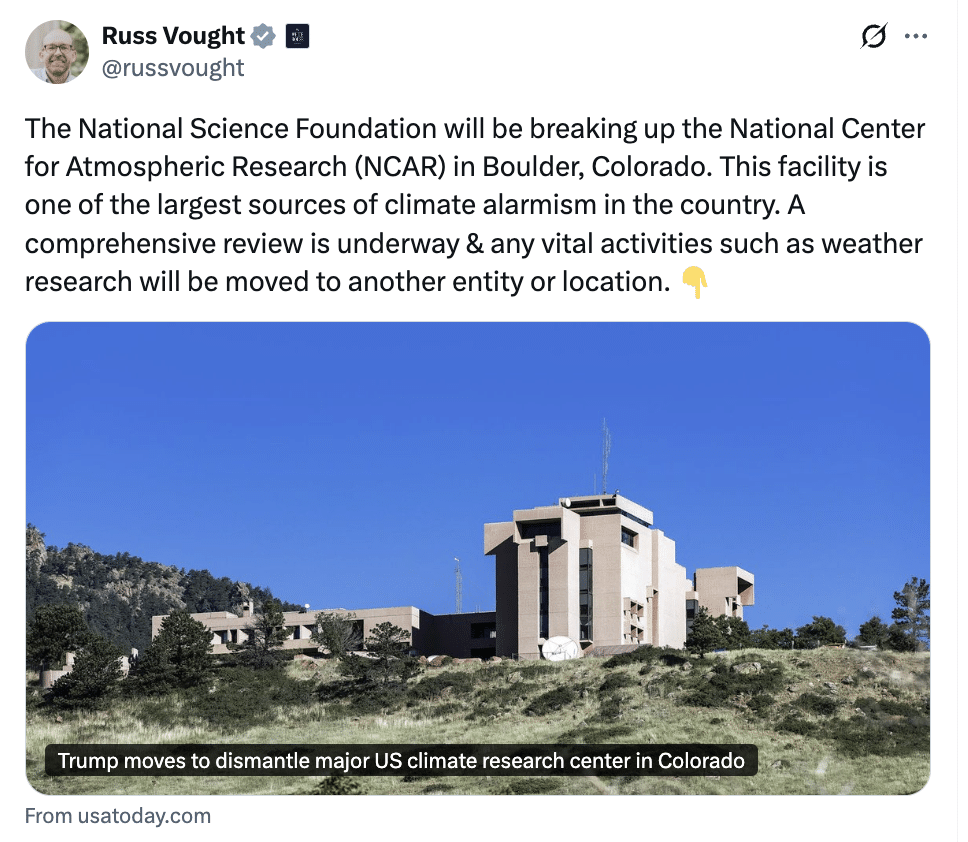
One (very) simple example really resonated with me, at least. In a piece explaining the value of NCAR to Americans in advance of Trump’s assault on it, It’s just a list of eight things that are not (as Russ Vought targeted) “climate alarmism.”
In accessibly wonky terms, it translates some of the things NCAR does — like making flights safer — into things people care about.
As a child, I remember hearing news stories about commercial airplanes crashing due to wind shear. Microbursts, which are localized downburst of sinking air associated with thunderstorms, were often the culprit. The Low-Level Wind Shear Alert System developed by NCAR researchers has helped to virtually eliminate microburst-related wind shear crashes. Such advances, along with Terminal Doppler Radar, are examples of the R&D machine at work for our benefit even as you may not realize it as your plane takes off or lands safely. Additionally, many of the computer algorithms used to alert pilots and airline managers about turbulence were developed at NCAR. Likewise, NCAR’s aircraft icing products have been a staple in the aviation industry and distributed by NOAA’s Aviation Weather Center.
Regular fliers are already outraged by the continued enshittification of air travel, including Crash Sean Duffy’s reversal of consumer protection rules imposed by Pete Buttigieg.
Here’s one aspect, turbulence, that Trump is actively planning to make worse.
Again, I think all of these are really good stories. I’m just looking ahead — not to elections, or even to what Khan will do as a key aide to the Mayor of New York — but to ways we can better tell stories about what Trump took away, about what Trump stole from the American people, so we can hold him accountable.