Posts

MAGAts Outraged Comey Indictment Dismissed on Same “Technicality” Trump’s Was!

In the wake of Judge Cameron Currie’s order dismissing the Jim Comey and Letitia James’ indictments, right wing Trump supporters have contorted themselves into knots trying to claim that Comey and James got special treatment, rather than simply the application of clear precedent to their case.

A technicality!!!!!!

The funniest wail from these MAGAts is their claim that Comey and James only got off on a “technicality,” so we can go ahead and consider them guilty.

In point of fact, Comey pointed out in a filing last week that the Loaner AUSAs have yet to point to any instance that fits the terms of their claimed alleged lie.

Here, the government has repeatedly failed to provide a coherent factual basis for its theory that Mr. Comey authorized Mr. Richman to be an “anonymous source” in news reports regarding the Midyear Exam investigation while Mr. Richman was “at the FBI.” Of the communications following Mr. Comey’s October 28, 2016 letter that the government cites in both briefs, none reflect Mr. Comey authorizing Mr. Richman to be an anonymous source. For instance, the communications show Mr. Richman discussed materials that were already public, like Mr. Comey’s letter to Congress. See, e.g., Opp. at 3 (“Wittes and I are spending a lot of time saying your letter means exactly, and only what it says.” (emphasis added)); id. at 3-4 (quoting the defendant as telling Mr. Richman that Richman’s contributing to a New York Times Opinion piece “would [be] shouting into the wind,” and “that they would ‘figure it out’” without Richman’s contributions). And even where the government alleges that Mr. Comey encouraged Mr. Richman to speak to the press in late October and early November 2016, there is no indication that Mr. Richman did so anonymously; to the contrary, one of the exhibits the government cites references Mr. Richman’s televised interview with Anderson Cooper. Opp. at 4 (citing ECF No. 138-6, 138- 7). The remaining communications cited by the government in its Opposition to Defendant’s Motion to Dismiss Indictment Based on Vindictive and Selective Prosecution suffer from numerous defects, but most critically, all occurred after February 7, 2017, when Mr. Richman left the FBI. This alone makes the government’s theory that Mr. Richman was “at the FBI” when these communications occurred incomprehensible.

And exhibits another Loaner AUSA submitted in the government’s response to James’ vindictive prosecution claim show that Lindsey the Insurance Lawyer was gaslighting Anna Bower when she was stalking her.

More astonishing, though, is that these indictments were dismissed on the very same “technicality” — that the prosecutor was unlawfully appointed — that Judge Aileen Cannon invoked to dismiss Trump’s far better substantiated stolen document case (though Cannon was a newbie judge departing from decades of precedent, while Currie is a senior judge simply following existing precedent).

Indeed, Judge Currie even cites Cannon’s opinion dismissing Trump’s indictment for the principle that everything had to be unwound.

In such a case, “the proper remedy is invalidation of the ultra vires action[s]” taken by the actor. United States v. Trump, 740 F. Supp. 3d 1245, 1302 (S.D. Fla. 2024). “Invalidation ‘follows directly from the government actor’s lack of authority to take the challenged action in the first place. That is, winning the merits of the constitutional challenge is enough.’” Id. (quoting Consumer Fin. Prot. Bureau v. All Am. Check Cashing, Inc., 33 F.4th 218, 241 (5th Cir. 2022) (Jones, J., concurring)).

To make things more awkward, in the hearing on this, Judge Currie asked Pam Bondi’s Counselor, Henry Whitaker, about that precedent and he partly disavowed it, and in doing so, noted that Bondi had other means she could have put Lindsey the Insurance Lawyer in place to indict Comey and James, means she did not take.

THE COURT: Mr. Whitaker, let me ask you one last question. Do you believe that U.S. v. Trump, decided by Judge Cannon, in, I believe, 2021, was wrongly decided?

MR. WHITAKER: Well, I think it’s certainly not controlling here, Your Honor, because in United States v. Trump, Judge Cannon held that various statutes that existed, some of which I’ve cited here today, did not authorize the appointment of a special counsel. But here, in a very important distinction between this case and Trump, is that we have available to us a number of statutes that the United States did not have available in making those arguments. For example, you know, you couldn’t have appointed Jack Smith as an AUSA under 542. I mean, we could have — we certainly could have done that with Ms. Halligan. You couldn’t have appointed Jack Smith as an assistant to a United States attorney under 543. We certainly could have done that with regard to Ms. Halligan.

But, I mean, look, to the extent that — and I do think that mostly what was driving Judge Cannon’s decision in that case was sort of the unique and broad authority that the special counsel possessed sort of free of supervision, which, of course, is an element that we do not have here. But I will say this: Like, look, to the extent you can read Judge Cannon’s decision as suggesting that the Department of Justice does not have authority under, for example, 28 U.S.C. Section 510 to appoint Main Justice attorneys, which would basically knock out most of the Department of Justice as it existed for the past, like, 50 years, yes, we certainly do disagree with that, and we agree that the attorney general has full authority to make appointments under statutes like 28 U.S.C. Section 510 and 509, and that source of authority would fully support Ms. Halligan being an authorized attorney to the government even though there may have been a paperwork error, a citation error in her appointment order.

A Clinton appointee swooping in to steal the case

Which brings us to the second complaint: that it was somehow improper for Currie, a Clinton appointed senior judge from South Carolina, to swoop into EDVA and end the case.

But that is precisely the process used in the three other districts where judges have ruled similar interim appointments unlawful, with a fourth (also involving Tish James) still in process.

When Julien Giraud, father and son, and Cesar Humberto Pino challenged Alina Habba the Parking Garage Lawyer’s involvement in their cases, the Chief Judge from the Third Circuit appointed an out of District judge to preside, Matthew Brann, a Republican appointed by Obama.

Shortly thereafter, the Honorable Michael A. Chagares, Chief Judge of the United States Court of Appeals for the Third Circuit, designated me for service in the District of New Jersey pursuant to 28 U.S.C. § 292(b) and reassigned this matter “and all related cases” to me.36

When a bunch of defendants in Nevada challenged Sigal Chattah the election denier lawyer’s involvement in their cases, the Chief Judge from the Ninth Circuit appointed an out of District judge to preside, David Campbell, a George W Bush appointee.

The Nevada District Court Judges recused from hearing these motions to dismiss, presumably because the motions implicate their own power to appoint an Acting U.S. Attorney. See 28 U.S.C. § 546(d). Exercising her authority under 28 U.S.C. § 292(b), Ninth Circuit Chief Judge Mary Murguia designated the undersigned judge to hear and decide these motions. Doc. 21.

When some Los Angeles defendants challenged liar for ICE goons Bill Essayli’s involvement in their cases, the Chief Judge from the Ninth Circuit appointed a different out of District judge, Michael Seabright, another George W Bush appointee, to preside over their challenges.

ORDER (U.S.C. § 292(b)) by Chief Circuit Judge Mary H. Murguia as to Defendant Jaime Hector Ramirez: Pursuant to 28 U.S.C. § 292(b), I hereby designate the Honorable Michael Seabright, United States Senior District Judge for the District of Hawaii, to temporarily perform the duties of United States District Judge on an as-needed basis for the Central District of California beginning on 9/8/2025, and ending on 12/31/2025, and for such additional time required in advance to prepare or thereafter to complete unfinished business.

And when Letitia James challenged subpoenas issued by John Sarcone after he falsely claimed NDNY judges had named him as US Attorney, the Chief Judge from the Second Circuit appointed an out of District judge to preside over that challenge, Lorna Schofield, another Obama appointee.

Of note, all these challenges to Pam Bondi’s playacting US Attorneys had started before Bondi installed Lindsey the Insurance Lawyer on September 22, and Judge Brann had already ruled Alina Habba’s appointment to be unlawful.

Bondi was on notice that what she was doing with Lindsey the Insurance Lawyer was going to be challenged and had been successfully challenged. And she didn’t even attempt any of the gimmicks she is using elsewhere to keep Trump hacks in place, those means cited by her own Counselor in court — in part because she couldn’t. She had already used one of those tricks, installing Maggie Cleary as First AUSA, when Trump insisted it had to be Lindsey the Insurance Lawyer.

These cases might have been dismissed on other grounds. But the unlawful appointment dismissals are entirely of Bondi’s doing.

Stop blaming judges appointed by whichever President when Bondi is 100% to blame.

The Blue Slip gaslight special

Finally, there are even right wing dumbasses claiming that this is about Blue Slips, the Senate tradition that US Attorneys and Judges must have the support of both Senators before being confirmed.

To be fair, Todd Blanche did go on Fox News and falsely claim that is what this is about.

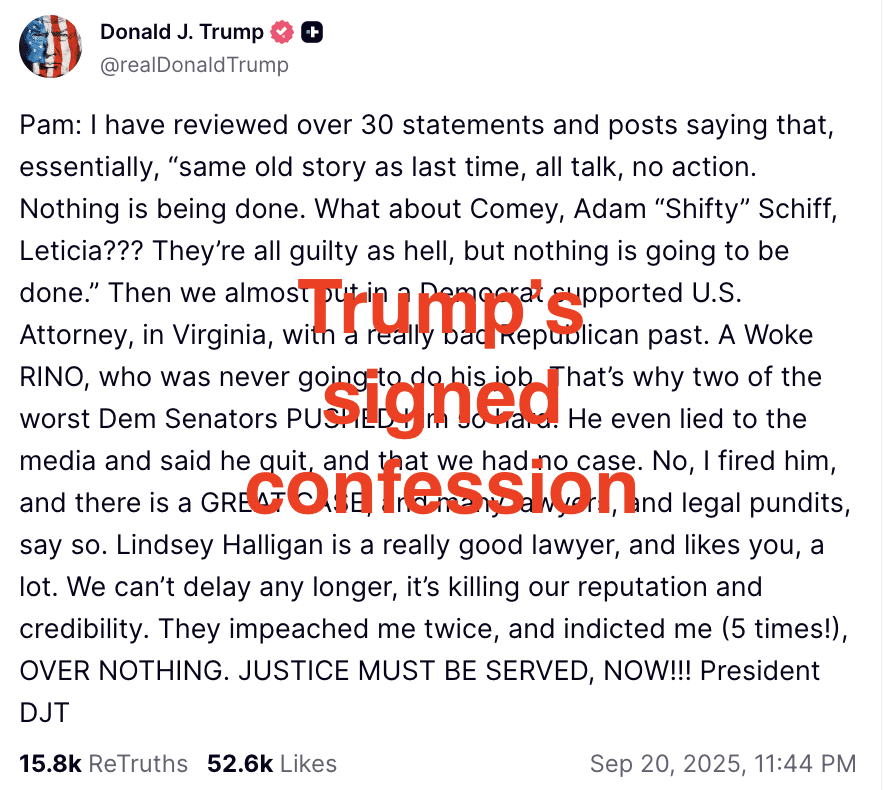
The way you know Blanche is lying is because Trump told us himself, when he ordered Bondi to install Halligan.

“[W]e almost put in a Democrat [sic] supported U.S. Attorney, in Virginia, with a really bad Republican past. A Woke RINO, who was never going to do his job.”

What he’s talking about is that Trump himself nominated Siebert with the support of both Mark Warner and Tim Kaine.

Siebert was someone everyone agreed on — Trump installed him, EDVA’s judges reinstalled him, Trump nominated him — until Siebert concluded, apparently with Blanche’s concurrence, that there was not probable cause to indict Jim Comey.

All this whining is nothing other than cope.

If you complain that Democrats aren’t supporting qualified nominees, you should be outraged that Trump pulled Siebert.

If you complain that unconflicted judges decide these issues, you’ve got one.

If you really had a problem with appointments clause dismissals, you should be demanding that Trump stand trial for stealing nuclear documents and stashing them in a bathroom.

But what you shouldn’t do is blame anyone other than the person responsible, Attorney General Pam Bondi.

Share this entry

Buh Bye Lindsey!

Judge Cameron Currie has issued her ruling in Jim Comey and Letitia James’ efforts to disqualify Lindsey Halligan as unlawfully appointed.

In both cases, she dismissed the indictments without prejudice.

On September 25, 2025, Lindsey Halligan, a former White House aide with no prior prosecutorial experience, appeared before a federal grand jury in the Eastern District of Virginia. Having been appointed Interim U.S. Attorney by the Attorney General just days before, Ms. Halligan secured a two-count indictment charging former FBI Director James B. Comey, Jr. with making false statements to Congress and obstructing a congressional proceeding.

Mr. Comey now moves to dismiss the indictment on the ground that Ms. Halligan, the sole prosecutor who presented the case to the grand jury, was unlawfully appointed in violation of 28 U.S.C. § 546 and the Constitution’s Appointments Clause. As explained below, I agree with Mr. Comey that the Attorney General’s attempt to install Ms. Halligan as Interim U.S. Attorney for the Eastern District of Virginia was invalid. And because Ms. Halligan had no lawful authority to present the indictment, I will grant Mr. Comey’s motion and dismiss the indictment without prejudice.

But she also ruled that the judges in EDVA will choose the US Attorney until such time as Trump can get one confirmed by the Senate, which might, in theory, lead Erik Siebert to be reinstated.

The power to appoint an interim U.S. Attorney for the Eastern District of Virginia pursuant to 28 U.S.C. § 546 during the current vacancy lies with the district court until a U.S. Attorney is nominated by the President and confirmed by the Senate under 28 U.S.C. § 541.

This decision will be appealed. And given that Currie stopped short of dismissing the indictment with prejudice, it may not moot Comey’s other challenges to his indictment (or James’, which are not yet fully briefed).

Update: This language seems to prohibit Bondi from trying to reindict Comey again, but does not moot his other legal challenges.

The Government also fails to meet the second requirement for a valid ratification, i.e., that the principal must have been able “to do the act ratified . . . at the time the ratification was made.” FEC v. NRA Pol. Victory Fund, 513 U.S. 88, 98 (1994) (emphasis in original) (internal quotation marks omitted). In NRA Political Victory Fund, the Supreme Court rejected the Solicitor General’s attempt to ratify the filing of an unauthorized petition for certiorari when the attempted ratification occurred after the filing deadline had already passed. Id. at 98. Similarly here, the Attorney General’s attempt to ratify Mr. Comey’s indictment on October 31 “came too late in the day to be effective,” as the statute of limitations for the charged offenses expired 31 days earlier on September 30.21 Id.

21 Generally, “[t]he return of an indictment tolls the statute of limitations on the charges contained in the indictment.” United States v. Ojedokun, 16 F.4th 1091, 1109 (4th Cir. 2021). “An invalid indictment,” however, “cannot serve to block the door of limitations as it swings closed.” United States v. Crysopt Corp., 781 F. Supp. 375, 378 (D. Md. 1991) (emphasis in original); see also United States v. Gillespie, 666 F. Supp. 1137, 1141 (N.D. Ill. 1987) (“[A] valid indictment insulates from statute-of-limitations problems any refiling of the same charges during the pendency of that valid indictment (that is, the superseding of a valid indictment). But if the earlier indictment is void, there is no legitimate peg on which to hang such a judicial limitations-tolling result.” (emphasis in original)).

Update: Comey has posted a video. And James posted this statement:

I am heartened by today’s victory and grateful for the prayers and support I have received from around the country.

I remain fearless in the face of these baseless charges as I continue fighting for New Yorkers every single day.

Share this entry

Blind Man’s Bluff in the Jim Comey Docket

Threshold issues

The very last thing Judge Michael Nachmanoff asked Michael Dreeben in Wednesday’s hearing on Jim Comey’s bid to throw out his indictment for vindictive prosecution, before turning to prosecutors’ argument, was whether he should wait and address all of Comey’s challenges at once or deal with vindictive prosecution on its own.

THE COURT: All right. Thank you. But before you sit down, let me just ask you, do you think that the other pending motions, including the issue of literal truth and ambiguity and the other matters that are yet to be litigated, are so wrapped up in vindictive prosecution that the Court should deal with them all at one time, or do you think that the Court can and should deal with vindictive prosecution separately?

MR. DREEBEN: I think vindictive prosecution, like our motion based on the appointment of the U.S. attorney, are threshold matters that the Court should resolve as a threshold. Mr. Comey would like to see both of those motions resolved because they both go to the very heart of whether a prosecution in this case is permissible, one by virtue of a challenge to the official who brought it, the other by virtue of whether it complies with the Constitution to bring a prosecution at all.

Our other motions are very important, and we have a series of them that challenge other aspects of the prosecution. As I’m sure the Court is well aware, there are issues relating to the conduct of the prosecutor in the grand jury. But this one and the appointments issue stand at the threshold. They’re the gateway to all further motions, and those should be resolved at the outset of the case, in our view.

Dreeben, calling vindictive prosecution and disqualification (which Judge Cameron Currie had heard the week before) “threshold” matters, said they should be decided at the outset.

That may explain Nachmanoff’s decision at the very end of the hearing to deny Jessica Carmichael’s request to move up the next motions hearing — the one that would address the other issues Nachmanoff asked Dreeben about — from December 9, what would be almost three weeks (including the Thanksgiving holiday) from that day, to the prior week.

There’s also a motion to move up the next oral argument, which is set on December 9th. I commend everyone’s enthusiasm for trying to move this even faster, but the Court is reluctant to do that. I believe that it was Ms. Carmichael that had a conflict, and I will permit counsel to appear without Ms. Carmichael, who’s local counsel, so that she doesn’t have that issue, but I will keep the current schedule that we have.

If Nachmanoff does treat the vindictive prosecution challenge as a threshold issue, then he may hope to rule before holding another hearing. If Nachmanoff were to rule for Comey on vindictive prosecution (or Currie were to disqualify Lindsey Halligan, as is likely), the December hearing might be delayed anyway during an appeal, possibly all the way to SCOTUS.

It’s worth noting that Comey’s appellate lawyers — Ephraim McDowell in the disqualification hearing and Dreeben in the vindictive prosecution one — argued these District level motions hearings. As I noted when they were added, Comey walked into these challenges preparing to fight this all the way to SCOTUS.

The Comey prosecution may go away, pending appeal, in less than 20 days, via one of at least two ways. Indeed, given Judge Currie’s promise to rule before Thanksgiving, it could go away in the next week (again, pending appeal).

I lay that out as a way to understand some other things that have happened since Nachmanoff’s hearing.

The drama

But first, the drama, which started shortly after Dreeben answered that question about threshold issues.

Loaner AUSA Tyler Lemons had barely started his argument when Nachmanoff questioned the prosecutor’s claim that the grand jury, “returned a true bill.”

THE COURT: Well, we’ll have some questions about that —

MR. LEMONS: That’s correct, Your Honor.

THE COURT: — but I’ll let you get through your argument.

Shortly thereafter, Nachmanoff challenged Lemons’ claim that Comey was relying on, “newspaper articles, anonymous sources, innuendo, [and] conjecture.”

THE COURT: Well, let me stop you there. With regard to the words of the president, whether it’s the post from September 20th or his answers to questions from reporters, you’re not suggesting that those aren’t things the president has said, are you?

Immediately before the drama of the declination memo, Nachmanoff bristled at Lemons’ insinuation that Erik Siebert, whom — the EDVA judge noted — had been appointed as US Attorney by the judges of EDVA, was involved in “machinations.”

MR. LEMONS: Absolutely, Your Honor. What I’m referring to is the newspaper reports that are relying on anonymous sources as to the machinations of former U.S. Attorney Siebert or to other decisions that essentially are not directly quoting the president or someone else.

THE COURT: Well, let me stop you there.

MR. LEMONS: Yes, sir.

THE COURT: I’m not sure what machinations you’re referring to. Are you referring to the fact that Mr. Siebert was the interim U.S. attorney and then appointed by the Court, and then either resigned on September 19th or was fired by the president on September 19th?

MR. LEMONS: Yes, Your Honor. And I guess more specifically referring to any sort of — across, it sounds like multiple cases, not just this case — any reluctance or willingness to pursue cases in this Court.

That’s when Nachmanoff spent several minutes slowly cornering Lemons into admitting, in spite of direction from Todd Blanche’s office to avoid doing so, that he did not just know of a declination memo, but had read it.

THE COURT: Well, was there a declination memo?

“Was there a declination memo?” was question one. Questions ten and eleven in the colloquy, which also included Nachmanoff reminding Lemons he was “counsel of record in this case” and then getting him to explain that Todd Blanche’s office had instructed him to dodge these questions, went this way:

THE COURT: And had one been prepared?

MR. LEMONS: My understanding is that a draft prosecution memo had been prepared.

THE COURT: All right. And did you review that?

MR. LEMONS: I — yes, Your Honor, I did.

That still wasn’t the most dramatic part of the hearing, of course.

Lemons finished his argument, and then Nachmanoff returned to that question, the grand jury presentment. From the start, he mentioned it would be useful to hear from Lindsey, but he did allow Lemons to explain what he thought had happened, first.

THE COURT: Well, I have a couple more questions before you sit down.

MR. LEMONS: Okay.

THE COURT: At the beginning of your remarks, you said that the grand jury had returned an indictment and there’s a presumption of regularity with what happened, but as we know from other litigation in this case, there have been some questions and some attempts to resolve those issues, and Ms. Halligan submitted a declaration on Friday that explained, in part, in response to the question from Judge Currie about what happened after the grand jury began to deliberate, and then what went on —

MR. LEMONS: Yes, Your Honor.

THE COURT: — after that. And I’ll ask you these questions, but it may be more direct to ask Ms. Halligan directly.

In spite of noting that it might be easier if Lindsey explained all this, Nachmanoff let Lemons explain what he understood had happened at length, including that the EDVA grand jury coordinator had had direct communications with the foreperson.

The judge asked Lemons the question about whether the full grand jury had voted on what he referred to as the second indictment three times, which is when he finally invited Lindsey to speak, as counsel of record. She barely said good morning before she interrupted the judge.

THE COURT: And so that the record is clear, when the grand jury return was taken, only the foreperson was in the courtroom, correct, the rest of the grand jurors were not present; is that right?

MR. LEMONS: Can I have a moment, Your Honor?

THE COURT: You can. Ms. Halligan, you can come to the podium. You’re counsel of record. You can address the Court. It might be easier. Good morning.

MS. HALLIGAN: Good morning.

THE COURT: So am I correct that, as is the usual —

MS. HALLIGAN: No, Your Honor.

THE COURT: — practice, that the grand jurors were not present, just the foreperson?

MS. HALLIGAN: The foreperson and another grand juror was also present, and Judge Vaala corrected the record in open court, and the foreperson said in open court, We only no true billed Count One, we want to true bill Count Two and Three, and the foreperson signed that indictment.

THE COURT: I’m familiar with the transcript.

MS. HALLIGAN: Okay.

THE COURT: But I just wanted to make sure that the entire grand jury never had the opportunity to see the second indictment. You may sit down. Thank you.

The government, of course, has now refuted this account, thinking it helps them to claim that Halligan (and Lemons) stood before the judge and misinformed him, all because a confused foreperson said that the entire grand jury had voted for the two-count indictment, which served primarily to corrode any presumption of regularity DOJ is afforded.

From the start (and so when he asked whether he should wait on the other challenges), Nachmanoff had at least those two questions, the grand jury and the declination memo, in mind, and also, probably, how Lindsey could have assessed the case in the three days before indicting.

THE COURT: Well, that’s why I was asking you the questions about the declination memo and the prosecution memo, because she was appointed on September 22nd, and she went into the grand jury on the 25th, and I believe what you’re saying is that she made an independent evaluation of the case and concluded to move forward with it in that time period, in those couple of days. And so my question is, what independent evaluation could she have done in that time period?

MR. LEMONS: Your Honor, I think that — that discussion is inevitably one that we would have if you order expanded discovery.

Michael Dreeben, in rebuttal, asserted that the irregularity with the indictment was obtained is yet another cause to dismiss the indictment, and asserted that Nachmanoff didn’t need to see what the declination memo said to dismiss it.

Nachmanoff closed the hearing not just by denying Carmichael’s request to advance the next motions hearing, but by ordering both parties to brief a case.

I have some housekeeping matters to address. I would like, especially in light of our argument today, both parties to address the case of Gaither v. United States, 413 F.2d 1061 (D.C. Cir. 1969), and it addresses this issue regarding the foreperson signing an indictment. And I know you have your objections due at 5:00 p.m. today, so I wanted to make sure the government was aware of the Court’s interest in addressing that case, and, of course, the defense can address it in turn when they file their response.

The oddities of a three-judge docket

Now, I’m going through this exercise not to share the drama from the transcript, much of which got covered in real time, but because I want to understand how the hearing on Wednesday — particularly Lindsey’s confession about the grand jury — jumbled what would have happened and will happen in the brief window before December 9, when some or all of this might be launched on its way to appeal, possibly all the way to SCOTUS.

Here’s what happened and will happen in the week since the hearing; I’ve color-coded response chains:

November 19: Vindictive prosecution hearing before Michael Nachmanoff; Nachmanoff denies motions schedule change, orders CIPA schedule, orders briefing on Gaither

November 19: Government objection to Fitzpatrick order giving Comey grand jury transcripts, writing up interactions between grand jury coordinator and grand jury foreperson and seemingly confirming that court reporter left after rest of grand jury left

November 19: Government brief on Gaither (responding to Nachmanoff’s order)

November 19: Insanely stupid Lindsey Halligan interview with NYPost misrepresenting record and attacking Judge Nachmanoff

November 20: Comey Reply on fundamental ambiguity

November 20: Comey Reply on Bill of Particulars (including exhibits on discovery, kicking off graymail)

November 20: Government notice “correcting” record, including return transcript

Later November 20: Comey Reply on his motion for grand jury materials

November 21: Consent motion to set CIPA hearing on December 9 instead of filing CIPA 5

November 21: Comey Response to government objection to Fitzpatrick order

November 21: Motion to dismiss because there is no indictment

November 21: Amended motion to dismiss because there is no indictment

November 24: Comey requested response date on MTD no indictment

November 26: Expected Cameron Currie ruling on disqualification

November 26: Comey motion to suppress due

Start from the end: with a motion to dismiss because there is no indictment, which Comey almost immediately amended. As the citations page makes clear, this is substantially Comey’s response to Nachmanoff’s request for briefing on Gaither.

As Comey explains in a footnote, rather than just responding to Gaither, he’s using belated disclosures — from the discovery about the Fourth Amendment and attorney-client violations, from William Fitzpatrick’s opinion on the grand jury transcript, and regarding the failure to present the second indictment — to submit a separate motion to dismiss to be considered along with the other ones.

Mr. Comey respectfully submits that the Court can and should consider this motion along with Mr. Comey’s other dispositive motions. ECF Nos. 59 [vindictive], 60 [disqualification], 105 [fundamental ambiguity]. Those motions are fully briefed, and the government has filed its notice concerning Gaither v. United States, 413 F.2d 1061 (D.C. Cir. 1969). See ECF No. 201. The defense requests that the Court direct the government to file its response to this Motion—if any—by November 24, 2025.

He is effectively attempting to squish this motion to dismiss into the window when Nachmanoff will be deciding the vindictive prosecution motion and Judge Cameron Currie will be deciding the disqualification motion, with the unrealistic request that the government have to respond over the weekend to also squish it into that same window.

Dreeben did say he was going to file another motion to dismiss and Nachmanoff did not object, but he’s trying to squish that motion into this window when the judges are deliberating.

The new motion to dismiss overlaps in significant part with two other filings submitted since the hearing: Comey’s reply on his request to get grand jury transcripts, and Comey’s response to the government’s objection to William Fitzpatrick’s order that he get those transcripts.

In his reply, Comey explains how all of these documents fit together.

1 The absence of a valid charging instrument will be the basis of a forthcoming motion to dismiss [that is, the Gaithner briefing as motion to dismiss].

2 As the Court is aware, Mr. Comey will file his response to the government’s appeal of Magistrate Judge Fitzpatrick’s order for the government to disclose the grand jury proceedings on Friday, November 21, 2025. This reply brief responds to the government’s arguments in opposition to the motion (ECF No. 184) to disclose the grand jury proceedings and highlights additional irregularities that have surfaced further warranting disclosure. Mr. Comey’s response to the government’s appeal of Magistrate Judge Fitzpatrick’s order will explain why Judge Fitzpatrick’s ruling is well supported by fact and law warranting affirmance and address the government’s opposition to that ruling. These litigation streams present two related, but separate, avenues to order the government to produce the grand jury proceedings.

And the seeming cause for amendment to the motion to dismiss — a replacement of one claim about how Lindsey Halligan integrated privileged material in the grand jury…

Ms. Halligan referred to those materials in her presentation to the grand jury and elicited extensive testimony about privileged materials from Agent-3. ECF No. 192 at 14.

With another…

In turn, Ms. Halligan extensively questioned Agent-3 about communications between Mr. Comey and Mr. Richman during Agent-3’s testimony before the grand jury. ECF No. 192 at 14.

… reveals one of the things going on. In all three documents, Comey aggressively accuses the government of purposely seeking out privileged material in advance of the presentment.

Agents knowingly reviewed and printed out dozens of pages of privileged communications between Mr. Comey and his lawyers and appear to have presented at least certain of those privileged communications to the grand jury in this matter.

Thus the delicate balance Comey tried to correct with the amendment: they’re pretty sure Miles Starr did not just present tainted testimony, but that Lindsey cued him with tainted questions, but that overstates what they can say without seeing the grand jury transcript.

Both those sentences must rely on this passage of Fitzpatrick’s opinion (they cite the unredacted version rather than this one; the redacted discussion starts on the next page).

The government’s position is that the grand jury materials “confirm the baselessness of the defendant’s claim that privileged information may have been shared with the grand jury.” ECF 172. While it is true that the undersigned did not immediately recognize any overtly privileged communications, it is equally true that the materials seized from the Richman Warrants were the cornerstone of the government’s grand jury presentation. The government substantially relied on statements involving Mr. Comey and Mr. Richman in support of its proposed indictment. Agent3 referred to these statements in response to multiple questions from the prosecutor and from grand jurors and did so shortly after being given a limited overview of privileged communications between the same parties. The government’s position that privileged materials were not directly shared with the grand jurors ignores the equally unacceptable prospect that privileged materials [page break] were used to shape the government’s presentation and therefore improperly inform the grand juror’s deliberations.

Both sides are working at a disadvantage in this argument. The government complained that it couldn’t see what Comey shared in ex parte submission to Fitzpatrick (and, generally, complained that it hadn’t been able to get its filter protocol).

2 Although the docket indicates the government provided the materials for in camera review, Dkt. No. 179, the docket does not reflect that defendant submitted ex parte information to the Magistrate Judge. However, the magistrate judge referenced the defendant’s ex parte notice in its opinion. See Dkt. 191 at 7.

In his response, Comey described some of what was included in that.

Pursuant to Judge Fitzpatrick’s order during the hearing, the defense filed an ex parte sealed submission to guide Judge Fitzpatrick’s review, which was supplemented with evidence that the government had produced to the defendant, such as the privileged communications the government’s agents printed out and used in September 2025 after their warrantless search of the materials seized from Daniel Richman.

[snip]

Mr. Comey plainly had an expectation of privacy in his communications with his lawyer, which was clear from the face of the communications the government agents reviewed and printed in September 2025, ECF No. 172-2 at 2,2 as set forth in the ex parte submission the defense submitted to Judge Fitzpatrick.

But unlike the government, Comey doesn’t know precisely what was said about the Richman texts to the grand jury, in particular whether Halligan’s promise of more evidence — a reference the government did no more than to confirm in its response by saying, “the government anticipated presenting additional evidence were the case to proceed to trial” — pertains specifically to the Comey side of the Richman texts.

Plus, both seem to be trying to hold their fire. Perhaps Comey is waiting on the motion to suppress — which may be held in abeyance if Judge Currie rules for him. Surely, he is guarding his privilege claim.

And, after admonishments from Fitzpatrick, the Loaner AUSAs dropped their reliance on the Richman texts in their Bill of Particulars response, so they’re probably trying to avoid knowing Fourth Amendment violations.

So neither will say what I keep saying: On the morning before the grand jury presentment, Spenser Warren provided others with a two page printout of Richman texts, all of which preceded the moment when the FBI knew Comey had retained Richman. But someone went back into that unscoped material they knew to include privileged texts and printed out at least eight pages of texts, going well beyond the time Comey had retained Richman.

And whatever the reason for the reticence on both sides, unless you are misrepresenting the questions at issue (and remember, there is no transcript of the exchange Comey had with Ted Cruz included among the 14 exhibits that appear to have been presented to the grand jury), there is no sound reason to present any of these texts. None could be proof that Comey had authorized Richman to share this information while at FBI, because Richman had left months earlier. None could be proof that Comey lied to Chuck Grassley on May 3, 2017 about serving as a source for stories on the Russian investigation (which Grassley called the Trump investigation), because they all postdated Grassley’s question. None could be proof that Comey intended to obscure all this in September 2020, because he had already told Susan Collins about all of this on June 8, 2017. Contrary to what Loaner AUSAs claimed in their urgent bill for a filter protocol (authored by James Hayes), nothing in the public record supports a claim that Comey and Richman (and Patrick Fitzgerald) were conspiring to leak classified information.

The only crime Comey committed was exposing Donald Trump’s corruption, which led to a Special Counsel investigation that showed abundant evidence Trump obstructed the investigation into his ties with Russia.

But in his effort to mislead a grand jury to believe that was a crime, Miles Starr may have knowingly and unlawfully surveilled attorney-client communications without a warrant much less a filter protocol.

As of now, Nachmanoff has not ruled on either parallel request to grant Comey grand jury access (he said he would rule on the filings, without a hearing), though a footnote to the motion to dismiss, “reserves the right to supplement this Motion with further facts and argument if and when the grand jury materials are disclosed to the defense.” So unless and until he does, the record will remain what it is, with vague gestures from both sides about a conflict at the heart of this case, potentially excluded from the record if this thing gets appealed.

When caught lying, troll

Meanwhile, of course, Lindsey Halligan is already resorting to the tactics she learned from her boss, falsely misrepresenting a question Nachmanoff posed about Dreeben’s belief, laid out in Comey’s reply to prosecutors’ arguments about imputation (which I laid out here)…

MR. DREEBEN: That is certainly correct, and that is an additional obstacle that supported the court’s factual conclusion that imputation was not appropriate on the facts of the case. But we, of course, have a very different situation. In the hierarchy, the president stands at the top, and he has declared himself to be the chief law enforcement officer of the United States. He has vested in him executive power, which includes supervision of the Department of Justice. The U.S. attorneys help him carry out his responsibility to see that the laws are faithfully executed, and as we argued in the brief, that is not just a theoretical constitutional structural argument; it is actually an argument that applies to the facts of this case because the president has taken on the responsibility and the authority to direct the Justice Department to take actions in the investigatory and prosecutorial realm that he thinks should be taken, and he has, in effect, substituted himself for the U.S. attorney as the decision-maker, and the facts of this case reveal that that’s why his vindictive motive is imputed to the prosecution. No, he didn’t go into the grand jury, but exercising the authority that’s vested in him, he brought about the prosecution through the chain of causation that we described earlier.

THE COURT: So your view is that Ms. Halligan is a stalking horse or a puppet, for want of a better word, doing the president’s bidding?

MR. DREEBEN: Well, I don’t want to use language about Ms. Halligan that suggests anything other than she did what she was told to do. The president of the United States has the authority to direct prosecutions. She worked in the White House. She was surely aware of the president’s directive. She didn’t have prosecutorial experience, but she took on the job to come to the U.S. Attorney’s Office and carry out the president’s directive, and this was a directive to the attorney general. I think we know that the attorney general is highly responsive to the president’s directives. She doesn’t say, Excuse me, Mr. President, this is my job.

The makebelieve US Attorney for EDVA instead falsely claimed this was a direct expression of Nachmanoff’s own opinion.

Interim US Attorney Lindsey Halligan suggested Wednesday that the Biden-appointed judge overseeing the criminal case against former FBI Director James Comey violated judicial conduct rules by asking if she was a “puppet” of President Trump.

District Judge Michael Nachmanoff asked Comey’s defense lawyer if he thought Halligan, the prosecutor who brought the indictment against the former FBI boss, was acting as a “puppet” or “stalking horse” of the commander in chief, during a hearing in an Alexandria, Va., courtroom.

“Personal attacks — like Judge Nachmanoff referring to me as a ‘puppet’ — don’t change the facts or the law,” Halligan exclusively told The Post.

“The Judicial Canons require judges to be ‘patient, dignified, respectful, and courteous to litigants, jurors, witnesses, lawyers, and others with whom the judge deals in an official capacity’ … and to ‘act at all times in a manner that promotes public confidence in the integrity and impartiality of the judiciary,’” she continued.

Lindsey’s attack in the NYP was similar to the one prosecutors made in their response to Fitzpatrick’s order (which Comey addressed in response).

Federal courts have an affirmative obligation to ensure that judicial findings accurately reflect the evidence. Canon 2(A) of the Code of Conduct for United States Judges requires every judge to “act at all times in a manner that promotes public confidence in the integrity and mpartiality of the judiciary” and to avoid orders that “misstate or distort the record.” Canon 3(A)(4) requires courts to ensure that factual determinations are based on the actual record, not assumptions or misrepresentations. Measured against these obligations and the rule of law, the magistrate’s reading of the transcript cannot stand.

They’re trolling.

They’re doing precisely what Trump always does when caught in a crime: he trolls and attacks rule of law.

Share this entry

Might Pam Bondi’s Latest Prosecutorial Abuse Give Us Ponies and Puppies?

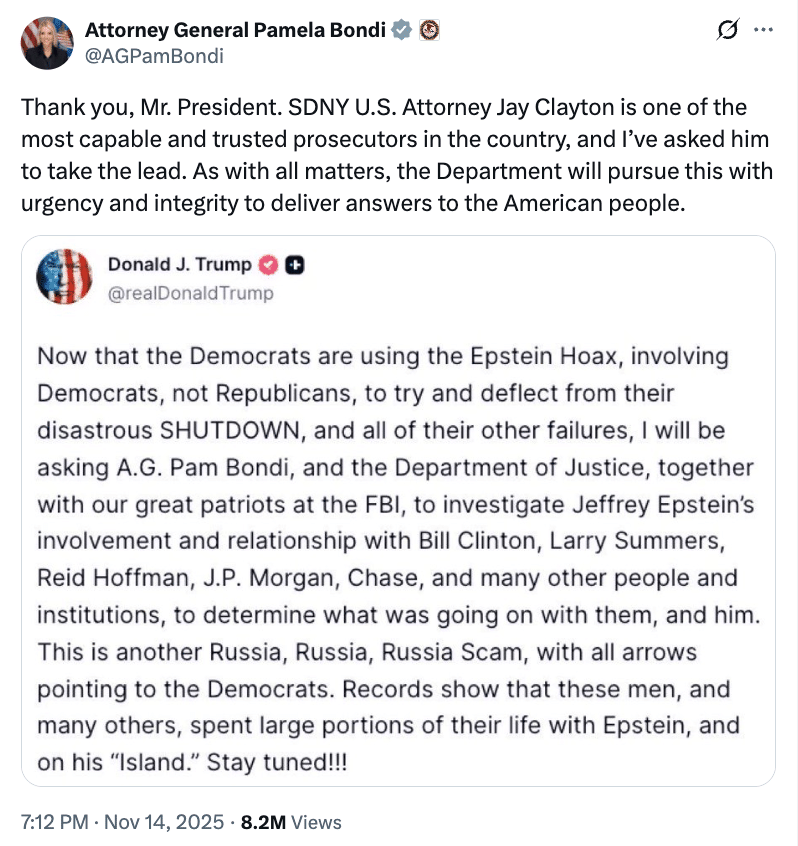
The media’s response to this exchange (remember, timezone reflects Irish time) between Donald Trump and Pam Bondi has been procedural.

At the NYT yesterday, for example, first Erica Green, Glenn Thrush, and Alan Feuer described it (competently) in procedural terms. It was a tired Trump strategy of projection, it might stall release of files to Congress, gosh it’ll make things hard for Jay Clayton. 30-some ¶¶ in, it briefly turned to politics, in the form of quotes from Robert Garcia (Ranking Member of Oversight) and Don Bacon. Tom Massie, Ro Khanna, and Marjorie Taylor Greene are not quoted, to say nothing of Epstein’s victims.

Then the NYT today turned to its SDNY reporters — Jonah Bromwich, Benjamin Weiser and William Rashbaum — to focus more closely on just how much trouble this could cause SDNY US Attorney Jay Clayton. That story mentions Maurene Comey’s firing in passing twice, but days ago, Bromwich and Rashbaum described how everyone in the New York Metro area dodged defending Ms. Comey’s wrongful termination lawsuit which, after some delay, NDNY, led by a corrupt Trump flunkie, will now take on.

Both stories make Trump the agent of the narrative. He made an order and as Bondi executes it, this is what will happen.

As I suggested in this video, I look at Bondi’s public haste to bow to Trump’s demands differently.

Pam Bondi doubled down on ratifying Lindsey Halligan’s indictment of Jim Comey, after having been caught in failing to exercise the least due diligence the last time she tried to do so. One reason she did so, no doubt, is that DOJ literally told Judge Currie that the unlawful means Bondi used to turn Lindsey the Insurance Lawyer into US Attorney was a mere “paperwork error,” Pam Bondi’s fuck-up. And so, in an attempt to salvage the fuck-up DOJ is attributing to the Attorney General, she may have inserted herself into what appear to be serious Fourth Amendment violations, among other things.

And, that very same day, she publicly bowed to the President’s demand that she pursue clearly political prosecutions just months after DOJ had publicly issued an (unsigned) declination decision in the same investigation (after reportedly having shut down an ongoing investigation into Epstein co-conspirators, presumably led by Jim Comey’s daughter, months earlier).

Even in July, it was crystal clear that Pam Bondi kept making things worse.

Then Bondi made things worse when she told Fox News that Epstein’s client file was on her desk for review. She made things worse when she orchestrated the re-release of the already-released files to a select group of right wing propagandists, all packaged up to look special, a spectacle that stoked divisions among MAGAts but also raised concerns that she was covering stuff up. She made things still worse when — responding to James Comer’s role in making things worse, when he claimed the Epstein files had been disappeared — she said there were tens of thousands of videos involving Epstein.

By the end of that week, Todd Blanche would announce he’d spend some quiet time with Ghislaine Maxwell, which I imagine he thought was clever but has resulted in further questions, starting with why he’s not charging Maxwell for the lies she told to his face and why the sexual predator got a puppy.

Pam Bondi has been trying to make the Epstein problem she made worse go away. It hasn’t worked. Nothing has worked. All the pressure she and Blanche and Kash Patel could apply failed to force Lauren Boebert to make it go away. And having failed so far, she very publicly and very quickly agreed to do something stupid, reopen an investigation that she already said could not be pursued.

She did so the week before Judge Michael Nachmanoff (on Wednesday) will preside over Jim Comey’s vindictive and selective prosecution claim, which will be followed by Letitia James’ motion in a few weeks, assuming one or both of those prosecutions are not preempted by some other dismissal before then. (Comey Motion; DOJ Response; Comey Reply; James Motion; there are a slew of Amici filing in both)

In Comey’s reply, he responded to Lindsey Halligan and her Loaner AUSAs’ attempt to claim only Halligan’s motive can be scrutinized in this prosecutorial decision by citing one of the most troubling passages in the Supreme Court’s ruling in Trump v. USA:

Imputation of President Trump’s vindictive motive to Ms. Halligan is particularly warranted because the President has “exclusive authority over the investigative and prosecutorial functions of the Justice Department and its officials.” Trump v. United States, 603 U.S. 593, 621 (2024). As the government itself describes, U.S. Attorneys are subordinate aides to the President, “help[ing the President] discharge” his “responsibility” to prosecute crimes. ECF No. 138 at 17. And President Trump’s authority is not merely formal or abstract: he has exercised an unprecedented and extraordinary degree of control over the DOJ, installing his personal allies to key positions and inserting himself into prosecutorial decisions that, in previous Administrations, would have been left to the DOJ’s independent judgment. See ECF No. 59 at 8-11. [my emphasis]

That’s the language John Roberts used to excuse Trump’s efforts, via Jeffrey Clark, to use DOJ to steal the election.

The Government does not dispute that the indictment’s allegations regarding the Justice Department involve Trump’s use of official power. The allegations in fact plainly implicate Trump’s “conclusive and preclusive” authority. The Executive Branch has “exclusive authority and absolute discretion” to decide which crimes to investigate and prosecute, including with respect to allegations of election crime. Nixon, 418 U. S., at 693. And the President’s “management of the Executive Branch” requires him to have “unrestricted power to remove the most important of his subordinates”—such as the Attorney General—“in their most important duties.” Fitzgerald, 457 U. S., at 750. The indictment’s allegations that the requested investigations were shams or proposed for an improper purpose do not divest the President of exclusive authority over the investigative and prosecutorial functions of the Justice Department and its officials. Because the President cannot be prosecuted for conduct within his exclusive constitutional authority, Trump is absolutely immune from prosecution for the alleged conduct involving his discussions with Justice Department officials. Pp. 19–21.

Trump seemed to echo this license when asked about ordering Bondi to investigate Democrats on Friday.

Reporter: Do you believe a President should be able to order investigations?

Trump: Sure. I’m the chief law enforcement officer of the country. Not that I want to use that. But I am considered the chief law enforcement agent in the country. And I’m allowed to do it.

Effectively, Comey argued that because of the monstrosity Roberts created, his vindictive prosecution claim must be judged according to different rules. And then Trump just reaffirmed his responsiblity.

If these things happened in a vacuum, I’d say that Bondi’s quick and public acquiescence to Trump’s demand that she investigate his enemies as a way to avoid scrutiny himself would be nothing more than a truly epic Constitutional confrontation.

A display of what happens when, as John Roberts did, you give the President literal immunity to hunt down his enemies for unrelated reasons, such as that the President’s one-time best friend “stole” his former spa girl and turned her into a sex slave a quarter century ago.

But it’s not happening in a vacuum.

The week before Trump’s defense attorney will sit mutely in a court room as Loaner AUSAs try to put lipstick on the pig of this prosecution, Trump made his abuse even more plain than he did when he accidentally ordered up this very investigation (and that of James) in September, a tweet prosecutors have already had to invent bullshit excuses for.

How interesting, Judge Nachmanoff might think, that Pam Bondi just performed her utter obeisance to Trump, just the thing prosecutors insist didn’t happen with Comey. How interesting, that the lady who claimed to ratify this prosecution did that.

As I said in the video, there are up to ten ways that the Comey prosecution might go away, and I’m already greedily hoping that those ten things things not just fall into place, but fall into place in an order that will result in far more trouble for DOJ.

Certainly, the fact that Judge Cameron Currie started her hearing last week on the most obvious thing that might make this prosecution go away, Halligan’s unlawful appointment, by raising another, the declination memos reported in the press, makes me hope I might get a pony.

THE COURT: Mr. [Ephraim] McDowell, are you aware of any evidence of whether there was a declination memo prepared in the Comey matter?

MR. MCDOWELL: We are not aware of that at the moment. I think, you know, that would be something that could potentially come out in discovery, but we don’t have that as of yet.

Another thing we’ve been promised this week is Jim Comey’s explanation of the multiple ways Kash Patel’s FBI violated his Fourth Amendment rights by sniffing through everything Bill Barr’s hyper-aggressive DOJ seized four years ago. Then there are the parallel requests Comey has made for grand jury transcripts that Judge Currie certainly seems to think are improper — but Pam Bondi claimed, both the first time, and the second time — are not.

Bondi demonstrated her willingness to conduct political prosecutions the week before the wheels may start to come off the Comey prosecution.

And if they don’t, Maurene Comey may get to force the issue. Attorney General James may get to force the issue.

That’s all legal though, and the law never works as quickly or decisively as you’d like, particularly not with Donald Trump.

But it happens in the very same week that — reportedly — up to a hundred Republicans are prepared to vote to release the Epstein files to stave off lasting damage from Trump’s sex trafficker scandal, something that — if it happens — will make this referral to Jay Clayton a problem, not a solution.

One reason Pam Bondi was so quick to bow to Trump’s demands, sacrificing her very last shreds of credibility with courts, was because she’s in real political trouble, and has been since she thought she’d get cute by handing out binders of already-released Epstein files.

Trump’s effort, Bondi’s effort, to make all this go away by handing it to Jay Clayton on a steaming-shit platter reflect desperation, not the agency NYT portrays it as.

Sure, it’s certainly possible all this will go away, as it always does for Trump. Maybe the dog that didn’t bark can wag one in Venezuela to make his troubles go away.

It’s still a good bet that Ghislaine will be the only one who gets a puppy.

But both Trump and Bondi are operating reactively. And in a desperate attempt to reclaim agency over the Epstein scandal — something Trump has been struggling to do since July — he may well have handed Jim Comey a gift pony.

Update: After I wrote this Todd Blanche made an appearance on Fox to lie about both these issues and Trump claimed that he had encouraged “House Republicans” (but not Republicans generally) to vote to release the files. There are a number of caveats built into that — the focus on the House (when Bondi could release these files herself), the attendant call to investigate Democrats, and the focus on giving “the House Oversight Committee can have whatever they are legally entitled to,” which they’ve already gotten. Whether this works depends both on the willful stupidity of the GOP (Tom Massie has already pointed out holes in this proposal) and Bondi’s ability to sustain the illusion of an investigation. In his comment, Trump explicitly spoke, as he has from the start, in terms of attention, and his demand that he control it. But the last time he tried this, it turned into a welcome-watch for Adelita Grijalva.

Share this entry

Pam Bondi Replaces Her Embarrassing Reading Comprehension Failure with a 4A Violation

When Judge Cameron Currie surprised Pam Bondi’s Counselor, Henry Whitaker, on Thursday with a question about whether DOJ believes Aileen Cannon wrongly dismissed Trump’s stolen documents case, Whitaker claimed what distinguished Jack Smith from Lindsey Halligan is that Halligan is closely supervised.

I do think that mostly what was driving Judge Cannon’s decision in that case was sort of the unique and broad authority that the special counsel possessed sort of free of supervision, which, of course, is an element that we do not have here.

He said that, mind you, even while conceding that Pam Bondi had claimed to ratify the Comey indictment even though the transcripts didn’t show how Halligan instructed the grand jury, yet.

MR. WHITAKER: Well, it’s true that — it is true, Your Honor, you’re right, that we didn’t have the intro and back end of the grand jury transcripts when we presented that.

Between that day, on October 31, when Pam Bondi claimed to ratify Lindsey’s work without noticing she couldn’t see that work, and yesterday, several things have happened.

We’ve gotten a lot more details about the suspected Fourth Amendment and Attorney-Client privilege violations Jim Comey’s investigators committed. First, Rebekah Donaleski told Magistrate Judge William Fitzpatrick that Jim Comey’s team believed investigators had worked off material seized from Dan Richman that was not responsive to the four warrants used to investigate him. Effectively, a general warrant.

[D]id the agents preserve nonresponsive copies or nonresponsive materials for five years? Because the Fourth Circuit has said that’s not reasonable. Did that happen? Because the prolonged retention of nonresponsive electronic data can render an initially lawful search unconstitutional. The Fourth Circuit has said that. That’s what appears to have happened here.

[snip]

We need to know was this a narrowly tailored responsive set or did they just mark the entire iCloud responsive, thus rendering it a general warrant. We don’t know the answers to those questions.

Then, the FBI agent who realized he was reading privileged material described that he had been given the “full Cellebrite extraction” of Dan Richman’s phone to review, precisely that general warrant Donaleski feared. His supervisor said that the original agent had prepped the grand jury team with “a two-page document containing limited text message content only from May 11, 2017,” designed to avoid any taint. But Miles Starr appears to have presented eight pages of those texts to the grand jury; the Bates stamp for those texts include only a number, nothing to indicate they post-dated a privilege review by Richman.

After that, the Loaner AUSAs confessed that they had no fucking clue whether the material used to investigate Jim Comey had been scoped for responsiveness (though Comey’s team described that it looked like these were “raw returns for the search warrants at issue, unscoped for responsiveness and filtered for Mr. Richman’s privileges”).

The Order also required the government to provide, in writing, by the same deadline: “Confirmation of whether the Government has divided the materials searched pursuant to the four 2019 and 2020 warrants at issue into materials that are responsive and non-responsive to those warrants, and, if so, a detailed explanation of the methodology used to make that determination; A detailed explanation of whether, and for what period of time, the Government has preserved any materials identified as non-responsive to the four search warrants; A description identifying which materials have been identified as responsive, if any; and A description identifying which materials have previously been designated as privileged.” ECF No. 161 at 1-2.

Despite certifying on November 6 that it had complied with the Court’s Order, ECF No. 163, the government did not provide this information until the evening of November 9, 2025, in response to a defense inquiry. The government told the defense that it “does not know” whether there are responsive sets for the first, third, and fourth warrants, or whether it has produced those to the defense, and said that in that regard, “we are still pulling prior emails” and the “agent reviewed the filtered material through relativity but there appears to be a loss of data that we are currently trying to restore.”

Then, in one of their response briefs, the government effectively threw out half their evidence, including all the texts from Richman’s phone.

At the earlier hearing, Fitzpatrick warned the government not to use any violative material.

THE COURT: The Court authorized you to search and to seize, or to seize primarily, a very specific subset of information; that’s it. It’s the government’s burden to comply with that court order. You need to confidently explain to me how you have done that. You need to confidently explain how you have complied strictly with the Court’s order. If you can do that, then I suspect that that narrow window of time, you probably still can review, at least pending the outcome of the other motions.

He even ordered them not to review any materials seized from those search warrants until further order of the Court.

ORDERED that the Government, including any of its agents or employees, shall not review any of the materials seized pursuant to the four 2019 and 2020 search warrants at issue until further order of the Court;

In the middle of this, Comey argued that if Halligan presented unlawfully seized material to the grand jury, then Pam Bondi’s review of the grand jury materials — the first one, on October 31 — might also constitute a violation of Comey’s Fourth Amendment.

2 Concerns about taint arising from the improper use of potentially privileged and unconstitutionally-obtained materials are heightened because of the government’s continued use of the materials obtained pursuant to the warrants and grand jury transcripts. On October 31, 2025, the Attorney General purported to ratify the indictment based on her review of the grand jury proceedings. ECF No. 137-1 at 2-3. If that review entailed further improper use of privileged or unconstitutionally-obtained materials insofar as they were presented to the grand jury, it casts further doubt on the propriety of the government’s conduct of this case. The government produced the grand jury materials on November 5, 2025 to Judge Currie for in camera review, and thus could quickly produce the same materials to the defense. See ECF No. 158.

So to sum up so far: Jim Comey said, you violated my Attorney-Client privilege and my Fourth Amendment rights. And it’s likely that when Pam Bondi reviewed that transcript where unlawfully seized materials were presented, she did too.

And then Pam Bondi — after her Counselor assured Judge Currie that Halligan is closely supervisedreviewed the grand jury transcripts again.

The ones that likely rely on unlawfully seized materials.

Share this entry