Posts

Lindsey Halligan Was Never Alone with the Grand Jury; EDVA’s Grand Jury Coordinator Was

In Lindsey Halligan’s first attempt to explain why there were two grand jury indictments, she was at pains to deny that any of her actions were missing from the transcript.

5. During the intermediary time, between concluding my presentation and being notified of the grand jury’s return, I had no interaction whatsoever with any members of the grand jury. This time represents the grand jury’s private deliberation which was done in secret with no one but the members of the grand jury present, consistent with Federal Rule of Criminal Procedure 6(d)(2).

6. I was never present in front of the grand jury alone. At every moment I was in front of the grand jury, the court reporter was also present.

An email from the transcription service, submitted as an exhibit to the government’s bid [link fixed] to stave off Jim Comey getting the grand jury transcript, notes that — aside from Lindsey’s difficulties running ELMO, the AV system — there’s nothing untoward in the recording.

With the high profile nature of these cases, we went back through the audio and transcript for the J.C. case again and can confirm that no audio was missed and no testimony was left out. There was one instance where the prosector had technical issues with ELMO and some of the jurors assisted and came in to assist as well. That is detailed out in the transcript. When the prosecutor was finished presenting her case, she and the court reporter left the room, as is standard procedure, to let the jury deliberate. It was about 2 hours of deliberations. Both the court reporter and the CSO remained in the Grand Jury area (outside the jury room but in the secure area where the breakroom and restrooms are) during the deliberation period. When the deliberations were finished and the jurors were released, the court reporter went back into the jury room, transferred the audio files and annotations to the envelope and brought the envelope to our offices. The length of the audio files match to the timestamps in the annotations and nothing was missed or otherwise left out of the transcript.

But Lindsey also claimed all interaction with the grand jury was captured by the transcript.

There was no additional presentation, interaction, or discussion with the grand jury outside of what is reflected in the transcript.

That’s false. The transcription service’s description lays out that the court reporter left after “the jurors were released” and they “transferred the audio files and annotations to the envelope.”

Which means the other key disclosure in this filing happened without a court reporter as witness.

After the grand jury coordinator learned the grand jury had rejected one charge, “the coordinator was informed,” passive voice, by a prosecutor at EDVA to revamp the indictment. The grand jury coordinator “presented” the “corrected” indictment to the grand jury foreperson and deputy foreperson.

As a result of the grand jury’s determination that probable cause existed to believe that defendant had committed two of the charges set forth in the proposed indictment, the draft indictment was amended to remove the first count and keep the remaining two counts on which the grand jury had concurred. 23

23 After the Nov. 19, 2025, hearing on the defendant’s vindictive prosecution memorandum, the EDVA Grand Jury coordinator informed the undersigned that the grand jury foreperson informed her they had returned a true bill as to counts two and three, and not as to count one. The coordinator was informed by the Deputy Criminal Chief to amend the indictment by removing the text of former count one, and moving the remaining counts, two and three, to reflect as counts one and two. The grand jury coordinator then returned to the grand jury room and presented the corrected indictment to the grand jury foreperson and the deputy foreperson.

Lindsey the Insurance Lawyer was never alone with the grand jury. But the EDVA grand jury coordinator was.

Sure, maybe nothing substantive happened. But you have no proof that’s true.
Share this entry

Loaner AUSA Gabriel Diaz: Why Do You Think There Are Two Indictments Signed by Lindsey Halligan?

Did Lindsey Halligan sign and docket two indictments — nay, one indictment plus two copies (fucked and fixed) of a no-billed indictment?

Why yes Lindsey Halligan did.

“So this has never happened before. I’ve been handed two documents that are in the Mr. Comey case that are inconsistent with one another,” Vaala said to Halligan. “There seems to be a discrepancy. They’re both signed by the (grand jury) foreperson.”

And she noted that one document did not clearly indicate what the grand jury had decided.

“The one that says it’s a failure to concur in an indictment, it doesn’t say with respect to one count,” Vaala said. “It looks like they failed to concur across all three counts, so I’m a little confused as to why I was handed two things with the same case number that are inconsistent.”

Halligan initially responded that she hadn’t seen that version of the indictment.

“So I only reviewed the one with the two counts that our office redrafted when we found out about the two — two counts that were true billed, and I signed that one. I did not see the other one. I don’t know where that came from,” Halligan told the judge.

Vaala responded, “You didn’t see it?” And Halligan again told her, “I did not see that one.”

Vaala seemed surprised: “So your office didn’t prepare the indictment that they —”

Halligan then replied, “No, no, no — I — no, I prepared three counts. I only signed the one — the two-count (indictment). I don’t know which one with three counts you have in your hands.”

“Okay. It has your signature on it,” Vaala told Halligan, who responded, “Okay. Well.”

Except now that Lindsey the Insurance Lawyer can’t explain how she spent her day on September 25, Gabriel Diaz fronting for James Hayes under the name of Lindsey Halligan says maybe there wasn’t a second indictment.

The government’s position is that disclosure of grand jury materials is not warranted under the facts presented to the Magistrate Judge. Indeed, the government believes the Magistrate Judge may have misinterpreted some facts he found when issuing the latest order to release the grand jury materials to the defendant. For instance, (1) whether the defendant has any standing to challenge the Richman materials, (2) the full context of the statements made by the prosecutor to the grand jury, (3) that Agent-3 was exposed to potentially privileged material, and (4) that two indictments were presented to the grand jury. Additionally, the Magistrate Judge acknowledges he “did not immediately recognize any overtly privileged communications.” Dkt. No. 192 at 14. The possible exposure of privileged materials to the grand jury was the primary focus of the Magistrate Judge’s inquiry. Having seemingly settled that issue, the Magistrate Judge turns to premature issues such as suppression that have not even been briefed by the parties.

Literally items (2), (3), and (4) came from the government!

But now, in a desperate bid to buy a week of time to try to find a way to delay Jim Comey’s discovery that Lindsey the Insurance Lawyer and the Attorney General of the United States think he’s not entitled to Fifth Amendment rights.

If two indictments weren’t presented, then Lindsey the Insurance Lawyer has submitted a fabrication to the court and we should start criminal contempt proceedings.

Judge Fitzpatrick rattled off eleven problems with this indictment. And you want to stall for time?

All the evidence suggests there is no indictment, because the foreperson no-billed the only one presented to the grand jury.

And they want to stall for time?

Update: From Comey’s response. Holy hell these people are way more moderated than I would be.

Moreover, with respect to the presentment, the affidavit Ms. Halligan voluntarily presented raised significant concerns about whether the operative indictment was actually presented to the grand jury, and if so, by whom. The logical conclusion from Ms. Halligan’s declaration is that no one from the government presented a new indictment to the grand jury after it issued a no bill. Ms. Halligan’s declaration attests that she did not reappear before the grand jury upon learning of the grand jury’s vote to no bill the indictment she presented between 2:18PM and 4:28PM. See ECF No. 188-1 at 2 (“During the intermediary time, between concluding my presentation and being notified of the grand jury’s return, I had no interaction whatsoever with any members of the grand jury.”). And, importantly, she asserts that “the transcript accurately reflects the entirety of the government’s presentation and presence in front of the grand jury. There was no additional presentation, interaction, or discussion with the grand jury outside of what is reflected in the transcript.” ECF No. 188-1 at 1 (emphasis added). If no one from the government presented the operative indictment, as logically follows from Ms. Halligan’s own assertions and her ultimate handing up of a purported indictment that differs from the one partially no true billed, then the grand jury did not vote on it. See ECF No. 193 at 17-18.

Update: Here’s the colloquy between Magistrate Judge Lindsey Vaala and the Foreperson.

THE FOREPERSON: So the three counts should be just one count. It was the very first count that we did not agree on, and the Count Two and Three were then put in a different package, which we agreed on.

THE COURT: So you —

THE FOREPERSON: So they separated it.

THE COURT: Sorry, I didn’t mean to interrupt you. So you voted on the one that has the two counts?

THE FOREPERSON: Yes.

THE COURT: Okay. And you’re just giving me the other one for what reason?

THE FOREPERSON: That we could not agree on.

THE COURT: Okay. But just for one count?

Update: Judge Nachmanoff has given the government two days to bitch. Comey has a reply due on his broader grand jury request on Thursday, so Comey might file early.

ORDERED that the Motion (ECF 195) is GRANTED IN PART; and it is further ORDERED that the government will file any objections to Judge Fitzpatrick’s Order by 5:00 p.m. on Wednesday, November 19, 2025. Thereafter, the defense will file any response to any objection by the government by 5:00 p.m. on Friday, November 21, 2025; and it is further ORDERED that Judge Fitzpatrick’s Order (ECF 193) is STAYED pending the resolution of any objections filed by the government, which this Court will consider on the papers as to James B. Comey Jr. Signed by District Judge Michael S. Nachmanoff on 11/17/2025.

There’s also a hearing on Comey’s vindictive and selective prosecution on Wednesday.

Share this entry

Gabriel Diaz’ 14 Exhibits

As I noted here, in a telephone hearing yesterday, Magistrate Judge William Fitzpatrick ordered the government to provide him with the grand jury transcripts in the Jim Comey case, which he will review after reading an ex parte filing from Comey’s team laying out the unlawful evidence they suspect got presented to the grand jury.

Loaner AUSA Gabriel Diaz may have helped them write that memo by confirming there were 14 exhibits presented to the grand jury.

His claim — that there were 14 exhibits — may not be entirely true.

I say that because that number — 14 — matches the number of exhibits included in last week’s response to Comey’s vindictive prosecution claim (the reply to which Comey submitted yesterday, which I’ll return to). The exhibits posted to docket last week, which all include exhibit tags, consist of the following:

This order would suggest they laid out the evidence that Comey lied, focusing heavily on the 2016 exchange (the only one from when Richman was at the FBI), and presenting Comey’s April 23, 2017 thank you email to Richman ahead of Richman’s February 11, 2017 recruitment of Chuck Rosenberg, possibly creating the misimpression that Comey asked for Richman to weigh in on what became the April 2017 story.

Then they presented the Comey memo exchange (Exhibits 10 and 11), and the “Clinton Plan” (Exhibits 12-14). As presented, they did not present the “Clinton plan” referral itself to the grand jury (which might have made it even more apparent that Lindsey was not asking about what Comey’s notes laid out).

There must be at least one more exhibit as presented for the indictment the grand jury approved. As laid out here, the grand jury was not shown how Comey responded to Ted Cruz’ question (to say nothing of Chuck Grassley’s question on which Cruz’ question was based). That is, as laid out here, prosecutors did not include the exhibit that laid out the one lie actually charged.

There must be a video or something — though I find it interesting that they didn’t provide a transcript of Cruz’ question (if they didn’t), since he garbled it about ten different ways.

There are three other questions this exhibit list raises for me.

First, one concern Comey’s attorneys have is the treatment of the materials obtained with a second warrant for Dan Richman’s Columbia emails  — presumably the source of Exhibits 4-9.

What’s interesting is the Bates stamps for those are inconsistent. The earlier set are marked with a Richman Bates stamp.

The two later ones, including the one from the same Jim Comey ReinholdNiebuhr7 alias Gmail, have COLUM Bates stamps.

That suggests those two sets of communications were treated differently. Possibly, the earlier one was part of Richman’s privilege log.

The Bates stamps on the texts between Richman and Mike Schmidt also raise questions, because there’s no source of any kind noted (or if there is, it is redacted), just a series starting with 4801.

Given some of the other details we’ve learned: that all the Feebs involved in this report directly to Kash Patel, that the agent who read the attorney-client privileged text was reading the entire Cellebrite extraction of Richman’s phone — that is, without privileged texts removed — it raises real questions about whether some other team provided them, a team with its own (obscured) Bates stamp.

Worse still, the one of the two agents who read the privileged text attested that he only handed Miles Starr two pages of texts, all dated May 11.

SA Warren provided the indictment preparation team a two-page document containing limited text message content only from May 11, 2017, predating the reference to potential future legal representation.

But the exhibit is eight pages long!

Having been told there was privileged communication there and shielded from it, someone went back to those texts to get more of them, to present them to the grand jury. And that same someone led the Loaner AUSAs to believe that sharing the Comey memos after consulting with attorneys was a crime.

Effectively, SA Warren has reported a crime committed by his superiors, the willful violation of Jim Comey’s privilege.

Which is undoubtedly why James Hayes is so intent on letting the FBI lead a privilege review.

Finally, one more thing. Remember how weird the no-billed indictment is, which I laid out here?

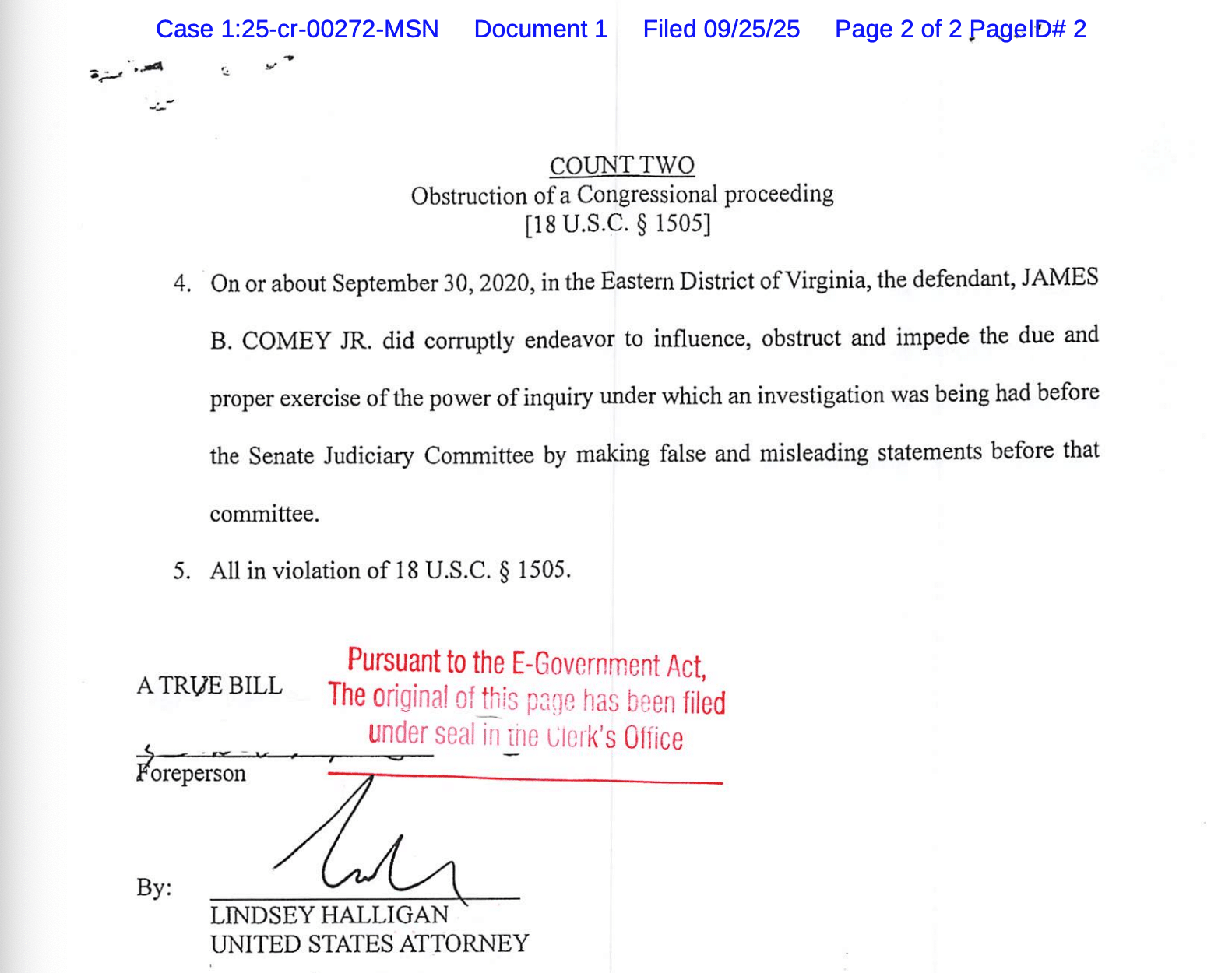
The indictment the grand jury approved charged Comey with lying to Ted Cruz (as Diaz would have it, without being shown what that lie is), and obstructing a Congressional proceeding, “by making false and misleading statements before that committee.”

The exhibit list makes clear that Lindsey the Insurance Lawyer did shoehorn the no-billed charge into the obstruction charge, presumably treating questions about the Comey memos and “Clinton plan” — the only things in the indictment that were material to the scope of the hearing — as “misleading” rather than “false” statements. Last week, Pat Fitzgerald had said they were going to raise concerns about that this week, but they may be waiting to get that grand jury transcript.

Now go back and look at how that obstruction charges looks in the no-billed (top) and approved (bottom) indictment.

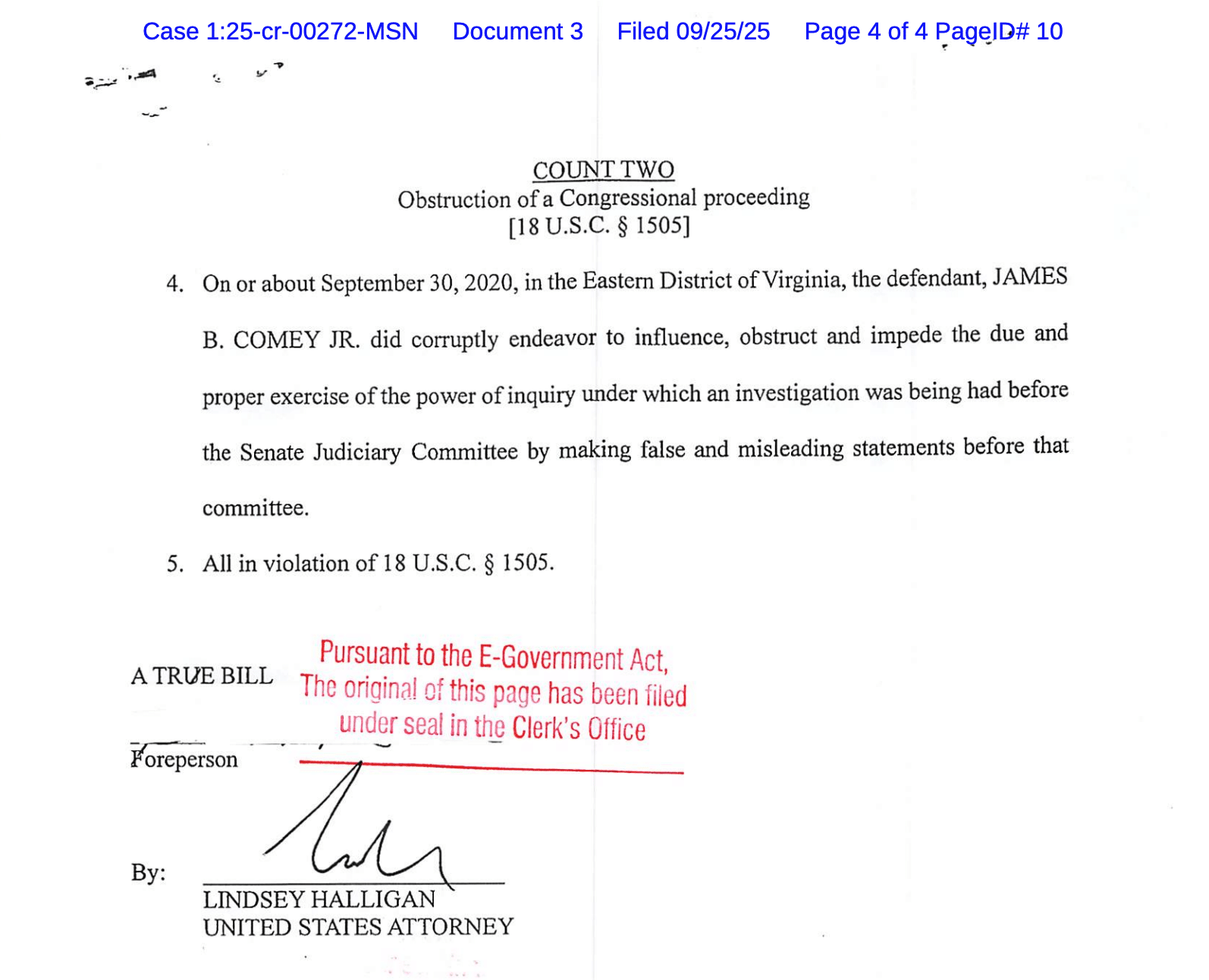
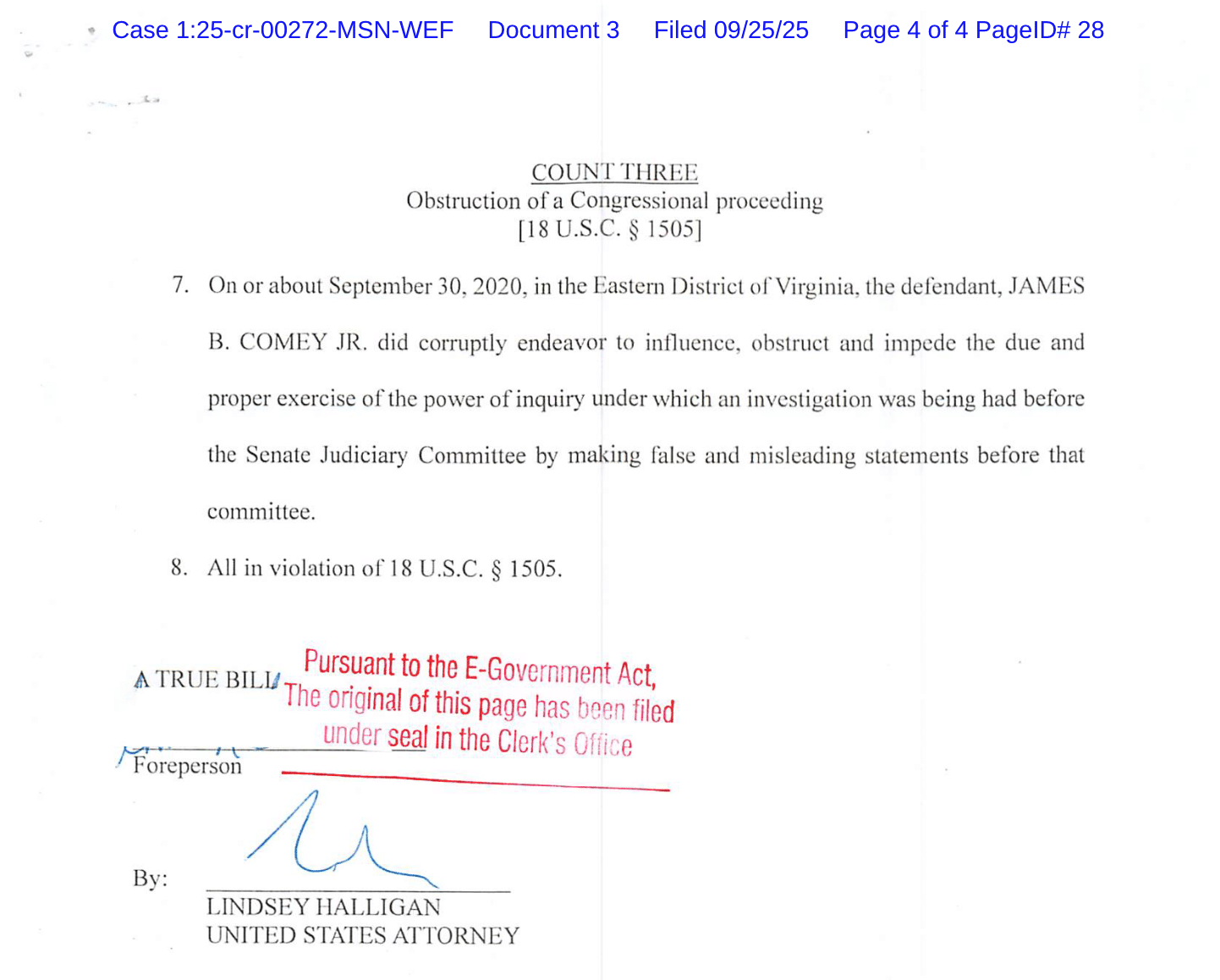
Update: As Amicus12 points out below, sometime within a day or so of the indictment, this error got fixed. Here’s what the fixed document looks like:

It is increasingly clear that Lindsey the Insurance Lawyer literally replaced what would have been Count Three of the no-billed indictment with Count Two of the approved indictment. That explains why that page has:

  • Staple and scan marks matching the real indictment
  • The numbering from the second indictment (these paragraphs should be numbered 7 and 8 in the no-billed indictment)
  • Both the signature of the foreperson (note the part of a signature that crosses into the “U” of the True Bill line) and Lindsey herself on that page

She simply swapped the page.

There’s good reason to ask whether she wasn’t just being dumb and inexperienced (which is what it looked like in the 7-minute hearing with the judge), but was also being deceitful.

For example, it’s possible that the original indictment charged Comey with obstructing the Senate’s investigation only by making false statements, but in a bid to get the material things in there pertinent to the larger investigation, the “Clinton plan” and the Comey memos, Lindsey the Insurance Lawyer added the word “misleading” to lower the bar to get a vote from the grand jurors.

It’s unclear whether Fitzpatrick will or can review some of these issues. He’s scrutinizing the indictment for unlawful and privileged exhibits. That also might explain why Diaz tried hard to prevent Comey from providing a list of things to look for.

The unlawful exhibits are bad enough. But there seems to be worse still.

Share this entry

“Sensitivities and Exposure:” Six Stupid Things about Lindsey Halligan’s First Filing

I already noted that, after Judge Michael Nachmanoff issued an order setting Monday as the deadline for prosecutors to provide Jim Comey all the discovery in his case, prosecutors submitted what they fashion as a Motion for a Discovery Order.

I was going to leave the filing well enough alone. Either Pat Fitzgerald or Judge Nachmanoff will respond later today, when things will get interesting. But there are a number of stupid things about the filing I can’t shake.

1) First, the prosecutors (it was submitted by Gabriel Diaz) do not fashion this as a motion for reconsideration. They just … pretend that Nachmanoff’s order doesn’t exist, and pretend they’re submitting this for the first time. That seems like a spectacular way to infuriate a judge.

2) They’re asking for two deadlines — October 14 for the things pertaining to the vindictive prosecution motion and October 20 for everything else, a transparent attempt to keep things from Comey that might be pertinent to his vindictive prosecution motion.

Part of their justification for filing this is that the parties had not reached an agreement and so they were following Nachmanoff’s order to submit competing versions on Monday.

On October 8, 2025, the Court ordered “the parties immediately confer regarding the entry of a joint discovery order” and further ordered “that if after good faith discussions the parties are unable to agree on and file a joint discovery order by Friday, October 10, 2025, . . . the parties shall each submit a proposed discovery order by Monday, October 13, 2025, at 5:00 p.m. D.E. 24.

But then, in a high school debate-worthy footnote, they suggest that Monday couldn’t be the deadline because it’s not five business days before the first pretrial motion deadline, since it’s a holiday.

Following the Court’s orders regarding discovery at docket entries 28 and 29, the Government conferred with Defense as to what the discovery deadline is. The Defense position was that, per the Court’s Order, discovery could have technically been due on Friday, October 10, 2025. But the notion that discovery was due prior to the Court entering a discovery order is not plausible. Alternatively, the Defense identified October 13, 2025, as the due date. This date is a Federal Holiday and is also inconsistent with the discovery order from this Court that lists discovery as due five business days before the pretrial motion deadline.

You’re already treating Monday as a business day!! Your entire premise here — that Fitzgerald should have held off on filing until Monday — is that you’re working on Monday.

3) Elsewhere — apparently in an attempt to suggest they were being really nice by letting Comey submit a second set of pretrial motions on October 30 — they describe that the default pretrial motion deadline going into last week’s hearing would have been October 22.

The defendant requested, the government agreed, and the Court ordered two motions Deadlines, October 20, 2025, and October 30, 2025. Notably, EDVA Local Criminal Rule 12 states that pretrial motions should be filed within 14 days of the arraignment. Here, the 14 day deadline would have been October 22.

This amounts to a confession that the default deadline for discovery going into last week’s hearing would have been five business days before October 22, or October 17. Prosecutors provide no explanation why they need an extra three days simply because Comey has two sequential pretrial motions.

4) They describe that Comey wouldn’t discuss the discovery order on October 7 when — for the first time in the 12 days since Comey had been indicted — prosecutors first reached out, because Comey’s team first demanded to know who the people described in the indictment were.

At that time, the government discussed with the defendant the proposed standard EDVA discovery agreement and a discovery protective agreement. At the initial discussion the defendant would not agree until the government provided information on the U.S. Attorney’s appointment and the identities of PERSON 1 and PERSON 3 on the Indictment.

Remember: Pat Fitzgerald said three different times in the arraignment the next day that he still hadn’t been told who these people were. So Diaz is effectively confessing that prosecutors wouldn’t — perhaps couldn’t — describe who these people were.

5) The only justifiable reason they give for delay is that the two sides have yet to agree on a protective order, which they claim is really important because of “the sensitivities and exposure associated with this prosecution.”

Additionally, the parties have yet to agree on a discovery protective agreement. Considering the sensitivities and exposure associated with this prosecution, a discovery protective agreement is a vital part of the overall discovery plan.

[snip]

On the afternoon of October 9, 2025, the defendant emailed back the government’s proposed protective agreement with significant proposed edits.

[snip]

Consistent with the Court’s direction at arraignment, the parties have also conferred regarding a discovery protection agreement. The government provided a past template used in the Eastern District of Virginia. The Defense made substantial edits, and the government agreed to those edits in large part. However, the parties still lack agreement as to whether the discovery can be provided and retained by the Defendant.

But they don’t provide the protective order (AKA “protection agreement”) with this filing. By their logic, they’re refusing to turn over discovery until they have one. By not turning it over, they’re ensuring that they cannot meet the currently set deadline of Monday.

6) Finally, they spelled North Carolina wrong.

Update: Corrected (from five to three) how many more days prosecutors are trying to get off what would have been the original October 17 due date.

Update: Here was Comey’s response (which noted that the government was just trying to change the terms of the discovery order after Comey signed it). And here’s Nachmanoff’s order rejecting the government bid.

Now the government is dicking around with the protective order, trying to mandate that the former Director of the FBI have a babysitter while reviewing discovery.

Update: Here’s Comey’s response and his proposed protective order.

Update: Judge Nachmanoff adopted Comey’s preferred protective order. In his order, he included this footnote.

1 The Court observes that protective orders entered in numerous other high-profile false statements cases, within and outside of this judicial district, do not contain such limitations. See, e.g., Protective Order, United States v. McDonnell, et al., ECF 46, No. 3:14-cr-12-JRS (E.D. Va. Feb. 6, 2014); Protective Order, United States v. Kiriakou, ECF 32, No. 1:12-cr-127-LMB (E.D. Va. April 13, 2012); United States v. Libby, ECF 22, No. 1:05-cr-394-RBW (D.D.C. Nov. 23, 2005); Protective Order, United States v. Blagojevich, ECF 67, No. 1:08-cr-888-JBZ (N.D. Ill. April 14, 2009); Protective Order, United States v. Manafort, et al., ECF 46, No. 1:17-cr-201-ABJ (D.D.C. Nov. 15, 2017).

As you all likely know, Libby was a Fitz case. So were Blagojevich and Kiriakou — the latter of which was in EDVA.

Manafort, of course, was Mueller. And McDonnell, also in EDVA, was under the supervision of Jack Smith.

So a tidy way of saying, “Lindsey the Insurance Lawyer is trying to treat Comey worse than the investigations Trump is trying to avenge.”

Share this entry