Posts

Loaner AUSA Gabriel Diaz: Why Do You Think There Are Two Indictments Signed by Lindsey Halligan?

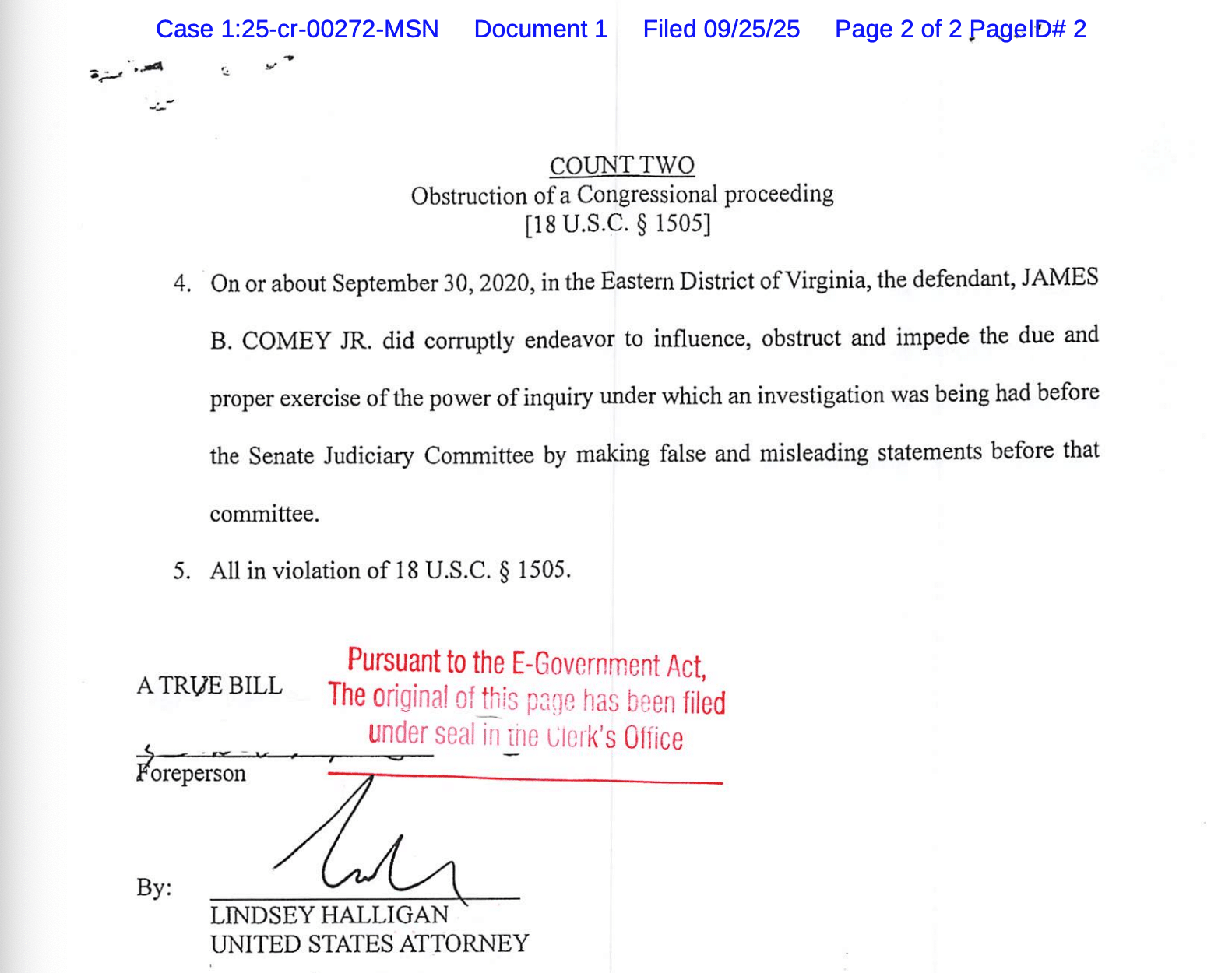
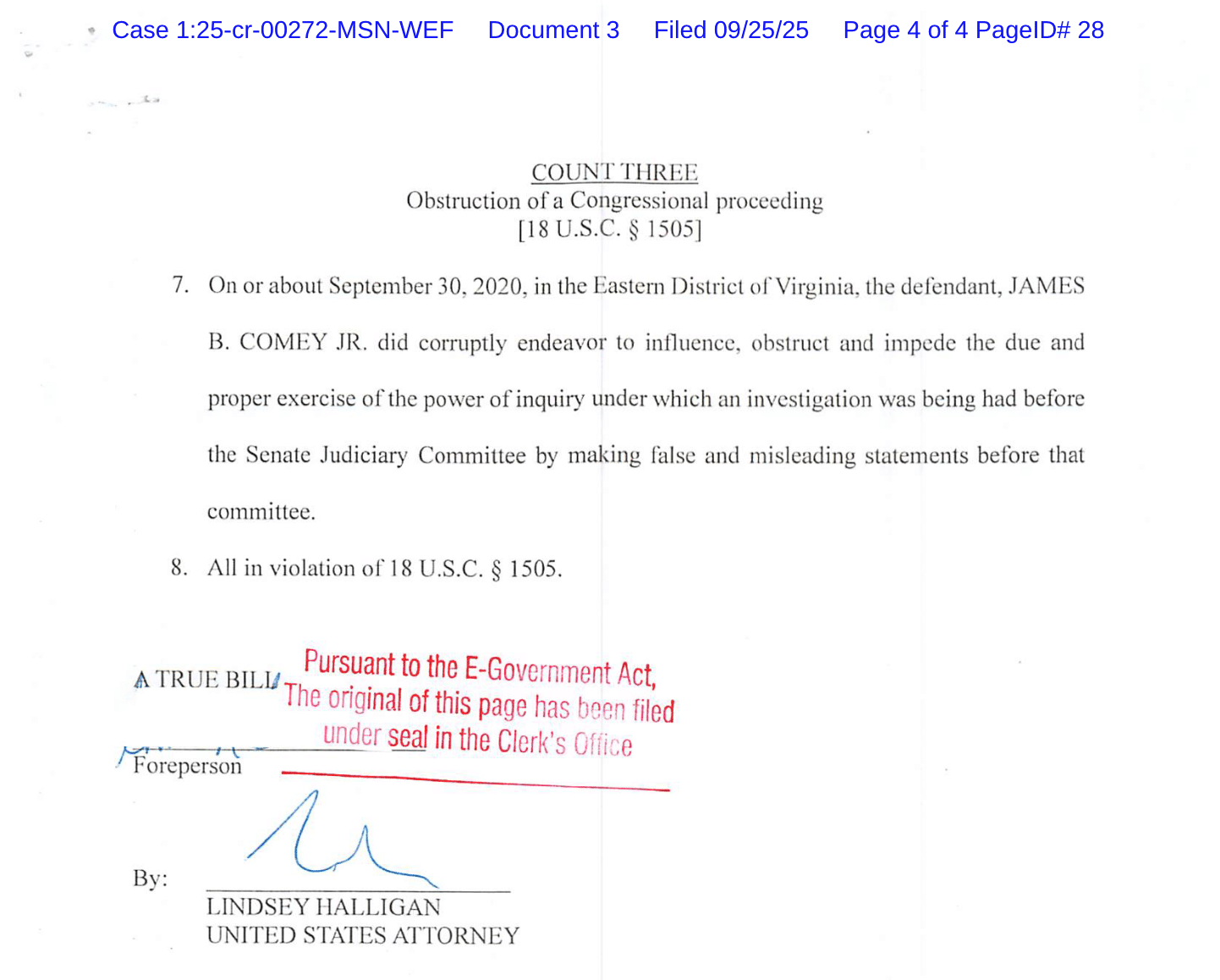
Did Lindsey Halligan sign and docket two indictments — nay, one indictment plus two copies (fucked and fixed) of a no-billed indictment?

Why yes Lindsey Halligan did.

“So this has never happened before. I’ve been handed two documents that are in the Mr. Comey case that are inconsistent with one another,” Vaala said to Halligan. “There seems to be a discrepancy. They’re both signed by the (grand jury) foreperson.”

And she noted that one document did not clearly indicate what the grand jury had decided.

“The one that says it’s a failure to concur in an indictment, it doesn’t say with respect to one count,” Vaala said. “It looks like they failed to concur across all three counts, so I’m a little confused as to why I was handed two things with the same case number that are inconsistent.”

Halligan initially responded that she hadn’t seen that version of the indictment.

“So I only reviewed the one with the two counts that our office redrafted when we found out about the two — two counts that were true billed, and I signed that one. I did not see the other one. I don’t know where that came from,” Halligan told the judge.

Vaala responded, “You didn’t see it?” And Halligan again told her, “I did not see that one.”

Vaala seemed surprised: “So your office didn’t prepare the indictment that they —”

Halligan then replied, “No, no, no — I — no, I prepared three counts. I only signed the one — the two-count (indictment). I don’t know which one with three counts you have in your hands.”

“Okay. It has your signature on it,” Vaala told Halligan, who responded, “Okay. Well.”

Except now that Lindsey the Insurance Lawyer can’t explain how she spent her day on September 25, Gabriel Diaz fronting for James Hayes under the name of Lindsey Halligan says maybe there wasn’t a second indictment.

The government’s position is that disclosure of grand jury materials is not warranted under the facts presented to the Magistrate Judge. Indeed, the government believes the Magistrate Judge may have misinterpreted some facts he found when issuing the latest order to release the grand jury materials to the defendant. For instance, (1) whether the defendant has any standing to challenge the Richman materials, (2) the full context of the statements made by the prosecutor to the grand jury, (3) that Agent-3 was exposed to potentially privileged material, and (4) that two indictments were presented to the grand jury. Additionally, the Magistrate Judge acknowledges he “did not immediately recognize any overtly privileged communications.” Dkt. No. 192 at 14. The possible exposure of privileged materials to the grand jury was the primary focus of the Magistrate Judge’s inquiry. Having seemingly settled that issue, the Magistrate Judge turns to premature issues such as suppression that have not even been briefed by the parties.

Literally items (2), (3), and (4) came from the government!

But now, in a desperate bid to buy a week of time to try to find a way to delay Jim Comey’s discovery that Lindsey the Insurance Lawyer and the Attorney General of the United States think he’s not entitled to Fifth Amendment rights.

If two indictments weren’t presented, then Lindsey the Insurance Lawyer has submitted a fabrication to the court and we should start criminal contempt proceedings.

Judge Fitzpatrick rattled off eleven problems with this indictment. And you want to stall for time?

All the evidence suggests there is no indictment, because the foreperson no-billed the only one presented to the grand jury.

And they want to stall for time?

Update: From Comey’s response. Holy hell these people are way more moderated than I would be.

Moreover, with respect to the presentment, the affidavit Ms. Halligan voluntarily presented raised significant concerns about whether the operative indictment was actually presented to the grand jury, and if so, by whom. The logical conclusion from Ms. Halligan’s declaration is that no one from the government presented a new indictment to the grand jury after it issued a no bill. Ms. Halligan’s declaration attests that she did not reappear before the grand jury upon learning of the grand jury’s vote to no bill the indictment she presented between 2:18PM and 4:28PM. See ECF No. 188-1 at 2 (“During the intermediary time, between concluding my presentation and being notified of the grand jury’s return, I had no interaction whatsoever with any members of the grand jury.”). And, importantly, she asserts that “the transcript accurately reflects the entirety of the government’s presentation and presence in front of the grand jury. There was no additional presentation, interaction, or discussion with the grand jury outside of what is reflected in the transcript.” ECF No. 188-1 at 1 (emphasis added). If no one from the government presented the operative indictment, as logically follows from Ms. Halligan’s own assertions and her ultimate handing up of a purported indictment that differs from the one partially no true billed, then the grand jury did not vote on it. See ECF No. 193 at 17-18.

Update: Here’s the colloquy between Magistrate Judge Lindsey Vaala and the Foreperson.

THE FOREPERSON: So the three counts should be just one count. It was the very first count that we did not agree on, and the Count Two and Three were then put in a different package, which we agreed on.

THE COURT: So you —

THE FOREPERSON: So they separated it.

THE COURT: Sorry, I didn’t mean to interrupt you. So you voted on the one that has the two counts?

THE FOREPERSON: Yes.

THE COURT: Okay. And you’re just giving me the other one for what reason?

THE FOREPERSON: That we could not agree on.

THE COURT: Okay. But just for one count?

Update: Judge Nachmanoff has given the government two days to bitch. Comey has a reply due on his broader grand jury request on Thursday, so Comey might file early.

ORDERED that the Motion (ECF 195) is GRANTED IN PART; and it is further ORDERED that the government will file any objections to Judge Fitzpatrick’s Order by 5:00 p.m. on Wednesday, November 19, 2025. Thereafter, the defense will file any response to any objection by the government by 5:00 p.m. on Friday, November 21, 2025; and it is further ORDERED that Judge Fitzpatrick’s Order (ECF 193) is STAYED pending the resolution of any objections filed by the government, which this Court will consider on the papers as to James B. Comey Jr. Signed by District Judge Michael S. Nachmanoff on 11/17/2025.

There’s also a hearing on Comey’s vindictive and selective prosecution on Wednesday.
Share this entry

Bill Barr Helped Lindsey Halligan Fuck Up the Comey Prosecution

As I noted, William Fitzpatrick ordered the government to turn over the grand jury materials to Jim Comey by 3PM today.

In spite of all the ways that Lindsey the Insurance Lawyer fucked up, she’s actually only responsible for three of the problems.

Others stem from conduct under Bill Barr, when these materials were first seized with warrants targeting Dan Richman.

Thus far, prosecutors have only named one investigation for which DOJ obtained these warrants: The Arctic Haze investigation into whether Richman — and through him, Jim Comey — leaked information about materials stolen from SVR in 2016; that investigation was closed without charge in 2021.

In 2017, the U.S. Attorney’s Office for the District of Columbia (“USAO-DDC”) initiated an investigation, referred to by the Federal Bureau of Investigation (“FBI”) as Arctic Haze. ECF 71 at 2. This investigation concerned an allegation of unauthorized disclosure of classified information to a New York Times reporter, which appeared in an April 22, 2017 article titled “Comey Tried to Shield the FBI from Politics. Then He Shaped an Election.” Id. The investigation focused on the article’s inclusion of classified information related to one of the factors that influenced Mr. Comey’s decision, as then-FBI director, to unilaterally announce the closure of the FBI’s investigation into then-Presidential Candidate Hillary Clinton’s handling of classified material while she was serving as Secretary of State. Id. Daniel Richman, a Columbia Law School professor, personal friend of Mr. Comey, and former Special Government Employee at the FBI during Mr. Comey’s tenure as FBI Director, was quoted by name in the article and was the subject of USAO-DDC’s investigation. Id.

But there must be a second investigation, because the warrants extend beyond the time of the Arctic Haze story and they include a crime, 18 USC 641, unrelated to it.

The Richman Warrants authorized agents to search for and seize information created or stored between March 1, 2016 and May 30, 2017 that constituted evidence of violations of 18 U.S.C. § 641 (Theft and Conversion of Stolen Government Property) and 18 U.S.C. § 793 (Unlawful Gathering or Transmission of National Defense Information).

As I said in my video today, the 18 USC 641 would correspond with an attempt to criminalize sharing memos recording Trump’s misconduct.

But even that can’t be all.

As a letter drafted by Richman’s attorney in April 2020 noted, DOJ twice extended the range of the seizure beyond the period authorized by the warrant.

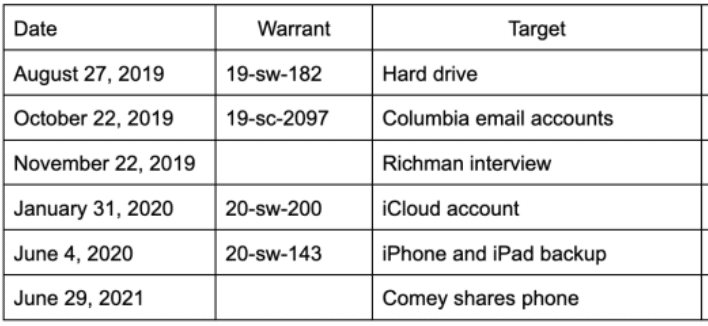
According to an April 29, 2020 letter from Mr. Richman’s then-attorney to the government–produced to the Court ex parte by the defense–the Department of Justice informed Mr. Richman that the data it obtained from his iCloud account extended to August 13, 2019, well outside the scope of the warrant and well past the date on which Mr. Richman was retained as Mr. Comey’s attorney. ECF 181-6 at 20. The same letter further states that the Department of Justice informed Mr. Richman that it had seized data from Mr. Richman’s hard drive that extended to June 10, 2017–again well into the period during which Mr. Richman represented Mr. Comey–despite the warrant (19-sw-182) imposing a temporal limit of April 30, 2017. Id.

In August 2019, the government obtained all of May and part of June 2017 beyond the warrant — which happened to include the scope of the Comey memos and go right through his testimony to Mueller and public testimony before the Senate Intelligence Committee. The approved scope of the warrants thereafter all extended to May 30, past the time Comey released his memos and Rod Rosenstein appointed a Special Counsel. Then, in January 2020, DOJ obtained iCloud content from two and a half years beyond the scope of the known warrant, through August 2019.

There’s likely good reason DOJ did that: to feed the Durham investigation, which had shifted to chasing the Clinton Plan conspiracy theory by early 2020.

The government never asked Comey to review those materials for privilege even though, as Fitzpatrick noted, three of the warrants extended beyond the time he retained Richman.

[T]he government never engaged Mr. Comey in this process even though it knew that Mr. Richman represented Mr. Comey as his attorney as of May 9, 2017, and three of the four Richman Warrants authorized the government to search Mr. Richman’s devices through May 30, 2017, 21 days after an attorney-client relationship had been formed.

[snip]

[I]n 2019 and 2020, the government made a conscious decision to exclude Mr. Comey from the filter process, even though Mr. Comey, as the client, is the privilege holder, not Mr. Richman.

Fitzpatrick excused Tyler Lemons and Gabriel Wolf, as well as EDVA, for the slovenly way the earlier searches were done: they all happened long before any of those AUSAs were involved in the case.

4 To be clear, the two assistant United States attorneys currently assigned to this case entered their appearances post-indictment and were not a part of the Arctic Haze investigative team.

7 It is important to note that the USAO-EDVA prosecutors were not involved in the 2019 and 2020 searches of the Richman materials and may have reasonably assumed the agents in 2019 and 2020 seized and preserved only those materials responsive to the warrants.

But there is someone who likely does span the slovenly earlier treatment and that of the last two months: Jack Eckenrode. Indeed, Eckenrode may even have worked for Durham (hunting Jim Baker for a different leak investigation) before Barr assigned Durham to chase Russian disinformation for four years. But those secondary investigations would have fed right into Durham.

That makes this description of the decision to have what is presumed to be Miles Starr testify before the grand jury more suspect.

The government presented this case to the grand jury on September 25, 2025. ECF 1. The same day, prior to the grand jury presentment, Agent-2 alerted the lead case agent (hereinafter referred to as Agent-3 [Miles Starr]) and an attorney with the FBI’s Office of General Counsel that “evidence obtained in the Government’s investigation of James Comey may constitute attorney-client privileged or attorney-client confidential information. It is also possible that [the agents] may have obtained evidence that constitutes attorney work-product information.”8 ECF 89-5. Agent-2 gave Agent-3 and the FBI attorney “a limited overview of the [privileged] communications.” ECF 172- 2.9 Agent-3, rather than remove himself from the investigative team until the taint issue was resolved, proceeded into the grand jury undeterred and testified in support of the pending indictment. ECF 179. In fact, Agent-3 was the only witness to testify before the grand jury in support of the pending indictment. Id. The government’s decision to allow an agent who was exposed to potentially privileged information to testify before a grand jury is highly irregular and a radical departure from past DOJ practice.

8 This is the language used by an FBI attorney to characterize their September 25, 2025 phone conversation with Agent-3. A second agent, possibly Agent-2, was also on the call but that that person’s identity has been shielded from the Court. ECF 89-5. [citing the filing that mentioned the two lead case agents]

9 The government provided no further detail about what, in its view, constitutes a “limited overview.” [my emphasis]

The two lead case agents mentioned in Comey’s most extensive discussion of what happened are reported to be Starr and Eckenrode, the latter rehired after failing to substantiate this conspiracy theory the first time.

And remember: one of the people who appears as author of a document but who did not notice an appearance is a second Gabriel, Gabriel Cohen, who registers an OGC email address. He authored Lindsey Halligan’s ill-fated declaration. Perhaps he’s the FBI lawyer who thought it’d be cool to have a tainted witness present to the grand jury.

Fitzpatrick plays coy about why no one thought to ask for a filter protocol until October 13 (perhaps not coincidentally, the day Maggie Cleary was fired).

For reasons that remain unclear, the government waited 31 days from September 12, 2025, the date the FBI began reviewing the materials, and 18 days from September 25, 2025, the date the FBI informed its Office of General Counsel about having been exposed to potentially privileged materials, before seeking court approval of a filter protocol on October 13, 2025.

One possible reason: They weren’t going to ask for a filter review at all until the Loaner AUSAs came in and put their bar licenses at risk.

They stumbled on something they thought would feed their grand conspiracy and tried to run with it.

Perhaps they anticipated that the least scrutiny of this conduct would reveal layers upon layers of misconduct.

Share this entry

The 11 Fuck-Ups Pam Bondi’s DOJ Made in Indicting Jim Comey

Magistrate Judge William Fitzpatrick has ordered the government to give Jim Comey grand jury materials by 3PM.

He provided four bases for doing so. First, it’s likely the material presented to the grand jury violated Comey’s Fourth Amendment, as I explained in a video this morning.

As Fitzpatrick describes, there were several errors. DOJ didn’t scope most of the communications seized in 2019 and 2020 (that is, a Bill Barr fuck-up). And then, they chose not to obtain a new warrant to access the materials for a totally different investigation.

By the summer of 2025, the FBI and the United States Attorney’s Office for the Eastern District of Virginia (USAO-EDVA) had initiated a criminal investigation into Mr. Comey. ECF Nos. 172-1 and 172-2. As part of the investigation, on September 12, 2025, an FBI agent assigned to the Director’s Advisory Team was instructed, apparently with the concurrence of the USAOEDVA, 7 to review “a Blu-ray disc that contained a full Cellebrite extraction and Reader reports of [Mr. Richman’s] iPhone and iPad backups.” ECF 172-1.

Inexplicably, the government elected not to seek a new warrant for the 2025 search, even though the 2025 investigation was focused on a different person, was exploring a fundamentally different legal theory, and was predicated on an entirely different set of criminal offenses. The Court recognizes that a failure to seek a new warrant under these circumstances is highly unusual. The Court also recognizes that seeking a new warrant under these circumstances would have required a fresh legal analysis and likely resulted in some delay, a delay the investigative team could not afford given that the statute of limitations would expire in a mere 18 days. See 18 U.S.C. § 3282(a).

If a new warrant had been sought by the government and issued by the Court, the Fourth Amendment would have required it to be narrowly tailored, authorizing access only to materials within a limited time frame and relevant to the new offenses under investigation. See Williams, 592 F.3d at 519. In addition, any new warrant would have imposed strict procedural safeguards to ensure privileged information was not reviewed by the prosecution team. As a result, the parameters of the 2025 search would inevitably have had a different and much narrower scope than the Richman Warrants. Faced with this prospect, the government chose to unilaterally search materials that were (1) seized five years earlier; (2) seized in a separate and since closed investigation; (3) that were never reviewed to determine whether the seized information was responsive to the original warrants; (4) that were likely improperly held by the government for a prolonged period of time; (5) that included potentially privileged communications; (6) did so without ever engaging the privilege holders; and (7) did so without seeking any new judicial authority.

Second, after being exposed to privileged communications, Miles Starr nevertheless still presented the case to the grand jury.

Third, Lindsey Halligan fundamentally mis-informed the jury, first by suggesting that Comey would have to testify at trial, and second by implying there was a bunch more evidence that would be used at trial (which might reflect taint from the privileged comms Starr knew of).

Fourth, she apparently did not re-present the charges the grand jury approved — what I surmised last week.

The short time span between the moment the prosecutor learned that the grand jury rejected one count in the original indictment and the time the prosecutor appeared in court to return the second indictment could not have been sufficient to draft the second indictment, sign the second indictment, present it to the grand jury, provide legal instructions to the grand jury, and give them an opportunity to deliberate and render a decision on the new indictment. If the prosecutor is mistaken about the time she received notification of the grand jury’s vote on the original indictment, and this procedure did take place, then the transcript and audio recording provided to the Court are incomplete.12 If this procedure did not take place, then the Court is in uncharted legal territory in that the indictment returned in open court was not the same charging document presented to and deliberated upon by the grand jury. Either way, this unusual series of events, still not fully explained by the prosecutor’s declaration, calls into question the presumption of regularity generally associated with grand jury proceedings, and provides another genuine issue the defense may raise to challenge the manner in which the government obtained the indictment.

12 It is the responsibility of the United States Attorney’s Office to record and, if required, transcribe all grand jury proceedings.

All in all, Fitzpatrick lists 11 things that might merit throwing out the indictment — if there is one — altogether.

Share this entry

Might Pam Bondi’s Latest Prosecutorial Abuse Give Us Ponies and Puppies?

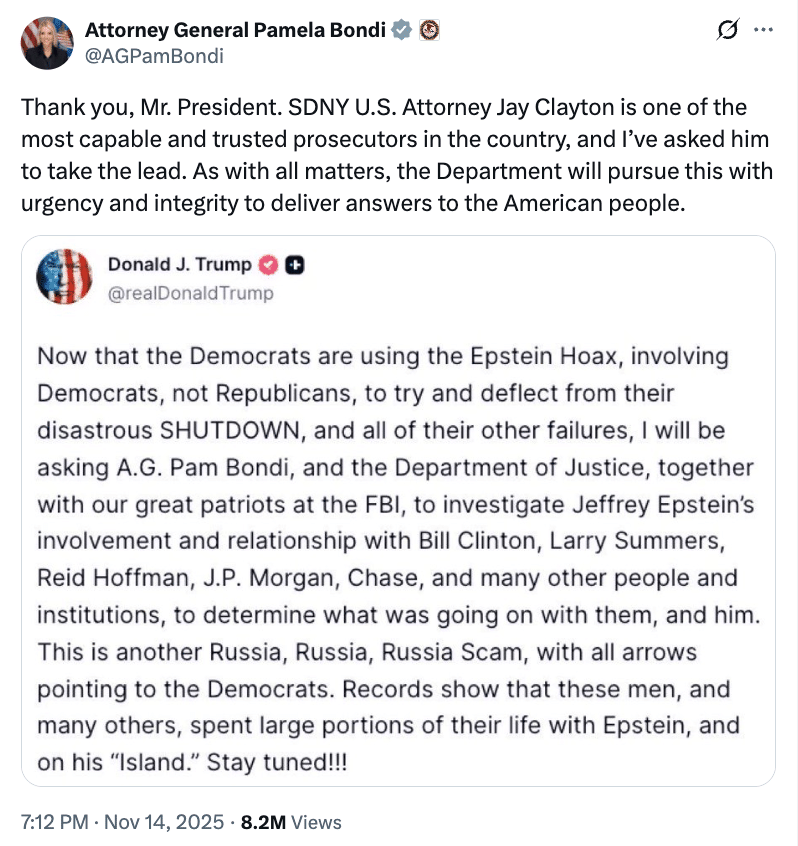
The media’s response to this exchange (remember, timezone reflects Irish time) between Donald Trump and Pam Bondi has been procedural.

At the NYT yesterday, for example, first Erica Green, Glenn Thrush, and Alan Feuer described it (competently) in procedural terms. It was a tired Trump strategy of projection, it might stall release of files to Congress, gosh it’ll make things hard for Jay Clayton. 30-some ¶¶ in, it briefly turned to politics, in the form of quotes from Robert Garcia (Ranking Member of Oversight) and Don Bacon. Tom Massie, Ro Khanna, and Marjorie Taylor Greene are not quoted, to say nothing of Epstein’s victims.

Then the NYT today turned to its SDNY reporters — Jonah Bromwich, Benjamin Weiser and William Rashbaum — to focus more closely on just how much trouble this could cause SDNY US Attorney Jay Clayton. That story mentions Maurene Comey’s firing in passing twice, but days ago, Bromwich and Rashbaum described how everyone in the New York Metro area dodged defending Ms. Comey’s wrongful termination lawsuit which, after some delay, NDNY, led by a corrupt Trump flunkie, will now take on.

Both stories make Trump the agent of the narrative. He made an order and as Bondi executes it, this is what will happen.

As I suggested in this video, I look at Bondi’s public haste to bow to Trump’s demands differently.

Pam Bondi doubled down on ratifying Lindsey Halligan’s indictment of Jim Comey, after having been caught in failing to exercise the least due diligence the last time she tried to do so. One reason she did so, no doubt, is that DOJ literally told Judge Currie that the unlawful means Bondi used to turn Lindsey the Insurance Lawyer into US Attorney was a mere “paperwork error,” Pam Bondi’s fuck-up. And so, in an attempt to salvage the fuck-up DOJ is attributing to the Attorney General, she may have inserted herself into what appear to be serious Fourth Amendment violations, among other things.

And, that very same day, she publicly bowed to the President’s demand that she pursue clearly political prosecutions just months after DOJ had publicly issued an (unsigned) declination decision in the same investigation (after reportedly having shut down an ongoing investigation into Epstein co-conspirators, presumably led by Jim Comey’s daughter, months earlier).

Even in July, it was crystal clear that Pam Bondi kept making things worse.

Then Bondi made things worse when she told Fox News that Epstein’s client file was on her desk for review. She made things worse when she orchestrated the re-release of the already-released files to a select group of right wing propagandists, all packaged up to look special, a spectacle that stoked divisions among MAGAts but also raised concerns that she was covering stuff up. She made things still worse when — responding to James Comer’s role in making things worse, when he claimed the Epstein files had been disappeared — she said there were tens of thousands of videos involving Epstein.

By the end of that week, Todd Blanche would announce he’d spend some quiet time with Ghislaine Maxwell, which I imagine he thought was clever but has resulted in further questions, starting with why he’s not charging Maxwell for the lies she told to his face and why the sexual predator got a puppy.

Pam Bondi has been trying to make the Epstein problem she made worse go away. It hasn’t worked. Nothing has worked. All the pressure she and Blanche and Kash Patel could apply failed to force Lauren Boebert to make it go away. And having failed so far, she very publicly and very quickly agreed to do something stupid, reopen an investigation that she already said could not be pursued.

She did so the week before Judge Michael Nachmanoff (on Wednesday) will preside over Jim Comey’s vindictive and selective prosecution claim, which will be followed by Letitia James’ motion in a few weeks, assuming one or both of those prosecutions are not preempted by some other dismissal before then. (Comey Motion; DOJ Response; Comey Reply; James Motion; there are a slew of Amici filing in both)

In Comey’s reply, he responded to Lindsey Halligan and her Loaner AUSAs’ attempt to claim only Halligan’s motive can be scrutinized in this prosecutorial decision by citing one of the most troubling passages in the Supreme Court’s ruling in Trump v. USA:

Imputation of President Trump’s vindictive motive to Ms. Halligan is particularly warranted because the President has “exclusive authority over the investigative and prosecutorial functions of the Justice Department and its officials.” Trump v. United States, 603 U.S. 593, 621 (2024). As the government itself describes, U.S. Attorneys are subordinate aides to the President, “help[ing the President] discharge” his “responsibility” to prosecute crimes. ECF No. 138 at 17. And President Trump’s authority is not merely formal or abstract: he has exercised an unprecedented and extraordinary degree of control over the DOJ, installing his personal allies to key positions and inserting himself into prosecutorial decisions that, in previous Administrations, would have been left to the DOJ’s independent judgment. See ECF No. 59 at 8-11. [my emphasis]

That’s the language John Roberts used to excuse Trump’s efforts, via Jeffrey Clark, to use DOJ to steal the election.

The Government does not dispute that the indictment’s allegations regarding the Justice Department involve Trump’s use of official power. The allegations in fact plainly implicate Trump’s “conclusive and preclusive” authority. The Executive Branch has “exclusive authority and absolute discretion” to decide which crimes to investigate and prosecute, including with respect to allegations of election crime. Nixon, 418 U. S., at 693. And the President’s “management of the Executive Branch” requires him to have “unrestricted power to remove the most important of his subordinates”—such as the Attorney General—“in their most important duties.” Fitzgerald, 457 U. S., at 750. The indictment’s allegations that the requested investigations were shams or proposed for an improper purpose do not divest the President of exclusive authority over the investigative and prosecutorial functions of the Justice Department and its officials. Because the President cannot be prosecuted for conduct within his exclusive constitutional authority, Trump is absolutely immune from prosecution for the alleged conduct involving his discussions with Justice Department officials. Pp. 19–21.

Trump seemed to echo this license when asked about ordering Bondi to investigate Democrats on Friday.

Reporter: Do you believe a President should be able to order investigations?

Trump: Sure. I’m the chief law enforcement officer of the country. Not that I want to use that. But I am considered the chief law enforcement agent in the country. And I’m allowed to do it.

Effectively, Comey argued that because of the monstrosity Roberts created, his vindictive prosecution claim must be judged according to different rules. And then Trump just reaffirmed his responsiblity.

If these things happened in a vacuum, I’d say that Bondi’s quick and public acquiescence to Trump’s demand that she investigate his enemies as a way to avoid scrutiny himself would be nothing more than a truly epic Constitutional confrontation.

A display of what happens when, as John Roberts did, you give the President literal immunity to hunt down his enemies for unrelated reasons, such as that the President’s one-time best friend “stole” his former spa girl and turned her into a sex slave a quarter century ago.

But it’s not happening in a vacuum.

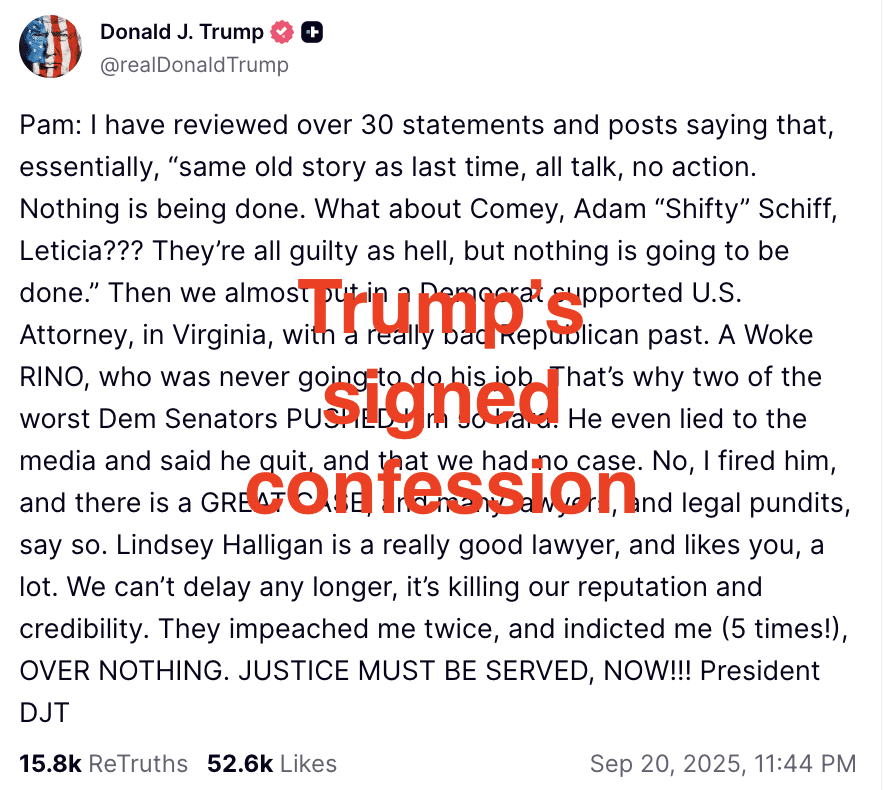
The week before Trump’s defense attorney will sit mutely in a court room as Loaner AUSAs try to put lipstick on the pig of this prosecution, Trump made his abuse even more plain than he did when he accidentally ordered up this very investigation (and that of James) in September, a tweet prosecutors have already had to invent bullshit excuses for.

How interesting, Judge Nachmanoff might think, that Pam Bondi just performed her utter obeisance to Trump, just the thing prosecutors insist didn’t happen with Comey. How interesting, that the lady who claimed to ratify this prosecution did that.

As I said in the video, there are up to ten ways that the Comey prosecution might go away, and I’m already greedily hoping that those ten things things not just fall into place, but fall into place in an order that will result in far more trouble for DOJ.

Certainly, the fact that Judge Cameron Currie started her hearing last week on the most obvious thing that might make this prosecution go away, Halligan’s unlawful appointment, by raising another, the declination memos reported in the press, makes me hope I might get a pony.

THE COURT: Mr. [Ephraim] McDowell, are you aware of any evidence of whether there was a declination memo prepared in the Comey matter?

MR. MCDOWELL: We are not aware of that at the moment. I think, you know, that would be something that could potentially come out in discovery, but we don’t have that as of yet.

Another thing we’ve been promised this week is Jim Comey’s explanation of the multiple ways Kash Patel’s FBI violated his Fourth Amendment rights by sniffing through everything Bill Barr’s hyper-aggressive DOJ seized four years ago. Then there are the parallel requests Comey has made for grand jury transcripts that Judge Currie certainly seems to think are improper — but Pam Bondi claimed, both the first time, and the second time — are not.

Bondi demonstrated her willingness to conduct political prosecutions the week before the wheels may start to come off the Comey prosecution.

And if they don’t, Maurene Comey may get to force the issue. Attorney General James may get to force the issue.

That’s all legal though, and the law never works as quickly or decisively as you’d like, particularly not with Donald Trump.

But it happens in the very same week that — reportedly — up to a hundred Republicans are prepared to vote to release the Epstein files to stave off lasting damage from Trump’s sex trafficker scandal, something that — if it happens — will make this referral to Jay Clayton a problem, not a solution.

One reason Pam Bondi was so quick to bow to Trump’s demands, sacrificing her very last shreds of credibility with courts, was because she’s in real political trouble, and has been since she thought she’d get cute by handing out binders of already-released Epstein files.

Trump’s effort, Bondi’s effort, to make all this go away by handing it to Jay Clayton on a steaming-shit platter reflect desperation, not the agency NYT portrays it as.

Sure, it’s certainly possible all this will go away, as it always does for Trump. Maybe the dog that didn’t bark can wag one in Venezuela to make his troubles go away.

It’s still a good bet that Ghislaine will be the only one who gets a puppy.

But both Trump and Bondi are operating reactively. And in a desperate attempt to reclaim agency over the Epstein scandal — something Trump has been struggling to do since July — he may well have handed Jim Comey a gift pony.

Update: After I wrote this Todd Blanche made an appearance on Fox to lie about both these issues and Trump claimed that he had encouraged “House Republicans” (but not Republicans generally) to vote to release the files. There are a number of caveats built into that — the focus on the House (when Bondi could release these files herself), the attendant call to investigate Democrats, and the focus on giving “the House Oversight Committee can have whatever they are legally entitled to,” which they’ve already gotten. Whether this works depends both on the willful stupidity of the GOP (Tom Massie has already pointed out holes in this proposal) and Bondi’s ability to sustain the illusion of an investigation. In his comment, Trump explicitly spoke, as he has from the start, in terms of attention, and his demand that he control it. But the last time he tried this, it turned into a welcome-watch for Adelita Grijalva.

Share this entry

Pam Bondi Replaces Her Embarrassing Reading Comprehension Failure with a 4A Violation

When Judge Cameron Currie surprised Pam Bondi’s Counselor, Henry Whitaker, on Thursday with a question about whether DOJ believes Aileen Cannon wrongly dismissed Trump’s stolen documents case, Whitaker claimed what distinguished Jack Smith from Lindsey Halligan is that Halligan is closely supervised.

I do think that mostly what was driving Judge Cannon’s decision in that case was sort of the unique and broad authority that the special counsel possessed sort of free of supervision, which, of course, is an element that we do not have here.

He said that, mind you, even while conceding that Pam Bondi had claimed to ratify the Comey indictment even though the transcripts didn’t show how Halligan instructed the grand jury, yet.

MR. WHITAKER: Well, it’s true that — it is true, Your Honor, you’re right, that we didn’t have the intro and back end of the grand jury transcripts when we presented that.

Between that day, on October 31, when Pam Bondi claimed to ratify Lindsey’s work without noticing she couldn’t see that work, and yesterday, several things have happened.

We’ve gotten a lot more details about the suspected Fourth Amendment and Attorney-Client privilege violations Jim Comey’s investigators committed. First, Rebekah Donaleski told Magistrate Judge William Fitzpatrick that Jim Comey’s team believed investigators had worked off material seized from Dan Richman that was not responsive to the four warrants used to investigate him. Effectively, a general warrant.

[D]id the agents preserve nonresponsive copies or nonresponsive materials for five years? Because the Fourth Circuit has said that’s not reasonable. Did that happen? Because the prolonged retention of nonresponsive electronic data can render an initially lawful search unconstitutional. The Fourth Circuit has said that. That’s what appears to have happened here.

[snip]

We need to know was this a narrowly tailored responsive set or did they just mark the entire iCloud responsive, thus rendering it a general warrant. We don’t know the answers to those questions.

Then, the FBI agent who realized he was reading privileged material described that he had been given the “full Cellebrite extraction” of Dan Richman’s phone to review, precisely that general warrant Donaleski feared. His supervisor said that the original agent had prepped the grand jury team with “a two-page document containing limited text message content only from May 11, 2017,” designed to avoid any taint. But Miles Starr appears to have presented eight pages of those texts to the grand jury; the Bates stamp for those texts include only a number, nothing to indicate they post-dated a privilege review by Richman.

After that, the Loaner AUSAs confessed that they had no fucking clue whether the material used to investigate Jim Comey had been scoped for responsiveness (though Comey’s team described that it looked like these were “raw returns for the search warrants at issue, unscoped for responsiveness and filtered for Mr. Richman’s privileges”).

The Order also required the government to provide, in writing, by the same deadline: “Confirmation of whether the Government has divided the materials searched pursuant to the four 2019 and 2020 warrants at issue into materials that are responsive and non-responsive to those warrants, and, if so, a detailed explanation of the methodology used to make that determination; A detailed explanation of whether, and for what period of time, the Government has preserved any materials identified as non-responsive to the four search warrants; A description identifying which materials have been identified as responsive, if any; and A description identifying which materials have previously been designated as privileged.” ECF No. 161 at 1-2.

Despite certifying on November 6 that it had complied with the Court’s Order, ECF No. 163, the government did not provide this information until the evening of November 9, 2025, in response to a defense inquiry. The government told the defense that it “does not know” whether there are responsive sets for the first, third, and fourth warrants, or whether it has produced those to the defense, and said that in that regard, “we are still pulling prior emails” and the “agent reviewed the filtered material through relativity but there appears to be a loss of data that we are currently trying to restore.”

Then, in one of their response briefs, the government effectively threw out half their evidence, including all the texts from Richman’s phone.

At the earlier hearing, Fitzpatrick warned the government not to use any violative material.

THE COURT: The Court authorized you to search and to seize, or to seize primarily, a very specific subset of information; that’s it. It’s the government’s burden to comply with that court order. You need to confidently explain to me how you have done that. You need to confidently explain how you have complied strictly with the Court’s order. If you can do that, then I suspect that that narrow window of time, you probably still can review, at least pending the outcome of the other motions.

He even ordered them not to review any materials seized from those search warrants until further order of the Court.

ORDERED that the Government, including any of its agents or employees, shall not review any of the materials seized pursuant to the four 2019 and 2020 search warrants at issue until further order of the Court;

In the middle of this, Comey argued that if Halligan presented unlawfully seized material to the grand jury, then Pam Bondi’s review of the grand jury materials — the first one, on October 31 — might also constitute a violation of Comey’s Fourth Amendment.

2 Concerns about taint arising from the improper use of potentially privileged and unconstitutionally-obtained materials are heightened because of the government’s continued use of the materials obtained pursuant to the warrants and grand jury transcripts. On October 31, 2025, the Attorney General purported to ratify the indictment based on her review of the grand jury proceedings. ECF No. 137-1 at 2-3. If that review entailed further improper use of privileged or unconstitutionally-obtained materials insofar as they were presented to the grand jury, it casts further doubt on the propriety of the government’s conduct of this case. The government produced the grand jury materials on November 5, 2025 to Judge Currie for in camera review, and thus could quickly produce the same materials to the defense. See ECF No. 158.

So to sum up so far: Jim Comey said, you violated my Attorney-Client privilege and my Fourth Amendment rights. And it’s likely that when Pam Bondi reviewed that transcript where unlawfully seized materials were presented, she did too.

And then Pam Bondi — after her Counselor assured Judge Currie that Halligan is closely supervisedreviewed the grand jury transcripts again.

The ones that likely rely on unlawfully seized materials.

Share this entry

Lindsey the Insurance Lawyer’s Story Gets Stupider

In an attempt to unfuck Pam Bondi’s Halloween attempt to ratify Lindsey Halligan’s attempt to indict Jim Comey, the blondes from Florida have fucked things worse.

Bondi submitted a declaration effectively saying, never mind that the last time I claimed to ratify Lindsey the Insurance Lawyer’s work, I didn’t read closely enough to notice that the transcripts were incomplete. This time, I have read “the entirety of the record now available to the government” and I re-ratify what Lindsey did almost two months ago.

The district court has subsequently raised questions about the completeness of the record of the grand jury proceedings presented to me at the time of the initial ratification. For the avoidance of doubt, I have reviewed the entirety of the record now available to the government and confirm my knowledge of the material facts associated with the grand jury proceedings.

Lindsey, for her part, claims there was no gap and confessed she did not re-present the charges after getting no-billed. There was only one presentment.

1. Accordingly, I, Lindsey Halligan, submit this declaration to clarify the precise sequence of events on September 25, 2025, to confirm that the grand jury transcript accurately reflects the full extent of my appearance before the grand jury, and to explain that the period in question consisted solely of the grand jury’s private deliberations, during which no prosecutor, court reporter, or other person may be present pursuant to Rule 6(d) of the Federal Rules of Criminal Procedure. There are no missing minutes, contrary to the suggestion raised by the court.

2. On September 25, 2025, I presented the case of the United States v. James B. Comey, Jr., to a federal grand jury in the Eastern District of Virginia, Alexandria Division. I have reviewed the full transcript of the grand jury proceedings, and the transcript accurately reflects the entirety of the government’s presentation and presence in front of the grand jury. There was no additional presentation, interaction, or discussion with the grand jury outside of what is reflected in the transcript. Below is a brief timeline of the events that day.

3. On September 25, 2025, I appeared before the grand jury. After introducing myself and the case proposed for indictment, the case was presented through testimony. At the conclusion of the presentment, I provided a brief summation to the grand jury and then departed along with the court reporter. The process of presenting the indictment took place from approximately 02:18 PM to 04:28 PM.

4. Approximately two hours later, at 06:40 PM, I was notified by then-First Assistant United States Attorney Maggie Cleary that the grand jury had returned a true bill as to the presented Count Two and Count Three of the indictment and that the grand jury had not returned a true bill as to the presented Count One. I then proceeded to the courtroom for the return of the indictment in front of the magistrate judge.

There are a slew of problems with that.

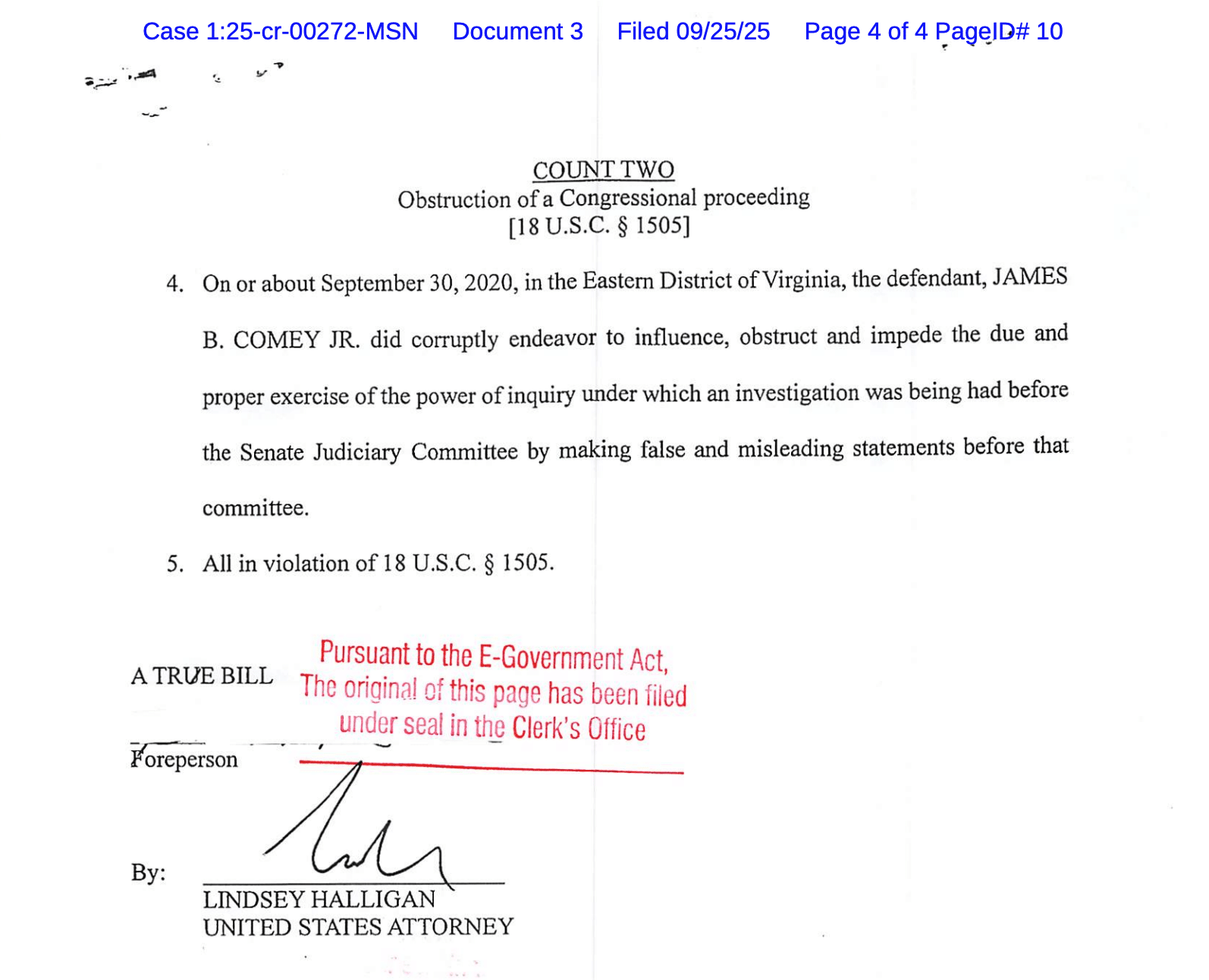
First, there are two indictments — or rather, three:

  • The no-billed indictment as Lindsey first presented it, with the signature page from the real indictment, which starts in blue ink and ends in black.
  • The no-billed indictment as it subsequently got corrected, with both a (claimed) signature from herself and the foreperson, all in blue ink.
  • The indictment purportedly supported by the grand jury, signed in black.

Lindsey now claims she only presented the case once, yet there are — or purport to be — two indictments.

For what it’s worth, when Amicus12 first pointed this out, I called the clerk to find out WTF, but have gotten no response.

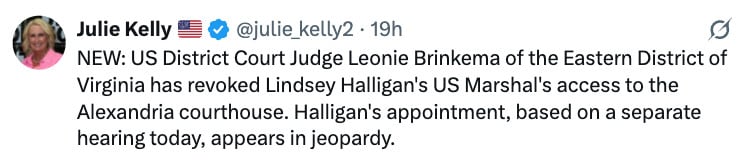
Also of interest, right wing propagandist Julie Kelly (who is quite chummy with Pam Bondi’s corrupt DOJ) claims that yesterday morning, the Chief Judge in EDVA, Leonie Brinkema, restricted Lindsey the Insurance Lawyer’s US Marshal detail from the courthouse.

But even if there’s not the colossal paperwork error there appears to be, there’s another problem.

The Loaner AUSAs confirmed … yesterday, that they plan to include Comey’s “Clinton Plan” statements — the stuff no-billed in original Count One — in the obstruction charge.

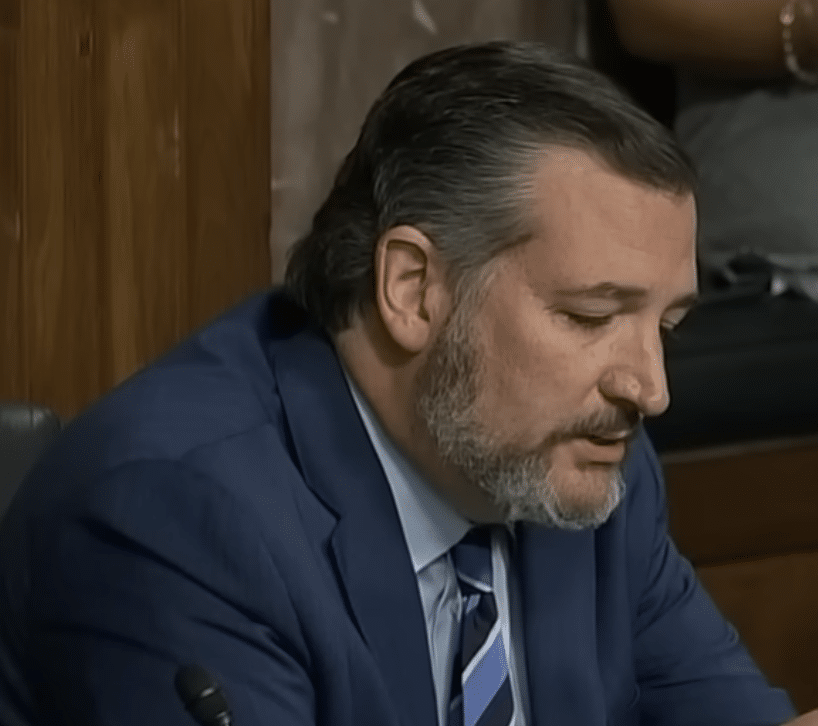
But, as provided in discovery and via the indictment, the government intends to seek the admission of evidence at trial on this count regarding the defendant’s statements to senators during the September 30, 2020, committee hearing. For instance, the defendant’s statements to Senators Grassley and Cruz regarding his use of Richman as an anonymous source concerning the Clinton email investigation and his statements to Senators Graham and Hawley regarding his alleged lack of memory concerning the so-called Clinton plan to “tie Trump” to Russia.

Comey attorney Pat Fitzgerald had already promised some challenge to this, in the halcyon days when everyone believed there were two presentments.

I think there’s another motion coming from us, in light of some disclosures that were made Monday, where we think that the government is expanding its case, we believe, to include the conduct that was no true billed in Count One as part of its proof of Count Two, which raises serious issues for us. So we’ll do everything we can, but to do all that while getting Mr. Comey access to materials…

But now Lindsey the Insurance Lawyer is claiming that she can rely on Count One even though grand jurors in the very same vote she’s claiming to rely on rejected that claim.

And Pam Bondi is signing on willingly to that claim.

Whatever else has happened, Lindsey the Insurance Lawyer has guaranteed that Comey will get to review what went down. The only remaining question, I suspect, is when he gets that — whether it is soon enough to help him throw out the evidence against him. But it seems like Judge Currie is not the only one alarmed by what she saw in these transcripts.

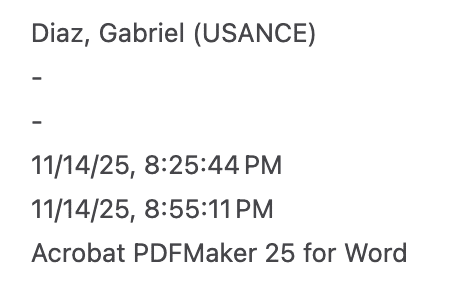
Update: I should add, given my continued obsession with the authors who have not noticed their appearance, Gabriel Diaz authored the document submitted today.

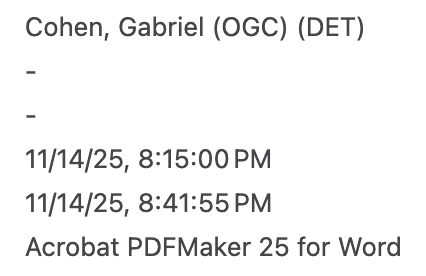
Meanwhile, Gabriel Cohen is the author of the digitally signed but unsworn declaration from Lindsey the Insurance Lawyer.

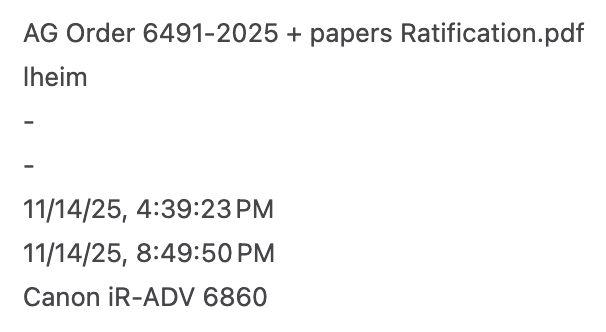
Someone named lheim authored Pam Bondi’s signed but unsworn declaration.

Update: Holy hell.

Lindsey the Insurance Lawyer appears to have resubmitted the entire package, not to fix her stupid story, but instead to fix her signature line (which Josh Gerstein first noted).

Update: Here’s the specific exchange about the missing stuff.

THE COURT: Let me ask you this. I was involved in receiving in camera provisions of the grand jury transcripts and tapes, and it became obvious to me that the attorney general could not have reviewed those portions of the transcript of the Comey presentation by Ms. Halligan which preceded and came after her presentation of the witness testimony in the case. There also is a missing section of what occurred between 4:28 and the return of the grand jury indictment, and it appears to me that there was no court reporter present, or if he or she was present, did not take down what happened during that time period.

So how does the attorney general ratify and say that she has reviewed the grand jury transcripts when they did not exist in the records of the Justice Department at that time?

MR. WHITAKER: Well, it’s true that — it is true, Your Honor, you’re right, that we didn’t have the intro and back end of the grand jury transcripts when we presented that.

Share this entry

Lindsey’s Loaner AUSAs Can’t Decide What the Clinton Investigation Is

Remember how I said that the hopeless confusion Tyler Lemons exhibited in his response to Comey’s motion to dismiss for vindictive and selective prosecution showed why Comey was right to request a Bill of Particulars? In that filing, Lemons played games with transcripts, confused what was a Clinton investigation, what a Russian investigation not yet focused on Trump, and what was, instead, inaccurate propaganda from John Solomon?

Well, if anything, the problem has gotten worse.

Loaner AUSA Gabriel Diaz submitted the following response memos today:

After Lemons spent 15 pages of last week’s vindictive prosecution response — laying out (A) November 2016 communications between Jim Comey and Dan Richman leading to this story, (B) February 2017 communications with Chuck Rosenberg leading to this story, and (C) May 2017 communications between Dan Richman and Mike Schmidt leading to this story, as well as presenting (D) a wildly misleading story about the “Clinton Plan,” the Gabriel[s] spent five pages throwing half that out.

(B) and (C) are gone, perhaps sacrificed to the reality that Dan Richman had left the FBI before those, meaning they didn’t fit the terms of Ted Cruz’ question. Or maybe, in the case of (C), to the possibility their attorney-client breach will blow up in their face.

After Lemons’ Response to vindictive and selection bitched twice that publicly available transcripts Comey had used included minor inaccuracies,

6 The transcript attached to the defendant’s motion non-substantively corrects Senator Grassley’s second question. See C-Span, User Clip: Sen. Grassley Questions James Comey (May 3, 2017), https://www.c-span.org/clip/senate-committee/user-clip-sen-grassley-questions-jamescomey/4853218.

[snip]

9 The transcript attached to the defendant’s motion non-substantively corrects Senator Cruz’s questions and the defendant’s first answer; the transcript also erroneously adds the word “that” to Senator Cruz’s final question and omits the word “is” from the same question. See, e.g., POLITICO, Archive: Sen. Ted Cruz questions James Comey on Trump and Clinton investigation leaks (Sept. 26, 2025), https://www.politico.com/video/2025/09/26/archive-sen-ted-cruzquestions-james-comey-on-trump-and-clinton-investigation-leaks-1759922.

The Response on Bill of Particulars noted that their own did too.

2 The Government’s response in opposition to the Defendant’s motion to dismiss erroneously omitted the word “the” before the words “Clinton investigation” in quoting Senator Cruz. See Dkt. 138 at 11.

Yet, if either the Response on Bill of Particulars or the Response to literal truth addresses this complaint from Comey, I don’t see it.

As detailed in Mr. Comey’s Motion to Dismiss the Indictment Based on Vindictive and Selective Prosecution, as well as the Motion to Dismiss the Indictment Based on Fundamental Ambiguity and Literal Truth, the text of Count One both misstates the testimony Mr. Comey actually gave and misquotes the question.

We’re two months into this thing and no one has gotten around to addressing the fact that the language in the indictment misrepresents what happened.

Remember: While Diaz said Lindsey the Insurance Lawyer showed 14 exhibits to the grand jury, none of those lay out the Cruz and Comey exchange, so we can’t entirely rule out Lindsey the Insurance Lawyer just … making up what was said, as she assuredly did in the indictment.

Then, having included a full transcript of the Cruz-Comey exchange in the filing, Lemons (or is it Shedd?) dismissed the way Cruz misspoke his lines — substituting “administration” for “investigation” in his question — this way.

The “other ambiguities” do no more to obscure the meaning of Senator Cruz’s questions. See Def. Mem., Dkt. 105 at 14. The defendant flags Senator Cruz’s mistaken use of “Clinton administration” instead of “Clinton investigation.” See Oversight Hearing Transcript at 11. Yet Senator Cruz had correctly referred to the “Clinton investigation” two sentences prior and he was recounting the defendant’s own testimony, so the mistake would have been obvious to the defendant.

But then it largely dodges the way Cruz framed his question to focus on Andrew McCabe.

Under the narrow interpretation, Senator Cruz asked the defendant only whether he authorized McCabe to be an anonymous source. Under the broad interpretation, Senator Cruz asked the defendant whether he authorized anyone at the FBI to be an anonymous source.

The broad interpretation is the better one.

That exacerbates a problem.

There wasn’t one — the — Clinton investigation in 2016.

There were two. And the one Cruz was invoking by addressing McCabe’s involvement in a WSJ story was not the email investigation. It was the Clinton Foundation investigation.

By October 25, 2016, McCabe had been notified that Barrett was working on a follow-up story to the October 23 article that would cover McCabe’s oversight of the CF Investigation and potential connections with McAuliffe campaign contributions to McCabe’s wife. McCabe thereafter authorized Special Counsel and AD/OPA to talk to Barrett about this follow-up story.

Lindsey’s Loaner AUSAs appear not to understand that we’re still fighting over a leak (plus McCabe’s response) that revealed a previously undisclosed investigation days before an election and somehow Trump is the victim? And so while they’re excusing Cruz’ imprecision they’re committing more of their own.

Now go back to the Response to the Bill of Particulars request. As Lemons did in the original map of the investigation, the Gabriel[s] buried the transcript for the exchanges about the “Clinton plan” in an exhibit, thereby burying the fact that they keep misrepresenting Lindsey Graham’s questions worse and worse. They don’t correct Lindsey Graham’s lie about this being an investigative referral. They couldn’t be bothered with the slop of his use of the word “taught.” And of course they don’t account for the fact that to Comey (and John Brennan), these details were interesting for what they said about Russia’s hacking of Hillary-related victims, not about the totally legal and normal thing Hillary was alleged to be doing, engaging in politics.

More insane still, the Gabriel[s] turn the “Clinton plan,” into a story about the Clinton email investigation.

During the same September 30, 2020 hearing, the defendant was asked by Senator Graham whether he remembered being “getting” or being “taught” of “a[n] investigatory lead from the intelligence community” regarding “U.S. presidential candidate Hillary Clinton’s approval of a plan concerning U.S. presidential candidate Donald Trump and Russian hackers hampering U.S. elections as a means of distracting the public from her use of a private email server,” i.e., the conduct that the FBI investigated during the Midyear Exam investigation. See Dkt. 138-14 at 1. The defendant replied that that information “d[idn’t] ring any bells with [him].” See id. He similarly informed Senator Hawley that he did not “remember” receiving the investigatory [sic] referral, or “anything described” therein. See id. at 5. The government has nevertheless determined that the defendant’s handwritten notes appear to show that he was informed in September 2016 regarding an “HRC plan to tie Trump.” See Dkt. 138 at 14–15; see also Dkt. 138-13. [my emphasis]

Note, the Gabriel[s] are misrepresenting the transcript here. Comey said, “I don’t remember receiving anything that is described in that letter,” referring back to the misleading letter Ratcliffe wrote about all this, not the referral itself.

Once again, proving Comey’s point that what prosecutors are presenting as the alleged lies are, themselves, lies.

Having misrepresented the alleged lie, some pages later, they confess that, yup, they’re prosecuting Comey for the conduct they got no-billed on.

But, as provided in discovery and via the indictment, the government intends to seek the admission of evidence at trial on this count regarding the defendant’s statements to senators during the September 30, 2020, committee hearing. For instance, the defendant’s statements to Senators Grassley and Cruz regarding his use of Richman as an anonymous source concerning the Clinton email investigation and his statements to Senators Graham and Hawley regarding his alleged lack of memory concerning the so-called Clinton plan to “tie Trump” to Russia.

I feel like maybe we’re a second or generation into frothy misrepresentations of what happened in 2016 and 2017, and these young AUSAs are badly in need of a roadmap laying out the actual events behind Grampa Trump’s delirium, rather than just regurgitating the slop that John Solomon feeds them.

There’s a reality here, and these Loaner AUSAs seem blissfully unaware of that reality.

And that’s all before you get into the fact that whatever frothy Republicans were misled into believing by Ratcliffe back in 2020, taxpayers have spent millions of dollars to confirm all this is Russian disinformation, and having determined that, those who use it to get indictments are (per John Durham and his lead investigator Jack Eckenrode) committing a crime.

Finally, having redefined Russian disinformation to be about Hillary’s email investigation rather than the conspiracy theory that the plan was true and proven by Christopher Steele getting snookered by Oleg Deripaska or Michael Sussmann passing along Rodney Joffe’s discovery of a real anomaly in good faith, they’ve made the “Clinton plan” useless for the one thing it might have been used for: materiality. As Comey noted in his Bill of Particulars motion, that 2020 hearing had a clear scope, and that clear scope must be adopted to define the scope of the investigation Comey allegedly obstructed.

1 Before the hearing, the committee agreed that it would be limited to four specific topics: (i) “Crossfire Hurricane,” (ii) the December 2019 Department of Justice Inspector General report’s “Review of Four FISA Applications and Other Aspects of the FBI’s Crossfire Hurricane Investigation,” (iii) the Carter Page FISA applications, and (iv) Christopher Steele’s source network and primary sub-source.

That wasn’t a hearing about Clinton’s emails! So every effort to retcon events so they’ll fit the Ted Cruz question in fact makes the evidence useless to prove Comey obstructed anything. Graham did, very much, want to suggest that Comey should have viewed the dossier more skeptically having been exposed to Russian disinformation claiming a Clinton plan, which is why he asked the question.

But Lindsey’s Loaner AUSAs, in a desperate bid to fit the available facts to their false claims about false claims, have turned it into something else.

Share this entry

Lindsey Halligan’s Seven Times 18-Minute Gap

Update As I lay out here, Lindsey Halligan has submitted a digitally signed unsworn statement saying that there is nothing missing from the transcript. One possible explanation is that she did not instruct the grand jury as to the law. In any case, she now appears to claim she only presented the case once.

It’s time to return to the mystery of the magical disappearing Jim Comey grand jury transcript.

On October 28, Senior Judge Cameron McGowan Currie — the woman presiding over Jim Comey and Letitia James’ challenge to Lindsey Halligan’s appointment, ordered the government to provide her, no later than Monday, November 3, 2025, at 5:00 pm, all documents relating to the indictment signer’s participation in the grand jury proceedings, along with complete grand jury transcripts.

On November 3, Currie revealed that when prosecutors gave her the transcripts on October 31, they hadn’t given her the part she most needed — revealing what Lindsey Halligan said to the grand jury — and ordered them to try again, asking them to provide a complete transcript and/or recording of what Lindsey the Insurance Lawyer did.

On Friday, October 31, 2025, the court received a package containing, inter alia, a “Transcript of Grand Jury proceedings on September 25, 2025.” This court has reviewed the transcript and finds it fails to include remarks made by the indictment signer both before and after the testimony of the sole witness, which remarks were referenced by the indictment signer during the witness’s testimony. In addition, the package contains no records or transcripts regarding the presentation of the three-count indictment referenced in the Transcript of the Return of Grand Jury Indictment Proceedings before the Magistrate Judge. See ECF No. 10.

Accordingly, the Government is directed to submit, no later than Wednesday, November 5, 2025, at 5:00 pm, for in camera review, a complete Transcript and/or recording of all statements made by the indictment signer to the grand jury on September 25, 2025, to include statements made prior to and after the testimony of the witness and during the presentation of the three-count and subsequent two-count indictments.

On the morning of November 5, Magistrate Judge William Fitzpatrick, presiding over Comey’s challenge to DOJ’s bid to breach his privilege, ordered the government to provide all of that to Comey.

As part of this, I am going to order the government to disclose to the defense all grand jury materials, not just the testimony of the agent, but anything that was said during the course of the grand jury. How the grand jury was instructed, any presentation to the grand jury, any questions that were asked of either the agent or the United States Attorney, all of that is to be disclosed because I think the defense needs that in order to marry up the information that they have or the information that they will get to how it was used.

Among the concerns Pat Fitzgerald raised was that Lindsey the Insurance Lawyer had presented materials pertaining to the “Clinton Plan” that had been rejected during her first attempt as part of her obstruction charge.

And on top of that, Your Honor, I think there’s another motion coming from us, in light of some disclosures that were made Monday, where we think that the government is expanding its case, we believe, to include the conduct that was no true billed in Count One as part of its proof of Count Two, which raises serious issues for us. So we’ll do everything we can, but to do all that while getting Mr. Comey access to materials…

Later that day, November 5, Loaner AUSA Tyler Lemons submitted a filing claiming he had complied with Currie’s order; he explained they had previously only provided the grand jury transcript that “was previously provided to the government [passive voice] by the transcription service.” But now, in response to Judge Currie’s order, they were providing “the complete recording.”

The Court had previously Ordered the government to provide, for in camera review, all documents relating to the indictment signer’s participation in the grand jury proceedings, along with complete grand jury transcripts. [DE 95]. In response, the government provided the transcript of the Grand Jury proceedings that was previously provided to the government by the transcription service.

The Court’s subsequent Order at Docket Entry 148 additionally requested the recording from the Grand Jury presentation. Upon receiving this order, the government immediately contacted the transcription service and requested the complete recording.

But Loaner AUSA Lemons did not make the grand jury transcript available to Comey. Instead, on November 6 (and in this order), he (or rather James Hayes, the guy at Main DOJ who keeps writing these things but who has not filed an appearance) claimed he would comply with the order to provide all the material seized from Dan Richman. Then he (or rather Hayes) appealed the order to share grand jury transcripts.

The next day, November 7, Judge Currie noted she had received the grand jury materials on November 5.

In advance of a hearing on November 10, Comey revealed that Loaner AUSA Lemons had not complied with Magistrate Judge Fitzpatrick’s order.

This Court subsequently entered a written order denying the government’s motion for implementation of a filter protocol and compelling production of seized materials4 and the grand jury materials, together with restrictions on further government review.

4 On November 6, 2025, the government produced various copies of what appear to be the raw returns for the search warrants at issue, unscoped for responsiveness and filtered for Mr. Richman’s privileges. But the government provided incorrect passwords to large subsets of those materials. The defense engaged a vendor who worked throughout the weekend to load and process those materials; the government provided the correct passwords on November 9, 2025.

5 The Order also required the government to provide, in writing, by the same deadline: “Confirmation of whether the Government has divided the materials searched pursuant to the four 2019 and 2020 warrants at issue into materials that are responsive and non-responsive to those warrants, and, if so, a detailed explanation of the methodology used to make that determination; A detailed explanation of whether, and for what period of time, the Government has preserved any materials identified as non-responsive to the four search warrants; A description identifying which materials have been identified as responsive, if any; and A description identifying which materials have previously been designated as privileged.” ECF No. 161 at 1-2.

Despite certifying on November 6 that it had complied with the Court’s Order, ECF No. 163, the government did not provide this information until the evening of November 9, 2025, in response to a defense inquiry. The government told the defense that it “does not know” whether there are responsive sets for the first, third, and fourth warrants, or whether it has produced those to the defense, and said that in that regard, “we are still pulling prior emails” and the “agent reviewed the filtered material through relativity but there appears to be a loss of data that we are currently trying to restore.” [my emphasis]

Nevertheless, Fitzpatrick adopted the government request that he first review the “transcript” to see whether Comey’s suspicions about privilege and Fourth Amendment violations could result in the dismissal of the entire indictment.

Later that day, November 10, the government submitted what should have been the grand jury materials for Fitzpatrick’s review.

At that point, both Judge Currie and Magistrate Judge Fitzpatrick should have had a record of everything Lindsey the Insurance Lawyer did in her attempt to indict Jim Comey.

In spite of the urgency, we haven’t heard from Fitzpatrick yet; I was wondering if he wanted to get a sense of how the Currie hearing today went.

But maybe he’s having the same problem Currie did.

In the disqualification hearing today, Currie revealed (ABC; CNN; Politico)  that nothing from 4:28 on was recorded.

Currie also laid into Whitaker during the hearing on whether Attorney General Pam Bondi had reviewed the grand jury transcript in James Comey’s case, noting there was no record of anything that happened after 4:28pm ET that day. Comey wasn’t indicted for nearly two hours after that, according to available court transcripts.

“It became obvious to me that the attorney general could not have reviewed” the entire proceeding, Currie said, adding that it appeared “there was no court reporter present” at the time of the missing portion.

In preparation for Thursday’s hearing, Currie privately reviewed the transcripts and said previously that she thought looking at the transcripts was “necessary to determine the extent of the indictment signer’s involvement in the grand jury proceedings.”

That’s what I said, Judge Currie!! Pam Bondi couldn’t have reviewed the transcripts when she claimed to ratify this prosecution on October 31!

If Lindsey presented in the order of the exhibit numbers, the latter part of this presentment focused on the Mike Schmidt communications and the “Clinton plan” documents — the things Comey expressed particular interest in. Plus, if you’re missing the latter bit of the presentment, you don’t have proof the grand jury voted to indict.

Remember that the foreperson did not specify that just one of the charges was no-billed (though there definitely were two indictments, both of which Lindsey the Insurance Lawyer signed).

Lindsey the Insurance Lawyer has done Rosemary Woods one, two, three, four, five, six, seven better, creating a gap of 139 minutes, from 4:28 until 6:47, over seven 18-minutes worth long.

Not bad for a rookie.

Update: Per CNN, DOJ claims nothing is missing.

In a statement to CNN following the hearing, a representative for the Justice Department denied that there was anything missing from the transcript.

“There is no ‘missing two hours.’ That time period refers to when the jurors were deliberating behind closed doors, which would not be included in a transcription,” the statement said.

The DOJ, however, did not offer an explanation for the gap in court.

Update: I think the answer is that the last bit of Lindsey’s instruction is missing, plus the entirety of the deliberation, which wouldn’t be recorded.

Update: Corrected “indictment” which would be dismissed for “transcript.”

Share this entry

“Witch Hunt!” Jim Comey Channels Media Matters

One of the most scathing passages in Jim Comey’s reply brief on his vindictive prosecution claim repeats something Media Matters does persistently to understand how Donald Trump’s brain works.

It’s a reply to this passage of the government response, which is the cornerstone to their claim that Donald Trump’s years of attacks on Comey weren’t animus, they reflected, instead, a sound concern about crime.

The defendant argues that he’s being prosecuted to punish him for being a “[v]ocal [c]ritic of President Trump.” Def. Mem., Dkt. No. 59 at 11. Yet according to his own version of events, the earliest that he “spoke out on public and political issues” was June 8, 2017. Id.; see Def. Mem., Dkt. No. 59-4 at 2 (pinning the earliest exercise of the defendant’s First Amendment rights to criticize the Trump Administration to a New York Times article published on June 8, 2017). By that point, however, the President had already accused him of committing a crime. On May 21, [sic] 2017, less than three weeks after the defendant first testified that he never “authorized anyone at the FBI to be an anonymous source in news reports about the Trump investigation or the Clinton investigation,” Def. Mem., Dkt. No. 59-2 at 4, the President publicly accused him of giving “false or misleading testimony,” Def. Mem., Dkt. No. 59-4 at 2. That accusation of criminal conduct was mounted before the defendant first stepped into his self-described role as a vocal critic of the President. And that “sequence of public events” should disabuse any notion that the defendant is being punished for exercising his First Amendment rights. See Wilson, 262 F.3d at 317 (reasoning that a defendant’s “theory on proving causation” will be “belied by the record” if the government’s “efforts to prosecute [him] preceded” his exercise of a protected right).

I focused closely on this passage — on other problems with this passage — here, noting that prosecutors had kicked off a fight about chickens and eggs.

I didn’t note that Lindsey’s Loaner AUSAs got the date wrong, May 21 instead of May 31 (Comey was generous enough not to note it), a date correctly recorded in both Comey’s appendices collecting these things (one, two).

[Note my screen cap is +5.]

But I missed the even bigger problem with this argument.

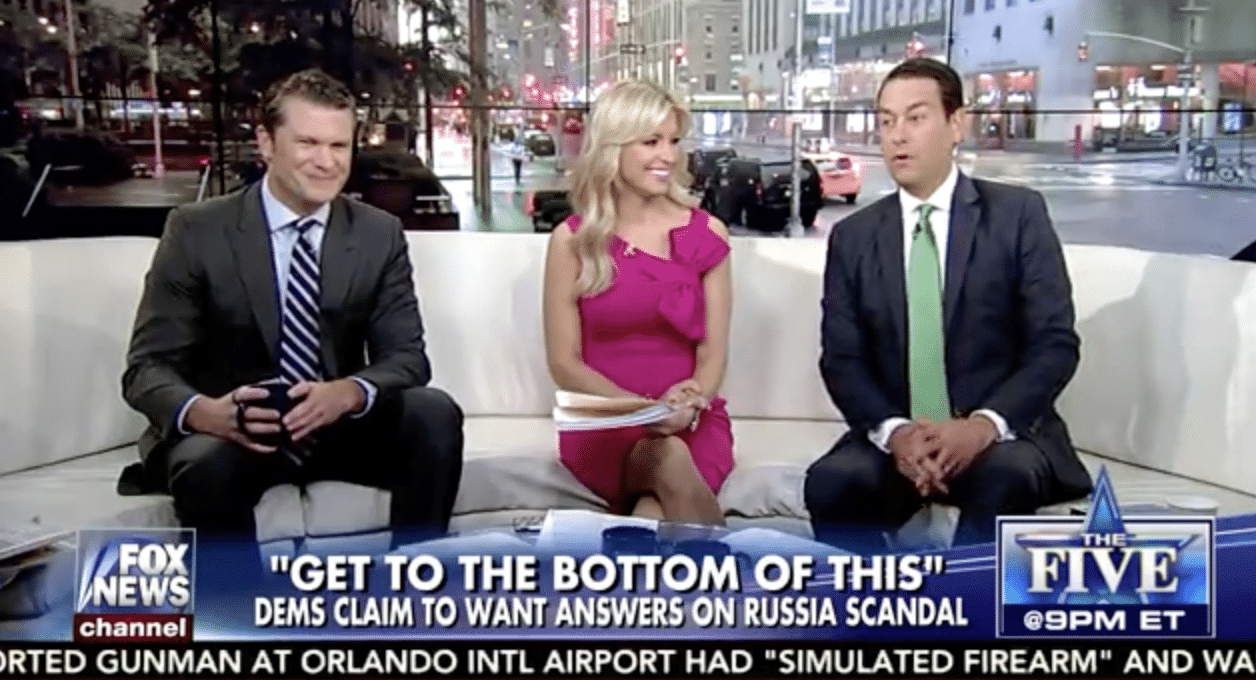
Lindsey’s Loaner AUSAs didn’t check what Trump was watching on Fox and Friends that day.

On May 19, 2017, in the uproar that followed, the Senate Intelligence Committee announced that Mr. Comey would testify before the Committee about his dismissal and the investigation into Russian interference with the 2016 election. Former FBI Director Comey Agrees to Testify in Open Session at Senate Intel Committee, U.S. Senate Select Committee on Intelligence (May 19, 2017), https://perma.cc/HC5K-KYUV.

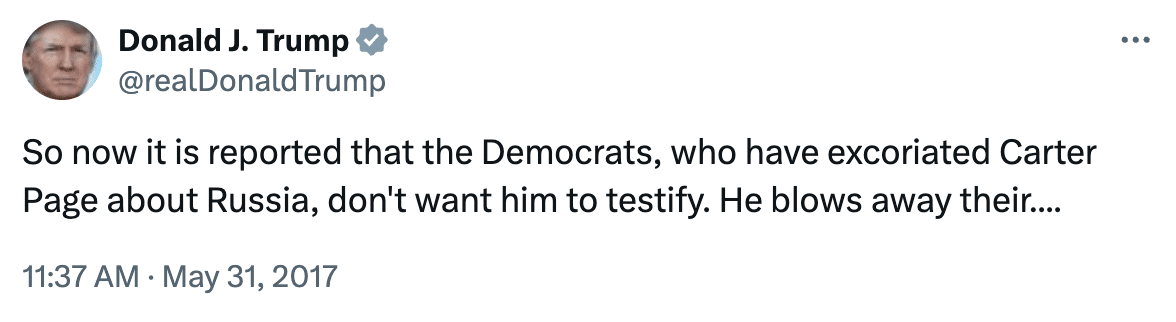
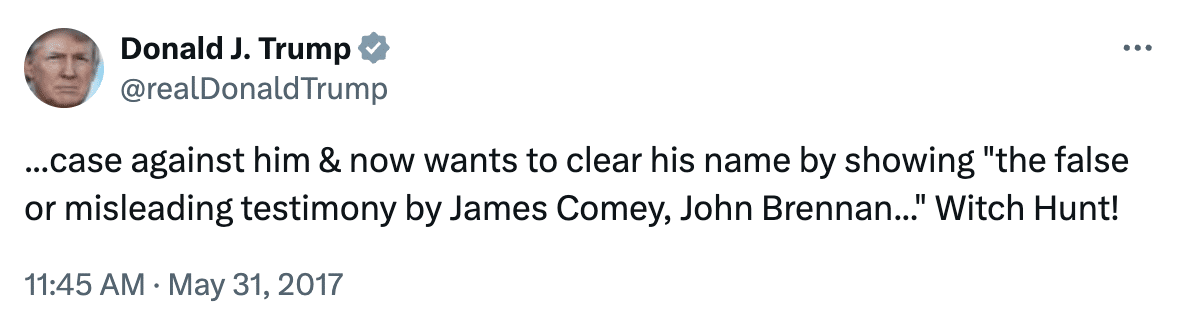
That announcement was followed on May 31, 2017, by the first of the President’s allusions to “false or misleading” testimony by Mr. Comey. The government suggests that this tweet shows that the President’s prosecutorial motive arose from Mr. Comey’s May 3, 2017 Senate Judiciary Committee testimony and that he voiced it before Mr. Comey entered into public debate. ECF No. 138 at 28. The tweet shows nothing of the kind.

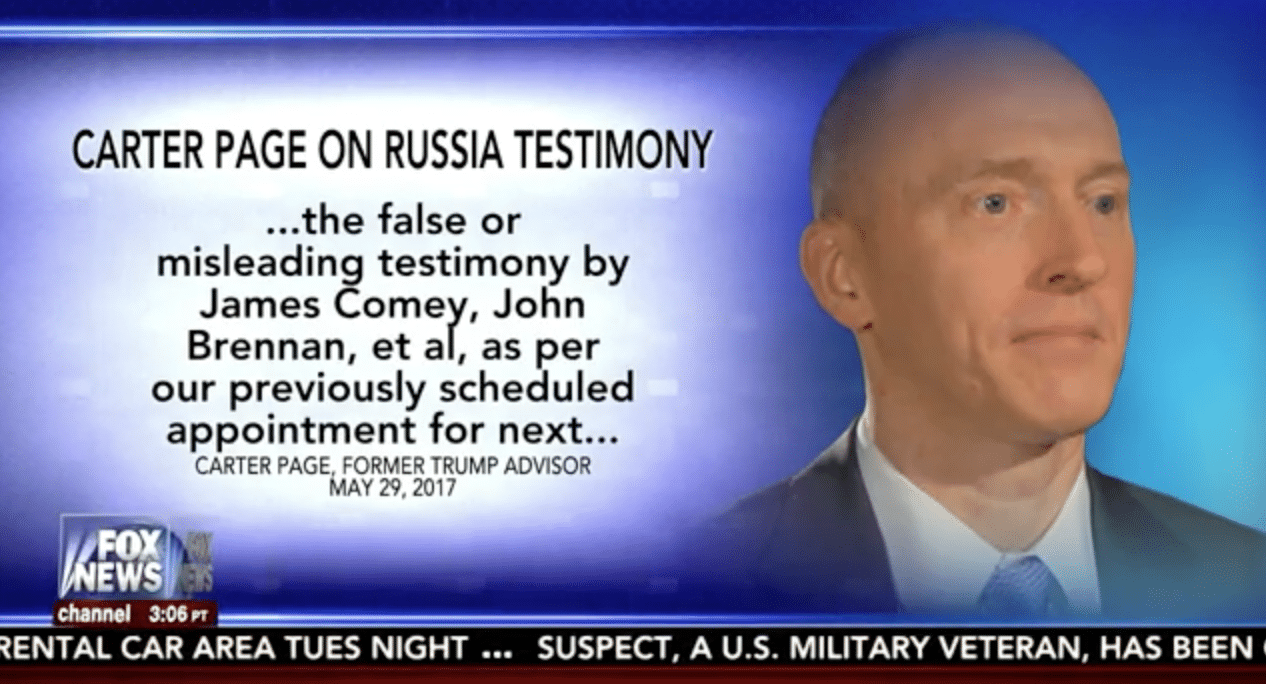
To begin, the tweet does not reflect the President’s opinion about Mr. Comey, nor does it refer to Mr. Comey’s May 3 testimony as the government misleadingly implies. Instead, the tweet quotes a report based on a conversation on Fox and Friends describing a letter written by former Trump campaign advisor Carter Page stating Page’s view of Mr. Comey’s March 20, 2017 testimony about links between the Trump campaign and the Russia government.5 This tweet can hardly qualify as expressing the President’s legitimate prosecutorial motive—as opposed to relaying hearsay from a television program with no factual basis. In fact, it is the type of unfounded accusation that displays animus rather than a genuine interest in justice. And despite the government’s reliance on it as preceding Mr. Comey’s public statements, the tweet came after the news broke about Mr. Comey’s imminent testimony, i.e., after the President knew that Mr. Comey intended to exercise his First Amendment rights to speak publicly about Mr. Trump’s conduct in office. The President’s preemptive effort to discredit Mr. Comey reflects his animus triggered by Mr. Comey’s anticipated protected speech.

Finally, and most damaging to the government’s theory of the President’s longstanding prosecutorial motive to bring this case, the tweet has nothing to do with this prosecution: it was issued years before the testimony that forms the basis for the charges against Mr. Comey.

5 The tweet (issued in two parts) says: “So now it is reported that the Democrats who have excoriated Carter Page about Russia, don’t want him to testify. He blows away their….” “…case against him & now wants to clear his name by showing ‘the false or misleading testimony by James Comey, John Brennan…’ Witch Hunt!” Appendix at 1. The tweet was issued thirty minutes after Fox and Friends broke the same story. Id. And Mr. Comey had testified publicly before the House Intelligence Committee on March 20, 2017, to confirm the Trump-campaign and Russian-interference investigation. See Mueller Report, supra n.4 at 52-53

Trump was parroting Carter Page complaining about Comey’s March 20 testimony, not commenting on Comey’s May 3 testimony, testimony that prosecutors want to make relevant to this case.

Donald Trump was parroting Carter Page and that’s what prosecutors claimed was the genesis of Trump’s purported good faith prosecutorial concern about Comey’s leaking.

Oops.

There is, to be clear, a fair amount of chicken and egg in Comey’s reply, too, some not entirely persuasive (though that pertains to their representation of the evidence prosecutors presented, not the legal argument, and so could be mooted if some of this gets suppressed). But it reads with the confidence of people who, now, have the exhibits with which prosecutors hope to prove their case, as well as a sense of whether and if so which exhibits will be thrown out as unlawfully obtained.

And in the process, Comey has demonstrated to the Loaner AUSAs how little they know about this whole story and the man whose batshit rants they’re treating as credible.

Share this entry

Gabriel Diaz’ 14 Exhibits

As I noted here, in a telephone hearing yesterday, Magistrate Judge William Fitzpatrick ordered the government to provide him with the grand jury transcripts in the Jim Comey case, which he will review after reading an ex parte filing from Comey’s team laying out the unlawful evidence they suspect got presented to the grand jury.

Loaner AUSA Gabriel Diaz may have helped them write that memo by confirming there were 14 exhibits presented to the grand jury.

His claim — that there were 14 exhibits — may not be entirely true.

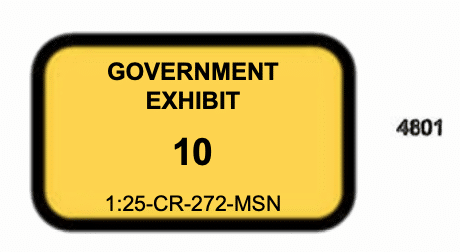
I say that because that number — 14 — matches the number of exhibits included in last week’s response to Comey’s vindictive prosecution claim (the reply to which Comey submitted yesterday, which I’ll return to). The exhibits posted to docket last week, which all include exhibit tags, consist of the following:

This order would suggest they laid out the evidence that Comey lied, focusing heavily on the 2016 exchange (the only one from when Richman was at the FBI), and presenting Comey’s April 23, 2017 thank you email to Richman ahead of Richman’s February 11, 2017 recruitment of Chuck Rosenberg, possibly creating the misimpression that Comey asked for Richman to weigh in on what became the April 2017 story.

Then they presented the Comey memo exchange (Exhibits 10 and 11), and the “Clinton Plan” (Exhibits 12-14). As presented, they did not present the “Clinton plan” referral itself to the grand jury (which might have made it even more apparent that Lindsey was not asking about what Comey’s notes laid out).

There must be at least one more exhibit as presented for the indictment the grand jury approved. As laid out here, the grand jury was not shown how Comey responded to Ted Cruz’ question (to say nothing of Chuck Grassley’s question on which Cruz’ question was based). That is, as laid out here, prosecutors did not include the exhibit that laid out the one lie actually charged.

There must be a video or something — though I find it interesting that they didn’t provide a transcript of Cruz’ question (if they didn’t), since he garbled it about ten different ways.

There are three other questions this exhibit list raises for me.

First, one concern Comey’s attorneys have is the treatment of the materials obtained with a second warrant for Dan Richman’s Columbia emails  — presumably the source of Exhibits 4-9.

What’s interesting is the Bates stamps for those are inconsistent. The earlier set are marked with a Richman Bates stamp.

The two later ones, including the one from the same Jim Comey ReinholdNiebuhr7 alias Gmail, have COLUM Bates stamps.

That suggests those two sets of communications were treated differently. Possibly, the earlier one was part of Richman’s privilege log.

The Bates stamps on the texts between Richman and Mike Schmidt also raise questions, because there’s no source of any kind noted (or if there is, it is redacted), just a series starting with 4801.

Given some of the other details we’ve learned: that all the Feebs involved in this report directly to Kash Patel, that the agent who read the attorney-client privileged text was reading the entire Cellebrite extraction of Richman’s phone — that is, without privileged texts removed — it raises real questions about whether some other team provided them, a team with its own (obscured) Bates stamp.

Worse still, the one of the two agents who read the privileged text attested that he only handed Miles Starr two pages of texts, all dated May 11.

SA Warren provided the indictment preparation team a two-page document containing limited text message content only from May 11, 2017, predating the reference to potential future legal representation.

But the exhibit is eight pages long!

Having been told there was privileged communication there and shielded from it, someone went back to those texts to get more of them, to present them to the grand jury. And that same someone led the Loaner AUSAs to believe that sharing the Comey memos after consulting with attorneys was a crime.

Effectively, SA Warren has reported a crime committed by his superiors, the willful violation of Jim Comey’s privilege.

Which is undoubtedly why James Hayes is so intent on letting the FBI lead a privilege review.

Finally, one more thing. Remember how weird the no-billed indictment is, which I laid out here?

The indictment the grand jury approved charged Comey with lying to Ted Cruz (as Diaz would have it, without being shown what that lie is), and obstructing a Congressional proceeding, “by making false and misleading statements before that committee.”

The exhibit list makes clear that Lindsey the Insurance Lawyer did shoehorn the no-billed charge into the obstruction charge, presumably treating questions about the Comey memos and “Clinton plan” — the only things in the indictment that were material to the scope of the hearing — as “misleading” rather than “false” statements. Last week, Pat Fitzgerald had said they were going to raise concerns about that this week, but they may be waiting to get that grand jury transcript.

Now go back and look at how that obstruction charges looks in the no-billed (top) and approved (bottom) indictment.

Update: As Amicus12 points out below, sometime within a day or so of the indictment, this error got fixed. Here’s what the fixed document looks like:

It is increasingly clear that Lindsey the Insurance Lawyer literally replaced what would have been Count Three of the no-billed indictment with Count Two of the approved indictment. That explains why that page has:

  • Staple and scan marks matching the real indictment
  • The numbering from the second indictment (these paragraphs should be numbered 7 and 8 in the no-billed indictment)
  • Both the signature of the foreperson (note the part of a signature that crosses into the “U” of the True Bill line) and Lindsey herself on that page

She simply swapped the page.

There’s good reason to ask whether she wasn’t just being dumb and inexperienced (which is what it looked like in the 7-minute hearing with the judge), but was also being deceitful.

For example, it’s possible that the original indictment charged Comey with obstructing the Senate’s investigation only by making false statements, but in a bid to get the material things in there pertinent to the larger investigation, the “Clinton plan” and the Comey memos, Lindsey the Insurance Lawyer added the word “misleading” to lower the bar to get a vote from the grand jurors.

It’s unclear whether Fitzpatrick will or can review some of these issues. He’s scrutinizing the indictment for unlawful and privileged exhibits. That also might explain why Diaz tried hard to prevent Comey from providing a list of things to look for.

The unlawful exhibits are bad enough. But there seems to be worse still.

Share this entry