
Public Finally Realizes Military Failed in Iraq & Afghanistan, But Will Pentagon & Pols Learn?
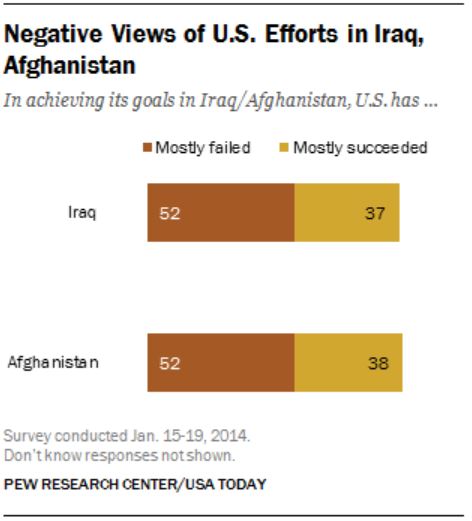
PewAt long last, after over twelve years of war in Afghanistan and nearly eleven years since the invasion of Iraq, the majority of citizens in the US admit that the vaunted US military failed to achieve its goals in either effort. A Pew poll released yesterday showed that in nearly identical results, 52% of Americans feel our goals were not met in either country, while 14 to 15% fewer felt we had met our goals.

Back in August, Lt. Col. Daniel Davis had one prescription for addressing these failures when he argued that it is time to “Purge the Generals“. I quoted extensively from his analysis in a post shortly after it was published, but one of the primary points from Davis is that for too long, military leaders have lied about the status of military missions and never faced any consequences for their false claims of success.

We have seen a partial purge of higher military ranks lately, but these removals have been primarily for offenses that have caused acute embarrassment to the military, such as being caught using counterfeit poker chips in a casino. Congress also plays a huge role in the promotion of lies about success in military missions. As I noted last April, Armed Services Committee member Jack Reed delighted in getting Dunford to enter into the record a statement that we were “winning” in Afghanistan at the time.

The Pentagon and other inhabitants inside the Beltway would benefit greatly from some soul-searching into just how these two misadventures were allowed to start in blind rage and then be so badly mismanaged for so long. Of course, that will never happen, but we now have reached the stage where the folks who have paid the bill for the fiasco realize that the lives, money and effort have all been wasted. With public opinion running so strongly against the two latest high-profile wars, our politicians and the Pentagon will have to content themselves now with more clandestine actions using the Special Operations Forces that are deployed in over 100 countries around the globe.

Share this entry

Reuters Allows Anonymous “Diplomats” to Blame Syria for Delays Mostly US’ Fault

Yesterday, Reuters granted anonymity to “sources”, including two who are each identified as “a senior Western diplomat”, to blame Syria for delays in shipping its chemical weapons-related materials out of the country. Only when we get to the very last paragraph of the article, though, do we get to the fact that these chemicals are to be destroyed aboard the Cape Ray, a ship which the US has outfitted with equipment for destroying the chemicals at sea. The article does note that the Cape Ray is now in transit to the region, but it fails to note that even though the original plan was for the Cape Ray to begin its work by the end of December, the ship did not leave the US until January 27. Allowing for transit time to get to the region, it would appear that the US delay in supplying the Cape Ray can account for the bulk of the 6-8 weeks by which Syria is reported to be behind schedule.

The anonymous smears hit paydirt, prompting Laura Rozen to wonder whether the delay would force the US into taking “kinetic action”. Fortunately, Cheryl Rofer saw through the ruse immediately, calling out the reliance on anonymous diplomats and cautioning that the situation falls far short of anything requiring such a response.

Before getting to the accusations transcribed by Reuters, it is important to go back to what we knew in early December when the plan for destroying the chemicals at sea was first announced. In my post about that development, I had this quote from a BBC article:

It is believed that the chemicals, all but 30 tonnes of which take the form of precursors – two or more of which have to be mixed to create the lethal agents – have been gathered in several marshalling areas by the Syrian army and amount to more than 600 tonnes. The other 30 tonnes consist of mustard gas.

This is very important context that is entirely lacking in the Reuters article: by early December, we knew that Syria had already gathered the key materials into “marshalling areas” where they were being held prior to destruction. Also missing from the Reuters report is that back in early November, Syria completed destroying all of the equipment that can be used for mixing binary chemical weapon agents and loading them into shells for firing. Note, too, that only about 30 tons of the material is intact active chemical agent rather than materials that have to be mixed to produce the agents.

Reuters opens: Read more

Share this entry

US Doubles Down on “Crazy Karzai” Meme

As the US military bumbles and stumbles toward an ignominious exit from Afghanistan that is looking more and more like it will follow the script from the Iraq exit, it appears that the final ploy from Washington is an effort to paint Afghan President Hamid Karzai as detached from reality. This current ploy seems to be serving two purposes. First, it attempts to set the stage for an end-run around Karzai in a last-ditch effort to get some other party to sign the Bilateral Security Agreement allowing US troops to stay in Afghanistan after the end of this year. Second, it is obscuring yet another incident of indiscriminate US air raids and affiliated operations resulting in civilian casualties. Totally missing from these US actions is any awareness that Afghans cooperating with the US in this operation could well be motivated by the upcoming elections or an appreciation that the willingness of some Afghan citizens to participate in fabricating charges against the US isn’t necessarily an endorsement of the Taliban as much as it represent the intense desire of many Afghans to get the US out of their country after 13 years of war.

The current circus was precipitated by the January 15 incident in the Ghorband District of Parwan province. As I noted right after it happened, distinctly different accounts of what happened appeared in the New York Times and Washington Post. Karzai appointed a commission to investigate the incident. Leading the commission was Abdul Satar Khawasi. He is a member of the Afghan Parliament and represents Parwan. He also is known to be anti-American, and articles about the commission’s report from both ToloNews and the New York Times mention a video in which he appears and:

Mr. Khawasi is heard urging a crowd of angry Afghans to wage a holy war against Americans, saying, “Anyone who sits silent is a traitor.”

The Times pointed out just after the report was released that at least one photo in the report was from 2009, but now the entire report is being questioned by the Times because of that one photo:

The CD-ROM contains nine other photographs, all of which appear to be frames from a video clip on the disk. The video purports to show the funeral of villagers who were killed in the airstrikes and houses that were destroyed. The graphic images include some of a woman whose face is gone.

The Times’ examination found no physical clues in the video that would help determine where or when it was shot. The file’s creation date is Dec. 18, nearly a month before the raid, though it may not be accurate; digital time stamps on the accompanying photos say they were created in April 2014, and the video’s embedded data could be similarly unreliable.

Even if the video is actually of a funeral in Wazghar, some Afghan and Western officials said there was no way to tell from it whether an airstrike or some other gunfire or explosion had killed the people seen being buried, or who was responsible.

But even though an Afghan villager was brought out to “identify” fellow villagers in the false photo in question, this whole episode of discrediting the commission’s report still has one major problem: Read more

Share this entry

The Unspeakable Tragedy of Homeless Drones

Yesterday, I speculated on whether Pakistan’s Prime Minister Nawaz Sharif was turning his back on his campaign promise of peace talks with the Taliban so that he could seek US counterterrorism funds suddenly not being used in Afghanistan. Today’s New York Times joins me in pointing out the key role of counterterrorism in an important US-Pakistan meeting in Washington today:

Secretary of State John Kerry is to meet Pakistan’s foreign and national security policy adviser, Sartaj Aziz, here on Monday, and counterterrorism operations are to be a major subject of discussion, a senior State Department official said Sunday.

The Times article, however, centers on a key piece of context that I hadn’t brought into yesterday’s speculation. The growing likelihood that all US troops will be forced to withdraw from Afghanistan by the end of this year in the absence of a signed Bilateral Security Agreement means that the US needs a new home for its drones:

 The risk that President Obama may be forced to pull all American troops out of Afghanistan by the end of the year has set off concerns inside the American intelligence agencies that they could lose their air bases used for drone strikes against Al Qaeda in Pakistan and for responding to a nuclear crisis in the region.

/snip/

The concern has become serious enough that the Obama administration has organized a team of intelligence, military and policy specialists to devise alternatives to mitigate the damage if a final security deal cannot be struck with the Afghan president, Hamid Karzai, who has declined to enact an agreement that American officials thought was completed last year.

If Mr. Obama ultimately withdrew all American troops from Afghanistan, the C.I.A.’s drone bases in the country would have to be closed, according to administration officials, because it could no longer be protected.

Oh, the horrors of it all! Who can bear the tragedy of all those poor, homeless drones, wandering around the world with no base close enough for a rapid trip inside the borders of a sovereign nation that has stated in no uncertain terms that it considers drone strikes to be illegal and to be war crimes?

The Times article reminds us that the US once used a base inside Pakistan for drone flights:

Their base inside Pakistan was closed after a shooting involving a C.I.A. security contractor, Raymond Davis, and the raid into Pakistani territory that killed Osama bin Laden, both in 2011.

That bit simplifies the Shamsi Air Base story a bit. While it is true that Pakistan stated that they were kicking the US off the base in June of 2011, not very long after the Osama bin Laden raid (and a bit longer after the Raymond Davis fiasco), the US didn’t actually leave the base until December, after the US killed 24 Pakistani troops at a border station.

So it would seem to me that in today’s talks with Aziz, Kerry will be dangling a couple billion dollars that will be Pakistan’s for the taking, but only if they meet two conditions. Condition one will be to continue Sharif’s new-found enthusiasm for attacking militant groups and condition two will be to re-open Shamsi air base for the US to continue drone operations.

Should such an agreement come to pass, it would completely invalidate the elections that Pakistan held last May, in which Pakistan for the very first time experienced a peaceful transition from one elected government to another. One of Sharif’s main campaign points was the establishment of peace talks with the Taliban. He now is carrying out military actions against them instead. Imran Khan, who came in second in the election, campaigned on a pledge to end US drone strikes. Opening a base inside Pakistan for US drones would render votes cast for Khan meaningless.

Perhaps the only solace that the US would be able to offer Pakistan should they agree to re-open Shamsi to drones would be that after the formal US withdrawal from Afghanistan, the base in Shamsi would almost certainly be used by the US to violate Afghanistan’s sovereignty on a regular basis, just as the US has been doing lately to Pakistan from Afghanistan.

Share this entry

Is Sharif Making a Play for Counterterrorism Funds US Cut from Afghanistan Budget?

Back in early November, the US carried out one of its most controversial drone strikes in Pakistan, killing TTP head Hakimullah Mehsud just hours before peace talks between the TTP and Pakistan were to begin. This move by the US seems to have pushed the TTP in a more radicalized direction, resulting in many new attacks. Pakistan’s government has responded to these attacks with counterattacks, effectively putting an end to prospects for restarting the talks.

Today, we see Sharif’s government vowing to take on another radical Sunni group, this time in Balochistan:

The government has finally decided to launch an operation against the feared Sunni terrorist outfit, the Lashkar-e-Jhangvi, and other militant groups involved in fomenting unrest in Balochistan.

The decision was taken in a meeting attended by Interior Minister Chaudhry Nisar, Balochistan Chief Minister Dr Abdul Malik Baloch, the Quetta corps commander, the Balochistan inspector general (IG) police and the Frontier Corps IG.

Dr Baloch was made in-charge of the operation against Lashkar-e-Jhangvi.

It is important to mention that the decision to launch an operation against terrorists was taken following an attack on Shias in Mastung that killed 29 pilgrims on Tuesday.

Significant government resources were brought in quickly after the attack on the bus:

The Government of Balochistan has suspended buses carrying pilgrims from travelling through the province to neighbouring Iran due to security concerns after a suicide attack killed 28 pilgrims in Mastung this week.

A 700 km highway connecting Quetta and Iran, home to many Shia pilgrimage sites, has seen dozens of suicide and roadside bomb attacks.

“We have temporarily suspended the movement of buses on the highway until the security situation improves,” a senior official of the Balochistan government told Reuters on Friday.

The provincial government then arranged C-130 flights to ferry 301 Shia pilgrims from Dalbandin town in Chagai district to Quetta International Airport for fear of more attacks on the pilgrims on Taftan-Quetta Highway. The pilgrims had entered Pakistan via Iran border in Taftan Town on Wednesday.

“The pilgrims were stopped in Taftan and barred from travelling by passenger buses. They were later shifted to Dalbandin under tight security,” another official said.

FC and Levies personnel escorted the pilgrims from Taftan to Dalbandin.

Although the C-130 flights were provided by the provincial government, the Frontier Corps is under the control of Pakistan’s army and so there appears to be national coordination in this response, as is also indicated by Nisar being mentioned in the Pakistan Today article quoted above (Prime Minister Nawaz Sharif, although not mentioned in the article, is in the accompanying photo).

Almost under the radar, we get word that talks begin in Washington, DC tomorrow on the “strategic” relationship between Pakistan and the US. It appears that counterterrorism is high on the list of topics under discussion: Read more

Share this entry

You Can’t Spread Justice in an Insecure Country

Back in July, SIGAR noted that $50 million in US funds had been awarded in a sole source contract secured only by a short letter of agreement between the Department of State and the contractor, the International Development Law Organization, known as IDLO.  That contract was for one of three programs that are administered by State’s Bureau of International Narcotics and Law Enforcement Affairs (INL) under the overall program called the Justice Sector Support Program, JSSP. IDLO’s contract covers Regional Justice Sector Training. PAE, which previously had been the contractor for all of JSSP, retains responsibility for the other two programs, a Case Management System and Institutional/Administrative Capacity Building. Over $200 million has been invested by INL for JSSP.

In an audit released today (pdf) SIGAR found that the contract with PAE is limited in how PAE’s performance can be assessed and whether the goals of JSSP are being achieved.

There is a much larger overall problem, though, and it is in how this program, like all of the rest of US plans for Afghanistan, was scuttled by the abject failure of the military to bring peace to Afghanistan. Note that the original plan was for the justice program to spread throughout Afghanistan. But the abject failure of the military to stabilize the country means that this program only was able to address small portions of the country:

Specifically, under the May 2011 statement of work agreed to between INL and PAE, the case management system was supposed to be completed nationwide by May 2012. However, geographic, logistical, and other challenges prevented PAE from expanding the electronic, internet-based case management system beyond 7 of 34 of Afghanistan’s provinces. As a result, INL modified the contract by replacing the requirement for a nationwide system with one that required implementation in only the seven provinces where it had already been installed.

So a portion of the program meant for all of the country wound up being operational in only 7 out of 34 provinces because of many failures, but I suspect that the indirect language in this section is meant to gloss over security failures being the main reason for restricting the reach of the program. I see no evidence that the budget for this portion of the program was cut to reflect the smaller size, so I wonder if PAE merely got to pocket what they would have spent expanding to the missing 27 provinces.

As noted back in July, the transfer of a portion of JSSP to IDLO was suspect. Today’s audit doesn’t reduce the concerns about IDLO: Read more

Share this entry

Does the Military Have a New Goal of Hanging Afghanistan Failure on Obama?

On Monday, I could only reply with the Twitter equivalent of uncontrolled laughter when Robert Caruso tweeted a quote from Stanley McChrystal, who was appearing on Morning Joe to hype the paperback release of his book. Responding to a question from Al Sharpton, McChrystal said, in Caruso’s transcription, “the military doesn’t have goals…we follow the policy of the nation”.

Of course, as Michael Hastings so exquisitely documented, McChrystal and his band of merry operators had as their primary goal the advancement of their own careers while also promoting the concept of forever war. And as Gareth Porter points out, David (ass-kissing little chickenshit) Petraeus gamed Obama on the end date for the surge in Afghanistan, significantly extending the time of maximum troop presence (and maximum fund flow to contractors). It is equally important not to forget the Pentagon operation that places “analysts” with television news operations, somehow always finding analysts whose views align with Pentagon goals of forever war (and more purchases from the defense contractors who employ these same analysts when they go to the other side of the revolving door). Yes, Eisenhower foresaw all of this and yet we ignored his warning in 1961.

But somehow last night’s headline from the Wall Street Journal seems on first blush to run counter to the concept of forever war. We are now told that the military’s latest plan for a troop presence in Afghanistan beyond the end of this year (pending a signed BSA, which is certainly not a given) would be only 10,000 troops (a significant reduction from previous ideas that have been floated) and that these troops would be drawn down to essentially zero in another two years, ending precisely with Obama’s term in office. The Journal offered this by way of explanation:

The request reflects a far shorter time frame for a U.S. military presence in Afghanistan than commanders had previously envisaged after the current international mission ends this year. The new approach is intended to buy the U.S. military time to advise and train the Afghan army but still allow Mr. Obama to leave office saying he ended America’s longest war, the officials said.

So the military is pitching this latest plan as being an opportunity for Obama to claim “success” in ending the war. But we all know that the effort in Afghanistan has been an abject failure that has achieved absolutely nothing beyond killing a huge number of Afghans along with far too many coalition troops while squandering an obscene amount of US money. Instead, this looks to me more like the military moving to try to hang its failure on Obama by not extending the quagmire into yet another presidential administration. And that view seems to me to be reinforced by the military’s framing of Obama’s options:

Military leaders told Mr. Obama that if he rejects the 10,000-troop option, then it would be best to withdraw nearly all military personnel at the end of this year because a smaller troop presence wouldn’t offer adequate protection to U.S. personnel, said officials involved in the discussions.

The military wants this debacle to end during Obama’s term no matter what, and you can bet that is because their goal is to blame him for their failure.

But lest we raise our hopes that sanity has finally broken out within the walls of the Pentagon and that the generals finally have learned to hate war, we have this gem from Reuters: Read more

Share this entry

Attacks and Counterattacks: TTP and Pakistani Military Escalate Actions

The past three days have seen a number of major attacks between Pakistan’s Taliban, known as the TTP, and Pakistan’s military. On Sunday, a bomb exploded in a van transporting Pakistani troops, killing 20. This attack took place in Bannu (Bannu will return to this story in a moment). On Monday, a suicide bomber killed 13 just a few meters from the outside wall of the General Headquarters of the Pakistani Army in Rawilpindi. Today, Pakistani jets killed at least 24 with bombs dropped in North Waziristan.

It appears that in the Sunday attack, the bomb was in a vehicle rented for transporting troops:

“The explosion took place in a civil Hiace van inside Bannu Parade Ground at 8:45 am,” a senior military official told The Express Tribune. The blast occurred just as Frontier Corps (FC) troops had stepped into the van ahead of their departure.

“The K-P paramilitary unit had rented a vehicle from the market for movement of its troops,” he added. The vehicle was supposed to carry the soldiers to Razmak, a town in North Waziristan Agency.

/snip/

“It wasn’t immediately known whether it was a suicide bombing or the device was detonated through a remote control,” he added. “The van driver was also killed in the blast.”

The suicide bomber in Monday’s attack was first seen on a bicycle:

District Coordination Officer Sajid Zafar Dall said that at the time of the attack a gaggle of children were heading to school. “Our initial assessment is that the bomber was possibly on a bicycle and he then approached the target on foot,” he added. Since it was morning time, RA Bazaar was bustling with office-goers and schoolchildren.

Quoting eyewitnesses, Sardar Zulfikar, the SHO of RA Bazaar police station, said the bomber was walking towards the GHQ but detonated the explosive vest the moment he saw army troops at RA Bazaar’s main roundabout, T-Chowk. The building of National Logistics Cell is located nearby.

/snip/

The RA Bazaar is considered a high security zone due to its proximity with the GHQ. Police investigators believe the bomber intended to target the military headquarters. However, he couldn’t get to his target due to the tight security.

Today’s bombing by the Pakistani Air Force appears to be in response to these attacks:

Several suspected militant hideouts were trampled by Pakistan’s military’s fighter jets in Mir Ali area of the North Waziristan, killing at least 24 persons and wounding 15 more, various local news channels reported on Tuesday.

The air strike followed a series of terrorist attacks across Pakistan in the past week, including Monday’s blast on a check post in Rawalpindi that martyred 6 army personnel and 7 civilians. Tehreek-e-Taliban Pakistan had claimed the responsibility for the attack. The events had led to a mounting pressure on Prime Minister Nawaz Sharif to take tougher decisions in response to the recent attacks by TTP.

“This hadn’t been planned before, and Pakistan Air Force jets were called to hit hideouts of the militants involved in attacks on security forces,” said one military official speaking on condition of anonymity.

It appears that the operations by Pakistani forces are continuing in several locations in North Waziristan.

At least one key TTP figure killed in today’s bombing has been identified. He has a very interesting history: Read more

Share this entry

Not Content With Stoking Iran Tensions Through “Analysis”, Albright Tries His Hand at Legislation

It’s no secret that I am hardly a fan of David Albright and his Institute for Science and International Security. He often has been the “go to” authority when countries hostile to Iran have chosen to leak selectively groomed information to put Iran in the harshest possible light. The countries leak the information to a select few journalists and then Albright is called in to provide his “analysis” of how evil Iran is and how determined they are to produce nuclear weapons.

I also have been hammering hard on Robert Menendez’s Senate bill that calls for increased sanctions on Iran. As Ali Gharib noted immediately, the bill spells out conditions for the final agreement between Iran and the P5+1 group of countries that we know Iran will never agree to, so the bill guarantees that the new sanctions will eventually kick in, even if a final agreement is reached.

The New York Times is finally catching up to the points Gharib made almost exactly a month ago:

But where the legislation may have an effect, and why it so worries the White House, is that it lays down the contours of an acceptable final nuclear deal. Since administration officials insist that many of those conditions are unrealistic, it basically sets Mr. Obama up for failure.

/snip/

White House officials zeroed in on three of the conditions: first, that any deal would dismantle Iran’s “illicit nuclear infrastructure”; second, that Iran “has not directly, or through a proxy, supported, financed, planned or otherwise carried out an act of terrorism against the United States”; and third, that Iran has not tested any but the shortest-range ballistic missiles.

“They’re basically arguing for a zero enrichment capacity, with a complete dismantling of Iran’s nuclear facilities,” said Daryl G. Kimball, executive director of the Arms Control Association. “That’s not attainable, and it’s not necessary to prevent Iran from getting a weapon.”

I was not at all prepared, though, for what the Times learned about how this abhorrent piece of legislation was crafted:

Proponents of the bill deny it would deprive Iran of the right to modest enrichment. They point to the qualifier “illicit” in the reference to nuclear facilities that must be dismantled, and they say the language on enrichment is intentionally vague to mollify both Republicans, who are reluctant to grant Iran the right to operate even a single centrifuge, and Democrats, who balked at signing on to a bill that would rule out all enrichment.

“There’s no language that says a centrifuge is prohibited or allowed,” said David Albright, an expert on Iran’s nuclear program at the Institute for Science and International Security, who helped Republicans and Democrats draft some of the technical wording.

The ambiguity, he said, reflected the fact that the lawmakers who sponsored the bill are “doing it in a bipartisan way, but they have disagreements on what the end state should look like.”

Oh. My. God.

To craft one of the most important bills in US foreign policy in over a decade, Menendez and his cronies turned to an “analyst” who has a long history of producing precisely the analysis that war hawks want. And he even has the gall to brag about how the weasel words that he crafted have different meanings depending on who is reading the bill.

I really have to just stop right here and let commenters fill in the rest for me. My health and sanity won’t let me think any further on the ramifications of David Albright writing legislation on US foreign policy toward Iran.

Share this entry

Latest Night Raid Afghan Civilian Deaths Put BSA into Further Doubt

Back in October, I noted that one of Hamid Karzai’s primary barriers to signing the Bilateral Security Agreement is his objection to night raids carried out by US-trained death squads because of the high rate of civilian casualties involved. Yesterday, yet another night raid went bad, but this time, instead of the death squad killing civilians, an air raid called in when the raiding party came under heavy fire was responsible for civilian deaths. In an attempt to deflect blame, ISAF tried to emphasize that this mission was Afghan-led:

International Security Assistance Force regrets that civilians were killed Jan. 15 during a deliberately-planned, Afghan-led clearing operation to disrupt insurgent activity in Ghorband district, Parwan province.

The mission, led by commandos of the 6th Special Operations Kandak and supported by ISAF special operations advisers, was conducted to disrupt insurgent activities in the district, including attacks on Bagram Airfield, and in support of Afghan National Security Forces’ tactical priorities. Local district and provincial officials were informed in advance of the operation and were provided updates during and after the actions.

It would not surprise me if ISAF eventually blames the “local district and provincial officials” who were warned for tipping off the insurgents so that an ambush could be carried out. But note that “ISAF special operations advisers” were present, and as I have noted previously, this is the hallmark of the US-trained death squads that have previously operated with impunity but have infuriated Karzai. Even though ISAF is claiming that the intelligence for the operation was generated by the Afghans, you can bet that our “advisers” would not have ventured off their base if our own intelligence hadn’t also been involved in planning the attack.

Strangely, the NYTimes article linked above puts the operation taking place at 6:30 am, but the Washington Post puts it at 1 am, which fits night raid timing much better. The details in the two stories differ substantially. From the Times:

Aziz Ahmad Zaki, a spokesman for the governor of Parwan, said that the coalition Special Operations advisers had come to assist the Afghan forces in the area, setting up alongside them in a district check post that quickly came under fire from Taliban attackers on Tuesday.

Around 6:30 a.m. Wednesday, Afghan and coalition forces began a clearance operation in the Wazghar Valley, but ran into a Taliban ambush, taking fire from several compounds in the area at once, officials said.

“Afghan and coalition forces returned fire and required defensive air support to suppress the enemy fire,” according to the coalition statement.

But according to the Post, the raiding party attempted to enter a home at 1 am, rather than conducting a “clearing operation” at 6:30:

According to Karzai and the governor of Parwan province, the incident occurred about 1 a.m. when U.S. Special Forces attempted to enter a home. A gun battle ensued, resulting in a coalition airstrike that killed the children and a female relative in the house, they said.

This version says nothing about being attacked at a checkpost but instead follows a usual night raid routine.

Karzai is furious. From AFP:

President Hamid Karzai on Wednesday accused the United States of killing seven children and a woman in an airstrike in central Afghanistan — an incident set to further damage frayed ties between the two allies.

Relations between Washington and Kabul have been rocky for years, and negotiations over an agreement that would allow some US troops to remain in the country after this year have broken down into a long-running public dispute.

“As a result of bombardment by American forces last night… in Siahgird district of Parwan province, one woman and seven children were martyred and one civilian injured,” a statement from Karzai’s office said.

“The Afghan government has been asking for a complete end to operations in Afghan villages for years, but American forces acting against all mutual agreements… have once again bombarded a residential area and killed civilians.

The zero option in Afghanistan is looking more and more likely.

Share this entry