Donald Trump’s [Miles] Starr Chamber

When the government first asked, on October 13, to use a filter review to access content seized from Dan Richman five years ago, it described that Jim Comey, “prefers to challenge the underlying search warrant first before any review takes place.”

But in his response yesterday, Comey didn’t do that.

Rather, after a heavily-redacted discussion of the problems with DOJ’s past and prospective access to the content, he proposed that Judge Michael Nachmanoff should deny the government’s filter request without prejudice, allowing DOJ to reconsider its bid for a filter protocol after they’ve first answered a set of questions.

For the foregoing reasons, the Court should deny the government’s motion to implement its proposed filter protocol without prejudice, and direct the government to disclose the following information to allow both the Court and the defense to assess the appropriateness of the protocol:

1. The legal authority for the contemplated review.

2. Whether any quarantined materials have been accessed by, shared with, or provided to the case team (and, if so, which materials were reviewed by which personnel on which day), and whether any such materials have been produced in discovery.

3. The protocol used during the prior filter review, including search parameters, segregation measures, privilege determinations, and associated logs or correspondence.

4. Whether the government intends to search raw returns or only the set already filtered in the prior review. See In re Search Warrant Issued June 13, 2019, 942 F.3d 159, 181 (4th Cir. 2019), as amended (Oct. 31, 2019) (holding that “the magistrate judge erred” by approving a filter protocol “without first ascertaining” the materials to be reviewed).

5. Whether non-lawyers will conduct any portion of the Filter Review. See ECF No. 38-1 ¶ 2 n.2 (“The Filter Team is comprised of Two Assistant United States Attorneys, and their support staff”) (emphasis added); see In re Search Warrant Issued June 13, 2019, 942 F.3d at 177 (criticizing the use of non-lawyers to designate documents as nonprivileged).

One might explain the reason why he’s doing this in one or two ways.

The first is a procedural reason. The warrants and original filter protocol themselves were probably reasonably sound for the purpose to which they were put: investigating whether Richman leaked classified information. The heavily redacted bit describes four different warrants and the loaner AUSAs’ original filing described content seized from “an image of a computer hard drive, an iCloud download, the backup of an iPhone, and the backup of an iPad.” There are five sealed exhibits to the filing (none cited in unredacted form), of which four are presumably the warrants and one may pertain to the original protocol, though there is something identified in footnote 4 that “was not produced,” not even after Comey’s team asked about it on October 23. While the seized material included a great deal of material, including material pertaining to Richman’s clients other than Comey and “sensitive and private materials belonging to his students,” the original filter protocol withheld, “private materials related to his students, as well as privileged materials, [from] the case team.”

But, contrary to the approach used with (for example) Michael Cohen as well as what we’ve been able to publicly review of warrants implicating Rudy Giuliani, in which prosecutors obtained new warrants every time the scope or target of an investigation changed, the government appears not to have obtained new warrants to search this material for a different crime, the alleged lie Comey told in 2020.

[I]t appears that the government has not obtained any search warrants in connection with the instant matter, including any warrant authorizing a search of the Arctic Haze materials for evidence of the two offenses with which Mr. Comey is charged.

Comey cites several precedents, one in the Fourth Circuit, that would require a new warrant.

He points to other reasons, too, why the government would need to obtain new warrants: because these warrants are not only stale, but they predate the alleged crime here, testimony from October 2020.

The government now proposes to use those warrants to search for evidence of different crimes that arose from a proceeding that occurred after USAO-DDC obtained the Arctic Haze warrants.

Comey also objects because some part of this was sealed by another court, which by date and location would probably have been an order from Beryl Howell when she was Chief Judge in DC.

The government has no lawful basis to review materials obtained more than five years ago, in a closed investigation that ended without any charges, pursuant to stale warrants for separate offenses, including materials that remain under seal by another court. [my emphasis]

Comey maintains that he can challenge the use of these warrants here.

The Fourth Amendment plainly prohibits the government from doing exactly what it seeks to do here: the Arctic Haze warrants were obtained more than five years ago in a separate and now-closed criminal investigation and authorized the seizure of evidence of separate offenses. Yet the government seeks to turn those warrants into general warrants to continue to rummage through materials belonging to Mr. Comey’s lawyer in an effort to seize evidence of separate alleged crimes. The Court should not authorize the government to conduct an unlawful review.

[snip]

Mr. Comey reserves his right to move to suppress these warrants, to the extent the government continues to use them in this manner. See, e.g., United States v. Place, 462 U.S. 696, 709–10 (1983) (a seizure lawful at its inception can nevertheless violate the Fourth Amendment based on agents’ subsequent conduct); DeMassa v. Nunez, 770 F.2d 1505, 1508 (9th Cir. 1985) (“an attorney’s clients have a legitimate expectation of privacy in their client files”). Until the government answers the questions the defense has previously raised about these warrants, which to date have remained unanswered and which are detailed at the end of this submission, the defense will not be in a position to file an appropriately targeted suppression motion.

But even the language here notes at one problem: Normally you challenge a Fourth Amendment violation by suppressing evidence for use at trial. Here, Comey is trying to do more. He’s trying to prevent investigators from even accessing it. And so, instead, he’s asking the judge to force prosecutors to answer some basic questions in the guise of allowing him to suppress the warrants.

Until the government answers the questions the defense has previously raised about these warrants, which to date have remained unanswered and which are detailed at the end of this submission, the defense will not be in a position to file an appropriately targeted suppression motion.

Which brings us to the second possible reason for responding this way: question 2. Who already accessed privileged material, when did they do so, and has the government turned over that material in discovery? The answer to that question, especially, would force investigators to confess if they’ve already snuck a peek into what is in the privileged communication.

The “spill” that Comey suspects happened may have happened recently: on the day Lindsey Halligan obtained the indictment.
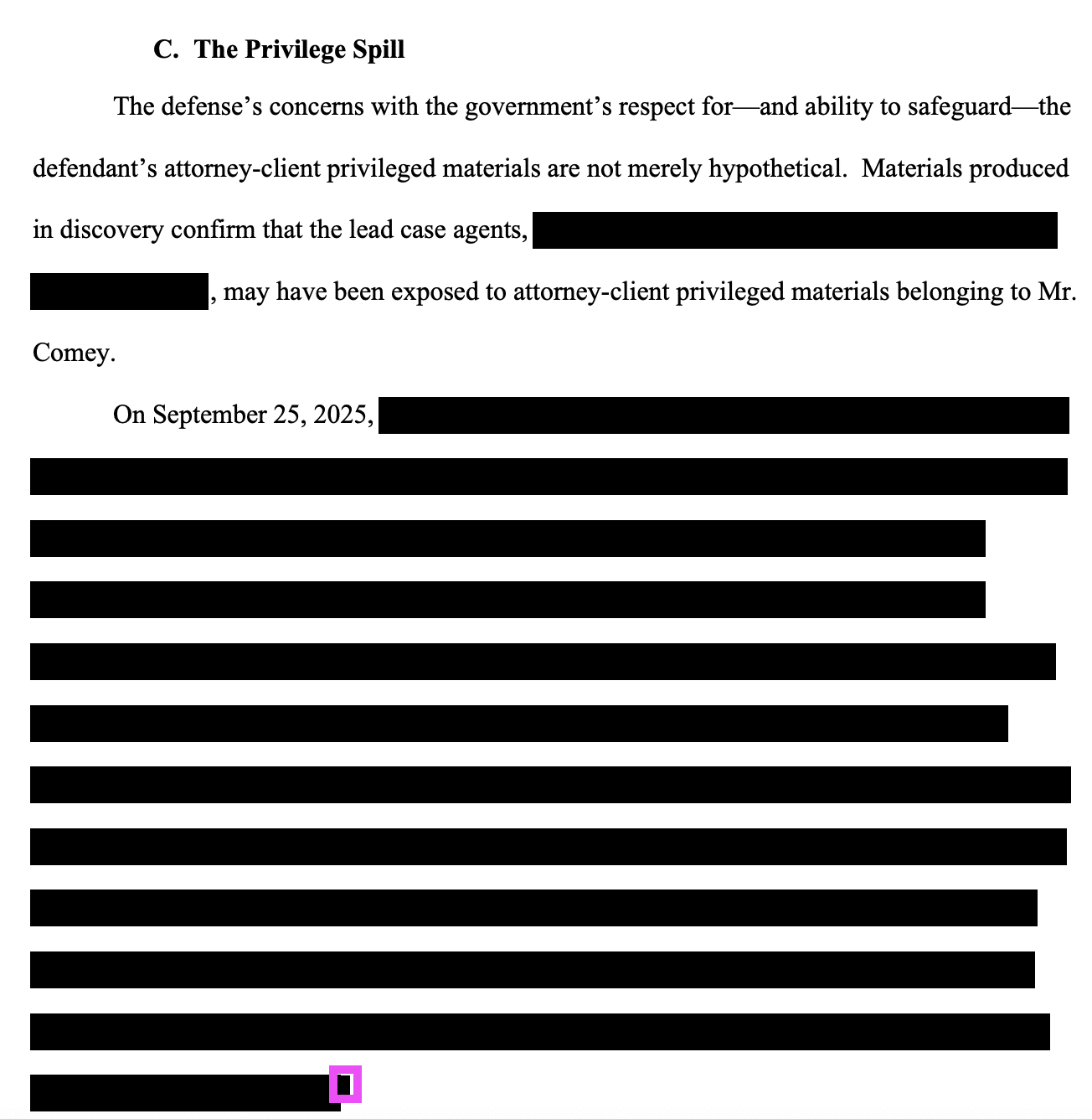
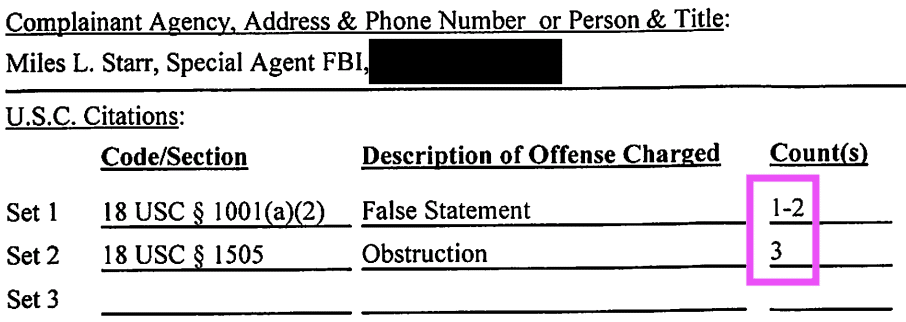
That footnote, marked in pink, cites the Criminal Case Cover Sheet, which, in spite of being labeled as “REDACTED,” is not, and so among other things, reveals the name of one of two FBI agents on the case, Miles Starr (the other being Jack Eckenrode, who investigated Scooter Libby but then left the team, and who joined John Durham in chasing Russian disinformation for four years).

I’ve redacted Starr’s phone number. You’re welcome, Miles.

But the Sheet also includes an error: it lists three counts, including the one, pertaining to Comey’s answer to Lindsey Graham’s question about a CIA referral (one that FBI may never have received) that Kash Patel and John Ratcliffe ret-conned into a “Clinton Plan” on which to hang the Durham investigation. That’s the one the grand jury no-billed.

While none of that explains when and how Starr and Eckenrode snuck a peek of privileged information, it might explain why.

Kash and Eckenrode are still chasing the theory behind the dropped charge, that Jim Comey purportedly knew Hillary Clinton had a plan (one fabricated by Russia and then embellished by Eckenrode and Durham to claim Hillary wanted to frame Trump) to emphasize Donald Trump’s ties with Russia. That’s the logic of the larger conspiracy theory that Eckenrode has been hired to chase. It was and remains Russian disinformation, but that didn’t stop Eckenrode the last time he tried this.

Indeed, because DC USAO obtained warrants in 2019 and 2020, there may be communications between Comey and his attorneys about the John Durham investigation, about Eckenrode’s past witch hunt, which would explain why Comey is so interested in the scope of proposed review, which the loaner AUSAs still haven’t told Comey.

Because Kash and Eckenrode are chasing that conspiracy theory, this is a much bigger issue than just the case before Nachmanoff. As I laid out in my post predicting that John Durham’s investigation was a preview of coming attractions (even before I knew that Kash had brought Eckenrode back!), Durham already played games to access attorney-client privileged material.

In response, Sussmann accused Durham of abusing the same grand jury process he abused with Benardo (abuse, ironically, that debunked Durham’s conspiracy theory).

First, the Special Counsel’s Motion is untimely. Despite knowing for months, and in some cases for at least a year, that the non-parties were withholding material as privileged, he chose to file this Motion barely a month before trial—long after the grand jury returned an Indictment and after Court-ordered discovery deadlines had come and gone.

Second, the Special Counsel’s Motion should have been brought before the Chief Judge of the District Court during the pendency of the grand jury investigation, as the rules of this District and precedent make clear.

Third, the Special Counsel has seemingly abused the grand jury in order to obtain the documents redacted for privilege that he now challenges. He has admitted to using grand jury subpoenas to obtain these documents for use at Mr. Sussmann’s trial, even though Mr. Sussmann had been indicted at the time he issued the grand jury subpoenas and even though the law flatly forbids prosecutors from using grand jury subpoenas to obtain trial discovery. The proper remedy for such abuse of the grand jury is suppression of the documents.

Fourth, the Special Counsel seeks documents that are irrelevant on their face. Such documents do not bear on the narrow charge in this case, and vitiating privilege for the purpose of admitting these irrelevant documents would materially impair Mr. Sussmann’s ability to prepare for his trial.

He also revealed that some of those privilege claims went back to August — that is, the weeks after Durham should have closed up shop.

Email from Andrew DeFilippis, Dep’t of Just., to Patrick Stokes, Gibson, Dunn & Crutcher LLP, et al. (Aug. 9, 2021) (requesting a call to discuss privilege issues with a hope “to avoid filing motions with the Court”); Email from Andrew DeFilippis, Dep’t of Just., to Patrick Stokes, Gibson, Dunn & Crutcher LLP, et al. (Aug. 14, 2021) (stating that the Special Counsel “wanted to give all parties involved the opportunity to weigh in before we . . . pursue particular legal process, or seek relief from the Court”). And since January— before the deadline to produce unclassified discovery had passed—the Special Counsel suggested that such a filing was imminent, telling the DNC, for example, that he was “contemplating a public court filing in the near term.” Email from Andrew DeFilippis, Dep’t of Just., to Shawn Crowley, Kaplan Hecker & Fink LLP (Jan. 17, 2022). [my emphasis]

In a hearing on May 4, right before trial, Joffe’s lawyer revealed they had demanded Durham press a legal claim much earlier, in May 2021.

MR. TYRRELL: So if they wanted to challenge our assertion of privilege as to this limited universe of documents — again, which is separate from the other larger piece with regard to HFA — they should have done so months ago. I don’t know why they waited until now, Your Honor, but I want to be clear. I want to say without hesitation that it’s not because there was ever any discussion with us about resolving this issue without court intervention.

THE COURT: That was my question. Were you adamant a year ago?

MR. TYRRELL: Pardon me?

THE COURT: Were you adamant a year ago that —

MR. TYRRELL: Yes. We’ve been throughout. We were not willing to entertain resolution of this without court intervention.

THE COURT: Very well.

Ultimately, Cooper did bow to Durham’s demand, but prohibited them from using those documents at trial.

That didn’t prevent DeFilippis from attempting to use the privileged documents to perjury trap his one Fusion witness, the kind of perjury trap that might have provided a way to continue the madness indefinitely.

There must have been nothing interesting there: most of the Fusion documents were utterly irrelevant to the Sussmann charges, but could implicate the Danchenko ones, but Durham didn’t use them there, nor did he explain their content in his final report.

That effort involved, among other things, abusing the prosecutorial process to bypass rulings (such as the sealing order mentioned above) that Beryl Howell had already made, and using one criminal case, against Michael Sussmann, to obtain attorney-client privileged materials that would only be relevant in another criminal case, the Igor Danchenko case (or a larger conspiracy).

Particularly given the reticence of the loaner AUSAs to tell Comey what happened, whether they have warrants, who read what, this feels like an attempt to retroactively bless access that investigators already got. And the stakes are bigger than this one case. As Durham (and Eckenrode) did in 2022, this likely would primarily serve to feed their bigger conspiracy theory.

Plus, if Eckenrode is sneaking peeks at Comey’s privileged communications still in FBI custody, there’s nothing that would prevent him from doing the same with all the other people whose privileged communications have been seized during this years-long witch hunt.

And that’s why you ask these questions.

Share this entry

A Tale of Three Footnotes for “Purported Interim U.S. Attorney Lindsey Halligan”

I suppose I should not have doubted that Abbe Lowell would file a request for relief based on Lindsey Halligan’s stalking of Anna Bower.

I mean, I didn’t doubt it.

But I was impatient. I should also have considered the optimal timing for Lowell to do that: the evening before the arraignment.

What a way for Lindsey Halligan to start out on the wrong foot with Judge Jamar Walker, with both the request to make Lindsey follow the rules on public comment and notice that Attorney General James (as Lowell refers to his client throughout) intends to move — tomorrow — to disqualify Lindsey on a schedule that will coincide with Jim Comey’s parallel attempt.

The request itself makes ample use of the opening Lindsey gave James to mock her inexperience. It refers to her as the “purported interim US Attorney” (or similar) five times.

Although the government sought and filed the indictment in this case on October 9, 2025—signed only by purported interim U.S. Attorney Lindsey Halligan—articles issued before the charges were filed indicated that charges would be brought.

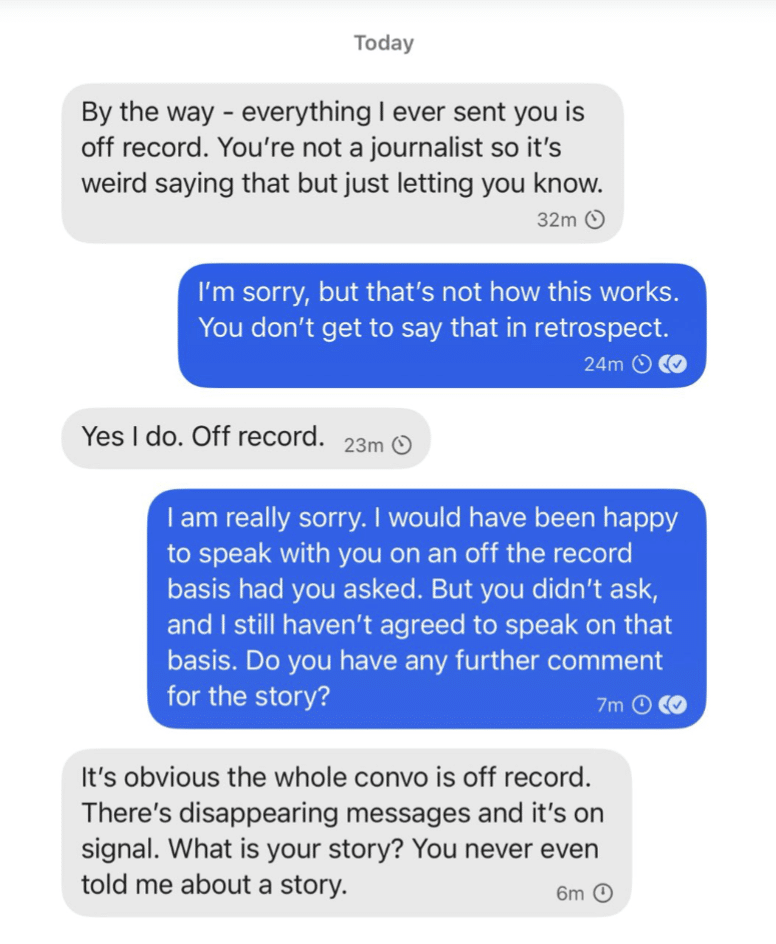
What precipitates this motion now is a digital messaging exchange that occurred after the government brought charges, between purported interim U.S. Attorney Halligan and Anna Bower, a senior journalist for Lawfare, published on Monday, October 20, 2025.

[snip]

After confirming Ms. Halligan’s identity, Ms. Bower asked the purported interim U.S. Attorney what she was “getting wrong,” and Ms. Halligan replied: “Honestly, so much. I can’t tell you everything but your reporting in particular is just way off. I had to let you know.”

[snip]

These extrajudicial statements and prejudicial disclosures by any prosecutor, let alone one purporting to be the U.S. Attorney, run afoul of and violate the Federal Rules of Criminal Procedure, the Code of Federal Regulations, this Court’s Local Rules, various rules of ethical and professional responsibility, and DOJ’s Justice Manual.

[snip]

Ms. Halligan’s initiation of contact, and then repeated exchanges, with the journalist—a mere two days after filing charges—appear to have violated several of the above-cited rules and codes of professional conduct. As the purported chief law enforcement officer for this District, as well as the individual who alone presented evidence to the grand jury in Alexandria and signed the two-count indictment of Attorney General James, 12 Ms. Halligan should know that she is prohibited by the federal, local, and Department rules governing extrajudicial statements and media contacts from engaging with a journalist about the substance and merits of a charged criminal case and the purported strength of the evidence put before a grand jury. [my emphasis]

It describes how even someone with absolutely no prosecutorial experience like Lindsey should know basic rules.

No prosecutor is exempt from following those rules, but they should be followed to the letter by anyone trying to lead a prosecutor’s office. Rather than follow DOJ’s rules protecting non-public, sensitive information obtained in connection with a criminal case and investigation from disclosure, Ms. Halligan opted to use an encrypted app to text with a journalist and discuss the case, certain evidence, and her views on the strength of the charges brought, while ignoring any concerns of prejudice to the defendant, a fair trial, and rules against extrajudicial statements and pretrial publicity.

It has been reported that Ms. Halligan has no prosecutorial experience whatsoever. But all federal prosecutors are required to know and follow the rules governing their conduct from their first day on the job, and so any lack of experience cannot excuse their violation. While the oftquoted phrase “the bell cannot be unrung” is true for that which has already occurred, the Court can require the government to follow the law going forward by entering Attorney General James’ requested Order and preventing further disclosures of investigative and case materials, and of statements to the media and public, concerning this case and any parties or witnesses.

It lists the many rules Lindsey broke:

  • Federal Rule of Criminal Procedure 6(e)
  • 28 C.F.R. § 50.2
  • A variety of local rules, starting with Local Criminal Rule 57.1, Free Press – Fair Trial Directives
  • American Bar Associations Model Rule 3.8, Special Responsibilities of a Prosecutor
  • Various parts of the Justice Manual, starting with Justice Manual (JM) 1-7.100

And then there are three footnotes which, as footnotes often do, have the meat of the argument.

Though the body of the motion does not mention Federal Records Act, Footnote 11 notes that Attorney General James will pursue the apparent violation of 44 U.S.C. § 2911 (violations of which require disciplinary action) “with the appropriate offices.”

11 In addition to apparently violating the rules addressed in this section, Ms. Halligan admitted in her exchanges with the journalist to a likely violation of the federal records laws and rules around using unapproved electronic messaging accounts. See 44 U.S.C. § 2911 (restricting officer or employee of an executive agency from sending messages using a non-official electronic messaging account). Ms. Halligan acknowledged she was using an unofficial messaging application, Signal, with its “disappearing messages” feature enabled and set to automatically delete after eight hours. Trying to delete the paper trail of improper communications does not mean they did not occur. For this reason, Attorney General James also asks the Court to order government attorneys and agents involved in this case to follow relevant laws around records retention, and to impose a litigation hold preventing the deletion or destruction of any records or communications having anything to do with the investigation and prosecution of this case. Attorney General James will pursue this apparent violation of the law with the appropriate offices.

As for the grand jury secrecy violations, Footnote 5 notes that a court can prosecute or hold someone in contempt for violating grand jury secrecy.

5 The government can and does prosecute knowing violations of Rule 6(e) pursuant to district courts’ contempt powers under 18 U.S.C. § 401(3), as well as pursuant to multiple felony criminal statutes. See Justice Manual, CRM 156 (observing that disclosure of “grand jury material with the intent to obstruct an ongoing investigation . . . may be prosecuted for obstruction of justice under 18 U.S.C. § 1503,” and that an individual who “improperly disseminates grand jury materials may be prosecuted for the theft of government property under 18 U.S.C. § 641”) (collecting cases).

But, Footnote 6 describes, Attorney General James is not asking for that kind of relief — that is, prosecution.

6 Attorney General James is not at this time formally moving for relief pursuant to FRCrP 6(e).

At least, “not at this time.”

And honestly, Lindsey may not be the real target here. One of the things Lowell requests is a log of all contact between “any government attorney or agent on this case and any member of the news media” on this case.

3. Directing government counsel to create and maintain a log of all contact between any government attorney or agent on this case and any member of the news media or press concerning this case.

Lindsey hasn’t been doing the bulk of that. Eagle Ed Martin has.

And because Lindsey blabbed her mouth, Eagle Ed may, as a result, have to catalog all the times he has leaked about this case.

Share this entry

Lindsey the Insurance Lawyer Gets into Signal Trouble

Lindsey Halligan’s ham-handed effort to bully Anna Bower into backing off her coverage of problems with the Tish James’ indictment has not gone unnoticed.

American Oversight just filed a FOIA  for Halligan’s Signal texts.

All messages on the messaging platform Signal and any app that can interfacewith Signal or otherwise borrow its technology sent or received by U.S.Attorney Lindsey Halligan regarding government business.

American Oversight requests that all images, videos, audio recordings, or otherattachments regarding official government business shared via Signal, includingany app that can interface with Signal or otherwise borrow its technology, beproduced in response to this request. To the extent any hyperlinks and/or URLs were shared, American Oversight requests records in a form that display the full URL.

Given that this request is limited to a specific, recent, and readily identifiable documents, American Oversight expects that this request can be processed on the Simple processing track and result in a prompt agency response.

Remember: American Oversight was the organization that sued to preserve Pete Hegseth’s Signal tweets, only to discover many of them were destroyed.

As the NGO noted in a presser, though, Halligan is under additional legal mandate to preserve the texts she sent to Bower: DOJ records retention rules that will become key in the Vindictive Prosecution motions filed against her.

Today, American Oversight launched an investigation into interim U.S. Attorney Lindsey Halligan’s reported use of Signal to communicate with a journalist about the prosecution of New York Attorney General Letitia James — one of President Trump’s perceived political enemies. Halligan, whose status and authority as interim U.S. Attorney are being contested in court, later attempted to retroactively claim her Signal messages to the reporter were off the record. According to reports, she set her messages to automatically delete after eight hours — which, if true, constitutes a clear violation of the Federal Records Act and the Department of Justice’s own records-retention rules requiring the preservation of official communications.

In launching its investigation, the nonpartisan watchdog filed a Freedom of Information Act (FOIA) request with the DOJ seeking Halligan’s Signal communications about government business, as well as related DOJ records concerning her use of the app.

“No one can go ‘off the record’ to avoid following the law, not even someone acting as a powerful interim U.S. Attorney. That Halligan used Signal to discuss government business and configured her messages to automatically delete raises serious concerns that she is actively violating the law and attempting to hide the record of her actions — including that she may have revealed sensitive grand jury information,” said Chioma Chukwu, Executive Director of American Oversight. “What makes this all the more alarming is the context: Halligan appears to have engaged in this conduct while leading prosecutions against the president’s perceived political enemies — heightening concerns that her lawlessness is part of a broader pattern of politicized and unethical behavior within the president’s Justice Department.”

Plus, it’s not like Halligan can claim ignorance of the Federal Records Act. The law was central to the logic of the stolen documents case on which she was a defense attorney for Trump.

I’m still somewhat surprised that neither Patrick Fitzgerald nor Abbe Lowell have filed a preservation order on Halligan. Perhaps they’re just assuming that Halligan’s destruction of these texts will guarantee DOJ’s failure on the Vindictive motions?

Correction: They have not sued for Halligan’s texts, yet; they’ve just filed the lawsuit.

Share this entry

Kash’s “lockbox in a vault…in a cyber place where no one can see or search these files”

There were two competing letters published yesterday designed to frame Kash Patel’s efforts to frame Democrats with being mean to Donald Trump, for which (the NYT reports) Trump wants to be paid $230 million. They are:

I’m a well-established critic of Lanny Breuer, but the letter is substantive and direct. After mocking Josh Hawley’s claim that he was “tapped,” the letter shows how toll records have been used in various other investigations:

  • The Robert Hur investigation of Joe Biden.
  • Charging documents in five different investigations charged since Kash has become FBI Director.
  • In leak investigations, targeting Adam Schiff, Eric Swalwell, and staffers (including Kash Patel).
  • The Robert Menendez investigation.

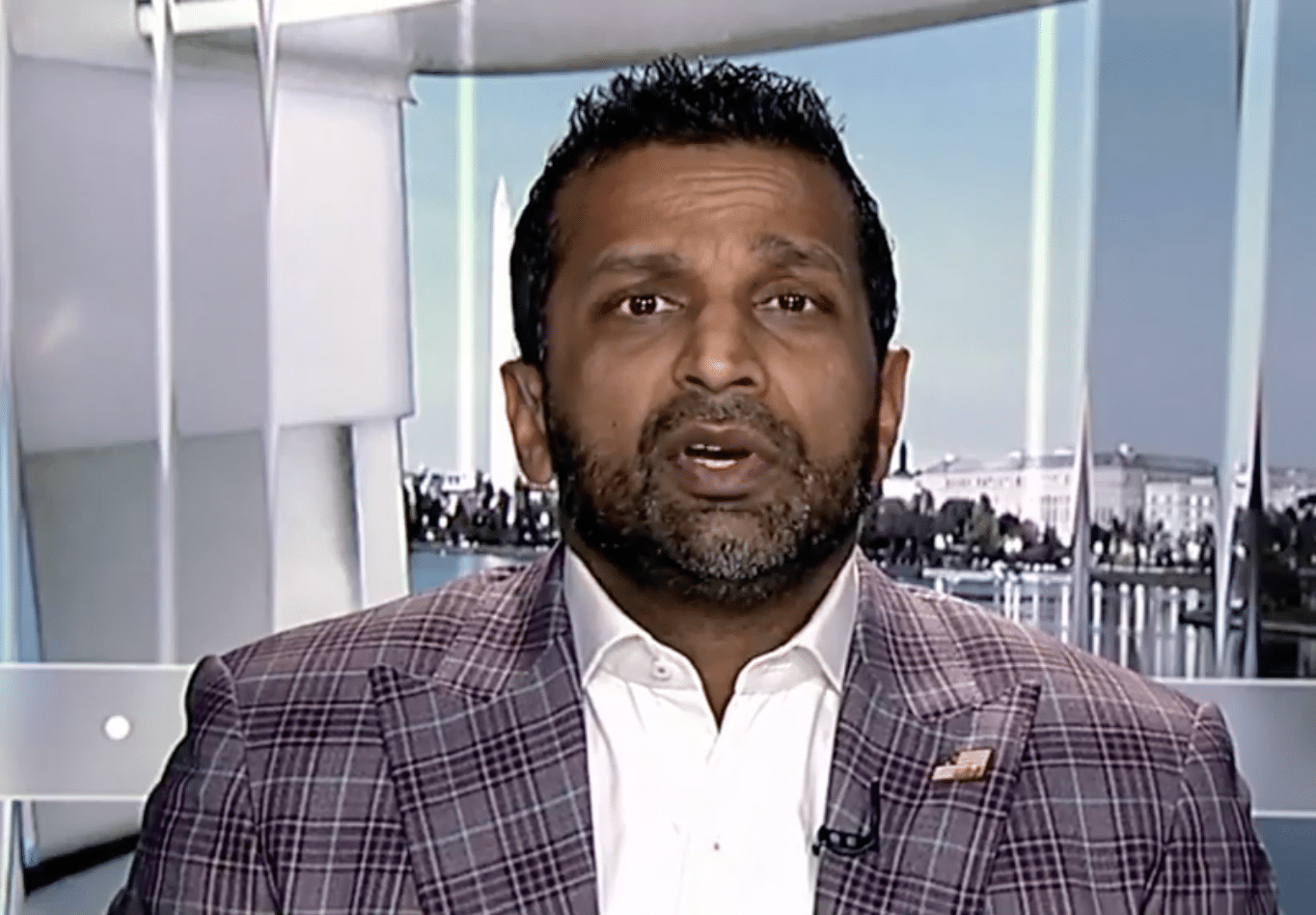
But all that’s just set up for this passage, mocking Kash for his claim, made on Sean Hannity’s show while he was wearing a ridiculous jacket, that Jack Smith was trying to hide his use of toll records in a “lockbox in a vault, and then put that vault in a cyber place where no one can see or search these files.”

[T]here is simply no support for FBI Director Patel’s recent assertion that Mr. Smith hid the toll records information so that “no one would find it,” or that Mr. Smith put the toll records in a “lockbox in a vault, and then put that vault in a cyber place where no one can see or search these files.”9 It is not clear what cyber place in a vault in a lockbox Director Patel is describing, but Mr. Smith’s use of these records is inconsistent with someone who was trying to conceal them. Paragraph 119 of the August 1, 2023 indictment describes some of the calls that were made to U.S. Senators on January 6, 2021, and footnote 132 of Volume 1 of the Special Counsel Report refers to the use of toll records in the investigation. Moreover, the precise records at issue were produced in discovery to President Trump’s personal lawyers, some of whom now serve in senior positions within the Department of Justice.

9 HANNITY: Patel: “We’re Just Warming Up” in Investigation of Alleged Tracking of GOP Senators, Fox News (Oct. 7, 2025), https://www.foxnews.com/video/6382234662112.

Even without this letter, sentient beings were able to point to the place in the indictment and the Jack Smith report where these toll records were described. And, as the letter notes, Trump’s attorneys — including Todd Blanche — got discovery on those toll records years ago, but did not challenge their use in a criminal case.

All this was quite clear to sentient beings. But not the staffers exploiting Chuck Grassley’s diminished capacities to make a stink about something very ordinary.

By comparison, the Jordan letter is shoddy even by his standards.

The ostensible purpose is to refer John Brennan to DOJ (but, significantly, not FBI) for testimony Brennan gave — in a hearing about the letter truthfully saying a bunch of spooks thought the Hunter Biden laptop had the hallmarks of a Russian information op — that mentioned the Steele dossier in passing. This may be an effort to predicate a case in DC after the case in Philly has stalled, but anyone aware of the law would question how comments about the Steele dossier were material to a hearing about the Hunter Biden letter, a point that Brennan even made at the time: “I don’t see any relevance to the Hunter Biden laptop issue now,” as quoted in Jordan’s letter.

More importantly, the letter appears to be an effort to launder debunked propaganda Kash Patel did years ago through Congress back into an investigation led by Kash Patel, something I’ve addressed in the past.

The key paragraph makes a number of claims, some of which are fabrications (and therefore commit the crime that Jim Jordan is referring), others of which are misrepresentations of prior reports that were themselves propaganda.

On January 6, 2017, the CIA, Federal Bureau of Investigation (FBI), and National Security Agency published a declassified version of an Intelligence Community Assessment (ICA) titled Assessing Russian Activities and Intentions in Recent US Elections. 3 The ICA stated, among other things, that Russia “developed a clear preference” for President Trump and “aspired to help” him win the election.4 This conclusion—now known to be false—was based in part on the Steele dossier, which “was referenced in the ICA main body text, and further detailed in a two-page ICA annex.”5 The Steele dossier was a series of reports containing baseless accusations concerning President Trump’s ties to Russia compiled and delivered to the FBI in 2016 by former British intelligence agent Christopher Steele.6 Subsequent investigations confirmed that the Clinton campaign and the DNC paid Steele via the law firm Perkins Coie and opposition research firm Fusion GPS to provide derogatory information about Trump’s purported ties to Russia, which resulted in the discredited dossier.7 In July 2025, the Trump Administration declassified numerous documents showing that the ICA’s main findings were false and that the Obama Administration knowingly fabricated the findings for the purpose of undermining the Trump Administration.8

3 OFF. OF THE DIR. OF NAT’L INTEL., ASSESSING RUSSIAN ACTIVITIES AND INTENTIONS IN RECENT US ELECTIONS (Jan. 6, 2017) [hereinafter “Russian Interference ICA”].

4 Id. at 1.

5 MAJORITY STAFF REPORT, H. PERM. SELECT COMM. ON INTEL., 116TH CONG., OVERSIGHT INVESTIGATION & REFERRAL: THE INTELLIGENCE COMMUNITY ASSESSMENT (ICA) “RUSSIA’S INFLUENCE CAMPAIGN TARGETING THE 2016 US PRESIDENTIAL ELECTION,” at 23 (2020) [hereinafter “HPSCI Report”].

6 See JOHN H. DURHAM, U.S. DEP’T OF JUST., OFF. OF SPECIAL COUNS., REPORT ON MATTERS RELATED TO INTELLIGENCE ACTIVITIES AND INVESTIGATIONS ARISING OUT OF THE 2016 PRESIDENTIAL CAMPAIGNS, at 11-12, 109-117 (2023) [hereinafter “Durham Report”].

7 See id. at 109-117; HPSCI Report, supra note 5, at 22-32; U.S. DEP’T OF JUST., OFF. OF THE INSPECTOR GEN., REVIEW OF FOUR FISA APPLICATIONS AND OTHER ASPECTS OF THE FBI’S CROSSFIRE HURRICANE INVESTIGATION, at v-xii (2019); Memorandum from HPSCI Majority Staff to HPSCI Majority Members, Re: Foreign Intelligence Surveillance Act Abuses at the Department of Justice and the Federal Bureau of Investigation (Jan. 18, 2018).

8 Sarah Bedford & Kaelan Deese, Russiagate definitive timeline: How new intelligence documents fit in, WASH. EXAM’R (July 26, 2025). [my emphasis]

The key claim in here — that what Jordan falsely says is the key claim of 2017 Intelligence Community Assessment, which he describes as, “that Russia ‘developed a clear preference’ for President Trump and ‘aspired to help’ him win the election,” is based on the Steele dossier — is based off two reports Kash substantially wrote (marked in blue). Never mind that it is only the key claim of the Intelligence Community Assessment if you have the thin skin of a Narcissist, never mind that any dispute is about how much evidence there was before discovering the June 9 meetings or Paul Manafort’s sharing of campaign information with Russian spies. That key claim had nothing to do with the subsequent investigation of Trump, which investigation had already been set into motion by Mike Flynn’s shitty OpSec.

But as I wrote extensively,  the one dated 2020, showing that Congressional Republicans packaged up older claims and Russian spycraft after the Mueller Report definitively showed the Russia did prefer Trump and Trump did welcome that help, is an attempt to create a time machine to go back to the halcyon time before we knew all that.

Jordan, perhaps wisely, doesn’t try to lay out how all this fits together. He outsources it to a right wing propaganda outlet, outsourcing to them their credulity about the time machine effect going on.

Jim Jordan lied, shamelessly, when he alleged that that claim was shown to be false. And he lied, shamelessly, when he said that a report that affirmatively did not incorporate intelligence from the Steele dossier, choosing instead to only link it and specifically say it was not incorporated into analytical work (which backs Brennan, not Jordan), instead relied on the dossier.

This conclusion—now known to be false—was based in part on the Steele dossier, which “was referenced in the ICA main body text, and further detailed in a two-page ICA annex.”

If the intimation that Kash Patel’s hand-picked investigators breached Jim Comey’s attorney-client privilege in service of this conspiracy bears out, it only adds to the list of corrupt and possibly illegal things Kash has done in pursuit of this witch hunt. And that’s before you consider all the cops and prosecutors that get fired along the way.

Kash Patel may well be in a race against time. He needs to package up things before Comey gets them all thrown out before Andrew Bailey becomes eligible to act as FBI Director bypassing confirmation, in mid-December.

Links

A Dossier Steal: HPSCI Expertly Discloses Their Own Shoddy Cover-Up

Think of the HPSCI Report as a Time Machine to Launder Donald Trump’s Russia Russia Russia Claims

Tulsi Gabbard and John Ratcliffe Reveal Putin “Was Counting on” a Trump Win

Tulsi Gabbard Teams Up with Russian Spies to Wiretap and Unmask Hillary Clinton

The Secrets about Russia’s Influence Operation that Tulsi Gabbard Is Still Keeping from Us

Tulsi Gabbard Accuses Kash Patel of Covering Up for the Obama Deep State


Share this entry

Taint

Earlier today, Jim Comey filed his opposition to the loaner AUSAs’ bid to do a quickie filter team to access materials that — the context makes clear — were seized in the investigation of Dan Richman back in 2019.

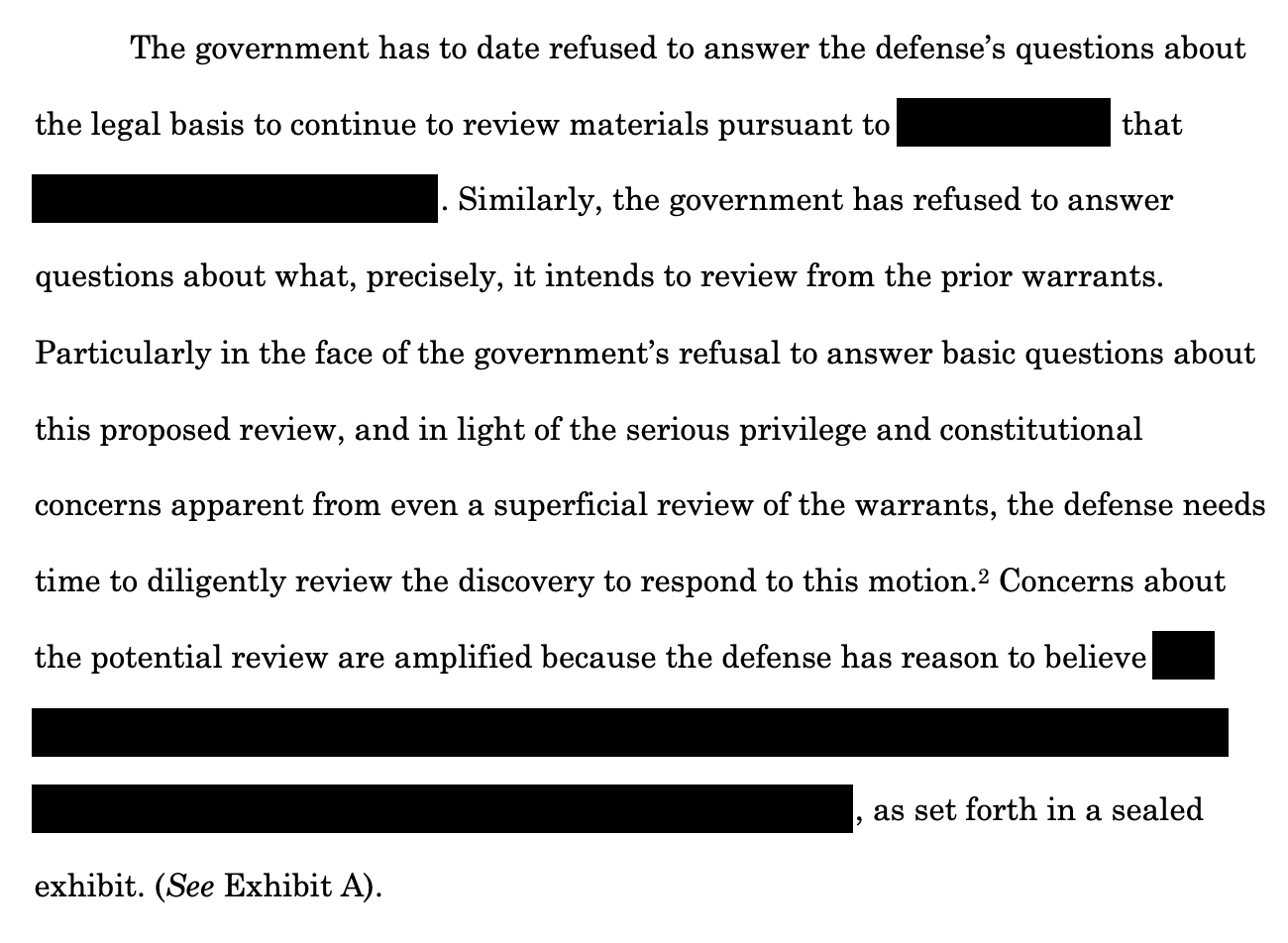
Key parts of that opposition were redacted under Sensitive labels applied to discovery, such as this passage describing concerns about the “continue[d]” review of material seized from Richman.

But in his order denying the loaner AUSA bid to accelerate this filter team, Judge Michael Nachmanoff described the main gist of the concern: The two main FBI investigators already peeked at the discussions among lawyers representing Comey back in 2019, including Dan Richman and Patrick Fitzgerald.

He also states that the underlying warrants were “obtained by prosecutors in a different district more than five years ago[,] in an investigation that closed without criminal charges[,] and [] authorized the seizure of evidence related to separate offenses that are not charged here.” Id. at 2. And, there is “reason to believe that the two principal FBI investigators may already have been tainted by exposure” to privileged information. Id. at 3.

Remember, the lead investigator is reportedly Jack Eckenrode, who knows Fitzgerald from way back, from the Libby case. He’s the same investigator who participated in John Durham’s ploy to breach privilege during the Michael Sussmann case in hopes of using that privileged information elsewhere.

The unethical dickishness makes much more sense now.

When the government first raised the privilege protocol with the defense, on October 10 and 11, the defense asked for an opportunity to review the underlying warrants at issue to determine whether Mr. Comey would agree to the protocol. The government refused to provide the warrants before filing its motion for a filter protocol, and did not produce the warrants until late in the evening of October 13, 2025.

They appear to be pushing for this filter review — a filter review entirely excluding Comey, a filter review unlike any of the ones Trump’s attorneys were subjected to — to bulldoze through the possibility they already snuck a peek, and took investigative steps based on that.

Share this entry

Lindsey Halligan’s Grand Jury Violation, with Love to Aileen Cannon

Most of this post lays out Jim Comey’s vindictive and selective prosecution challenge. It is very tidy, providing little we didn’t already know.

Aside from the confirmation that Lindsey Halligan was appointed under 28 USC 546, that’s generally true of Comey’s motion to dismiss because of Halligan’s unlawful appointment, as well.

But it feels different, because it’s a bid to win before the far right Supreme Court.

That starts with the memo that Sammy Alito wrote in 1986 — a memo conservative lawyer Ed Whelan has highlighted in his commentary against such an appointment. Back then, Sammy interpreted 28 USC 546 as prohibiting making serial Interim US Attorney Appointments, as Trump did in EDVA to install Lindsey the Insurance Lawyer.

Just three days after Congress enacted the 1986 law, the Office of Legal Counsel (OLC) within the DOJ issued a memorandum, authored by then-Deputy Assistant Attorney General Samuel Alito, interpreting the provision in precisely the same manner as Mr. Comey here. See Definition of Vacancy for the Purpose of Interim Appointment of United States Attorneys pursuant to 28 U.S.C. 546, as amended, Office of Legal Counsel (Nov. 13, 1986), https://perma.cc/SD5Q7CPH. Specifically, OLC concluded that while a “vacancy exists when the 120-day period expires under the amended section 546 and the President has either not made an appointment or the appointment has not been confirmed,” “it does not follow that the Attorney General may make another appointment pursuant to 28 U.S.C. 546(a) after the expiration of the 120-day period.” Id. at 3 (emphasis added)

There’s the dickish comment from Bill Essayli, whose own appointment is being challenged in Los Angeles (before a Hawaiian judge).

Nor is the government’s gambit limited to this case. In several cases throughout the country, the government has sought to end run Congress’s framework in Section 541 and 546 before being rebuffed by courts. See Giraud, 2025 WL 2416737, at *1, *8 (detailing the Executive Branch’s perpetuation of “Alina Habba’s appointment to act as the United States Attorney for the District of New Jersey through a novel series of legal and personnel moves” and concluding that she “was not lawfully acting as the United States Attorney in any capacity” 120 days after the Attorney General first invoked her power under Section 546(a)); United States v. Garcia, et al, No. 25-cr-227, 2025 WL 2784640, at *3 (D. Nev. Sept. 30, 2025) (“The Nevada judges did not have an opportunity to exercise [Section 546(d)] power because, on the 119th day of Ms. Chattah’s term, the government purported to switch her appointment to the [Federal Vacancies Reform Act] and its longer term of service.”). In fact, when one interim U.S. Attorney was asked whether his term was “up at the end of this month” given subsection (c)(2)’s 120-day limit, he responded that “we’ve got some tricks up our sleeves.”15 This Court should reject the government’s machinations here.

15 See The Glenn Beck Program: Bill Essayli, at 44:14 (Jul. 22, 2025), http://bit.ly/4nc6yck.

But the real high point comes in the challenge under the Appointments Clause, where a team including Michael Dreeben cites liberally from Trump v. US and US v. Trump to argue that one of Trump’s defense attorneys from his stolen documents case was unlawfully appointed under the very same logic Aileen Cannon used to throw out that case.

B. Ms. Halligan’s Appointment Also Violates The Appointments Clause

As explained above, the Appointments Clause allows Congress to “by Law vest the Appointment of such inferior Officers, as they think proper, in the President alone, in the Courts of Law, or in the Heads of Departments.” U.S. Const., Art. II, § 2, cl. 2. The requirement that Congress participate in the appointment of inferior officers—either through Senate confirmation or through specifying an appointment procedure “by Law”—reflects the Framers’ concerns about the Executive Branch’s “manipulation of official appointments.” Freytag v. Comm’r, 501 U.S. 868, 883 (1991) (citations omitted).

Here, Congress vested the appointment of interim U.S. Attorneys “by Law” in a “Head of Department[]”—the Attorney General—as well as in “the Courts of Law”—district courts. In so doing, Congress established a finely tuned statutory scheme for such appointments. See supra at 8-9. Because the Attorney General appointed Ms. Halligan in violation of that scheme, Ms. Halligan’s appointment as an inferior officer is not authorized “by Law.” And the “head of a department has no constitutional prerogative of appointment to offices independently of the legislation of Congress, and by such legislation he must be governed, not only in making appointments, but in all that is incident thereto.” United States v. Perkins, 116 U.S. 483, 485 (1886). The Attorney General’s appointment of Ms. Halligan thus violates not only Section 546, but also the Appointments Clause. See Trump v. United States, 603 U.S. 593, 644-45 (2024) (Thomas, J., concurring) (citations omitted); United States v. Trump, 740 F. Supp. 3d 1245, 1263 (S.D. Fla. 2024).

[snip]

In light of these principles, the Supreme Court has invalidated judgments issued or reviewed by an improperly appointed adjudicator. In Ryder v. United States, 515 U.S. 177 (1995), for instance, the Supreme Court “reversed” the court-martial conviction of a defendant after he successfully challenged the appointment of the intermediate appellate judges who reviewed his case. Id. at 188. Likewise, in Lucia v. SEC, 585 U.S. 237 (2018), the Court set aside an agency adjudication “tainted with an appointments violation,” making clear that a decision of an improperly appointed official cannot stand. Id. at 251.

Similarly, in United States v. Trump, 740 F. Supp. 3d 1245 (S.D. Fla. 2024), the court applied these principles when dismissing an indictment on Appointments Clause grounds because of a defect in the appointment of the prosecutor who secured the charges. The court concluded that “[b]ecause Special Counsel Smith’s exercise of prosecutorial power has not been authorized by law,” there was “no way forward aside from dismissal of the Superseding Indictment.” Id. at 1302. Indeed, the government there did not even “propose an alternative course.” Id. The court reasoned that “[i]nvalidation follows directly from the government actor’s lack of authority to take the challenged action in the first place.” Id. at 1302-03.

That is, a team with a lawyer from Jack Smith’s team is citing Aileen Cannon’s disastrous opinion in Trump’s stolen documents case for the principle that for a lawyer to do what Lindsey the Insurance Lawyer did, she needs to be Senate approved.

Lindsey the Insurance Lawyer should know that (as should Deputy Attorney General Todd Blanche). After all, she was part of that “successful” defense team.

This is not to endorse this view. It is to say that if the sentiment behind Aileen Cannon’s dismissal of Trump’s stolen documents prosecution holds — if Clarence Thomas really wants to go there — than Halligan’s appointment, and all the work she did, must be thrown out, just as Jack Smith’s was.

The other vindictive and selective prosecution argument — that Donald Trump cannot simply appoint a US Attorney to take out his enemies is right on the facts but inapt on the legal precedents. But this one is designed to corner the right wingers on the Supreme Court.

And if that happens, this motion to dismiss goes further than the other — it puts Lindsey the Insurance Lawyer in an awkward spot. Because if she was not authorized by law to go before the grand jury, she violated grand jury secrecy rules.

Here, Ms. Halligan’s unlawful appointment tainted the structural integrity of the grand jury process. Absent Ms. Halligan’s unlawful title, she would not have been able to enter the grand jury room, let alone present and sign an indictment. Indeed, the Federal Rules of Criminal Procedure allow only “attorneys for the government” to be “present while the grand jury is in session,” Fed. R. Crim. P. 6(d)(1), and define such attorneys to include only “attorney[s] authorized by law to conduct” grand jury proceedings, Fed. R. Crim. P. 1(b)(1)(D) (emphasis added). Those rules implement the longstanding principle “that the proper functioning of our grand jury system depends upon the secrecy of the grand jury proceedings”—a principle that “is ‘as important for the protection of the innocent as for the pursuit of the guilty.’” United States v. Sells Eng’g, Inc., 463 U.S. 418, 424 (1983) (citations omitted). By limiting participation to government attorneys “authorized by law,” Rules 1 and 6 maintain the secrecy of the grand jury proceeding and reinforce that an unlawfully appointed attorney’s presentation to the grand jury underminesthe structure of that proceeding. The fundamental error here thus allows a presumption that Mr. Comey was prejudiced, “and any inquiry into harmless error would [require] unguided speculation.” Bank of Nova Scotia, 487 U.S. at 257.

Which is weird, because she was trying to lecture Anna Bower about relying on NYT reporting from witnesses … who are allowed to share their testimony before the grand jury.

This is the easier way to throw out this prosecution. It’s the same interpretation of the law that already got Alina Habba and Sigal Chattah disqualified from cases that won’t, however, sink the entire case.

But if that does happen, Lindsey may be in a bit more trouble for even pretending to be a government prosecutor.

Share this entry

60 Pages of Animus: Jim Comey’s Motions to Dismiss His Prosecution

Along with his motions to dismiss because Lindsey Halligan was unlawfully appointed and for vindictive and selective prosecution, Jim Comey included a 60-page filing of all the mean things Donald Trump has said about him, dating from May 2, 2017 to September 27, 2025.

With very few examples, there’s very little that wasn’t already public:

  • Lindsey the Insurance Lawyer’s appointment, showing that she was appointed under 28 USC 546, which Ed Whelan has argued is unlawful.
  • A footnote describing that, “On October 15, 2025, the government confirmed to the defense that Person 1 refers to Hillary Clinton and Person 3 refers to Daniel Richman.”

There’s nothing (besides the appointment) hinting at what Comey received in discovery.

Curse you, Pat Fitzgerald!!!

That has the advantage of allowing Comey to submit everything in unredacted fashion (his response to the loaner prosecutors’ bid to breach his privilege did have key redactions). It likely also had the advantage of being mostly written by the time of the arraignment.

There are some interesting legal details, however, which also telegraph what Comey will file if these two, closely linked motions fail. One paragraph describes the way Lindsey the Insurance Lawyer misrepresented what he said to Ted Cruz five years ago, which the filing notes will become a motion to dismiss because what he said was literally true (the basis on which Judge Anthony Trenga dismissed one of five counts against Igor Danchenko).

The indictment misstates the exchange between Senator Cruz and Mr. Comey. Senator Cruz asked Mr. Comey to affirm or deny prior testimony that he authorized “someone else at the FBI to be an anonymous source in news reports about . . . the Clinton Administration.” But Hillary Clinton was not elected, and Senator Grassley’s original questioning in 2017 related to the “Clinton investigation.” See FBI Oversight Transcript at 5, Exhibit B. The indictment nonetheless mischaracterizes Mr. Comey as stating that he “had not ‘authorized someone else at the FBI to be an anonymous source in news reports’ regarding an FBI investigation concerning PERSON 1,” ECF No. 1 at 1 (emphasis added). Thus, the indictment replaces Senator Cruz’s reference to the “Clinton Administration” with a reference to “PERSON 1” (Hillary Clinton) and misleadingly attributes statements to Mr. Comey that he did not in fact make during his September 30, 2020, testimony. 8

Further, the indictment omits Senator Cruz’s words that explicitly narrow the focus of his questions to Mr. McCabe and misleadingly implies that the questioning related to Mr. Richman. In fact, Mr. Comey’s September 2020 exchange with Senator Cruz made no reference whatsoever to Mr. Richman, who ultimately appears in the indictment as PERSON 3. Instead, the context of the exchange confirms that Senator Cruz was asking about leaks by Mr. McCabe—indeed, Senator Cruz asked Mr. Comey whether he or Mr. McCabe was “telling the truth.” In other words, the indictment presents an inaccurate description of the testimony at the heart of this case.

8 Mr. Comey expects to move to dismiss Count One based on a defense of literal truth. See Bronston v. United States, 409 U.S. 352 (1973).

Another describes that, because Lindsey the Insurance Lawyer was unlawfully appointed, she had no business being in the grand jury.

To start, the government has flagrantly violated due process, equal protection, and the First Amendment by prosecuting Mr. Comey based on his protected speech and based on personal animus. Those acts alone satisfy the first factor. And there is more: The government effectuated the prosecution through a separate and independent willful violation—an unlawful appointment of a White House aide as interim U.S. Attorney.11 The government’s conduct is antithetical to fundamental constitutional principles and serves no legitimate governmental end.

11 The government also violated the Federal Rules of Criminal Procedure, which allow only “attorneys for the government” to be “present while the grand jury is in session,” Fed. R. Crim. P. 6(d)(1), and define such attorneys to include only “attorney[s] authorized by law to conduct” grand jury proceedings, Fed. R. Crim. P. 1(b)(1)(D) (emphasis added). Those rules implement the longstanding principle that grand jury proceedings must remain secret and thus reinforce that the unlawful appointment of Ms. Halligan tainted the structure of the grand jury proceeding. See United States v. Sells Eng’g, Inc., 463 U.S. 418, 424 (1983).

This is how the two motions work in tandem. The aberrant procedures used to install Lindsey the Insurance Lawyer is itself proof of vindictiveness.

The other interesting arguments address why this should be dismissed with prejudice — most notably (given the loaner prosecutors’ games with privileged communications) because if Judge Nachmanoff does not, they’ll try again in the next six months.

Finally, dismissal with prejudice is warranted because any other remedy would put Mr. Comey “at a greater disadvantage than [he] would have faced had the government” not violated the Constitution. Id. at 1043. In fact, dismissing the indictment without prejudice would reward the government for its last-minute installation of Ms. Halligan as interim U.S. Attorney and consequent manipulation of the statute of limitations. As noted, the statute of limitations on Mr. Comey’s purported offenses was set to expire just ten days after Ms. Halligan’s unlawful appointment. Had the Attorney General not appointed Ms. Halligan at the eleventh hour, there is no reason to believe that the indictment would have been filed within the limitations period. That timing is significant not only because it allowed the government to bring this prosecution, but also because the government will likely argue that the filing of the indictment tolls the limitations period under 18 U.S.C. § 3288. And if this Court were to dismiss without prejudice, the government will likely argue that it has six months from the date of dismissal to file a new indictment. See id.12 The government would thus be in a better position than it would have been but for its constitutional violations. And Mr. Comey is in a worse position because he faces criminal prosecution, rather than experiencing the repose of an expired limitations period.

12 Mr. Comey disputes that reading of Section 3288. But for present purposes, the important point is that the government can at least argue that Section 3288 allows it to file a new indictment if this case is dismissed without prejudice—thus prolonging this deeply flawed case.

There’s very little fucking around here.

There’s no hint whether and if so how much of the earlier documents (like the declination decisions by Bill Barr and John Durham or even the 302s from those prosecutors) prosecutors even gave Comey in discovery.

We don’t even get to hear about Kash Patel’s well-documented malice!

We might have to wait to see that for Maurene Comey’s lawsuit.

Share this entry