Brennan Cedes to Feinstein on Torture Tape Destroyer But “Defiant” on Torture Report

The WaPo reports that the woman who helped Jose Rodriguez destroy the torture tapes will not — as had been floated — officially lead the Clandestine Services.

A female CIA officer who was the first woman to lead the agency’s clandestine service, but was also closely tied to the agency’s interrogation program, will not get to keep that job as part of a management shake-up announced Tuesday by CIA Director John O. Brennan, U.S. officials said.

The report (sourced to “US officials,” which can be code for members of Congress or staffers) emphasizes that the intervention of members of Congress — and Dianne Feinstein specifically — played in key role in persuading John Brennan such an appointment would be a problem.

But the woman, who remains under cover, faced opposition from senior lawmakers over her ties to an interrogation program that critics have said employed torture to get information from al-Qaeda captives after the Sept. 11, 2001, attacks.

[snip]

Sen. Dianne Feinstein (D-Calif.), the chairwoman of the Senate Intelligence Committee, had called Brennan to express concern over the possibility that someone so closely linked to the program would be put in position to lead the agency’s spying service.

Kudos to DiFi for what appears to be successful oversight.

The only problem is the same article notes that Brennan is preparing to blow off DiFi’s torture report.

The transition comes at a time when the agency is assembling what is said to be a defiant response to a recently completed report by the Senate Intelligence Committee that is sharply critical of the interrogation program and its results.

As I have noted in the past and elaborated on at Salon yesterday, Brennan’s “defiance” should not matter. Ultimately, the White House has the authority to release the report.

But it’s trying to dodge the issue.

And now, in spite of Panetta’s claims that the White House originally made torture a SAP, the White House has done nothing to accelerate the release of a report that — according to Democrats on the committee and John McCain — will correct many misconceptions about the torture program.

Of course, as president, Obama would have the authority to order John Brennan to declassify the report in any case. But the White House seems unwilling to acknowledge whether it possesses the sole authority over this decision. In response to a question whether — as Panetta’s statement indicates — the White House has classification authority over the program, NSC spokesperson Caitlin Hayden didn’t answer.

Instead, she used the same kind of stalling technique as the CIA:

The Administration is currently reviewing the full 6,000 page report at the invitation of the SSCI and we look forward to working with the Committee once that review is complete.

I suspect the White House will use Brennan’s “defiance” as cover for keeping the report hidden.

What Brennan does in personnel decisions that remain hidden won’t get the CIA out of the torture business. Only real transparency on it will.

Update: The Cable published the entire letter announcing the personnel changes at CIA. It ends with this claim about the woman passed over at Clandestine Services.

The assertion she was not chosen because of her affiliation with the CT mission is absolutely not true.

I guess for the CIA, destroying evidence of torture is considered “the [counterterrorism] mission.”


The Moral Rectitude Torture Cover-Up Promotion Czar

Oh hi! Are you folks still here? Missed you!

First off, thanks to bmaz and Jim and Rayne for holding down the fort while Mr EW, McCaffrey the MilleniaLab, and I explored Kentucky. There are many wonderful aspects of the state: the sandstone arches, the ham, and I think we’re even finally beginning to get this Bourbon thing!

I’ll be catching up for a few days, probably commenting on things that broke while I’m away. Such as this news, that John Brennan is showing his leadership at CIA by having three former CIA people weigh in on whether he should retain the woman who destroyed the torture tapes as the head of the clandestine service (she’s the acting head now, Brennan is considering making her appointment permanent; Mark Mazzetti has more details on her career here).

To help navigate the sensitive decision on the clandestine service chief, Brennan has taken the unusual step of assembling a group of three former CIA officials to evaluate the candidates. Brennan announced the move in a previously undisclosed notice sent to CIA employees last week, officials said.

[snip]

“Given the importance of the position of the director of the National Clandestine Service, Director Brennan has asked a few highly respected former senior agency officers to review the candidates he’s considering for the job,” said Preston Golson, a CIA spokesman.

The group’s members were identified as former senior officials John McLaughlin, Stephen Kappes and Mary Margaret Graham.

Note that at least two of these three were deeply implicated in the torture program, with McLaughlin involved in decisions and briefing of the program itself (and also vouching for Brennan’s claimed opposition to torture back when it mattered, solely because he’s “honest”), and Kappes involved in covering up the Salt Pit killing of Gul Rahman, among other things. So they’re not exactly neutral on the contributions of people who cover up the CIA’s torture program. While the selection of these three is being spun as expertise (I suspect they were also selected because Dianne Feinstein respects them, though that’s a guess), it should be clear that they are not neutral on torture.

But I’m just as amused at how this process — Brennan’s fairly transparent attempt to outsource the morally repugnant decision to promote someone involved in torture and its cover-up — undermines all the carefully cultivated claims about Brennan’s role as the priest serving as a moral compass for others, at least on the drone program.

Among other descriptions offered of the guy in charge of drone assassinations, Harold Koh described him as a priest.

“If John Brennan is the last guy in the room with the president, I’m comfortable, because Brennan is a person of genuine moral rectitude,” Mr. Koh said. “It’s as though you had a priest with extremely strong moral values who was suddenly charged with leading a war.”

That same formulation–moral rectitude–shows up in Karen DeYoung’s profile of John Brennan today.

Some White House aides describe him as a nearly priest-like presence in their midst, with a moral depth leavened by a dry, Irish wit.

One CIA colleague, former general counsel John Rizzo, recalled his rectitude surfacing in unexpected ways. Brennan once questioned Rizzo’s use of the “BCC” function in the agency’s e-mail system to send a blind copy of a message to a third party without the primary recipient’s knowledge.

“He wasn’t joking,” Rizzo said. “He regarded that as underhanded.”

Back when Brennan’s boosters were promising he’d be a controlling figure at CIA, they suggested he’d make these decisions based on a priest-like moral compass.

Yet, just weeks into the job, he has instead asked those who benefitted from this woman’s cover-up to bless her promotion, thereby dodging the responsibility himself.

I warned that this moral rectitude thing was just a myth when Brennan was nominated. It sure didn’t take long to be proven right.


Did Logistics Guy John Brennan Set Up the Torture Taping System? Did He Buy the Torture Coffin?

This was one of the most interesting little-noticed exchanges at John Brennan’s confirmation hearing last week.

CHAMBLISS: In 2002 what was your knowledge of interrogation videotapes about Abu Zubaydah, and did you seek any information about an Office of General Counsel review of them in 2002?

BRENNAN: I have — I don’t have a recollection of that, Senator.

CHAMBLISS: Of the tapes, or that request?

BRENNAN: At the time, in 2002, I do not know what my involvement or knowledge was at the time of the tapes. I believe that they — I was aware of the Abu Zubaydah debriefings and interrogation sessions being taped.

John Brennan not only knew of the torture tapes but … well, he doesn’t remember whether he asked about the OGC review of torture tapes or not.

As a threshold matter, remember that Brennan was in a logistical role at the time the torture sessions were first taped. He had nothing to do with the development of the techniques, he says. But thus far, I think no one has asked him if he procured any of a number of items the torturers used.

For example, did John Brennan help set up the torture taping system? That would explain how he knew they were taping the sessions.

But that’s not all. Remember, the Office of General Counsel reviewed the torture tapes — originally as a preliminary to them being destroyed in 2002 — to make sure what the torturers did matched what DOJ’s Office of Legal Counsel approved them to do.

We know they shouldn’t have. We know the tapes should have shown the torturers exceeding the guidelines of waterboarding. We know the tapes should have shown the torture preceding the date when OLC actually approved it.

And we know the tapes should have shown the torturers putting Abu Zubaydah in a box as part of a mock burial, the only torture technique John Yoo ever labeled illegal.

In short, we know that the tapes should have shown that the torturers exceeded even the limited restrictions OLC put on them.

Instead, by the time OGC reviewed the torture tapes, 15 of the tapes were already partially or entirely destroyed. Some were taped over, some were broken, some showed the taping system had been shut off. 21 hours of Abu Zubaydah’s torture somehow did not remain on the tapes at the time of the OGC review in November to December 2002. As it happened, when the Inspector General later reviewed the tapes and compared what John McPherson, the OGC lawyer who had reviewed the tapes, actually recorded, he discovered that McPherson had found it unremarkable that the torturers were deviating from the guidelines approved by OLC.

But it appears, given Saxby’s comment, that Brennan was not so much interested in what the IG found, but in what McPherson found. Brennan appears to have been interested in what remained on the tapes after they had been partially destroyed, the first time, after the presumably most incriminating aspects of Abu Zubaydah’s torture had been destroyed.

Here’s another question. Did logistics guy John Brennan procure the waterboard the use of which exceeded the guidelines laid out by OLC? More importantly, did logistics guy John Brennan procure the box used to conduct an even-John-Yoo-said-it-was-illegal mock burial? And if so, did John Brennan know that the torturers considered the box a coffin?

Did John Brennan know, because he had done the logistics for the torture program, that the torturers had violated the only law Yoo ever put into place?

It would sure explain why the Obama Administration worked so hard to cover up the torture program.


The Kiriakou Conundrum: To Plea Or Not To Plea

There are many symbols emblematic of the battle between the American citizenry and the government of the United States in the war of transparency. One of those involves John Kiriakou. Say what you will about John Kiriakou’s entrance into the public conscience on the issue of torture, he made a splash and did what all too few had, or have since, been willing to do. John Kiriakou is the antithesis of the preening torture monger apologist in sullen “big boy pants”, Jose Rodriquez.

And, so, people like Kiriakou must be punished. Not by the national security bullies of the Bush/Cheney regime who were castigated and repudiated by an electorate who spoke. No, the hunting is, instead, by the projected agent of “change”, Barack Obama. You expect there to be some difference between a man as candidate and a man governing; the shock comes when the man and message is the diametric opposite of that which he sold. And, in the sling of such politics, lies the life and fate of John Kiriakou.

Why is the story of John Kiriakou raised on this fine Saturday? Because as Charlie Savage described, Kiriakou has tread the “Path From Terrorist Hunter to Defendant”. Today it is a path far removed from the constant political trolling of the Benghazi incident, and constant sturm and drang of the electoral polling horserace. It is a critical path of precedent in the history of American jurisprudence, and is playing out with nary a recognition or discussion. A tree is falling in the forrest and the sound is not being heard.

You may have read about the negative ruling on the critical issue of “intent to harm” made in the federal prosecution of Kiriakou in the Eastern District of Virginia (EDVA) last Tuesday. As Josh Gerstein described:

Prosecutors pursuing former CIA officer John Kiriakou for allegedly leaking the identities of two other CIA officers involved in interrogating terror suspects need not prove that Kiriakou intended to harm the United States or help a foreign nation, a federal judge ruled in an opinion made public Wednesday.

The ruling from U.S. District Court Judge Leonie Brinkema is a defeat for Kiriakou’s defense, which asked the judge to insist on the stronger level of proof — which most likely would have been very difficult for the government to muster.

In 2006, another federal judge in the same Northern Virginia courthouse, T.S. Ellis, imposed the higher requirement in a criminal case against two former lobbyists for the American Israel Public Affairs Committee.

However, Brinkema said that situation was not parallel to that of Kiriakou, since he is accused of relaying information he learned as a CIA officer and the AIPAC staffers were not in the government at the time they were alleged to have received and passed on classified information.

“Kiriakou was a government employee trained in the classification system who could appreciate the significance of the information he allegedly disclosed. Accordingly, there can be no question that Kiriakou was on clear notice of the illegality of his alleged communications.

Gerstein has summarized the hard news of the court ruling admirably, but there is a further story behind the sterile facts. By ruling the crucial issue of “intent” need not be proven by the accusing government, the court has literally removed a critical element of the charge and deemed it outside of the due process proof requirement, much less that of proof beyond a reasonable doubt.

What does that mean? In a criminal prosecution, it means everything. It IS the ballgame.

And so it is here in the case of United States v. John Kiriakou. I am going to go a little further than Gerstein really could in his report, because I have the luxury of speculation. As Josh mentioned:

On Tuesday, Brinkema abruptly postponed a major motions hearing in the case set for Wednesday and a hearing set for Thursday on journalists’ motions to quash subpoenas from the defense. She gave no reason for canceling the hearings.

HELLO! That little tidbit is the everything of the story. I flat out guarantee the import of that is the court put the brakes on the entire case as a resultnof an off the record joint request of the parties to facilitate immediate plea negotiation. As in they are doing it as you read this.

There is simply no other reason for the court to suspend already docketed process and procedure in a significant case, much less do so without a formal motion to extend, whether by one party or jointly. That just does not happen. Well, it does not happen unless both parties talked to the court and avowed a plea was underway and they just needed the time to negotiate the details.

So, what does this mean for John Kiriakou? Nothing good, at best. Upon information and belief, Kiriakou was offered a plea to one count of false statements and no jail/prison time by the original specially designated lead prosecutor, Pat Fitzgerald. But the “word on the street” now is that, because the government’s sheriff has changed and, apparently, because Kiriakou made an effort to defend himself, the ante has been ridiculously upped.

What I hear is the current offer is plead to IIPA and two plus years prison. This for a man who has already been broken, and whose family has been crucified (Kiriakou’s wife also worked for the Agency, but has been terminated and had her security clearance revoked). Blood out of turnips is now what the “most transparent administration in history” demands.

It is a malicious and unnecessary demand. The man, his family, and existence are destroyed already. What the government really wants is definable precedent on the IIPA because, well, there is not squat for such historically, and the “most transparent administration in history” wants yet another, larger, bludgeon with which to beat the baby harp seals of whistleblowing. And so they act.

To date, there have been no reported cases interpreting the Intelligence Identities Protection Act (IIPA), but it did result in one conviction in 1985 pursuant to a guilty plea. In that case, Sharon Scranage, a former CIA clerk, pleaded guilty for providing classified information regarding U.S. intelligence operations in Ghana, to a Ghanaian agent, with whom she was romantically involved. She was initially sentenced to five years in prison, but a federal judge subsequently reduced her sentence to two years. That. Is. It.

So, little wonder, “the most transparent administration in history” wants to establish a better beachhead in its fight against transparency and truth. John Kiriakou is the whipping post. And he is caught in the whipsaw….prosecuted by a maliciously relentless government, with unlimited federal resources, and reliant on private defense counsel he likely long ago could no longer afford.

It is a heinous position Kiriakou, and his attorneys Plato Cacheris et. al, are in. There are moral, and there are exigent financial, realities. On the government’s end, as embodied by the once, and now seemingly distant, Constitutional Scholar President, and his supposedly duly mindful and aware Attorney General, Eric Holder, the same moralities and fairness are also at issue. Those of us in the outside citizenry of the equation can only hope principles overcome dollars and political hubris.

Eric Holder, attorney general under President Barack Obama, has prosecuted more government officials for alleged leaks under the World War I-era Espionage Act than all his predecessors combined, including law-and-order Republicans John Mitchell, Edwin Meese and John Ashcroft.
….
“There’s a problem with prosecutions that don’t distinguish between bad people — people who spy for other governments, people who sell secrets for money — and people who are accused of having conversations and discussions,” said Abbe Lowell, attorney for Stephen J. Kim, an intelligence analyst charged under the Act.

The once and previous criticisms of John Kiriakou, and others trying to expose a nation off its founding tracks, may be valid in an intellectual discussion on the fulcrum of classified information protection; but beyond malignant in a sanctioned governmental prosecution such as has been propounded against a civilian servant like John Kiriakou who sought, with specificity, to address wrongs within his direct knowledge. This is precisely where, thanks to the oppressive secrecy ethos of the Obama Administration, we are today.

Far, perhaps, from the “hope and change” the country prayed and voted for in repudiating (via Barack Obama) the festering abscess of the Bush/Cheney regime, we exist here in the reality of an exacerbated continuation of that which was sought to be excised in 2008. Kiriakou, the human, lies in the whipsaw balance. Does John Kiriakou plead out? Or does he hold out?

One thing is certain, John Kiriakou is a man, with a family in the lurch. His values are not necessarily those of those of us on the outside imprinting ourselves on him.

If the government would stop the harp seal beating of Mr. Kiriakou, and at least let the man stay with his family instead of needlessly consuming expensive prison space, that would be one thing. But the senseless hammer being posited by the out for blood successor to Patrick Fitzgerald – Neil MacBride, and his deputy William N. Hammerstrom, Jr. – is scurrilous.

Rest assured, far from the hue and cry on the nets and Twitters, this IS playing out on a very personal and human scale for John Kiriakou while we eat, drink and watch baseball and football this weekend.


The First Torture Cover-Up Was Covered Up By The First Torture Cover-Up Lawyer

Document Exploitation blog has read Jose Rodriguez’ book so I don’t have to!

Seriously, I will eventually get around to reading Rodriguez’ book, when I can get it cheaper than toilet paper. But until then, I’m glad a document wonk has done the work.

One of the more interesting observations from DocEx pertains to Judge Hellerstein’s apparent misreading of CIA’s promises to fix their contemptuous document responses. Click through for that. (Though now that I understand that Hellerstein was unsuccessfully trying to expose that the President had authorized all this torture, perhaps he believed he had achieved a just result.)

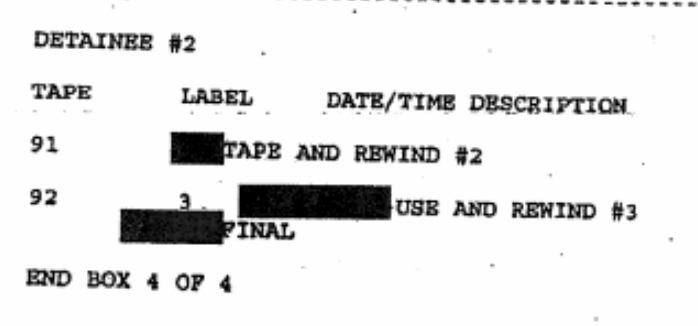
But the real “ah ha” for me was this–showing that the CIA lawyer that reviewed the already-damaged torture tapes and found evidence of that damage not noteworthy

This report appears to show McPherson admitting that he saw some of the tapes were partially blank, or had snow on them.

[Redacted] for many of the tapes one 1/2 or 3/4 of the tape “there was nothing.” [Redacted] on some tapes it was apparent that the VCR had been turned off and then turned back on right away. [Redacted] on other tapes the video quality was poor and on others the tape had been reused (taped over) or not recorded at all. [Redacted] The label on some tapes read “interrogation session,” but when viewed there was just snow. [Redaction] did not make note of this in [redaction] report. [Redaction] estimated that “half a dozen” videotapes had been taped over or were “snowy.”

Though he claims not to have noticed that two of the tapes were broken (though perhaps they were broken later). When asked why he had not reported the blank tapes in his report, McPherson said he didn’t find that “noteworthy.”

… Was also the lawyer who provided the original, contemptuous FOIA response.

Rodriguez’s account also sheds new light on a crucial lynchpin in the ACLU FOIA case by identifing the CIA attorney from the Office of General Counsel (OGC) who viewed the videotapes in Nov. 2002 as “one of the assistant general counsels” whom Rodriguez calls “a very senior Agency officer.”  The attorney was later interviewed by the CIA Office of Inspector General (OIG) about that review. Rodriguez’s small, but important details corroborate earlier reporting by the AP and WashPo that the OGC attorney was John L. McPherson, who based on unrelated court filings, was an Assistant General Counsel as of 2001 and later became an Associate General Counsel.

Why is this significant? Hellerstein found the tapes subject to FOIA because they were “identified and produced to” the CIA’s OIG “as part of its investigation into allegations” of unauthorized interrogations and human rights violations. Yet Hellerstein stopped short of finding the CIA in contempt in part because “the individuals responsible for processing and responding to plaintiffs’ FOIA requests may not have been aware of the videotapes’ existence before they were destroyed.”

Remarkably, however, the crucial FOIA response from the CIA regarding the records of the OIG in April 2005 (ergo, 7 months prior to the destruction of the tapes) was written by none other than John L. McPherson. Continue reading


What If the Biggest Risk ISN’T Khalid Sheikh Mohammed Giving Speeches?

The guy who covered up CIA’s torture, Jose Rodriguez, worries that Khalid Sheikh Mohammed might give a speech during the course of his military commission.

Although he acted defiantly in court, Rodriguez said KSM would like nothing more than a forum to preach radical Islam.

“This is a process that will continue for a long time,” Rodriguez said. “I have heard he may plead not guilty, and if he does, he’ll use the [legal] process as his platform . . . to talk about his jihadist beliefs.”

[snip]

“It seemed to us that he was looking for a platform from which he could spout his hatred for all things American, and a trial would certainly present that opportunity,” Rodriguez writes. “It strikes me as more than a little ironic that several years later, Attorney General Eric Holder almost granted KSM his wish.”

Ironically, Rupert’s rag decided to plug these Rodriguez fears the day after KSM and his co-defendants tied up the military commission in knots not by speaking, but by remaining silent.

Judge [James] Pohl turns to Mohammed’s attorneys and his right to counsel. Mr. Mohammed, he says, pursuant to the Manual for Military Commissions, you are today represented by two military lawyers, Derek Poteet and Jason Wright, your detailed counsel. Do you understand this?

There’s a pause – the first of many, as we’ll soon see – as the court and counsel wait for the defendant’s responds.  KSM doesn’t give one, and Judge Pohl notes as much. Very well, he continues, detailed counsel will be provided to you.

No response.

Continue reading


Big Boy Pants and the Presidency

Frankly, I think Jose Rodriguez was being naive when he claimed that having Jay Bybee’s signature on a memo authorizing some, but not all, of the torture the torturers had already done by August 1, 2002 constituted full authority for what they had done.

But before moving forward, Jose Rodriguez got his superiors, right up to the president – to sign off on a set of those techniques, including waterboarding.

Jose Rodriguez: We needed to get everybody in government to put their big boy pants on and provide the authorities that we needed.

Lesley Stahl: Their big boy pants on–

Jose Rodriguez: Big boy pants. Let me tell you, I had had a lot of experience in the agency where we had been left to hold the bag. And I was not about to let that happen for the people that work for me.

Lesley Stahl: There wasn’t gonna be any deniability on this one?

Jose Rodriguez: There was not gonna be any deniability. And I tell you something. In August of 2002, I felt I had all the authorities that I needed, all the approvals that I needed. The atmosphere in the country was different. Everybody wanted us to save American lives.

After all, to this day, these counterterrrorism programs are being run on a Memorandum of Notification that not only doesn’t comply with the terms of the National Security Act, but shields the President (Obama even more so than Bush) from any direct accountability, a carefully crafted deniability that the CIA has worked to preserve.

Lesley Stahl was apparently not up to the task of asking Rodriguez about the torture the torturers actually used which exceeded the terms of the authorization. She describes waterboarding as laid out in the Bybee Memo, without acknowledging that the torturers didn’t follow those guidelines. Stahl asserts as fact that the CIA kept Abu Zubaydah up for 3 straight days, when evidence suggests his sleep deprivation lasted longer, perhaps as long as 11 days. Had Stahl laid out the degree to which the torturers were known to have exceeded guidelines (both before and after those guidelines were codified in the Bybee Memo), she might have noted the underlying problem with this exchange.

Lesley Stahl: Oh, you had rules for each thing?

Jose Rodriguez: Yes, we had rules. And not only that, but every time we did any of this, we had to ask permission. The field had to ask permission of headquarters.

Lesley Stahl: Each time.

Jose Rodriguez: Each time.

As she herself pointed out, Rodriguez was not doing the torture. He wasn’t in the field. He was at HQ. In fact, he was one of the guys sitting in Langley giving the oral permissions for individual torture techniques both before and after Bybee signed his memo, the techniques that exceeded the rules laid out in Bybee. You’d think Stahl might have pointed that out.

Continue reading


Why Jose Rodriquez Should Be In Prison, Not On A Book Tour

As Marcy noted, Adam Goldman and Matt Apuzzo of the AP have gotten their hands on an early copy of Jose Rodriquez’s new screed book, “Hard Measures”. The one substantive point of interest in their report involves the destruction of the infamous “torture tapes”. What they relate Rodriquez saying in his book is not earth shattering nor particularly new in light of all the reporting of the subject over the years, but it is still pretty pretty arrogant and ugly to the rule of law:

The tapes, filmed in a secret CIA prison in Thailand, showed the waterboarding of terrorists Abu Zubaydah and Abd al-Nashiri.

Especially after the Abu Ghraib prison abuse scandal, Rodriguez writes, if the CIA’s videos were to leak out, officers worldwide would be in danger.

“I wasn’t going to sit around another three years waiting for people to get up the courage,” to do what CIA lawyers said he had the authority to do himself, Rodriguez writes. He describes sending the order in November 2005 as “just getting rid of some ugly visuals.”

As you may recall, specially assigned DOJ prosecutor John Durham let the statute of limitations run out on prosecuting Jose Rodriquez, and others directly involved, including four Bush/Cheney White House attorneys (David Addington, Alberto Gonzales, John Bellinger and Harriet Miers) involved in the torture tapes destruction, as well as two CIA junior attorneys, on or about November 9, 2010. There was really never any doubt about what Rodriquez’s motivation was in light of the fact he destroyed the tapes of Abu Zubaydah and al-Nashiri within a week of Dana Priest’s blockbuster article in the Washington Post on the US “black site” secret prisons.

But, just as there was no doubt, then or now, as to the motivation of Rodriquez and/or the others, there was similarly never any doubt about the legitimate basis for criminal prosecution. The basic government excuse was they could not find any proceeding in which the torture tapes were material to so as to be required to have been preserved. For one thing, Judge Alvin Hellerstein determined the tapes were indeed material to the ACLU FOIA suit and within the purview of their evidentiary hold (even though he refused to hold CIA officials in contempt under the dubious theory they may not have had notice).

More important, however, was the immutable and unmistakable fact that the torture tapes were of specific individuals, al-Qaeda members Abu Zubaydah and Abd al-Rahim al-Nashiri, who, at the time of destruction of the tapes, were in detention awaiting trial, whether it be in an Article III Continue reading


Jose Rodriguez’ Idea of “Ugly Visuals”: Blank and Altered Tapes

Jose Rodriguez, not exactly a squeamish guy, is spreading a myth that the reason he destroyed the torture tapes was because the torture depicted on them was so bad that people would kill CIA officers in response to the violence

Especially after the Abu Ghraib prison abuse scandal, Rodriguez writes, if the CIA’s videos were to leak out, officers worldwide would be in danger.

“I wasn’t going to sit around another three years waiting for people to get up the courage,” to do what CIA lawyers said he had the authority to do himself, Rodriguez writes. He describes sending the order in November 2005 as “just getting rid of some ugly visuals.”

Except there’s a problem with that claim.

The problem with the torture tapes is not what they showed, but what they didn’t show. Such as the two separate waterboarding sessions that were, for some reason, not captured on tape at all.

OIG found 11 interrogation tapes to be blank. Two others were blank except for one or two minutes of recording. Two others were broken and could not be reviewed. OIG compared the videotapes to logs and cables and identified a 21-hour period of time” which included two waterboard sessions” that was not captured on the videotapes.

Or the way many of the tapes showed some sign of tampering that hid their content.

[Redacted] for many of the tapes one 1/2 or 3/4 of the tape “there was nothing.” [Redacted] on some tapes it was apparent that the VCR had been turned off and then turned back on right away. [Redacted] on other tapes the video quality was poor and on others the tape had been reused (taped over) or not recorded at all. [Redacted] The label on some tapes read “interrogation session,” but when viewed there was just snow. [Redaction] did not make note of this in [redaction] report. [Redaction] estimated that “half a dozen” videotapes had been taped over or were “snowy.”

In other words, the tapes probably didn’t show the worst torture sessions. On the contrary, the tapes were enduring proof that the torturers tampered with the tapes to make sure they didn’t show the torture sessions.

Apparently, Jose Rodriguez thinks a bunch of snowy taped over tapes–proof that the torturers covered up evidence of what they did–constitutes “ugly visuals.” And I guess it does, but not in the way he’s claiming in his book.


Rizzo’s Brief with Nancy Pelosi: Bush Didn’t Include Torture in the Finding Authorizing Torture

I’m going to deal with John Rizzo’s purported “mea culpa” in three posts, one each for each of his regrets.

Rizzo’s first regret is that the CIA did not push the White House to allow it to brief the entire intelligence committees so they could, as Rizzo said, “allow the committees—compel them, really—to take a stand on the merits to either endorse the program or stop it in its tracks.”

It’s an argument I totally agree with. But to make his argument, Rizzo mobilizes some of the same lies about the CIA’s briefing of the torture program, notably about Nancy Pelosi. He does so, however, with a really spooky move.

Shortly thereafter, almost seven years after CIA first informed her about its employment of waterboarding and the other EITs, the Speaker of the House of Representatives, Nancy Pelosi, stood before the cameras and claimed that all CIA ever told her was that waterboarding was being “considered” as an interrogation tactic, not that it would be ever employed. Confronted with evidence to the contrary, the Speaker subsequently conceded that she had been informed about EITs from the outset but insisted she was always opposed to them but powerless to do anything to stop them. None of which was true, but in hindsight the Speaker’s moonwalk was hardly unforeseeable.

It’s the same old story turning the question of whether Pelosi was briefed prospectively or historically into a claim that “she had been informed about EITs from the outset” without mentioning that even Porter Goss’ version of the briefing is consistent with Pelosi’s claim that CIA didn’t tell them in September 2002 that they had already started using torture. Rizzo’s use of this tired tactic is all the worse considering that 1) it appears that he was not at the briefing in question, and 2) the CIA changed its record of the briefing after the fact.

In other words, Rizzo’s attack on Pelosi is total bullshit. Furthermore, the attack falsely suggests that CIA briefed Congress before torture started.

But his use of Pelosi to make this point is rather intriguing. Rizzo makes no mention of Bob Graham’s attempt to exercise oversight over the torture program, which was discouraged by the CIA and thwarted by Pat Roberts.

More significantly, Rizzo makes no mention of Jane Harman, who did object to the program but proved unable to “stop it in its tracks.”

Rizzo’s silence about CIA’s briefing to Harman–and her objection to the torture program–is more significant given something else he asserts in this piece.

A few days after the attacks, President Bush signed a top-secret directive to CIA authorizing an unprecedented array of covert actions against Al Qaeda and its leadership. Like almost every such authorization issued by presidents over the previous quarter-century, this one was provided to the intelligence committees of the House and Senate as well as the defense subcommittees of the House and Senate appropriations committees. However, the White House directed that details about the most ambitious, sensitive and potentially explosive new program authorized by the President—the capture, incommunicado detention and aggressive interrogation of senior Al Qaeda operatives—could only be shared with the leaders of the House and Senate, plus the chair and ranking member of the two intelligence committees.

Rizzo starts by invoking the September 17, 2001 Presidential Finding that authorized the CIA to capture and detain al Qaeda members. He tells us–this may be news, actually–that that Finding was briefed to the entire intelligence committees and to appropriations committees. But then he says that the torture part of that program “could only be shared” with the Gang of Eight.

The detail is interesting, by itself, for the way it contradicts Rizzo’s later (false) claim that “every other member of Congress” “would be kept in the dark” about the torture program. After all, the Leaders are also members of Congress, but if the CIA’s own error-ridden briefing list is to be believed, the only Leader who ever got briefed in that role was Bill Frist (while Appropriations Subcommittee Republicans Duncan Hunter, Ted Stevens, and Thad Cochran also got briefings, as well as John McCain).

The comment is more interesting for what it says about the Finding itself. The CIA has long suggested (and reporting has repeated) that that Finding authorized the torture program. But Rizzo is making it clear here that that Finding did not include authorization for the torture program. The oral briefings the Gang of Four got were the only way the way the President informed Congress about the torture program.

While it’s significant that Rizzo is here admitting that fact, we already knew it. We knew it because Jane Harman twice asked about a Finding on torture, once implicitly in 2003 when she asked “Have enhanced techniques been authorized and approved by the President?” and once in the briefing CIA gave her on July 13, 2004, when she,”noted that the [redacted--almost certainly the Finding] did not specify interrogations and only authorized capture and detention.”

In other words, Rizzo basically admits that the point Jane Harman appears to have made repeatedly was correct: the torture program had not been formally included in a Finding briefed to Congress.

Rizzo’s lies about briefing Congress don’t appear to be the issue here. Rather, the problem is that the Administration did not issue the legally required Finding to Congress.