Even With Non-Validated Afghan Self-Reporting, SIGAR Finds ANSF Falls Short of 352,000 Goal

A central tenet of DoD dogma regarding withdrawal of US troops from Afghanistan rests on Afghan National Security Forces reaching a force size of 352,000 and taking over full responsibility for security in the country as US forces leave at the end of 2014. There are multiple problems surrounding the myth of ANSF force size of 352,000. As reported last quarter by the Special Inspector General for Afghanistan Reconstruction (SIGAR), the “official” force size reported by DoD relies on self-reporting by Afghanistan and can not be validated. Further, NATO ministers proposed back in February that financial support for the 352,000 size should be extended through 2018, rather than allowing the force size to drop by about a third at the end of 2014. I equated this offer to dangling an extra $22 billion in front of Afghan government officials for embezzling in return for a grant of criminal immunity for US forces remaining behind after the official withdrawal.

SIGAR released its latest quarterly report yesterday (pdf), covering the first quarter of 2013, and we see that the problems surrounding the myth of 352,000 ANSF force size persist and show no prospect of improving.

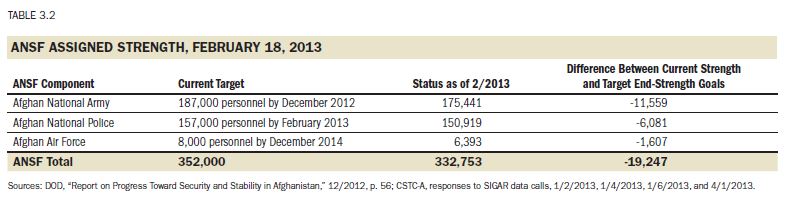
From the report, we see that even with Afghanistan self-reporting in an unvalidated way, and with US goals clearly known, force size falls short of the goal:

ANSF force size

Although the reported force size is only about 5.5% below the goal, it seems remarkable that Afghan officials developing their own numbers in a non-validated way were not able to reach the goals that are clearly known to them.

This process of developing the ANSF has drawn the largest portion of US funds that have been allocated to Afghanistan. Here is how funds have been allocated since the beginning of the Afghan war:

As of March 31, 2013, the United States had appropriated approximately $92.73 billion for relief and reconstruction in Afghanistan since FY 2002. This total has been allocated as follows:

• $54.27 billion for security
• $22.97 billion for governance and development
• $6.39 billion for counter-narcotics efforts
• $2.43 billion for humanitarian aid
• $6.66 billion for operations and oversight

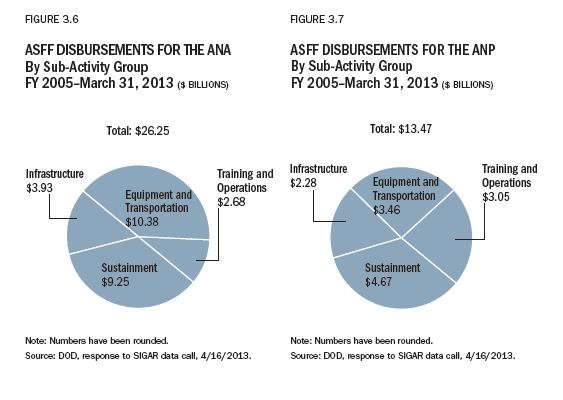
Of all the funds allocated to Afghanistan by the US, over half have gone to developing ANSF. Here is how security money breaks down from 2005 to the present time:

ASFF breakdown

Note that since the beginning of the 2005 fiscal year, we have provided nearly $14 billion in salaries for troop sizes that are self-reported in a non-validated system and therefore ripe for embezzlement. Further, another $13.8 billion was provided for “equipment and transportation” of ANSF, which would also seem a good source for corruption. That is a huge amount of money and it appears to be very poorly spent, given the lack of preparedness for ANSF.

SIGAR calls DoD into question on its claims that the 352,000 ANSF force size has been met: Continue reading


SIGAR: Widely Cited 352,000 ANSF Force Size Is Not Validated

The January 2013 Special Inspector General for Afghanistan Reconstruction report has been out for some time now, but @SIGARHQ has still been tweeting about it regularly. One of their tweets yesterday brought my attention to the section of their report (pdf) where they discuss force size for Afghan National Security Forces. Since the interruption in training brought about by decreased interactions between US and Afghan forces during the  massive outbreak of green on blue attacks, I have maintained that the claim of 352,000 for ANSF force size was no longer credible. It appears that my skepticism is well-founded, as the pertinent section of the SIGAR report bears this heading:

ANSF NUMBERS NOT VALIDATED

The section begins:

Determining ANSF strength is fraught with challenges. U.S. and coalition forces rely on the Afghan forces to report their own personnel strength numbers. Moreover, the Combined Security Transition Command-Afghanistan (CSTC-A) noted that, in the case of the Afghan National Army, there is “no viable method of validating [their] personnel numbers.” SIGAR will continue to follow this issue to determine whether U.S. financial support to the ANSF is based on accurately reported personnel numbers.

There are several important bits to unpack in that paragraph. First, note that even though the US (well, officially, NATO) is training the Afghan forces, it is the Afghans themselves who report on their force size. It appears that our training of the Afghans, however, has not trained them on how to count personnel in a way that can be validated. But the end of the paragraph is the kicker, because it appears that our financial support of the Afghans is based on their own reporting of the force size. Since we are paying them for the force size they report, why wouldn’t they inflate the numbers to get paid as much as possible? The Afghans know that the bulk of US policy is built around the 352,000 force size myth, so they know that there will be absolutely no push-back (aside from an obscure SIGAR report that only DFH’s will read) for inflating the number to get the result the US desires. For further enticement, recall that NATO has proposed extending the time over which a force size of 352,000 will be supported, in a move that I saw as a blatant attempt to dangle an additional $22 billion ready for embezzling in front of Afghan administrators.

It comes as no small surprise, then, that SIGAR has found that the Afghan-reported numbers somehow manage to include over 11,000 civilians in the reports for security force size that is specifically meant to exclude civilian personnel.

A related area in which SIGAR has found a disgusting level of dishonesty is in how the US goes about evaluating Afghan forces in terms of readiness. Because it became clear to the trainers in 2010 that they had no hope of achieving the trained and independent force size numbers that NATO planners wanted (and because SIGAR found that the tool they were using at the time was useless), they decided that the only way to demonstrate sufficient progress was to redefine the criteria for evaluating progress. From the report: Continue reading


NATO Wants US to Buy $22 Billion SOFA in Afghanistan

Both Reuters and the New York Times carry stories this morning reporting that NATO has floated the idea of extending the 352,000 Afghan National Security Force size for a number of years beyond the current plan that calls for it to fall significantly after the US completes its withdrawal. There are a number of problems with this idea. The first is that the 352,000 number bears little relation to reality at this point, since the ongoing high attrition rate for Afghan forces continued during the prolonged disruption in training due to green on blue attacks. Although ISAF continues to claim that recruiting and initial training goals to support the 352,000 level were met, the likelihood that this level of troops still exists and is integrated into ANSF is very low. (See this post for just one example of the deployment deficit at an Afghan National Border Police facility.) Second, the US bears the bulk of the budgetary load for maintaining ANSF, so extending the commitment to the increased troop level is asking for a large financial commitment from the US at a time when budget deficits are the panic du jour in Washington. Finally, because only one Afghan National Army unit now is reported to be able to function without any advisor input, a large number of US advisors is required to achieve the required ANSF force size and there is not yet a negotiated Status of Forces Agreement (SOFA) that grants immunity to US troops remaining in Afghanistan after the planned withdrawal at the end of 2014. The lack of such an agreement in Iraq resulted in our rapid withdrawal of advisors there.

Here is how the Times described the proposal:

NATO defense ministers are seriously considering a new proposal to sustain Afghanistan’s security forces at 352,000 troops through 2018, senior alliance officials said Thursday. The expensive effort is viewed as a way to help guarantee the country’s stability — and, just as much, to illustrate continued foreign support after the NATO allies end their combat mission in Afghanistan next year.

The fiscal package that NATO leaders endorsed last spring would have reduced the Afghan National Security Forces to fewer than 240,000 troops after December 2014, when the NATO mission expires. That reduction was based on planning work indicating that the larger current force level was too expensive for Afghanistan and the allies to keep up, and might not be required. Some specialists even argued that the foreign money pouring into Afghanistan to support so large a force was helping fuel rampant official corruption.

Recall that the Obama administration managed to quash the semi-annual report on “progress” in Afghanistan that was due in October until after the November elections, but once it finally came out, the New York Times reported:

As President Obama considers how quickly to withdraw the remaining 68,000 American troops in Afghanistan and turn over the war to Afghan security forces, a bleak new Pentagon report has found that only one of the Afghan National Army’s 23 brigades is able to operate independently without air or other military support from the United States and NATO partners.

So we see that there is a huge dependence on “advisors” (=US troops) who are required for there to be any semblance of function for the ANSF. And yet, as I discussed back in November, there is not yet a SOFA in place that provides full criminal immunity to US forces who are in Afghanistan posing as advisors after 2014. Is NATO floating the idea of extending the large force size myth as an enticement to Afghan officials to keep their corruption dollars coming in by approving US troop immunity in the new SOFA? Continue reading


How NATO Will Game the Numbers on Afghan National Security Force Size

Last month, when the combination of rising green on blue killings and anger over the anti-Islam film finally shut down most joint operations between NATO and Afghan forces, I predicted that this would lead quickly to Afghan National Security Forces falling below the level of 350,000 that NATO has stated to be the goal when security responsibility for the country shifts to Afghan control as NATO withdraws. The prediction was based on already knowing that Afghan forces suffer from huge attrition losses and knowing that the most important aspect of training for Afghan troops occurs during joint patrols that are carried out at the platoon level where only a handful of troops from each side are present. The shutdown of joint operations was for everything below the battalion level, so it seemed to me that with the most important level of training ended, ongoing attrition would decimate the force size.

While reading today’s New York Times article in which the Times has finally realized what a huge problem the high attrition rate poses, I finally deciphered how NATO will be gaming the numbers on ANSF size in order to claim that the original plan for withdrawal can be followed without significant changes. The Times tells us:

Now at its biggest size yet, 195,000 soldiers, the Afghan Army is so plagued with desertions and low re-enlistment rates that it has to replace a third of its entire force every year, officials say.

The attrition strikes at the core of America’s exit strategy in Afghanistan: to build an Afghan National Army that can take over the war and allow the United States and NATO forces to withdraw by the end of 2014. The urgency of that deadline has only grown as the pace of the troop pullout has become an issue in the American presidential campaign.

The reality is that although NATO has set a goal for ANSF size to allow withdrawal, it has completely given up on the idea of those Afghan forces being fully functional. My error when I predicted that cessation (now followed by a resumption that Panetta claims is “nearly normal”) of joint patrols would reduce force size was to think that ANSF size would be at all affected by a decreased level of training and experience gained on joint patrol.

NATO will continue to claim that ANSF size is at the goal for withdrawal because, as we see in the Times article, recruitment will continue at the rate needed to make up for the high attrition rate. Recruitment is all that matters for maintaining force size, as the Times noted:

Colonel Stanikzai, a senior official at the army’s National Recruiting Center, is on the front line of that effort; in the six months through September, he and his team of 17 interviewers have rejected 962 applicants, he said.

“There are drug traffickers who want to use our units for their business, enemy infiltrators who want to raise problems, jailbirds who can’t find any other job,” he said. During the same period, however, 30,000 applicants were approved.

“Recruitment, it’s like a machine,” he said. “If you stopped, it would collapse.” Continue reading


Confusion Rules in Afghanistan

Still steadfastly refusing to admit publicly that its Afghanistan strategy has failed completely and that a new, more rapid timetable for withdrawal must be developed before the November election, the Obama administration and its Department of Defense are reduced to utter confusion in trying to understand the sources of attacks on coalition forces. After halting most joint US-Afghan operations in the middle of September, Defense Secretary Leon Panetta led efforts last Thursday to claim that joint operations had returned to “nearly normal” levels while claiming that each joint operation would be evaluated carefully to reduce risks. It took less than two days for that evaluation process to be shown to be useless, as two Americans and three Afghan troops were killed in an exchange of gunfire while out on joint patrol.

The investigation into this event stands as a microcosm of the confused state of affairs in Afghanistan as the US struggles to understand that resistance to the presence of US forces now spreads through virtually all of Afghanistan and that uniforms for Afghan security forces are a tool for getting close to US targets. The military first announced Saturday’s attack as a green on blue killing and then backed off, claiming for a while that perhaps insurgents who were not a part of the joint patrol fired first and that US forces fired on the Afghan forces out of confusion. Yesterday, the Washington Post published details from a leaked report that suggests that it was indeed a member of the Afghan National Army platoon in the joint patrol who first opened fire and that he was quickly joined by other members of his patrol. Despite all of the accumulating evidence that Aghans resent our presence in the country, defense officials express surprise and confusion that multiple members of an Afghan patrol could all turn their weapons on US forces:

Two days after the U.S. military resumed joint operations with Afghan security forces last week following a spate of “insider attacks,” a platoon of American soldiers stopped at an Afghan army checkpoint in a volatile eastern province.

The Americans had a cordial conversation and cracked a few jokes with their Afghan comrades during the Saturday afternoon patrol in Wardak province. The Afghans offered the Americans tea. Then, according to a U.S. military official, an Afghan soldier, without warning or provocation, raised his weapon and opened fire — mortally wounding the senior American on the patrol.

In a war in which insider attacks have become commonplace, what happened next made the incident extraordinary, the American official said. Another Afghan soldier at the checkpoint opened fire on the Americans, killing a U.S. civilian contractor and wounding two other American soldiers. Soon, Afghan soldiers and possibly insurgents began firing at the Americans from several directions.

/snip/

A preliminary military report, however, has concluded that the gunfight began only after an Afghan soldier opened fire on U.S. troops, according to the American official, who spoke on the condition of anonymity.

“What sets this apart is that there were multiple attackers from multiple positions and there was zero provocation,” said the official, who had access to the report but was not authorized to speak for the record. Continue reading


How Many Ways Out of Afghanistan?

Ain’t but one way out baby, Lord I just can’t go out that door.

The long-stated “mission” for NATO forces in Afghanistan has been to train Afghan security forces so that they can take responsibility for the nation’s security as NATO forces are withdrawn by the end of 2014. But with most joint operations involving both US and Afghan forces now suspended due to the rapid increase in green on blue killings, that goal seems unobtainable since training is mostly suspended and the high rate of attrition means that the overall size of the ANSF will shrink rapidly. Articles this week from Reuters and the New York Times indicate that major media are now beginning to realize the impossibility of meeting this objective. Reuters brings us details on a green on blue killing from August 27, while the Times goes into detail on what the training program now looks like.

Reuters provides suggestions that the Afghan National Army member responsible for the attack on August 27 was recruited by the Taliban before he joined the ANA. Whether he was Taliban or not, the poor vetting leading to the perpetrator being in the ANA highlights the extent of the problems with the current Afghan forces:

Interviews with Afghan officials suggest that Welayat Khan was not properly vetted. He was admitted to the force seven months before the attack, despite presenting a fake birth certificate and having gotten a flimsy recommendation from a commander who vouched for him simply because the two men were ethnic Pashtuns, according to Afghan sources speaking on condition of anonymity.

might be your man I don’t know

Reuters is not buying the military’s claim that vetting will be better in the future, even though there appears to be no thought given removing the many thousands of current force members who shouldn’t be there:

The Pentagon is promising better vetting of Afghan recruits like Welayat Khan, and NATO last week announced it was scaling back cooperation with Afghans to reduce risk to Western troops. That includes Anders’ unit, stationed at Combat Outpost Xio Haq in Laghman province, in eastern Afghanistan, which, for the moment, has halted joint operations.

But it’s unclear whether the United States or NATO or the Afghan government forces they’re training will be able to stop the next Welayat Khan before he strikes.

In its description of what training has become, the Times describes a day of “training” that is nothing short of farce:

Advisers flew into Bad Pakh last month to teach the Afghans how to load wounded soldiers into an American medevac helicopter. Time permitting, they also planned mortar practice.

But when the Americans flew out 10 hours later, the training day had gone much like three previous ones held here in the past two months: the helicopter never showed. It was either down for maintenance or called away for a more pressing mission. The advisers never got a clear answer why.

Mortar practice also had to be scratched when it turned out the Afghans were missing the sight for their sole mortar tube.

Even more telling is that the Times even points out how the military has resorted to outright lies to present an illusion of progress in training (I previously addressed this particular lie): Continue reading


Panetta Continues to Ignore Reality, Calls Surge a Success

Defense Secretary Leon Panetta looks as though he is going to be the last person on the planet to realize what a failure US strategy in Afghanistan has become. Today, while visiting New Zealand, he announced that the final surge troops have left Afghanistan, returning troop levels to 68,000 from a high of 101,000 at the peak of the surge President Obama ordered at the end of his first year in office.

The Washington Post set Panetta’s “success” language apart from other comments:

“There’s no question there will continue to be difficult days ahead in this campaign,” Panetta said at a news conference in Auckland, where he was making a visit, in part, to thank New Zealand for its contribution of about 180 troops to the NATO-led coalition in Afghanistan. “But this is an opportunity to recognize that the surge did accomplish its objectives.”

The New York Times gave a bit more of Panetta’s statement:

“As we reflect on this moment, it is an opportunity to recognize that the surge accomplished its objectives of reversing Taliban momentum on the battlefield, and dramatically increased the size and capability of the Afghan National Security Forces,” Mr. Panetta said.

It’s not until the very end of the article however, where we learn that Panetta’s claims don’t hold up:

However, the level of violence remains higher than it had been before the surge forces came. In the first six months of 2012, for instance, 1,145 civilians were killed, compared with 1,267 in the same period of 2010, when surge forces were only just arriving.

How can it be that the Taliban’s momentum has been reversed if civilian deaths are now higher than before the surge? [Correction: as pointed out by harpie in comment number 1, although the Times says violence levels are higher after the surge, the civilian death rate post-surge is slightly lower rather than slightly higher.]

Besides allowing Panetta to deny the reality of a Taliban that has lost no strength, the Times article article allows an anonymous military spokesman to lie about changes in the size of Afghan security forces during the surge:

“What did the surge give us?” a senior American official reflected on Friday. “We’re going to hit a point where, I won’t say that’s as good as it gets, but now it’s up to them to hold what we gave them. Now really it’s Karzai’s turn.”

The official spoke on condition of anonymity as a matter of military policy.

The surge brought American troops to a high of 101,000, along with as many as another 50,000 coalition troops, mostly from NATO countries. Over the past three years, the increase in American troops helped to enable an accelerated training program, the senior American official said, with the Afghan police and army more than doubling in number by this year, to 300,000.

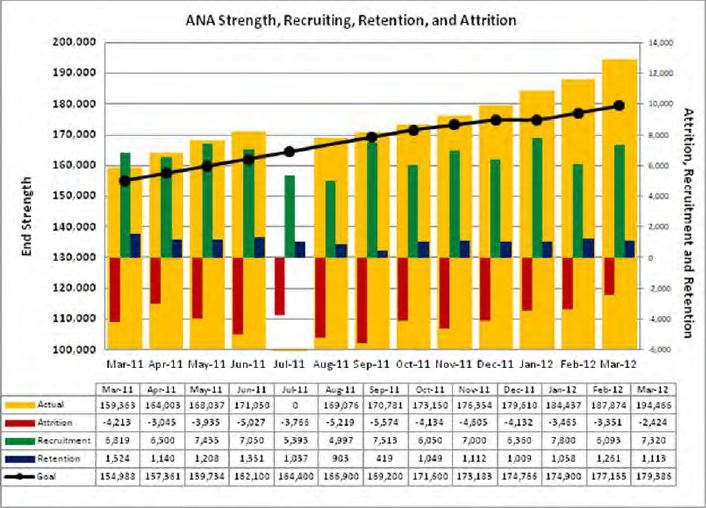
Two things stand out immediately in the numbers supplied by the anonymous spokesman. First, until this statement, all recent stories have been referring to the size of the ANSF as 350,000. How did the number drop by 50,000? Is this a result of the re-screening that Afghanistan has been carrying out? This chart shows that the Afghan National Army, which accounts for about two thirds of the ANSF, saw a maximum attrition rate of just under 5600 in one month, so attrition alone cannot account for this large drop. [Note: I noticed when I checked the article again after 2 pm that the 300,000 number has been revised to 350,000. There is no indication within the article or at the usual slot at the bottom of the page where corrections are usually noted that this change has taken place. I had already pointed out that the military source was lying whether we used 300,000 or 350,000 as the current ANSF level.]

But the other thing that stands out in this anonymous statement is an outright lie. The official claims that during the surge, the ANSF “more than” doubled to 300,000. This Brookings publication (pdf) documents force size for the ANA and ANP, and it shows that in December 2009, when Obama ordered the surge, the force size was 195,089. If we use the source’s 300,000 figure for the current size, the current force is only 1.54 times the previous size, not more than twice. Even if we use the 350,000 figure that was used in all previous statements, the ratio only improves to 1.79, still well below twice the original size.

The military can lie all it wants, but it still cannot hide its failures in Afghanistan.


DoD’s Bungled Answers to Questions on Re-Vetting ANSF and Cultural Awareness

On Saturday, I noted that the move by US Special Operations forces to halt training of Afghan Local Police and Afghan special forces while those entire forces were re-screened for security threats meant that there would need to be an equivalent action taken on the larger effort to train the Afghan National Army and Afghan National Police while they are re-screened:

So, while only Special Operations forces have suspended training for now, it is hard to see how this will not extend to all training of Afghan security forces soon, because the lapses in screening of recruits applies equally to the much larger ANA and ANP forces (approximately 350,000 for those two forces combined, compared to various estimates in the 20,000 range for the ALP and Afghan special forces when combined).

Even though it was a holiday weekend, it is remarkable that Pentagon Spokesman George Little was taken so off-guard in this line of questioning that Marcy pointed me to in Tuesday’s transcript:

 Barbara, do you have a question?

Q:  Thanks, two questions.  On green-on-blue or insider attacks, what I didn’t hear you mention was that — what ISAF tells us is essentially all 350,000 Afghan security forces either have gone or are going through the process of being re-screened.  And that comes from ISAF.  So what would you — what does — what do you say to the families who have lost loved ones or their colleagues in the military after so many incidents this year alone?  Who’s accountable for it taking so long for the U.S. military, for the coalition to realize they had to re-screen?  Because for months, we were told isolated incidents, and apparently not.

MR. LITTLE:  Well, let me put this in some perspective here, Barbara.  It’s not that we have come only recently to this issue.  We’ve taken it seriously for some time.  In March of this year, six months ago, the — ISAF issued a tactical directive — and let me just list all that that tactical directive contained.  It made it the adoption of specific and tailored force protection measures.  Personnel and increased risks from insider attack were required to undertake specific close quarter combat and active shooter training.  All commands are required to conduct refresher training, particularly for mentors and others who routinely work side-by-side with Afghans.

The directive required additional in-theater cultural awareness training.  The directive also asked that coalition force units create safe zones inside ANSF compounds where they can defend themselves if necessary.  And more recently, there’s been a great deal of focus by General Allen and his team on the importance of Guardian Angels, small unit leadership, and counterintelligence matters that will help identify potential attackers early on.

Q:  But why did it take — and I have a follow-up to this, please — why did it take so long for the military in the department to come to the conclusion that 350,000 troops had to be re-screened?  Why did (off mic)

MR. LITTLE:  Three hundred and fifty thousand troops?  Continue reading


Afghanistan Begins Purge of Army While NATO Chief Promises “Cultural Awareness Training”

In a news conference this morning, Afghanistan’s Defense Ministry spokesman General Zahir Azimi announced that “hundreds” of soldiers have been dismissed from the Army or detained in a probe that began six months ago and is aimed at removing soldiers with ties to insurgents and therefore pose a risk for green on blue attacks. Separately, NATO Secretary-General Anders Fogh Rasmussen telephoned Afghan President Hamid Karzai to urge further action by Afghanistan to stem green on blue killings. Remarkably, Rasmussen acknowledged that NATO training on “cultural awareness” is important to stopping the increasing rate of these attacks. After first attempting to retroactively classify the report “A Crisis of Trust and Cultural Incompatibility” it appears that perhaps NATO is finally ready to take actions aimed at implementing its recommendations to raise the awareness of NATO troops regarding actions and attitudes that conflict with deeply-held beliefs of Afghan recruits.

Reuters describes Azimi’s press conference:

The Afghan army has detained or sacked hundreds of soldiers for having links to insurgents, the Defence Ministry said on Wednesday, as it tries to stem an alarming number of so-called insider attacks eroding trust between Afghans and their allies.

/snip/

“Hundreds were sacked or detained after showing links with insurgents. In some cases we had evidence against them, in others we were simply suspicious,” Ministry spokesman Zahir Azimi told reporters in Kabul.

“Using an army uniform against foreign forces is a serious point of concern not only for the Defence Ministry but for the whole Afghan government,” Azimi said, adding that President Hamid Karzai had ordered Afghan forces to devise ways to stop insider attacks.

It is very interesting that Azimi claims this probe of the Army began six months ago:

He said his Ministry started an investigation into the attacks, which are also called green-on-blue attacks, within the 195,000-strong Afghan army six months ago.

Khaama adds a bit of detail on the basis for expelling or detaining soldiers:

Ministry spokesman Mohammad Zahir Azimi did not provide any other details or specific numbers on Wednesday. He said many of the troops had been discharged from the military because they had suspect documents, either incomplete or forged.

Several aspects of this account stand out. Continue reading


GAO Catches DoD Changing Definitions to Claim Progress Training Afghans, Misses Real Risks

Patrick Eddington pointed us toward a report (pdf) released yesterday by the GAO. The report is titled “Afghanistan Security: Long-standing Challenges May Affect Progress and Sustainment of Afghan National Security Forces”. GAO describes their reasons for the report (which is also Congressional testimony):

This testimony discusses findings from GAO reports and ongoing work that cover (1) progress reported and tools used to assess ANSF capability, (2) challenges affecting the development of capable ANSF, and (3) use of U.S. Security Force Assistance Advisory Teams to advise and assist ANSF.

The report does a very good job of catching the Defense Department redefining the highest category of ANSF capability in order to claim progress in the percentage of units that have achieved the highest level. However, as Eddington pointed out in his tweet, GAO falls far short of its second goal of enumerating the “challenges affecting the development of capable ANSF”, as the report is entirely silent on the two biggest hurdles faced: defections and green on blue killings.

Here is Reuters’ Missy Ryan describing the use of changed descriptors to claim progress:

The Pentagon’s decision to change the standards used to grade the success of Afghan police and soldiers, who are a centerpiece of U.S. strategy for smoothly exiting the war in Afghanistan, helped it present a positive picture of those forces’ abilities, a U.S. government watchdog reported on Tuesday.

“These changes … were responsible, in part, for its reported increase in April 2012 of the number of ANSF units rated at the highest level,” the Government Accountability Office said in a new report on Afghan national security forces, known as ANSF.

In a twice-annual report to Congress in April 2012, the Defense Department reported that Afghan police and soldiers “continued to make substantial progress,” classifying 15 out of 219 army units as able to operate ‘independently with assistance’ from foreign advisors. Almost 40 out of 435 police units got the same rating.

And what was the redefinition of terms that was used? Merely a slight change that completely negates its meaning:

“Key definitions used in capability assessments … have changed several times,” the GAO said. Its report said the Pentagon’s highest rating for Afghan forces had changed from ‘independent’ in early 2011 to ‘independent with advisors’ later that year.

Gosh, the only way that DoD could show that the ANSF had increased the number of units rated at the highest level of capability was to redefine that highest level of capability. So, instead of “independent”, the most capable units are now “independent with advisors”, which is, you know, NOT independent. Continue reading